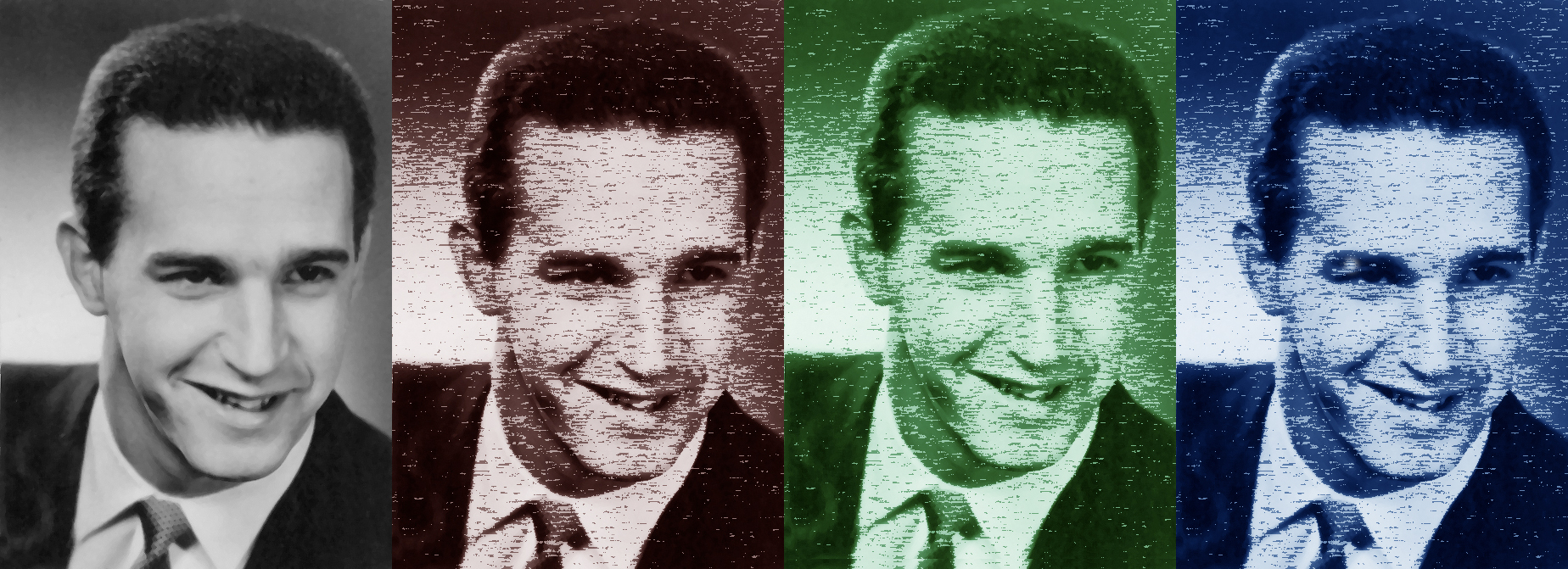
You have questions? Here are some answers.

Last week, as we were observing the 65th anniversary of Ron Tammen’s disappearance, I promised to address some of your questions. Because that’s how it goes with this mystery, right? Every new tidbit of information brings with it a ton more questions. Some pertain to Ron and his open psych book. Others may have been bugging you for a while, either from earlier blog posts or from the few scant details that were made public about his last moments before going AWOL. Before we begin, let me just say this: you really know your stuff. No, I mean it. Many of you are veritable walking encyclopedias on Ronald Tammen.

Some of your questions are so good that I won’t be able to provide a satisfactory answer to them. They were probably the same questions on the minds of the people who had their hands on whatever evidence was available at the time. In fact, some of your questions could only be answered by those very people because they alone had access to information that was never mentioned to a reporter or even written down on a notepad. (Here’s a question I’d like to ask: why was that?) But I’m getting ahead of myself.

Some of your questions I’ve boiled down to a smaller word count, some I’ve clarified, and some I’ve combined if they cover similar territory. Even if I answered a question during the livestream event, I might still include it here, since some of you may have missed it and I felt like elaborating. Sometimes you really didn’t have a question, but more of a comment, and I felt like riffing on it anyway. Lastly, if I didn’t address a comment you’ve made—and that goes for anytime—don’t be offended. Many of your comments stand on their own and don’t seem to require further discussion from me. Nevertheless, all have been really, really good and totally on point.

Here goes:

Pretend you’re just now starting your project and can interview “Uncle Phil” (former President Phil Shriver). What do you ask him?

As I’ve mentioned before, Dr. Shriver was my first interview, and my questions were pretty uninspired. I did ask him about the Delts though, and I remember how surprised he seemed at my suggestion that it could have been a fraternity prank gone awry. That was the first time anyone had ever raised that question with him, he told me. I remember feeling a little silly—as if I were being scolded for thinking the thought. I quickly moved on to the next question.

Today, knowing everything we know now, the key question I’d most like to ask Dr. Shriver is: Have you ever heard of any hypnosis studies being conducted in the psychology department in the early-1950s? The reason I’d ask him this is because Dr. Shriver seemed to know at least several people in the psychology department. (And bear in mind: just because someone was in the psychology department and/or was a hypnosis expert back then doesn’t mean that I think he or she had something to do with Ron’s disappearance.) There’s a photo of Dr. Shriver socializing in one of the psychology labs in the 1960s. I’ve also seen some of the professors’ names in his daily planner shortly after he’d arrived as the new president. So I’d love to share with him some of my findings and ask for his perspective. Of course, maybe he’d respond in the same way he did to my question about Ron’s fraternity brothers. This time, however, I wouldn’t feel silly or move on to the next question so quickly.

If you were a friend of Ron’s and knew the answer to the mystery on April 18,1953, what would you say to him?

I’m not the type of person who doles out advice. I have enough trouble dealing with my own foibles and day-to-day schtuff to feel as if I have any business telling someone else what I think he or she should say or do when standing at one of life’s crossroads. I’m pretty sure this would still be the case if I had advance knowledge of what was about to happen to Ronald Tammen and why. Granted, if I knew that something bad was going to occur, like if he was going to be jumped by a couple thugs with a pillowcase, of course I’d warn him, risking whatever damage that might inflict on the space-time continuum. (But even if I did warn him on the 18th, who’s to say that the thugs wouldn’t return another day?) Thinking what I think at this moment, I probably wouldn’t say anything instructive or cautionary to Ron Tammen. Instead, I’d use the opportunity to ask him a few questions, because the one place I’ve most longed to be over these past eight years is inside Ronald Tammen’s head. So my three questions would be:

  • I hope you’re doing OK. Is something bothering you? You seem…stressed.
  • Who’s that woman from Hamilton we sometimes see you with? You know, the one with the car?
  • Have you ever heard of some sort of hypnosis studies being conducted in the psych department?

If we had time for one more question, I’d also ask: why did you drive all the way to Hamilton on a Wednesday to have your blood type tested when you could have had it tested on campus or at the blood donation center for free?

And one last thing: As he turned to go, I’d probably wish him well and let him know that he was about to become very, very famous.

Have you seen a picture that really struck you, mystery-related or not?

I love every photo that has anything to do with this story. I especially love every photo of Ron, and how different he looks depending on the circumstances. The wrestling photo in particular fascinates me because he doesn’t look at all like the fraternity guy in the suit. The prom photos of him standing next to Grace are awesome because you can just sense the excitement and the nervousness in the two of them. But the photo that I’ve found most compelling is the one of the open psychology book on Ron’s desk. In my mind, I feel as though it’s evidence that was largely ignored.

What’s been the biggest surprise?

The transcripts were a pretty big deal for me. Finding out that the FBI had purged Ron’s fingerprints in 2002 was also big. But the biggest surprise is yet to be revealed.

What was your original best guess back in 1980?

I just thought that he got fed up with school and all its stressors and walked (or hitchhiked) away from it all. I always thought he’d show up alive somewhere, which is why I kept checking online, just to see if anything new had turned up.

What I hadn’t realized back in 1980 was how shocking his disappearance was based on who he was. I knew a little bit about his activities at Miami, but I had no idea what a  fine person he was. (And I use that word in the best sense, as in fine wine or fine linens, not in the “How are you?” “I’m fine” sense.) Everyone seemed to look up to him for their own reasons—his niceness, his friendliness, his smartness, his handsomeness. All of those things and more. That discovery introduced a whole new level of mysteriousness to the mystery for me. Lots of people disappear, but Ron Tammen?! That’s when I decided that I needed to dig deeper, because the answer couldn’t have been as simple as his merely giving up and running away. There had to be more to the story.

What working hypothesis, in whole or in part, have you had shot down?

On the livestream, I answered this question as follows:

  • Charles Findlay had nothing to do with Ron’s disappearance.
  • Neither did Richard Tammen.
  • Neither did the Delts.
  • Neither did the Campus Owls.

I’ve since learned that the questioner had wanted to know what hypothesis (or hypotheses) did I subscribe to that I eventually shot down. That’s slightly different, because I never suspected Charles, Richard, or the Campus Owls. (More on the Delts in a second.) Also, I feel the need to admit here that, while the idea that I could shoot down any theory on my own is flattering, I’m not sure how attainable it is. After so many years, and so much lost evidence, it’s not so much about disproving something happened as opposed to proving that something else is much more likely to have occurred. You know, like Perry Mason used to do: “It can’t be the defendant, ladies and gentlemen of the jury, because, take a look at the guy in the third row!”

Early on, I was delving into the Delts and the “fraternity prank gone awry” theory (even though Dr. Shriver wasn’t a fan). But I soon found that the Delts whom I was able to track down were utterly delightful and forthcoming and receptive to my calls and questions, which didn’t seem consistent with guilty parties who’d signed a pact of secrecy. When I asked a couple of them, point blank, if they’d ever “kidnapped” one of their own as a prank and dropped him off in the middle of nowhere (which might explain a potential Ron sighting in Seven Mile), some told me “no,” but one person said you had to live in the house for that to happen.

“They’d call you on the telephone and about four of them would throw you in the backseat of a car and all that kind of stuff, drop you in the middle of nowhere,” he said with a laugh.

But, he added, they wouldn’t have done it to Ron because Ron didn’t live in the house. Plus, don’t forget that one of the Delts distinctly remembers an evening of song practice, burgers, and wrestling moves at the house prior to a walk back to the dorms with Ron. It may seem unconvincing to some readers, but these guys are just as eager to find out what happened to their friend as the rest of us.

I also investigated the possibility that the mob might have been involved, not because of the fish in Ron’s bed, but because no one knows how to hide a body quite like they do. I’d trained my laser on one man and spent the first year of my investigation getting to know his story, but I eventually came to terms with the nothingness in that premise and moved on.

I’d also wondered if Ron might have gotten a girl pregnant, what with his blood type test on November 19, 1952. There was a girl he sometimes dated during his freshman year, but she’d moved to Colorado to attend nursing school after only one semester at Miami. There were some interesting aspects to that theory—one being that I wasn’t able to obtain confirmation that she’d earned a nursing degree from that institution. But the timeframe in which Ron had taken the blood test doesn’t work out. As I mentioned in this post, a potential baby would have had to be conceived by August 1951, which was before Ron had even started at Miami. Moreover, I’d begun gathering evidence that supported my current theory, and, in July 2014, I found what I considered to be the smoking gun.  Four years later, I’m still pursuing that lead in high gear.

One thing that I’d like to add: somewhere on my website, I mention that I plan to hold back some of the bigger findings for the book. I’ve had a change of heart on that front. If and when I obtain what I need regarding that document, I’ll be making the information public immediately. But it could take some time.

What could or should someone or anyone have done to stop the disappearance?

Truthfully, I don’t think anyone could have done a thing to stop it. As far as whether someone should have stopped it, I don’t know that answer either. Maybe Ron lived a good life afterward. I hope so.

 If Ron’s disappearance was voluntary, why didn’t Ron ever contact his family?

Make no mistake—Ron loved his family. His brother John told me that Ron was “family-oriented” and very caring toward his parents and siblings. If what I think happened did happen, I don’t think Ron had much of a choice. He may have thought that, as unthinkable as it was to leave his family for the rest of his life, it was the only answer to whatever dilemma he was in. I’m guessing that this is probably why he was showing signs of stress after spring break.

I’ve sometimes wondered if Ron was somehow involved in scheduling the Campus Owls gig at John Carroll University in Cleveland for the weekend before he disappeared. That way, he could see his parents and younger siblings at least one more time before he left. I’ve also wondered if he intentionally left his jacket at his parents’ home as a keepsake. (They immediately mailed it back to him.) The papers didn’t specify which jacket it was, but my hunch is that it was the same one that he’d worn the night he disappeared—his blue and tan checked Mackinaw.

Is there any possibility that his roommate was taking psychology and had left the book there instead of Ron? Could they have assumed it was Ron’s simply because the roommate was away?

I don’t think so. The open book was one of the few clues that investigators pointed to as an indication that Ron had been studying, and it was on Ron’s side of the desk. Also, Chuck was interviewed and photographed for the 1954 Hamilton Journal-News article that shows the book from two angles. I’m sure he would have said something if the book were his. Also, in October 2014, I spoke with Chuck about the book. Here’s how that exchange took place (paraphrased in my notes):

JW: Do you remember seeing the book open on his desk?

CF: I vaguely recall seeing the book, although it was a very long time ago.

JW: Do you recall seeing what section it was opened to? People have said it was open to Habits. Do you remember seeing that?

CF: No, I don’t remember that.

Again, if it had been Chuck’s book, I believe he would have said something.

Was there any human error involved with entries on Ron’s transcripts?

There’s always room for human error, but in this case, I don’t see it. Everything fits according to what was recorded and described. Ron’s student records said he was given Incompletes, and his transcripts confirm that. His transcripts also indicate that he’d withdrawn from PSY 261, and the Registrar’s Office possesses a grade card that confirms that he withdrew with a passing grade. Therefore, I think we’re interpreting this scenario correctly. Also, I believe Dean Knox found the open psych book to be more than a little interesting, and I have evidence that indicates he and others were investigating the matter. But that’s a post for another day.

Could there have been some misguidance in the way the book notations were written?

I’m assuming you’re referring to the notation that specified the book title and edition? I think we have enough clues to rule out the possibility that someone misidentified those details. We know from Dean Knox’s notes that the psych book was opened to “HABITS,” which is consistent with sections in Munn’s book. Also, the first edition of Munn’s book was published in 1946. That’s probably too dated for use in 1952-1953, especially since students purchase their own books, and the second edition had come out in 1951. The third edition was published in 1956, which is too late. I believe we have the right book.

Maybe Ron just had a profound interest in the subject of psychology and was reading on his own.

The only problem with that theory is that he’d dropped the course twice. So he couldn’t have been that interested in psychology. But, maybe there was some aspect of psychology that he found relevant to his life. That’s where my thinking is right now.

Was Ron being used as a guinea pig by one of the university’s professors? 

Hmmm. Interesting. By “guinea pig,” you’re referring to possible university studies. I do have evidence that there may have been something going on at that time. We’ll discuss this possibility more in future posts.

Do you suspect anyone, outside of the feds, of knowing but not telling?

I do suspect that one or more people may have known something about Ron’s case, and that they managed to keep quiet over the years. One person whom I’ve wondered about is Ron’s younger brother Richard. His aggressive behavior leading up to Ron’s disappearance on April 19 makes me think that he was experiencing a great deal of inner turmoil about his brother, and his evasiveness afterward makes me think that he knew something and promised not to tell. I also think that people from the university might have known something, though perhaps they didn’t know the whole story. Maybe they were told by a higher authority that they needed to stop looking for Ron, but they weren’t told why. Judging by how closely they guarded the details of their investigation, someone might have been told to withhold some of their discoveries from the press. Thankfully, reporters such as Joe Cella managed to unearth certain details anyway.

Would you have done the same thing if you’d been in Ron’s shoes?

Perhaps. I don’t judge the choices he made. Whatever he was going through was a different reality from mine. Ron was a smart guy and, even though he was barely an adult, he had a good head on his shoulders. I have to assume that it took a lot of courage to do what he did. Maybe that’s the difference between the two of us. I probably wouldn’t have been as courageous as he was.

I once had a fleeting thought of asking if he was in a psychology class. I guess the many generic references to “he was doing well in school” took my mind off the more specific question.

I’ve found this interesting too. The April 24, 1953, Hamilton Journal-News said: “Miami professors said his work has been good in the classroom and that there was little likelihood of pressure from that point.” This stellar assessment was repeated in subsequent HJN issues as well as other newspapers, including the Dayton Daily News and Cleveland Plain Dealer. We now know that things were a lot shakier grade-wise that year for Ron than reporters had been led to believe.

Why was the university telling a different story, and why were they publicizing his higher freshman grade point average instead of his sophomore GPA? Did Miami officials want to avoid tarnishing a student’s reputation, even if that student happened to be missing and the information might help provide a clue? Or was it simply that the professors who said he was doing well represented courses Ron hadn’t dropped, thus skewing his academic performance in a more favorable light? If anyone understood the bigger picture, however, it would have been Carl Knox.

How is it Ron took Economics 201 two semesters in a row his sophomore year? Did he withdraw from the Economics class first semester, apparently while he was grading out as an A?

It’s true that Ron had withdrawn from Economics 201 the first semester of his sophomore year, and then he took the course again during the second semester. The A’s and B’s immediately following the course title appear to be sections, not grades. We don’t have his grades for either semester that he was enrolled in Economics 201.

When he withdrew from two courses to 11 hours, unless things were different back then, he was no longer a full-time student. That would affect grants, loans, ability to live on campus, etc.

Good point. I’d figured that he’d fallen below full-time status, but it didn’t occur to me that it could affect his ability to live on campus, among other issues. I suppose I didn’t think much about it because he was still living on campus the second semester. I don’t have the complete Miami Rules and Regulations booklet for 1952-53. I’m currently attempting to get a copy to see how this change in status might have affected other aspects of his college life.

So he falls below full-time student status first semester, then turns around and takes 2 of the very same classes he withdrew from in the second semester!

In my mind, I figured he was taking the same courses for a second time because they were requirements for a business degree. I’m currently seeking information on required courses for that degree program back then. It would be very strange indeed if he took the same courses twice in one year if they weren’t required.

His class schedule for the semester that he disappeared doesn’t sound very busy to me. Where was he, what was he doing?

Indeed. The Campus Owls kept him busy, but they played primarily on weekends. He was also known to study quite a bit. But from what I can tell, he wasn’t wrestling. He wasn’t very active with his fraternity. Many of his fraternity brothers have said they didn’t see him much because of his other activities, such as the Campus Owls, his work as a residence hall counselor, and his need to study. His roommate and the men Ron counseled mentioned how busy he was with other things, such as his fraternity and the Campus Owls. And his Campus Owl bandmates would often remark about how busy Ron was with his fraternity and his counseling.

Do you sense a pattern here? I think Ron may have had other things going on in his life that weren’t part of the activities we’ve read so much about. If we can figure out what those additional things were, I think we’ll have a better grasp on why he disappeared.

The blog says Knox wrote down a vague note: “all except putting pillow in pillow case.” To me that sounds like the pillowcase is laying there in the room, just not on the pillow. Did people interpret that phrase to mean that the pillowcase was missing? Or do we know for sure it was missing?

Welcome to my personal purgatory. So Ron goes downstairs to get some new sheets because of the fish. Even though Knox’s notes or subsequent news articles don’t say so explicitly, I’m sure that he dropped off the old sheets and pillowcase with Mrs. Todhunter and brought only the new ones up. Then, and this is critical, Knox’s notes say (with his capitalizations included): “Madeup [sic] Bed, all except putting pillow in Pillow Case.” I agree with you that his note implies that the pillowcase was sitting somewhere in the room and, for whatever reason, didn’t make its way onto the pillow.

But did you notice the photo of the bed in the April 22, 1954, Hamilton Journal-News article? [Article provided through permission of Hamilton Journal-News and Cox Media Group Ohio.]

It’s difficult to see in the online version, but in a copy held at Miami University’s Archives, you can see the striped pillow covering without its pillowcase. I can’t tell if the pillowcase is on the bed, however. The caption says: “ROOM LIKE HE LEFT IT…..book, freshly made bed without pillow case.”

That caption—written by someone who had a clear view of the photo—might be interpreted as saying that the pillowcase wasn’t there. And, as you point out, it could be a big deal if Mrs. Todhunter had given Ron a pillowcase and the pillowcase disappeared with Ron. One knock against the “missing pillowcase” theory is that Joe Cella doesn’t mention it in any of his articles. Only the photo caption alludes to the possibility that it may not be there, and Cella may not have helped write the caption.

So, to answer your question, yes, some people have interpreted the lack of a pillowcase on the pillow to mean that the pillowcase had disappeared. Because we don’t have a definite answer—and probably never will—I look at it both ways. Maybe it was there, and maybe it wasn’t. My theory doesn’t hinge on a missing pillowcase, but if it were missing, that would add some interesting color to the story.

And missing pillowcase or no missing pillowcase: Ron was considered a tidy person. It wasn’t like him to make a bed and leave the pillowcase off. At the very least, there’s that.

Would a musician normally leave his bass out in those temperatures for a long time?

Most websites advise against keeping a stringed instrument in the car ever, and definitely not in extreme temperatures. My husband, a percussionist, had this to say on the topic: Even if the temperatures were hovering around freezing that night, they probably wouldn’t have damaged the wood in that amount of time. The temperatures would have to be really cold—below zero—to damage the wood. Ron probably would’ve had to retune his bass the next time he played, but that wouldn’t have been a big deal.

Therefore, even though leaving a bass fiddle out in the car in those temperatures wouldn’t have been recommended, it isn’t necessarily a sign that Ron was signing out.

It’d be wonderful to find someone who was in the same class who could confirm a hypnosis experiment. Or to narrow it down, you might be able to track down a grad student in Psychology in that year who conducted the experiments.

Yes, absolutely. I’ve been attempting to track down possible psychology students/grad students for several years now. It’s been slow going, but I’ve found a couple noteworthy remembrances that have spurred me on. One of the reasons I’ve decided to post this discovery is the hope that it might jog more people’s memories. If anyone reading this recalls participating in or hearing about hypnosis studies in the early-1950s at Miami University or wherever, please contact me.

The open psych book

Psych book
Cover of 1951 edition of “Psychology–The Fundamentals of Human Adjustment,” by Norman L. Munn, the issue and title of the book that was open on Ronald Tammen’s desk the night he disappeared.

One of the most frequently named items that Ronald Tammen had left behind—apart from his wallet, IDs, and car keys—was the open book on his desk. Remember the book? From what I can tell, it was first brought to the public’s attention on April 25, 1953, when the Hamilton Journal-News reported “books” (plural) being “open on a study table” after he’d disappeared. On May 2, 1953, the books were narrowed down to “a textbook” that “was left open on his desk,” though some reports reverted to the plural form on occasion after that date. In April 1954, we learned from Joe Cella, also of the Hamilton Journal-News, that it was a psychology book, and in 1976, Cella reported that the psychology book was turned to “Habits.” This detail is posthumously corroborated by Carl Knox, dean of men, whose investigative notes say “Psych Book opened to HABITS,” with the last word written in all caps and underscored twice. What’s more, Knox had also noted that Tammen was spotted “Studying Psych” from 3:00 to 4:00 p.m. on the day of his disappearance. How someone might have known the subject matter that Tammen had been studying, we can’t be sure, but that person must have felt reasonably confident of that detail to mention it to investigators.

Carl Knox notes -- HABITS
The HABITS reference, underlined twice, can be seen at the bottom of Carl Knox’s note.
Carl Knox notes -- studying psych
Beneath Tammen’s name is Carl Knox’s notation that Tammen had been “Studying Psych” from 3-4 p.m. that Sunday.

Juxtapose all of the above with what Dick Titus told me Tammen had said to him before Tammen had walked out of Titus’s room the evening of his disappearance: that he needed to study his own subjects. What does all of this tell you? For me, it indicates that one of the last things on Tammen’s mind before he went missing was psychology. In fact, it appears to have been the subject he felt most compelled to study during the afternoon and evening of his final day as a Miami student. The topic of “Habits” is an added bit of intrigue.

Here’s why I find the open psych book so fascinating: Ronald Tammen wasn’t taking a psychology class.

Oh, let me rephrase that. Although Ronald Tammen had been enrolled in psychology the semester that he disappeared, he’d already withdrawn from the course by the time he went missing.

The documents that I’m posting today, which, to the best of my knowledge, have never been posted online before, are Ronald Tammen’s college transcripts. Here they are.

Before we get to the topic of psychology, let’s take a look at Ronald Tammen’s grades. He was a B student—the average of the A’s, B’s, and C’s he had accumulated since he’d arrived at Miami. His much-publicized grade point average of 3.205 was from his freshman year. The A’s were in courses such as Unified Math and General Geology—he was, after all, a math and science guy. The C’s were in American Social and Economic History (first semester) and Freshman Composition (second semester). All things considered, he was doing fairly well academically his first year away from home.

transcripts-p1
Page 1 of Ronald Tammen’s transcripts

Now, let’s turn our attention to Ron’s sophomore year. W’s—withdrawals—had begun popping up like wins in the Brooklyn Dodgers’ 1953 baseball standings. Except Ron wasn’t winning. He was struggling. Juggling. At the start of the first semester of his sophomore year, Ron was carrying a course load of 17 credit hours, which is typical for a full-time student. At its completion, however, he was carrying only 11 hours, having dropped two 3-hour courses—an economics course and General Psychology, PSY 261. Despite the much lighter load, his grade point average had now slipped to 3.178, by my calculations.

That’s where the grades end, because at the conclusion of Tammen’s second semester, we see only a string of I’s (incompletes), a P (passing) in gym, and a W in psychology, the same course he’d dropped the previous semester. The P is of no consequence to this story. It only tells us how badly a person would have to be doing in gym to be given a failing grade. You could fall off the planet five weeks before finals and still pass the course. It’s the lone W in the line-up of I’s that was most curious to me. I needed to know the timeframe by which those I’s and W were handed out.

Our first clue is a statement at the bottom of page 3 of Tammen’s student records (made available for the first time here), that says: “DISAPPEARED FROM RESIDENCE HALL APRIL 19, 1953. GIVEN INCOMPLETES FOR SEMESTER (2ND, 1952-53).”

Ron's student records

In my mind, that would imply that when Ron disappeared, he’d already dropped his psychology course and those I’s only pertained to courses in which he was still enrolled. To make sure my reasoning was correct, I contacted the Miami University Registrar’s Office in October 2010, asking how it could be that Ron had received that W in his psychology course.

Miami’s Registrar, David Sauter, is one of the most responsive administrators I’ve encountered anywhere. He’s also interested in the Tammen case. He got right on it. The next day, an assistant contacted me with information from an old grade card. It said that if a course is dropped after seven weeks, “either ‘WP’ for withdrawn passing or ‘WF’ for withdrawn failing must be entered.”

“The old grade card for that course indicates Mr. Tammen had a midterm grade of ‘C’ for the course in Spring 1953 and that he was dropped with a ‘WP.’  It does not, however, provide a drop date,” she said in her email. She added that she and her colleagues in the Registrar’s Office believed that the reason that there is a lone W on the transcript, and not a WP, was because the columns were only one character wide.

That provided me with one endpoint to my timeframe—Ron must have withdrawn at least seven weeks into the semester. But what about the other endpoint? I contacted Miami’s archivist at that time, Bob Schmidt, who emailed me a page from the 1952-53 issue of Rules and Regulations Governing Students, Student Activities, and Student Organizations for Miami University. In addition to confirming the information that the Registrar’s Office had provided, it said that course withdrawals had to be performed through the student’s adviser, and any withdrawals after eleven weeks resulted in a WF.

So, to recap, thus far:

  • Ron Tammen had indeed already dropped his psychology course by the time he’d disappeared.
  • He’d done it between the seventh and eleventh weeks of the second semester.
  • Ron’s adviser, a professor by the name of Belden J. Dennison, knew it; Carl Knox, in his principal role as dean of men, also likely knew it; and now we know it too.

University calendars for 1952-53 show that Tuesday, February 3, was the date when second-semester classes started at Miami. Not quite seven weeks later, Saturday, March 21, 1953, was the last day a student could withdraw from a course without receiving a grade, and Saturday, April 25, 1953, a little over 11 weeks after the semester’s start, was the last day a student could withdraw from a course without receiving a WF. That means that the timeframe in which Ron had withdrawn from the course was likely sometime between Monday, March 23, and Saturday, April 18. Not only was this “drop” period within weeks of Ron’s disappearance, and possibly only a day or two before, it also overlapped with spring break, which had taken place from noon, Saturday, March 28, until Monday, April 6, with classes resuming on Tuesday, April 7. Ron wouldn’t have been able to drop his psych course during the university’s week off, so he either did it right before spring break or right after. My guess is that it would have been after spring break, because that was also the time period in which Ron had appeared to be showing signs of stress. Carl Knox had noted that Ron had been consulting the Bible several times after spring break and had also spoken of “being ‘tired lately’ since vacation.”

Carl Knox notes -- signs of stress
According to Carl Knox’s notes, Ronald Tammen seemed to be showing signs of stress following spring break.

So I think the question on everyone’s minds is: why would Ronald Tammen be reading a textbook for a class he’d already dropped?

It could be that he had a general, non-school-related question he was pondering—something that led him to crack open an authoritative resource, not unlike how we now crack open our laptops to ask Google What’s romanesco? or How old is Kirk Douglas?

But why look up the very vague and arbitrary topic of habits? If Ronald Tammen had a habit he wanted to break, it would make more sense to research that specific topic somewhere, like a library, or to seek guidance from an expert. Besides, what habit would Ronald Tammen even have that needed breaking? Smoking? He didn’t smoke. Drinking? He wasn’t a drinker either. Was he a nail-biter? I doubt it. To be honest, it’s difficult to imagine what habit Ronald Tammen would want to kick with such urgency that he would interrupt his busy Sunday to consult his former textbook for a dry-as-a-bone description of habits. That would be like looking up the word Italy in an encyclopedia in hopes of finding a really good marinara recipe. It makes no sense.

HABITS

Among the boxes devoted to Ronald Tammen at the Miami University Archives are copies of textbook pages, many of which have the following notation typed on them: “Copy of textbooks left open on Ron Tammen’s desk.” The word “textbooks” is plural, but the pages are from one book: Psychology–The Fundamentals of Human Adjustment, by Norman L. Munn. At the top of one of the pages, someone has made the notation that the book was a 2nd edition, from 1951. I found it puzzling that the archived documents covered a range spanning pages 152 to 295. Typically, if a book is open on a desk, there are only two pages facing upward, not a range of 143 pages.

I purchased the 1951 issue of Munn’s textbook online. When it arrived, one of the first things I did was make sure that the nine copied pages from University Archives corresponded with my version, and they did. I felt confident that I was perusing the same textbook edition that Ron had been spotted studying. The second thing I did was check to see if there was a chapter titled “Habits,” and there isn’t one. I then took a deductive leap, and reasoned that whoever observed that Ron’s book was opened to “Habits” must have noticed the word in a section head or subhead. (We’ll discuss why I think this was the right decision a little later.) I examined each of the 143 pages looking for headings with some form of the word habit written there. I also checked the rest of Munn’s book for any other possible mentions of the word in a section head or subhead.

I found four pages in all, which happened to be among the nine archived pages. They were pages 152 (with the section head Levels of Complexity in Habit Formation), 162 (subhead: Habit Interference), 277 (section head: Man is Primarily a Creature of Habit), and 294 (section head: Force of Habit). Finally, it dawned on me. Whoever had made the archived copies was probably doing what I was doing: trying to figure out which two pages Tammen was studying before he disappeared. (That person even went a little farther than I was inclined to go, making copies of a couple additional pages that included the word habits in the regular text.) But how could I narrow down those four pages, plus the pages they were facing, to just two? If only someone had taken a photo of the open book.

As it so happens, someone had. A few days after the first anniversary of Ronald Tammen’s disappearance—April 22, 1954—the Hamilton Journal-News published an article that included photographs of Ron and Chuck’s room after Ron had disappeared. One of the photos was a close-up of the open book he’d left on his desk and a second photo was of the same book from another angle. Although we can’t be 100-percent certain that the pages in the photos are exactly as Ron had left them—a current of air or an accidental bump could have caused one or two pages to flip—nevertheless, it’s all that we have. Moreover, the article was written by Joe Cella, who likely obtained the photos from investigators. If Cella believed the photos to be accurate, who am I to second guess him?

Unfortunately, I’m not able to obtain enlarged versions of the photos. The originals no longer exist. However, you can access the article here and zoom in on the two photos. [Article is provided with the permission of the Hamilton Journal-News and Cox Media Group Ohio.]

From what I can tell, the left-hand page appears to lack any images or graphics. Therefore, at a minimum, I believe we can rule out two of the two-page spreads on the basis that there were fairly prominent photographs on the left-hand pages. They are pages 152, which had a photo of a memory drum in the upper left-hand corner, and 276, which is opposite the habits reference on page 277, and which had four photos down its left column of a mother rat and her babies. In my view, spreads 152–153 and 276–277 are no longer contenders.

The right-hand page is more difficult to discern in the Journal-News photos. It doesn’t appear to have images either, which would eliminate pages 162–163 on the basis that the latter page has a photograph on the upper left side of a student operating a card-sorter.

But there’s another, more compelling reason to remove pages 162–163 from consideration. As I mentioned earlier, Munn’s book contains both section heads and subheads. The section heads are written in all capital letters, while the subheads are written in bold type with only the first word capitalized. As I’ve already mentioned, when Carl Knox wrote the word “HABITS” in his notes, he did so in all capital letters, accentuated by a double underline. I can’t help but believe that he was imitating the style in which the words were written in the book, perhaps without even realizing what he was doing. In my opinion, Carl Knox was looking at a section head, not a subhead, which would eliminate the page spread 162–163.

HABITS 2

That leaves us with two pages that are composed entirely of text: pages 294 and 295. On the left-hand page is the section head “FORCE OF HABIT,” which Dean Knox could have shortened to “HABITS.” On the opposite page is a subject even more intriguing. Within a section titled “UNCONSCIOUS MOTIVATION” is a discussion on how someone can be influenced to behave in certain ways. The subhead is “Post-hypnotic suggestion.”

I’m not sure why investigators failed to specify the page numbers that the book was turned to or why Carl Knox chose to write “HABITS” in his notes as opposed to the actual section head. As we’ve established, no subhead or section head on any of the pages was simply called “Habits.” It’s also curious that university officials didn’t appear to question why Ron would be studying psychology, since they knew he’d already dropped the course. Did that detail somehow escape them?

Or could it be that investigators had noticed the reference to post-hypnotic suggestion and didn’t want to raise suspicions that Ronald Tammen’s disappearance could have had something to do with that phenomenon? I get it—why get everyone all riled up if it had no relevance to the case? But with Miami’s psychology department employing at least three faculty members who were hypnosis experts—two of them having collaborated with a renowned psychologist on the 1933 seminal book Hypnosis and Suggestibility, and one of those two being Ronald Tammen’s former psych professor—it seems as if that might have been something worth inquiring about.

­­­­­­­­­__________________________________

­­­­­­­­­­­­­

Yep, we’re going to go there in subsequent posts, but we’ll be proceeding slowly and cautiously. I don’t intend to point fingers at a person, department, or agency before all of the evidence is in. I also won’t be disparaging a medical practice that has helped countless people overcome personal difficulties. What I will be doing is posting relevant documents as they become available and asking questions that, as far as I know, haven’t been posed before—at least not publicly.

In the meantime, please join me today on Facebook (https://www.facebook.com/agmihtf/) at 11:30 a.m. ET as I live-stream additional information concerning today’s post. Among other things, we’ll be leafing through the individual pages of Tammen’s psychology book, looking at the habits references. If you’re tied up at that time, or are discovering this website after April 19, no problem. You can access a recording after-the-fact.


Hoover, JFK, and the day the FBI stopped writing to the Tammens

Over these next several posts, we’ll be continuing to focus our attention on what’s in the documents that were sent to me by the FBI as a result of my 2010 FOIA request, and what, if anything, they might add to the story.

________________________________


JFK funeral
Jacqueline, Caroline, and John Kennedy, Jr., among other family members, on the day of Kennedy’s funeral. Photo credit: National Archives; Photographer: Abbie Rowe, National Park Service

On the morning of Tuesday, May 2, 1972, FBI Director J. Edgar Hoover didn’t wake up. His body was discovered at around 8:30 a.m. by his maid, who had arrived at his home to make his breakfast. He’d worked all day at the office the day before, had dinner with his long-time companion and deputy director, Clyde Tolson, and then died of a heart attack sometime during the night or early morning.

Immediately upon Hoover’s death, and at his instruction, his secretary, Helen Gandy, went into high gear destroying what she later claimed to a House subcommittee to be “letters to and from friends, personal friends, a lot of letters.”

Yes. How very thoughtful of this man who’d made an art form of gathering the goods on the powerful, famous, and nonconforming to preserve the trust of those he held most dear by having his secretary tear up, and then send away for further shredding, all of those friendly, personal letters.

Hoover’s death also seemed to bring an end to a different kind of letter—something more relevant to those of us who are concerned with what happened to Ronald Tammen: the form letters. You may recall that the FBI would send a form letter to the Tammens every two or three years, usually in the autumn, to ask if they should continue looking for Tammen. Mr. or Mrs. Tammen would check the box marked “Is still missing,” sign the bottom, and mail the letter back to the FBI. After Hoover died, however, the letters came to a halt, even though, in the final letter, the “Is still missing” box was checked by Ron’s father.

While Hoover was still alive, the FBI had been fairly consistent about sticking to the schedule—jarringly so in 1963. That letter was dated November 29, just seven days after President Kennedy had been assassinated, and the last day of a grueling week in which the country had bid their tearful goodbyes to him. On a day when the nation was still mired in the shock and grief of having seen their young, energetic leader being carried around in a flag-draped casket, someone in Hoover’s employ had the clarity of mind to glance at the calendar and say to him or herself, “Time to send the Tammen family another form letter.”

To put the above action into context, let’s take a quick look at the timeline of that unspeakably sad week, juxtaposed with a few of the more tangible ways in which J. Edgar Hoover had busied himself.

Friday, Nov. 22, 1963

President John F. Kennedy is murdered in Dallas; President Johnson is sworn in. Hoover speaks with Attorney General Robert Kennedy and later sends a memo to his executive staff summarizing his conversation: that the person whom he believed shot and killed the president was in custody at Dallas Police headquarters, and the name of the shooter was Lee Harvey Oswald, who was “working in the building from which the shots were fired.” He concluded, “I told the Attorney General that, since the Secret Service is tied up, I thought we should move into the case.”

Saturday, Nov. 23, 1963

President Kennedy’s casket is on display in the East Room of the White House. President Johnson declares Monday, Nov. 25, 1963, a National Day of Mourning. J. Edgar Hoover briefs LBJ about the FBI’s investigation (transcript — 3 pages), telling him, among other things: they had charged “this man in Dallas” with the president’s murder; they had the rifle that killed the president, the bullet, and the gun that killed the policeman; and “one angle that’s confusing”: a person who showed up at the Soviet Embassy in Mexico City in September 1963 using Oswald’s name was not Oswald.

Sunday, Nov. 24, 1963

JFK’s casket lies in state in the Capitol Rotunda for 21 hours. Roughly 250,000 mourners wait in long lines to pay their respects. At Dallas Police headquarters, as he is being transferred to the county jail, Lee Harvey Oswald is shot on live television by nightclub owner Jack Ruby, and he later dies. At 4:00 p.m. ET, J. Edgar Hoover dictates a summary of the investigation, saying that Oswald is dead, and that he was shot in the stomach by Jack Ruby. “The thing that I am concerned about, and so is [deputy attorney general] Mr. Katzenbach, is having something issued so we can convince the public that Oswald is the real assassin,” he said.

Monday, Nov. 25, 1963 – National Day of Mourning

Beginning at roughly 11 a.m., there is a procession and funeral for John F. Kennedy, after which he is buried at Arlington Cemetery at roughly 3:30 p.m. (View Associated Press footage.) President Johnson calls J. Edgar Hoover at 10:30 a.m., to speak about his concern that people are calling for a presidential commission to look into the assassination. “Some lawyer in Justice is lobbying with the [Washington] Post because that’s where the suggestion came from for this presidential commission, which we think would be very bad,” (Hoover: “I do too,”)…“and put it right in the White House. We can’t be checking up on every uh, every uh, shooting scrape in the country…” Johnson then said that they planned to do two things: 1) Hoover would give a full report to the attorney general, which would be made available to the public, and 2) the attorney general of Texas would “run a court of inquiry.” Listen to the conversation (20:23) or read the transcript.

Wednesday, Nov. 27, 1963

President Johnson gives his “Let Us Continue” speech before Congress.

Thursday, Nov. 28, 1963 – Thanksgiving

(Unbelievably, Americans that year had to celebrate Thanksgiving three days after watching the funeral of their president.)

That evening, President Johnson delivers a televised speech to the nation asking Americans for their help, strength, and prayers, “that God may guard this Republic and guide my every labor.” (See transcript.)

Friday, Nov. 29, 1963

On Friday evening, President Johnson names the Warren Commission to investigate the assassination of President Kennedy.


Earlier that day, at 1:49 p.m., President Johnson and Hoover discuss possible members of the presidential commission. When they move on to the FBI investigation, Hoover says “We hope to have this thing wrapped up today, but could be we probably won’t get it before the first of the week.”  Listen to Part 1 (10:06) and Part 2 (10:24) of the taped conversation or read the transcript.

Oh, and one more thing: a form letter signed by Hoover is mailed to the Tammen family.

I don’t know about you, but I find it extraordinary that the FBI was even thinking about Ronald Tammen during that momentous week in our nation’s history.

Of course, Hoover may not have been aware that a letter with his name and signature was mailed to the Tammens on November 29, 1963. It could be that a low-level civil servant had readied the memo and had it signed with an autopen while Hoover was on the phone with the president telling him about Oswald’s ties to the Fair Play for Cuba Committee or the ACLU. Regardless, what this says to me is that in a week when the FBI should have been firing on every cylinder in an effort to determine who killed our president and why, someone within the organization had a more menial task on his or her plate. Even if that person’s job had nothing to do with helping with the Kennedy assassination investigation, even if his or her only job was sending out missing person memos, in my view, it was rather unseemly to be going off-topic so soon. For the rest of the country, the week was rife with cancellations, postponements, and closings in somber reflection of the upheaval we’d experienced. Why couldn’t the FBI—the nation’s top law enforcement agency—have held off on some of its other public duties until, say, after the weekend? Apparently, the bureau had moved on, and they didn’t seem to care if anyone outside its walls knew it.

One last point about the 1963 memo: it wasn’t as if there was a firm date when the memos were mailed out. Nope, the dates were all over the map, as can be seen here:

August 25, 1955

October 1, 1957

November 16, 1959

October 30, 1961

November 29, 1963

January 19, 1967

October 1, 1970

I’m sure the Tammens wouldn’t have minded if the FBI had waited another week or two before sending the letter.

Here’s the other thing that I want to point out about those dates. Based on the above pattern (other than the blip in January 1967), it would be logical to conclude that Mr. Tammen was due to receive another letter in 1972 or 1973, probably in October or November. But then Hoover died in May 1972 and the letter was never mailed. In fact, if these documents are telling us what I think they are, the FBI never wrote the Tammens again. Either Tammen’s case had fallen by the wayside or someone had made the decision that it was time to put a stop to the form letters.

________________________________

In my next post, I’ll discuss the two documents from May 1973.


The dog handler, the dad, and the director

Director Hoover Portrait
J. Edgar Hoover, FBI Director from 1924 to 1972 — Photo credit: FBI

Let’s take a few steps back to the year 2010, when the FBI had sent me their first round of FOIA documents on the Tammen case. What do the FBI’s officially sanctioned records say and how might that information offer up some additional clues into the case, knowing everything else we know now?

For a quick recap, here are the FBI documents we’ve mentioned so far:

  • This is the initial report that was submitted roughly a month after Marjorie Tammen contacted the FBI informing them of her missing son.
  • This document shows that the FBI had Ronald Tammen’s fingerprints on file as early as 1941 “for personal identification.”
  • This form letter (as well as this one) sent by the FBI to Ron’s parents features the notations used to describe Ron’s fingerprints.

The document that I want to focus on today is the below letter, written to J. Edgar Hoover from Ronald Tammen’s father, Ronald H. Tammen, Sr.:

Mr. Tammen's letter to JEH on AP photo
Click on link for closer view

The document isn’t dated, however it references an Associated Press photo that appeared in the October 2, 1967, issue of the Cleveland Plain Dealer, as well as numerous other newspapers around the country. The photo was of a dog handler and his dog in Vietnam.

You can see the photo at this link.

 And here’s the caption that ran beneath it:

“COOLING OFF IN VIETNAM – A dog handler attached to the U.S. 173rd Airborne Brigade and his dog take a cooling swim in a stream near the unit’s home base at Bien Hoa, near Saigon. They had just returned from a patrol and both leaped into the water.”

Mr. Tammen had this to say about the photo: “From the few features I can see of this soldier, I would swear it is my son.”

Although I can see a resemblance, I have no idea if the soldier in that photo was Ronald Tammen, who would have been 34 at that time. However, the letter does tell me a couple things about Mr. Tammen. First, counter to the FBI FOIA liaison’s claim that Mr. and Mrs. Tammen thought Ron “to be deceased given some suspicious facts” (the FBI’s supposed reason for sending me the FOIA documents without requiring proof of death or third-party authorization), as of October 1967, Mr. Tammen was still hopeful that his son was alive. (Mrs. Tammen had passed away by then, in 1964.) Second, the letter shows that Mr. Tammen had no idea what had happened to his son. If any readers have been secretly wondering if Ron’s parents might have known something by that time, this letter should put those suspicions to rest.

Now let’s review the response from then–FBI Director J. Edgar Hoover, dated October 11, 1967:

Hoover response to Mr. Tammen
Click on link for closer view

I’m going to go ahead and say it: That was one lame-o response, J. Edgar Hoover! Why do I think so? This was a disappearance in which the FBI had, at least at one time, more than a little interest. It was a case on which they’d staked their fabled reputation, one they’d sunk some serious tax dollars into, dispersing agents hither and yon to investigate what might have happened to Ron. Then, after 14 years with (supposedly) little to no new evidence, Ron’s father—someone who knew Tammen about as well as anyone could—writes in to tell them, Hey fellas! I could swear the person in this photo is my son! Can you check it out? Mr. Tammen hadn’t asked that much of the FBI up until that point. It wasn’t as if he’d been calling them once a week asking for an update. I’m no expert, but I’d call this a potential lead.

But is J. Edgar intrigued? Does he put a couple of his dark-suited G-men back on the trail to follow up in hopes that he can wrap up this case, while getting some great P.R.? No, he does not. Instead, Hoover responds with a tepid, “In reference to the newspaper item you enclosed, you may wish to write directly to The Adjutant General, Department of the Army, The Pentagon, Washington, D.C. 20310, for possible assistance.”

That, Good Man readers, is what I would call a first-class, grade-A, top-of-the-line brush-off.  If Mr. Hoover had truly been interested in finding out if the soldier in the photo was Ronald Tammen, don’t you think he would have made a phone call of his own to the Adjutant General? After all, in 1967, Tammen’s fingerprints were still on file with the FBI, and the Army obviously would have taken the soldier’s fingerprints when he enlisted. If the FBI didn’t already have the dog handler’s prints in their identification files (a big if), the Army could have sent them a copy, and, bada bing bada boom, question answered. But Hoover didn’t take that simple step. Why not?

I’ll venture a guess. By 1967, I think Hoover had stopped caring about what happened to Ronald Tammen. Either that, or he already had a good idea what the answer was. And if it was the latter, there must have been some reason that he didn’t want that information to be made public.

__________________

Congratulations! You’ve just completed post #20 of A Good Man Is Hard to Find. After reading some of the new details presented on this website, you may have begun forming an opinion of your own about what happened to Ronald Tammen—or maybe your opinion has evolved. If you wish to discuss your views, the floor is always open, and, at this stage of the game, there are no wrong answers. Also, don’t forget to share this blog with friends and family members! The more followers we have, the more people we can involve in the discussion, which could produce more leads and possibly more answers.

Did Ronald Tammen cross paths with Richard Colvin Cox?

Richard Cox
Richard C. Cox

Happy New Year, Good Man followers! Did you know that January 2018 marks the 68th anniversary of another person’s disappearance from his college dorm? That individual is Richard Colvin Cox, from Mansfield, Ohio, who was a sophomore cadet at the U.S. Military Academy at West Point, in New York, in 1950, the year he disappeared. On the day he went missing, Cox had been watching a basketball game with roommate Deane Welch, and, on their return to their room in the North Barracks, he took a detour to check his grades. While in that vicinity, Cox ran into an acquaintance who had visited him the previous weekend—a person he’d known in Germany while he was in the Army who supposedly went by the name of George. After a brief conversation, Cox headed back to his room to change into the requisite uniform before going to dinner at the Thayer Hotel with his visitor. At 6:18 p.m., he said a quick goodbye as Welch preceded him out the door, and was never heard from again.

Although the two young men’s stories have their differences, there are plenty of parallels. Here’s a short list:

Personal/Family Characteristics

  • Both were from Ohio. Tammen was from Maple Heights, a Cleveland suburb, while Cox was from Mansfield, a small town between Cleveland and Columbus.
  • Both were intelligent and studious.
  • Both were considered leaders in their class. Tammen was a counselor in Fisher Hall, and Cox was voted by his classmates as the highest-ranking yearling (the term used for sophomores at West Point) in his company.
  • Their birthdays were only two days apart, though Tammen was five years younger than Cox. Cox was born July 25, 1928, and Tammen was born July 23, 1933.
  • Both were considered friendly, but private. They tended to keep things to themselves.
  • Both were handsome with similar smallish builds. Cox was 5’8” and 165 lb.; Tammen was 5’9” and 175 lb.
  • Both came from families of modest means. Cox’s family owned an insurance agency in Mansfield, however Mr. Cox had passed away when Richard was 10. Tammen’s father worked as a clerk for the Brotherhood of Locomotive Firemen and Enginemen in Cleveland.

Conditions of Disappearance

  • Both disappeared while they were sophomores in college.
  • They disappeared within three years of each other. Cox disappeared Jan. 14, 1950, and Tammen disappeared April 19, 1953.
  • They disappeared on a weekend—Cox on a Saturday, and Tammen on a Sunday.
  • They disappeared at the end of the day. Cox disappeared a little after 6:15 p.m., while Tammen disappeared sometime between 8:00 and 10:30 p.m., based on varying accounts of his final moments.
  • Both young men appeared to be showing signs of stress or inner conflict. Cox sometimes shared that he was growing fed up with West Point, while Tammen had spoken of being “tired lately” and had been seen reading the Bible several times, which was considered out of character.
  • Both seemed to be in good spirits on the day of their disappearance.
  • Both walked away with just the clothes on their backs and little money.
  • Both had supposedly been sighted after-the-fact by people who knew them. Cox was reportedly spotted in March 1952 at a restaurant in the Greyhound bus terminal at 11th Street and New York Avenue, N.W., in Washington, D.C. Ernest Shotwell, a friend of Cox’s from their days at the Stewart Field Prep School in New York, had seen him sitting at a table, and they spoke briefly, though Cox appeared uncomfortable and left shortly thereafter. (The Greyhound building is still there, a curvy, Art Deco blast from the past now bordered on three sides by more modern—and boring—structures.) Tammen was potentially seen in a restaurant in Wellsville, NY, in August 1953, by H. H. Stephenson, the housing administrator at Miami who had given Tammen permission to have a car on campus. Stephenson had walked out of the restaurant without saying anything to the young man.
  • Both men’s fingerprints were on file with the FBI when they’d disappeared. Tammen’s had been on file since 1941, when he was in the second grade, and Cox’s was on file at least since he’d enlisted in the Army in September 1946.
  • After committing significant resources and manpower into finding the young men, the FBI ostensibly, failed to solve either case.
IMG_0314 New York Ave terminal
The Greyhound bus terminal, in Washington, D.C., where there had been a potential sighting of Richard Cox in 1952.

Finding the similarities compelling, in June 2011, I submitted a FOIA request to the FBI seeking all documents that they had on the Richard Cox investigation. At that time, I hadn’t yet come to fully appreciate the nuances of FOIA—and by “nuances,” I mean, well, let’s just say that it isn’t an exact science. People at the agency of interest are likely to make judgment calls on a regular basis. Some decisions may hinge on the topic in general, the way a request is phrased, and any number of factors.

With that said, the FBI saw fit to send me 24 pages on the Cox case within the same month of my request. (They told me that they were sending me information that had already been processed for another requester, which is the probable reason behind the quick turnaround.) As with my FOIA documents on Tammen, the amount seemed surprisingly small to me, considering the fact that Cox had been affiliated with the U.S. Army, and the military doesn’t take disappearances from its ranks lightly. Nevertheless, I moved on without submitting an appeal. I had little knowledge of the case at that point and 20-odd pages seemed to be the FBI’s M.O. when it came to men who’d gone missing in the 1950s.

And then I dug deeper. What I found was that two people had done a good deal of digging ahead of me, and they got much, much more from the FBI. One person was James Underwood, who, as a reporter for the Mansfield News Journal, wrote an in-depth investigative series on Cox’s disappearance in 1982. (In 2012, Mr. Underwood appeared on the History Channel’s episode on West Point and the Cox disappearance.) The second person was Marshall Jacobs, a retired Florida teacher who began investigating Cox’s disappearance several years after Underwood. Jacobs eventually collaborated on a book, titled Oblivion, with Harry J. Maihafer, a graduate of West Point. Jacobs had conducted the research, while Maihafer did the writing. In their respective publications, Underwood and Marshall/Maihafer had disclosed that they’d both received thousands of pages from the government—some from the Army, some from the FBI—which provided me with ammunition for a follow-up FOIA request. In 2013, I wrote (in part):

…after reading the attached article from the 8-1-1982 issue of the Mansfield (OH) News Journal, I’d like to make a second FOIA request for FBI Bureau file 79-23729 as well as file #79-25 from the Cleveland field office. I understand that Mr. Underwood and another researcher (Marshall Jacobs, who is now deceased) received more than 1200 pages [I guesstimated] on the Cox disappearance from their FBI FOIA requests, and I would like to receive the same documents they received…

Of course, I realized that it had also been roughly 30 years since they’d submitted their FOIA requests, and a lot of purging can happen in that amount of time. Still, I thought it was worth a try. The one thing I had going for me was that, because Richard Cox had been declared dead by the state of Ohio in 1957, there was no need to provide proof of death or third-party authorization.

With little fanfare, and no apology whatsoever, the Department of Justice (DOJ), the FBI’s parent agency, sent me three CDs with 1631 pages of documents on them—which is a far cry from the original 24 pages the FBI had sent me in 2011, and serves to underscore the oft-repeated advice that one should always appeal his or her FOIA request. Why my Cox FOIA was bumped up all the way to the DOJ, I’m not sure. At the time, we were still in the middle of my FOIA lawsuit on Tammen, and they seemed to be tying the two cases together, even though they’re unrelated. (As for the Army, they’ve been harder to crack than the FBI. So far, they’ve sent me a smattering of documents, though I’m currently following up on one FOIA request.)

Incidentally, I wasn’t re-requesting the Cox files to be a thorn in anyone’s side or because I didn’t have anything better to do. I was trying to locate the source of a certain piece of information that had been mentioned on page 97 of Marshall and Maihafer’s book. What to most readers appeared as a footnote of little consequence seized my attention as if it had been written in blazing, buzzing neon.

Maihafer wrote: “Meanwhile, tips about Cox had continued to come in at the rate of nearly three a day. One report said a man resembling Cox was working at Miami University in Ohio…”

What kind of a crazy coincidence would it be to have one inexplicably missing person turning up in the same tiny university town just prior to someone else going inexplicably missing? What’s more, wouldn’t it be incredible if Richard Cox and Ronald Tammen had actually known one another? The book said that all of the leads turned up nothing. Still, I had to see the documents for myself.

I feel compelled to point out here that the documents I received from the FBI weren’t electronically searchable. They’re PDFs of old, difficult-to-decipher pages that require reading. Lots and lots of reading. On evenings and weekends, and even during a trip to Switzerland, I’d insert one of the CDs into my laptop and, folder by folder, wade through the bureaucratic minutia of names, places, and dates, until I was bored out of my mind, my lower neck muscles were screaming, or both. Periodically, I’d have to reassure myself that this wasn’t a colossal waste of my time. It took months for me to get through them all. As I was nearing the end of the third CD, when I’d just about given up hope, I found the reference to Oxford, Ohio.

The first document to catch my eye was an FBI report recounting a visit to the home of Mr. and Mrs. Curtis Sandage, of Lombard, Illinois, by agent William H. Gray. The report was dated November 21, 1952, and the visit was in response to a letter that Mr. Sandage had written to the Army’s 10th Criminal Investigation Detachment in New York, NY, on August 5, 1952. A few details of the letter were included, such as the fact that the couple had recognized Cox’s photo from a recent article in Life magazine. Although Mr. Gray didn’t specify the date of the magazine, I can tell you that it was the April 14, 1952 issue. The article can be read here (albeit not easily), beginning on page 147.

FBI report
For closer view, click on link

Gray indicated that the visit yielded no new information, as Mrs. Sandage had “nothing pertinent” to add to what her husband had written in the letter. In the main narrative, however, he also mentioned that the Sandages didn’t know the young man by name, but that both felt sure that “the man they knew was employed in some public or semi-public place such as a restaurant or filling station in Oxford, Ohio and that he wore sport clothing.”

About 20 pages later, I arrived at the letter, which had been reproduced in a summarizing document by the Army and thus the reason that there’s no signature. Here it is:

Page 1:

Sandage letter to CID, page 1
For closer view, click on link.

Page 2:

Sandage letter to CID, page 2
For closer view, click on link.

As the letter states, the Sandages, who were both faculty members at Miami, remember seeing Cox (or someone who looked like Cox) between January and September 1950, before they moved to Illinois. During that same winter and spring, Ronald Tammen was a junior in high school, and, that September, he was just beginning his senior year. If it were Richard Cox and he was pumping gas over the next couple years, when Ronald Tammen was at Miami, I’d think that the chances would have been pretty good that they would have bumped into one another, especially since Tammen was one of the few students with a car on campus during his sophomore year. Those are a lot of “ifs,” I know, but it’s interesting to ponder.

The Sandages have both passed away, however, I contacted a son to find out if he was aware of their potential sighting of Richard Cox. He was interested, but knew nothing about it.

I won’t be discussing Jacobs’ theory regarding what may have happened to Richard Cox in this post. Cox’s family feels strongly that the assertions made in his and Maihafer’s book are untrue, so I’ll be steering clear of that debate for now.

I will say this: Nothing I read in the FBI files indicated that they had followed up on the Oxford sighting after the November 1952 visit to the Sandages’ home. (The pages I’ve received from the Army don’t mention the potential sighting.) That also means that I’ve seen nothing to indicate that the FBI had ruled out whether the person in Oxford might have been Cox.

Although we can’t be sure that the person the Sandages knew in Oxford was Richard Cox, here’s what I come away with as a result of their story:

  • There’s a chance that Richard Cox and Ronald Tammen may have known one another or perhaps had a common acquaintance.
  • It’s also possible that their disappearances might have been related to one another.
  • It’s intriguing how, just five months after their visit with the Sandages to discuss a possible sighting of Richard Cox in Oxford, Ohio, the FBI was brought in to search for Tammen, who happened to disappear from, of all places, Oxford, Ohio. If anyone at the FBI wondered if there was a connection between two high-profile cases of missing college men and the town of Oxford, they didn’t put it in writing.

What does their story tell you?

The missing fingerprints

Shortly after Ronald Tammen went missing, the FBI began their own investigation into his disappearance. Because the FBI is part of the federal government, it’s subject to the Freedom of Information Act (FOIA), which means that an ordinary U.S. citizen can ask them to provide documents on a topic within their jurisdiction, though some exemptions apply. (Actually, non-citizens can submit FOIA requests too.) In April 2010, I submitted a FOIA request seeking everything they had on the Tammen case and, just before Christmas of that same year, the FBI sent me 22 pages.

Here you go. (Click on link to view documents.)

These pages provide much to mull over, and, meaning no disrespect to the G-men  and administrative staff who were just doing their jobs back then, they’re a tad sloppy and chaotic. When I shared them with someone who used to work for the FBI and asked him what he thought, he said that it appeared as if a lot was missing. Mind you, this person didn’t have a scintilla of background knowledge on the Tammen case. He based his observation on the fact that the FBI is a memo-happy place (my words, not his), where a phone call or visit generally warrants a new report. In an unsolved missing person’s case from 1953, one would expect more than 22 pages. In addition, several people with whom I’d spoken had told me that either they or their parents were interviewed by the FBI after Tammen disappeared, yet those visits weren’t mentioned anywhere in the documents I’d received.

After a few more related FOIA requests that yielded nothing, I appealed, arguing that there must be more documents based on the missing interviews and a couple other pieces of evidence I’d gathered. Months later, I was sent nine additional pages pertaining to the Georgia “dead body” case of 2008.

Here they are.

As you can imagine, taking on the FBI can be a challenge, and I won’t be able to cover my history with them in a blog post or two. I need to save some of that drama for the book.  However, one of the more surprising discoveries can be found on page 3 of the first batch of documents they sent me. To cut to the chase: when Ronald Tammen’s mother telephoned the Cleveland FBI office on April 30, 1953, to report her son missing, the FBI Headquarters in Washington, D.C. already had his fingerprints on file.

From the year 1941.

When Ron Tammen was seven or eight years old.

FBI memo
Click on document to enlarge.

That seemed odd to my FBI contact and me. He considered it uncommon to fingerprint a child back then because people generally weren’t concerned about the sorts of crimes that we worry about today. I wondered if the other Tammen kids might have been fingerprinted too, and asked Marcia, John, and Robert if they could recall their parents having them fingerprinted as children. They each told me “no.” Although John had no memory of Ron being fingerprinted, and Marcia and Robert weren’t born at the time, Marcia said that she did recall being told that Ron had been fingerprinted in school. I subsequently found a 1960 anniversary article in the Cleveland Plain Dealer that stated, “…fingerprints taken when Ronald was in the second grade at Fairview Park Elementary School are on file in the FBI in Washington.” No reason was given as to why a child would be fingerprinted during the second grade, but the FBI document states that it was for personal identification. Maybe some prescient teacher had the students fingerprinted as a class project. The children could learn about how law enforcement operated while doing their civic duty.  Oh, and if (God forbid) one of them should happen to go missing someday, well, they’d be ahead of the game.

That’s precisely how FBI Director J. Edgar Hoover would have viewed things too. Hoover felt that everyone in the country should be fingerprinted, not just the criminals, civil service applicants, and members of the military. He encouraged all citizens to voluntarily have their fingerprints sent in so that the information could be used to aid in missing persons investigations, or to help the bureau identify an amnesia victim or an unidentified body. So with the FBI already in possession of Ron’s fingerprints in 1953, wouldn’t that have given them a leg up in their investigation into his disappearance? Apparently not.

But here’s the wildest part: If a member of law enforcement were to contact the FBI today seeking a copy of Ronald Tammen’s fingerprints—in the event someone encountered a person who resembled him or someone turned up dead who might have been Ron Tammen—an FBI representative would have to tell that official that no fingerprints exist.

They had them, and you can see the notations for yourself on pages 6 (dated Nov. 16, 1959) and 7 (Oct. 30, 1961) of the first batch of FBI documents. They look sort of like this (the best I can approximate using this software):

19M    17W    r12

L       3 W

But they no longer have them. Detective Frank Smith tried to get them in 2008 when he was handling cold cases for the Butler County Sheriff’s Department, and was turned away empty-handed. (By the way, if we have any fingerprint specialists among us who can shed some light on what these notations mean, please feel free to comment.)

To put it plainly, the fingerprints of Ronald Tammen, the central player in one of the most famous missing persons cases in the state of Ohio, were already on file with the FBI the year that he disappeared. Furthermore, although Tammen has never been found, and we are still within the timeframe in which he could feasibly turn up alive, someone from the FBI looked at those prints and decided that, for whatever reason, they didn’t need them cluttering up their files anymore. Someone decided they should be purged. Was it a mistake (and by “mistake,” I mean an act of mind-boggling negligence), or did they know something that the rest of us haven’t yet learned? That’s just one of the questions I’ve spent the past seven-plus years attempting to have answered.

The woman from Hamilton

monica-silva-144544 (fn)
Photo credit: Monica Silva at Unsplash

Of all the movie genres that are out there, the one I adore most is the film noir. The shadowy lighting, the 1940s fashions, the witty repartee spoken in clipped sentences between drags on a smoldering cigarette, the monsoon-like levels of rainfall—such are the elements of a truly great mystery. But, perhaps above all, there’s the mysterious woman—the glamorous vixen who knocks on Humphrey Bogart’s office door late at night in need of a P.I., or the femme fatale who fixes Fred MacMurray a drink as the two plot out a new life insurance policy for her husband. Who is she? What’s her story?, we all think. I’d almost contend that no great mystery goes without one.

Well, hold onto your fedoras, Ron Tammen fans, because we have a mysterious woman too.

She sauntered her way into our saga back in 2010, when I was having a phone conversation with Ron Tammen’s freshman roommate. Tammen had resided in Fisher Hall both of his years at Miami—as a freshman and a sophomore—and, just as it was with Tammen’s sophomore roommate, his freshman roommate really didn’t have any stories to share about Tammen. He thought he was a nice guy, but that’s about it. And then he brought up her.

He remembered that Ron had told him that he was dating an older woman, although, to an 18-year-old guy, the term “older” could have meant anything—from someone in her early 20s to way up in her 30s even. She had a car. She wasn’t a student. She was from somewhere like Hamilton or Middletown, he said, and she would pick Ron up, and the two would drive off together. Some of the other Fisher Hall residents used to whisper about her, he told me. He didn’t recall her name, and in a more recent conversation, he said that he didn’t recall Ron ever mentioning her name to him. He’d never seen her before, so he couldn’t describe what she looked like.

While I found the revelation fascinating, I had no idea where to go with it. I couldn’t imagine that there would be any hard evidence I could seek in document form. The phrase “A woman from Hamilton or Middletown” is a tad too vague when searching a database or submitting a FOIA request. (Actually, I did try searching old newspapers to see if a woman from either of those towns might have gone missing at the same time that Ron did, in the event the two had run off together, but nothing turned up.)

I knew that what I was dealing with was the flimsiest form of evidence there is—hearsay—though that’s not to say that hearsay isn’t valuable. If I could find just one other person who remembered the same obscure details, then I’d be getting somewhere. I asked a few Delts and Fisher Hall residents if they’d ever seen or heard about Ron with an older woman, but that’s about all I could think to do.

After hearing so many “Nos” in reply, I began leaving that question off my list. It didn’t seem pertinent to where the story was heading. Besides, even if Ron Tammen was hanging out with an older woman during his freshman year, how would that relate to his disappearance during his sophomore year?

Then, just last month, I met with Ralph Smith (not his real name), the nearly 97-year-old man who’d been on the Oxford police force when Tammen disappeared. Ralph felt that there were two compelling clues in the case. One was public knowledge and one wasn’t.

The first clue, the one that had already been made public, had to do with the fish in Ron’s bed. To Ralph, that fish was the key to the mystery. He felt that Ron had been so startled and outraged by the fish that he confronted the culprit(s) and a fight ensued. He thought Ron was probably killed and thrown into the basement and never found. Ralph believes this theory so fervently that he wasn’t about to change his mind even after I told him who’d put the fish in Ron’s bed and why. It’s hard to abandon something we’ve believed in for so many years, I guess.

The second clue—the one that hadn’t made its way into public discourse (until now)—had to do with a woman.

Ralph mentioned her early in our conversation, when he told me that there was a report that someone had seen Ron “sitting in a car with a lady out front, and they drove off.” At first, I viewed his comment with skepticism, thinking that it sounded a lot like the hitchhiking reports that had been called in to the Oxford police shortly after Ron disappeared but that had been disproved. However, as he continued bringing up his two main talking points—the fish and the woman, the woman and the fish—I started taking his story more seriously. Here’s exchange number 2 (with light edits and extraneous conversation removed for readability):

RS: I thought, when they talked about him sitting in the car with some lady, I thought it might have been a lady friend or a girl that he liked or something. But why would he just drive off with her, unless she had so much money, that he’d leave his billfold, his contact with the bank?…

JW: OK, who saw him in a car with the lady? Do you remember?

RS: I don’t know. I think one of the fraternity members. I think that was made up…It’s possible that it did happen, but she lived in Hamilton, Ohio. I know that much.

JW: Do you know the name?

RS: No. No name was given.

JW: Was she older? Was she an older person?

RS: No, she was about the same age.

Later, with about 20 minutes left in our conversation, the topic of the woman in the car came up one more time, and I tried to extract any additional information about her that I could  (again, transcript lightly edited for readability):

JW: When did you find out about the woman? Of him talking to a woman or sitting in a car?

RS: I think the next day or so.

JW: Somebody said that he saw Ron Tammen. In a car. With a woman.

RS: Yeah. And they never, they haven’t investigated the person. Nobody knows who the person was who said that, whether it was a fake deal to cover up for a cover-up or what. They definitely said that he was in a car. They saw him in a car about 45 minutes or close to an hour and all of a sudden they just drove off.

JW: And they drove off, but we don’t know what time.

RS: No. It was late. It was night, real late.

JW: OK, was this after the fish?

RS: After the fish deal. It was after the fish deal. After the episode with that…

JW: Interesting.

RS: So he had to go down, and either she called him, or he had called her. Why she came up there, that was never expressed. And she wasn’t investigated.

JW: But did they know her name at one point?

RS: They didn’t know her name. They just said she was a lady who drove up in a car and he got in, and they sit there and then all of the sudden they drove off.

JW: Do you remember what kind of car?

RS: There was no further investigation. Who the lady was or…

JW: OK, so Oscar Decker [the police chief in charge of the investigation] couldn’t act on it because there was no name.

RS: No names involved. The person that said it—they didn’t know the woman. And see, most…the only way, he might have been a fraternity brother or a resident of the same dorm, and she might have been at one of the parties that they had. That was the only way that she might have been known. Because, they all have their own woman at the party. You don’t have no two or three women.

JW: OK, and I don’t know what I would do with this, but do you remember what kind of car?

RS: No. It wasn’t even mentioned.

JW: A color of a car?

RS: The color of the car, nothing. The only thing that was mentioned was that somebody saw him in a car. They didn’t say if it was red, blue, or what or what kind of car, and they were sitting there and they saw them drive off. And no check was made on whether that was true or whether it was a make-up deal or some type of cover-up or whether it really happened and where she really lived. She wasn’t a student. She wasn’t a student. She was just a lady.

JW: From Hamilton? Do we know that for sure?

RS: From Hamilton, they said. They thought she was. So she might have been his connection for a party when he had…See, whenever fraternities on weekends, they all have parties.

JW: Right. And did this person who reported it…

RS: We have no idea who that person is and nobody has no idea who said it.

JW: Can I ask who they told? Did they talk to the university and you found out or did they tell the police? Who did the person who saw Ron in the car…

RS: None of that was ever mentioned.

JW: You don’t know who they told.

RS: No. That’s what I say.

JW: Nobody talked to the police.

RS: Word just got out that…

JW: Word got out.

RS: Yeah. Word just got out, just like, “yeah, I saw him in the car and they drove off.”

After my sit-down with Ralph, I touched base with Ron’s freshman roommate again to see if he could provide additional details about the older woman, but he couldn’t think of anything more to add. I’m currently following up with more Delts and Fisher Hall residents to see if anyone remembers seeing or hearing about Ron and a woman from Hamilton, either on the night in question or any other night. Of course, it still isn’t clear if the older woman is the same person as the woman from Hamilton or if there actually was a woman from Hamilton.

It could be something, or it could be nothing, but it’s another clue that was never investigated, which is something in and of itself.

A big thank you to the Miami University Alumni Association, which recently posted a link on its Facebook page that drew more than 1000 Miami alumni to this website.
If you’re a Miami alumnus who was there at the time and who recalls hearing something about Ron Tammen and a woman from Hamilton, I’d love to talk to you. Please write me through the contact form.

Hitting the lottery

lotto-864035_1920Had I known he was alive seven years ago at the start of my project, I would have contacted him then, when he was a mere 90 years of age. Thankfully, he was still reasonably strong and feisty. When we first spoke, our phone connection was breaking up—it was a rainy Monday morning and I was in a small town. He told me to write him a letter, which I promptly did. In it, I let him know that I’d be coming to his apartment “this coming Saturday” at 11 a.m. for an interview. Unless he had a problem with that time and date, I’d look forward to meeting him then.

After a few days, I still hadn’t received word from him, so I continued with my plans in the hope that he wouldn’t let me down. In my line of work, it probably isn’t considered wise to drive more than three hours to an interview that was set up by way of a letter sent through the U.S. mail. There should have been follow-up phone calls and emails to confirm dates, places, and contingency plans in the event of traffic or weather. But I was quite sure that this person didn’t own a computer and he didn’t seem to do well with phones either. When he responded to my first letter—the one in which I’d asked him if he might be interested in talking to me about the Ronald Tammen disappearance—he didn’t bother to leave a message because of what it might cost him.

On Friday, I tried calling him to confirm that he’d received my second letter about our Saturday meeting, however there was no answer, and his voicemail box was full. I grew uneasy, but knew that I still needed to chance it. That afternoon, I made the long drive and checked into a hotel that, as pure luck would have it, was only a mile and a half from his apartment. The next morning, I awoke early and contemplated what I would do if he wasn’t there. I resolved that I’d wait for at least an hour, and if he still didn’t arrive, I’d leave a note and would make the trip again if need be. I felt that it would be worth it based on something he’d said to me during our initial phone conversation. At the moment that he uttered the words “Gilson Wright was the reporter who’d written most of the news articles on the case,” I knew that his brain cells were still working. I walked to my car and headed across the river.

His apartment was in a once majestic-looking building with ornate stone carvings that were reminiscent of craftsmanship from the turn of the 20th century. I parked my car across the street and walked to a gate where two people were shooting the breeze and soaking in some sun—one an old man in a wheelchair and the other a younger man in his 30s. I said that I was there to see Ralph Smith (not his real name) and asked if they had any suggestions on how I should enter the building. The older man said, “I’m Ralph Smith!” Whoopee!, I thought, and I followed him in.

Ralph and I talked for two hours. I won’t tell you the details of our conversation, not yet, but I’ll at least tell you the answer to the question on most readers’ minds: no, he doesn’t know what happened to Ronald Tammen. After so many years, he subscribes to a theory that I walked away from years ago. He thinks it had something to do with the fish in Ron’s bed, and he wasn’t willing to abandon that belief even after I told him all about Dick Titus and his practical joke. But he did offer up one small detail that I consider to be a bona fide lead, though it’ll be nearly impossible to chase down. Nevertheless, I’m going to try.

When I ran out of questions, I thanked him several times, and promised to write him again and to send him some of the evidence I’ve discovered. He accompanied me to the gate, shook my hand, and told me how much he’d enjoyed our visit. I thought those parting words would be our last, however, upon reaching my car, as I was rifling through my duffle bag for more comfortable shoes for the drive home, I looked up to see that he’d crossed the street and had rolled his wheelchair directly in front of my car.

“I wanted to check out your license plate,” he told me. “I play the lottery, and I’m going to play your numbers.”

“Good luck!” I said.

Driving home, I had that giddy feeling I sometimes get when I talk to someone who was there when it all happened. Only this time, it was better. This time, I had actually spoken face-to-face with someone who had served in the Oxford PD under Oscar Decker, the former chief of police who led the investigation into Tammen’s disappearance. Sure, Ralph may play the numbers from time to time, but, this time, I felt as if I was the one who’d won the Lotto.

8:30, 10:30…does it really matter?

Carl Knox note--jpg
A page from Dean Carl Knox’s notes describing what Charles Findlay had discovered when he walked into their room (see red arrow): “Sunday 10:30 Light on — Door Open, but [Ron] never returned.”

Does it even matter whether Ronald Tammen disappeared two hours later than what we’d all been led to believe? Who cares if it was 8:30 or 10:30 p.m.? We still don’t know what happened to Tammen.

It matters because of what it might mean regarding how Ron went AWOL. Did he walk out of his room voluntarily or was he ushered out by force? One knock against the “foul play” theory with regards to an 8:30 departure time was that, with Ron sticking so close to his room for most of the evening, there would have been little opportunity for someone to catch him off guard and whisk him away. First he was studying with Dick Titus down the hall, then he was supposedly reading in his room, and next he was walking downstairs to pick up some sheets as well as reportedly talking on the phone with his brother Richard. While it’s possible for someone to nab him under those circumstances, it doesn’t seem ideal. My guess is that if he disappeared at around 8:30 p.m., he likely walked out of his room on his own.

If, however, Ron was at song practice, a planned occurrence that occupied a designated block of time, someone would have had nearly two hours in which to prepare for an encounter of some sort. According to a Fisher Hall resident whose room faced Ron and Chuck’s room, Ron frequently left the door to their room open, even if he left the building.

“The only time he closed the door was when he went to bed,” the person told me. “Otherwise, it was open at all times, even when he was studying or out.”

What’s more, there was a fire escape outside their window. If someone knowledgeable about Ron’s schedule and habits wished to ambush him (for whatever reason), that person could have entered through the door or window, stepped into the closet, pillowcase in hand (remember the pillowcase that never made its way onto the pillow?), and waited until Ron returned to his room.

Of course, 10:30 was also the time at which Findlay returned to the room, according to Dean Knox’s notes (see red arrow in image), which means that, whether it was precision planning, uncanny luck, or both, someone would have pulled off a fantastic feat just in the nick of time. Or perhaps someone was hiding outside in the shadows of Fisher Hall at 10:30 p.m. awaiting Ron’s return and he never made it back inside. The latter scenario makes it more difficult to explain why Ron’s wallet and keys were left in the room, but perhaps he’d emptied his pockets before heading to song practice. Either way, whether it happened indoors or outdoors, if Ron had disappeared after 10:30 p.m., it seems more likely that someone else had been involved.

There’s a third option, one recently suggested to me by a reader, that combines a voluntary exit with a forced departure. Suppose Ron walked outside on his own to meet someone—maybe at 10:30 p.m. after song practice, but it could have happened at 8:30 too. Ron might have been leery of the person, so much so that he decided to leave most of his personal effects behind. He might have even brought along the pillowcase to carry something back from a transaction. At some point, the person (or persons) could have thrown Ron into the back of a car and driven him somewhere, perhaps Seven Mile. This is a possibility too, which (sadly) means that the potential discovery of two additional hours doesn’t rule out very much—not without more information.

Perhaps the true implication of whether Ron left at 8:30 or 10:30 is this: for some odd reason, university and law enforcement officials never told reporters about their discussions with Paul. (It still isn’t clear who, in addition to Carl Knox, had interviewed Paul. Although Paul first described him as a member of the police force in Oxford, he later said that he wasn’t entirely sure what operation he was affiliated with since the man was out of uniform.) Investigators publicly discussed other leads that had gone nowhere—a lady in Cincinnati, for example, who’d thought that she’d rented an apartment to someone who looked like Tammen or motorists who’d reported picking up hitchhikers who resembled him—but they never disclosed Paul’s claim that Ron had been to song practice that night. The case was so lacking in clues that, even if investigators had possessed ironclad evidence that ruled out Paul’s story (which, by the way, I haven’t seen any indication of), you’d think that they would have at least mentioned to reporters that they’d chased down that lead but that it, too, was a bust. So the secrecy—the secrecy about song practice—may be what matters most.

Addendum — What about the fraternity pin?

As an addendum to today’s post, it’s interesting how a new discovery can affect how you look at old clues. Just as I was adding the above image to this page, I reread the words Dean Knox had penciled in at the top: “Car Keys in Desk with Fraternity Pin.” It struck me: were the Delts required to wear their fraternity pins to all functions, including song practice? If so, and if we are to believe Paul’s story, then it would appear that Ron did make it back to his room before he disappeared. I asked Paul if he remembered having to wear his pin to all fraternity functions, to which he said, “The House encouraged guys to wear their pin but I don’t recall a fine for not wearing it.” Looks as though I may need to get my hands on the 1953 Delta Tau Delta bylaws.

When memories collide, part 1: The Delts, song practice, and a momentous walk home

david-beale-179723
Photo credit: David Beale on Unsplash

It can be a jolting experience when a highly credible person I’m interviewing reveals information that doesn’t jive with what’s been said or written on Ron Tammen’s disappearance. If my underlying premise is solid, new details can adjust and resettle around the old, and things can return to normal fairly quickly. My understanding of what happened is slightly altered, but stronger. If, however, the premise is more loosely constructed, full of gaps and leaps, I’d know pretty much then and there that I needed to abandon it and start rebuilding from scratch. Such was the test I faced one recent Thursday morning when everything I thought I knew about Ronald Tammen’s last minutes at Miami experienced a tremor measuring about 7.1 on the Richter scale.

I’d been speaking to a former fraternity brother of Ron’s, whose name had been passed along to me by one of his classmates. He’d just celebrated his 84th birthday, but his voice sounded as if he were in his 60s or early 70s, and his memory was strong and sure on the most minuscule of details.

“The only times that I really saw him was at song practices,” my Delt friend told me (let’s call him Paul), when I’d asked him if he ever interacted socially with Ron. Paul explained that on Mother’s Day weekend, an event in May when students’ moms would descend on Miami’s campus in lavender-scented droves, fraternities would hold a singing competition at Withrow Court. (Withrow, a beloved brick building where dances were held and basketball games played, was demolished last summer.) The competition was the high point of the weekend, and an occasion for which the Delts had been preparing for weeks. It was, Paul let me know, a very big deal.

“The only guy who could carry a tune or who knew anything about music in the Delt house was Ron,” Paul said, so Ron was the Delts’ obvious choice for song leader. Paul also remembers the day and time at which they’d scheduled their practices: Sunday evenings at around 10 p.m., after women’s curfew. (That way, a guy could return from a date and still make it to singing practice.) Sometimes, however, they might opt to hold practice an hour earlier, he said.

With respect to the practice on April 19, 1953, Paul is unsure if it was held at 9 or 10 p.m. It was, after all, 64 years ago.

“But you do remember that Ron was at practice?” I asked.

“There’s no question. I walked home with him,” he responded.

What?, I thought. The seismic rumblings had begun.

“So what happened that night was we had the song practice, and Daddio [the house chef] made hamburgers for us, and then we all broke up,” he said.

Paul then proceeded to tell me how he, a guy named Chip Anderson, and Ron walked back to their dorms on a path that ran from the Delt House, between the Natatorium and Withrow Court, and across what is now the baseball field. They ended near Symmes Hall, the freshman dorm where Chip and Paul lived.

“And we said good night to [Ron] and he walked on. And as far as we know, Dean Knox told me we were probably the last ones that he knows that saw him.”

I’m not going to lie—the entire time that I was listening to his story, I was thinking that he must be mistaken. I wondered if it might have been Richard, Ron’s younger brother, who had walked back with them. That would have made more sense to me. Richard had pledged Delta Tau Delta that spring. I could easily imagine how, as the years rolled by, the part of the brain where memories are stored might replace one Tammen with another one. Or maybe it was Ron whom he walked home with but just on a different night.

But his last comment—the one about Carl Knox, the dean of men who headed up the university’s investigation—suddenly gave me pause. That’s a memory that would stick hard and fast.

“This is all new information,” I stammered. I said something about there being no news accounts putting Ron at song practice at 10 p.m—that everything I’d read stated that he returned to his room at about 8 or 8:30 after picking up the sheets.

“It’s possible that he was back in his room at 8:30,” he replied, “but the point is that if he was there at 8:30, he wasn’t in for the night. He had left and come back out to the Delt house for song practice. There’s no question—he wasn’t back before 10:30 p.m.”

Before my conversation with Paul, song practice was one of the more benign details of the case. In 1956, Murray Seeger of the Cleveland Plain Dealer had reported that, about a week before Ron disappeared, he had been asked by the fraternity to step down as song practice leader because his other activities were getting in the way. “But this did not seem to upset him unduly—he took a place in the singing group and let someone else direct it,” wrote Seeger.

Whatever, I thought, after stumbling on that passage for the first time. Ron Tammen was a busy guy. Being the bar-setting overachiever that he was, he was probably a little embarrassed to be asked to step down, but also relieved to give up one of his many obligations. Maybe he was experiencing some stress, but name one college sophomore who hasn’t. In my seven-plus years of research into Ron Tammen’s disappearance, I honestly don’t think I spent more than ten minutes thinking about the Delts’ song practice and how it might have fit into the equation.

Now, all of the sudden, I was being told that Ron was actually at song practice on the night of April 19 and walking back to Fisher Hall at around 10:30 p.m.? That was too much to wrap my head around at that moment.

“There was information in the news saying that Ron led the song practice, but then like a week before he disappeared, he was asked to step down. Do you remember that?” I asked.

“Not at all.”

“…and that somebody else took over?”

“I can’t imagine. We didn’t have another guy that could carry a tune, Jenny. There’s no question. We couldn’t have. That’s not true.”

So here was my predicament: Paul’s story had never before reached the light of day, yet he was crystal clear on the details, many of which were aligned with what I already knew (or thought I knew). He told me that he remembered Ron teaching wrestling moves to a few other guys that night as they waited on their burgers. He recalled a light snow falling, barely covering the ground, yet enough so that he had noticed his footprints as they walked to the dorms.

“I remember it well because I went through all kinds of interrogations on this. Dean Knox talked to me several times. There was a member of the police force in Oxford who also spoke to me about it, so I remember the details pretty well of what happened that night.”

After the call ended, and I had time to fully process what he’d just told me, questions began churning in my brain regarding the implications of this new version of events:

  • If Ron was going to song practice after he changed his sheets, why would he tell Mrs. Todhunter that he was going straight to bed?
  • Why didn’t someone from the fraternity tell Chuck Findlay, Ron’s roommate, that Ron had been at song practice, when he asked them on Monday if anyone had seen him?
  • If Ron had arrived at his room at around 10:30 p.m., how did he not run into Chuck, who also supposedly arrived at the dorm at that time?
  • And finally, how did this fairly explosive detail get past every single reporter who’s ever written about the case, particularly Murray Seeger, who actually had a conversation with someone on the very topic of song practice?

One thing was obvious: if Ronald Tammen had arrived at his dorm room at 10:30 p.m., there was no way that he’d be able to hike the 11 or so miles to Seven Mile and knock on Mrs. Spivey’s door before midnight. Not without a little help.

Coming soon: my search for corroborating evidence