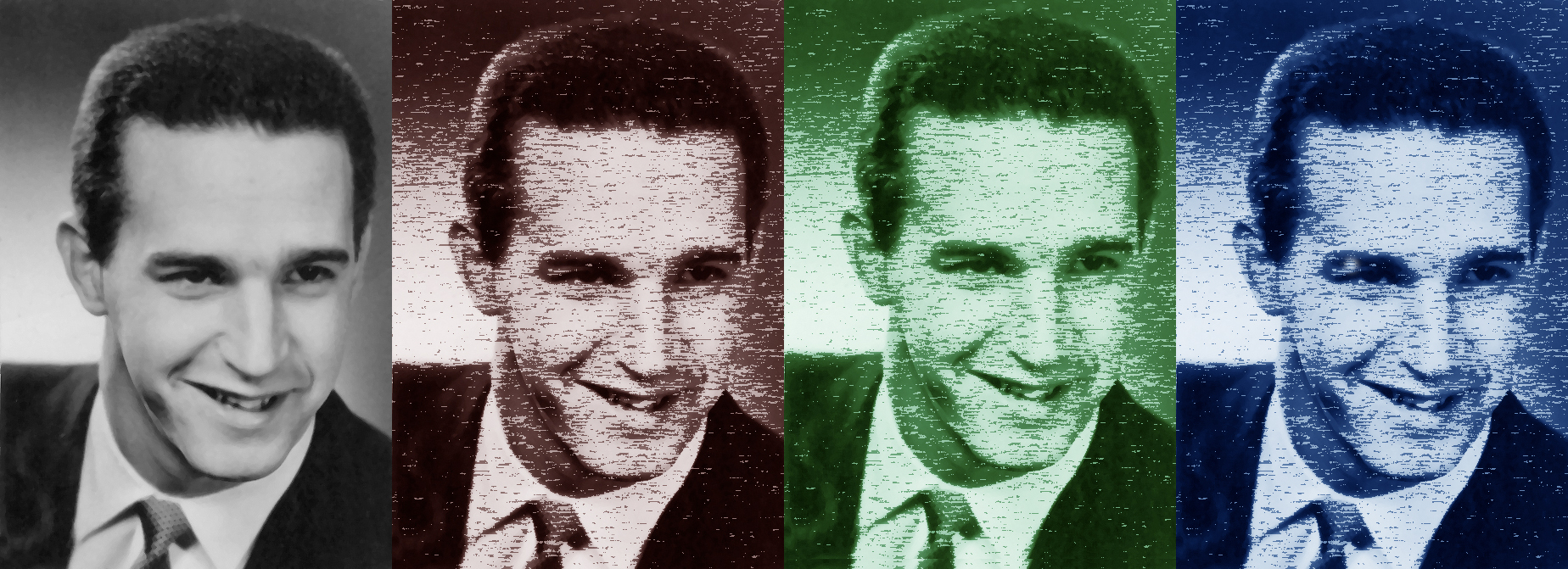
Why did a press officer for the military send a fake photo of Richard Cox to a Cincinnati newspaper in 1953?
It’s Halloween, a day when people often saunter by the ol’ blog site to learn of any recent developments concerning Ron Tammen’s case. On that front, I’m still deep diving into Ron’s FBI documents and focusing on a couple scribbles that someone had made, but I’m not yet ready to share what I’ve found. So let’s talk a little bit about Richard Cox instead.
As I’m sure you know by now, Richard Cox was another college-aged guy from Ohio who disappeared three years earlier than Ron. Although he disappeared from a different school—he was a cadet at the United States Military Academy in West Point, NY—I’ve wondered if the two cases might be related.
I’m not the only one who’s entertained that idea. On May 5, 1953, the Cincinnati Times-Star FAMILY Magazine published an article about Tammen’s case, and the article discussed Cox’s case too. The reporter was Gilson Wright, a journalism professor at Miami University who’d made extra money serving as an on-call correspondent (aka a stringer) for newspapers in the region. As we’ve discussed many times before, I’m not a huge fan of his reporting on Tammen, since I feel that he was being intentionally misled by university administrators who didn’t want certain details to get out about Tammen’s case.
As you’ll soon see, apparently university administrators weren’t the only ones who were intentionally misleading Gilson Wright.
The article the newspaper ran concerned three college students with Ohio ties who’d disappeared after being spotted in the vicinity of their respective dorms at their respective universities: Ron Tammen, Richard Cox, and Ruth Baumgardner. I’m not going to discuss their individual cases here today. You can look them up online.
Here’s what we will be discussing: the photo that was published of Richard Cox. It’s not him. It’s not even close.
The source of the photo would have ostensibly been a press officer for the West Point Military Academy or the U.S. Army—I don’t know which. I can conclude this because that’s how things were done before the internet. If a newspaper was publishing an article about someone and they wanted an accompanying head shot, they’d contact the person’s affiliated organization and ask their press office to please send them one. But instead of sending the photo that had been published widely at the time of Cox’s disappearance, which was this…

…someone opted to send this:

I have questions.
My first question has to do with every reference to Cox in the article. They never got his name right. In the photo caption and elsewhere, Gilson Wright or an editor misidentified Richard Cox to be William Cox, which was bad enough. But then Wright referred to Richard Cox as “Cadet William Scott” in paragraph 3 of the article, which was even worse. So my question is…how did that happen? (No, I’m serious. How?)
Another question I have is who the poor guy was who was being misidentified as Richard Cox, or rather William Cox, by his own alma mater. His sweatshirt tells me that he was probably a jock. Judging by the size of his neck and a nose that may have been broken a long time ago, I’m going to guess that he was a wrestler or football player.
I’ve been going through past issues of West Point’s yearbook, the Howitzer, and, although I’ve found a student who somewhat resembles our guy, it’s really too tough to say. I feel this way because I don’t have a lot of faith in that photo. Of the three photos in the article, the “Cox” photo stands out as the weirdest. Ron and Ruth look normal, but Cox’s photo looks as if it’s been doctored—as if his outline had been traced and carefully cut out of another photo and placed on a white background. Why do that when you have a perfectly great photo of the real Cox in his prestigious Whites? His other features look strange too. Did they darken William’s eyes and futz with his hairline? He almost looks more like a drawing than a real person.
One thing I can say with confidence is that I’ve found someone in the 1949 Howitzer who is wearing the same sweatshirt as the one that William is wearing, so I think William graduated around the same time that Richard Cox disappeared.

If someone should recognize this person, please let me know. As I’ve said, I have a hypothesis, and I may check in with that person’s family members to see if I’m right. I’ll keep you posted.
My third question is the most important one: why would a press officer send the wrong photo of Richard Cox to a reputable Ohio newspaper? By 1953, Richard had been missing for three years. Surely, they had to know they’d sent the wrong guy.
I have a theory on that question too. My theory is that the Army already knew what had happened to Richard Cox by then and they didn’t want to remind people what he looked like. In the book Oblivion, by Harry J. Maihafer, the author contends that Richard Cox was working for the CIA after he disappeared. Imagine if they’d published his photo in the paper and two weeks later, his cover was blown by a well-meaning family from Cincinnati who happened to be vacationing in Florida or some such place.
One piece of evidence we have to back up this hypothesis is that on January 14, 1953, three years to the day after Richard Cox disappeared, J. Edgar Hoover had sent an urgent Teletype to the special agent in charge of the New York Field Office. The teletype said that the FBI was to discontinue their search for Richard C. Cox because the Army had “WITHDRAWN REQUEST FOR FURTHER BUASSIST” [i.e., Bureau assistance].

If the Army was calling off the FBI in January of 1953, what’s a self-respecting PR flack for the Army or the Military Academy going to do when Gilson Wright gives them a jingle four months later and asks them for a nice photo of the guy in question?
I dunno—maybe start rummaging through the supply drawer looking for an X-ACTO knife? That’s just a theory too.
***********
Sending a big shout-out and thank you to The Miami Student journalists/podcasters Taylor Powers and Sarah Kennel, who have featured the Ron Tammen story on their podcast Bizarre Butler County. We covered a lot of territory in our discussion, including some of the new stuff. Give it a listen!

That photo also looks decades older than the real one of Richard.