
I need to tell you about my recent visit to the National Archives (aka NARA), the one in College Park, Maryland. The reason for my visit was to review old missing person files that the FBI had transferred to them in 2014 and that I’d found out about thanks to the good folks at The Government Attic. I’d requested the records through a FOIA request I submitted in June 2022. In November 2022, someone from NARA wrote the following to me:
“The estimated total page count for your request is approximately 950 pages. Requests between 701 and 3,000 pages are assigned to our second-tier processing queue. To give you an indication of our existing second-tier backlog, we are currently processing requests received in February 2014.
Once we notify you that processing is complete, you may either visit our College Park, MD facility to view the file at no cost, or order a reproduction. Our current fee for reproductions is 80 cents per page, so we estimate the total cost will be $760.00.”
Waiting out an 8-year backlog for the pleasure of forking over $760 seemed a little much to me. Also, College Park is about 350 miles away, so it’s not exactly a day trip.
The other possibility they suggested was to narrow my request, which I did. I asked to see 18 of the files that I chose somewhat randomly from their list of 87 names I’d never heard of. Two years later, in August 2024, they informed me that my files were ready. Just about two years after that, in June 2026, I told them I was planning a visit to College Park in August. I asked them if I could see the 18 files I’d originally requested and then, on a whim, I said that if they happened to process any more of the 87 files on the list, I’d like to see those too.
I was in luck, they responded. They’d processed more of the files. Great, said I. See you in August.
And see them, I did. When I showed up to NARA’s Textual Records reading room, an archivist handed me a box that held two CDs. The CDs contained 86 of the 87 files of the FBI’s missing person cases from the 1940s, 50s, 60s, and 70s. For the amazingly low price of $5.00, another NARA archivist handed me a thumb drive upon which I could transfer copies of all those cases, which I did.
I suppose for one fleeting moment I wondered why they’d made me drive all the way to College Park to view records that had been digitized and could have been mailed to me on CDs that would’ve cost far less than $760, but I didn’t really care. I was there now, and what I was looking at on the computer screen made everything worth it. I was now able to compare Ron’s missing person records with a larger sample of people who were also missing during roughly the same period. I could get a sense of which markings were typical, run-of-the-mill missing person markings and which were truly special. I could finally see if Ron’s 10’s and Hacs and underlined lf’s and 366 m hau’s and all the other scribbles I’ve written about over the years held any meaning whatsoever.
Today’s post will be in show-and-tell format. I’ll be sharing several things I learned about Ron’s case after my trip and offering examples from the missing person files that led me to those conclusions.
Also, as I mentioned in the headline, I’ll be providing evidence that the FBI is attempting to mislead us about the meaning of a certain set of marks in the upper righthand corners of people’s FBI records, including Ron’s. (Spoiler alert: I’m talking about the 10’s…they’re attempting to mislead us about the meaning of Ron’s 10’s.) They’re doing this through a common deceptive practice known as cherry-picking and, I kid you not, I believe that I have the FBI to thank for ensuring that I received almost the entire batch of available missing person records (sans one) so that I’d arrive at the conclusion they wanted me to arrive at. Happily, I’m onto them big time and I have hard evidence that shows everyone what they’ve been up to. So hang on to your Stetsons, cowboys and cowgirls, as we catch the FBI red-handed in some rip-snortin’ cherry-pickin’ trickery. You’ll see what I mean soon.
Let’s go!
Discovery #1: I don’t think that 366 m hau is in reference to Robert Maheu after all.
This discovery has taken me well over a week to come to terms with. I’d been so sure that we had this mini-mystery all figured out…that 366 m hau was the same person as LV 366-PC and that person was Robert Maheu, right-hand man to Howard Hughes. But there, staring at me from a September 13, 1972, missing person report was the phrase “366 m hau.” The report concerned a missing woman from Culpeper, VA. It had nothing to do with Las Vegas. I doubt that she knew Howard Hughes, Ash Resnick, or Ronald Tammen either. Therefore, I don’t believe it pertains to an informant broadly or to Robert Maheu specifically, which sucks bigly.

But it does provide some information. Below the 366 m hau, in the same handwriting, are the words “Crim & Dead.” Above it, also in the same handwriting is…I can’t tell. It looks like a 9 with a t and something else, probably someone’s initials. Also, it’s written in regular, graphite-colored pencil, which I believe indicates that it was written by someone in the Identification Division. (That’s versus the blue, red, and green pencil markings I’ve seen on other original FBI records.) As for what “Crim and Dead” stands for, it means “Criminal and Dead,” because I saw that exact phrase written on another person’s missing person record. As I was trying to figure out what that phrase could mean, I discovered that, from roughly 1971 to 1994, there was a Deceased Criminal Identification Files list, which was housed in the Identification Division. The people who were on the list were ostensibly known criminals who were now deceased. Maybe they were referring to that list. Or maybe 366 m hau had checked two lists: the criminals and the dead criminals. The missing woman was deemed a fugitive in three states, so that would warrant the “criminal” description. I don’t know when she died. Also, the Deceased Criminal Identification Files list is available on Ancestry.com, and she isn’t on it. I’m not printing her name because her two daughters appear to be living.
So, bummer-and-a-drag, 366 m hau wasn’t Robert Maheu. But as I mentioned in a recent Facebook post, it doesn’t mean that Robert Maheu didn’t know Ron Tammen. We still have the Hac scribbles on Ron’s pages, which match Robert Maheu’s good friend Hank Greenspun’s Hacs and which did not appear on the 86 missing person files I reviewed. It’s still my theory that Hac refers to the Hughes Aircraft Company, which was a front for the CIA, and might have served as a cover for Ron. The letters Hac could have been FBI shorthand for Howard Hughes, which absolutely would still involve his alter-ego Robert Maheu. We just don’t have a direct reference to Maheu on Ron’s records. It’s OK. It was a fun theory, but I’ve moved on.
Discovery #2: The FBI continued sending form letters with check boxes to families of missing persons after J. Edgar Hoover died. For some reason, they stopped sending them to the Tammens.
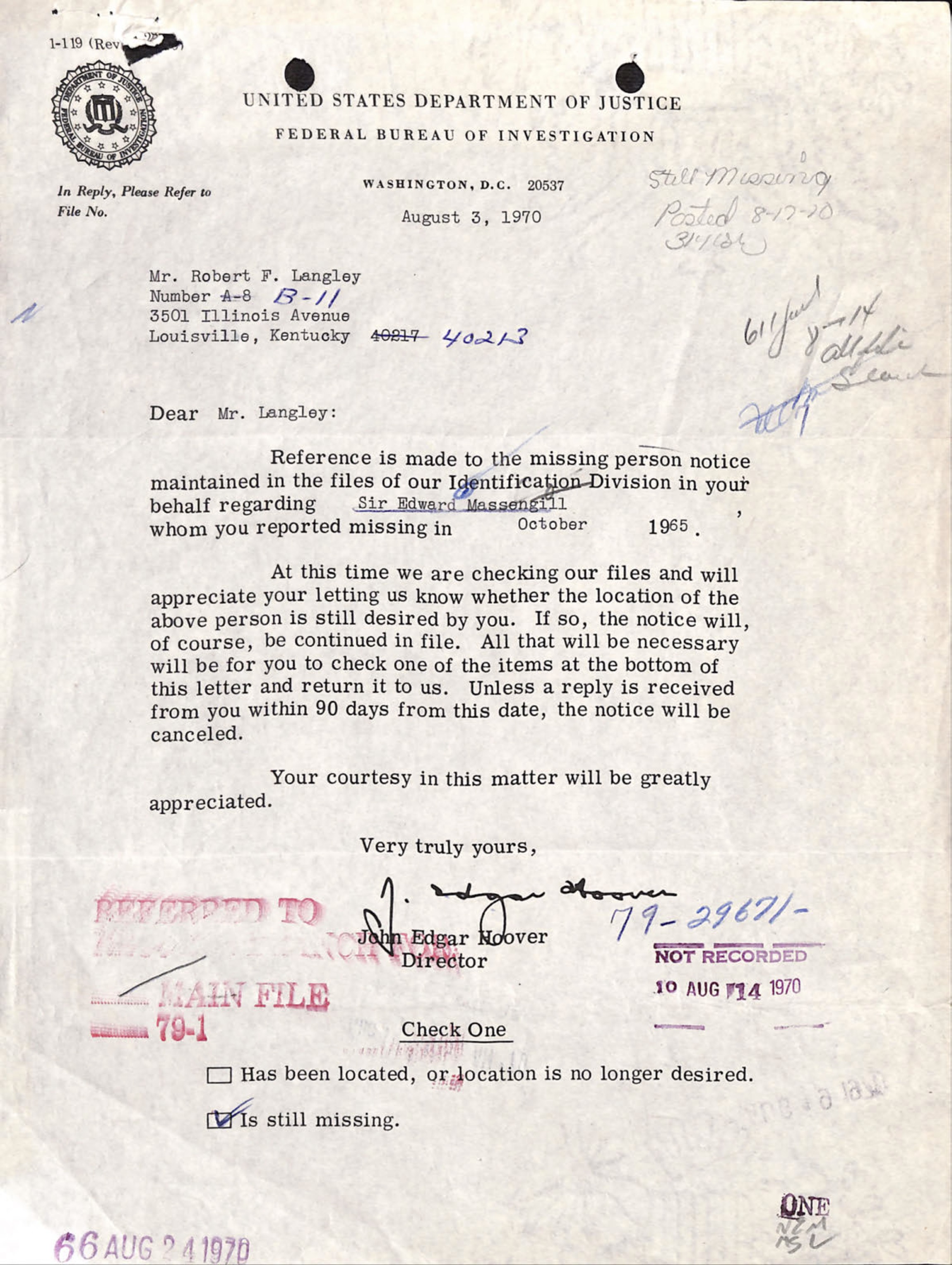
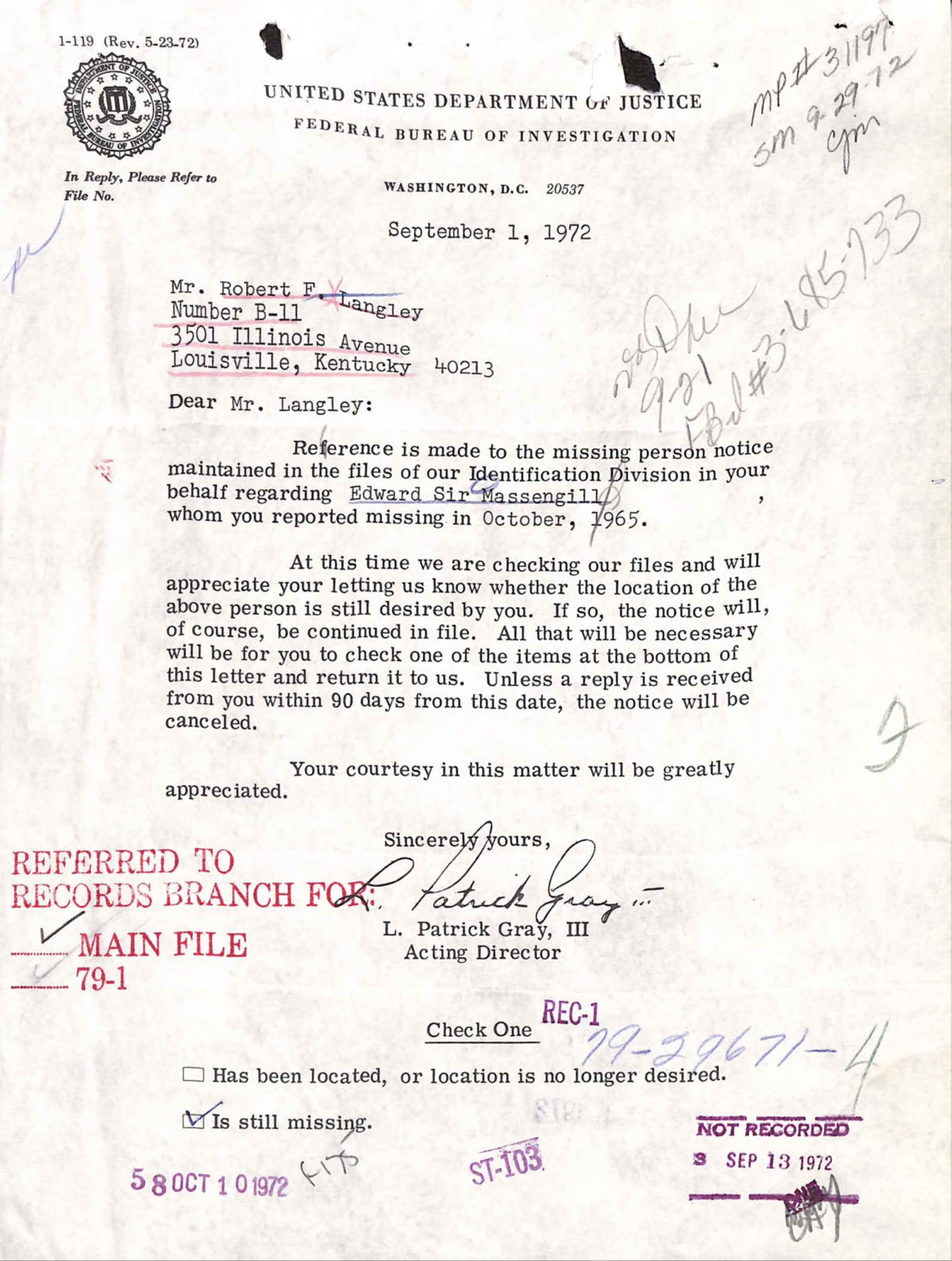
Every few years after Ron disappeared, the FBI would send a form letter to Mr. and Mrs. Tammen asking if Ron was still missing (check this box) or if he’d been located or his location was no longer desired (check this box instead). The Tammens would dutifully check that he was still missing and send the form back. Mr. Tammen continued doing so after Mrs. Tammen died in 1964. But you know what? The last form letter received by Mr. Tammen was in October 1970. In 1972, at roughly the time when the Tammens were due to receive another letter, J. Edgar Hoover died and the form letters stopped arriving.
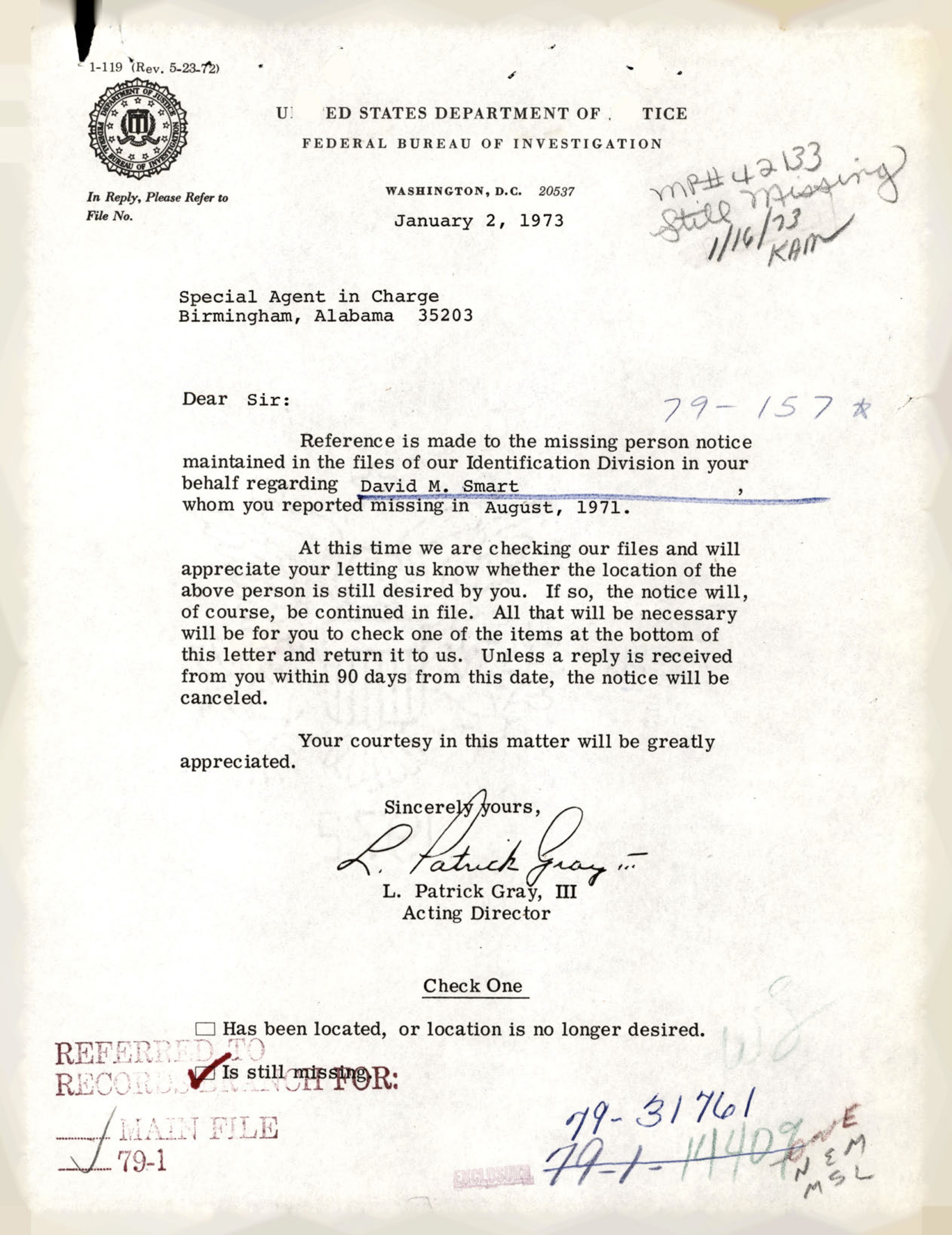
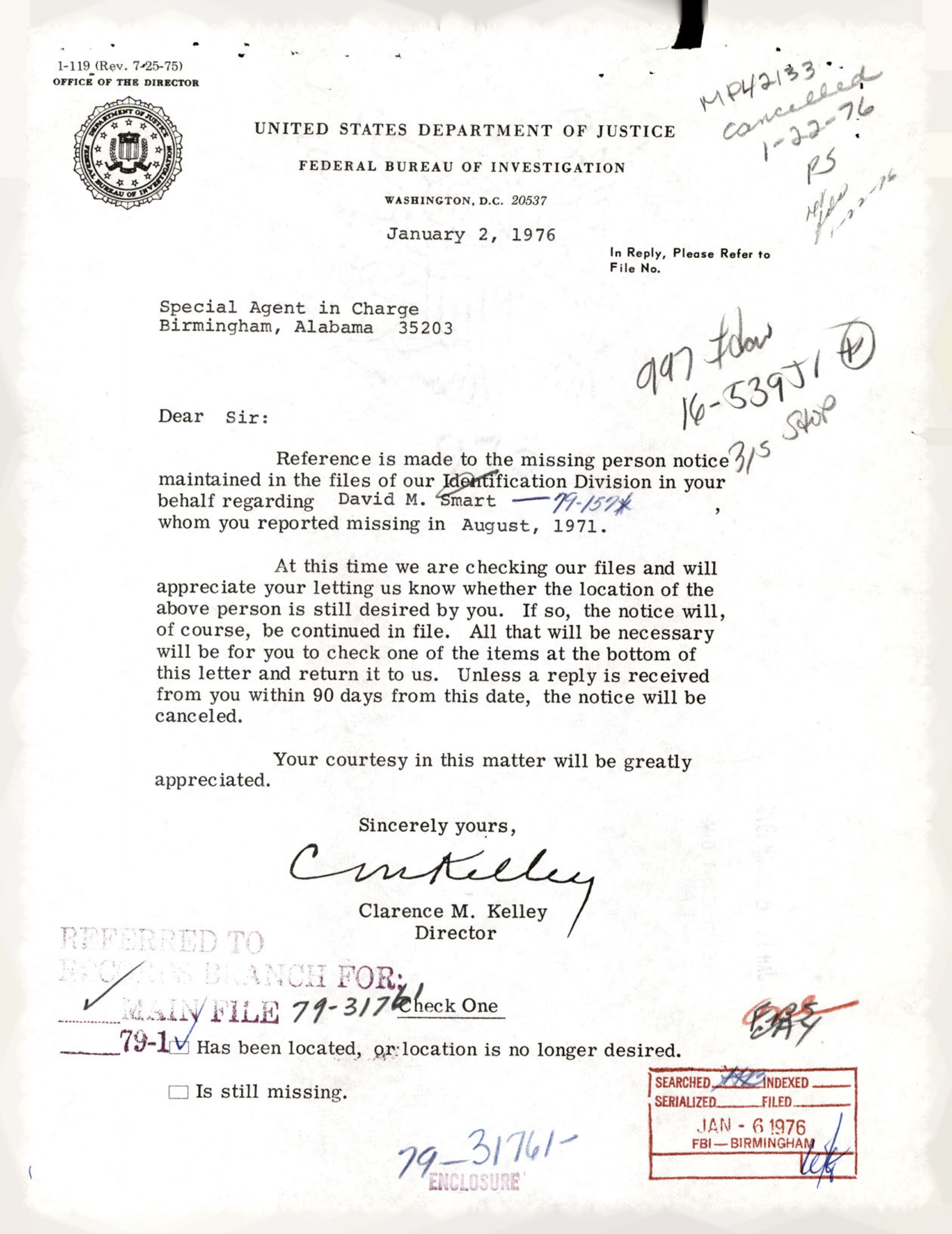
I’d wondered if that was just a Hoover practice, and once Hoover had died, the practice was discontinued. But I now know that, even after Hoover died, Acting Director L. Patrick Gray continued sending the same families their form letters, and then Director Clarence Kelley picked up the baton after that. Nevertheless, Mr. Tammen had stopped receiving his form letters about Ron. If I could pinpoint the date that the FBI’s Identification Division stopped caring about Ron’s case, I’d guess it was June 5, 1973, when Ron’s missing person records were “removed from Ident files.” This was shortly after the Cincinnati Field Office had fingerprinted the guy from Welco Industries and sent those fingerprints to Headquarters to run a comparison to Ron’s prints. Something that the FBI had discovered about Ron’s case as they were tracking things down led them to remove Mr. Tammen from the rotation.
Hmmm…what could it be? I wonder.
Sir Edward Massengill
David M. Smart
Discovery #3: A bunch of missing people had ‘see index’ written on their FBI records; likewise, many files were stored in the Missing Person File Room.
I’ve been learning that the people who went missing weren’t perfect angels. They had stories. Some had committed crimes. Many of them probably had good reasons for running away. So I guess it wasn’t too surprising to find that a lot of them had their files stored in the Missing Person File Room, room #1126 of the Identification Building, just like Ron did. I mean, if the FBI sees fit to set aside a special room for the NSFW missing person files, which is my guess regarding its purpose, there are going to be occupants. Still, not all of the missing people had their files stored there. Something was keeping these files apart from the others.


As for the people with the phrase “see index” scribbled on one or more of their records, if I’m right that it refers to the Security Index, then the FBI did add missing people to the Security Index even if they didn’t know their whereabouts. So I was wrong about that. Also, you might think that if you’re going to have “see index” written on your records, your file is probably going to wind up in the Missing Person File Room, but that’s not the case. There were “see index” people who weren’t in the Missing Person File Room and there were people in the Missing Person File Room who didn’t have “see index” written anywhere. Ron had both. Whether they knew Ron’s whereabouts when they wrote down that phrase on page one of his records, I can’t say. But by June 5, 1973, I think they had a pretty good idea.


Discovery #4: The 10’s on Ron’s records continue to be significant. Maybe they’re even more significant than I realized.
I have a story to share. There I was, reading through the missing person files and organizing them on a spreadsheet of sorts by last name. Next to each person’s last name, I’d type in a few notes, such as whether the person’s file was in the Missing Person File Room, whether the phrase “see index” was written somewhere, plus a few others, including what the number was in the upper righthand corner of their record.
It wasn’t long before I noticed a pattern emerging regarding those numbers. The people who had last names beginning with an A or B had a 1 in their righthand corner; people who had a last name beginning with a C or D had a 2 in their corner; and so on all the way to the S’s and T’s, which had 10’s. The three people whose names started with a W had an 11. There were outliers, but the pattern was undeniable.
What…the bloody…hell, thought I, as my entire world began to implode. I think I became light-headed. Ron’s 10’s are central to my theory that he was living a life of danger for the CIA. The other cases in which I found 10’s described some remarkable circumstances as well.
But if Ron’s 10’s are there simply because his last name starts with a T, then I’m officially done here. Game over. I’ll take down my blog site, remove myself from society, and live my life in solemn quietude. Maybe I’ll get another cat…or 10. I can think of several people out there who’d be overjoyed with this development. In all seriousness, this may have been the closest I’ve come to a full-on existential crisis.
As many of you know, my theory has been that those numbers refer to an official within the FBI who received a copy of the record. Sometimes the numbers are followed by a dash followed by a 1 or 2 or sometimes an even higher number, indicating how many copies they received. I also posited that the official was the FBI’s liaison to a federal agency and that Ron’s 10’s were in reference to the FBI’s liaison to the Secret Service. To be honest, I wasn’t as sure about what agencies they represented—maybe they represented outside agencies or maybe they represented certain offices within the Department of Justice, which oversees the FBI—but I was certain that the number in the righthand corner represented a person. And now this.
But…but…but…(thought I)…it didn’t make any sense for them to alphabetize names within a classification group. It doesn’t follow FBI protocol. FBI protocol at that time was simple and straightforward. First, they checked the general index, which consisted of thousands, and probably hundreds of thousands, of index cards organized alphabetically by people’s names and other identifiers, all meticulously cross-referenced. The index card would then provide the appropriate case number (or numbers) for that person, with the first part of the case number being the classification group, which for missing persons is the number 79. The FBI staffer would then stroll over to where the case files were housed, find the 79 classification group, and pull out the respective file. Ron’s number was 79-31966. Richard Cox’s number was 79-23729. Ronnie York’s was 79-32021. Anna Marie Altmeier’s was 79-31499. And so on. (Oh, I know, I know. What about the Missing Person File Room? I’m thinking that the index card likely mentioned if the file was in there instead, where they’d also be filed by their case numbers. No biggie.) Nowhere have I read that the FBI grouped files alphabetically within a classification group. And think about it: A case file is much easier to locate by its case number than by having to also know some sort of alphabetized section number assigned to it and written in the upper righthand corners of some, but not all, of that person’s records. And what if there were two or more numbers, which sometimes occurred? Does that mean that copies were made so that the files would be in multiple places within the classification group? That would be insane.
So what’s a girl do when she’s presented with this kind of life-altering, book-project-killing information? I’ll tell you what she does. She pours herself a glass of passion fruit kombucha and continues reading the missing person records while taking notes.
Here’s what she found.
The dashes, 1’s, and 2’s
Many of the numbers had dashes followed by 1’s and 2’s too. Why would they have those additional numbers if they were organized alphabetically within the classification group, which, again, would be insane?
Here are examples from 1 to 11:


Here are two examples of outliers in which multiple numbers are listed. In the Sampson example, according to my theory, FBI reps #3 and #9 received 1 copy of the record, and reps #1 and #9 received two copies of the enclosures.


The FD-217’s
Several of the missing person records have the notation “FD-217” scribbled near their number. As you may recall, many of the non-missing-person records also have the FD-217 notation near their number, as if that notation was the reason for that particular number being assigned.
To recap from a while ago, the FD-217 was an FBI form titled “Notification of Bureau File Number,” which, to the best of my knowledge, was generally submitted by field offices along with a report if they didn’t know the person’s case number. I think it provides more interesting information than that though, since I can’t get my hands on one, not even one that’s blank. The FBI claims that they can’t find it, even though I pointed them to a page number in the FBI Form Book’s Table of Contents.
Someone’s initials are usually written near the number and FD-217 notation, as if they’re saying “I checked the FD-217 and it provided this number.” If the numbers were merely some sort of alphabetical shorthand (e.g., 1= A-B, 2=C-D, etc.), they wouldn’t need to check the FD-217. They could just hang an alphabet chart on a wall somewhere.


The blue pencil
Unlike other missing person records I’ve seen over the years, including Ron’s, these missing person records are originals, which is especially helpful, because I can see what colors the notations are written in. Consistently, the number in the upper righthand corner is written in blue pencil, just like the phrase “see index,” FD-217 (usually, except for the one on pink above), and the accompanying initials. For some time, I’ve believed the blue pencil indicates that it was written by someone in Domestic Intelligence, Division 5, because of the notations, with “see index” being the biggest giveaway. I continue to feel that way.
The yellow sheet
If I were a practitioner of inverted-pyramid journalism versus my usual preference of romping through the weeds on my way to completing a full circle or, if the situation calls for it, a 3-D rhombus, I would’ve led with this next finding. It’s a big deal.
Sometimes, I noticed the phrase “o’d on yellow” or “o’ed on yellow,” also in blue pencil, in the top right of a page that had no number. It was as if the phrase was written in lieu of the number. I had no idea what the phrase meant, but I typed it into my quasi spreadsheet anyway.
Here are 6 examples. The writing is sometimes small and light, but it’s always in blue in the upper right.


Then I read the missing person records associated with Edward Theodore Myers, who, in 1954, at the age of 50, had been missing for about 10 years when his mother wrote to the FBI. At the top of the page on which her letter was affixed, on both sides, someone wrote “7 circled on yellow.”


“What’s with all the yellow?” I wondered.
I soon learned that the word yellow was referring to the preprinted “Message Relay” cover sheet, which is yellow in color. When the FBI passed along information about a missing person case to a senator, the attorney general, or another important person or agency all the way up to the White House, they’d use the Message Relay cover sheet. It had two purposes: to specify the officials on the distribution list and to hide from casual view the contents of the document being transferred. The fact that someone wrote the number 7 on a Message Relay cover sheet for Edward Theodore Myers tells us that whoever 7 is, they were on the distribution list and they should get a copy too.
As for what the “o” in “o’d” or “o’ed” stands for, I wish I could tell you. Maybe it stands for “office” or maybe “official.” As bizarre as it sounds, maybe it was FBI lingo to write that they’d “o’d on yellow” if they’d written the office’s or official’s designated number on the Message Relay sheet. As further confirmation that the numbers in the top right corner correspond to the numbers written on a Message Relay sheet, I found a Message Relay sheet for Lady Bird Johnson in which the phrase “o’d 2” is written in the top right.

It appears that an agency official with the 2 designation had been kept in the loop about Lady Bird Johnson, whose name, I feel the need to point out, doesn’t start with a C or a D. I also have located non-missing-person examples in which the number on a Message Relay sheet matches the numbers assigned to the regular FBI records. In short, the numbers in the upper righthand corner correspond with the numbers on Message Relay sheets, and none of them have anything to do with where a person’s name falls in the alphabet.
Incidentally, this is also evidence that the FBI didn’t save all of its missing person records. Even though they wrote “o’d on yellow” on someone’s records, they didn’t bother to save a copy of the Message Relay sheets for the missing person files. “TMI,” they likely thought.
The file envelopes
For additional corroboration, let’s talk again about FBI protocol. When an FBI staffer pulled someone’s file, the individual records were stored in a manila envelope. Stamped on the envelope on the righthand side was the case file number, because, as we’ve discussed, that’s how the files were organized. Nowhere on the outer envelope is a number ranging from 1 to 11 that corresponds to the numbers written in blue pencil in the top righthand corner of some of the pages of a person’s records—numbers that the FBI would have us believe represents some sort of secondary alphabetized system. Those numbers aren’t on the envelopes because, again, that would be insane.


To conclude this section, the above examples confirm that the numbers in the upper righthand corner hold meaning, Ron’s 10’s continue to be significant, and I don’t need to go dig a hole in which to live out my days.
I’d mentioned earlier that I found some 10’s in the missing person records as well. As with Ron’s 10’s, not all are clear as to why they earned them, but here are several that do seem a little more self-explanatory and far juicier than the other, lower-numbered records:
David Smart, aerospace engineer for NASA who disappeared on his way to work

Roger Alan Smith, a Marine who’d just completed training in counterintelligence and was being sought by Naval Intelligence

Andrew J. Tyler, a college student in the Air Force ROTC who had participated in marches against the Vietnam War

Discovery #5: I now believe that the FBI is actively attempting to mislead us
Here’s the question that’s on most of our minds: Why does it appear as if the numbers from 1 to 11 on the missing person records are based on the alphabet? Answer: the FBI cherry-picked the records. When the FBI released the missing person records to NARA in 2014, I strongly believe that they chose records to make it appear as if the numbers were alphabetically based. To represent the 1’s, they chose people with 1’s on their records whose last names started with A’s and B’s—and only those people. For the 2’s, they chose people with 2’s on their records whose last names started with C’s and D’s, and so on. As a result, I think there are a lot more missing person files out there from that era.
In an April 14, 1952, article in Life about Richard Cox’s disappearance, authors Herbert Brean and Luther Conant estimated that roughly a million Americans “excluding criminals” attempted to disappear each year. They also said that 95 percent of those cases were solved by missing person departments. Still, that leaves roughly 50,000 people per year who managed to stay hidden. In comparison, the FBI transferred 87 files representing the years 1947 to 1980. Eighty-seven.
I don’t think the FBI was cherry-picking their files because of me. Those files were transferred to NARA long before I started my blog and got all vocal about the numbers in the upper righthand corner. It could be that that’s how the FBI, as a rule, releases its records, in case anyone should question those numbers and as a time-saver to reduce the number of redactions they’d have to make.
I do, however, think that I was on the FBI’s and NARA’s minds in June 2026, when I let them know that I’d be coming to town. After they finished my request in August 2024, NARA continued working on the rest of those files for a year, processing 48 more. Then they took a 9-month break. Maybe they thought I didn’t care about the files anymore. Maybe they thought I’d moved onto other things so they felt they could expend their time and resources elsewhere. But then, when I told them in June that I’d be coming to College Park in August, they flew into high gear. They processed 20 more files, totaling 86.
Look, I’m extremely grateful to NARA for making all of those files available to me so quickly. They accomplished that feat in only four years when I’d been forewarned that they were still working under an 8-year backlog. But I don’t think that the FBI has ever forgiven me for asking for NARA’s assistance in determining why the FBI was able to expunge Ron’s fingerprints 30 years earlier than their normal record retention period would permit. I think it’s highly likely that someone at the FBI read NARA the riot act for giving me information that led to my conclusion that it was due to a conflict with the Privacy Act, and, if so, Ron was probably alive in 2002 and the FBI knew it. I’m thinking there’s probably a note in red somewhere on my NARA researcher profile telling them to contact the FBI whenever I ask for anything that pertains to the Bureau. I think they probably told the FBI that I was coming and I think the FBI told them to finish the files (sans one). If anyone from the FBI has been reading my blog, they knew that I’d be looking at those numbers. I think the FBI wanted me to see its handiwork, and I’m here to say that I did. It’s just that I’m not buying what they’re selling. Sorry, but I’m not.
And you? What do you think? Any ideas on what the “o” stands for in “o’d on yellow”? How about questions…surely, you have a question or two about all of this…

Hey all — I was being reeeeealllly safe when I guessed that there were hundreds of thousands of index cards in the General Index. According to The FBI Records Appraisal, published in 1988, by James Gregory Bradsher, there were 65 million of them. So…yeah…there WERE hundreds of thousands of index cards….like 650 hundreds of thousands! You can download the publication from this website:
https://www.iastatedigitalpress.com/archivalissues/article/id/10555/ .
Jennifer, you may well have come across these already, but just in case: I found references in the 1975 Church Committee/FBI records to two specific FBI documents called Guide to Indexing and Rules Pertaining to the General Index. According to the FBI’s records, copies were provided to the Church Committee on August 11, 1975, in connection with FBI file 62-116395.
Given your current work on the 1–11 markings, especially the striking alphabetical pattern you found, I wondered whether these might be worth tracking down, if you haven’t already. They sound like exactly the sort of internal instructions that might clarify whether the numbers had any connection with indexing or routing.I
Wow. Thank you so much for passing along this info. I wasn’t aware of this document and will look into it. If it’s not available online with file 62-116395, I’ll submit a FOIA request today. Many, many thanks.
Hi again. Here’s the link: https://archive.org/details/FBI-Church-Committee-File/62-116395-547%20Bulky/. The part having to do with indexing is on pages 97 to 166.
What this shows is how intricate the General Index was, which was the first stopping point when someone was looking for a certain FBI file. Basically, these are the rules they followed when they were creating new index cards, filing the index cards, cross-referencing the index cards, or looking for a certain person or other identifier in the General Index. It’s super detailed. Unfortunately, this doesn’t get into our question regarding the numbers that were written in the top righthand corner of an FBI record within a person’s file or to a Message Relay sheet. But thank you again for sending this!
Thank you so much for checking it so quickly, and for posting the link! I’m glad it was at least useful for narrowing things down, even if it didn’t answer the question about the numbers.
Since the indexing rules don’t seem to explain them, I wonder whether the better target might be the routing/Message Relay instructions instead. If you do end up filing a FOIA request, it might be worth asking specifically for any 1950–1975 instructions governing Form 0-73 (Message Relay), internal distribution/routing codes, and any tables defining handwritten numeric designations such as 1–11 or forms like “8-1” / “8-2.”
Thanks again for taking the time to look into it, I’ll keep an eye out for anything more specific too!
Thanks for these suggestions!
Jennifer;As per usual I for one remain entirely lost but thats on me. I would be interested in you taking a look at the numbers and such on my records and letting know what you think you can decifer (sp). And, congrats on the successful trip to College Park. Bill.
Thanks, Bill! One bummer is that I didn’t have time for the Watergate records, especially the WH Plumbers. However, I’ve obtained more specific info to request the next time I’m there…and I plan to go back.
Do I have your records? If not, please free to send and I’ll be happy to take a look.
PS. I do know that the record regarding Terry Gene Davis’s suicide after the NPRC fire has a 10 on it, which also doesn’t fit an alphabetized scenario.
Amazing finds as always!
I don’t have a clue what it would actually mean but since someone had written “circled on yellow”, my initial guess is that those might be drawn circles and not o’s?
Thank you! And that’s a great guess!