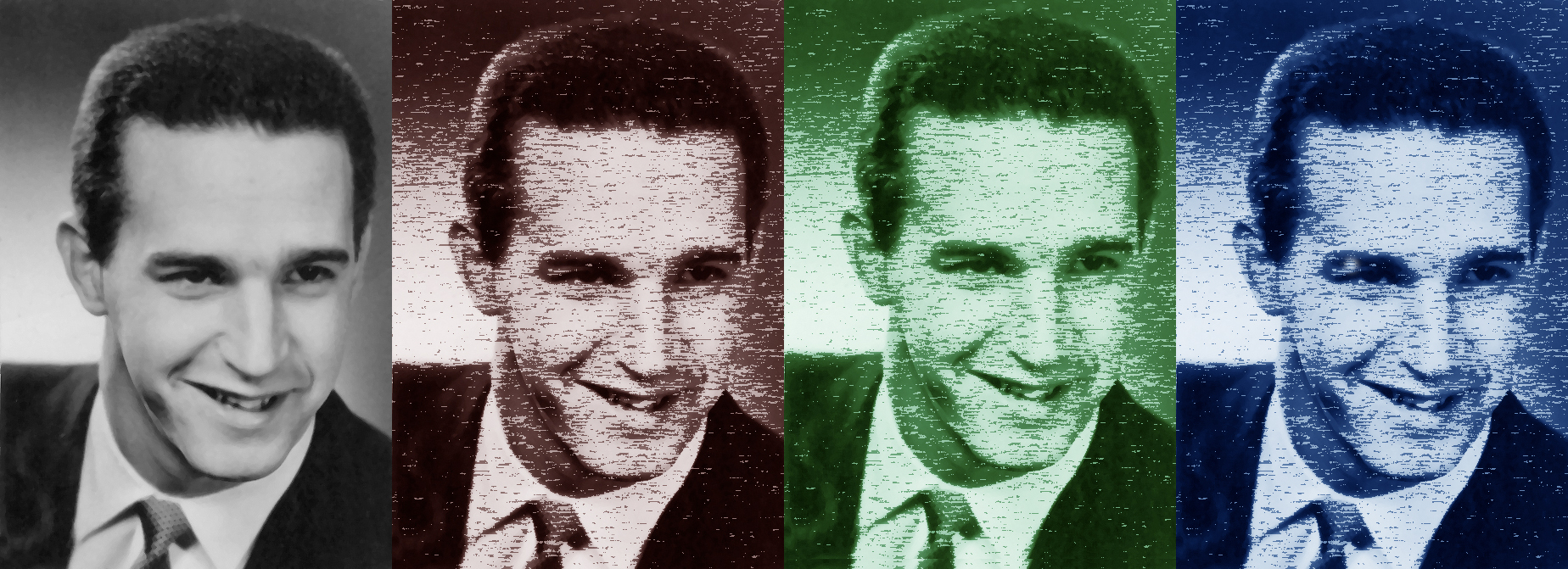
Our recent discussions about Ron’s finances, loans, and faculty co-signers on those loans reminded me of something this morning: a letter that Ron’s father had written to Ron back in the fall of Ron’s sophomore year. Mr. Tammen wrote the letter on September 19, 1952—a Friday. Although his handwriting is beautifully legible, a remnant of days gone by, I’ve typed it out for you here:
19 Sept. 1952
Dear Ron: —
We have been waiting more or less to hear from you, but realize that you must be extremely busy not only with your studies, but also with your other activities: — such as, counselor and the Owls.
Mom picked up your checks today so we thought we would forward them as quickly as possible so you could get your “Savings Account” started. We are going along with you on this deal as we feel you are old enough and should have the experience of handling your own money. We hope you will be wise and remember that practically all of it will have to be used for next semester.
I am retaining your check stubs for your tax purposes, but will put down exactly what the stub shows:
All in all, it was slightly more than you expected and you were paid for that day.
When you do find time to write, please give us a brief on expenses and expenditures.
Love,
Dad.
Mr. Tammen seemed to have a question concerning the dates of Ron’s bus-washing services. In addition, written in pencil at the bottom in the left-hand column is the following:
When I first read his letter, I was struck by how parental it sounded, but not in a warm way. It felt formal. The sentence that stood out most was the one about Ron being paid for that day, underlined twice. What could have happened at his city job that was so terrible, Mr. Tammen didn’t even want to put it in writing? Did Ron roll a truck? Did he get into a fistfight with another bus washer? The mind reeled. I tried to find out—I really did. I asked Ron’s siblings if they remembered some incident that happened to Ron at work that summer, and no one had any idea. I contacted the City of Maple Heights to see if they still had an employment record for Ron, but they didn’t. I visited the city’s museum where they store boxes of old books and city papers to see if his employment record might have been there. It wasn’t.
The rest of the letter didn’t interest me that much. It sounded like Ron was just trying to become more independent by handling his own finances, which only seemed fair. Ron was responsible for putting himself through college, just like his two brothers, John and Richard. Mr. Tammen wasn’t contributing a dime to his education. I filed the letter and didn’t think much more about it.
Until today.
Several things stand out for me in light of what we now know:
First, the “Savings Account” that Mr. Tammen alludes to in the letter wasn’t mentioned by Mr. Shera of the Oxford National Bank when he wrote to Carl Knox about the $87.25 balance he’d mailed to Miami’s bursar. Mr. Shera calls it a “commercial account,” singular, and we already know that Ron was writing checks. I don’t think Ron had a savings account—I think it was just checking. In addition, a “commercial account” is defined as a business account where funds are readily accessible, as with a checking account. According to his brother John, in addition to playing with the Campus Owls, Ron was known to manage gigs on the side. Perhaps this is the reason his account is referred to as commercial? Unfortunately, I don’t have the answer.
Second, Mr. Tammen’s last sentence, where he’s requesting a “brief on expenses and expenditures” is telling. He seems like a micromanager and, I’ll say it, a bit of a pain. With Ron taking over his own finances, perhaps he thought he could somehow avoid his father’s scrutinizing every little expenditure. This could be Ron’s way of making sure that Mr. Tammen didn’t know about every single check he wrote.
And that’s when it occurred to me. Perhaps Ron wasn’t seeking to manage his own finances so that he could expedite adulthood. Maybe he wanted to keep some expenses hidden from his father.
But what expenses? Ron was so busy working, he barely had time to spend his money. Nevertheless, he was always in need of money.
Here’s where my head is right now: blackmail.
Several of you have suggested this possibility and I think you may be right. Think about it: Ron’s freshman year at Miami went fairly well, but his sophomore year was pretty much a bust from the get-go. Even beginning that first semester, he started to drop courses and was no longer considered full-time. He was always working and his grades were slipping.
During the summer of 1952, Ron was working for the City of Maple Heights doing a number of assorted jobs. Could it be that sometime during that summer, Ron and another male were caught in a tryst and the witness decided to make it lucrative? Maybe the blackmailer said that he could be paid on the installment plan.
So how might this have played out: At the beginning of the fall semester, Ron asks his father to let him handle his own finances. That way, his dad wouldn’t know about any checks Ron might have written to his newfound “friend.”
He struggles to make it work, again taking on jobs and securing loans. Perhaps he even volunteered for the Psychology Department’s hypnosis study, both to make some money as well as to see if they could change him somehow, to prevent this situation from happening again.
When Ron went home during spring break, however, something happened. Maybe he saw his blackmailer and the person upped his amount. Whatever happened, when Ron returned to school the following week, people noticed a change in Ron’s behavior. According to Carl Knox’s notes, he was seen reading the Bible 5 or 6 times, and, he “spoke of being ‘tired lately’ since vacation.”
He was in a crisis. Someone may have been threatening to out him if he didn’t pay up, and he was way over his head in debt. Crazy as it sounds, this could have been what brought the CIA to his rescue.
A couple other thoughts:
I’m not sure who penciled in the calculations at the bottom of Mr. Tammen’s letter. It may have been Ron, though, based on another note page, the numbers appear to match those made by Carl Knox.
It amazes me that Ron had held onto his father’s letter for so long and that the university was able to obtain it. In addition, Carl Knox’s penciled-in notes asking “Did he owe Univ any money?” or telling himself to “Follow up re Check Book” clearly show that the university found Ron’s money issues to be as interesting as we do.
Sorry to be a bother, you guys, but I can’t keep this in. This afternoon, I was busy working on — what else? — Tammen research when I discovered something pertinent to our topic du jour. In the summer of 2019, I was visiting University Archives (sigh…I really miss road trips) going through a bunch of documents. On that particular day, I was leafing through issues of their Information Bulletin for Faculty and Staff from the early 1950s — 1950 and 1952 to be exact. As I recall, the university didn’t produce a new bulletin every year. Sometimes they just produced an addendum. Fortunately, I had taken photos of numerous pages — some relevant to the topic I was obsessing about at that moment, and a couple having to do with what I’m obsessing about now: student loans.
Here’s what they had to say about student loans in the 1950 issue (apologies for the bad photos, but I’m guessing you’re used to that by now):
And here’s what they had to say about them in the 1952 addendum, right around the time when Ron would have been applying for one:
Here are the points I want to leave you with today:
Student loans were a big deal.
Since Ron was a sophomore, his loan would have been limited to $100.
I’m guessing that Ron had been a recipient of this loan, and it’s the same one that Mr. Alden had written up when discussing Ron’s outstanding debt.
And the juiciest tidbit of all: our friend H.H. Stephenson oversaw the student loan program.
So H.H. Stephenson was overseeing the student loan program when Ron received his loan. That loan may have even been relatively recent, since Carl Knox’s notes indicate that Ron had recently deposited a $100 check from a loan. What this tells me is that H.H. Stephenson was even better acquainted with Ron than we had previously known. Sure, sure, H.H. knew him because he’d given him a car permit. But he’d also just handed him $100! Could that be one of the reasons the university kept a lid on H.H.’s potential Ron sighting — they didn’t want the money issue to come out? What’s more, for me at least, it also makes the potential sighting more believable.
Purposely lying to a member of the press is a big fat no-no for a spokesperson of any stripe. Obfuscating—intentionally throwing up smokescreens—is really bad too. But to look a reporter in the eye and say something that’s not in the least bit true takes a special kind of moxie. It also requires a motive. Otherwise, why not just tell the truth? For those with nothing to hide, honesty is so much easier.
So for someone like Carl Knox—who, from what I’ve been told, was an aboveboard kind of guy—to introduce an untruth with a reporter when discussing Tammen’s case seems especially bizarre. Wouldn’t he and other university officials have wanted to get everything out in the open in hopes that it might help them find Ron? What’s more, Knox was still in his first year as dean of men at Miami—a brand new post. He would have wanted to pour everything he had into a task that held such high visibility. Lying about it? That would be the last thing he would have wanted to do.
But then, nobody starts out planning to lie.
Lately, after finding tangible evidence of a university cover-up, I’ve been examining all of the old news articles for what feels like the zillionth time. I’ve been tracking any lies and obfuscations that are quoted—directly or indirectly— from university officials, knowing what they knew at the time.
We already know about a couple of them. We know that Gilson Wright (and others) chose to mislead the public about the psychology textbook on Ron’s desk, most likely to direct attention away from Dr. Switzer. We also know that they tried to depict Ron as doing very well in his classes. Once we saw his transcripts, however, we knew that Ron had recently dropped his psychology course for the second time in a year and was slipping far behind in his degree program. Again, the motive behind the deception was most likely to avoid shining a big bright light on Switzer.
There were the other lies and obfuscations too. Among the greatest hits are:
When Carl Knox decided not to divulge Paul’s (not his real name) story about his walk back to the dorms after song practice with Ron and Chip Anderson the night Ron disappeared.
When Gilson Wright disclosed in a news article that three amnesiac youths had wandered off and later returned, but never mentioned the youths in his articles again.
When Oscar Decker added an hour to the time of arrival of the young man who appeared on Mrs. Spivey’s doorstep on the night Tammen disappeared.
Living your life with one lie can be hard enough. But juggling all of those lies and obfuscations TOGETHER? That’s practically a full-time job.
Today, I want to discuss another lie that officials opted to tell about Ron—the one about his finances.
On April 25, 1953, the Saturday after Ron disappeared, Carl Knox was quoted in the Hamilton Journal-News by Gilson Wright, with the following matter-of-fact pronouncement:
“‘He was not in financial difficulties,’ Dean Knox said after a checkup Friday. ‘But he could not have had more than $10 or $11 in his possession when he left Fisher Hall.’”
On April 29, 1953, Wright wrote this in the Cincinnati Enquirer:
“A sizable balance was left in a downtown bank.”
And on May 4, 1953, Wright wrote this in the Hamilton Journal-News:
“…he took only $10 or $11 and left more than $100 in a local checking account.”
I don’t know how much money Ron had in his pocket when he disappeared, but I do believe Carl Knox fibbed about Tammen’s finances. Ron Tammen was experiencing financial difficulties. Despite the fact that Ron was always busy earning money as well as looking for ways to earn more money, he still owed a lot of money, with one of his primary creditors being the university. Also, his bank balance wasn’t “more than $100”—it was $87.25.
Here’s what was going on behind the scenes:
On May 26, 1953, Miami’s bursar, a guy named David C. Alden, wrote a memo to Carl Knox summarizing Tammen’s standing with the university. He said that Tammen still owed the university $100 in board (dining hall fees) and $100 on a “loan fund note,” minus the pay Ron was due as a residence hall counselor ($29.41) and a refund on his room rent and laundry ($29.10). The total Tammen owed, therefore, would be $141.49.
(We’ll get more into that boarding fee and loan fund note in a second.)
Mr. Alden added: “If the brother is still in town and the father and brother have approved the transfer of the account at the Oxford National Bank against the University account, the balance could be reduced by the amount of the account at the bank.”
The Tammens must have agreed to the transfer of funds. On July 2, 1953, Don Shera, vice president of the Oxford National Bank, wrote to Carl Knox letting him know that Ron’s balance of $87.25 had been sent via a certificate of deposit to bursar Alden to help defray the balance owed to the university.
That same day—July 2, which was a Thursday—Alden wrote to Mr. Tammen letting him know that the board fee was actually $110, not $100, and that, with the money from Ron’s bank account applied to the balance, the amount owed by Mr. and Mrs. Tammen was now $64.24. That might not sound like much, but if you plug the numbers into the inflation calculator, you’ll see that $64 in 1953 was worth almost ten times as much as it is today, or $624.
But that’s not my favorite part of Alden’s letter. Here’s the best part:
“I was sorry not to have had a chance to talk with you when I stopped at your residence on Monday. Please be assured that this communication is not being written to press for payment on the balance. Whatever time you need to clear it is satisfactory.”
Um, excuse me? At a time when the Tammens were at a perpetual Red Alert readiness level, hoping and praying with every doorbell and telephone ring for news of Ron, Miami’s bursar thought it would be a swell idea to hop into his car and drive to the Tammens’ house at least 4 hours away (probably longer back then) to discuss Ron’s outstanding balance. What’s more, it sounds as though he did it unannounced. A surprise pop-in! Let me put it thusly: if the university thought the situation warranted the bursar’s driving from Oxford to Maple Heights to personally discuss Ron’s balance, then please don’t tell me that Ron wasn’t in financial difficulties. If $64 meant that much to the university, then think about how much more it must have meant to Ron and Ron’s parents.
But let’s also talk about the university’s initial bill. The bursar said that Ron’s outstanding debts equaled $110 for board plus another $100 for a loan. According to the 1952-53 M Book, every semester, in-state male students who lived in the dorms had to pony up $315.88 for all of their expenses, which included tuition, residence hall rent, board, laundry, and other fees. The most expensive cost was board—eating in the dining hall—which for males came to $175. Although the university asked students to pay the entire amount upfront at the start of each semester, they did allow students to pay board in installments, as Ron chose to do.
Page from the 1952-53 M Book
But Ron wasn’t keeping up very well with the installment plan either. The second semester was almost exactly four months long, starting February 3 and ending with the last day of finals on June 4. Ron should have paid more than two months’ worth in board ($43.75/month), and possibly three months’ worth, yet he’d only paid $65 when he disappeared. (If you think that doesn’t sound like much, I’ll just direct you to Mr. Alden, who felt differently. And don’t forget to use the inflation calculator.)
Now here’s the weirdest part of the university’s bill: that $100 loan fund note. Ron had received a loan from the university for some unnamed purpose. Could this be the same loan that Willis Wertz and Glen Yankee had co-signed, according to Carl Knox’s notes? However, when you take a closer look at what Knox had written, you see that next to Wertz’s name, he wrote “co-signed a note at bank” while next to Yankee’s name, he wrote “co-signed a note.” It appears as if there may have been two loans, one a bank loan signed by Wertz and the other a university loan, ostensibly signed by Yankee. Or maybe Yankee’s note and the university note are different, in which case he may have had three notes.
Which leads me to my next question: why was Ron struggling so much financially when he was bringing in money from residence hall counseling, playing the bass, donating blood, and who knows what else? During the summers and breaks, he worked his butt off at decent-paying jobs as well. He didn’t drink or do drugs. Didn’t go out much with friends. Didn’t date much. He didn’t drive his car much. Even with his car on campus, he was known to hitchhike and bum rides from other people. Where was his money going?
In his notes, Knox scribbled in some expenses that Ron had incurred here and there with little explanation. Here’s my best attempt at a summary:
Deposits
Of the most recently deposited money, Ron deposited a total of $40 from playing jobs (band gigs) and he also deposited a $100 check on a loan. (Could this be the university loan?) There was no “activity” in Ron’s bank account—and by “activity,” I think Knox means bank deposits—after April 6, 1953.
Checks written
According to Knox, here were the checks that Ron had written the week before he disappeared.
4/13/53 $24.45 Delta Tau Delta
4/13/53 $4.07 Shillitos (clothing store)
4/15/53 $15.00 Cleveland Trust Co., Cleveland, Ohio, American Express Co.
4/16/53 $5.00 Check cash, John Minnis (drug store)
Knox also noted that in December 1952, Ron had obtained a $50 loan to clear up a “Housebill,” which I think means that he needed the loan to pay off his board from the first semester. Knox also noted that he “planned to repay [the loan] after Christmas work.”
By far, the most sizable payment had to do with Ron’s car, a green 1939 Chevy sedan, for which he needed to pay approximately $175 sometime before Christmas 1952. That was a major expense that may have involved some servicing problem—an engine, brakes, or something equally huge. From what I can tell, Ron had paid for the car in full after trading in his first car, a 1929 Ford. (His first car was really old-timey. These days, they’re cute in parades, but compared to what wealthier guys his age were driving, I’m sure he felt the need to upgrade asap.) Thanks to reporter Joe Cella, we know that Ron also paid his car insurance on the Friday night before he disappeared for $17.45. Both the $175 car bill and the $50 housebill expenses had also been paid.
But let’s be real. Ron wasn’t just juggling his grades, he was juggling his finances as well—taking out loans to pay his bills and other loans, which I suppose would be fine if it weren’t for the other bills and loans that lay in wait. See how cyclical debt can be? Ron was drowning in it, and Knox and the others in Miami’s administration knew it. But for some reason, they didn’t want anyone else to know.
The Tammens weren’t made of money either. I think they were a little freaked out by the bursar’s in-your-face manner of doing business—wouldn’t you be?—and said so to Carl Knox, which prompted Knox to send a follow-up letter on July 6, backing up what Alden had said in his letter and cushioning it with some hopeful news about Mrs. Spivey’s possible sighting. On August 17, 1953, roughly 4 months after Ron disappeared and 12 days after Ron was possibly spotted in Wellsville, NY, Mr. Tammen submitted his check for $64.24, thus closing the university’s ledger on Ronald Tammen, and making Mr. Alden a very, very happy man.
So why did university officials feel the need to lie about Ron’s finances in addition to everything else they lied about? My feeling is that they already had their narrative in place and didn’t want to deviate from it. In their imaginary world, Ron was a stellar student with no failings, therefore, he MUST have walked away with amnesia. If he was having problems—with grades, with money, with his personal life, or anything else—then that would just raise problematic questions from troublesome reporters. And if someone wielding a lot of power was requiring the university to cover up the truth, maybe Carl Knox and the others didn’t have any choice in the matter.
*******************************
Monday, 11/16/20, add-on:
Because Mr. Alden’s visit and July 2, 1953, letter to the Tammens was of particular interest to readers, I thought I’d also post Carl Knox’s follow-up letter to Mr. and Mrs. Tammen from July 6, 1953. Although I paraphrased the letter in my write-up, perhaps I didn’t do it justice.
Is it just me, or do you detect a certain officiousness/harshness/annoyance in his tone concerning payment, even while telling them to take whatever amount of time they need? Perhaps his decision to open with the words “It was my understanding” is what gives it a less-than-fuzzy feel, despite the “hoping and praying” that comes later, in the 3rd paragraph.
(Supplement to season 2, episode 3 of The One That Got Away)
*This post was formerly titled “More thoughts on two ignored clues,” but that was really boring, so I changed it. The URL remains the same, however.
I’m not gonna lie—podcasting has been fun. Not only is it helping me cope with my covid-fueled despair in a meaningful and productive way, but it inspires me to revisit some of the old blog posts and think new thoughts in light of findings that came out a little later in the process. (Please note: I won’t be producing a supplemental blog post for every podcast episode; I’ll only create a new post if we cover territory there that I haven’t discussed here.)
What I’m about to share is discussed in season 2, episode 3 of the podcast The One That Got Away, which I encourage you to listen to when you have a few idle minutes on your hands. Josh and Tyler are delightful human beings and they’re becoming quite the avid Tammen fans as well. But if you prefer to get your Tammen news by way of written words on a screen, no problem. I love that you like to read. Here are my latest ruminations regarding two questions that you may have already wondered about but were too polite to ask. I’m also going to share some brand new info that was released by Josh and Tyler during episode 3.
Question 1: Why did investigators choose to dismiss Paul’s and Chip’s story so quickly?
Let’s talk about those two extra hours we discovered in Ron’s timeline. Remember when Paul (not his real name) swore up and down that he and a guy named Chip Anderson (real name, but deceased) walked home with Ron after song practice on the night of April 19, and that they didn’t arrive until around 10:30 p.m.? And remember how university reps and the police interviewed them but completely ignored their story, instead telling everyone that Ron disappeared from his room at around 8:30 p.m.?
In a subsequent post, I discussed my theory of why investigators embraced Mrs. Spivey’s story so wholeheartedly. I even demonstrated—using my sweet ride, a 2011 Mazda 3, and the calculator on my phone—how Ron could have feasibly (though improbably) ended up in Seven Mile on foot under the 8:30 scenario, but most definitely not the 10:30 p.m. scenario. If he left at 10:30, and if it was Ron Tammen at Mrs. Spivey’s door, someone would have had to drive him there, which would complicate matters in ways investigators probably didn’t wish to imagine.
But Mrs. Spivey didn’t come forward until June. Why then did investigators choose to dismiss Paul’s and Chip’s story right off the bat?
I think the answer has to do with their favorite theory as to how Tammen disappeared. Very early in the investigation, by Friday, April 24, the university had declared in several Miami Valley and Cleveland papers that Ronald Tammen probably had amnesia. “Officials believe that he might have suffered an attack of amnesia,” an article in the Hamilton Journal News read. The Cincinnati Enquirer wrote: “University officials said Tammen might be suffering from amnesia as he took no clothing or personal articles with him.” (Neither article contained a byline, but my guess is that they were penned by Gilson Wright, since he wrote for both papers.) At least the Cleveland Plain Dealer showed some healthy journalistic skepticism about the university’s conclusion. It read “The dean [Carl Knox] believed the youth might have suffered an attack of amnesia, but had nothing to back that theory.”
So, amnesia. Now let’s consider how investigators would have tried to explain their amnesia theory under both estimated times of departure. Under the 8:30 p.m. scenario, Ron would have developed his amnesia at some point while he was in his dorm room, after he’d changed his sheets. Maybe it had hit him while he was studying at his desk. No one could possibly know the reason, because no one was there. He was alone, so anything was possible. In their view, he just, you know, cracked.
Under the 10:30 p.m. scenario, Ron had walked back to the dorms with Paul and Chip. He dropped them both off at Symmes Hall, and then headed toward Fisher Hall. But Ron never made it back to his room in Fisher. How do we know that? We know it because that’s roughly when his roommate, Chuck Findlay, had returned from his weekend in Dayton. Chuck never saw Ron.
Therefore, and this is crucial: Ron would have been struck by amnesia at some point between Symmes Hall and Fisher Hall.
Below is a map that shows you how close the two buildings were to one another, circled in red. Symmes is building #37, and Fisher is building #36. In my driving video on Ron’s possible trip to Seven Mile, that’s Symmes Hall on the left, immediately after I exited the circular driveway that’s now in front of Marcum Hotel and Conference Center. That driveway used to be in front of Fisher. You guys…Symmes and Fisher are super close.
Which scenario do you think investigators gravitated toward? While both are a little tough to swallow, wouldn’t it be easier to explain the one in which Ron went wandering off when no one was watching as opposed to walking with two people and then forgetting who he was immediately afterward? Exactly. Scenario A was the one they chose: 8:30ish. This brings me to the second question.
1952-53 map of Miami University; circled in red is Fisher Hall (Bldg #36) and Symmes Hall (Bldg #37); Click on map for closer view.
Question 2: Why did no one follow up on the clue regarding the woman in the car?
In July 2017, I learned about an astonishing lead. I learned that Ron had reportedly been spotted sitting in a car with a woman from Hamilton late on April 19 and, after about 45 minutes or so, the two had driven away. I learned this after I’d met with a former member of the Oxford police force—someone who had actually worked for police chief Oscar Decker in 1953, when Tammen disappeared. In my blog post, I refer to this man as Ralph Smith, but that was just a pseudonym. I was keeping his identity secret.
Until now.
In preparing for the podcast, I checked online to see if my source was still alive, and unfortunately, I found his very brief obituary. My source’s true name was Logan Corbin, and he passed away at the age of 97 on December 16, 2017, five months after our meeting. I’m posting his photo below as well as a link to an audio clip of him telling me about the purported woman in the car.
Logan Corbin, formerly with the Oxford Police Department, 1952-1959; photo taken in July 2017
Logan was African American. In those days, it was virtually unheard of for a rural, small-town, predominantly white community such as Oxford to hire a Black cop, and, for that reason, I give the city credit for taking a step toward progress in the early-1950s. Nevertheless, racism was rampant there, and Logan endured daily doses of slurs from his fellow officers, sometimes over the police radio. Eventually, he decided to leave that position for another job, though he remained with the Oxford PD for seven years, from 1952 to 1959.
When you listen to Logan tell the story, one of the points he keeps repeating is that the lead concerning the woman in the car was never checked out. To that I say, WTfreakinF, Oscar Decker?! Logan wasn’t sure how the police had found out about it—”word just got out,” he’d told me. Granted, it would have taken some detective work to follow the lead. They didn’t know the woman’s name, the make or model of her car, its color, the exact time she drove away, any of that. But it would have been way easier to check out those details then, when all the major players were still alive and well, and walking around that small section of campus, as opposed to six decades later. The cops could have publicized the possible sighting far and wide, asking anyone with information to come forward. For some reason, they chose not to.
If, as I believe, Ron Tammen disappeared from somewhere between Symmes Hall and Fisher Hall, that circular driveway between the two buildings could have been ground zero to where it all happened.
So, again I ask, why wouldn’t investigators follow the one lead that places Tammen in that exact location—in a car, in the driveway between Symmes and Fisher Halls? For some reason, investigators felt the need to steer everyone in a different direction.
**and the ways in which Ronald Tammen’s case was treated as an exception to the rule
The year that fingerprints first became part of J. Edgar Hoover’s tactical toolkit was 1924, the same year Hoover was named director of the Bureau of Investigation, forerunner of the FBI, and also the year in which the Identification Division was created. The technology itself has changed since then, but you’d expect that, wouldn’t you? In 1924, Calvin Coolidge was occupying the White House, the Charleston was all the rage, and “23 skidoo” was something people would actually say to one another to appear street smart and hip. It was a very long time ago.
And yet, change didn’t come quickly for the folks in the Identification Division—or Ident as they were known to their fellow employees. For decades, the FBI was collecting fingerprints with the same tried-and-true method that they’d used since 1924—rolling black inky fingers onto white cardstock—and training thousands of employees the art of eyeballing one card against another to assess whether they came from the same set of fingers. They were using this methodology through 1941, when Ronald Tammen was fingerprinted as a second grader. They were still using it in 1973, when they fingerprinted the guy at Welco Industries to see if he might be Ron. And they kept on using it for more than a quarter century after that. Not until 1999, after the FBI had changed the division’s name to Criminal Justice Information Services (CJIS) and later moved the division to West Virginia, did fingerprinting finally go digital.
Millions of cards—Ron’s, the guy from Welco’s, plus all the others—were trucked from FBI Headquarters to the new facility in Clarksburg, WV. So many cards. Enough to go around the world if laid back to back, according to a former employee. Each and every card was scanned into a database, a feat in itself. Initially, that database was the Integrated Automated Fingerprint Identification System, or IAFIS. IAFIS was a game-changing innovation that could sort through and match fingerprints in a fraction of the time that it would have taken an Ident staffer to do under the manual system. And as skillful as Ident staff were at reading fingerprint cards, no longer would the FBI need to rely on occasional judgment calls, which, much to Hoover’s and his successors’ chagrin, could vary. In 2011, CJIS began incrementally upgrading to the Next Generation Identification (NGI) system, a massive database that is even faster and more powerful than IAFIS and incorporates fingerprint technology with all other biometric technologies except DNA. DNA has its own database, called the Combined DNA Index System, or CODIS, which we’ve discussed in previous blog posts.
So the process of collecting, sorting, and searching fingerprints has become way faster and more efficient thanks to the digitization of fingerprint data. But the basis of the technology—where the loops, whorls, and arches found on everyone’s fingertips are counted, categorized, and compared—is essentially the same as it was in 1924. And the importance of fingerprints in identifying one individual from another hasn’t changed much either, even today, when DNA reigns supreme.
Speaking of which, you know the meme of the guy who’s walking down the street with his girlfriend while he’s checking out another woman who just passed by?
Yeah, that one. DNA and the latest biometric tools, such as palm prints, irises, and facial recognition, may be what evokes oohs and aahs from people who like to keep up on the coolest new tech trends, which, to some degree, is most of us. But dollar for dollar, fingerprints continue to be the cute, nice, reliable technology that’s sometimes taken for granted. And yet, even with all the advances that are made in biometrics, it’s a safe bet that fingerprinting will continue to be an important identification tool for years to come. That’s because it’s built on the utterly astounding and never-proven-otherwise premise that no two people’s fingerprints are ever the same, even those of identical twins. And—get this—according to the book The Fingerprint Sourcebook, produced by the National Institute of Justice, of the U.S. Department of Justice, some people in China were using fingerprints as a means of identification as early as 300 BC. Does that blow your mind as much as it blows mine? How could people from 300 BC have known that fingerprints were so special? I’m quite sure that the first person to have used them would be surprised, no stunned, to know that their wild, out-of-the-box idea—their ancient hack to a primitive need—would still be used in 2020 and beyond.
Don’t get me wrong: No one here wants to disparage DNA. DNA is great. DNA is important. DNA technology has improved so much since the early days that even miniscule samples have helped solve cold cases such as the Golden State Killer. And if your DNA is found at a crime scene? Well, you’re probably toast. It’s pretty much attained “smoking gun” status, which isn’t the case for fingerprints. Fingerprints that are left at a crime scene—called latent prints—can be damning too, but, they’re rarely perfect. According to a 2017 study of the American Association for the Advancement of Science, they are often refutable, since they’re usually incomplete and, as the AAAS study points out, nearly impossible to match to a single source.
Nevertheless, fingerprints, especially what the FBI calls the “ten print,” non-latent variety, aren’t going away anytime soon. If you want to know the true identity of someone, their fingerprints are better than a name. Better than a Social Security number. Better than a picture ID.
“Fingerprints are considered positive identification, so it’s a much better way to identify people who, for whatever reason, don’t want to be identified. And that probably means most of the criminal element,” said one former CJIS employee.
So yeah—fingerprints, baby!
But we aren’t going to be talking about the science of fingerprints anymore on this blog post. No, the topic for today is standard operating procedures—or the bureaucratic maneuverings and machinations that take place once a set of fingerprints has been collected. In essence, we’ll be examining the life and death of a fingerprint, from the moment it’s pressed onto a white card or scanner and entered into the FBI’s system to the day it’s expunged. And friends, I challenge you to find anything on the internet that attempts to do what we’re attempting here. For the first time ever (I’m pretty sure), we’re pulling together information obtained from experts who categorized and analyzed fingerprints for the FBI for many years, a process that was drilled so deeply into their skulls that they could do it in their sleep. Then—when possible—we’re going to compare what the FBI routinely did, and sometimes still does, to what they did in Ronald Tammen’s case. And, spoiler alert: they aren’t the same.
My sources requested anonymity so they could speak openly, and because they no longer officially represent the FBI. We’ll do it like last time, in Q&A fashion. This time, however, I’ll list a question, provide an answer that merges what my sources told me with info from other related resources, and then, when applicable, compare and contrast that summary with the way things were handled for Ron Tammen, which will be printed in blue. Some answers may sound familiar to you, since we’ve discussed them before. Sometimes I added two and two together. You ready? Let’s do this.
Who can submit fingerprints to the FBI?
Only law enforcement agencies or a court can submit fingerprints to the FBI.
How it pertains to Tammen: This jives with Tammen’s case. Evidence indicates that Ron Tammen’s fingerprints were taken by the local police in Fairview Park, Ohio, in 1941, when he was a second grader, and they submitted the fingerprints.
How were fingerprints submitted to the FBI under the manual system?
The FBI generally didn’t accept fingerprint cards from local police departments because they would have been overwhelmed by the numbers. Instead, they had state police bureaus and other channeling agencies. Generally, the local police department would send the prints to the state police bureau and the state bureau would send them to the FBI. Conversely, once the FBI determined whether or not there was a match, they would respond to the state bureau and the state bureau would notify the local police.
How it pertains to Tammen: According to info I have from around that time, the Fairview Park police sent the fingerprints directly to the FBI as opposed to going through a state police bureau. It could be that they’d gotten such an early jump on the FBI’s civil fingerprinting efforts that they didn’t need to involve a middleman. Whatever—this little swerve from the norm isn’t a big deal, in my view.
How are fingerprints submitted now?
It’s still law enforcement types and the courts who can submit fingerprints to the FBI, but they can do so electronically using the NGI system. Police officers can even fingerprint someone using a mobile device in their squad car, hit the send key, and then, in a matter of seconds, receive information on the person’s identity and whether he/she has a criminal record and if there are possible warrants out for their arrest.
How it pertains to Tammen: It doesn’t. It’s just interesting.
What does the FBI number mean?
The FBI number is assigned to fingerprints when they are submitted and placed in a file. It would not be assigned to a “return print,” a civil fingerprint that was going to be returned immediately to a local police department or to someone’s parents. This was the number that the Identification Division would use to track all information pertaining to those fingerprints.
How it pertains to Tammen: Ron had an FBI number (#358 406 B] assigned to his fingerprints, which means that the Identification Division took the time to create a fingerprint jacket for him (the folder where fingerprints were stored). This tells us that the FBI likely retained Ron’s prints from day one, as opposed to sending them back to Fairview Park, and that they also likely had his fingerprints on file the day Ron went missing. Is it weird that the FBI would have kept his prints when every FBI source I’ve spoken with has found this detail most unusual? Yes, it’s weird. But I’m just glad that A) he was fingerprinted at all, and B) the FBI retained the prints. Think about how much less information we’d have on the Tammen case if the FBI hadn’t had a fingerprint file on him. All the strange behaviors during all those critical years (particularly 1967, 1973, and ultimately 2002) wouldn’t have occurred. If my theory of what happened to Tammen bears out, then those fingerprints could be the one detail that his shrewd handlers had no prior knowledge of, and that Tammen had long forgotten about, that could finally bring us some answers.
What information was included in the fingerprint file/jacket?
The fingerprint jacket contained a person’s fingerprint card or cards. In a missing person case, if the Identification Division was fortunate enough to have the missing person’s fingerprints, that’s the only information they would maintain in this file. Other descriptive information would be housed in Records Management. As we all know from the preceding post, there was also an Ident Missing Person File Room, but it didn’t appear to be well known among Ident staff, and it was not part of the usual protocol when handling missing person cases.
How it pertains to Tammen: According to the FBI memo from 5-22-73, there was only one fingerprint card in Ron’s file, which followed protocol. What was unusual were the documents that had been kept—and removed from—the Ident Missing Person File Room, number 1126, in June 1973. I’ve filed several FOIA requests in hopes of figuring out that little side mystery and will keep you posted.
What did the FBI do with the civil print cards they collected?
Most of the civil fingerprint cards that the Identification Division received were treated as “return prints,” which meant that the FBI had no intention of keeping them in their files. Each fingerprint card would be searched manually against the criminal fingerprint file and, if there was no match, it would be stamped on the back: “no criminal record.” The card would then be mailed back to the submitting agency. If the civil fingerprint matched a criminal record, the submitting agency would receive a copy of the criminal record known as “a rap sheet.” (The FBI likely held onto those prints.)
Generally, the only fingerprint cards that would have been permanently retained by the FBI in the civil file would be military personnel and employees of the federal government. However, there was one group in particular whom Hoover encouraged to be fingerprinted, and that was the Boy Scouts of America. The organization, which had developed a merit badge in fingerprinting, would send the scouts’ prints to FBI Headquarters, and, in return, the boys would receive a letter thanking them for helping with the cause. According to MuckRock.com, the Boy Scouts’ prints were maintained in the civil file, though my FBI sources recalled that they had been returned.
How it pertains to Tammen: Every FBI source I’ve spoken with has been both surprised and skeptical that the FBI would have kept Ron’s fingerprints from 1941. Apparently, it was extremely rare for the FBI to retain children’s fingerprints in the civil file back then. However, the FBI clearly had his fingerprints on file at some point because in 2002, they expunged them. The fact that Ron’s fingerprints were assigned an FBI number convinces me that they held onto them as opposed to sending them back to the police or parents and asking them to return them when he went missing. (It doesn’t really matter which scenario happened, to be honest, but we’re going for accuracy here.) If the FBI did keep his fingerprints from childhood, they would have maintained them in the civil file until 1953. Then, when he went missing, they would have moved them to the criminal file since the criminal file is the active file that is always consulted when new prints come in.
What does the FBI do with the criminal prints they collect?
They keep them all. People who’ve been arrested 10 times will have ten sets of fingerprints in their file, ostensibly as a means for identifying latent fingerprints in possible future arrests. For example, if the fingerprint picked up at a crime scene isn’t very good, the FBI could bring up a suspect’s fingerprints from all ten arrests to find if a corresponding section of one of those prints is a match with the latent print. Also, retaining all criminal fingerprints creates a comprehensive history of all the dates the person was arrested.
Under the manual system, the first fingerprint card from the first arrest would be filed in the master criminal file. Fingerprints from any subsequent arrests were filed together in the person’s fingerprint jacket. Likewise, under the digital system, all fingerprint data was also entered into the database for that person.
The criminal file includes the fingerprints of, you guessed it, criminals, such as people who are incarcerated, arrested, or who have warrants out for their arrest. It also includes missing persons as well as some federal employees, such as people who work for the FBI. The latter policy started with—who else?—Hoover, who said, “if any of my employees have any contact with the law, I want to know about it!” Several other federal agencies with law enforcement responsibilities have their fingerprints in the criminal file as well.
How it pertains to Tammen: As you can see, the FBI goes to great lengths to preserve every set of criminal fingerprints that it collects, even in cases where multiple sets of prints for the same person are already on file. However, Ronald Tammen’s fingerprints—of which they only had one set—were expunged in 2002, even though Tammen was ostensibly still missing. We’ll be discussing this development in more detail later, but, for now, let’s try to fully appreciate how inexplicable and bizarre this action seems to be. By that year, Tammen’s single set of fingerprints—the FBI’s only definitive means for identifying him—would have been entered into IAFIS, taking up a negligible amount of digital space and harming virtually no one as they sat there waiting for a potential hit. For what earthly reason would the FBI feel compelled to erase them forever from their vast database? Why would that be in their best interest? I wonder.
Did the FBI ever check the civil file for a match?
According to one knowledgeable source, the only time an Ident staffer would consult the civil file is in the case of an unidentified deceased individual. If a set of fingerprints came in of an unknown person who had died, they’d first search the criminal file, then they’d search the civil file. During the Vietnam War, for example, the fingerprints of unknown soldiers who had died in combat would be sent to the FBI for identification. In such cases, the civil file would always be checked, since that’s where the prints for members of the military were maintained.
How it pertains to Tammen: This would only pertain to Tammen if his fingerprints were in the civil file and he turned up dead. Unfortunately, we have no way of knowing if either happened.
Do they still keep criminal and civil fingerprints separate in NGI, or are they all lumped together?
According to a 2015 article published by the Electronic Frontier Foundation, all fingerprint data, civil and criminal, are now lumped together under NGI, and searched together thousands of times a day. While individuals found in the criminal file should be used to having their fingerprints searched for matches, this was a new development for people in the law-abiding civil file, and it creates privacy concerns. My FBI sources had retired before this policy was implemented, so they wouldn’t be able to comment. However, the controversy appears to be ongoing.
How it pertains to Tammen: It doesn’t, since Tammen’s prints were expunged in 2002, nine years before the transition to NGI had begun.
How difficult would it be to compare two sets of fingerprints in 1967: Ron Tammen’s, whose prints were in the criminal file, and a soldier in Vietnam’s, whose prints would have been in the civil file? (Question is in reference to this post.)
On average it used to take an Ident staffer 30 to 60 minutes to manually search an incoming fingerprint card against the criminal file, depending on the complexity of the print. A longtime employee said: “…If there were two sets of prints, one from an individual, one the military, it would be very easy to compare them to see if they were the same individual or not.”
How it pertains to Tammen: When Mr. Tammen wrote J. Edgar Hoover in October 1967 asking if the soldier pictured in an AP photo might be his son, Hoover responded that he didn’t have any more information on Ron’s case and suggested that Mr. Tammen contact the adjutant general of the U.S. Army regarding the soldier. In my opinion, this was a classic attempt at appearing helpful without helping at all.
Was Hoover’s response flaky? Couldn’t Hoover have found out the soldier’s name and asked his staff to test Ron’s prints against the soldier’s?
Said one expert: “Yes, it was. I thought so too.” Said another: “I am guessing that the Bureau did not have the time or resources to follow up on a newspaper article with a picture.”
How it pertains to Tammen: Let the record show that I consider it flaky—and telling—that Hoover wouldn’t have asked one of his Ident staffers to do this minor task for Mr. Tammen. As for the suggestion that Hoover may have had insufficient time and resources, the Identification Division was one of Hoover’s biggest bragging points, where hefty amounts of resources were devoted to the processing of millions of fingerprint cards each year. In 1964, the year of the FBI’s 40th anniversary, they were averaging 23,000-24,000 incoming fingerprint cards daily. Couldn’t they take some time to look at a couple more? Once Hoover had determined who the soldier was by calling the AP or the adjutant general himself, all he needed to do was ask one of his many Ident employees to spend an hour or less comparing the two cards. If it was a match, he could be a hero. For some reason, he didn’t feel it was worth that small effort.
What does it mean to expunge fingerprints?
The word expunge is often used in legal situations when referring to a criminal record. If a criminal record is expunged—some indiscretion of youth, for example, for which a judge decides a person has done their penance and, in a sense, lets bygones be bygones—it’s either sealed or wiped clean, as if it never existed. In a missing person case, the preferred terminology is generally to purge the records.
How it pertains to Tammen: According to Stephen Fischer, the CJIS media liaison in 2015, Tammen’s prints were “expunged” in 2002, though no evidence exists to indicate that he had a criminal record. Fischer later referred to the criteria by which fingerprints are “purged,” using the terms interchangeably. From this point on in this post, I’ll use both terms interchangeably as well.
When are fingerprints expunged?
According to Stephen Fischer in 2015, “The FBI purges fingerprint data and records at 110 years of age or 7 years after confirmed death.” In addition, according to other sources, the FBI will purge fingerprint data upon receipt of a court order to do so.
How it pertains to Tammen: Ronald Tammen would have been 68 or 69 in 2002, far younger than the 110 years of age currently required with NGI or even the slightly more youthful 99 years of age that was required with IAFIS. Unless there was a court order (which I’m still attempting to find out), the only other (ostensible) possibility is that the FBI had confirmed Ronald Tammen to be dead. It should be noted, however, that when I asked my FBI sources if they would make the same inference, no one was willing to go out on that limb for reasons that I’ll get into shortly.
How does the FBI know when 7 years/110 years have expired?
Under the manual file system, it would have been more tedious and probably fairly random to keep track of expiration dates. Now, however, my sources concur that it is an automated process, though no one I spoke to was aware of how the system sifts through the file to detect expired records.
How it pertains to Tammen: Unless his fingerprints were purged because of a court order or there’s another possible reason to remove a person’s fingerprints that I’m unaware of, something must have tripped the automated system.
Why would the FBI want to expunge someone’s fingerprints?
In general, this is something they’d prefer *not* to do. The FBI still relies heavily on fingerprints as a means of identifying people, particularly all the standout folks whose prints are in the criminal file. It’s not in the FBI’s best interest to purge those fingerprints without a very good reason. Storage space happens to be one very good reason. Once the FBI digitized its fingerprint data in 1999, beginning with IAFIS, a need arose to free up some storage space on occasion. And with NGI adding biometric data that requires even more space, the need has grown stronger since 2011. That’s why they have the 110/7-year rule. Other reasons for purging involve the legal system—the court ruling we’ve discussed earlier, for example. But according to most of the FBI experts I’ve spoken with, the reasons for purging a fingerprint can be counted on three fingers of one hand.
How it pertains to Tammen: This is the question that keeps me up nights. Ron didn’t make the 110-year age cut, so it’s either that he’s dead, and the FBI knows he’s dead but they don’t want us to know they know he’s dead, or it’s the court order thing. However, one source I spoke with speculated that perhaps someone in CJIS decided to purge Ron’s prints when they noticed that, if alive, he would be a much older adult in 2002, and maybe he didn’t want to be found:
“There were some situations where people were adults that had been reported missing and they weren’t really missing. They didn’t want to be found for some reason. And so, to me, it makes a difference whether you’re a minor child or above the age of 18 or 21, because an individual can choose, for whatever reason, just choose to disappear for their own reasons, for whatever purpose.”
The problem with that theory is that it completely goes against protocol. Nowhere have I read or heard that the FBI would purge a missing person’s fingerprints once a missing youth had reached adulthood. Perhaps an Ident staffer might have been inclined to make that sort of judgment call under the manual system…I don’t know. But, in 2002, when they were relying on the automated IAFIS system? I doubt it. There’s another reason I don’t think someone would have removed his fingerprints simply because he was older. I’ll discuss it in the next question.
What happens if a missing person turns out to be dead?
If an unidentified body was found, the local police could submit their fingerprints to the FBI through the state bureau. If the FBI already had the missing person’s fingerprints on file and they were a match, the submitting agency would have been notified of the match through the state bureau. In addition, a notice would have been placed in the missing person’s file saying that they had been confirmed dead, and, if available, the date they died. Here’s an important point to remember: the FBI doesn’t immediately purge the fingerprints of a missing person who has been proven dead. They just add the note. Even if a person is dead, those prints can still be valuable. They might be useful in helping solve cold cases or for identifying bodies following a disaster. That’s why they have a policy to wait seven years before purging them.
How it pertains to Tammen: If the FBI purged Ron Tammen’s prints in 2002 because he’d been confirmed dead seven years prior, that would mean that he would have died in 1995 at the latest. The FBI was still using its manual system in 1995. They were still using fingerprint jackets, and there should have been a note in the jacket saying that he was dead, and perhaps when he’d died.
As one knowledgeable source said:
“And even if a print had been identified as deceased, in that jacket, there still would have been information written in there by hand that it had been identified as deceased individual such-and-such. So all that would have been automated [after IAFIS was introduced], along with the actual fingerprints themselves that were digitized.”
Ostensibly, no notes have been written claiming that Tammen is deceased. However, it also bears repeating that, even if they’d found Tammen to be dead, it wouldn’t be reason for immediately tossing his fingerprints. They would have waited the seven years. If the FBI doesn’t think it should just toss the prints of a dead person right away, I doubt very much that they’d purge the fingerprints of a missing person who’d managed to evade detection for many years as an adult.
Would the FBI purge a missing person’s prints after they’re found?
Same answer as above. The fact that a missing person was located would be noted in the jacket but the fingerprint card would be retained. A court order would be needed to physically remove the print—which would also include a note saying that the prints had been expunged. Otherwise, they’d wait until that person was 110 years of age or seven years after confirmed death.
How it pertains to Tammen: Again, no explanatory information was in his file—no record of having been located and, as pointed out earlier, no record of his being found dead, and no record of a court-ordered purging. Also, to further drive home this point, if the FBI isn’t willing to purge a missing person’s fingerprints after they’ve been found, why would they remove them while he was still out there, unaccounted for? Answer: they wouldn’t.
How do you fingerprint a dead body?
[Warning: this is gross] If an unknown deceased body was discovered, sometimes the fingerprints would be in bad shape due to decomposition. However, fingerprints have three ridges that penetrate the skin fairly deeply. In such cases, a technician would put on rubber gloves and remove the skin down to a more, um, legible layer, shall we say? Then, they’d roll those prints on a ten print card. According to one former employee, any fingerprint that came from a deceased body was generally of poor quality—too dark or too light. Therefore, it was often difficult to conduct a manual search using a dead person’s fingerprints.
How it pertains to Tammen: Sorry about that. But if Ron Tammen died and the FBI confirmed that he died, they might have had to do that. We don’t know.
What types of records are kept after fingerprints are expunged?
We’re building up to one of our primary take-home messages, and here it is: Fingerprints aren’t supposed to just disappear without some sort of record. Based on information provided by Stephen Fischer in 2015, no other info was available on Tammen other than the fact that his prints were expunged in 2002. But the removal of fingerprints while they were considered still active would require some note of explanation regarding when they were removed and why. And these notes of explanation were all to be digitized as part of IAFIS.
According to FBI protocol back then, the notes were to be printed in the file jacket on sheets called Additional Record Sheets or ARS’s. Not only did the ARS require an employee to provide their employee number and date the sheet any time they removed the file, but they also were required “to record any disseminations of the record, including notations of expungement or purges of record entries, such as deletions of arrests for non-serious offenses.”
And here was their record retention policy after adding these notes to IAFIS:
Hard copy files: DESTROY after verification of a successful scan.
Scanned version: DELETE when the individual has reached 99 years of age, or 7 years have elapsed since notification of individual’s death, whichever is later.
Instructions regarding how notations were to be made on the Additional Record Sheets, and later, how the ARS’s were to be digitized when CJIS converted to IAFIS.
You guys, and I’ll put this in bold italics for added emphasis: the information on Tammen’s ARS should theoretically still be available for his expunged fingerprints.
There was an additional record-keeping system that the FBI used to implement between the years 1958 and 1999. When the FBI purged a fingerprint file, they would put those fingerprints on microfilm for archival purposes. However, CJIS stopped making microfilm copies after IAFIS was implemented, which had been in place for roughly three years when Tammen’s prints were purged. Therefore, the microfilm library doesn’t apply to Tammen’s case.
How it pertains to Tammen: In February 2008, when former Butler County, OH, cold case detective Frank Smith requested a “hand search” for Tammen’s fingerprints, CJIS sent this response a couple days later by Fax:
“A SEARCH OF OUR CRIMINAL AND CIVIL FILES HAS FAILED TO REVEAL ANY FINGERPRINTS FOR YOUR SUBJECT. A COMPLETE SEARCH OF OUR ARCHIVE MICROFILM FILES HAS FAILED TO REVEAL ANY FINGERPRINTS FOR THIS MISSING SUBJECT AS WELL.”
What the CJIS rep neglected to tell the detective—a member of law enforcement, and therefore a supposedly valued working partner of the FBI’s—was that they’d expunged them in 2002. So, to recap:
It appears as if someone in the Identification Division or CJIS didn’t document, didn’t digitize, or flat-out destroyed the ARS notations from Tammen’s manual jacket, including the reason for the expungement of his fingerprints in 2002, which is a clear break with protocol.
CJIS also didn’t disclose to the Butler County Sheriff’s Department the full extent of their knowledge about the case, the very least of which would be that they’d expunged Ron’s prints in 2002. This, in my view, is another break in protocol since I would think that members of law enforcement should generally try to be forthcoming with one another. (I’m guessing that, if the FBI had told Smith that they’d expunged the prints, they could anticipate a potential follow-up question that they didn’t feel like answering. Something along the lines of “Oh, really? Why?”)
Does the FBI verify someone’s identity before they expunge their prints?
The FBI will not purge someone’s fingerprints unless they’re certain that the person whose prints they’re purging is who they think he or she is. If the FBI is purging fingerprints because of a court order, the court or submitting agency would have to provide identification to ensure that the FBI was removing the right set of prints. Often, this would involve another set of fingerprints since fingerprints are still one of the best ways to identify someone. Other times, they may get away with simply providing telling details, such as the FBI number, the date of the arrest, and other specifics on the case, but fingerprints are still best. In the case of a deceased person or a missing person’s fingerprints being purged, a source said that it would be based on comparing two sets of fingerprints to make sure they’re the same individual.
How it pertains to Tammen: Think about the above paragraph for a second and maybe read it again, because it says a lot. First, the FBI wouldn’t have purged Ron Tammen’s fingerprints without verifying that they were indeed Ron Tammen’s prints. This helps solve a gnarly little question about the year in which Ron would have supposedly died. If they purged his prints in 2002, that would mean that Ron had probably died around 1995. Well, guess who else died in 1995: Ronald Tammen, Sr., who died on January 10 in Florida. So that was always a possibility. But according to my FBI sources, this likely didn’t happen because they would have verified it. Second, if they purged Ron’s fingerprints in 2002 because he’d been dead for seven years, then they would have verified those prints against a second set of prints sometime around 1995. Remember what Stephen Fischer had said about the seven-year rule: “seven years after confirmed death.” That means that they would have confirmed Ron to be dead by comparing his prints against the prints on file, and then waited seven years before the system purged them. That could also mean that they know where his remains are. Third is the question raised by the source who said it could be that someone tossed Ron’s prints because he would now be an adult who doesn’t want to be found. If the FBI ensures that every fingerprint that’s purged needs to be verified, then that rule would nullify this possibility. How could they verify that it’s the correct person if they don’t have a second set of prints with which to compare his to?
Discussion: When a missing person’s records go missing
Are we any closer to being able to say that the FBI knows more than they’re letting on? I think so. It’s clear that the FBI broke protocol at least once, and possibly more than once when dealing with Ron’s fingerprints. Since the last update, I’ve submitted several more FOIAs, one of which has to do with the question about Ron’s father. Although I’m nearly positive that it was Ron Jr.’s fingerprints that were purged in 2002, I’ve submitted a FOIA request asking the FBI to search the National Crime Information Center (NCIC) offline historical database for any files on Mr. Tammen too, including evidence of possible fingerprint files. If they don’t have anything, I think we can safely conclude they were Ron Jr.’s. With this latest post, you can see that there are more FOIA requests to submit, including, for example, an in-depth search of Ron’s digitized Additional Record Sheets.
It’s probably also a good time to raise another possibility with you, a “what if?” that may have been in the back of some readers’ minds throughout this entire blog. What if Ron’s fingerprints weren’t destroyed because he died in 1995 but because someone in a high place decided that, for whatever reason, they needed to be purged—someone who also didn’t want telltale notes getting in the way of “plausible deniability.” Missing notes and expunged fingerprints aren’t smoking guns. The missing notes could possibly be blamed on anything: a distracted employee, an inadvertent mix-up, a computer glitch, whatever. Or they may have never existed at all. Likewise, it’s extremely tough to explain why fingerprints were expunged when the records that could give the backstory on why they’re missing are also missing.
Most maddening of all is that If I were to lay out my (nonexistent) evidence before an official FBI spokesperson, this is what I’d get:
That’s essentially what I got when I asked them a while back to comment, yes or no, whether they’d confirmed that Ron was dead. Remember what the spokesperson said? “The FBI has a right to decline requests.”
All along, I’ve been pointing to the FBI’s 2002 purging of Ron’s fingerprints as reason to believe that Tammen is dead. But if the missing documents and destroyed fingerprints tell us anything, it’s that, for whatever reason, the FBI may have made the decision to break protocol in Tammen’s case. And if protocol wasn’t being followed, well, that opens up a whole range of new possibilities, doesn’t it? I mean, could it be that Tammen, who would be 87 on the 23rd of this month, is still alive after all?
One question that’s been floating around for decades is whether housing official Heber Hiram (aka H.H., aka Hi) Stephenson actually bumped into Ronald Tammen at a hotel restaurant in Wellsville, NY, on Wednesday, August 5, 1953. If it did happen to be Ron, the next question would be: who were the men he was with? And third: why were they there?
As I’ve pointed out elsewhere on this blog, these questions could have been fairly answerable back in 1953, after Hi told Carl Knox, dean of men at Miami who oversaw the university’s investigation, about his encounter. Knox could have helped spur the process along by asking H.H. this no-brainer: “Which hotel, Hi?”, and then calling his contact at the FBI. The FBI’s Buffalo office could have chased down some of those details and, if they determined that it was likely Ron, they would have had a super hot lead on their hands. If they decided it wasn’t Ron, they would have reported that info back as well. It’s what they do. But, for some reason, Carl Knox didn’t get that ball rolling.
For what it’s worth, I believe H.H. saw Ronald Tammen that day. I believe it for three reasons. One is that H.H. knew Ron and, as his son has told me, he never forgot a face. That’s big, in my view—much bigger than a stranger who saw a photo in a newspaper and thought that same person had showed up at her doorstep late at night two months prior.
My second reason has to do with human behavior. H.H.’s account is consistent with how two people who think they recognize each other in an out-of-context location would normally act. I mean, we stare, don’t we? We wait for eye contact, assessing whether the other person recognizes us too, and if they do, then we say something. And that’s what they both did—they stared at each other. Because it was less than four months since his disappearance, Ron would have looked about the same, as did H.H. And although we wish he would have acted differently, even H.H.’s decision to not approach the young men’s table seems consistent with what many people would have done in that situation.
OK, perhaps that wouldn’t apply to readers of this blog. Members of our little clique would have likely spoken up. Maybe something like: “Pardon my intrusion, but you look like someone I know. I don’t suppose your name is Ron Tammen?” Or, as one reader pointed out, he would have expected a 1950s version of “WTF, Ron?!?” Either would have been a normal response. But H.H.’s decision to walk out the door and immediately regretting it is normal too. And what did Ron’s lookalike do? He got the heck out of there before H.H. returned. If it were Ron, isn’t that what you’d expect him to do—to run as soon as he had an opening?
The third reason is that H.H. reported his encounter to Carl Knox the next day. If Stephenson had any reservations about who the young man was, he might have said something like, “Wow—I just saw a guy who, if I didn’t know better, looked exactly like Ronald Tammen.” But H.H. fully expected Knox to act on the tip. Considering the fact that they were colleagues and he was putting his credibility on the line, he obviously had no doubt in his mind that it was Ron.
“I was sure it was him,” he told reporter Joe Cella in April 1976.
There is, however, one thing I learned about Hi Stephenson that doesn’t quite jive with my theory. According to his son, Hi Stephenson kept a journal throughout his life, and, as of our phone conversation in February 2013, his son still had the collection. Needless to say, when his son shared this news with me, I was stoked. To obtain a more complete accounting of that encounter in Wellsville would be amazing, would it not? Maybe Stephenson would have described the table of guys a little more—their appearance, their demeanor. Maybe he’d included the name of the hotel and what the daily special was. (The latter tidbit wouldn’t add much to the mystery, but it’s the sort of color I adore.)
Unfortunately, a couple weeks after we spoke, his son sent me an email saying that, after looking through his father’s journal for the date in question, he couldn’t find an entry regarding the Ron Tammen sighting. Of course I was profoundly disappointed, not to mention surprised. On a day when most of Hi’s time was spent reading road signs and counting miles, how he could have thought to write anything other than “Gadzooks—I just spotted Ron Tammen!” is beyond me.
In September 2014, I took a little trip to Wellsville myself.
When I’m on one of my typical Ronald Tammen road trips, there’s one song on my playlist that I crank up louder and more often than the others. It’s Brandi Carlile’s The Story. The studio version is great, but the version with the Seattle Symphony is my all-time favorite. The reason I love this song so much is that A.) It allows me to scream like a rock goddess when she hits that high note, and B.) I feel the lyrics apply to my search for Tammen. I mean, I’ve literally or figuratively done all of those things (which I won’t name, for copyright reasons) for Ron. And that thing she says about her, um, creases in her countenance? After dedicating nearly nine years of my life to this project, well, let’s just say that that hits home in a very big way too.
So there I was, one sunshiny fall Tuesday, blasting Brandi along the highways between my then-home in D.C. and Wellsville, NY. Wellsville is the name of both a village and surrounding town totaling around 7400 people in the southwest part of the state, just eight miles north of the Pennsylvania border. As I neared my destination, I had a strong sense that I was passing the same houses and barns that Ron would have passed by—if indeed it was Ron in that hotel restaurant.
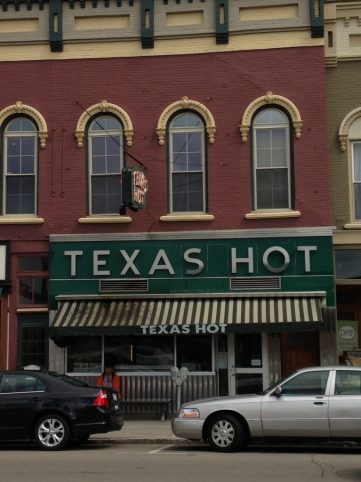
Even a billboard for a restaurant called Texas Hot, which has been serving up chili dogs to Wellsvillians since 1921, looked as if it had been standing along that stretch of road for decades. I knew as soon as I passed it that I’d be eating dinner there that night on the off chance that Ron might have eaten there too.
Texas Hot is named for a type of hot dog topped with mustard, chili sauce, and chopped onions, all on a soft, steamed bun. They are, culinarily speaking, ridiculously delicious. The iconic restaurant has been owned and operated all these years by the same two families, and is now run by the grandsons of the longtime partners and Greek immigrants who got it all started, James Rigas and George Raptis. If you’re anywhere near Wellsville, you have to go. (No, seriously, promise me.)
After finishing off the specialty of the house, accompanied by french fries and gravy, I roamed the town and was soon drawn to the old train station located one block north of Main Street on the corner of Pearl and Depot Streets. The red brick building, once bustling with visitors and the people who welcomed them or bid them goodbye, was boarded up and rimmed with weeds. Located in the center of town, it ostensibly had been a pipeline that helped power Wellsville’s prosperity in the early part of the 20th century.
Wellsville Erie Depot in September 2014.
Most noticeably, the train station was steps away from one of the four hotels that, with the help of a 1953 phone directory, I’d narrowed down as being H.H.’s and Ron’s most likely meeting spots. That was the Hotel Brunswick, at the corner of North Main and Pearl Streets, which now houses a real estate office among other businesses. The other three possible hotels, all of which are no longer standing, were the Fassett Hotel, which was a short walk southeastward on Main Street (55 North Main), Pickup’s Hotel (38-40 North Main), and, a little less than a mile to the north, the Wellsville Hotel (470 North Main), where the Lutheran church now stands.
The building formerly known as the Hotel Brunswick, September 2014.
The proximity of the train station to the Hotel Brunswick led me to wonder: Could Ron have been journeying by train and stopped off at Wellsville for a quick bite or to spend the night? Before that little epiphany, I’d been operating under the assumption that Ron was temporarily living in Wellsville—that perhaps he and his associates were being prepped for some clandestine purpose in a nearby government facility. But if Ron was traveling by train to parts unknown, then the odds of Ron and Hi Stephenson bumping into one another were even more astronomical than I’d originally thought.
The next morning, I paid a visit to the office of Craig Braack, Allegany County’s historian, whose building was located one town over in Belmont, the county seat. Braack, who has since retired, seemed genuinely intrigued by the Ron Tammen mystery, and he ventured a guess that the hotel in which the sighting occurred was probably the Fassett or Brunswick, which had been my top two choices at that point as well. In addition to occupying space among the businesses that lined Main Street, both hotels seemed upscale enough that they would offer the type of restaurant that might suit the tastes of a woman in her mid-thirties—Hi’s wife Kay. Then again, the restaurant couldn’t be too fancy, or it might have discouraged a group of young men from eating there, at least one of whom was on the lam and possibly didn’t have a lot of cash on him.
Braack wasn’t aware of any government training facility, covert or overt, in Wellsville. He was more inclined to believe that Ron was just passing through town, by road or by rail. He informed me that before the Interstate system, Main Street was part of State Route 17, a major east-west thoroughfare at the time. (State Route 17 has since been replaced by 417, which circumvents Main Street.)
“Route 17 goes parallel to our New York-Pennsylvania state line, so it’s possible that they could have been on that,” he suggested.
“Sounds reasonable,” I replied, “as long as they had access to a car.”
I explained that Ron had left his car parked outside of his dorm the night he disappeared, though there was also a chance that he could have been riding in someone else’s vehicle. The other option would have been the train. Braack pointed out that Wellsville’s train station was a major stop along the Erie Railroad, which, like Route 17, ran east and west. Each day, three or four passenger trains would arrive in Wellsville, connecting Chicago to New York City and places in between.
“If they were taking the train, that would have been a way to easily travel a long distance in a very short period,” he said. “That could also be why he was at the hotel.”
Later that afternoon, I stopped by Wellsville’s Nathanial Dyke museum. I was greeted by Mary Rhodes, who was town historian when I met with her, but who recently moved to South Carolina, and Jane Pinney, then-president of the Thelma Rogers Genealogical and Historical Society. (A September 18, 2018, article in the Wellsville Daily Reporter describes Rhodes’ and Pinney’s commitment to preserving the history of the area and their many contributions.) They agreed with Braack that the Erie Railroad and State Route 17 were the two most likely means by which Ron might have rolled into town, since that’s how most people did it back then. Pinney recounted how neighborhood kids peddling lemonade on Main Street would play the license plate game, making a list of the states that were represented as cars either barreled by or pulled over to make a purchase.
“They had every state in the union by the end of the summer,” she said.
But there were plenty of reasons for people to stay in Wellsville as opposed to just passing through. There were jobs there—lots of them. In the late 1800s, oil was discovered in the region, and a refinery was built, which, in 1953, was owned and operated by Sinclair Oil. The refinery was shut down in 1958 after a fire, but the remnants of oil money are still evident by the string of mansions, oozing with opulence, along the roadside north of town.
“OK. Now the name Wellsville makes sense,” I said. As if by reflex, both women jumped in to correct me, something they’d no-doubt done with out-of-towners many times before. Wellsville wasn’t named for its oil wells, but rather for Gardiner Wells, who was the principal landowner when residents were deciding upon the important matter of what to call themselves.
Other major industries in 1953 were the Air Preheater Company, which produced equipment for improving the efficiency of electrical power plants, and the Worthington Corporation, which produced steam turbines, also used in energy production. According to Pinney and Rhodes, the companies were frequent recipients of federal contracts, especially during WWII, and it wasn’t uncommon for hotels to be filled with clients who wished to tour the facilities, to inspect the product, or to be trained in operations. Pinney recalls driving to her job at 7:00 a.m. each day and seeing 20 or 30 executives who were visiting from China performing their exercises on the sidewalk in front of the Fassett Hotel.
In other words, at the time that Ron was potentially spotted by Hi Stephenson, Wellsville was by no means just a tranquil little town along the Genesee River. It was a player, both nationally and internationally.
“The place was booming,” said Rhodes.
Even so, I couldn’t see Ron throwing his old life away to reinvent himself in Wellsville, NY. I mean no disrespect to the good people of Wellsville. It’s just that I don’t understand why there would be any urgency for a young man to run away, cutting off all ties to friends and family to pursue a career in the power industry. I asked if they had any idea which hotel Ron might have been more likely to eat or spend the night in—if, again, it was Ron. Mary said that she thought that the Brunswick was being used as a residence hotel by then, so the sighting probably wouldn’t have been there. Jane’s husband Dave, who’d grown up in Wellsville and who’d joined our conversation by that time, agreed, and added that he didn’t think the Brunswick had a dining room then. The three decided that the Fassett was a more likely candidate. Or Pickup’s. Or the Hotel Wellsville.
Months after my visit, in an email, Mary let me know that she had followed up with one of the town’s residents, who said that the Hotel Brunswick only had a coffee shop and a bar. “Not a real dinner place,” she told me.I decided to eliminate it from consideration, narrowing the options to three.
In Joe Cella’s 1976 news article, Hi had remarked that “he and his wife walked out of the hotel onto the street” when he told Kay about his possible Ron sighting, which is consistent with the locations of the Brunswick, Fassett, and Pickup’s hotels. The Hotel Wellsville, however, was set farther back from the main road, on landscaped grounds. I eliminated it from consideration as well. I was now down to two possibilities: Pickup’s Hotel and the Fassett Hotel.
Pickup’s might seem a little weird for the name of a hotel, but it was named for the family who bought the building in 1936. Constructed in 1852, it was the oldest building in the Main Street business district, though the owners had modernized it. The building had a big sign that said “RESTAURANT” out front that would have been a draw for travelers. An article describing a 1961 fire that “ravaged” the hotel noted that very little of the building was devoted to hotel space and the “principal business activity…centered around its restaurant on the ground floor.” For these reasons—the prominence of the restaurant, and its nice-but-not-too-nice modern touches—Pickup’s was becoming more appealing to me as the backdrop of Hi’s potential Tammen sighting. Plus, it would have likely been the first restaurant Hi would have seen driving into town.
But the Fassett Hotel had its pluses too. Built in 1870, it was a stately brick building whose ground floor had been updated in the 1940s with eye-catching window treatments. It, too, was a popular place for dining—it advertised a “Dining Room” on the sign facing Main Street—in addition to hosting other events.
“You don’t happen to know where I could get my hands on some old hotel registries, do you?” I asked the trio as I was getting up to leave. At once, I felt silly for suggesting that anyone would hold onto 60-year-old hotel registries—even there, in a museum, among people who were fanatical about preserving their town’s history.
Mary said that the former owner of the Fassett Hotel still lived in town and she promised to ask him for me. I thanked her, but I knew the chances were next to nil he would have stored them away somewhere. Unfortunately, I was right.
And that’s where I’m afraid we’ve hit a dead end. My best guess for where Hi Stephenson saw Ronald Tammen or Tammen’s lookalike is at Pickup’s Hotel or the Fassett Hotel, with my personal choice being Pickup’s.
Either it was a run-of-the-mill doppelganger sighting, nothing more, or it was a coincidence beyond all coincidences—an encounter whose odds of occurring are so remarkably small that it appears that something or someone bigger than all of us may have stepped in to make it happen. Call it fate. Call it the universe. Call it a supreme being overriding free will and moving a couple human chess pieces himself. I can think of no other explanation for why two people so close to the Tammen mystery—one being Tammen himself—would land 480 miles away from Oxford in the tiny town of Wellsville, on the same day, at the same hour, and in the same hotel restaurant. But that’s exactly what Hi Stephenson believed had happened.
And Carl Knox? Regardless of whether it was Ronald Tammen or not, the only reasonable explanation for his inaction is that his investigation into Tammen’s disappearance had taken a back seat to his other university responsibilities sometime between June 29, 1953, when newspapers reported Clara Spivey’s possible Ron sighting, and August 6, when Hi Stephenson reported his. Did someone of a higher ranking step in during that period to call off the search? That’s my best guess too.
Clara Josephine Spivey lived with her husband, Carl, in a two-story home on North Main Street in Seven Mile, Ohio. Carl, who was once the mayor of that small town, was an electrician by trade and Clara’s second husband. Her first husband had been tragically killed when, in 1918, a mere five months into their marriage, the delivery truck he was driving collided with a train in nearby Hamilton. Clara married Carl two years later.
By the spring of 1953, Clara was 54 years of age with two grown children. Son Jearl was 32 years old and married. The best I can tell, he was also an electrician living about 20 miles from his parents, in Lebanon, Ohio. Daughter Barbara was 28 and married to a man named Donald Ries. (They would divorce in 1963.) From what I can tell, the couple was also living in Seven Mile.
Late on Sunday, April 19, 1953, reportedly at about midnight, there was a knock on the Spiveys’ front door. Clara was apparently still up at that hour, along with Barbara and at least one other person whom we’ll discuss a little later in this post. Perhaps Clara was emboldened by the presence of the other night owls sitting up with her—safety in numbers, and all that. Or maybe it was just the innocence of the times. Whatever her reason, she went ahead and opened the door.
Thankfully, there was nothing to fear. Standing on her porch was a well-mannered young man with a smudge on his cheek—probably from fixing a flat tire, she presumed—and an embarrassed look on his face. The jacket he had on didn’t seem at all sufficient for the chilly temperatures, in her viewpoint, and he wasn’t wearing a hat either. He had dark, deep-set eyes and close-cropped hair—his most distinguishing characteristics in her mind’s eye. He asked for nothing except some direction.
“What town am I in?” the youth had asked her, according to the earliest news accounts. And then: “Where will I be if I go in that direction?”, pointing northeastward, toward Middletown.
Clara recalled telling the youth that he could catch the bus to Middletown, which just so happened to stop at the nearby corner at that time of night. It wasn’t until the next day that she realized the information she’d given him was in error. The bus schedule for the Oxford Coach Lines had been changed that very day, April 19, and the last run from Oxford to Middletown, which passed through Seven Mile, had been suspended.
Other than perhaps a twinge of regret for having led her visitor astray, Clara didn’t think much about the incident afterward. Then, that June, she learned about Ronald Tammen. She’d somehow missed all the ballyhoo about Tammen when he’d first disappeared, and only became aware of the story by way of a follow-up news article that, in essence, reported that A) he’d been gone for two months, and B) there were no new leads. The article, which featured a large photo of Tammen, appeared in the June 20 issue of the Hamilton Journal-News, Clara’s most likely preferred news source. The same article also appeared in the June 22 issue of the Cincinnati Enquirer. Sometime after seeing the article, she notified the Oxford police, and by June 29, her story was being reported across the Miami Valley as the first real clue in the case. Clara Spivey was convinced that the young man at her doorstep had been Tammen. That photo, which had immediately whisked her back to the night in question, served as proof.
The photo of Tammen that appeared in the June 20, 1953, Hamilton Journal-News and the June 22, 1953, Cincinnati Enquirer.
Oscar Decker, Oxford’s police chief, welcomed the potential sighting with a great big bear hug. If it happened to be Ron Tammen, he reasoned, that would bolster the amnesia theory very nicely.
“Tammen disappeared about 8:30 or 9 o’clock from his room in Fisher Hall,” Decker was quoted as saying in one of the June 29th articles. (Based on the font and layout, I think it was the Cincinnati Enquirer, though my clipping doesn’t contain a reference.) “If he wandered away, it would have taken him about three hours to walk to Seven Mile.”
Sure, it was cold, it was hilly, it was late, but it was totally doable in his opinion.
Also convincing to Decker was Clara’s description of what Tammen was wearing that night. The June 29th Hamilton Journal-News article said this: “Mrs. Spivey described the youth’s wearing apparel almost perfectly, according to the chief.” Also, the September 18, 1953, issue of the Miami Student said: “Although she could not see under the dim porch light what the man was wearing, Mrs. Spivey declared that he seemed to have on a light-weight coat with a checked pattern and dark trousers.” Investigators had described Tammen as wearing a blue and tan checked or plaid wool jacket (sometimes referred to as a mackinaw) and blue pants when he disappeared.
An article in the July 3, 1953, Hamilton Journal-News stated that Henry Ciesicki, who was identified as president of the Delta Tau Delta fraternity, had interviewed Mrs. Spivey and found that she was indeed positive that the young man she saw was Tammen after looking at photographs of him. However, the article continued, “There were certain discrepancies as to the type of clothing the missing student was wearing and that of the man whom Mrs. Spivey saw, Ciesicki said.” The discrepancies were brought up again in an article by Joe Cella in the April 22, 1954, issue of the Hamilton Journal-News: “[Tammen’s] brother, Richard, maintains that there are some discrepancies in Mrs. Spivey’s story. The type of clothing worn and missing has come up for considerable discussion throughout the investigation.”
Was the visitor on Mrs. Spivey’s porch Ronald Tammen? Before placing your vote, here are some additional points to consider:
The route
If it was Ron who showed up on Mrs. Spivey’s doorstep, he would have most likely traveled State Route 73 East to 127 South, which leads directly into Seven Mile. The terrain is hilly, and it seems as if it would require some fairly purposeful trekking as opposed to the wanderings of someone with amnesia. Moreover, if Ron had been on foot, he would have passed by numerous homes along Main Street on his way to Mrs. Spivey’s. An atlas from 1930, which shows the number of properties that existed in northern Seven Mile at that time and, presumably, a corresponding number of houses, can be viewed below. (Mrs. Spivey’s property is along Hamilton & Eaton Road, aka Main Street, near High Street.)
For a closer view, click on image.
An atlas of the northern part of Seven Mile from 1958 is here.
But don’t just take the Butler Co. cartographers’ word for it. Follow the route for yourself in this video, and try to picture a totally out-of-it Ronald Tammen walking these roads on a chilly, snowy night in unsuitable outerwear. Are you as convinced as Oscar Decker that it was Ron? (Uncopyrighted traveling music provided by the YouTube Audio Library. Apologies in advance for my knack for driving over every possible bump in the road.)
The time of the encounter
As discussed earlier, the first time anyone had heard about the potential Spivey sighting was on Monday, June 29, 1953, when at least two news articles were published. The article that I believe was in the Cincinnati Enquirer reported that the visitor had arrived on Mrs. Spivey’s doorstep at “about midnight,” while the Hamilton Journal-News reported that the time of night was “about 11 o’clock.” The time discrepancy is intriguing, because the author of both articles was Gilson Wright, a Miami journalism professor who was also an on-call correspondent for a number of area papers. (I’m certain that Wright wrote both articles because, even though there isn’t a byline for either article, the Journal-News identifies Wright as the correspondent for its Oxford section on that date, and the two articles, though not identical, have the same phrasing throughout.) That the same reporter would publish conflicting times for the encounter on the same news day is kind of, um, bizarre, considering the significance of the hour to the overall timeline. “About midnight” was the most frequently reported time over the years, including later issues of the Journal-News, which is why I repeated it in the third paragraph of this post. Also, Oscar Decker is quoted directly in the September 18, 1953, article of the Miami Student, saying that the time was “about midnight.” On the other hand, the 11 p.m. time was attributed to Mrs. Spivey (who, after all, would have been the best source), though not as a direct quote. “Mrs. Spivey said the youth came to her door about 11 o’clock…,” Wright stated in that article.
If the June 29th Hamilton Journal-News version is closer to the truth, Ron wouldn’t have had the full three hours that Oscar Decker estimated a walk to Seven Mile would have required. According to this September 2018 fitness article and the Centers for Disease Control and Prevention, a brisk walking pace is considered to be 3 miles per hour or 20 minutes per mile. If the time was midnight, Tammen would have had 180 minutes to walk approximately 11 miles, or a little over 16 minutes per mile. That would have been a pretty good clip, but still doable. But if the time was 11 p.m.? Ron would have needed to be in a full-on run. The latter scenario wouldn’t exactly fit the storyline that everyone was selling, would it? What’s more, if Ron had been at the Delta Tau Delta song practice until around 10:30 p.m., as has been claimed by at least one person, there was no way Ron could have made it to Seven Mile by either 11 p.m. ormidnight if he was walking.
But what if Ron Tammen had actually been driven to Seven Mile? If a car was involved, there are a few possible scenarios to consider:
He hitchhiked.
Ron was known to hitchhike from place to place, especially when he didn’t have a car on campus. Granted, it would have been odd for him to choose to hitchhike out of Oxford as opposed to driving his own car. However, if, for some reason, he did so and someone picked him up somewhere between Fisher Hall and Seven Mile, chances are that person would have reported it when the media began publicizing his disappearance. If Oscar Decker had received such a call, you better believe that he would have announced it to the press. From what I can tell, there were no phone calls from anyone who either picked up a hitchhiker or who spotted someone walking alongside that stretch of road on April 19, 1953. One caller did think he’d spotted Tammen in Middletown the week after the Spivey article was published, though that obviously didn’t check out.
He was “kidnapped” and left in Seven Mile as a prank.
As we’ve discussed elsewhere on this site, fraternities back then used to kidnap pledges and drop them off in the middle of nowhere so they would have to find their way home. Many people, including yours truly at one point, have wondered if that might have been what happened to Ron—the whole fraternity-prank-gone-awry theory. But several factors have led me to rule this theory out. First, the men in Ron’s fraternity are wonderful people and they don’t act all weird when I ask them about Ron Tammen. They really would love to know what happened to him. Second, Ron wasn’t a pledge. He was an active member of Delta Tau Delta, which means that he wouldn’t have been a target for such antics. Third, he didn’t live in the fraternity house, which, according to one of his fraternity brothers, was home base from which a guy would have been kidnapped ifhe were being kidnapped.
Fourth (and perhaps foremost), instead of asking Mrs. Spivey for directions, wouldn’t Ron’s more obvious first question be “Can I use your phone?” According to Carl Knox’s notes, the door to his dorm room was left open and his car keys were in his desk. He could have asked someone from Fisher Hall to pick him up. His roommate, Chuck Findlay, would have been back by then. Also, the questions the visitor asked didn’t pertain to finding his way back to Oxford. In April 1954, Mrs. Spivey would embellish her conversation with the young man to include her pointing the way to Hamilton, Middletown, and Oxford. But that wasn’t the case in June 1953. As described above, the youth asked her what town he was in and where he would be if he went in “that direction,” which was toward Middletown. She’d told him how to catch the bus to Middletown, the crucial detail that enabled her to date stamp the night he’d appeared at her door, since the bus route had ended on April 19. Based on her earliest recollection and, in my view, the one that would have probably been most accurate, there was no mention of Oxford.
Someone who knew him drove him there.
Perhaps someone else could have driven Ron to Seven Mile—someone like the mysterious woman from Hamilton, for example. If that’s true, why he would have gotten out of the car at Mrs. Spivey’s residence isn’t clear, unless, perhaps, he’d tried to escape as the car had slowed down on Main Street. But if he did escape, why (again) wouldn’t he have asked Mrs. Spivey if he could use her telephone to call for help? And where did he go after he left Mrs. Spivey’s? Perhaps someone overpowered him and pushed him back in the car. Still, the young man’s questions for Mrs. Spivey don’t exactly jive with those that might have been asked by someone who was being taken somewhere against his will. At least, they aren’t the sorts of questions that someone would have asked had he been thinking clearly.
The other people in the room
In Joe Cella’s 1976 article in the Hamilton Journal-News, we learned that Clara’s daughter Barbara, whose last name was now Jewell after a second marriage, was also present when the visitor showed up at the door. Though Clara had died in 1975, Barbara stood by her mother’s story. Here’s what Cella wrote:
“Mrs. Spivey has since died but her daughter, Mrs. Barbara Jewell of Seven Mile, remembers the night well. She was there when the knock was answered.
‘I still believe it was him,’ said Mrs. Jewell. When her mother viewed a photograph of Tammen at the time, she said, ‘That’s him. I know I’m not mistaken.’”
Barbara Jewell passed away in 1999. However, in 2012, Frank Smith, Butler County’s former cold case detective, informed me of someone else who was present when the visitor showed up at the door. Smith had stopped by a United Dairy Farmers store for a cup of coffee around the time that the Butler County Sheriff’s Office was getting a lot of local press for their work regarding the dead body in Georgia. According to Smith, a guy came out of the store and said he’d been reading in the paper about the Tammen case.
Recounted Smith, “He said, ‘I was there that night when the door was opened too.’”
Smith then added, “And he told me, he said that he absolutely was confident that that was not Tammen that knocked on the door that night. He thought it was one of the local ruffians that lived down the road. But he was absolutely confident.”
According to Smith, the man who approached him—as he recalled, it was Mrs. Spivey’s son—had been in the military and was battling cancer. He also said that he’d passed away shortly after they talked. I accepted this information at face value and didn’t delve further, which turned out to be a mistake. Memories, as I’ve come to learn time and again, aren’t 100 percent foolproof. If I’d done my fact checking a little sooner, I might have been able to speak with the man myself.
Several years ago, as I was doing some online research, I discovered that the man who’d approached Frank Smith couldn’t have been Clara Spivey’s son. Jearl Spivey had died in 1980, long before Smith had gotten involved in the case. Donald Ries, who, along with Carl Spivey, had passed away in the 1970s, could also be ruled out. However, another possible candidate did pop up—Paul Jewell, Barbara’s second husband. Jewell died in 2014, two years after my conversation with Smith. According to his obituary, Jewell had worked at the Champion Paper Company and, later, The Workingman’s Store, a beloved clothing and shoe store for everyday working people that his parents had opened in Hamilton and where he eventually became owner. The obit also said that he’d served in the U.S. Army from 1958 to 1960, and suggested that memorials be given to the American Cancer Society, among other charities. My guess is that Paul Jewell was the man who approached Frank Smith.
There is one puzzling aspect to placing Jewell in Mrs. Spivey’s home late at night on April 19, 1953. Paul Jewell was 13 years younger than Barbara, born in September 1937. In April 1953, Barbara was still married to Donald Ries, whereas Paul would have been 15 years of age and a sophomore at McGuffey High School in Oxford. (He graduated in 1955.) From what I can tell from old city directories, Paul and Barbara were married in the mid-1960s. So one question I have is, if it was Jewell, why would he have been at the Spiveys so late on a Sunday night when the next day was a school day for him? Another big question I have is: again, if it was Paul Jewell who spoke with Frank Smith, did he and Barbara actually see the visitor or did they just hear Clara’s account, like the rest of us, and form their own opinions? Unfortunately, I’m not sure we’ll ever know the answer.
So what do you think? Was it Ronald Tammen at Mrs. Spivey’s door or merely one of Seven Mile’s local ruffians? Feel free to register your vote here:
(Please note that Crowdsignal/Polldaddy is a third-party site that uses cookies. Also, sharing on Facebook and Twitter uses cookies.)
And now, for all you readers in the U.S., please be sure to vote for real if you haven’t already. It’s our right, our privilege, and our obligation and probably way more important than anything else we may have on our plates these days.
***************
Let’s also open up the floor. Feel free to weigh in on anything Tammen-related, especially your thoughts on Mrs. Spivey’s story and why you voted one way or the other in our poll.
By now, I think you should have a pretty good indication of how (in my opinion) the city of Oxford, Ohio, and Miami University conducted their investigations into Tammen’s disappearance. I’ll say it here plainly, just so there’s no confusion: They did a really bad job.
Time and again, investigators would lament in the news about what few clues they had to go on after Tammen disappeared. Sure, they’d received some early tips about several area hitchhikers and an apartment dweller in Cincinnati, but none of those panned out. Then, Clara Spivey came forward with her alleged late-night Ron sighting in Seven Mile, and they finally felt as if they had a true lead. (In response to one reader’s request, we’ll be discussing Mrs. Spivey’s story in more detail in another post that I’m planning for Tuesday, November 6. You’ll have a chance to vote on whether you believe the person who appeared at her door was Ron or not.**)
After Mrs. Spivey’s call in late June 1953, investigators hit another dry spell clue-wise, which supposedly lasted 20 long years. In 1973, the drought ended, at least for the interested public, when reporter Joe Cella revealed that Ronald Tammen had visited Dr. Garret Boone’s office five months before he disappeared to have his blood type tested. We also learned that university officials had already known about the doctor’s visit shortly after Tammen went missing. They just didn’t view it as a clue.
So, Mrs. Spivey’s story? Definite clue.
Dr. Boone’s? Not so much.
When it came to determining whether something was a potential clue or not, these guys were (again, my opinion) clueless.
We’ve already covered some additional details about Tammen’s disappearance that I would categorize as clues. Some of the most significant ones include:
Song practiceRon is alleged to have been to song practice at the Delt house the night he disappeared and had walked back to the dorms with two other guys at around 10:30 p.m. If true, Ron disappeared more than two hours later than what was widely reported.
The fightRon allegedly had a fight with his younger brother Richard in the third-floor bathroom of Fisher Hall the night he disappeared.
The woman from HamiltonRon was supposedly seen seated in a car with a woman from Hamilton for a long time and then driving away with her late that night.
The psych bookRon had been reported reading his psychology book the afternoon that he disappeared, and his psychology book was left open on his desk, even though he’d dropped his psychology course earlier that semester.
The things in Ron’s backgroundRon Tammen might have had “things in his background” that were consistent with his having experienced dissociation (amnesia).
The dead fish Ron likely hadn’t slept in his bed at least one night, and possibly two, before his disappearance. We know this because Dick Titus had put the fish in Ron’s bed after class on Saturday or perhaps even Friday.
All of the above (and probably more) were known by university officials and Oxford police. If they viewed these details as clues, they chose not to make them public. But from what I can tell, they didn’t do much more than the most perfunctory of probes either. In particular, they could have pursued the rumor about the woman from Hamilton more enthusiastically, enlisting the news media for help. The Journal-News could have run the headline “Tammen allegedly last seen in car with woman from Hamilton,” and the accompanying article could have closed with “Anyone with information is asked to call this number.” But, nah.
And, let’s not forget Heber Hiram (H.H.) Stephenson, the housing official who swore up and down that he’d seen Tammen sitting in a hotel restaurant with a small group of men in Wellsville, NY, on Wednesday, August 5, 1953. Stephenson had shared this information with university officials immediately upon his return—the next day, he said—and we see the cryptic “H.H.S., Aug. 5, 1953, Wellsville, New York” in Knox’s notes to confirm that a conversation had indeed taken place. Again, if it hadn’t been for Joe Cella revealing the detail in 1976, we probably wouldn’t be talking about it now.
So I have to ask: If the potential sighting by Mrs. Spivey was such a promising clue back on June 29, 1953, when it was first reported in the news, why wouldn’t H.H. Stephenson’s potential sighting have been considered just as promising when he reported it on August 6, about five weeks later? Hi Stephenson knew Ron. Clara Spivey didn’t.
And I have to follow with this question: Did university officials even think to alert the FBI about Stephenson’s story? On May 26, 1953, the FBI had a missing person file on Tammen, and roughly one week earlier, Carl Knox had informed Tammen’s parents that the FBI had been attending faculty conferences. Also, by July 27, 1953, Ron was listed as delinquent for his draft board physical, and therefore, in violation of the Selective Service Act. Carl Knox should have called them—immediately—and reported that an acquaintance of Ronald Tammen’s was quite sure he’d spotted him at a hotel restaurant in Wellsville, NY, the previous day. The FBI could have summoned their Buffalo office to check things out, and the Buffalo agents, in turn, could have shown the proprietor Ron’s picture and asked if anyone had seen him. They could have checked the hotel’s registry for the names of the young men. They could have asked if anyone had spoken with them, and if so, why were they there? Where were they going? Heck, if Knox had told them soon enough, the FBI could have possibly even dusted the lookalike’s chair for fingerprints, or, if he’d stayed overnight, the furniture in his room. But judging from the Stephenson quote in Joe Cella’s article, he was never approached again. Here’s what he told Cella: “I was under the impression all these years that my story was generally known by everyone, since Dr. Knox knew about it and was handling the investigation for the university. I am amazed to hear that this information was not known until now.” There’s nothing in the FBI files to indicate such a report was called in either.
So, again, Mrs. Spivey? Clue!
H.H. Stephenson? Better luck next time!
Which brings us to the spring of 1955, two years after Ronald Tammen’s disappearance, when Miami University received yet another potential clue in the Tammen case. Again, by all indications, officials promptly chose to sweep it under the rug.
The clue came in the form of a letter dated May 10, 1955, and addressed to: “Dean of Miami University, Oxford, Ohio.” As vaguely worded as that was, it must have found its way to Carl Knox, who was still dean of men at that time, and several copies can be found in the Tammen materials at University Archives. The letter was signed by Major Delmar Jones, director of the Georgia Bureau of Investigation (GBI). Major Jones told of a dead body that had been found near LaFayette, Georgia, on June 24, 1953. The GBI, having received a news clipping about Tammen, was wondering if the body might have been Ron’s.
Here’s what the letter said:
Dear Sir:
A newspaper clipping was turned over to this Bureau several days ago by Mr. Hill Pope, the coroner of Walker County, Georgia. We do not know from whom this clipping came but it has reference to a young man by the name of RONALD TAMMEN, a nineteen year old sophomore who disappeared from your institution approximately two years ago.
Someone had evidently secured knowledge whereby we were trying to identify a badly decomposed body that was found on the outskirts of LaFayette, Georgia, on June 24, 1953.
This investigation is still pending, and we are still endeavoring to ascertain the identification of this body.
It will be appreciated very much if you will give us the full details and complete description of Ronald Tammen so that we may compare them with the identification of the unidentified body.
Your response to this communication will be appreciated very much and we will do everything in our power to assist in locating the subject Ronald Tammen if he should be in our territory.
Delmar Jones was Georgia’s number one law enforcement official from 1948 to 1962, and not someone to be taken lightly. (In 1962, he was demoted to trooper by the governor for campaigning for the former governor in a primary election, which, I suppose, was a risk he’d been willing to take.) Granted, H.H. Stephenson and Garret Boone weren’t slouches either. But you’d have to think that a letter from Georgia’s version of J. Edgar Hoover would have elicited some sort of response from the university.
I have no idea if Carl Knox or anyone else got back to Major Jones. In Miami’s archives, there are no carbon copies of letters mailed in reply. Perhaps Dean Knox placed a phone call to Major Jones, suggesting that the GBI contact the FBI, although no surviving FOIA documents indicate that contact had been made. (As a side note, Ron’s Selective Service case with the FBI was closed on April 29, 1955, 11 days before the GBI letter was written.) Or maybe officials called Major Jones and provided a full accounting of the case over the phone, but the GBI ruled Ron out for some reason and didn’t follow up with anyone. By all accounts, no one seemed to mention the letter to Joe Cella, Gil Wright, or Murray Seeger, since there are no news reports about a dead body in Georgia being possibly tied to Tammen’s case. I don’t even think the university bothered to tell the Oxford police. When I asked my friend Ralph (not his real name), the former cop who was still with the Oxford PD that year and several years after, he was surprised—stunned, actually—to hear about the letter.
So, once more: Confused guy on Mrs. Spivey’s doorstep on the night Tammen disappeared?
👍👍👍
Dead body found in ditch 400 miles south of Oxford two months later?
👎
Here’s what we can safely assume: no one went to the lengths that officials went to in late 2007 and early 2008 when, on their own, without even initially knowing about Delmar Jones’ letter, the Walker County, Georgia’s, Sheriff’s Office hypothesized that the two cold cases might be related.
It happened like this:
Mike Freeman, the cold case detective for Walker County, was conducting an end-of-the-year review of unsolved cases in his portfolio when his boss, Sheriff Steve Wilson, posed a question to him.
“What about that dead body found in a ravine back in 1953?” Wilson asked him (or something along those lines). Wilson wasn’t around when the dead body was discovered—he was born several years later—but his dad used to tell him about it, and he can point out the location to anyone who asks. To this day, people in the area refer to the site as Dead Man’s Hollow.
Walker County Sheriff Steve Wilson stands next to the site where the dead body was found in 1953.
Freeman didn’t know anything about the case, but the story intrigued him. The department no longer had a file, so, for starters, he headed to the local library (which, conveniently, is just a few buildings away from the sheriff’s department) and found news articles that ran at the time the body was found. Based on information found in the articles, he learned that an autopsy was conducted by the state medical examiner’s office, which, thankfully, he was able to obtain. [Read the full autopsy report here.]
The details, provided in news accounts and the autopsy, aren’t pretty. The body was found in a highly decomposed state in a wooded ravine off Rogers Road, five miles south of LaFayette, on June 24, 1953. According to Dr. Herman Jones, director of the GBI crime lab (and probably no relation to Delmar, but who really knows?), it was “heavily infested from head to foot with maggots and other worms,” a sure sign that the man had been dead for a while. What was left of his face (which, by that point, was devoid of soft tissue and therefore any recognizable features) was angled upward, toward the sky, and his arms and legs were fully extended, kind of like da Vinci’s Vitruvian Man.
Some features were still discernible. His hair was dark brown to black, his height was 5’9,” and, when he was alive, and still had all of his internal organs and tissues in place, his weight would have been around 150 pounds. He had long arms and long slender fingers from which extended nails that were also long and “apparently well kept,” according to Dr. Jones, who’d conducted the autopsy on the same day the body was found. The decedent’s teeth weren’t as well cared for as his nails. Two lower back molars had large cavities in them and several teeth had been extracted. “No dental work done,” Dr. Jones reported, which could be interpreted to mean that he didn’t have any fillings or crowns. There was no evidence that any of the bones in his body had been broken, either recently or in the past. He was estimated to be between 25 and 30 years of age.
The man was wearing only a white T-shirt, size 38, with four round holes in it, and boxer shorts, size 32, the kind with buttons up the fly and a drawstring around the waist. Two khaki-colored wool socks lay at his feet. One sock lay near where his left foot should have been—it was missing, as were the toes on his right foot—and the other sock lay between his straddled legs. (Dr. Jones blamed an animal for the missing foot.) The shorts and socks were military-issue—U.S. Army. A quarter-inch-wide rubber band encircled each ankle, most likely to blouse the bottom of each pant leg, a common practice of G.I.s so that the full boot shows underneath. As for the man’s boots and pants, they were nowhere to be found, but, based on the items that had been left behind, it was clear that he was probably a soldier. What wasn’t clear was how the man died, though officials presumed it was a homicide. According to the sheriff at that time, the holes in his T-shirt were about the size of .38-caliber bullets, however Dr. Jones found no broken bones or skull damage and no evidence of foreign bodies.
The GBI also conducted an investigation (hence Delmar Jones’ letter), and they exhumed the body a second time after the autopsy for additional analysis, including obtaining fingerprints. The Army conducted an investigation as well. Unfortunately, neither have been able to produce records on the case.
Freeman went on the internet—something they obviously didn’t have in 1953—and searched for missing persons from that year. He immediately discovered the treasure trove of websites discussing the Tammen case (except, alas, for this one, which obviously came later). Freeman noted that both LaFayette and Oxford were on U.S. Route 27, and, in fact, the dead soldier was discovered only about 200 yards away from the highway. If Ron had been hitchhiking to Florida, he thought, it was the best possible route to take, since there was no interstate system back then. Ron’s height, weight, and hair color seemed to be in the ballpark too, and his age wasn’t too far off. Ron wasn’t in the Army, but who’s to say that he didn’t enlist after he left Miami? It was worth a shot.
Freeman contacted Frank Smith, Butler County’s cold case detective at that time, and the two decided to make use of another new technology—DNA testing—to determine if the dead man was Tammen. On February 8, 2008, Freeman, Wilson, and Smith, along with Georgia’s chief medical examiner, GBI’s forensic anthropologist, Walker County’s coroner, members of the media, and curious onlookers witnessed the exhumation of remains buried in an unmarked grave in Lot 206 , Block A, in LaFayette Cemetery. The few bone remnants they obtained were forwarded to the FBI and other facilities for DNA testing. The results would be compared with a DNA sample that had been submitted a couple weeks prior by Tammen’s sister Marcia.
The following June, they got their answer: there was no match. The soldier wasn’t Tammen. It was a big disappointment, but cold case detectives probably get used to these sorts of let-downs. Interestingly, I arrived at the same conclusion in another, more roundabout way. In August 1958, human bones had been found in a gravel pit in Preble County, Ohio, which is about 25 miles north of Oxford. Authorities there had sent bone and teeth samples to Ohio’s Bureau of Identification and Investigation, in New London, for analysis to see if the remains might be Ron’s. (Before DNA testing, dental records were the primary method for identifying unknown victims and they’re still valuable today.)
According to an article in the August 17, 1958, Cleveland Plain Dealer, the Preble County sheriff had said that no dental work had been performed on the teeth that they’d unearthed, though, admittedly, the set was incomplete.
The article continued:
Ronald’s mother, when informed of the find, said that her son had several teeth filled.
“Also, his upper teeth lapped,” she continued, “and he had planned to have them straightened.”
“Furthermore, he had a couple of broken bones that could be identified. When he was three, he got a broken collarbone jumping off a bed. Later, playing football in the street, he broke one of the small bones in one of his hands.”
As you’ll recall, the dead soldier in Georgia appeared to have had no dental work and no evidence of having broken any bones. Plus, there was no mention of an overlap of the front teeth. Based on the fact that Ron had had several fillings plus the overlap plus a couple broken bones, it’s obvious that, even before the DNA test, the person buried in Walker County, Georgia, wasn’t Tammen. The DNA evidence sealed the deal.
Miami and Oxford officials couldn’t have stated the above so unequivocally. In fact, it almost seems as if they’d given up looking for Tammen not long after he disappeared. Did someone in a position of authority tell them to stop their investigation? I wonder.
*******
Oh, and P.S. As for the dead guy in Georgia, could it have been Richard Cox? I wonder about that sometimes too…
Let’s take a breather from the whole hypnosis/amnesia/psych book question right now. Rest assured, things are happening in that arena as we speak—things having to do with (fingers crossed) the possible declassification of key names on significant documents. But these things take time, and I need to chill for a little while and let some important people make their pivotal decisions in peace. We’ll jump right back over to that topic as soon as there’s a new development.
In the meantime, let’s talk about the fish in Ron’s bed a little more. Why? Because there’s something intriguing about that fish story that I haven’t shared with you yet.
We already know that the fish was a prank, not a message from the Mafia. We also know who put it there. It was Richard (Dick) Titus, the guy who lived down the hall from Ron in room 212. The same guy who’d been studying with Ron at around 7 p.m. on April 19, 1953. In 2010, he confessed to me that he was the culprit behind the fish prank and, in 2013, he elaborated a little more on the incident. So, what more can that fish—that cold, slimy, disgusting, long-dead fish—teach us about Ronald Tammen?
Think of it this way: in these emotionally charged and divisive times, when no one seems to agree on much of anything, I present to you one shining example of a core belief with which all of humanity can surely agree. And that time-honored value is this: no one in his or her right mind would ever knowingly sleep with a dead fish in their bed.
Keeping that singular uniting principle in mind—that people of all stripes are inherently averse to sleeping with rotting fish—isn’t it just a little bit odd that Ronald Tammen would wait to change his sheets until Sunday night, when the fish had been there since at least one day prior, and possibly two?
That’s right. During our second or perhaps third conversation, Dick Titus and I had moved beyond his surprise revelation of being the person behind the fish in Ron’s bed and conducted a deep dive into the question of when he put it there. Walking me through the incident with what seemed to be the clarity of his adolescent self, Dick told me that it happened on the way home from class. He didn’t have retaliation on his mind, he told me. In their ongoing game of prank/counterprank, Ron had most recently short-sheeted Dick’s bed, throwing in some Rice Krispies for added crunch. In this telling, Dick told me that their back-and-forth had been going on for about a month and that Dick had allowed some time to go by after Ron’s latest stunt. (This version differs from our 2010 conversation, when his timeline was a little more condensed. In that interview, he’d said that Ron had pulled the sheet trick the day before he disappeared. I allowed the slight variation and continued listening.)
It was on Dick’s walk home that he spotted the dead fish in the pond outside of Fisher Hall, and a lightbulb had gone off. “Perfect,” his 18-year-old brain told him. He managed to bring the fish ashore and then carried it upstairs (by the tail? under his arm? I forgot to ask him for those specifics, but I’m sure it was gross) and placed the fish in Ron Tammen’s bed. It could have been a Saturday, because classes were held on Saturday mornings in those days. It might have even been as early as Friday. But, in his mind, it was most definitely not on Sunday.
Here’s a paraphrased snippet from our conversation that I typed up after we spoke:
Dick: I remember I was coming back from class, so it had to be a Friday or Saturday.
Me: Did you take the fish up to Ron’s bed right away?
Dick (sounding a little perplexed): Yes…so I don’t understand why he didn’t change his bed until that Sunday. Unless he didn’t come back to his room until Sunday.
Bingo.
In 1953, they didn’t have security cameras to track everyone’s comings and goings. There were no towers registering the pings of nearby cell phones. There was no such thing as GPS. However, thanks to Dick Titus, there was a fairly foolproof tracking device in Ronald Tammen’s room the weekend that he disappeared. Because of that foul little fish, we can reasonably conclude that Ron hadn’t slept in his bed on Saturday, the 18th, and he might not have been there the preceding Friday night either.
I know what you’re thinking. Can we trust the memory of someone 60 years after an event had taken place? I’d wondered about that too. Maybe Dick Titus hadn’t spotted the fish while returning from a class. Maybe he’d been walking back to Fisher Hall after some Sunday activity—a baseball game, a fraternity function, a trip to the library—and that’s how his brain had edited the scene. We already know that his 2013 timeline was a little different from the one in 2010. Could he have gotten things scrambled?
Fortunately, Murray Seeger, a nationally renowned reporter who was employed by the Cleveland Plain Dealer in the 1950s, published an article on May 4, 1956, that supports the story Dick told in 2013. The article said this:
“At about 8 p.m., [Tammen] went downstairs and asked the house manager for clean linen. Some freshmen pranksters had put a dead fish in his bed the night before.” [emphasis added]
It wasn’t some pranksters, it was one prankster. And, according to Titus, it happened during the day, not the night. But Seeger places the fish in Ron’s bed at least on the Saturday before Ron went missing. I’d call that corroborating evidence.
A two-day-old fish in Ron’s bed also helps clear up one minor mystery I’d been grappling with for a while. Namely, if Ron wasn’t planning to go to bed early Sunday evening—if he were still planning to attend song practice, for example—what would have motivated him to change his sheets at 8 p.m.? In other words, how would he even know about the fish unless he’d turned down the covers? But after at least two days, I’d think that the fish would have made its presence known even before Ron observed the visual evidence. Put simply, I’m sure it was smelling up the room.
The fish was probably one of several topics university investigators spoke about with Dick, whose name is included in Dean Knox’s notes, though the fish isn’t mentioned. The feds were well aware of the fish. Dick described to me a time in which two men from the FBI paid a visit to Mr. and Mrs. Titus at their home in Rocky River to discuss the fish incident, scaring poor Dick to death. [View Carl Knox’s note by clicking here.]
Even though we can deduce that Tammen wasn’t in his bed that Saturday night, we still don’t know where he went. It had to have been late when he arrived, however. He was said to have been playing with the Campus Owls at the Omicron Delta Kappa carnival that evening and then reportedly at a bull session at the Delt house. His brother Richard had said that he was with Ron until between 11 and 11:30 p.m. on Saturday.
Perhaps Ron was involved with someone whom none of his friends or family knew about. Maybe he was out with a group of people, although that wasn’t exactly like him. I doubt very much that he was alone. Other than stalkers, serial killers, and the occasional cat burglar, who goes out by himself all night?**
If Ronald Tammen was with one or more people on the night of Saturday, April 18, 1953, no one appears to have come forward after he went missing. Were they too embarrassed or afraid? Were they somehow responsible for his disappearance? It’s all just a little…fishy.
***********************************
(** Note: Stargazers, late-night wayfarers, sometimes insomniacs, etc., excepted, though I don’t think these describe Ron very well either.)
Artwork developed using WordArt.com. Not for reproduction.
In May 2011, I was conversing by email with a Miami alum, let’s call him Peter, who was a psychology major at Miami when Ronald Tammen disappeared. Like many students, Peter was curious about Ron’s disappearance and read whatever stories he could find on it. Peter also had a friendly acquaintance with Dr. Patten, then-chair of Miami’s psychology department, and looked up to him as a mentor, which wasn’t unusual. Dr. Patten was highly respected in the psych department—knowledgeable, yet warm and grandfatherly.
Here’s a remembrance Peter shared with me that provides yet another reason why investigators likely thought Ronald Tammen had amnesia. I’ve copied the email directly, typos and parenthetical asides included. I have, however, inserted a missing word or two in brackets for clarity or correction.
Reason #3: There were ‘things in his background’
“Now, when Ron ‘vanished’ the university formed a committee of facility [sic] and administrators (I don’t really know who was on the committee). Patten was the chair, and there was a short article in The [Miami] Student saying the committee had met (I don’t know if it was more than once) and had concluded that Ron’s disappearance was most likely due to a dissociation (forgetting who he was, where he belonged, wandering, etc.)…
“When I saw Patten I said I’d seen the article in The Student, and that the committee felt the best explanation was the dissociation hypothesis. He commented, and I believe this is exactly what he [said], ‘Yes. There are things in his background that would be consistent with that.’ Naturally, I asked ‘Really? What kind of things?’ (or words to that effect). Unfortunately, Dr. Patten said, ‘Well, I can’t comment on that.’ (I’m sure that is exactly what he said.) So…I never heard what things in Ron’s background had been considered to be ‘consistent’ with proneness to a dissociative disorder.”
Peter’s story raised a number of questions in my mind, the first being something along the lines of: What the …?!
And then:
What could be in Ronald Tammen’s background that would be consistent with dissociation?
How would Dr. Patten (and a university committee of faculty and administrators) have known about something in Ron’s background that would lead them to such a conclusion?
What faculty panel? I don’t remember reading about a faculty panel.
Oh, and by the way: where was this Miami Student article that Peter referred to?
The first thing I tried to do was locate the article and, guys, I might as well break it to you sooner rather than later: I can’t find it. I asked Peter when it ran, and he said that he thought it was early, before the semester ended. That would make sense, because that’s when the amnesia theory came to the forefront. But, from what I can tell, there were only five articles on Ronald Tammen that appeared in the Miami Student between April 19 and the end of classes for the spring 1953 semester. Here are the titles, with links to the applicable issue:
~~~~~~~~~~~~~~~~~~~~~~~~~~~~~~~~~~~~~~~~~~~~
—Friday, April 24, 1953,Miami Sophomore Missing, page 1, near bottom
—Tuesday, April 28, 1953,Missing Youth Baffles Police; Clues Lacking, page 1, upper left
—Friday, May 1, 1953, no article
—Tuesday, May 5, 1953,Police Find No Trace of Tammen, page 1, upper right
—Friday, May 8, 1953,Must Tongues Wag?, page 2, editorial section
—Tuesday, May 12, 1953, no article
—Friday, May 15, 1953, no article
—Tuesday, May 19, 1953, no article
—Friday, May 22, 1953, no article
—Tuesday, May 26, 1953,Name of Tammen Added to Missing Persons by FBI, page 4, upper right
~~~~~~~~~~~~~~~~~~~~~~~~~~~~~~~~~~~~~~~~~~~~
It’s not as if any issues are missing. The Miami Student published every Tuesday and Friday (except for vacation days and the week that followed), and they all appear to be there, online. I also checked for possible articles on the faculty panel that might have run during the next academic year, and nothing turned up. I asked Peter if it could have been in another publication—some internal newsletter that the psych department put out or something. He said no. Still, his memory was unwavering about his conversation with Dr. Patten. We discussed the scenario several times, and the details remained consistent.
Even though the article that Peter recalls reading is nowhere to be found, we do have a few details to help corroborate his story:
Dr. Patten was an early spokesperson on the Tammen story…
As we already know from the preceding post, Dr. Patten became a spokesperson on the Tammen story fairly quickly. As early as April 28, 1953, he was quoted by Gilson Wright for his article that ran in the Dayton Daily News. If Patten had headed up a faculty panel and that information was somehow made public at Miami, that would have put him on Gilson Wright’s radar for an interview request. That’s what reporters do—they call the person who’s in charge. It makes a lot more sense for Wright to approach Dr. Patten about his views on amnesia and overstudy if he knew that Patten was leading a panel that had already declared publicly that Ronald Tammen’s disappearance was probably “due to a dissociation.”
…a spokesperson who seemed to know more than he was saying publicly.
In the communications field, there’s one response that PR flacks far and wide are forever advising subject experts not to say when speaking with a reporter. That response is “no comment.” To say “no comment” implies that you’re hiding something—that you know something that you don’t think should be made public. In his April 28, 1953, Dayton Daily News article, Wright reported this about Patten: “He refused to comment on the Tammen case except to say that it is his ‘guess’ that the Maple Heights, O., youth will be found alive.” Refused to comment. Not even a more subtle “hesitated to” or “didn’t wish to” comment. He flat-out refused.
Here’s why I think that Wright was practically quoting Patten verbatim when he wrote that sentence: it’s because of what Peter said he remembered Patten saying to him about why things in Ron’s background were consistent with dissociation. “Well, I can’t comment on that,” Patten had said, according to Peter.
Think about it. If someone asked you if you knew where Jimmy Hoffa was buried, would you say, “I can’t comment on that”? Only if you were kidding around. The more typical response would be ¯\_(ツ)_/¯. Dr. Patten’s response to the reporter hints to me that he had access to additional information about Tammen that, for some reason, he wasn’t ready, willing, or able to discuss publicly, which would be consistent with Peter’s account.
Faculty were meeting about Tammen.
Not long ago, I was revisiting some old news articles and landed on this headline from the May 18, 1953, issue of the Cleveland Plain Dealer: “FBI Joins Hunt for Miami Student.” The article, which was written principally to inform readers that Tammen had been added to the FBI’s missing persons list, includes this sentence that I’d somehow previously overlooked: “Dean Carl Knox told the boy’s parents, Mr. and Mrs. Ronald H. Tammen, Sr., that the FBI had been called into faculty conferences.”
It’s one thing for law enforcement to meet with university officials about Tammen. “Officials” generally means administrators, which, in the case of Tammen’s disappearance, usually meant Carl Knox. But if Carl Knox informed the family that there were faculty conferences about Tammen’s disappearance, that has an entirely different connotation—professors. Professors seated around a table. Professors discussing what they knew about Ronald Tammen with a representative of the FBI.
One possible theory worth mulling over is that Ronald Tammen’s psychology textbook—potentially open to a section on posthypnotic suggestion—could very well have inspired Dean Knox to convene a faculty committee to see if they could determine where Ron’s head was when he disappeared. If that’s the case, it would make sense to install the chair of the psychology department, Everett F. Patten, a noted hypnosis expert, as head of the panel. It also would have made sense to ask the three faculty members listed in Carl Knox’s notepad—Professors Dennison, Delp, and Switzer—to take part on the panel as well.
Unfortunately, we’ll never know who was participating on the faculty panel. The article Peter remembers having read no longer seems to be in the public record. Also, no notes from any faculty conferences have turned up—not in the university’s archives, and not in the FBI’s Central Records System either.
Dr. Patten indeed thought that Ron had experienced dissociation.
In an article that ran in the Miami Student on April 20, 1965, Dr. Patten was once again approached about his theories on what happened to Tammen. This time, however, he didn’t refuse to comment. Instead, the newspaper reported the following:
“Consulted at the present time, Dr. Patten added, ‘Tammen’s condition can be labeled as a fugue, which is a species of conversion hysteria, characterized by wandering and other unusual antics of which the individual is not conscious.’”
The word “fugue” is a shortened term for dissociative fugue, which involves forgetting one’s identity and wandering, as Peter described in his email. It’s a subcategory of dissociative (or functional or psychogenic) amnesia. (The term “hysteria” is generally not used to describe this condition anymore.) It’s also rare, estimated to occur in only 0.2 percent of the general population.
Perhaps Dr. Patten felt he could speak more openly by that time—a dozen years after Tammen disappeared and two months before Patten would retire. Also, four years earlier—in 1961—he’d stepped down as department chair and turned the reigns over to Dr. Switzer. Perhaps he felt freer to speak because he was speaking only for himself, and not as the whole department or as the head of a faculty panel.
By that time, Dr. Patten’s opinion wasn’t necessarily the popular viewpoint. In 1960, the Dayton Daily News had printed an article that provided this update: “Two theories—that the youth met with foul play or that he was a victim of amnesia—have long since been discarded. A third theory, that he deliberately planned to leave the campus and to start a new life under an assumed name, is considered ‘most likely’ by authorities.”
Unfortunately, Dr. Patten didn’t have the long, enjoyable retirement that he earned from all his years of teaching and administering. He passed away in September 1966 at the age of 71, taking with him whatever knowledge he had about Tammen’s tendency toward dissociation.
I believe Peter did have that conversation with Dr. Patten all those years ago. But when I asked Ron’s siblings if they were aware of anything in Ron’s background that might make him prone to dissociation, no one had an inkling what it could be. They couldn’t recall any time in their brother’s past when he’d forgotten who he was and wandered off.
Besides, how would Dr. Patten and his fellow professors have found out about Ron’s propensity to forget who he was? Ron was a vigorously private person who strived to present himself to the world in the most positive light. I can’t imagine him volunteering personal details of that nature to a professor or administrator, even if they were true. Also, no such information was included in his student records. His freshman adviser wrote only this about Ron: “Earnest and capable student. Plays in dance bands some. Loyal and well behaved. May have periods of slump in interest.” There was nothing in the realm of “tends to forget who he is and wander.” When I attempted to obtain Ron’s student health records, Miami’s general counsel responded that “medical treatment records are not public records” and “student health records are only maintained for a period of 6 years following attendance.” So, we’re out of luck there too.
Still, it seems unlikely that Ronald Tammen had experienced dissociative fugue, based on its low prevalence and, moreover, how baffled Ron’s family members are by Peter’s story. On the other hand, the similarities between dissociation and hypnosis are well-documented in the scientific literature. In fact, experts in dissociative disorders frequently use hypnosis in the treatment of their patients. For many years, hypnosis had been widely considered to be a dissociative state based on such phenomena as posthypnotic amnesia. According to the 1997 review article “Hypnosis, memory and amnesia” by John F. Kihlstrom (Philosophical Transactions: Biological Sciences), posthypnotic amnesia “has long been considered to be a laboratory model of the functional amnesias associated with hysteria and dissociation.”
Could it be that Dr. Patten’s references to dissociation and fugue were another way of hypothesizing that Ron may have been experiencing a form of amnesia brought on by hypnosis? If so, was someone from the university tinkering with Tammen’s memory? And for what purpose? And was Ron the only one?
To be continued—A case of amnesia, part 3: Three youths from Ohio
******
A general note of caution: This story gets complicated. Please keep in mind that my mentioning someone here is not intended to imply that he or she had something to do with Ronald Tammen’s disappearance. I’m simply presenting old details about the case next to new ones and asking a few questions. It’s still early.