Today, I want to discuss lies, a topic on which I’ve become somewhat of an expert. It’s not that I myself do much lying, other than the usual stuff everyone lies about. You know, like when you say that you like someone’s haircut when you really don’t or when you tell someone that you’re too busy to attend some function, when you’re not. We’re not talking about those kinds of lies. We’re also not talking about the little half-truths that people tell online. You know, like when a commenter on a blog post isn’t on the up and up about who they are. Truth be told, even the pretenders have asked some great questions or made some valid points. Whether you’re real or fake, you’ve probably contributed to the greater good in some way, so no harm, no foul.
No, we’re talking about the bigger lies. Like when someone who knows something useful about Ron Tammen’s case tells you something that’s 100 percent not true. Or when someone chooses not to tell you something that they know is pertinent to the question at hand. Or when someone says or does something to purposely steer you in the wrong direction or to stop you cold from whatever you’re currently investigating.
Before I get into the most recent example in which I’ve been intentionally deceived during this investigation, I need to tell you about a lie I once told. I do this out of a great deal of shame and embarrassment, but, as you’ll soon see, I’m telling this story because it illustrates an important point. I’ve kept this lie to myself since I was in the sixth grade. Only one person has heard this story, and that’s my running partner, and I only told her just recently. My sister and brother have never heard this story before, and neither has my husband—current or ex. Thank God, both of my parents are gone, so they’ll never have to know.
My lie has to do with the science fair. As I said, I was in the sixth grade, and, for my project that year, I was growing plants under fluorescent lights. As much as I like and respect science now, I didn’t really understand it then. I didn’t “get” the whole scientific method, and how you first need to come up with a question and then figure out how you can answer that question by designing an experiment. I was just growing plants under lights, and the only reason I chose that project was it also happened to be my dad’s hobby at the time. (My dad always played a major role in helping us choose our science fair project.) I titled my project “Moon Farming,” and I felt that it demonstrated how society could exist on the moon through artificial lighting. I did all the work and wrote up a report, and I felt pretty well prepared on the big day when I’d soon be standing in front of my project and explaining it to a judge.
Before I left for school, my sister, who is four years older, wished me luck, and then she passed along some sisterly intel: the judges don’t like it if you spend a lot of money on a project. She wasn’t telling me to lie, just to tread carefully around the money issue. Besides, I had no idea if my fluorescent lights cost a lot—my father had paid for them. But good to know. I thanked her and went on my way.
What do you think? Is moon farming feasible? Photo by NASA on Unsplash
Sure enough, as I was explaining my project to the judge, she asked me about the cost of the lights. “Oh, there was no cost,” I lied to the judge. “No?” she asked. “We already had those lights,” I lied again, as if we had a stockpile of fluorescent lights in some corner of the house, waiting to be put to use. She gave me a “good” on my project, which I think was one notch up from “fair” which was another notch up from “poor.” Her stated reason: “It doesn’t seem possible.”
The next day, my teacher, a male who was in serious need of some sensitivity training, was leading the class in a debriefing over how everything had transpired with our science projects. When I remarked that I felt the judge’s reason for my “good” seemed a little unfair, my teacher told me—in front of the whole class—that the reason for my mediocre evaluation was because I’d lied about the lights. He said that I’d told the judge that we’d already had the lights when, on Day 1 in my report, I’d described removing the lights from the box they came in to set up my moon farm. I was mortified and embarrassed and probably a little miffed at myself for incorporating that level of detail into my report. (Judging by the wordcount of some of my blogposts, my love for detail hasn’t waned.) To save face, I had to lie again—because that’s what lies demand that we do—repeating that our family already had the lights in our possession when I began my project. It was a horrible, shameful moment in my young life, but perhaps it was also the turning point in which I became the avid truthteller who stands before you today.
It also illustrates why I love archival documents so much. That first entry in my report—one that I’d probably written months before and then forgotten about—told the truth about the fluorescent lights, not the 11-year-old girl who’d done all the watering and measuring but who, in her mind, had a motive to deceive. If a human being and a document are at odds about something that happened, I’ll side with the document pretty much every time.
In the university’s case, I’m still trying to get to the bottom of their recent actions concerning the interview someone conducted with Carl Knox’s secretary. Do I feel in my gut that I’m being misled? I do. But I’m not ready to say outright that a cover-up that started in 1953 is ongoing. I’m still trying to find documents that might lead us to the answer, either way. Nevertheless, I’ve also decided to do most of my musing offline from here on out. When I finally track down the person who conducted the interview—and, trust me, I’m giving it all I’ve got—I’ll need to be able to promise anonymity to him or her should they request it. If I were to continue writing about every new development in real time, that promise would be harder to keep as the list of possible candidates would shrink. Therefore, mum’s going to be the word for now.
Instead, I want to talk about our friends at the FBI and the Department of Justice (DOJ) and the lengths to which they’ve gone to twist the truth about what they have on Tammen. Because when you think about it, the university may have any number of possible explanations for its behavior, not the least of which is that they may honestly have no idea where that piece of paper in the Ghosts and Legends folder came from. The CIA, if given its druthers, would never disclose anything to the public, as evidenced by the praline recipe that was classified for 50 years. It’s the FBI’s actions over everyone else’s that have brought me to the point where I think the Ronald Tammen story is a lot bigger than Ronald Tammen.
My saga begins with my most recent FOIA requests to the FBI. Lately, I’ve been requesting copies of various people’s Additional Record Sheets, the jotted-down records explaining actions taken on someone’s criminal fingerprints when the FBI’s Identification Division was still using its manual system. The most relevant of these FOIA requests concerns Richard Colvin Cox. In 1950, Cox, a sophomore cadet from Mansfield, Ohio, disappeared from the United States Military Academy at West Point in a similar fashion to Tammen. As readers of this blog know, the two cases possess several interesting parallels, and I’ve wondered if they might be related. (For the fun of it, I’m also seeking the Additional Record Sheets for Lee Harvey Oswald, James Earl Ray, and Charles Manson, who have also been potentially tied to the CIA and/or MKULTRA. I mean, how cool would it be if we could put to rest all the lingering questions pertaining to those cases as we await the final word on Tammen’s psychology professor? We’re multi-taskers, y’all!)
On April 14, I submitted my FOIA request on Cox, and on April 21, I received the FBI’s response. It was eerily familiar-sounding—only a slight variation to the response I’d received when I submitted my request for Ronald Tammen’s Additional Record Sheets: Sorry, per your settlement agreement, you can’t ask us about Richard Colvin Cox ever again.
To refresh your memories, in 2011, I’d submitted a separate FOIA request with the FBI seeking everything they had on Richard Cox’s case. At first, they sent me 24 pages, and I accepted them with gratitude and waltzed away. (I know. I should have appealed. I was new at this, you guys!) Two years later, after reading the book Oblivion and a series on Cox written by Mansfield News Journal reporter Jim Underwood, I discovered that I’d been shorted that first time by at least 1200 pages. I submitted a new request, asking for the documents that they’d received. Soon thereafter, I received three CDs with, by my count, over 1600 pages on them. (Always appeal.)
But make no mistake: I’d never requested any documents on Richard Cox for my lawsuit, and I hadn’t requested them for my settlement either. Why was the FBI tying the two cases together?
I consulted my old lawsuit emails, the bone-dry exchanges between my lawyer and the DOJ attorney as they discussed the terms of my lawsuit and a possible settlement. The moment in question happened during the month of March in 2013. We hadn’t even decided to settle at that point—we were just entertaining the possibility.
Here’s the setting: two Washington, D.C., lawyers are in discussions regarding the FBI’s recent discovery of a new Tammen-related report (the name of which I’m not permitted to say out loud) that no one other than law enforcement generally has access to. The DOJ attorney has suggested that, if I choose to settle, I might be able to get my hands on a portion of that report.
In another corner of the city, on a Sunday afternoon, I electronically submit my totally unrelated and completely separate FOIA request on Richard Cox to the FBI. The day is March 3rd, overcast with a high of 43 degrees. There’s no sign of precipitation, unless we’re talking about how my right to submit a FOIA request soon precipitated the DOJ to put the screws to yours truly.
As you may know, I love a good timeline, and this one doesn’t disappoint:
Sunday, March 3, 2013: I submit my second FOIA request on Richard Cox.
Saturday, March 23, 2013: I hadn’t received an acknowledgement from the FBI regarding my new FOIA request, which I generally receive within a day or two. I send them a friendly email reminder.
March 27, 2013—the following Wednesday: Three working days after I’d sent that nudgy email to the FBI’s FOIA office, it’s now in the hands of the DOJ’s attorney. I mean, what could be the downside of having your name so well-known around the FBI’s FOIA office that they immediately fast track your separate, unrelated FOIA request to their parent agency’s lawyers?
12:41 p.m.: In advance of a pending deadline in which the DOJ attorney needs to submit a status report on my Tammen lawsuit to the judge, she writes to my attorney. In the first line of her email she says this:
“Re the status report –To this point, 3000 pages have been found on Cox and rolling releases are commencing, with the 1st release to go out on 3/28/13 (about 500 pages with some 6 and 7(c) redactions). I will put this information in a status report and file it on Monday, if it’s ok with you.”
The DOJ attorney raises the issue of Richard Cox with my lawyer: A) as if my lawyer had any clue regarding what in the blue blazes she was talking about, and B) as if Cox is some household name—no need to even say which Cox. You know, good ol’ Cox, that ol’ hellraiser rapscallion Cox with the 3000 pages. She then informs my lawyer that she’s going to be wallpapering my home with those 3000 pages in rolling releases. Lastly, and ever so surreptitiously, she says that she plans to talk about the 3000 pages in the status report to the judge, which she’ll file Monday “if it’s ok with you.”
At 12:45 p.m., my attorney forwards her email to me and asks me to think about it. He also lets me know that he’ll be out of the office Thursday and Friday due to a death in his family.
At 7:41 p.m., I respond to my attorney. I was still working full-time then, and as a personal rule, I attended to lawsuit-related matters during my off hours. I responded with a short list of comments and questions, including this: “The Richard Cox request is totally unrelated to the Tammen request…is it strange that my request went straight to the lawyer, or is that how they usually handle these matters?”
At 8:25 p.m., my lawyer tells me that he’ll give me an analysis of my questions next week.
OK by me. Honestly, I didn’t know what the DOJ attorney was up to. I was happy to be getting the Cox documents in an expedited manner, albeit two years late. But I felt uncomfortable with the sudden flurry of activity on Cox, when I wanted my lawsuit to be focused on Tammen. Still, we had until Monday to figure things out before the DOJ attorney submitted her status update to the judge on my Tammen lawsuit. Or so I thought from her email.
But no, we didn’t. Turns out, she’d already filed her update to the judge at 5:30 p.m. the same day. I didn’t even have time to make my commute home when she’d already sent the update to the judge. If it wasn’t due till Monday, what was her hurry?
Here’s what she wrote in her status update:
“Defendant reports on behalf of the parties that approximately 3000 pages of documents have been located in connection with one aspect of the case and a rolling release of approximately 500 pages, with redactions, will commence on March 28, 2013.” (She accidentally left out the part about the pages being responsive to another FOIA request I’d submitted in 2011. Also, it was more like 1600 pages by my count, but why split hairs.)
Let’s look at it another way: The previous weekend, I’d nudged the FBI to send me an acknowledgement of my FOIA request for some documents I should have received in 2011, and three working days later, a judge is being told of their existence and how I will be receiving them in rolling releases. Talk about customer service!
The following week, I sent my lawyer a detailed email letting him know that I was concerned about her actions and the motives behind them. I wrote:
“Is XXXX trying to make the FBI look super responsive to my Tammen request by handing over 3000 pages on a different case that I just requested last month? And how does she know that it’s related? What if I happen to be writing two books? I just don’t want the judge to rule in favor of her because of this potentially unrelated case.”
“I reread the complaint and you are right,” he said. He also said that he’d get back to me, though I have no record of whether he did or not. I also don’t know if he’d given her the OK to submit that status update. It wasn’t like him to do so without my OK, and I certainly didn’t approve it.
If you’re thinking that she outwitted me, and I should give up, don’t be sure. Why not? Documents.
In her March 27 email to my lawyer, the first paragraph led with the phrase “Re the status report,” at which point she discussed the 3000 Cox pages.But status reports aren’t settlements, as she makes clear in her second paragraph. That paragraph led with this phrase: “Re possible settlement,not to be included in the status report”(bolded type hers). She then proceeded to negotiate with my lawyer by offering me a portion of the report not to be named—the narrative—“if you are willing to dismiss the action.” Again, surreptitiously, she added this sentence: “Of course, if we agree to settle the case, the rolling releases on Cox will continue until concluded.”
Look, it’s obvious what the DOJ’s lawyer was up to. She was trying her mightiest to link the 3000 pages on Richard Cox to the settlement agreement. But she can’t. Why?
There were only two things that my lawyer and I had requested through our settlement: a written declaration that spelled out their search for Tammen-related records as well as the narrative from the report that shall not be named. Unless I signed the settlement agreement, I wouldn’t be getting diddly squat from them. On January 29, 2014, I signed the settlement agreement, and on February 7, 2014, I received the declaration and the narrative.
Meanwhile, the FOIA office was busily sending me their rolling releases of Richard Cox documents, beginning March 28, 2013, and, cleverly enough, ending January 29, 2014, the same date on which I signed the settlement.
You have to wonder why a DOJ lawyer would be so deceptive in her dealings with a nobody like me. Why the rush to add the “3000 pages” verbiage to her status update to a sitting judge? I’d grown used to seeing their previous status updates which did little more than request an extension. Also, why did she feel the need to preemptively strike against both the Tammen and Cox cases at one time? I never mentioned Ronald Tammen in any of my FOIA requests on Richard Cox. Do they indeed know of a connection “with one aspect of the case” as she’d informed the judge?
I’ve appealed the FBI’s decision on my recent FOIA request. Here’s a taste of the mood I was in:
“To play these games makes a sham of the FOIA process, and showcases how derisively the FBI treats ordinary taxpaying citizens who are trying to seek the truth. It certainly makes this ordinary taxpaying citizen wonder what it is the FBI doesn’t want me to see.”
I’ll keep you posted.
*********************
Have you been living with a lie since grade school that you need to get off your chest? How about a science fair project story that’s hilarious? We want to hear from you!
…and how it could tell us more about what happened to Ron
It’s (almost) April 19th again, which means that 68 years have come and gone since Ronald Tammen went missing from Miami University, in Oxford, OH. In the four years in which this blogsite has been in existence, and that’s counting that one year we were on a hiatus, we’ve experienced a lot of firsts together, wouldn’t you say?
In that same vein, my devoted subscribers, occasional drop-ins, and public at large, I’d like to present our topic du jour, which is also a first. It has to do with the “Additional Record Sheets” that the FBI’s Identification Division used to keep in fingerprint jackets with the fingerprint cards when they were still using their manual system. As we’ve established here (in another first!), Ron Tammen’s fingerprints were on file at the FBI from 1941 through 2002, but then the FBI purged them, though no one seems to know (or want to admit) why. This past summer, I submitted a Freedom of Information Act (FOIA) request for Ron’s Additional Record Sheets thinking they might help answer that very question.
At this point in the blog post, I’d like to ask you to do something. Try Googling the term “Additional Record Sheets” plus “FBI” plus “fingerprint” all on the same search bar and see what happens. With the FBI using their manual system for 75 years (from 1924 to 1999), one might think that hundreds of archival documents on their website along with other related websites would turn up. I’d expect to see sample Additional Record Sheets, training booklets, and other records from the agency’s bureaucratic past, some signed by J. Edgar himself. But that’s not what happens. At the time of this writing, eight results turn up, though that number should soon skyrocket to nine with the addition of this blog post. Currently occupying the top and second-place positions is content written by yours truly. In third place is a document posted by someone at the National Archives—and let me just add a great big THANK YOU! to whomever posted that gem, as you’ll soon understand why. What I’m trying to say is, other than you, me, and the former staffers of the FBI’s Identification Division, I don’t think very many people know about Additional Record Sheets. What’s more, I don’t think I’m overstating things when I say that this may be the first time in the history of the universe that anyone has submitted a FOIA request (and an appeal, and now the next thing, which I’ll be getting to shortly) on Additional Record Sheets, let alone written an entire blog post on them. We’re trailblazers, y’all!
Before I get to the next steps, I wish to address a question with you: namely, how is it that you and I have even come to know about the elusive and unironically named Additional Record Sheets when the rest of the world seemingly does not? If you thought that one of my sources from the Identification Division (later renamed Criminal Justice Information Services, or CJIS) was casually tossing around the term as I was questioning them about their fingerprint protocol, you would be mistaken. Not one person mentioned Additional Record Sheets or their abbreviated term, ARS, even once. And honestly, where would the challenge have been if they had?
So how did I get here, where I’m so sure about the existence of Ronald Tammen’s Additional Record Sheets that I’m willing to continue traveling down this lonesome FOIA road, much to the annoyance of the FBI, in hopes of getting my hands on them? Adding two and two probably wouldn’t have cut it. Rather, this particular discovery required the use of an equation in which statements made by person 1 and person 2 were juxtaposed with an observation provided by person 3, and, after a translation to the standard vernacular supplied by a 2008 Fax, the sum of those key terms were then subdivided and reapportioned by way of the aforementioned 2004 National Archives document, made available courtesy of an online search algorithm commonly known as Google. Who said we’d never use new math in our adult lives?
Here’s an excerpt from the conversation I had with the two people who got the ball rolling:
Me: Do you think it’s still odd that they would have purged his prints?
Person #1 (speaking to Person #2): Would they have put things on microfiche?
A little later in the conversation:
Person #2: When they purged the files, they used to put them on microfiche. There should be a record somewhere if those were microfiched.
Me: But would they have told Butler County that they don’t have them even if they had them on microfiche? [I was referring to the year 2008, when the Butler County cold case detective, Frank Smith, had requested a “hand search” for Ron’s fingerprints from CJIS in Clarksburg, WV, and was told they weren’t anywhere to be found.]
Person #1: You see, that doesn’t add up to me.
Person #2: There should be a way for them to identify that they have the prints on microfiche. None of that sounds normal to me.
Me: Which aspect doesn’t sound normal?
Person #2: The fact that they said: we just threw it away. If it went through a process, there should have been a record of the process. Just like these documents here, saying, “removed from FBI file…” So there’s a reason why that happened. I don’t know what that reason would be.
What I learned during this exchange was that A) Under the manual system, the FBI didn’t just destroy fingerprints and be done with them. They required records to be made describing the process by which the fingerprints were destroyed, including the reason for their destruction. Also, B) purged fingerprints weren’t actually purged purged. They were put onto microfiche—a purged print purgatory, of sorts, where they would sit around just in case someone might need them someday. It’s like when you accidentally delete an email. At least for a while, it’s not really deleted—it’s just sitting in a different place (i.e., the trash) so you can retrieve it if you need to. Or when you store documents in the cloud—if your laptop crashes, nothing is really lost. Same concept goes for the purged fingerprint cards.
And so, in theory, if a fingerprint card is purged, they should still have the microfiche and they should still have the records. At the time of our conversation, I was picturing the microfiche in labeled boxes in a dusty storage room, but where were the records kept? We know from an FBI memo that Ron’s fingerprint jacket had exactly one fingerprint card in it in 1973, when they compared his prints to the man from Welco Industries, in Blue Ash, OH. There was no mention of an accompanying record.
Some months went by, and I found myself talking to another FBI retiree about Ron’s missing fingerprints. I asked that person what they would have done with Ron’s prints if he’d died. Here’s what that person said to me:
Person #3: “…even if a print had been identified as deceased, in that jacket, there still would have been information written in there by hand that it had been identified as deceased individual such and such. So all that would have been automated along with the actual fingerprints themselves that were digitized.”
Again with the record-keeping talk. But where were these notes being written? On the fingerprint jacket itself? I was imagining scribbles on a folder. The person specified that the notes were made “in that jacket.”
Their biggest reveal, however, was how the notes were “automated” along with the digitized fingerprints. In other words, all of those explanatory notes wouldn’t have been lost when the FBI changed over from their manual system to the Integrated Automated Fingerprint Identification System (IAFIS) in 1999. The notes would have been digitized too.
I went online to see if I could learn more about the FBI’s record-keeping system for purged fingerprints. The keywords I chose were pretty basic—something like FBI, fingerprint, purge, and microfiche. Nothing useful turned up.
At some point, I must have been reminded of the Fax written by the person from CJIS to Frank Smith, and I retrieved it from a manila folder in my research files. It was this Fax that I was referring to when I spoke with persons 1 and 2 about how CJIS couldn’t locate Ron’s fingerprints after Smith had requested them. Here’s what the CJIS rep had written, or SHOUTED, to Smith in February 2008:
“A SEARCH OF OUR CRIMINAL AND CIVIL FILES HAS FAILED TO REVEAL ANY FINGERPRINTS FOR YOUR SUBJECT. A COMPLETE SEARCH OF OUR ARCHIVE MICROFILM FILES HAS FAILED TO REVEAL ANY FINGERPRINTS FOR THIS MISSING SUBJECT AS WELL.”
“Ah, yes, microfilm,” said I, with a palm smack to my forehead. Microfilm is another word for microfiche. When I used it alongside the other search terms, up popped the glorious 2004 National Archives document.
Why is the document so glorious, you ask? As it so happens, federal agencies are required to submit such documents to the National Archives to ensure the proper management of government records. This particular Request for Records Disposition Authority had been submitted by the FBI describing their record retention protocol under IAFIS. The description it contained for Additional Record Sheets was exactly as persons 1, 2, and 3 had told me:
Additional Record Sheets (ARS): Prior to automation, CJIS maintained fingerprint files in a manual jacket. The cards were two-hole punched and attached to a file back by the use of a two-pronged clasp. The file back was known as the ARS back. One side of the ARS back contained employee identification numbers and dates that indicated when a file was pulled for some action. The other side of the ARS back was used primarily to record any disseminations of the record, including notations of expungements or purges of record entries, such as deletions of arrests for non-serious offenses. ARS backs were only maintained for criminal fingerprint cards. CJIS is in the process of converting these cards to electronic format.
Granted, the above paragraph is a little confusing, since it refers to fingerprint “files” instead of cards, and ARS “backs” or “cards” instead of sheets. Here’s how I picture it: Inside the fingerprint jacket was a fingerprint card and behind that card, attached with a two-pronged clasp (remember those things?), was another card, called the ARS back (because it was in the back, get it?), where notes would be written on both sides.
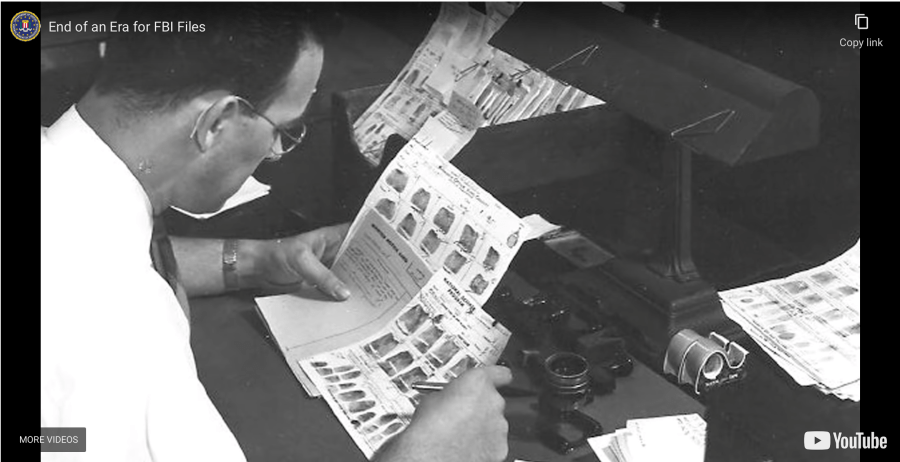
But you’re in luck. The FBI has posted a video on YouTube that discusses the digitization of their hard copy fingerprints, and on that video is a photo of a long-ago staffer reviewing someone’s fingerprint cards along with—YES!—their Additional Record Sheet. And now, without further ado, I present a screen grab of an Additional Record Sheet, in full view, outside its protective fingerprint jacket.
A closer, albeit blurrier view of an Additional Record Sheet
GED
How does the National Archives document apply to Ron Tammen?
The 2004 disposition authority request submitted by the FBI to the National Archives has a lot to say about how long the FBI should retain criminal and civil fingerprints under IAFIS, not to mention the Additional Record Sheets and microfilm. Below is a link to the document as well as a timeline to help show where Ron factors in, and why, to quote person #1, his case “doesn’t add up.”
1941 – Ron Tammen is fingerprinted in Fairview Village (now named Fairview Park), OH, along with his second-grade classmates, and the fingerprint card is sent to FBI Headquarters. Ron’s fingerprints would have likely been held in the civil file at this point.
1953 – Ron Tammen disappears from Miami University on April 19. Mrs. Tammen soon contacts the FBI’s Cleveland office and they send a report to headquarters, where his fingerprints are discovered. His prints would have been moved into the criminal file at this time, since that’s where missing persons’ fingerprints were routinely maintained.
1958 – The FBI begins its microfilm program as a space-saving measure. In a 1991 booklet on the Identification Division of the FBI, the duties of the Microfilm Unit are described as primarily to thin out the fingerprint jackets of repeat offenders. The unit also microfilmed the fingerprints of subjects who’d died.
1973 – Tammen’s fingerprint card is reliably in its jacket when Tammen’s prints are compared to the guy who worked for Welco Industries in Blue Ash, OH, near Cincinnati. The date in which they pulled his card for comparison would have been included on Ron’s ARS back along with a brief description of actions taken.
1992 — The Identification Division’s name is changed to Criminal Justice Information Services (CJIS).
1995 – CJIS relocates to Clarksburg, WV.
1999 – This is a big year for the folks in fingerprinting. They begin converting from a manual system to IAFIS, digitizing all of their fingerprint cards along with the Additional Record Sheets. They also stop putting fingerprints onto microfilm because they no longer need to worry about all those fingerprint cards exceeding their cabinet space. Nevertheless, they retain the 38,000-plus microfilm rolls they have, which contain roughly 50 million prints.
It should be mentioned here that the fingerprint cards are NOT destroyed immediately after they’ve been scanned. According to the 2004 disposition authority request: “At the present time, CJIS maintains a dual recordkeeping system consisting of an electronic fingerprint identification system (IAFIS) as well as a paper based repository of criminal master fingerprint cards. In 1995, CJIS and the [FBI’s] Laboratory Division signed a Memorandum of Understanding (MOU) agreeing that CJIS would continue to maintain the paper file until both parties approve its destruction.” It goes on to say that the two divisions signed the MOU because the IAFIS fingerprint scans didn’t meet the Laboratory’s resolution specs. So that’s interesting.
2002 – Three years after the rollover to IAFIS, Ronald Tammen’s fingerprints are purged from the system with seemingly no explanation. Because we now know that the FBI had both electronic and hard copy versions of fingerprints in their care at this time, we also know that it probably wasn’t just a computer glitch or human error that caused Ron’s fingerprints to disappear. Someone had to make a special trip over to the manual files, seek out Ron Tammen’s fingerprint card, and purposely destroy it as well. Did it happen on the same day? We don’t know that. But with the window of time being between 1999, when his fingerprints would have ostensibly been digitized, and 2008, when Frank Smith requested the hand search, I’d say the chances are good that whatever inspired someone to delete Tammen’s electronic prints in 2002 would have been enough motivation for them to destroy his manual file at that time as well.
July 2, 2004 – The FBI submits its disposition authority request to the National Archives. In a nutshell, it says that the FBI should retain fingerprints until the individual reaches 99 years of age or seven years following notification of the subject’s death for both electronic and paper records. Same for the Additional Record Sheet scans. It also adds this powerful phrase for all of the above: “whichever is later.” This means that 99 years of age is the YOUNGEST a person should be before these records can be deleted. If he or she should die an untimely death, say, at a youthful 98 1/2, the FBI would, in theory, be required to wait an additional seven years before the fingerprints and Additional Record Sheets could be deleted. Here are the specifics:
Criminal Subject Master File(scanned fingerprints): DELETE/DESTROY when the individual is 99 years of age or 7 years after notification of an individual’s death, whichever is later.
Additional Record Sheets:Hard copy files: DESTROY after verification of a successful scan. Scanned version: DELETE when the individual has reached 99 years of age, or 7 years have elapsed since notification of individual’s death, whichever is later.
Criminal Fingerprint Cards/Records (hard copy fingerprints):DESTROY when the records indicate that the individual has reached 99 years of age or 7 years have elapsed since notification of individual’s death, whichever is later.
Microfilm Library: The entire microfilm collection will be maintained until the birth date of the most recent set of fingerprints (i.e., born in 1981) reaches 99 years of age. DESTROY in 2080.
February 2008 – Detective Frank Smith contacts CJIS requesting a hand search for Ronald Tammen’s fingerprints. Not only don’t they have his prints as a scan or hard copy, they’re not on microfilm either.
What does it all mean?
Just this: When the FBI decided to purge Ronald Tammen’s fingerprint files, they broke the retention rules that had been approved by the National Archives. In federal lingo, this means that one or more persons within the FBI (allegedly) committed an unauthorized disposition of federal records.
I know what you’re thinking. You’re thinking: Jenny, this document was from 2004, and Ron’s fingerprints were purged in 2002. How do you know that these rules were in effect two years earlier?
I know this because the document says on its cover page that it consolidates four disposition authority requests from previous years (1990, 1995, 2000, and 2002) “into one comprehensive document.” As back-up, I also have all four of the earlier disposition authority requests. Below is the document that establishes the 99-year/”whichever is later” rule, as you can see by the handwritten notes. You guys, they’d been doing it this way since at least 1995.
You may also notice on the 2004 document some crossed-out paragraphs that were superseded in 2010 by new language. Below is the document from 2010, which now stipulates that they should maintain everything until a person reaches the age of 110, period, whether they lived or died. They don’t mention the seven years after confirmed death and they no longer mention “whichever is later.” If there’s a document that supersedes this one, it isn’t referenced here, as far as I can tell.
I know what else you’re thinking. You’re thinking: Jenny, I’m sure they hadn’t finished scanning those millions of fingerprint cards in 1999. Is it possible that they were about to scan Ron’s fingerprints in 2002, noted how many years had passed since he’d disappeared, and decided to purge them at that time?
I mean…it’s possible, but that’s not how it was described to me in 2015 when the FBI spokesperson had written the following: “Jennifer — We ran the FBI# and discovered it was expunged from our system in 2002. No other info available.” “Expunged from our system” tells me that Ron’s fingerprints had already been scanned into IAFIS (the “S” in IAFIS stands for “system”) and was later expunged, or purged, a term the spokesperson later used. Also, even if it happened that way, it would have still been against protocol, since Ronald Tammen wouldn’t have been 99 years of age.
Here are the take-homes:
According to their own rules, the FBI should have been able to produce Ronald Tammen’s fingerprints, both the electronic and hard copy versions, when Frank Smith requested them in 2008. Also, based on the 1995, 2004, and 2010 disposition documents, they should be able to produce them today. Even if Ronald Tammen were known to be dead, the FBI should have his fingerprints on file until at least the year 2032, 99 years after Tammen was born. Or if they’re going by the 2010 disposition protocol, they should have them until the year 2043.
Those who have been following this blog for a while are keenly aware that I’d thought that Ron Tammen had probably died in 1995, when I was informed that his fingerprints were purged in 2002. I thought this because I’d been told by the FBI’s spokesperson that the FBI purged fingerprints at 110 years of age or seven years after confirmed death. It was presented as an either-or scenario and, because Ron was nowhere near 110, I chose door B. If the FBI had been following their IAFIS protocol, even if Tammen were dead, those fingerprints should have been there in 2002, in 2008, and many years hence. So, guess what this means? It means we still don’t know if Tammen is alive or dead, and I have no idea what compelled them to purge his prints in 2002.
As for the missing microfilm, if Ron had died before 1999, the FBI might have also microfilmed his fingerprints. However, if he died after 1999, they likely wouldn’t have—they were purportedly done with microfilming. You’d think that it would be a much more involved process to delete a set of fingerprints if they’re buried somewhere within an entire roll of microfilm. I don’t think there’s much we can do to find out. You know the title of that Frozen song that’s really fun to crank up and sing your heart out to when you’re alone in a car? I think that sentiment applies here.
And what of the Additional Record Sheets? The hard copies would have been destroyed after they scanned them, as described in the 2004 retention protocol, but the electronic versions should be around until at least 2032 and possibly 2043. If I were a gambling person, I’d bet that they deleted the scans at the same time that they were deleting his electronic fingerprint file. I mean, if they’re going to break one rule, they might as well break all the rules, right? Nevertheless, it’s a question worth pursuing, and pursue it, we will.
Next steps
Before I tell you the next steps, I need to fill you in on some stuff. On March 23, the Department of Justice ruled on my appeal for the Additional Record Sheets and I lost. In the DOJ’s eyes, because of my 2012 lawsuit, I have no right to ask them about Ronald Tammen ever again, even if I’m asking them about documents that they’d never searched or thought to search before we signed our settlement in 2014. That’s despite the fact that the same DOJ division had ruled in my favor in 2016 when I used the same argument about another Tammen file that they hadn’t searched before. I thought lawyers loved precedent, but apparently not in Ronald Tammen’s case.
If you’re hoping to hear that a new lawsuit against the DOJ is now in full swing, prepare to be let down. The lawyer who represented me in my 2012 lawsuit, a FOIA expert who advised me that my 2014 settlement wouldn’t preclude me from submitting future FOIA requests on Tammen if I should discover relevant files that the FBI hadn’t yet searched, is no longer in private practice. Lately, I’ve been trying to find another FOIA lawyer to represent me, however, one expert had an alternative opinion about the settlement provisions and another might be ghosting me. But don’t feel bad—I have a feeling that this is all just part of the game when you’re dealing with FOIA law and the FBI. (You know in the Frozen song where she sings about not letting anyone see her cry? Some days, that fits too.) In the meantime, I’ll continue looking.
But there’s another step I can take before I need to start shelling out some of my sad little savings for a lawsuit, if indeed that time comes. It involves our friends at the National Archives, the holder and purveyor of government records. I’m approaching them in two ways. First, the Office of Government Information Services (OGIS) was started in 2009 to serve as a mediator of FOIA requests, and they’re considered a next stop before a lawsuit. So far, I’ve sent them a detailed email explaining why I should have the chance to see Ronald Tammen’s Additional Record Sheet scans if they still exist and asking them to help make it happen. I’ll let you know how it goes.
Second, I’m reaching out to another division of the National Archives—the people who oversee unauthorized disposition cases. That’s right, readers, I have in my arsenal a weapon known as “tattling,” commonly wielded by individuals of the 6-year-old variety, and by golly, I’m wielding it too. Yes indeed, I’ve recently informed them of what I perceive to be the FBI’s mishandling of Ronald Tammen’s fingerprints. I don’t know what types of policing powers the nation’s archivists hold. They don’t immediately spring to mind when one thinks of feds who enforce the laws of the land SWAT-team-style—you know, like the FBI? Judging by their web page, they appear to handle such cases through polite correspondence with the agency in question. Nevertheless, I think that someone should register their displeasure. Why not me?
Of course, if Ron Tammen had been working as an undercover operative for the CIA, his fingerprints might have fallen outside the purview of the FBI’s sanctioned fingerprint protocol. When I asked my FBI sources how fingerprints were maintained for people whose identities had been changed by a government agency, such as the CIA, they let me know that they weren’t sure how those cases would have been handled.
“That never was anything that I was, I guess, supposed to know. So I don’t,” one of them said to me.
Just a thank you
Whew—what a year, right, guys? I know we’re not out of the woods yet, but things are definitely looking up, and I am so ready to take to the road again, once it’s safe to do so.
Last year at around this time, just as Covid cases had started popping up everywhere and communities were going into lockdown, I decided to write a Ron Tammen update for the anniversary—the one on Wright Patterson Air Force Base. For the entire previous year, from April 2019 to April 2020, we were on our hiatus, and I was quietly doing my research while writing short updates on Facebook. I didn’t think I had much more to tell you, so I just, you know, withdrew a bit. But once Covid struck, I decided to start back up with the blog, and then we taped the podcast episodes, and everything picked up again. I found that, as we were waiting on ISCAP to rule on the big question, there were numerous other questions needing to be addressed, many of which were posed by you.
Recently, I half-jokingly told a friend that, if it weren’t for her, I think I would have surely perished this year. Thanks to our morning runs and deep and sometimes hilarious convos, I’ve managed to stay healthy and sane throughout this ordeal. I feel the same way about you all. You helped me focus on something other than my mortality. I hope you managed to get through this year in good health as well, and hopefully the blog gave you something else to think about. Anyway, big, big thanks. Also, here are a couple photos of how I spent the pandemic—one in podcasting mode and the other in pre-run mode. Feel free to share photos of yourselves and how you managed to get through this year of insanity as well. Or share a vaccination pic of yourself, and don’t forget to tell us which team you’re on. (Go, team Pfizer!) Of course, if you have thoughts on today’s post, I’d love to hear those as well. The floor is now open.
**and the ways in which Ronald Tammen’s case was treated as an exception to the rule
The year that fingerprints first became part of J. Edgar Hoover’s tactical toolkit was 1924, the same year Hoover was named director of the Bureau of Investigation, forerunner of the FBI, and also the year in which the Identification Division was created. The technology itself has changed since then, but you’d expect that, wouldn’t you? In 1924, Calvin Coolidge was occupying the White House, the Charleston was all the rage, and “23 skidoo” was something people would actually say to one another to appear street smart and hip. It was a very long time ago.
And yet, change didn’t come quickly for the folks in the Identification Division—or Ident as they were known to their fellow employees. For decades, the FBI was collecting fingerprints with the same tried-and-true method that they’d used since 1924—rolling black inky fingers onto white cardstock—and training thousands of employees the art of eyeballing one card against another to assess whether they came from the same set of fingers. They were using this methodology through 1941, when Ronald Tammen was fingerprinted as a second grader. They were still using it in 1973, when they fingerprinted the guy at Welco Industries to see if he might be Ron. And they kept on using it for more than a quarter century after that. Not until 1999, after the FBI had changed the division’s name to Criminal Justice Information Services (CJIS) and later moved the division to West Virginia, did fingerprinting finally go digital.
Millions of cards—Ron’s, the guy from Welco’s, plus all the others—were trucked from FBI Headquarters to the new facility in Clarksburg, WV. So many cards. Enough to go around the world if laid back to back, according to a former employee. Each and every card was scanned into a database, a feat in itself. Initially, that database was the Integrated Automated Fingerprint Identification System, or IAFIS. IAFIS was a game-changing innovation that could sort through and match fingerprints in a fraction of the time that it would have taken an Ident staffer to do under the manual system. And as skillful as Ident staff were at reading fingerprint cards, no longer would the FBI need to rely on occasional judgment calls, which, much to Hoover’s and his successors’ chagrin, could vary. In 2011, CJIS began incrementally upgrading to the Next Generation Identification (NGI) system, a massive database that is even faster and more powerful than IAFIS and incorporates fingerprint technology with all other biometric technologies except DNA. DNA has its own database, called the Combined DNA Index System, or CODIS, which we’ve discussed in previous blog posts.
So the process of collecting, sorting, and searching fingerprints has become way faster and more efficient thanks to the digitization of fingerprint data. But the basis of the technology—where the loops, whorls, and arches found on everyone’s fingertips are counted, categorized, and compared—is essentially the same as it was in 1924. And the importance of fingerprints in identifying one individual from another hasn’t changed much either, even today, when DNA reigns supreme.
Speaking of which, you know the meme of the guy who’s walking down the street with his girlfriend while he’s checking out another woman who just passed by?
Yeah, that one. DNA and the latest biometric tools, such as palm prints, irises, and facial recognition, may be what evokes oohs and aahs from people who like to keep up on the coolest new tech trends, which, to some degree, is most of us. But dollar for dollar, fingerprints continue to be the cute, nice, reliable technology that’s sometimes taken for granted. And yet, even with all the advances that are made in biometrics, it’s a safe bet that fingerprinting will continue to be an important identification tool for years to come. That’s because it’s built on the utterly astounding and never-proven-otherwise premise that no two people’s fingerprints are ever the same, even those of identical twins. And—get this—according to the book The Fingerprint Sourcebook, produced by the National Institute of Justice, of the U.S. Department of Justice, some people in China were using fingerprints as a means of identification as early as 300 BC. Does that blow your mind as much as it blows mine? How could people from 300 BC have known that fingerprints were so special? I’m quite sure that the first person to have used them would be surprised, no stunned, to know that their wild, out-of-the-box idea—their ancient hack to a primitive need—would still be used in 2020 and beyond.
Don’t get me wrong: No one here wants to disparage DNA. DNA is great. DNA is important. DNA technology has improved so much since the early days that even miniscule samples have helped solve cold cases such as the Golden State Killer. And if your DNA is found at a crime scene? Well, you’re probably toast. It’s pretty much attained “smoking gun” status, which isn’t the case for fingerprints. Fingerprints that are left at a crime scene—called latent prints—can be damning too, but, they’re rarely perfect. According to a 2017 study of the American Association for the Advancement of Science, they are often refutable, since they’re usually incomplete and, as the AAAS study points out, nearly impossible to match to a single source.
Nevertheless, fingerprints, especially what the FBI calls the “ten print,” non-latent variety, aren’t going away anytime soon. If you want to know the true identity of someone, their fingerprints are better than a name. Better than a Social Security number. Better than a picture ID.
“Fingerprints are considered positive identification, so it’s a much better way to identify people who, for whatever reason, don’t want to be identified. And that probably means most of the criminal element,” said one former CJIS employee.
So yeah—fingerprints, baby!
But we aren’t going to be talking about the science of fingerprints anymore on this blog post. No, the topic for today is standard operating procedures—or the bureaucratic maneuverings and machinations that take place once a set of fingerprints has been collected. In essence, we’ll be examining the life and death of a fingerprint, from the moment it’s pressed onto a white card or scanner and entered into the FBI’s system to the day it’s expunged. And friends, I challenge you to find anything on the internet that attempts to do what we’re attempting here. For the first time ever (I’m pretty sure), we’re pulling together information obtained from experts who categorized and analyzed fingerprints for the FBI for many years, a process that was drilled so deeply into their skulls that they could do it in their sleep. Then—when possible—we’re going to compare what the FBI routinely did, and sometimes still does, to what they did in Ronald Tammen’s case. And, spoiler alert: they aren’t the same.
My sources requested anonymity so they could speak openly, and because they no longer officially represent the FBI. We’ll do it like last time, in Q&A fashion. This time, however, I’ll list a question, provide an answer that merges what my sources told me with info from other related resources, and then, when applicable, compare and contrast that summary with the way things were handled for Ron Tammen, which will be printed in blue. Some answers may sound familiar to you, since we’ve discussed them before. Sometimes I added two and two together. You ready? Let’s do this.
Who can submit fingerprints to the FBI?
Only law enforcement agencies or a court can submit fingerprints to the FBI.
How it pertains to Tammen: This jives with Tammen’s case. Evidence indicates that Ron Tammen’s fingerprints were taken by the local police in Fairview Park, Ohio, in 1941, when he was a second grader, and they submitted the fingerprints.
How were fingerprints submitted to the FBI under the manual system?
The FBI generally didn’t accept fingerprint cards from local police departments because they would have been overwhelmed by the numbers. Instead, they had state police bureaus and other channeling agencies. Generally, the local police department would send the prints to the state police bureau and the state bureau would send them to the FBI. Conversely, once the FBI determined whether or not there was a match, they would respond to the state bureau and the state bureau would notify the local police.
How it pertains to Tammen: According to info I have from around that time, the Fairview Park police sent the fingerprints directly to the FBI as opposed to going through a state police bureau. It could be that they’d gotten such an early jump on the FBI’s civil fingerprinting efforts that they didn’t need to involve a middleman. Whatever—this little swerve from the norm isn’t a big deal, in my view.
How are fingerprints submitted now?
It’s still law enforcement types and the courts who can submit fingerprints to the FBI, but they can do so electronically using the NGI system. Police officers can even fingerprint someone using a mobile device in their squad car, hit the send key, and then, in a matter of seconds, receive information on the person’s identity and whether he/she has a criminal record and if there are possible warrants out for their arrest.
How it pertains to Tammen: It doesn’t. It’s just interesting.
What does the FBI number mean?
The FBI number is assigned to fingerprints when they are submitted and placed in a file. It would not be assigned to a “return print,” a civil fingerprint that was going to be returned immediately to a local police department or to someone’s parents. This was the number that the Identification Division would use to track all information pertaining to those fingerprints.
How it pertains to Tammen: Ron had an FBI number (#358 406 B] assigned to his fingerprints, which means that the Identification Division took the time to create a fingerprint jacket for him (the folder where fingerprints were stored). This tells us that the FBI likely retained Ron’s prints from day one, as opposed to sending them back to Fairview Park, and that they also likely had his fingerprints on file the day Ron went missing. Is it weird that the FBI would have kept his prints when every FBI source I’ve spoken with has found this detail most unusual? Yes, it’s weird. But I’m just glad that A) he was fingerprinted at all, and B) the FBI retained the prints. Think about how much less information we’d have on the Tammen case if the FBI hadn’t had a fingerprint file on him. All the strange behaviors during all those critical years (particularly 1967, 1973, and ultimately 2002) wouldn’t have occurred. If my theory of what happened to Tammen bears out, then those fingerprints could be the one detail that his shrewd handlers had no prior knowledge of, and that Tammen had long forgotten about, that could finally bring us some answers.
What information was included in the fingerprint file/jacket?
The fingerprint jacket contained a person’s fingerprint card or cards. In a missing person case, if the Identification Division was fortunate enough to have the missing person’s fingerprints, that’s the only information they would maintain in this file. Other descriptive information would be housed in Records Management. As we all know from the preceding post, there was also an Ident Missing Person File Room, but it didn’t appear to be well known among Ident staff, and it was not part of the usual protocol when handling missing person cases.
How it pertains to Tammen: According to the FBI memo from 5-22-73, there was only one fingerprint card in Ron’s file, which followed protocol. What was unusual were the documents that had been kept—and removed from—the Ident Missing Person File Room, number 1126, in June 1973. I’ve filed several FOIA requests in hopes of figuring out that little side mystery and will keep you posted.
What did the FBI do with the civil print cards they collected?
Most of the civil fingerprint cards that the Identification Division received were treated as “return prints,” which meant that the FBI had no intention of keeping them in their files. Each fingerprint card would be searched manually against the criminal fingerprint file and, if there was no match, it would be stamped on the back: “no criminal record.” The card would then be mailed back to the submitting agency. If the civil fingerprint matched a criminal record, the submitting agency would receive a copy of the criminal record known as “a rap sheet.” (The FBI likely held onto those prints.)
Generally, the only fingerprint cards that would have been permanently retained by the FBI in the civil file would be military personnel and employees of the federal government. However, there was one group in particular whom Hoover encouraged to be fingerprinted, and that was the Boy Scouts of America. The organization, which had developed a merit badge in fingerprinting, would send the scouts’ prints to FBI Headquarters, and, in return, the boys would receive a letter thanking them for helping with the cause. According to MuckRock.com, the Boy Scouts’ prints were maintained in the civil file, though my FBI sources recalled that they had been returned.
How it pertains to Tammen: Every FBI source I’ve spoken with has been both surprised and skeptical that the FBI would have kept Ron’s fingerprints from 1941. Apparently, it was extremely rare for the FBI to retain children’s fingerprints in the civil file back then. However, the FBI clearly had his fingerprints on file at some point because in 2002, they expunged them. The fact that Ron’s fingerprints were assigned an FBI number convinces me that they held onto them as opposed to sending them back to the police or parents and asking them to return them when he went missing. (It doesn’t really matter which scenario happened, to be honest, but we’re going for accuracy here.) If the FBI did keep his fingerprints from childhood, they would have maintained them in the civil file until 1953. Then, when he went missing, they would have moved them to the criminal file since the criminal file is the active file that is always consulted when new prints come in.
What does the FBI do with the criminal prints they collect?
They keep them all. People who’ve been arrested 10 times will have ten sets of fingerprints in their file, ostensibly as a means for identifying latent fingerprints in possible future arrests. For example, if the fingerprint picked up at a crime scene isn’t very good, the FBI could bring up a suspect’s fingerprints from all ten arrests to find if a corresponding section of one of those prints is a match with the latent print. Also, retaining all criminal fingerprints creates a comprehensive history of all the dates the person was arrested.
Under the manual system, the first fingerprint card from the first arrest would be filed in the master criminal file. Fingerprints from any subsequent arrests were filed together in the person’s fingerprint jacket. Likewise, under the digital system, all fingerprint data was also entered into the database for that person.
The criminal file includes the fingerprints of, you guessed it, criminals, such as people who are incarcerated, arrested, or who have warrants out for their arrest. It also includes missing persons as well as some federal employees, such as people who work for the FBI. The latter policy started with—who else?—Hoover, who said, “if any of my employees have any contact with the law, I want to know about it!” Several other federal agencies with law enforcement responsibilities have their fingerprints in the criminal file as well.
How it pertains to Tammen: As you can see, the FBI goes to great lengths to preserve every set of criminal fingerprints that it collects, even in cases where multiple sets of prints for the same person are already on file. However, Ronald Tammen’s fingerprints—of which they only had one set—were expunged in 2002, even though Tammen was ostensibly still missing. We’ll be discussing this development in more detail later, but, for now, let’s try to fully appreciate how inexplicable and bizarre this action seems to be. By that year, Tammen’s single set of fingerprints—the FBI’s only definitive means for identifying him—would have been entered into IAFIS, taking up a negligible amount of digital space and harming virtually no one as they sat there waiting for a potential hit. For what earthly reason would the FBI feel compelled to erase them forever from their vast database? Why would that be in their best interest? I wonder.
Did the FBI ever check the civil file for a match?
According to one knowledgeable source, the only time an Ident staffer would consult the civil file is in the case of an unidentified deceased individual. If a set of fingerprints came in of an unknown person who had died, they’d first search the criminal file, then they’d search the civil file. During the Vietnam War, for example, the fingerprints of unknown soldiers who had died in combat would be sent to the FBI for identification. In such cases, the civil file would always be checked, since that’s where the prints for members of the military were maintained.
How it pertains to Tammen: This would only pertain to Tammen if his fingerprints were in the civil file and he turned up dead. Unfortunately, we have no way of knowing if either happened.
Do they still keep criminal and civil fingerprints separate in NGI, or are they all lumped together?
According to a 2015 article published by the Electronic Frontier Foundation, all fingerprint data, civil and criminal, are now lumped together under NGI, and searched together thousands of times a day. While individuals found in the criminal file should be used to having their fingerprints searched for matches, this was a new development for people in the law-abiding civil file, and it creates privacy concerns. My FBI sources had retired before this policy was implemented, so they wouldn’t be able to comment. However, the controversy appears to be ongoing.
How it pertains to Tammen: It doesn’t, since Tammen’s prints were expunged in 2002, nine years before the transition to NGI had begun.
How difficult would it be to compare two sets of fingerprints in 1967: Ron Tammen’s, whose prints were in the criminal file, and a soldier in Vietnam’s, whose prints would have been in the civil file? (Question is in reference to this post.)
On average it used to take an Ident staffer 30 to 60 minutes to manually search an incoming fingerprint card against the criminal file, depending on the complexity of the print. A longtime employee said: “…If there were two sets of prints, one from an individual, one the military, it would be very easy to compare them to see if they were the same individual or not.”
How it pertains to Tammen: When Mr. Tammen wrote J. Edgar Hoover in October 1967 asking if the soldier pictured in an AP photo might be his son, Hoover responded that he didn’t have any more information on Ron’s case and suggested that Mr. Tammen contact the adjutant general of the U.S. Army regarding the soldier. In my opinion, this was a classic attempt at appearing helpful without helping at all.
Was Hoover’s response flaky? Couldn’t Hoover have found out the soldier’s name and asked his staff to test Ron’s prints against the soldier’s?
Said one expert: “Yes, it was. I thought so too.” Said another: “I am guessing that the Bureau did not have the time or resources to follow up on a newspaper article with a picture.”
How it pertains to Tammen: Let the record show that I consider it flaky—and telling—that Hoover wouldn’t have asked one of his Ident staffers to do this minor task for Mr. Tammen. As for the suggestion that Hoover may have had insufficient time and resources, the Identification Division was one of Hoover’s biggest bragging points, where hefty amounts of resources were devoted to the processing of millions of fingerprint cards each year. In 1964, the year of the FBI’s 40th anniversary, they were averaging 23,000-24,000 incoming fingerprint cards daily. Couldn’t they take some time to look at a couple more? Once Hoover had determined who the soldier was by calling the AP or the adjutant general himself, all he needed to do was ask one of his many Ident employees to spend an hour or less comparing the two cards. If it was a match, he could be a hero. For some reason, he didn’t feel it was worth that small effort.
What does it mean to expunge fingerprints?
The word expunge is often used in legal situations when referring to a criminal record. If a criminal record is expunged—some indiscretion of youth, for example, for which a judge decides a person has done their penance and, in a sense, lets bygones be bygones—it’s either sealed or wiped clean, as if it never existed. In a missing person case, the preferred terminology is generally to purge the records.
How it pertains to Tammen: According to Stephen Fischer, the CJIS media liaison in 2015, Tammen’s prints were “expunged” in 2002, though no evidence exists to indicate that he had a criminal record. Fischer later referred to the criteria by which fingerprints are “purged,” using the terms interchangeably. From this point on in this post, I’ll use both terms interchangeably as well.
When are fingerprints expunged?
According to Stephen Fischer in 2015, “The FBI purges fingerprint data and records at 110 years of age or 7 years after confirmed death.” In addition, according to other sources, the FBI will purge fingerprint data upon receipt of a court order to do so.
How it pertains to Tammen: Ronald Tammen would have been 68 or 69 in 2002, far younger than the 110 years of age currently required with NGI or even the slightly more youthful 99 years of age that was required with IAFIS. Unless there was a court order (which I’m still attempting to find out), the only other (ostensible) possibility is that the FBI had confirmed Ronald Tammen to be dead. It should be noted, however, that when I asked my FBI sources if they would make the same inference, no one was willing to go out on that limb for reasons that I’ll get into shortly.
How does the FBI know when 7 years/110 years have expired?
Under the manual file system, it would have been more tedious and probably fairly random to keep track of expiration dates. Now, however, my sources concur that it is an automated process, though no one I spoke to was aware of how the system sifts through the file to detect expired records.
How it pertains to Tammen: Unless his fingerprints were purged because of a court order or there’s another possible reason to remove a person’s fingerprints that I’m unaware of, something must have tripped the automated system.
Why would the FBI want to expunge someone’s fingerprints?
In general, this is something they’d prefer *not* to do. The FBI still relies heavily on fingerprints as a means of identifying people, particularly all the standout folks whose prints are in the criminal file. It’s not in the FBI’s best interest to purge those fingerprints without a very good reason. Storage space happens to be one very good reason. Once the FBI digitized its fingerprint data in 1999, beginning with IAFIS, a need arose to free up some storage space on occasion. And with NGI adding biometric data that requires even more space, the need has grown stronger since 2011. That’s why they have the 110/7-year rule. Other reasons for purging involve the legal system—the court ruling we’ve discussed earlier, for example. But according to most of the FBI experts I’ve spoken with, the reasons for purging a fingerprint can be counted on three fingers of one hand.
How it pertains to Tammen: This is the question that keeps me up nights. Ron didn’t make the 110-year age cut, so it’s either that he’s dead, and the FBI knows he’s dead but they don’t want us to know they know he’s dead, or it’s the court order thing. However, one source I spoke with speculated that perhaps someone in CJIS decided to purge Ron’s prints when they noticed that, if alive, he would be a much older adult in 2002, and maybe he didn’t want to be found:
“There were some situations where people were adults that had been reported missing and they weren’t really missing. They didn’t want to be found for some reason. And so, to me, it makes a difference whether you’re a minor child or above the age of 18 or 21, because an individual can choose, for whatever reason, just choose to disappear for their own reasons, for whatever purpose.”
The problem with that theory is that it completely goes against protocol. Nowhere have I read or heard that the FBI would purge a missing person’s fingerprints once a missing youth had reached adulthood. Perhaps an Ident staffer might have been inclined to make that sort of judgment call under the manual system…I don’t know. But, in 2002, when they were relying on the automated IAFIS system? I doubt it. There’s another reason I don’t think someone would have removed his fingerprints simply because he was older. I’ll discuss it in the next question.
What happens if a missing person turns out to be dead?
If an unidentified body was found, the local police could submit their fingerprints to the FBI through the state bureau. If the FBI already had the missing person’s fingerprints on file and they were a match, the submitting agency would have been notified of the match through the state bureau. In addition, a notice would have been placed in the missing person’s file saying that they had been confirmed dead, and, if available, the date they died. Here’s an important point to remember: the FBI doesn’t immediately purge the fingerprints of a missing person who has been proven dead. They just add the note. Even if a person is dead, those prints can still be valuable. They might be useful in helping solve cold cases or for identifying bodies following a disaster. That’s why they have a policy to wait seven years before purging them.
How it pertains to Tammen: If the FBI purged Ron Tammen’s prints in 2002 because he’d been confirmed dead seven years prior, that would mean that he would have died in 1995 at the latest. The FBI was still using its manual system in 1995. They were still using fingerprint jackets, and there should have been a note in the jacket saying that he was dead, and perhaps when he’d died.
As one knowledgeable source said:
“And even if a print had been identified as deceased, in that jacket, there still would have been information written in there by hand that it had been identified as deceased individual such-and-such. So all that would have been automated [after IAFIS was introduced], along with the actual fingerprints themselves that were digitized.”
Ostensibly, no notes have been written claiming that Tammen is deceased. However, it also bears repeating that, even if they’d found Tammen to be dead, it wouldn’t be reason for immediately tossing his fingerprints. They would have waited the seven years. If the FBI doesn’t think it should just toss the prints of a dead person right away, I doubt very much that they’d purge the fingerprints of a missing person who’d managed to evade detection for many years as an adult.
Would the FBI purge a missing person’s prints after they’re found?
Same answer as above. The fact that a missing person was located would be noted in the jacket but the fingerprint card would be retained. A court order would be needed to physically remove the print—which would also include a note saying that the prints had been expunged. Otherwise, they’d wait until that person was 110 years of age or seven years after confirmed death.
How it pertains to Tammen: Again, no explanatory information was in his file—no record of having been located and, as pointed out earlier, no record of his being found dead, and no record of a court-ordered purging. Also, to further drive home this point, if the FBI isn’t willing to purge a missing person’s fingerprints after they’ve been found, why would they remove them while he was still out there, unaccounted for? Answer: they wouldn’t.
How do you fingerprint a dead body?
[Warning: this is gross] If an unknown deceased body was discovered, sometimes the fingerprints would be in bad shape due to decomposition. However, fingerprints have three ridges that penetrate the skin fairly deeply. In such cases, a technician would put on rubber gloves and remove the skin down to a more, um, legible layer, shall we say? Then, they’d roll those prints on a ten print card. According to one former employee, any fingerprint that came from a deceased body was generally of poor quality—too dark or too light. Therefore, it was often difficult to conduct a manual search using a dead person’s fingerprints.
How it pertains to Tammen: Sorry about that. But if Ron Tammen died and the FBI confirmed that he died, they might have had to do that. We don’t know.
What types of records are kept after fingerprints are expunged?
We’re building up to one of our primary take-home messages, and here it is: Fingerprints aren’t supposed to just disappear without some sort of record. Based on information provided by Stephen Fischer in 2015, no other info was available on Tammen other than the fact that his prints were expunged in 2002. But the removal of fingerprints while they were considered still active would require some note of explanation regarding when they were removed and why. And these notes of explanation were all to be digitized as part of IAFIS.
According to FBI protocol back then, the notes were to be printed in the file jacket on sheets called Additional Record Sheets or ARS’s. Not only did the ARS require an employee to provide their employee number and date the sheet any time they removed the file, but they also were required “to record any disseminations of the record, including notations of expungement or purges of record entries, such as deletions of arrests for non-serious offenses.”
And here was their record retention policy after adding these notes to IAFIS:
Hard copy files: DESTROY after verification of a successful scan.
Scanned version: DELETE when the individual has reached 99 years of age, or 7 years have elapsed since notification of individual’s death, whichever is later.
Instructions regarding how notations were to be made on the Additional Record Sheets, and later, how the ARS’s were to be digitized when CJIS converted to IAFIS.
You guys, and I’ll put this in bold italics for added emphasis: the information on Tammen’s ARS should theoretically still be available for his expunged fingerprints.
There was an additional record-keeping system that the FBI used to implement between the years 1958 and 1999. When the FBI purged a fingerprint file, they would put those fingerprints on microfilm for archival purposes. However, CJIS stopped making microfilm copies after IAFIS was implemented, which had been in place for roughly three years when Tammen’s prints were purged. Therefore, the microfilm library doesn’t apply to Tammen’s case.
How it pertains to Tammen: In February 2008, when former Butler County, OH, cold case detective Frank Smith requested a “hand search” for Tammen’s fingerprints, CJIS sent this response a couple days later by Fax:
“A SEARCH OF OUR CRIMINAL AND CIVIL FILES HAS FAILED TO REVEAL ANY FINGERPRINTS FOR YOUR SUBJECT. A COMPLETE SEARCH OF OUR ARCHIVE MICROFILM FILES HAS FAILED TO REVEAL ANY FINGERPRINTS FOR THIS MISSING SUBJECT AS WELL.”
What the CJIS rep neglected to tell the detective—a member of law enforcement, and therefore a supposedly valued working partner of the FBI’s—was that they’d expunged them in 2002. So, to recap:
It appears as if someone in the Identification Division or CJIS didn’t document, didn’t digitize, or flat-out destroyed the ARS notations from Tammen’s manual jacket, including the reason for the expungement of his fingerprints in 2002, which is a clear break with protocol.
CJIS also didn’t disclose to the Butler County Sheriff’s Department the full extent of their knowledge about the case, the very least of which would be that they’d expunged Ron’s prints in 2002. This, in my view, is another break in protocol since I would think that members of law enforcement should generally try to be forthcoming with one another. (I’m guessing that, if the FBI had told Smith that they’d expunged the prints, they could anticipate a potential follow-up question that they didn’t feel like answering. Something along the lines of “Oh, really? Why?”)
Does the FBI verify someone’s identity before they expunge their prints?
The FBI will not purge someone’s fingerprints unless they’re certain that the person whose prints they’re purging is who they think he or she is. If the FBI is purging fingerprints because of a court order, the court or submitting agency would have to provide identification to ensure that the FBI was removing the right set of prints. Often, this would involve another set of fingerprints since fingerprints are still one of the best ways to identify someone. Other times, they may get away with simply providing telling details, such as the FBI number, the date of the arrest, and other specifics on the case, but fingerprints are still best. In the case of a deceased person or a missing person’s fingerprints being purged, a source said that it would be based on comparing two sets of fingerprints to make sure they’re the same individual.
How it pertains to Tammen: Think about the above paragraph for a second and maybe read it again, because it says a lot. First, the FBI wouldn’t have purged Ron Tammen’s fingerprints without verifying that they were indeed Ron Tammen’s prints. This helps solve a gnarly little question about the year in which Ron would have supposedly died. If they purged his prints in 2002, that would mean that Ron had probably died around 1995. Well, guess who else died in 1995: Ronald Tammen, Sr., who died on January 10 in Florida. So that was always a possibility. But according to my FBI sources, this likely didn’t happen because they would have verified it. Second, if they purged Ron’s fingerprints in 2002 because he’d been dead for seven years, then they would have verified those prints against a second set of prints sometime around 1995. Remember what Stephen Fischer had said about the seven-year rule: “seven years after confirmed death.” That means that they would have confirmed Ron to be dead by comparing his prints against the prints on file, and then waited seven years before the system purged them. That could also mean that they know where his remains are. Third is the question raised by the source who said it could be that someone tossed Ron’s prints because he would now be an adult who doesn’t want to be found. If the FBI ensures that every fingerprint that’s purged needs to be verified, then that rule would nullify this possibility. How could they verify that it’s the correct person if they don’t have a second set of prints with which to compare his to?
Discussion: When a missing person’s records go missing
Are we any closer to being able to say that the FBI knows more than they’re letting on? I think so. It’s clear that the FBI broke protocol at least once, and possibly more than once when dealing with Ron’s fingerprints. Since the last update, I’ve submitted several more FOIAs, one of which has to do with the question about Ron’s father. Although I’m nearly positive that it was Ron Jr.’s fingerprints that were purged in 2002, I’ve submitted a FOIA request asking the FBI to search the National Crime Information Center (NCIC) offline historical database for any files on Mr. Tammen too, including evidence of possible fingerprint files. If they don’t have anything, I think we can safely conclude they were Ron Jr.’s. With this latest post, you can see that there are more FOIA requests to submit, including, for example, an in-depth search of Ron’s digitized Additional Record Sheets.
It’s probably also a good time to raise another possibility with you, a “what if?” that may have been in the back of some readers’ minds throughout this entire blog. What if Ron’s fingerprints weren’t destroyed because he died in 1995 but because someone in a high place decided that, for whatever reason, they needed to be purged—someone who also didn’t want telltale notes getting in the way of “plausible deniability.” Missing notes and expunged fingerprints aren’t smoking guns. The missing notes could possibly be blamed on anything: a distracted employee, an inadvertent mix-up, a computer glitch, whatever. Or they may have never existed at all. Likewise, it’s extremely tough to explain why fingerprints were expunged when the records that could give the backstory on why they’re missing are also missing.
Most maddening of all is that If I were to lay out my (nonexistent) evidence before an official FBI spokesperson, this is what I’d get:
That’s essentially what I got when I asked them a while back to comment, yes or no, whether they’d confirmed that Ron was dead. Remember what the spokesperson said? “The FBI has a right to decline requests.”
All along, I’ve been pointing to the FBI’s 2002 purging of Ron’s fingerprints as reason to believe that Tammen is dead. But if the missing documents and destroyed fingerprints tell us anything, it’s that, for whatever reason, the FBI may have made the decision to break protocol in Tammen’s case. And if protocol wasn’t being followed, well, that opens up a whole range of new possibilities, doesn’t it? I mean, could it be that Tammen, who would be 87 on the 23rd of this month, is still alive after all?
Tuesday, June 5, 1973, promised to be 90 degrees and sunny in our nation’s capital—the kind of run-of-the-mill day of intense heat and high humidity to which the DC crowd is well-accustomed. Richard Nixon, who had a little over a year remaining in his presidency, would be facing a fully booked schedule of meetings and photo ops that day, topped off by a state dinner and concert honoring Liberia’s president. Just down Constitution Avenue, the Watergate Hearings were in full swing, televised live from the Russell Senate Office Building, across the street from the U.S. Capitol. Meanwhile, roughly two miles away, in a leafy, less ornate area of Capitol Hill, J. Edgar Hoover was still lying in his grave, having succumbed to a heart attack the previous year.
As cataclysmic as Hoover’s death had been for the women and men of the Federal Bureau of Investigation (one former employee joked that they’d half-expected him to return from the dead on the third day), they had since rebounded. They were back to the daily grind of carrying out their mission and raison d’être: “to protect the American people and uphold the Constitution of the United States.” In two more years, they’d be moving to the FBI’s present home—the J. Edgar Hoover Building at Pennsylvania and Ninth Streets NW. But in 1973, some staffers were operating out of the Department of Justice Building, next door to the FBI’s current site, while two major divisions were located in an AC-free building at Second and D Streets in the SW section of the District. (I’ve learned in interviews that Hoover was notorious for not providing air conditioning to his employees because he liked to show legislators how frugal he could be with his budget.) And so it would be here—at this sweltering site, on this sizzling day—that one of the weirder aspects of the Ronald Tammen saga would take place.
The documents we’ll be discussing won’t be new to you. They’re the same old scribbled-on records from my 2010 Freedom of Information Act (FOIA) request. (You can access them here.)
What is new, however, is that, since we’ve last discussed my interactions with the FBI on this blog site, I’ve had the chance to speak with several people who were working in the two relevant divisions at the time that the 1973 incident occurred: Identification and Records Management. Not only did these people help interpret what many of the scribbles mean, but they also shared their views on how normal or not-so-normal it was to treat Tammen’s documents the way they did. In addition, I also spoke with people—some the same, others different—who happened to be working in the Identification Division when Tammen’s fingerprints were destroyed 29 years later, in 2002. I’ll be sharing their thoughts as well—although, I’ve decided to save that synopsis for a future day. (Sorry! There’s too much info here, so I’ve decided to take on each of these topics one at a time.)
Most of these people spoke to me “on background,” which means that I’ll be telling you what they said, but I’ll be protecting their anonymity. I realize that some of you may not appreciate when a source isn’t named, and I apologize for that, but, honestly, sometimes it’s the only way to get someone to talk to me. But trust me, they’re credible sources. Also, I’m tracking down more individuals as we speak. As with everything else on this blog, it won’t be ending here.
Who’s MSL and What are the Ident Files?
So let’s get back to June 5, 1973. As you may recall, several weeks before that date, a special agent (SA in FBI vernacular) representing the FBI’s Cincinnati field office investigated a possible lead that had been called in about the Tammen case. The caller had suggested that a man who worked at Welco Industries in Blue Ash, OH, was Tammen. The SA, whom I’ve met, and who is incredibly nice and unbelievably helpful, paid a visit to Blue Ash on the same day the FBI received the call. In addition to filing a report, the SA’s boss in Cincinnati sent the Welco guy’s prints to the Identification Division at FBI Headquarters and asked them to compare those prints with Tammen’s fingerprints that they had on file to see if there might be a match. There wasn’t, but, in my view, it was that innocent and responsible act in which an SA and his boss, who were simply following protocol, brought about what happened on the fifth of June. (If you haven’t read the earlier blog post—or even if it’s just been a while since you have—I’d encourage you to reread it, since it supplies a lot of the details.)
What happened on the fifth of June? That was the day that a civil servant with the initials MSL removed documents contained in Ron Tammen’s missing person file from the Identification Division. Yep, that’s right. On that Tuesday, MSL walked over to Ron’s file, made notations that those documents were to be “Removed from Ident files,” jotted his or her initials on nearly every document, and, well…who knows what else. Mind you, I have no beef with MSL. I’m sure MSL was a hard worker and a team player. In fact, if you look closely at the May 22, 1973, response memo to the Cincinnati office from Headquarters, MSL has initialed the line next to the name Thompson in the list of FBI higher-ups. That particular Thompson would have been Fletcher Thompson, who headed up the Identification Division at that time. Therefore, I’m guessing MSL was Thompson’s assistant and just following instructions. For example, that same May 22 memo suggested that “MP placed in 1953 to be brought up to date.” That’s probably what MSL was up to: bringing Ron’s missing person file up to date. [Note: if you or someone you know should happen to be MSL, please contact me. I’m dying to talk to you. Dyyyyyyyyyyiiiiiiiinnnnng.]
A large stamp also stands out on many of these pages. It says “Referred to Records Branch for” and provides two options: “Main File” and “79-1,” the latter of which is the Missing Person classification. Interestingly, Main File is the option they’ve checked. I would have thought they’d go with the other one.
The question I’ve been asking everyone who might have been in the vicinity of the Ident or Records Management Divisions at that time is: Why did they do this? Was it considered normal protocol, even if a missing person hasn’t been found? Was it something that’s done after a person has been missing for, say, 20 years? If the Identification Division is responsible for overseeing missing persons cases for the FBI—and it is—why would a missing person file for someone who was still missing be moved out of Identification?
Before I share with you some of the insights that were provided to me, I need to let you know that things today have obviously changed since 1973. As of 1992, the Identification Division is now known as Criminal Justice Information Services (CJIS—pronounced SEE-jis), which is the largest division of the FBI, and located in Clarksburg, WV. CJIS maintains fingerprint data along with other biometric data, and it oversees other high-tech initiatives as well. There aren’t manual files anymore. Also, the missing person program has been rolled into the National Crime Information Center database, or NCIC. NCIC is available to law enforcement representatives across the country, mostly for finding people who are charged with committing a crime, but also for locating missing persons. Although NCIC began on a limited basis in January 1967 and grew from there, missing persons information wasn’t added to the database until 1975, two years after Ron’s file was ostensibly removed from Ident.
Also this: just because someone speaks to me on background doesn’t mean that they’re going to be giving up the family jewels. People are inclined to support the actions of the agency for whom they’ve given the best years of their lives. I get that. Nevertheless, everyone I spoke with tried to answer my questions honestly, and if they didn’t know and were just guessing, they said so. Also, if something didn’t mesh with how they remembered things to work, they said that too.
Included below are excerpts of summaries of discussions I had with three subject matter experts in Q&A fashion. No one is quoted directly here. Two experts had strong ties with the Identification Division and/or CJIS and one was with Records Management for many years.
What information is stored in NCIC?
NCIC is nothing but descriptive data. It might include identifying numbers, the person’s name, aliases, the date of birth, height, weight, color of hair, color of eyes, and descriptions of scars, marks and tattoos, though not pictures. A picture can now be stored, but, at this point, not searched. There are no fingerprints stored in NCIC. There is, however, a link from NCIC to NGI, which is the FBI’s very powerful Next Generation Identification system that includes biometric data, including fingerprints. If a person’s fingerprints are searched with NGI, then NGI can tap into NCIC to see if there’s a warrant on that person or if they’ve been listed as missing.
Would the kinds of documents I obtained through FOIA—the letters between Ron’s parents and Hoover, etc.—be stored in NCIC?
Ron’s missing person documents would not be stored in NCIC. If Ron’s case was entered into NCIC, only the above descriptive information would have been entered.
How can I find out if Ron Tammen was entered into NCIC?
The law enforcement agency that took the initial missing person report would be responsible for entering the case into NCIC. Usually, the submitting entity is local police, however, in Tammen’s case it was the Cleveland office of the FBI, which tends to complicate matters. One expert is doubtful that Tammen’s case was entered into NCIC due to the length of time since his disappearance and he felt it would have been of low priority among all of the other cases they had to enter during the transition to NCIC.
I should note here that, in 2015, I’d filed a FOIA request to the FBI to see if there were any criminal records on Ron in NCIC, and that search came up empty. However, one thing I’ve learned through these discussions is that NCIC has a historical file, which is separate and offline from the NCIC database. It contains nearly all the records that were ever entered into NCIC and that are no longer active. To the best of my knowledge, the historical file has never been checked for Ronald Tammen-related records.
Tell me more about the NCIC historical file.
There are two parts to the historical file. Not only is there a database of virtually every record that was ever in the system but there’s also a database of every transaction that ever went through the system. A transaction is simply a record of an action that was taken, including a search. This means that I could potentially find out if any police department ever ran a search on Ronald Tammen, which is one of the FOIAs I intend to submit. Incidentally, the NCIC historical file seems like a hidden gem/best-kept-secret of the FBI that I think more people need to know about and use. Note that it’s important to specify which of the two databases you’re inquiring about—the historic records or the historic transactions—to help narrow things down.
How long are missing person files normally retained in NCIC?
The records are kept forever unless the submitting entity removes it.
What are the most common reasons for removal of a missing person record from the NCIC database?
By far, the most common reason for removal of an NCIC missing person record is that the missing person has been located, either alive or deceased. There should be a record of the transaction that removed the online record, however it wouldn’t contain information as to the reason for the removal. Records can also be removed by either the state agency that manages the state system or the CJIS staff, but such removals are rare. If the person is found by the agency that took the original missing person report, they could simply cancel the record.
Where would my FOIA docs have been kept?
The missing person record is placed in the General File, which is maintained by the Records Management Division. If there’s a fingerprint, it’s maintained in the fingerprint jacket in the Identification Division. The file will remain with Records Management until it’s destroyed based on the agency’s destruction schedule.
Note that many of the Tammen FOIA documents have a stamp that says in all caps: RETAIN PERMANENTLY IN IDENT JACKET: 358406B, which supports the notion that the fingerprint jacket was in Identification, though it also appears that at least some of the documents (e.g., the ones with the stamp on them) were kept in that jacket as opposed to (or in addition to) Records Management. However, the memo dated May 22, 1973 states at the bottom: “MP, who has been missing since April, 1953, may be ident with FBI # 358 406 B. This record consists of one personal identification fgpt card taken in 1941,” which is consistent with the preceding paragraph.
What do you think was “Removed from Ident” on 6-5-73?
This question has everyone stumped. My Identification experts have said “the fingerprint card IS the Ident record.” Their interpretation of the statement was that the fingerprints had been removed from Ident in 1973, so they wondered: if the fingerprints were removed in 1973, what did they expunge in 2002, unless there were two sets of prints? Suffice it to say that, at least at this point, I’ve found no one with an inkling of an idea what records MSL was referring to.
Are you aware of any policy by which, once 20 years go by, the FBI is no longer looking for a missing person?
Among these experts, in addition to several others I’ve spoken with, no one can recall a 20-year rule in closing a missing person case. With regards to the NCIC and missing persons, retention is until the entering agency removes it. There is no life cycle for a record in the NCIC system for a missing person.
What can you tell me about the Missing Person File Room?
On some of the FOIA documents, you may have noticed that a stamp has been crossed out, saying: “Return to Ident Missing Person File Room,” followed by a space for the room number. The October 1967 letter from Hoover to Ron’s father regarding whether the soldier in an AP photo could be Ron Jr. contains the stamp and specifies room 1126.
To date, none of the experts I’ve spoken with in Identification or Records Management knows anything about the Ident Missing Person File Room. One person guessed that all civil fingerprints might have been stored in that room, including military prints, but it was just a guess, and that person was outnumbered by everyone else I’ve ever interviewed on the topic. The overwhelming majority of sources have said that there were only two categories of fingerprint files—criminal and civil—and missing person fingerprints were stored with criminal fingerprints since that was the most active file against which to check incoming prints. Just to hammer this point home, do you want to try a fun experiment? Type “Missing Person File Room” into Google, and see what pops up. As of this morning, the only links and images you’ll see will point to this blog site. The phrase isn’t mentioned anywhere else on the web.
Interestingly, the expert in Records Management pointed out a notation on the May 26, 1953, report that had never before registered with me. It said: “Copy of photo filed in 1126 Ident 6-5-73,” and it was signed by our friend MSL. Then, near the bottom, the familiar: “Removed from Ident files 6-5-73,” again, signed by MSL. As I’ve pointed out from another document, room 1126 was the Missing Person File Room. It seemed curious to her that they’d be filing the photo in 1126 if they were removing documents from that same room on the same day.
She’s right—it is curious.
As I was writing this blog post, I was planning to wrap things up at this point, thus putting the finishing touches on perhaps one of the dullest, most disappointing updates ever. But then I remembered a book I have, titled Unlocking the Files of the FBI, by Gerald K. Haines and David A. Langbart. There, in a brief introductory section on “The FBI Record-keeping System,” I found a possible clue about the Missing Person File Room. On page xiii, paragraph 5, it says:
In 1948, Hoover established at FBI headquarters Special File Rooms [emphasis added] to hold “all Files that have an unusually confidential or peculiar background…including all obscene enclosures.” In general, material placed in the Special File Rooms included what was known as June Mail [jw: June Mail is later described as “most sensitive sources”], ELSUR documents [jw: ELSUR was defined as electronic surveillance], informant files, and sensitive records on Bureau employees and prominent people, as well as on undercover operations and foreign-source information. The field offices also have special file rooms for informant and ELSUR materials.
Wouldn’t it be just like Hoover to create innocuous sounding “File Rooms”—capitalized and pluralized—to hold records that are “unusually confidential or peculiar” or, one of Hoover’s favorite categories, obscene? A File Room for extremely sensitive missing person cases would explain why no one I’ve spoken with had heard of it. I’m sure not everyone was privy to its existence. Someone in Ident probably stumbled upon it at the time they were checking into whether the Welco guy could be Ronald Tammen, and the alarm bells went off. Someone at the top may have asked “What are those hot-potato documents doing in there anyway?” and then barked “Get me MSL on the phone.”
Because I’ve just discovered the existence of the Special File Rooms, I haven’t had time to contact any sources about it. But trust me, come tomorrow morning, I will.
Some closing thoughts…
So where does all this lead us? Here are my main conclusions based on everything I’ve presented here mixed in with a few earlier findings:
–Even though some info on the FOIA documents may suggest otherwise, I believe that there wasn’t anything in the Identification Division’s fingerprint jacket for Ronald Tammen other than Ron’s fingerprint card, submitted in 1941.
–I believe Ron’s fingerprint jacket was initially in the civil file when his prints were first submitted in 1941, but it was added to the criminal file after Ron was listed as a missing person in 1953.
–I think those fingerprints remained in that jacket and were digitized in the 1990s after Ident became CJIS. I believe it was those prints that were purged in 2002.
–I don’t believe there was any such protocol in which the FBI would remove missing person files from Identification after 20 years had passed.
–I believe that the FOIA records I received had been maintained in Records Management from the beginning.
–As far as which documents were “removed from Ident,” I think it must have been whatever was being stored in the Missing Person File Room. Perhaps there were duplicate files of what was in Records Management, but I think there were other documents as well. Based on the 5/9/73 memo, we know that at least one document from 12/19/58 is referenced but missing from my FOIA documents.
–I think that the Missing Person File Room stored files that were somehow sensitive in nature about Ron’s case. I also think that Ron’s case continued to have a file in there, even after documents had been removed. As the expert in Records Management pointed out, even though files were removed from the Missing Person File Room on 6-5-73, a copy of his photo was filed in that room that same day.
–I believe that it was the Cincinnati field office’s request for Ident to compare the Welco employee’s fingerprints with Ron’s prints that triggered Ident to remove whatever was in the Missing Person File Room, thus leading to this clue. (Thank you, Cincinnati!)
For years, I’ve been trying to figure out if there were breaches in protocol regarding how the FBI handled Ron’s missing person case. I think we’ve finally found one. If the Missing Person File Room held potentially sensitive documents concerning Ron’s case, that would elevate it to something far more than just a ho-hum missing person case. And guys, that’s what keeps me going.
Building that housed the Aero Medical Laboratory at Wright Patterson Air Force Base (Credit: Library of Congress)
Greetings everyone! Can you believe we’ve matured another year since I last posted on this blogsite? Can you see how a whole ten years can go by lickety split when you’re working on a book? Yeah, this is the part of book research—and life in general—that tends to suck. As someone once said to me, time flies.
So here we are, on the 67th anniversary of Ron Tammen’s disappearance, in the middle of A PANDEMIC. I hope you all are doing OK. I’m hoping that you’ve been sheltering at home as much as possible. I hope you, like I, have developed a deeper appreciation for soap—that lovely, sudsy surfactant we’ve been using all of our lives, and still the best defense we currently have against the coronavirus. I hope you’ve found cleverly nuanced ways to avoid touching your face. I hope you’re tipping your delivery person with gusto. If the spread of COVID-19 is impacting your life more directly than it has for most of us—if you’re in health care or you’re a first responder or if you’re in food production or food service or food delivery or you’re filling consumers’ online orders for all their needs—my God. You’ve been selflessly carrying the survival of so many of us on your backs. To say “thank you” is hardly enough, but it’s all I have right now, and believe me, it’s from the heart. Lastly, please, every single one of you who is taking the time to read this post, please stay well. Let’s all look out for each other during this historic, surreal, and rip-roaringly bonkers time in our lives and do our part to flatten that curve.
SO…what to tell you? First, some bad news: I have yet to hear back from the Interagency Security Classification Appeals Panel (ISCAP) about my mandatory declassification review (MDR) appeal concerning the two names listed in the third paragraph of the January 14, 1953, CIA memo. If you were hoping to hear the results of that appeal in this post, I’m afraid you will not. This past October, ISCAP updated their log to indicate that they’d received “materials” from the CIA in response to their request for information on my behalf, but unfortunately, that hasn’t seemed to help spur things along. When I asked the folks at ISCAP if that was a promising sign during a livestreamed info session, they quashed any feelings of hopefulness I had and reemphasized how backlogged they are. So…settle in, amigos, it could be a while.
Over the past year, I’ve continued pursuing new leads and tracking down old acquaintances and contemporaries of Ron Tammen. I’ve sought corroboration or, if possible, documentation of some of the more compelling memories that various sources have shared with me from that time period. Last fall into early winter, I dug deep into the fingerprint issue, and spoke with a number of retired FBI employees about their fingerprint retention policies and how unusual it was that they had purged Ron’s prints when they did. (There’s more to be uncovered there and I’m still working on it.) For those of you who follow AGMIHTF on Facebook, you’ve learned some of the day-to-day stuff I’ve picked up along the way. And I’ve been doing some writing.
(Care to share what you’ve been up to over the past year? Or maybe you’d like to focus on what you’ve been doing during the pandemic? Or you could send pictures of yourselves in your homemade masks. Feel free to provide any of the above—plus pet photos!—in the comments.)
Today I want to focus on a question that’s probably crossed the minds of most people when they hear my theory of how the CIA and MKULTRA had something to do with Ron Tammen’s disappearance. And that question is usually something along the lines of: “Hmmm…I don’t know…”
I mean, I feel you. It sounds so far-fetched. Oxford, Ohio, cute-as-a-button college town that it is, is so remotely located—even now—and a long way from Langley, Virginia. Why would the CIA find it prudent to set up shop there during their mischievous MKULTRA years, despite a certain psych professor’s expertise in hypnosis and drugs? What’s more, why would they be drawn to a small town at all, when small towns are known for their ability to pry open deep, dark secrets, adding them, and everyone involved, to the menu of topics for discussion at the local lunch counter?
Although I don’t profess to know all the things that Allen Dulles, Richard Helms, Sidney Gottlieb, and the gang were contemplating during this time, I do have some thoughts.
First, the CIA liked doing business with universities. The agency was known to have lots of professors on its payroll, recruiting among the country’s cream of the crop to build up its ranks. In addition, when Project Artichoke and MKULTRA were in full swing, much of the work was being performed at universities all over the country, with Gottlieb, stationed at CIA Headquarters, pulling the strings.
Also, you may recall that the CIA already had a prior history with Miami University. Sidney Souers, the first director of central intelligence, was from Dayton, and had graduated from Miami in 1914. So they were…familiar, shall we say?
But, until today, I haven’t delved into one aspect concerning Oxford, Ohio, that could have outweighed any knock it would have had against it. That one aspect is this: Oxford is roughly an hour’s drive from Wright Patterson Air Force Base (AFB), near Dayton.
Oh, and there’s a second aspect: St. Clair Switzer, Miami’s hypnotically-adept and pharmaceutically-adroit psychology professor, who was also a lieutenant colonel in the USAF and, later, Air Force Reserves, had a longstanding association with Wright Patterson.
Some historical background on Wright Patterson AFB
Wright Patterson AFB—or Wright Patt to the locals—was named in honor of two guys by the name of Wright, and one guy named Patterson. Of course, you already know the first two esteemed fellows. They were Wilbur and Orrville, aka, the Wright brothers. The Wright brothers spent most of their lives in Dayton, OH, after the family had moved from Richmond, IN. They had a bicycle shop on Williams Street before they began inventing, building, and flying airplanes, and they’re buried in Woodland Cemetery, near the University of Dayton—the same cemetery in which Erma Bombeck is buried. After their experimental aircraft—dubbed “the Wright Flyer”—was successfully launched near Kitty Hawk, NC, in December 1903, the Wright brothers made use of a piece of land called Huffman Prairie to improve upon their invention and, later, to open a flight training school for military pilots. In 1917, the U.S. Army leased the land for its Army Air Corps, renaming the property Wright Field, short for Wilbur Wright Field. (I’m not sure why Wilbur was singled out, but I’m guessing it’s because, by that time, Wilbur had passed away of typhoid fever at the young age of 45, and they probably thought it would be a nice gesture.)
Wright Brothers aircraft — looks like a version of the Wright Flyer to me! (credit: Pixabay)
The Patterson part comes from a guy named Frank Stuart Patterson, a test pilot who was the son and nephew of the men who started National Cash Register. Patterson died in 1918, when the plane he was flying crashed in…wait for it…Wright Field. To memorialize him, the Army carved out a slice of Wright Field, renaming it Patterson Field. After the end of WWII, in 1947, the U.S. Air Force separated from the U.S. Army, becoming its own branch of the military. A year later, Wright Patterson AFB was created, and—I think you can see where this is going—the two airfields were rejoined, and a couple adjacent properties were added. (If you’re really into the specifics, I recommend you read this historical document commemorating Wright Patt’s 100-year anniversary. Also, if you haven’t visited it yet, the National Museum of the United States Air Force, which is on its premises, is amazing.)
Before I write another word, I need to make the following statement: Wright Patterson Air Force Base is a world-class hub of aviation ingenuity, leadership, and training that has been a huge asset to the state of Ohio as well as the country. (My mother grew up in Dayton, and her grave-spinning would have commenced immediately if I didn’t take care of that.) Yet, despite its sterling reputation, Wright Patt has had its share of controversies, some of which may involve the CIA’s mind control program, not to mention other related programs. (Sorry, Mom—I love and miss you, but I still have to go there.)
Operation Paperclip
One such controversy has to do with U.S. activities following WWII, and—spoiler alert!—if this is the first time you’re hearing about this and you’re an idealist with a clear, black-and-white view of right versus wrong, prepare to be outraged. After the war, as one part of the U.S. government was very publicly taking part in the prosecution of Nazi war criminals for the atrocities they’d committed on prisoners in concentration camps, other parts of our government were surreptitiously involved in quite the opposite activity. Some members of the military, the Office of Strategic Services (the CIA’s forerunner), and others on what was called the Joint Intelligence Objectives Agency had decided that the United States’ next nemesis would be the Communists, and they speculated about whether all of the science the Nazis had been involved with—including the horrific human experiments—shouldn’t still be put to use somehow. They also didn’t like the thought of seeing the Soviets and Chinese luring those scientists over to their side and using them against us. So, they decided to bring some of the Nazis to the United States (and by “some,” I mean more than 1600) to start mining their knowledge. The endeavor was called Operation Paperclip, named for the process by which sanitized cover sheets were attached to the Nazis’ paperwork to help disguise their fascist backgrounds and speed up the approval process for U.S. entry. Some of the scientists were aeronautical engineers who were later credited with significantly improving our understanding of aviation technology and enabling the U.S. to achieve space travel. (One engineer, named Wernher von Braun, went on to head up NASA’s Marshall Space Flight Center. The National Space Society has created an award in his name.) Others were medical doctors, some of whom had taken part in heinous human experiments without informed consent that could be considered a blueprint for the CIA’s mind control efforts. So yeah…a mixed bag.
According to Annie Jacobsen, author of Operation Paperclip, The Secret Intelligence Program That Brought Nazi Scientists to America, Wright Field was one of the primary destinations for these German men of science and engineering early on. “In the fall of 1946, of the 233 Nazi scientists in America, 140 were at Wright Field,” she writes. Many who arrived at Wright Field were aeronautical engineers, however others would have medical expertise. That’s because the Aero Medical Laboratory there, which had been established by Major General Malcom Grow, the surgeon general of the U.S. Strategic Air Forces in Europe, and Lt. Col. Harry Armstrong, the laboratory’s first commander, would be seeking new recruits. During the war, the laboratory had been instrumental in developing equipment that protected airmen from both physiological stressors, such as flying in high altitudes, to the physical ones, such as withstanding artillery fire, and now, writes Jacobsen, the two men “saw unprecedented opportunity in seizing everything that the Nazis had been working on in aviation research so as to incorporate that knowledge into U.S. Army Air Force’s understanding.”
Several of the German scientists who were brought to Wright Field’s Aero Medical Laboratory (as indicated in this historical document) were the same ones who’d been recruited by Grow at the war’s end for the establishment of a similar laboratory in Heidelberg. Those names probably won’t mean much to you—Willie Buehring/Buehrung, Otto Gauer, Ulrich Henschke, Hans Mauch, and Henry Seeler—however, you may have heard of a few of their bosses. Theodor Benzinger, Siegfried Ruff, and Hubertus Strughold (the one-time director of the Aviation Medical Research Institute of the Reich Air Ministry), were part of the scientific leadership at the Heidelberg laboratory and they have all been linked to war crimes. (You can page through a book documenting the Aero Medical Center in Heidelberg from 1945 to 1947, with photos of all of the above people. By the way, after Strughold was brought to the States, he was named head of the School of Aviation Medicine at Randolph AFB, in San Antonio, and later, chief scientist at NASA. The former war criminal had managed to rebrand himself as the Father of Space Medicine.)
Three German scientists tried as war criminals were Hermann Becker-Freyseng (far left), Siegfried Ruff (center), and Konrad Schaefer (front right). The scientist in the right rear is Otto Gauer, who worked in the Aero Medical Laboratory at Wright Patterson AFB. Credit: National Library of Medicine, Bethesda, MD (fair use)
If the above Wright Patt Paperclip scientists weren’t involved in the insidious experiments in wartime Germany, they obviously rubbed elbows with those who had been, as you can see in the Heidelberg photos. However, it’s important to not get ahead of ourselves. As far as I can tell, none of the above medical researchers brought to Wright Patt under the guise of Operation Paperclip have been linked to Nazi war crimes. However, each man is listed on the Federation of American Scientists War Crimes chart with the following caveat: “This is a listing of file subjects compiled by the Interagency Working Group on Nazi War Crimes for which files exist at the National Archives. It should not be inferred that any individual listed below is a war criminal.”
That said, there may also be evidence that at least three of the more notorious Nazi doctors had at least some interaction with Wright Field. In the April 1985 issue of the journal Bulletin of the Atomic Scientists, this detail was included in an article about Project Paperclip:
“…then on June 2, 1946, Brig. Gen. N.B. Harbold, in a memo from AAF Headquarters to the War Department, asked that Konrad Schaefer ‘be contracted for Project Paperclip for exploitation at Wright Field’ in Ohio but be permitted to continue his work at the Aero Center until November 1. On June 14, Harbold sent an identical secret memo to request Paperclip contracts for [Hermann] Becker-Freysing [sic] and Ruff.”
I can’t tell if Harbold’s secret memos were actually requesting that Schaefer, Becker-Freyseng, and Ruff be physically relocated to Dayton sometime after November 1, 1946, or if they were to be “exploited” remotely. But it’s a question worth asking, since all three were considered war criminals. I have some research to conduct in that regard. But, at least at this point, it’s safe to say that Wright Patterson was home base for a hefty number of Nazis not long after the end of WWII.
Was Wright Patterson AFB involved in MKULTRA?
As you know by now, the question of whether Wright Patterson AFB was involved in MKULTRA is not easy to address, since the majority of evidence concerning BLUEBIRD, ARTICHOKE, and MKULTRA was summarily destroyed in 1973. This, by the way, should tell you a lot about MKULTRA. I mean, if a secret program focused on sneaking Nazis into the United States a little over a year after the end of WWII was willing to come clean with the American public, but MKULTRA wasn’t, well, MKULTRA must have been truly awful. But we already knew that.
Thankfully, there are remnants that can be patched together to form some sort of picture. And these remnants have led me to believe that MKULTRA was alive and well and walking the hallways of Wright Patterson AFB. Let’s take things step by logical step, as I share my evidence, from the general to the specific. And again, keep in mind that this evidence is cursory. I intend to dig deeper and to FOIA, FOIA, and, if all else fails, FOIA some more (and then appeal).
1. The military brass, including the USAF, was at the table.
We know that the Air Force, Army, and Naval intelligence were all represented at MKULTRA meetings, as is indicated by this memo, date stamped Feb. 18, 1952. The memo is difficult to read, but the important part is under bullet 2a. It reads:
On 2 April 1951, Project Artichoke was discussed at an Executive Session of the Intelligence Advisory Committee attended by the members representing G-2 [Army Intelligence], ONI [Office of Naval Intelligence], A-2 [Air Force Intelligence], and the FBI. Except for the FBI which indicated no interest, the members agreed to assist and to appoint a representative to work with CIA on the project.
In John Marks’ book, The Search for the Manchurian Candidate, he expounded on this:
There was bureaucratic warfare outside the CIA as well, although there were early gestures toward interagency cooperation. In April 1951, the CIA Director approved liaison with the Army, Navy, and Air Force intelligence to avoid duplication of effort. The Army and Navy were both looking for truth drugs, while the prime concern of the Air Force was the interrogation techniques used on downed pilots. Representatives of each service attended regular meetings to discuss ARTICHOKE matters. The Agency also invited the FBI, but J. Edgar Hoover’s men stayed away.
2. The USAF was funding ARTICHOKE/MKULTRA experiments.
There’s scant evidence regarding financial support from non-CIA sponsors in the MKULTRA documents that have survived, but I suppose that makes sense. The documents that remained were the CIA’s financial records. The target audience would have been the agency’s bean counters, who were most concerned about their own expenses. However among the MKULTRA subprojects listed in The Project MKULTRA Compendium (Stephen Foster, ed.), at least two projects were either funded or considered for funding by the Air Force.
Subproject 129 Subproject 129 is described as “Computer analysis of bioelectric response patterns: significance for polygraph.” While the Society for the Investigation of Human Ecology, a CIA front organization, ponied up $2505 for the project, the USAF Office of Scientific Research paid over ten times that amount, or $27,500. Even though the researcher and university are redacted, a little sleuthing from the grant proposal (and a listing of publication titles he included) turns up the name Herbert Zimmer, an associate professor of psychology at Georgetown University. The sponsor representing the Air Force Office of Scientific Research was Albert Biderman, who coauthored a book with Zimmer, titled The Manipulation of Human Behavior, on the techniques used to manipulate Air Force POWS during the Korean War.
Subproject 68 Subproject 68, which was led by Ewen Cameron of McGill University, in Montreal, is one of the most infamous of all the MKULTRA projects. Cameron was conducting psychic driving experiments in which he played repetitious sounds to patients and then tried to psychologically break them down through additional means, in this case, LSD-25. His patients were often severely and permanently damaged, and class-action lawsuits continue to this day. The CIA paid Cameron $60,000 to perform this research. Under “Other Sponsors” is the Allan Memorial Institute of Psychiatry, which is Cameron’s institute, as well as this notation: “17 August 1960 Memorandum for the Record indicates the U.S. Air Force was considering co-sponsorship of effort.” It’s not clear if the Air Force followed through or if they came to their senses and walked away.
Fun fact! On the bottom of both of those projects, is the name C.V.S Roosevelt, who is listed as an approver. That’s Teddy Roosevelt’s grandson, Cornelius Van Schaak Roosevelt, or Corney for short. Corney was head of the CIA’s Technical Services Division for a period, and ostensibly, Sidney Gottlieb’s supervisor. Judging by the number of times he approved the various subprojects, ol’ Corney was up to his neck in MKULTRA.
Interrogation Methods Study
The third example of relevant USAF-funded research is this December 18, 1953, memo that appears to be between two Air Force personnel, one of whom was Col. A.P. Gagge. There are a couple interesting coincidences tied to this memo. First, you’ll note in his obituary that Gagge had been chief of biophysics at Wright Patterson’s Aero Medical Laboratory before moving onward and upward to the top spot of the Human Factors Division of the Air Force’s R&D Directorate, which is his position in 1953. In addition, the memo, which discusses interrogation research, refers to a study that was conducted by Douglas Ellson, of Indiana University, for the U.S. Office of Naval Research. The Ellson study was on the physiological detection of deception, and the letter writer is interested in having the Air Force make use of the Ellson equipment—the main piece being a commercial lie detector—for their study. He adds that the CIA could benefit as well. As it so happens, Professor Ellson had graduated from Miami University in psychology in 1935 and he had been a student of St. Clair Switzer. Eventually, he, too, had received his Ph.D. under Clark Hull.
3. Wright Patterson’s Aero Medical Laboratory sponsored LSD research.
In his book, The CIA Doctors, Colin A. Ross, M.D., points to one LSD study supported by Wright Patterson’s Aero Medical Laboratory as evidence of military involvement in the CIA’s mind control program. The resulting research paper, entitled “Cognitive Test Performance Under LSD-25, Placebo, and Isolation,” was published in the Journal of Nervous and Mental Disease in January 1966. The author, Leo Goldberger, Ph.D., also happened to be an unwitting participant in MKULTRA research conducted at both McGill and Cornell Universities when he was a graduate student. Goldberger wrote an essay in 1991 about his experience, although, in it, he also argues that the LSD and sensory deprivation research he conducted for the Air Force and other entities was “carried out under quite legitimate auspices, governmental and otherwise. Not everything in these areas of research was tainted by CIA moneys.” He added that the Air Force found the studies useful for the selection of astronauts for the Mercury space program.
4. Wright Patterson experimented with germ warfare.
One extension of the MKULTRA program, called MKNAOMI, focused on the testing and stockpiling of biological and chemical agents for potential use against U.S. adversaries. You may remember that one of the first casualties of the MKULTRA experiments was Frank Olson, a bioweapons expert at Fort Detrick, MD. (Olson is the guy who’d been given LSD by Sidney Gottlieb and his deputy, Robert Lashbrook, at a cabin retreat in November 1953, and who subsequently died from a fall out of a 10th story NYC hotel window.) In August 1955, Wright Patterson was one of several sites in which so-called “harmless” bacteria were released by the Army. [One of the bacterial species that was used, Serratia Marcescens, is now a recognized pathogen.] Here’s what a March 9, 1977, newswire article reported:
An Army spokesman yesterday said, ‘The reason they used the agent simulants was because they were harmless and easily detectable.’
He said the purpose of the Wright Patterson test—like all of the other tests conducted over the 20-year period—was to determine ‘how far and how fast a biological substance might travel.’
The spokesman, Lt. Col. Hugh Waite, said no other details are available regarding the outcome of the Wright-Patterson test.”
Another interesting coincidence is that, at that time of the above experiment, a highly-regarded physiologist named David Bruce Dill was employed as director of research for the U.S. Army Chemical Research and Development Laboratory, Edgewood Arsenal, a facility that conducted bioweapons testing on humans. Earlier in his career, from 1941 to 1945, Dr. Dill had served at Wright Patterson’s Aero Medical Laboratory. Weirder still, according to author H.P. Albarelli, Jr., in A Terrible Mistake,The Murder of Frank Olson and the CIA’s Secret Cold War Experiments, Dill was one of the attendees at a 1952 retreat, much like the retreat in the fall of 1953, to discuss “the use of psychochemicals as a new concept of warfare.” Among the others who attended were: Gottlieb, Lashbrook, and Frank Olson.
I’m not saying that Dill was one of the persons behind the Wright Patterson exercise or that he was involved in the drugging of Olson. I’m just saying that there appears to be a great deal of overlap between people in the world of MKULTRA and this is another area that may call for more digging.
5. A woman who was experimented on as a child remembers going to Wright Patterson for “tune ups.”
Lastly, and most tragically, is the experience of Carol Rutz, who says that, as a child, she was the subject of experimentation through the CIA and MKULTRA. The details are horrifying. Rutz claims that, because she’d been sexually abused by family members beginning at a very young age, Sidney Gottlieb and his associates had deemed her an excellent candidate for MKULTRA. The reason for this, they figured, was that she would have a tendency to “dissociate,” which is to bury the trauma and to create alter egos that could be used for their nefarious purposes. Here’s the passage from a 2003 lecture she gave at Indiana University that caught my attention:
Over the next twelve years, I was tested, trained, and used in various ways. All the programming that was done to me by the CIA was to split my personality making me a compliant slave. It was trauma-based using things like electroshock, sensory deprivation, and drugs. Later the trauma wasn’t necessary, only hypnosis accomplished with implanted triggers and occasional tune-ups that took place at Wright Patterson Air Force Base not far from my home.I became a human experiment—part of their search for a way to take control of a man‘s mind. During the course of these experiments they created alters to do their bidding—Manchurian Candidates is an appropriate term.
Fortunately, Ms. Rutz was able to overcome these horrific experiences, and she has led a healthy, happy adult life. However, when I contacted her to see if she might be willing to tell me more about Wright Patterson, she let me know that she was retired and no longer doing interviews. She also said that she’d already written everything that she could remember about Wright Patterson. Her book, fascinating as it was, provided no additional details on Wright Patterson.
Was Wright Patterson involved in MKULTRA? And if so, could it be the missing link between the CIA and St. Clair Switzer? As I said earlier, the above evidence is cursory and needs to be further researched. If you or someone you know has information on any of the above topics—if any of the above resonates with you—I’d love to hear from you. Or if you have an opinion about my reasoning or anything else, I’d love to hear about that too. Feel free to weigh in starting…now!
Good morning! Is everyone sufficiently caffeinated and ready for the big reveal? Good. Let’s get to it.
But first, a disclaimer: What I’m about to share with you is a theory I’ve arrived at after assembling some key evidence and determining the most likely person that the clues point to. Admittedly, there are holes, and I could be wrong about some details. In order to help you distinguish between what’s fact and what’s conjecture, I’ll be making a clear distinction in my wording. In the case of the latter, I’ll be using words like “may” and “could” and “possibly” and “allegedly” whereas, if I’m 100 percent certain about something, I’ll use words like “is” and “was” and maybe the occasional “for sure.” I’ll also post original documents as supporting evidence. Despite the holes, I believe that, if we haven’t hit the nail directly on the head, this is as close as we’ve ever been to the truth about what happened to Ronald Tammen. And if you’re with the CIA or FBI and feel that you know better, I simply ask that you prove me wrong.
St. Clair Switzer’s ID at Miami University
ACT 1: The I & I memo
On Tuesday, March 25, 1952, when the CIA was still young and green, though hardly naïve, one of its foot soldiers sat down at his typewriter to compose a memo. The memo’s intended recipient was Robert Jay Williams, a former Naval commander who’d grown up in Spokane, WA, and now, at the age of 38, was one of the head honchos in the Office of Scientific Intelligence (OSI). The author decided on the subject line of “I & I,” which, cryptic as it sounds to the rest of us, was crystal clear to Williams. As you may recall from earlier posts, Williams was at that time the project coordinator of ARTICHOKE, the CIA’s secret program in which they aimed to control people’s thoughts and behaviors with drugs, hypnosis, and other means. I’m sure he preferred to keep things as vague as possible.
Even though the memo writer’s name is redacted, I think it was probably Morse Allen, since he was the person who did so much of the day-to-day, boots-on-the-ground BLUEBIRD and ARTICHOKE work in the early days. However, because his name is still considered classified for some unknown and ridiculous reason (it’s been released in other memos, why not this one?), there continues to be a shred of doubt as to the author’s identity, so I’ll just refer to him as “the author.” (But I’m 99 percent sure it was Allen.)
As for the subject head, I can only wager a guess regarding what that means too. The first “I,” I believe, stands for interrogation, since the interrogation process was always a primary focus for ARTICHOKE—both to prevent the release of U.S. intelligence while, at the same time, getting more info out of the enemy. The other “I,” I believe, stands for indoctrination, since that word seemed to go hand-in-hand with interrogation. We know this is true from the words of Allen Dulles in his Brain Warfare speech, delivered April 10, 1953. In that speech, Dulles used some form of the word “indoctrination” ten times and “interrogation” nine times in describing Communist brainwashing methods. For example, he described how Americans were indoctrinated into making false confessions, and that one reason that the Communists hadn’t caused this to happen on a more widespread basis was a “shortage of trained interrogators.” In the CIA’s mindset, interrogation went together with indoctrination like Desi went with Lucy, Martin went with Lewis, and Tonto went with the Lone Ranger. Other examples of these two “I” words used in tandem is a report from 1955 in which the subject head is referring to the “Interrogation and Indoctrination of PWs” (prisoners of war) and this 1956 report for the American Medical Association, conducted at Dulles’ request by Drs. Lawrence Hinkle and Harold Wolff. So I’m pretty confident that “I & I” was shorthand for Interrogation and Indoctrination, even though I couldn’t get confirmation of this while I was on the phone with a CIA rep one day (shocker).
In the weeks leading up to the March 25 memo, Williams (I think, since the name is always redacted) had expressed his frustration with how ARTICHOKE had been progressing, or, rather, not progressing. The folks at OSI wanted to pursue cutting-edge scientific research in ARTICHOKE methods—they were especially enamored with the “very latest ‘ideas’” in “electroshock, lysergic acid [LSD], drugs, electro-encephalograph, hypnosis, etc., etc.,” while the guys in the Inspection and Security Office (IS&O), which happened to include Allen, were all about operations. The security guys wanted to pursue whatever worked best, and, as one meeting summary stated (also likely written by Allen), the writer didn’t understand why OSI wanted to pursue electroshock and lysergic acid, when [sodium] amytal and pentothal had “been used with some success in the United States and elsewhere.”
The aforementioned summary document, which had been typed up for the departmental files on February 12, 1952, described “a long, involved, and somewhat heated discussion concerning ‘Artichoke’” between the author and someone who was obviously in command. Among other things, the author described how the person he was speaking with—again, I’m thinking Williams—had been inquiring about a hypnosis researcher who wouldn’t be averse to working on a project such as this. Maybe that conversation was the impetus for the March 25 memo, or maybe it was just one of many exchanges they’d had of late on the topic.
Regardless, on this particular Tuesday, March 25, the author was hoping to placate Williams by providing names of serious-minded hypnosis researchers. “You have asked me to put down in writing some of my ideas on how I would go about getting expert help on hypnotism,” the author began. “Above all, I would rely upon proven experimental psychologists who have their feet on the ground on this subject and who have done plenty of research work on hypnotism.”
Nice lead. Way to write for your audience, my dude.
In paragraph 2, our author then begins to discuss perhaps one of the foremost researchers in hypnosis, and, even though, some 67 years later, the CIA still considers this information to be classified, we can figure out many of the words that were redacted, and, I would venture to say, they are quite undeserving of the “classified” designation. Let’s give it a shot, Mad Libs-style, shall we?
“The most extensive and careful series of experiments on hypnotism were carried out by BLANK over a ten-year period,” he said.
Does anyone know who our author is referring to? I’ll give you a hint: three Miami professors studied under him.
That’s right, it’s Clark Hull.You’ll see why in a second. Moving on:
“He began his work while he was still at the BLANK and finished his studies after he transferred to the BLANK.”
Some of you who have read this post may recall that these answers are the University of Wisconsin-Madison and the Yale University Institute of Human Relations. Easy breezy.
If you had any doubts about the above answers, here’s the giveaway sentence:
“His book, entitled BLANKETY BLANK, “is a carefully documented research classic which is a [sic] ‘must’ reading for anybody who professes to be even seriously interested in the subject.”
“Unfortunately, BLANK is no longer interested in hypnotism and moreover he has become quite feeble…”
The answer, again, is Clark Hull. Remember how Hull had stopped studying hypnosis as soon as his book came out, and even wrote in a journal that “I shall never be able to live down the stigma cast upon me by it”? Also, regarding the “feeble” part, Hull had always had health issues, but it turns out that a “bad heart condition” had limited his activities over his last several years at Yale, and he died on May 10, 1952, just six weeks after the memo was written. So feeble—weak, ailing—fits too.
Clark Leonard Hull
“…but his two principal research assistants are still active in psychology and would prove particularly valuable as consultants on a research project on hypnotism. They are BLANK AND BLANK.
There’s no way to figure out who the two researchers are with that limited amount of information. Thankfully, we have paragraphs three and four to help us. Bear in mind that these individuals aren’t going to be nearly as obvious as Hull. However, what first narrows down our options is the fact that they had to have studied under Hull and were at some point considered his “principal research assistants.” Also, they needed to be active in the field of psychology in March 1952. So at least we have that.
Let’s proceed to paragraph 3:
“BLANK BLANKETY-BLANKED before he became a psychologist.” That could be anything. We’ll have to come back to it once we have a little more information.
“He is an extremely competent, broad-minded, and non-dogmatic scientist.” Very nice, but again, no giant arrows pointing to someone we know.
“At the present time, he serves as a BLANK.” Grrrr. Fine, we’ll come back to this one too.
“He has plenty of experience in research, experimental, clinical, and business psychology.”
I’ll ask you to ignore the lack of parallel structure in the above sentence and concentrate on the last two words, which happen to provide a big clue. Why would Commander Robert Jay Williams give a whit about business psychology when he’s looking for a serious-minded scientific researcher in hypnosis? Nevertheless, I am so glad our author inserted that needless selling point, because, guess what? I do know of one person who was a principal research assistant to Clark Hull who also happened to have experimental, clinical, and, yes, even business psychology expertise. He was Clark Hull’s right-hand man during the publication of his book Hypnosis and Suggestibility and Hull singled him out in his autobiography by expressing his indebtedness to him. He had experimental research experience through his time spent with Hull for his master’s and Ph.D. degrees as well as in hypnosis studies that he helped conduct at Miami in the 1930s. He obtained clinical experience in the summer of 1936 when he worked for the U.S. Public Health Service as a clinical psychologist for prisoners of Northeastern Penitentiary in Lewisburg, PA. And he oversaw the business psychology course at Miami, a course that all business majors were required to take. That person is St. Clair Adna Switzer, Ronald Tammen’s psychology professor.
St. Clair Adna Switzer
“I would certainly trust his judgment on any problem dealing with hypnosis and drugs,” the author stated.
Hmmm…Switzer was a psychology professor—he didn’t dispense drugs. However, perhaps the author was referring to something Switzer had done in a former life. Maybe he was referring to the two years Switzer had spent as a pharmacist in Farmington, MI, before he decided to pursue an undergraduate degree in psychology at Miami? Bingo. Let’s go back to the beginning of this paragraph and fill in some blanks to see if they fit.
Sentence 1: “St. Clair Adna Switzer (or Adna St. Clair Switzer—he went by both names) was a pharmacist before he became a psychologist.” Absolutely true. Switzer referred to himself as a “registered pharmacist” in a publication as late as 1950. He was extremely proud of that degree in pharmacy from Ferris Institute School of Pharmacy, and, according to Fern Patten’s book, Eighty Years of Psychology at Miami, that’s the reason he asked his colleagues to call him by his nickname, Doc.
Sentence 2: “He is an extremely competent, broad-minded, and non-dogmatic scientist.” That’s true too. He was fairly no-nonsense from what I can tell, and judging by Hull’s letters to him, Hull felt he was an exceptional scientist, which tells me that Switzer was no slouch in the research department.
Sentence 3: “At the present time, he serves as a professor of psychology at Miami University.” Or maybe it said, “At the present time, he serves as a lieutenant colonel in the Air Force Reserves,” because he was doing that intermittently too. I’m guessing it was the former though.
Then comes the business psychology reference and the reference to hypnosis and drugs.
And finally: “An indication of his writing and thinking can be obtained from a recent article entitled BLANK.”
At this point in Switzer’s career, most of his publications were from the 1930s, which makes sense, since his military responsibilities took over much of the 1940s, throughout the war, and then, after the war, in the Veteran Guidance Center in Oxford. In 1950, however, Switzer authored a small section of the book Handbook of Applied Psychology, edited by Douglas H. Fryer and Edwin R. Henry. The second chapter was titled “Individual Efficiency,” and Switzer’s section, “Drugs and Smoking,” was three pages in length plus references. In 1951, Switzer wrote a chapter on “Personnel Tests” for the book Personnel Handbook, edited by John F. Mee. Perhaps our author cited one of these? If so, my money would be on the “Drugs and Smoking” section, since it’s more relevant to the subject at hand.
It might seem strange that our memo’s author would even be aware of St. Clair Switzer, who, at that time, was toiling away in a crumbling and bug-infested Harrison Hall (the first one, which was torn down in 1958) in Oxford. But Switzer was known by the U.S. government. The Air Force certainly knew where to find him and would regularly send orders for him to appear at such-and-such Air Force Base on assignment. Moreover, in August through December 1951, Switzer had served a stint with the Air Research and Development Command (ARDC) in Baltimore, a facility tasked with the development of state-of-the-art aircraft and missiles. His role was a civilian consultant, and, according to Switzer, he “assisted in formulating the long-range training program for Reserve officer scientists who have research and development assignments in the Air Force.” So Switzer was indeed a known commodity in the Air Force and, because the Air Force worked closely with the CIA in Project BLUEBIRD and ARTICHOKE, it wouldn’t have been a stretch for him to be noticed by the folks in Langley too. But that’s probably not how Morse Allen (or whomever our memo’s author was) knew about Switzer. I think the memo’s author telephoned Clark Hull one day in February or March 1952 to ask him about hypnosis researchers. Hull would have informed him that he was no longer in the hypnosis business and that his health was in decline, and then, ever the mentor, he would have passed along the names of the two assistants whom he remembered fondly and who he thought might be interested in assisting in some government work. That seems like the most logical way in which Switzer’s name would have been passed along, at least in my view.
As for the person mentioned in paragraph 4, at first, I wondered if it might have been Everett F. Patten, but then I sought the opinion of someone who has studied Hull’s work in hypnosis, and is acquainted with Switzer and Patten’s contributions as well as other hypnosis researchers from the past. That person agreed that Hull was undoubtedly the first person, and said that he would bet good money that Switzer was the second person. However, he suggested that the person described in paragraph 4 was Griffith Wynne Williams, who was by then a psychology professor at Rutgers. Griffith Williams was another of Hull’s primary research assistants, having accompanied him on his move from the University of Wisconsin to Yale. The reason my source arrived at this conclusion is that Williams had been prolific in publishing on the topic of hypnosis and had also conducted many hypnosis demonstrations, as described in the memo. Also, Griffith Williams had developed a test for determining a person’s suggestibility, which was featured in Hull’s book. Although he’s not important to our story, I’ll hazard the guess that person number two is Griffith Wynne Williams and leave it there.
Of course, just because the names St. Clair Switzer and Griffith Williams may have been suggested to Commander Williams in a memo, that wouldn’t necessarily mean that they were actually approached by the CIA and that they subsequently signed on. At this point, it’s just a “You know who we should approach? We should totally approach so-and-so,” sort of deal and it could have all died there. Except for one tiny little thing. In the CIA’s zealousness to keep its people and intelligence sources confidential, they may have given themselves away. (You might want to read that last sentence a second time, since it’s so deliciously ironic.) Remember the post titled FOIA follies where I described my efforts to get the three people’s names released? If so, do you also remember what the CIA said? To make things easy on you, I’ll just copy/paste that verbiage here:
They came back and said (and I paraphrase here), no. They did so on the basis of Section 6 of the Central Intelligence Agency Act of 1949, as amended, and Section 102A(i)(l) of the National Security Act of 1947, as amended. The latter statute doesn’t say much of anything except for establishing the Central Intelligence Agency. The former statute, however, says this (bold added):
SEC. 6. [50 U.S.C. 403g] In the interests of the security of the foreign intelligence activities of the United States and in order further to implement section 102A(i) of the National Security Act of 1947 that the Director of National Intelligence shall be responsible for protecting intelligence sources and methods from unauthorized disclosure, the Agency shall be exempted from the provisions of sections 1 and 2, chapter 795 of the Act of August 28, 1935 1 (49 Stat. 956, 957; 5 U.S.C. 654), and the provisions of any other laws which require the publication or disclosure of the organization, functions, names, official titles, salaries, or numbers of personnel employed by the Agency: Provided,That in furtherance of this section, the Director of the Office of Management and Budget shall make no reports to the Congress in connection with the Agency under section 607, title VI, chapter 212 of the Act of June 30, 1945, as amended 1 (5 U.S.C. 947(b)).
I’m no lawyer, but this seems to tell me that all three individuals whose names were redacted in the memo had worked for the CIA at some point in their lives.
Would I be showing my bias if I told you that I agree completely with my past self? I mean, it appears as if the CIA is saying that all three people—including feeble old Clark Hull—had some affiliation with the CIA. In my appeal, I mentioned Hull’s feebleness as a reason that they could at least release HIS name. Right? Wrong. Appeal denied. Of course, if Hull had worked for the CIA before 1952? Well, you got me there.
I’ve gone the entire FOIA route with this document, short of filing a lawsuit, which an extremely knowledgeable lawyer has dissuaded me from based on the impossible-to-beat exemptions they’re claiming. Now, someone else has kindly picked up this ball and is running with it. That’s all I’ll be saying on the matter, but hopefully, that person will be more successful than I in getting the names released.
I’m less sure of the second document, though my confidence is growing. While the first document landed on my laptop in nanoseconds, after I ran a search for “hypnosis” on the CIA’s online reading room, I stumbled on the second one while reading page after grueling page of the PDFs on the CIA’s MKULTRA DVD.
It’s dated January 14, 1953, still several months before Allen Dulles approved MKULTRA, and the subject head is “Interrogation Techniques.” The memo is written to Dr. BLANK. While I’ll post the whole document, the only paragraph I’m concerned with is paragraph 3.
Here’s what it says:
3. If the services of Major BLANK, USAF (MC), a trained hypnotist can be obtained and another man well grounded in conventional psychological interrogation and polygraph techniques, and the services of Lt. Colonel BLANK, a well-balanced interrogation research center could be established in an especially selected location.
The sentence is pretty terrible and appears to be missing a comma after the word “hypnotist,” but let’s just focus on the two people whose names are redacted. Even though the first person isn’t identified in our version, other sources have identified it to be Major Louis Jolyon West, who was chief of the Psychiatric Service at Lackland Air Force Base in San Antonio at that time. (Here’s a reprinted article from the magazine Nexxus that also identifies him from that sentence.) As you may recall, Jolly West was heavily into hypnosis and LSD research (he infamously killed Tusko, the elephant, in the Oklahoma City Zoo) and, when MKULTRA came to be, he was funded under Subproject 43. According to author Colin Ross, M.D., West had received “top secret” clearance from the CIA, which tells us that he would have been able to see a lot more of what the government was up to than a typical unwitting MKULTRA-funded researcher.
As for the second individual, Lt. Colonel BLANK, from what I can tell, that person has never been identified, or even attempted to be identified. Until today. Guys, I think the person named there is Switzer. I kid you not. St. Clair Switzer was made a lieutenant colonel in 1946, after WWII ended. That was quite a feat, since it normally takes 16 years’ time in the service in order to attain lieutenant colonel status. In 1946, Switzer had only spent four years with the Army Air Corps (precursor to the U.S. Air Force) and two years with the Navy before he went to pharmacy school. A Miami Student article from September 15, 1942, said that Switzer was in the Army Air Corps Intelligence Service during WWII, the only reference to intelligence that I’ve seen published about him. This might have expedited his escalation in military rank and bolstered his status with the CIA as well. Also, we already know from the I & I memo that, if Switzer is named there, and I am 99 percent sure that he is, he likely had something to do with the CIA’s efforts in interrogation and indoctrination.
And now I want you to do me a favor. I want you to open up the document at the link below and I want you to focus on that second name in the third paragraph, even though it’s blacked out. Zoom in as high as you can and really examine it. It says Switzer, does it not? I swear, I can see a capital “S,” a “w,” a “z,” and an “er.” It seems to have the right number of letters. There’s a little tail after the “er,” but I think that was a hand-drawn closing parenthesis. I especially like how the author doesn’t feel the need to identify him further—they just refer to “the services of Lt. Colonel BLANK,” as if he’s already well-known around there. Good ol’ reliable Lt. Colonel BLANK.
This time, instead of submitting a FOIA request, I submitted a mandatory declassification review (MDR) request to the CIA for the release of the two names in paragraph 3. (A person can submit a FOIA request or an MDR request, but not both for the same document.) After having heard nothing in over a year, I’ve submitted an appeal to the Interagency Security Classification Appeals Panel (ISCAP) for a ruling. If they should order the CIA to release the names and the lt. colonel turns out not to be Switzer, well, OK then. I’ll just crawl under a rock and promise not to bother anyone ever again. But if it does say Switzer? Oh, man. Then, I’m going to have one or two follow-up questions for the CIA. Because if St. Clair Switzer was working for the CIA’s ARTICHOKE program in 1953 and one of his students just so happened to disappear that spring, then we need to find out if he was involved and how. And if St. Clair Switzer is mentioned in the same sentence as Louis Jolyon West in connection with the creation of an interrogation research center for ARTICHOKE, well, I don’t think that I have to tell you that that would also be a very big deal.
So THIS, Good Man readers, is what we’ll be waiting on from here on out. The current appeals log is below, and, as you can see, my name is on line 1379, ISCAP number 2018-089. I’ll definitely let you know how the panel eventually rules, but you can also keep abreast of my case by visiting their website and downloading the latest log whenever you feel like it.
Documents are great—I love how straightforward they are in a bureaucratic, understated sort of way. But documents can be destroyed, which is why so little is left concerning the CIA’s ARTICHOKE and MKULTRA years. Stories, from the mouths of actual people, can help fill in some gaps created by missing documents, and I just so happen to have several to share.
The men in front of Fisher Hall
The sun was shining on this particular fall day. Classes were about to start for the 1952-53 academic year, and some older students with added responsibilities were beginning to arrive and settle in to their dorm rooms before the onslaught of the rest of the students. So many years later, a peer of Ronald Tammen’s recalls feeling energized on that day. Like Tammen, he, too, was going to be a sophomore residence hall counselor in Fisher Hall, and he was looking forward to receiving training on how to do his job. After dropping off his stuff and taking a look around his room, the young man, we’ll call him Walt, went back outside to soak in the excitement. He immediately was drawn to a group of men who were engaged in conversation on the front lawn of Fisher Hall.
They looked different to him. Their ages were a little outside the norm—older than a typical student, though younger than the professors. Their clothes looked different too. They wore jackets, but not full-on suits. Sport coats and ties. He decided that they were probably administrators who would conduct the residence counselor training, and he walked over to the group to introduce himself.
“Hi! I’m Walt, and I’m one of the new counselors,” he said jovially. He fully expected a “hi” back, and an invitation to join in their conversation.
What he got was stony silence. The men turned to face him and just stared.
“Oh, pardon me. Pardon me,” he said, “Pardon me. I’ve intruded in your personal conversation.”
Walt was deeply humiliated—so deeply that he still cringes when he thinks about the incident, even more than six decades later. He left quickly, finding sanctuary in another group standing nearby.
“Do you know what that is over there, because I don’t have an idea what was going on,” he remembers saying. “Because I’m really embarrassed.”
He recalls one person saying something to the effect of, “Well, they were talking about hypnosis and a program in hypnosis in the psychology program.”
As it turns out, Walt had an interest in learning how to hypnotize people, and he thought this sounded like a great opportunity. But there was no way he was going to be heading back over to the group of men talking on the lawn. He’d go to the source. He was enrolled in a psychology course that semester, and, one day, he inquired about the program at the departmental office. A secretary told him that she wasn’t aware of such a program but suggested that he ask Dr. Patten, the department chair who also happened to be Walt’s instructor.
After waiting a couple weeks for the right moment and summoning his courage after class, he said, “Dr. Patten, I have a question to ask you. I’m interested in hypnosis. It may be presumptuous of me, but I’d like to be a physician, maybe even a psychiatrist.” (He felt really weird saying that last part.)
I’ll let him tell the rest:
“And he turned around and looked at me—not hostilely, and not really indifferently. And he said, ‘We don’t have a curriculum here in hypnosis,’ something like that. And I said, ‘Well, I heard there’s a special program and that you were taking volunteers.’ I used the word ‘volunteers,’ because the other guy said it was some kind of a volunteer program or something. I said I’d volunteer if I could learn something, and he said, ‘Well, maybe in the future.’ And that dropped it. To me, these were powerful people, psychology professors and all that, and I didn’t force the issue.”
The clandestine exit
In my post The hypnotists of Oxford, Ohio, I described a conversation between C. Theodore (Ted) Perin and former Dean Karl Limper about Perin’s time both as a student and a faculty member in the Department of Psychology. Perin was the other hypnosis expert who’d studied under Clark Hull, in addition to Patten and Switzer. Here’s another interesting snippet from that conversation:
KL: Did he [Patten] leave the chairmanship upon retirement, or had he done it before that?
TP: No, he was chairman until he retired. [Correction: Actually, Patten stepped down from the chairmanship in 1961, and retired in 1965.]
KL: In those days, chairmen usually went right to the retirement.
TP: That’s right. And he got out of it and Switzer…in those days, they didn’t have searches, you know, throughout the country, they just…
KL: Inherited.
TP: Inherited…Switzer was next in line, and so he took it over. That was in the 1960s—early 1960s, I think. Yes. And Switzer…you can erase this stuff…remember…these tapes, you only need to copy what you…what you want.
KL: That’s right.
TP: Switzer was very difficult. He was not overly friendly.
KL: I got the feeling he was not one of everybody’s favorites. He was very military in his operation of the…
TP: He was very military. That is correct. And very private.
KL: The dean received? He had him…
TP: He had a lot of interesting other people, I think.
KL: Yeah.
TP: And he suffered through several years there as chairman. When Switzer retired, I may have told you this before, Karl, he locked his door, went out and left the office and never came back…never said goodbye to anybody—even myself—I had been there since 1934, and he never said goodbye to anybody.
KL: Isn’t that interesting?
TP: The only…I only saw him one other time up in a bank box when he was gettin [sic] his box out and I was gettin [sic] my box out and he exchanged a couple of little words—pleasantries—and he moved to California and died.
KL: Well, I assume he emptied his office before he locked it.
TP: Yeah, he…
KL: I mean, he didn’t lock everything in there.
TP: Yeah, but he just moved it all out himself and then he was gone.
KL: Isn’t that strange?
TP: Uh huh.
Karl and Ted are correct. It is strange. Do you know what’s also strange? After Switzer retired, he obtained a post office box for his mail. Why would a retiree need a post office box when he had a perfectly good mailbox at his home? What sort of mail was he expecting to receive that warranted the additional privacy? True, people use P.O boxes all the time, but this just seems…well, I suppose it fits the behavior of a guy who surreptitiously cleans out his office and then leaves without saying goodbye to the people he’d worked alongside for more than 30 years. Yeah, come to think of it, maybe it wasn’t strange at all.
The phone call
St. Clair Switzer died in May 1976, before I even started at Miami, so I would have never had the chance to ask him about Ron Tammen, even if I’d started my investigation on my first day of class. The good news, however, is that I’ve spoken with someone who did have the chance to talk to Switzer by phone about Tammen. Here’s a transcript of our conversation about that phone call:
Person On the Phone (POP): “…I found out that Ron Tammen had been in Doc Switzer’s class. I thought, ‘Oh, I know him. I’ll call him.’ So I called. Now, you’re asking me to remember something from, what, 45 years ago?”
Actually, it was probably even longer than that, since it was in the late 1960s that this person contacted Switzer, after he’d moved to California.
POP: “And it wasn’t really a conversation. He said, ‘Yes, Ron had been in his class. He had no particular memory of him. He’d been questioned at the time, and there really hadn’t been anything that he could add to anything.’ And that was the extent of it.”
JW: “I see.”
POP: “So, it wasn’t really anything like an enlightening conversation. You sort of hope that someone would say, ‘Oh yes, I remember him. He was a bright student. Blah blah blah,’ whatever, but there was nothing like that.”
JW: “Yeah. Did he still seem open and welcoming to talk about it, or was he, I don’t know…”
POP: “Well, he had not been a particularly friendly person when we met him here, and if anything, I mean, he didn’t seem to have anything to say that was as though, ‘I don’t really have anything more to say,’ and that’s it. I mean, there was nothing, there was nothing.”
JW: “Yeah, got it. And he never mentioned that Ron had actually dropped the course by the time he disappeared?”
POP: “No, and honestly, that surprises me because if Ron had dropped the course, why did he have his psych book open on his desk the night he disappeared? Are you sure he dropped it?”
JW: “Yeah, I have it on his transcript. I got it from the Registrar’s Office.”
So put yourself in the shoes of St. Clair Switzer. If someone whom you knew had contacted you to ask about Ronald Tammen being in your psychology class, wouldn’t your first response be, “Actually, he wasn’t enrolled in my class at the time he disappeared. He’d already dropped the course.” That’s the first thing I would have said, especially if I’d been questioned about it by investigators, as he’d said he was, and that crucial detail had ostensibly been discussed at that time. But he didn’t say that. Instead, he said something along the lines of “I have no particular memory of him.” And then something like “I don’t really have anything more to say.”
Ummm…really? Because, normally, when we humans come into contact with a newsworthy person or event, even a tragic one, we tend to talk about our slice of the story. Something like “Oh, yeah, I remember he was such a quiet guy,” or “We were all so surprised when he disappeared,” or maybe even “He dropped my course a few weeks before he disappeared—that was so strange!”, or whatever. But all he could think of was…nothing. Also, I don’t care how many years had transpired, this is the sort of thing that a person doesn’t forget. I’ve spoken with a lot of people who had far less in common with Tammen than Switzer did and still had plenty of thoughts on the topic.
It occurred to me that maybe Switzer’s psychology course was simply too big for him to notice Ronald Tammen. If there were a couple hundred students in his class, then perhaps it would have been easier for Ron to blend in and to not make an impression. I knew that Switzer’s class was held in room 124 of old Harrison Hall, but I didn’t know how many students were enrolled in the class. I tried the Registrar’s Office, but they don’t keep records of class sizes. I settled on seating capacity. If I knew how many seats a classroom could hold, then it would at least give me an upper limit of the number of students in the class. Here’s what Jacky Johnson, Miami’s Archivist, told me:
“The maximum student load for Room 124 of Harrison Hall was 45.”
Guys, that’s not a big number. At all. And again, if one of those 45 (or fewer) students happened to disappear shortly after dropping your course, well, it’s something you’re still going to remember. Surely, St. Clair Switzer knew more about Ronald Tammen than he was letting on. To me, his answers are indicative of someone who wanted to end the phone call as quickly as possible. What does that tell you?
Sun City, here we come!
In June 1968, St. Clair Switzer and his wife Elizabeth (she went by Betty) purchased one side of a duplex in Sun City, CA, to live out their golden years. Their home was on Pebble Beach Drive, a name that evokes sand and sea, even though there’s no water or beach in sight. It was the fourth Sun City retirement community to be created by developer Del Webb (the first and most famous being Sun City, AZ), and was located in Riverside County about 78 miles east of L.A. The Switzers moved there in August 1968.
It has always mystified me why the Switzers would move to Sun City, CA. As far as I could tell, they had no friends or family there. Their only daughter and her husband lived in Washington, D.C., at the time. One person has suggested that they did it for Betty, who had mobility issues, so that she could get out of the cold. But by then, there was a Sun City Center in Florida. If they were so determined to get in on the Sun City fun, why not move there, where you could get all the sun you wanted and still be close enough to family? I needed to see what the draw was.
Last month, my husband and I took a trip to California, where I spent the first two days at UCLA’s Charles E. Young Research Library going through Jolly West’s correspondence and other papers. While Switzer’s name on anything could have provided me with one sweet smoking gun, I’m sorry to report that I was unsuccessful. But that’s OK. Because if anyone was going to spend two perfectly gorgeous days in L.A. camped out in UCLA’s Special Collections room searching for St. Clair Switzer’s name on Jolly West’s archival documents, I do believe that I’m the only person in the world who was cut out for that job. And it’s not like I didn’t find anything of interest—just not that.
Another stop on the trip was Sun City. Though it appears to be a nice retirement community with tidy homes and well-maintained recreational facilities, it still didn’t seem like a place for two Midwesterners to settle with no friends or family nearby, although I’m told that plenty of them did back in the day. Besides the golf course and shuffle board courts, one of Sun City’s enticements at that time was the opportunity to socialize with other retirees by participating in various clubs. From what I can tell, though, the Switzers weren’t joiners. Some former Oxford neighbors even considered them somewhat reclusive. So that didn’t make sense either. I toured Sun City’s new museum, which is a room set aside for records and nostalgic knick-knacks in the Arts and Crafts building, and so far, we haven’t found any signs of the Switzers in photo or roster form. The very helpful people there told me they’d notify me if they do. (I particularly loved one photo in which husbands and wives were ballroom dancing in the rec center in the middle of the day, the wives’ purses dangling from the crooks of their arms. You can look at other photos and news articles on their Facebook page.)
Sun City’s Arts & Crafts Center sign, which has been up since Sun City was constructed in 1962. The Switzers would have seen this sign as well.Sun City’s lawn bowling field. I don’t exactly picture the Switzers doing this either.
The one place that did look as if it might appeal to St. Clair Switzer was March Air Force Base, now March Air Reserve Base (ARB), which is just up the road from Sun City. Could Switzer have been called to work there? When I wrote them to ask if he might have been employed there, I was told that March ARB doesn’t keep records for anyone who is not currently assigned there and their historian position was vacant. Of course, it also occurred to me that, if the CIA were involved, his assignment probably would have been kept off the books anyway. On May 26, 1976, just around the time MKULTRA was becoming public knowledge, St. Clair Switzer died in his sleep of “suspect cardiac arrhythmia,” due to coronary artery insufficiency that was tied to coronary artery atherosclerosis, according to his death certificate. Two years later, a national cemetery was dedicated outside Riverside, near March AFB/ARB, and this is where St. Clair and Elizabeth are now buried.
St. Clair and Elizabeth Switzer’s grave marker in Riverside National Cemetery.St. Clair Switzer’s grave is in the foreground. In the background is the American flag, which is always flying at half staff in honor of the veterans buried here. Further in the background, to the right, is Box Springs Mountain with its “M” to signify March Air Reserve Base (look through the branches of the tree and zoom if you have to).
Epilogue: My theory
With all of this new information, plus all of the new details I’ve presented over the past two years, here’s where my head is concerning what happened to Ron Tammen:
I think Tammen was afraid that, if he were drafted by the Army, he’d be outed as gay, which, in 1953, would have been devastating for him.
On possible CIA involvement
I think St. Clair Switzer worked as a consultant for the CIA’s ARTICHOKE program.
I think the psychology department may have been involved in conducting hypnosis studies for the CIA during the 1952-1953 academic year.
I think Tammen may have volunteered for a hypnosis study.
I think Switzer knew about Tammen’s personal history and the dilemma he was in by word of mouth in the psychology department and/or through a hypnosis study.
I think the reason that the FBI, DOJ, and/or CIA haven’t told the Tammens about what happened to Ron is because it could open a Pandora’s box—either of other families who were affected in the same way or of new details regarding some MKULTRA-related project that is yet unknown.
On what the university knew
I think someone from the federal government told university officials and the Oxford PD to call off their searches.
I don’t think Miami University officials knew what happened to Tammen, though I think they probably felt that Tammen was still alive and supposedly in good hands (with the government).
After spring break, Ron was showing signs of stress, I believe, over his grades and draft dilemma and perhaps because of a sexual relationship he may have been in.
Dr. Switzer may have approached him with an offer: see the world, serve your country, make a good living, and be true to who you are. However, he wouldn’t be able to see family and friends anymore, for whatever reason, which would have also been stressful for him.
I think Ron chose to cut his losses and agreed to sign on with the CIA. He also could have dropped his psychology course at this time to create distance between Switzer and him, since his credit hours/grades would no longer matter once he joined the CIA.
I don’t think he knew when he would be officially brought on board for whatever they had planned for him.
On the day of Ron’s disappearance:
Ron had no idea what was in store for him on April 19.
Ron had a jampacked schedule that Sunday, and he didn’t suspect that his life was in for a drastic change. He cut records with the Campus Owls all morning and then returned to campus in the afternoon. He had some questions about posthypnotic suggestion, and read up on the topic in his psychology book, even though he’d dropped the course. He did everything else that’s been documented: showered, ate dinner with Collins head resident Ken McDiffett and a table of fellow students, helped Dick Titus study, and changed his sheets.
He told his brother Richard something on the phone that may have angered Richard—maybe he even told him that he was planning to leave Miami.
At that point, I believe Ron was driven to some CIA training facility—maybe passing through Wellsville, NY, maybe not—and lived another 42 years. Hopefully, he experienced a happy, fulfilled life. Or so goes my theory.
*****************
Whew! So there you have it. I realize it’s a lot to digest, and I’m opening myself up to a few darts and arrows for not fleshing out some details particularly well and not addressing certain questions (like the blood test, which I think was a red herring). But that’s OK. I’m just letting you know where I stand and letting you have your say as well. Feel free to comment below. Also, don’t forget to join us from 1 to 2 p.m. ET today for our Twitter chat (@jwwenger; #Tammenchat). Or, if you’re near Oxford, stop by Mac & Joe’s during that hour to say “hi”!
Oh, and one last thing: These last two years have been extremely instructive for me and a total blast as well. I’m going to miss our talks. Thanks so much for being part of this community, everyone. I’ll be in touch as soon as I hear from ISCAP or if anything else really huge happens on the Tammen front that you need to know about. I feel honored to count you among my posse.
ADDENDUM TO POST (April 22, 2019): Please note that, just because I’m putting my blog on hiatus doesn’t mean that I’ll be putting an end to my research. There’s still much to learn on the Tammen case, and I have every intention of chasing down whatever lead I can find as well as filling in as many details as possible. I’m not going away anytime soon–I’m just going to be doing things a little more quietly, under the radar. I’ll aways be accessible through the contact page, however.
In view of the last several posts, I thought it would be a good idea to provide a little background on MKULTRA. At the end of this post, we’ll discuss what’s in store for the next couple months, particularly 4/19/19.
In the early-morning hours of Saturday, November 28, 1953, a 43-year-old man by the name of Frank Olson flew out of his 10th-story window at the Hotel Statler, a century-old brick structure in Midtown Manhattan that, to this day, stands directly across the street from Penn Station and Madison Square Garden. (It’s called the Hotel Pennsylvania now.) Olson was a bioweapons expert employed at the U.S. Army’s facility known as Camp Detrick (renamed Fort Detrick in 1956) in Frederick, MD, and, in the preceding days, he’d been struggling with some ethical issues regarding the work he was involved with. Olson had also been acting strangely of late, and for good reason. He’d attended a three-day retreat, November 18-20, at a cabin at Deep Creek Lake, MD, with a select number of people from Camp Detrick and the CIA, and two officials from the latter organization, Sidney Gottlieb and Robert Lashbrook, had slipped some LSD into his drink. Things with Olson were never the same. In the ensuing days, Lashbrook had accompanied Olson twice to New York City to get him some help—from a CIA-affiliated psychiatrist/allergist—and it was during the second excursion that Olson fell to his death.
The CIA contends that Olson’s death was a suicide and that Lashbrook, who’d been rooming with Olson, had been awakened when Olson took a running leap, breaking through a closed window. But despite the CIA’s spin, the jury is still very much out on the question of how and why Olson exited that window. If you’d like to know more about that case, I suggest you watch the highly binge-able, six-part documentary “Wormwood,” on Netflix. You can also visit Frank’s son Eric Olson’s website for background information or the many other articles and books that have been written on the case.
The reason I bring up Frank Olson here is because, as far as I can tell, he may have been the first person who nearly outed MKULTRA as his horrific death hit the front pages of area newspapers. In its inimitable way, the CIA managed to cover up the whole thing, and for the next couple decades, the agency went back to its business of drugging, hypnotizing, electroshocking, and who knows what else to innocent citizens, all in the name of fighting Communists.
Until Watergate, that is.
Some of our younger readers may not realize this, but, in a very weird way, if it hadn’t been for Richard Nixon and Watergate, we may have never learned about MKULTRA and its precursors, BLUEBIRD and ARTICHOKE.
Richard Nixon, accidental hero
I know. It feels strange to call Richard Nixon a hero in any sense of the term, but I consider an accidental hero to be someone who does something important and positive purely by accident—that the good that came out of a particular situation was unintentional. And, when it comes to MKULTRA, that would be an apt description for Nixon. It happened like this: After five burglars were arrested for breaking into Democratic National Committee headquarters in the Watergate Hotel on June 17, 1972, it was discovered that several of them, such as James McCord and Frank Sturgis, in addition to co-conspirator E. Howard Hunt, were affiliated with the CIA. (Sidebar: Those three names have also been linked to the JFK assassination, by the way. So on that topic, can we all just have a kumbaya moment here and agree that the CIA was responsible for killing JFK and move on with our lives? Howard Hunt admitted as much to his son when he thought he was on the verge of dying. Yes? No? Ah well, never mind.)
Back to Watergate. Richard Helms, then director of central intelligence, was later fired by Nixon after his reelection, but not because of the CIA’s connection to the break-in. Instead, Nixon was angry with Helms for not allowing the CIA to assist in the cover-up. Before Helms walked out the door in early February 1973, he ordered the destruction of all documents pertaining to MKULTRA.
“These experiments went on for many years,” Helms said about the program’s LSD experiments in a lengthy interview with David Frost, republished in the Fall 2000 issue of Studies in Intelligence.(The link to the article is currently broken on the CIA website. I’m asking them to fix it.) “There is the inevitable question of whether they should have been ended sooner.”
And he would know. Helms wasn’t just the person who witnessed the end of MKULTRA. He was there, at the beginning, when it was just the germ of an idea floating around in his commie-obsessed brain. In fact it was Richard Helms who infected Director Allen Dulles with the idea. Dulles, in turn, gave the program the green light on April 13, 1953. Obviously, Helms was aware that, should information on the program become public, the public would have blown a collective gasket.
James Schlesinger, unlikely hero
An unlikely hero, in my mind, is someone who does something courageous when most people wouldn’t have expected such actions from him or her, which I think applies nicely to Helms’ successor, James Schlesinger. I mean, who would expect the director of central intelligence to air the agency’s dirty laundry in full view of the American public, not to mention the whole world? When Schlesinger arrived on the job, he wondered what else the CIA had been up to that fell outside its normal charter. He issued a directive asking all CIA employees past and present to report to him all of the outlying programs that they’d been involved in over the years, no matter how ill-conceived, pernicious, or flat-out illegal. And egads! The result was a nearly 700-page compendium endearingly known as The Family Jewels.
Within those pages were descriptions of all sorts of operations—mail tampering, conducting surveillance on journalists and political dissidents, teaming up with mobsters to attempt to assassinate Fidel Castro, and, of course, venturing into mind control and the drugging of unwitting victims. Olson wasn’t identified in the report, however, once Congress began taking action, the sordid details spilled forth, most notably through investigations conducted by President Ford’s Rockefeller Commission and the Senate’s Church Committee. The Rockefeller Commission report, which was released in July 1975, also didn’t specify Olson by name. But when members of Olson’s family turned to page 227, they knew instantly who the commission was referring to and filed a wrongful death lawsuit against the CIA. (You can read Eric’s website to learn more about the family’s ordeal and settlement.) Here’s what the commission said:
“The Commission did learn, however, that on one occasion during the early phases of this program (in 1953), LSD was administered to an employee of the Department of the Army without his knowledge while he was attending a meeting with CIA personnel working on the drug project. Prior to receiving the LSD, the subject had participated in discussions where the testing of the substances on unsuspecting subjects was agreed to in principle. However, this individual was not made aware that he had been given LSD until about 20 minutes after it had been administered. He developed serious side effects and was sent to New York with a CIA escort for psychiatric treatment. Several days later, he jumped from a tenth-floor window of his room and died as a result. The General Counsel ruled that the death resulted from ‘circumstances arising out of an experiment undertaken in the course of his official duties for the United States Government,’ thus ensuring his survivors of receiving certain death benefits. Reprimands were issued by the Director of Central Intelligence to two CIA employees responsible for the incident.”
“The threat as well as the promise posed by newer types of drugs, particularly the hallucinogenic drugs, made at least exploratory research on them essential. You will recall our concern over the possible role of drugs in the apparent brainwashing of American POW’s [sic] in Korea, and the haunted eyes of Cardinal Mindzenty as he “confessed” at a Communist trial. I might add that we believe that a drug was administered to one of our officers overseas by a foreign intelligence service within the past year. Those responsible for providing technical support to clandestine operations felt it necessary that they understand the ways in which these drugs could be used, their effects and their vulnerabilities to countermeasures. In pursuing such concerns as these, many different materials were obtained and stored for provision to contractors who did the actual scientific research involved. This concern also led to the experiments which led to the unfortunate death in 1953 of Mr. Frank Olson.“
It’s important to bear in mind that the above information concerning the CIA’s “drug project” was originating in large part from people’s memories, on account of Richard Helms’ efforts to destroy all of the paper evidence. There was, however a 1963 Inspector General’s report that provided some background on MKULTRA, meager as it was. Part of the testimony for both Directors William Colby and Richard Helms focused on the fact that the evidence had been destroyed in January of 1973. “It’s all gone,” Helms, in essence, told them on pages 104 and 105 of the Church Committee’s report. “So, so sorry.”
“[Gottlieb] came to me and said that he was retiring and that I was retiring and he thought it would be a good idea if these files were destroyed. And I believe part of our reason for thinking this was advisable was there had been relationships with outsiders in government agencies and other organizations and that they would be sensitive in this kind of a thing but that since the program was over and finished and done with we thought we would just get rid of the files as well, so that anybody who has assisted us in the past would not be subject to follow up, or questions, embarrassment, if you will.” (41, Richard Helms testimony, Sept. 11, 1975, p. 5) (By the way, I’m not able to find this testimony directly online—I can only find it quoted by other sources. If anyone is able to find it, can you send me a link?)
John Marks, real-life hero
Thankfully, this was when real-life hero John D. Marks stepped in. The way I see it, real-life heroes are the people who accomplish something great because their heart’s in the right place and they’re willing to take whatever arduous path is required to make it to the finish line, perhaps even putting themselves into harm’s way in the process. Marks didn’t settle for what Helms had to say. A former intelligence officer with the State Department, Marks submitted a Freedom of Information Act request in 1976, seeking “all documents relating to the CIA’s drug and behavior-modification programs,” and later specifying BLUEBIRD, ARTICHOKE, and MKULTRA as well as related programs MKSEARCH and MKDELTA. What came back, eventually, was 16,000 pages of documents—seven boxes’ worth—that Helms and his minions had (fortunately) missed because the documents were from the CIA’s Budget and Fiscal Section and had been housed offsite. (See page 5 of the report of the 1977 Joint Hearing on MKULTRA for a thorough explanation by CIA Director Stansfield Turner of how the documents were discovered.) Marks used those documents along with extensive interviews to produce his 1979 classic, The Search for the Manchurian Candidate: The CIA and Mind Control, which is must reading on this topic. Seriously, if you read only one book on the CIA’s mind control programs, this is the one you want.
Not only did Marks’ FOIA request make his blockbuster book possible, but it also enabled the rest of us to dive into the source material, though it has taken a while for that to happen. More on that in a minute.
It seems that the CIA never really “got it” regarding the whole MKULTRA matter and the need for keeping the public in the loop. Not long after the Joint Hearing on MKULTRA took place in August 1977—after they’d withstood the scoldings for Helms’ 1973 document purge, and then had to subsequently explain how they were able to find seven boxes of documents after all—a 1978 CIA memo was issued saying that MKULTRA was the number one program in which they had concerns regarding the Freedom of Information Act. Why the concern? Because they felt that releasing information about the program in “bits and pieces” only misled the public. Of course, releasing the information in that form was a problem of their own making. But whatever.
The unsung heroes
The unsung heroes are all the people who continue to seek new MKULTRA-related documents by submitting FOIA requests and Mandatory Declassification Review appeals even though the cards are stacked against them. They’re the people traveling the same rocky path that John Marks traveled—one that requires heart and chutzpah and hard-earned cash. They’re real-life heroes but without the name recognition, at least outside FOIA circles. For despite Richard Helms’ efforts at putting the kibosh on any public knowledge of MKULTRA whatsoever, documents continue to be declassified and are being made available online.
The Black Vault is a website repository of declassified government documents that’s overseen by John Greenewald, Jr. In 2004, Greenewald obtained more than 1700 documents from the CIA on MKULTRA, and he’s continuing with those efforts, having posted more documents in October and November 2018. I’m pretty sure that I have Mr. Greenewald to thank for his initial FOIA request because it greased the wheels for my request in 2014. Whereas he had to wait years for his CD-ROM, mine arrived in a matter of days. In fact, I’ve recently discovered that, had I known about The Black Vault then, I wouldn’t have needed to pony up the $10 for the CD-ROM, since, even after ten years, everything I received from the CIA had already been posted on his website. (It’s unclear how the CIA’s “MKULTRA Collection” compares to the documents John Marks received. I imagine many, if not most, of the files are the same, but, as Mr. Greenewald points out on his website, some pages that the CIA lists in its index are missing from the CD-ROM. So there’s clearly more out there.)
MuckRock.com, a “nonprofit collaborative news site,” is a gathering spot for anyone interested in government transparency to file, track, and post FOIA requests and results. Thanks to a FOIA lawsuit fought and won by MuckRock, every man, woman, and child can now access the CIA’s declassified CREST files online instead of having to drive to the National Archives in College Park, MD, and sit at one of the CIA’s designated computer stations. Speaking as someone who has done the latter a time or two, the ability to conduct research day or night from my laptop 300 miles away from there is JUST SO WORTH IT.
Then there’s Thomas Blanton, director of the National Security Archive, who filed the FOIA lawsuit that enables us all to view the Family Jewels. There are also FOIA lawyers who, on occasion, are willing to offer their expertise pro bono to help obtain public access to the more tightly guarded CIA documents. And those are just several shining examples. The rest of you know who you are. We thank you too!
Some present and past CIA employees are also unsung heroes. They’re the people who fervently believe in the public’s right to information once it’s been determined that there is no risk to national security or an individual’s privacy. Take that FOIA guy from 1977 who finally discovered the financial documents for MKULTRA in an offsite location for retired records. Where would we all be without him? Or Jeffrey Scudder, a former CIA employee who was so annoyed by the CIA’s unwillingness to let go of information that had been cleared for release, he filed his own FOIA request to have the documents made public. I don’t know if any of those documents had to do with MKULTRA, but maaaan…the way the CIA treated him for doing his job? Those guys don’t play nice.
Where are we headed?
As I’ve mentioned elsewhere on this site, amidst all of the MKULTRA documents that have been released to the public, I’ve found two that I believe are related to Ronald Tammen’s disappearance. One I’m 99% sure of, and the other I’m less sure of, though my confidence grows by the day. The documents are heavily redacted and are both under review for the possible release of the name of an individual who is linked to Tammen. I’m cautiously optimistic that the person’s name will be released and, if so, that it will be the person I think it is. But, as you know, this process isn’t for people with short attention spans. It’s been roughly five years since I found the first document—about two years for the second one. This could take another year or two. Or ten.
Here’s my plan: This blog will be two years old in April, and many of you have been with me the entire time. (Btw, thank you for being part of this little community! You are all smart and savvy and your comments and questions have influenced my thinking in a big way.)
On April 19, 2019, the 66th anniversary of Tammen’s disappearance, I’m going to share the two documents with you, even if we haven’t heard from the powers that be yet. I’ll also propose who I believe is named in them and why I think so. I’ll also give you my theory regarding what I think happened to Ron. There will be holes—loads of them—as far as what exactly happened, since that information is probably impossible to get our hands on in document form and, alas, time travel is still not a thing. But I’ll present my case and everyone will have a chance to weigh in.
Then, Good Man readers, I’ll be putting this blog on hiatus, and we’ll begin the waiting period for the final verdict. For those of you who wish to be notified as soon as it happens, I’d suggest following the blog if you haven’t already. You’ll receive an email within five minutes of my receiving the news—good or bad, right or wrong. In the interim, I’ll be heading back underground—deep into writing and researching and (fingers crossed) attempting to find an agent who is in the market for these sorts of stories.
But that’ll be in a couple months. We still have a few more things to discuss.
This is a mini-post—just a little over 300 words in length—but I can’t sit on it any longer. First: I need to point out that the government shutdown is affecting this blog as we await a decision on the possible release of certain names on key documents. No matter where you stand politically, I think we can all agree that our federal workers need to be called back in to do their jobs ASAP.
Remember Commander Robert Jay Williams (aka Cmdr. Robert J. Williams, or just plain old R.J. Williams), of the OSI (Office of Scientific Intelligence), of the CIA (Central Intelligence Agency)? As I mentioned in the Dec. 7, 2018 post, Commander Williams’ name appears on a memo that I believe also contains the name of my person of interest—a person from whom I can draw a direct link to Ronald Tammen.
Well, today, I’m posting another document with our friend R.J.’s name prominently displayed. The document is long and dense. Some of you may choose to read the whole thing, which is great. I admire your enthusiasm! For others, just seeing how R.J. is identified should do the trick.
Here’s the To, From, and Subject head:
And here’s the signature:
That’s right. In this 9-page memo, which was written about a month after my memo in question was written, R. J. Williams is identified as the project coordinator of ARTICHOKE. ARTICHOKE! For those of you who are not familiar with the name, Project ARTICHOKE is the forerunner of MK ULTRA, the CIA’s ignoble mind control program. Some of you have been predicting this all along, and to you I offer high fives and fist bumps all around. Yes, Good Man readers, this is indeed the direction in which we’re headed—full throttle. As soon as the government shutdown ends, that is.
In the book Oblivion, which delves into the Richard Cox disappearance, the authors have suggested that (spoiler alert!) Richard Cox may have been gay or bisexual and that the CIA recruited him in 1950 for that reason. We’ve already discussed how Ronald Tammen’s 1953 disappearance draws a number of parallels to Cox’s disappearance, and I’ve also provided evidence that helps support the theory that Tammen may have been gay. So it begs the question: Was the CIA furtively recruiting gay men in the early 1950s, for whatever reason, and if so, were Tammen and Cox two of their more visible recruits representing the great state of Ohio?
Before I proceed with today’s post I need to state this caveat as clearly as possible: I can’t fathom the totality of the CIA’s operations back in the height of the Cold War. If the agency had an interest in hiring members of the gay or lesbian community for intelligence work, it has done an excellent job of keeping that detail a secret, in addition to its underlying reasons for doing so. What I’m presenting here is one scenario that has received a small amount of publicity. However, in no way do I intend to imply that, if Tammen or Cox were gay and recruited by the CIA, they would have been utilized in this way. I’m only asking if the CIA was hiring gay individuals when no one else in the federal government was doing so and presenting some supporting evidence.
With that caveat firmly in mind, let’s talk about spies and sex and the use of sex by spies for the sole purpose of sexy spying. Anyone who’s seen a James Bond film can understand how sex can be used as a tactical weapon in the world of espionage. Sexpionage, as some call it, works like this: someone on an organization’s payroll sets up a steamy little “honey trap” to entice an opposing target to swap his or her government’s secrets for sex. Or a late-night tryst might provide an opportunity for a spy to rifle through a high-level diplomat’s suitcase after drugging his daiquiri. Or there’s also the potential for blackmail. Sex makes a person vulnerable and if there’s one thing that people in the intelligence biz absolutely love 💕, it’s intelligence sources who are vulnerable.
As you can imagine, the sex lives of spies is a subject that the CIA doesn’t care to talk about. As this December 9, 2010, article from Slate states, “The Central Intelligence Agency doesn’t comment on whether its agents use their sexuality to obtain information, but current and former intelligence officials say it does happen occasionally.” (That quoted sentence used to link to an article from the April 17, 2007, issue of Harper’s Magazine, called “Sex and the CIA,” to back up its latter claim. Alas, if you click on it, you’ll see that the link no longer works, and the article is also nowhere to be found on the Harper’s website. Welcome to the world of intelligence research! HOWEVER, thanks to one of our own astute researchers and Wayback Machine, we can now provide a link to it on this site.🔥)
“Few national secrets have been more carefully guarded, but the CIA has provided kings, presidents, potentates and magistrates with female companionship,” wrote famed journalist Jack Anderson in his syndicated column in June 1976. “On a lower level, girls have been made available to defectors and the CIA’s own agents.”
According to the Anderson article, the CIA’s “sex shop” was run by its Office of Security. Sometimes the diplomat was in the know about the CIA’s role in that evening’s fix-up, however, other times, the agency made its arrangements more clandestinely, for the purpose of spying.
Wrote Anderson, “…the agency has used prostitutes to lure foreign diplomats into love traps where their sexual antics were filmed through one-way mirrors. The film was later used to blackmail the foreigners into becoming informants.”
If the CIA was employing women to pursue intelligence sources who were straight, wouldn’t they also employ men to target those who happened to be gay? The CIA often claimed that the Soviets wouldn’t hesitate to use the latter tactic on us, particularly for its blackmail potential, and, as a result, they supposedly felt that people who were gay or lesbian would be a risk to national security. (By the way, this logic only seems to make sense if the person were closeted and afraid of being outed.) But, if the Soviets were doing it, wouldn’t we have used the tactic too? Doesn’t the CIA generally consider turnabout to be fair play? (Asking for a friend…)
On the other hand, as you may recall, Executive Order 10450 was signed by President Eisenhower on April 27, 1953, thus introducing a policy against hiring federal civil servants who were gay, lesbian, or bisexual. What’s more, the Lavender Scare began even earlier than that, in the late 1940s, and by 1950, the government’s zeal for discriminating against people who were gay or lesbian picked up steam courtesy of the despicable Senator Joseph McCarthy. But since when does the CIA follow what everyone else is doing? I would think that, if the cloak and dagger crowd believed it was in their best interest to recruit gay operatives, then that’s what they’d do.
The public record doesn’t support this theory, however. Here’s what’s on record regarding the federal hiring policy of LGBT individuals, both in general and at the CIA specifically:
In the 1960s, gay rights organizations such as the Mattachine Society of Washington, cofounded by renowned activist Frank Kameny and Jack Nichols, began filing lawsuits to challenge the across-the-board firings of gay and lesbian federal employees simply because of their sexual orientation.
In 1969, the federal Civil Service Commission (CSC) lost a court case in which a NASA employee named Clifford Norton sued CSC chair John Macy for having been terminated after he was arrested for a gay liaison in D.C.’s Lafayette Square during non-working hours. The court ruled that “the Civil Service Commission has neither the expertise nor the requisite anointment to make or enforce absolute moral judgments …,” and, consequently, it had no right to fire someone for being gay or lesbian, though it took four more years before changes were fully implemented government-wide. While the ruling applied to some federal agencies, it didn’t apply to all of them. According to the 2015 book Hoover’s War on Gays, by Douglas M. Charles, “For agencies outside CSC coverage, political appointees, or those engaged in national security work, however—such as the FBI, CIA, National Security Agency (NSA), and military—antigay employment discrimination continued unabated.”
In 1996, the CIA created a group called ANGLE, which stands for Agency Network for Gay, Lesbian, Bisexual, and Transgender Officers and Allies, and which has produced a 43-minute documentary about the transition that has taken place within the agency. Nevertheless, change came slowly for the folks in Langley, VA, as is also described in this 2015 article in the Daily Beast.
Sometime around 2011 or 2012 (sources vary), the CIA began publicizing the fact that it was actively recruiting LGBT individuals.
To sum things up: the CIA had a policy against the hiring of members of the LGBT community until the mid-1990s; the culture began to evolve after that, albeit slowly; and then around 2011 or 2012, their doors were flung wide open and they were actively recruiting. This doesn’t exactly mesh with the running thesis I’m investigating, but that’s their story and they’re sticking with it.
Fact-checking Oblivion: Was Richard Cox gay?
In the spring of 2014, I drove to Mansfield, Ohio, Richard Cox’s hometown, in hopes of meeting with one of Cox’s sisters to discuss the similarities between his and Tammen’s cases. Although Cox’s sister wasn’t available for a sit-down, she put me in touch with a family friend, whose overriding objective was to shoot down the book’s premise. For an uncomfortable 20 minutes or so, the man insisted to me that the book was “garbage,” “trash,” and that there was no evidence to back up its claims that Cox was gay and was recruited by the CIA. “There isn’t a shred of truth to it,” he said.
I’m not going to say here whether or not I think Richard Cox was gay. I didn’t know Richard Cox. The family friend, who also didn’t know Cox, was adamant that he wasn’t. I’m just going to share several FBI documents that may have led some people to infer that Richard Cox might have been gay or bisexual or, at the very least, experimenting. A lot has been redacted, and I’ve been unsuccessful in getting the whited-out details released, but I think you can get the gist of things from the surrounding verbiage.
The documents I’m about to share have to do with an incident that took place in April 1948 in New York City between Cox and a former soldier identified as Victor Wolf, from Detroit. The two met at Tony Pastor’s, a gay-friendly bar in Greenwich Village. Later that night, Cox visited Wolf’s room at the Hotel Dixie on 42nd Street and stayed the night. (Judging by this website, the hotel’s boasting of “700 rooms, each with bath and radio” leads me to think that we’re not talking spacious suites here.)
The following passage was part of a report from the FBI’s New York office in a document dated May 26, 1950. This redaction-free synopsis (from this point on, referred to as “item A”) helps us validate key details in subsequent passages.
The next three passages were included in a document dated July 13, 1951 created by the Detroit office of the FBI.
Background: Sometime in late June or early July 1951, the FBI interviewed Wolf’s landlords, Mr. and Mrs. A. R. Keith, of Detroit. Despite the redactions, we know they’re talking about Wolf because the address (1798 Field) is the same as that included in item A. One wonders what the Keiths had discovered about Wolf and his roommate that led them to immediately ask them to move out of their home. In the second paragraph, two informants from Detroit said that both BLANK and BLANK are known BLANKETY BLANKS. I’m sure that the first two blanks are referring to Wolf and his roommate. As for what they were “known” to be, one can only wonder about that as well.
Background: Included below is a three-page statement dated July 7, 1951, and signed by Victor Wolf concerning his interactions with Richard Cox. Again, despite the redactions, we know that it’s Wolf’s statement, thanks to item A, which describes the timeframe and locations of their liaison in New York. The third paragraph of page one says that Cox, Wolf, and “another soldier” had met up at Tony Pastor’s bar, which Wolf describes as “having a reputation of being BLANK.” Later that night, Cox showed up at Wolf’s hotel room and Wolf told him he could spend the night with Wolf and BLANK. Wolf was later awakened by something—a whole paragraph’s worth of BLANKING—that, to this day, the FBI deems too confidential or of such a delicate nature that it needs to protect the public from such details, 70 years after-the-fact.
As for next steps, the author of the FBI memo had suggested that the following lead needed to be checked out by the New York office regarding the “Subject,” Richard Cox.
Evidence that the CIA was recruiting gay men
If you were to contact the CIA (and I have) and ask them if they used to recruit gay men in the 1950s (and I did), they would likely tell you that they wouldn’t be addressing that question (and they didn’t). However, I’ve found several small clues over the years that deem it at least plausible that the CIA was knowingly hiring gay men back then, for whatever reason, regardless of what the agency’s official stance was at the time.
Clue #1: The CIA was modeled after Britain’s Secret Intelligence Service, which had been employing gay spies for decades.
If you’re remotely interested in the world of espionage, you’ll know that one of the most notorious spies during the Cold War was Kim Philby, a handsome and sophisticated Cambridge-educated man who charmed a lot of people, including the CIA’s James Jesus Angleton. Angleton had studied under Philby. He developed his intelligence chops under him in London when Philby was with Britain’s Secret Intelligence Service, known as MI6, and Angleton was with the fledgling CIA. The trouble was, Philby also happened to be spying for the Soviets for many years and Angleton had handed him a lot of state secrets and contacts when Philby was serving in Washington as a liaison between MI6 and the CIA and FBI. Philby eventually defected to the Soviet Union, as did fellow KGB spies Guy Burgess, who was openly gay, and Don Maclean, who was bisexual. Phillip Knightley, an esteemed journalist who had interviewed Philby at length for his definitive book, contends in this 1997 piece that Britain has had a long history of gay spies and, moreover, that spying is a natural fit for someone who is gay. In addition, Jefferson Morely, who wrote an acclaimed recent biography on Angleton, has hypothesized that the relationship between Angleton and Philby may have been a lot closer than just that of mentor and mentee.
Clue #2: Jack Anderson said so (sort of).
I’ve already cited the 1976 news article by Jack Anderson that brought to light several sex operations overseen by the CIA. An article that he’d published a year earlier had gone into greater detail concerning the CIA’s love nests that were being used for blackmail purposes on the East and West Coasts. In the last paragraph, Anderson said this:
“To stage the shows, both male and female prostitutes with a variety of sexual skills were used. The CIA possibly got the idea from the Russians, who have long used sex blackmail to entrap Westerners into spying for them.”
Although Anderson doesn’t mention anything about the entrapped being gay, the fact that male prostitutes were used tells me that that’s what he was referring to, since most foreign diplomats would have been male.
Clue #3: Former CIA employee Victor Marchetti said so.
Victor Marchetti, who passed away this past October, was a former Soviet-military specialist and executive assistant to the deputy director of the CIA. Over time, he had become disillusioned with the agency’s actions and one of its most outspoken critics. He’s most famous for coauthoring a 1974 nonfiction book with John D. Marks, formerly of the State Department, titled The C.I.A. and the Cult of Intelligence, which entangled him in a drawn-out legal battle with his former employer.
In a September 1982 Reuters article, Marchetti is quoted in the following snippet:
“Soviet intelligence agents routinely cruise gay bars seeking candidates for blackmail who could be coopted as spies, a spokesman for the CIA, another agency which is concerned about possible espionage, said.
“Former CIA official Victor Marchetti said in a separate interview that the United States employed similar techniques not only against Communists but in order to extract information from officials of allied governments who were ‘closet’ homosexuals.
“The CIA declined to comment on Mr. Marchetti’s statement.”
Clue #4: Allen Dulles was told by his mistress of OSS’s need to penetrate an underground gay network during WWII.
In her book, Autobiography of a Spy, author Mary Bancroft shared an experience she had while she was the mistress of spy master and future CIA Director Allen Dulles during WWII. Dulles was with the Office of Strategic Services (OSS), forerunner to the CIA, in Zurich, and had been using Bancroft to obtain information from various sources. While in this role, she felt it her duty to inform Dulles, who was ten years older than she and utterly naïve about the subject, about an underground gay network among the “Foreign Offices of England, Switzerland, Greece, and our own State Department and through which information traveled even more rapidly than by the channels of the Catholic Church and various Jewish organizations.” She recalled how “a colleague of my generation had told me how essential it was for us to tap this homosexual underground by having, as he put it, ‘Washington send us a guy with a pretty behind.’” Bancroft doesn’t say if Washington responded after she conveyed this request to Dulles, however, if people in intelligence were aware of the benefits of gay operatives in the 1940s, I can’t imagine what would have changed their minds by the 1950s.
Clue #5: Former CIA Director Roscoe Hillenkoetter admitted as much to Congress.
On July 14, 1950, Roscoe H. Hillenkoetter, then-director of Central Intelligence, testified before Congress regarding his views of whether a person who was gay was considered to be a risk to national security. His answer was a resounding yes, and he emphasized that a gay employee needed to be “weeded out of government employment wherever he is found.” His final sentence is a doozy: “The failure to do this can only result in placing a dagger in the hands of our enemies and their intelligence services, and the point of that dagger would lie at the heart of our national security.”
However strong that statement was, and however homophobic his views are throughout the rest of his statement, he actually does a 180 in a couple places and shares that it wouldn’t be so bad after all, and may actually be beneficial, to have a gay person on his intelligence squad. On page 25 of his typed comments, he says this: “…while this agency will never employ a homosexual on its rolls, it might conceivably be necessary, and in the past has actually been valuable, to use known homosexuals as agents in the field.” (bold added)
In addition, on pages 35 and 36, he says: “In one case in which were were [sic] interested abroad in the early months of this year, we found what I believe to represent a Soviet intelligence operation, and we believe that our task will be made considerably easier by the appearance in the area of a known homosexual who we think will be extremely helpful in this particular case.” (bold added)
[You can read his full statement here. But be prepared: it’s, um, a wee bit vile.]
Granted, the above evidence isn’t much to go on, but, at the very least, it doesn’t rule out the argument that the CIA may have recruited gay men back in Tammen’s and Cox’s day for some purpose that it deemed useful to our country’s service, despite its official policy. I’ll close with these two thoughts:
Executive Order 10450 was signed eight days after Tammen disappeared, at which time, it would have likely been extremely difficult for a person who was gay to obtain a security clearance. Could the CIA have recruited Ron the week prior to get his name on the books before the E.O. went into effect?
Also, some have wondered why the CIA would have had any interest in recruiting a student from quaint little Miami University in rural southwest Ohio, be he gay or straight. Didn’t they have a hefty supply of Ivy Leaguers to choose from on the East Coast? But those doubters probably aren’t aware that the first director of Central Intelligence was a Miami graduate. His name was Sidney W. Souers, and he was born in Dayton. Just saying.
(or…how I came to learn about a little-known, upper-tier CIA official through a run-of-the-mill FOIA request)
So guys…I’ve been blogging for a little over a year and a half on Ron Tammen, and I think by now most readers would agree that, even though there’s still more information to be revealed, we know a lot more than when we did at the get-go. I think most readers also have a fairly decent idea of how tough it can be to get ahold of some of this information, since not everyone has been forthcoming. Sometimes an embarrassing amount of chutzpah has been required to pry certain bits of info from certain entities’ filing cabinets.
Take the FBI, for example. I’ve already posted several updates that let you know about the kinds of tactics that are employed by their Freedom of Information/Privacy Act (FOIPA) Office. Alas, I’m sorry to say that I’ve developed a hard-shelled cynicism through it all and have come to view many of their responses to my inquiries on Tammen (or Tammen-related topics) as bluffs, smokescreens, or flat-out, um, departures from the truth. My forever goal is to find the crack in whatever tale they’re telling.
Case in point #1: the 1631 pages of documents that they somehow forgot about during my initial FOIA request for the Richard Cox files.
When I first submitted my request for everything the FBI had on Richard Cox’s disappearance, they sent me 24 pages of documents and left it at that. Only when I realized two years later that two other researchers had received tons more documents than I had, and pointed that fact out to them, did the Department of Justice send me three CDs filled with 1631 pages. There was no letter of apology or explanation for their error—just a here-ya-go, I-guess-you-caught-us sort of response. This leads me to ask: If you happen to be a plain old taxpaying citizen on the outside looking in, who doesn’t have a hefty slush fund for the sole purpose of hiring FOIA lawyers, how do you know if what they’re sending you is all that they have? Answer: you don’t (#alwaysappeal).
Case in point #2: their shifting reasons for sending me Ron Tammen’s documents.
As you may recall, a supposedly hard and fast rule of the FBI is that they won’t send you documents concerning another person without proof of death or authorization from that third party. (They do mention a “public interest” caveat, but it’s hard to tell how they define that category, and they never agree with my assertions that anything I’m doing holds any interest for the public.) For some reason, they’d sent me Ron Tammen’s documents without either a proof of death or third-party authorization. When I tried to find out why, a representative of the FBI first conveyed to me through a liaison that they’d sent me Tammen’s documents because “…over the years the FBI had contact with his family who indicated that they believed Mr. Tammen to be deceased given some suspicious facts, namely, that after his disappearance a fish was found in his college bed.” When I pursued that dubious explanation further with the FBI rep by phone, he said it was just a poor attempt at humor and that he’d been referring to a famous scene from The Godfather. I knew I’d caught him in a lie, so my lawyer pressed them on that issue during my lawsuit’s settlement process. We were informed in writing that “The FBI inadvertently accepted plaintiff’s third-party request despite the fact that it is the FBI’s policy not to process third party requests in the absence of a policy waiver, proof of death or a showing of sufficient public notoriety. Based on the administrative records available to us, we have determined that the reason [the Record/Information Dissemination Section] proceeded with this request, despite its deficiencies, is that it treated the request as a request for a missing person investigation.”
I’ll admit that that excuse got by me in 2012, but as I was going through all of the back-and-forth with them in seeking an answer to whether or not they’d already confirmed Tammen to be dead, I revisited their settlement declaration. Not having any idea what a “request for a missing person investigation” was and how that differed from my FOIA request, I asked my lawyer about it. He suggested I do some online research and, if I found nothing, to submit a FOIA request on that question. In September 2016, I submitted a FOIA request seeking “policy documents that describe the FBI’s Records/Information Dissemination Section’s protocol when handling requests from the public pertaining to a ‘missing person investigation.’” Just to make sure we were discussing the same timeframe, I then added: “If the protocol has changed in the recent past, I am interested in the protocol that was in place in 2010.” I didn’t refer to my lawsuit, because I knew what they’d say: We don’t have to address any more questions about your silly little lawsuit. Several weeks later, I received their response: “Based on the information you provided, we conducted a search of the Central Records System. We were unable to identify main file records responsive to the FOIA.” Yeah, I didn’t think they would.
Yet, the FBI has been a cup of honey-sweetened chamomile tea when compared to dealing with the CIA. Many of you who have predicted some sort of CIA connection in Tammen’s disappearance will be pleased to know that I’ve been submitting FOIA requests to them since I began my research, and more earnestly beginning in 2014. I get it—they have a lot of secrets they need to keep to protect our national security. But I also think that they tend to overdo it in the classification department, long after everyone involved has died and programs have been shelved. I mean, if it takes them 50 years to declassify a high school student’s praline recipe, that just tells me that their rule of thumb with FOIA is to turn over as little as humanly possible.
Occasionally, however, they will send something your way, which brings me to our topic for today’s blog: a little-known CIA employee during the late 1940s and early ’50s by the name of Cmdr. Robert J. Williams. What I’m about to share with you is breaking news. As far as I can tell, the internet has not yet had access to this information. He’s not even mentioned in the CIA’s FOIA Reading Room. However, Williams’ name was provided to me courtesy of the CIA in response to one of my FOIA requests. It carries some degree of intrigue for the Tammen case, particularly given the department he represented, which was the Office of Scientific Intelligence, or OSI. (Fyi, “Cmdr.” is an abbreviation for commander in the U.S. Navy. The Air Force also has a commander rank, but the abbreviation they use is CC.)
I’m posting this information now so that you can see what I’ve been up against for the past several years. The way I view things is: If I can contribute to the greater good by offering up a bit of background information for the Google algorithms to chew on so that this blog post will pop up whenever someone runs a search for Cmdr. Robert J. Williams, then it will be well worth it. Cmdr. Robert J. Williams. Cmdr. Robert J. Williams. Cmdr. Robert J. Williams. (The more a term is mentioned on a website, the higher the ranking Google will give it in a keyword search, right?) Cmdr. Robert J. Williams!
So what does this stealth commander have to do with Ronald Tammen? Back in July 2014, I found a CIA memo that I consider pivotal to the Tammen case. On that document are three names—all blacked out—that I would even call the smoking gun regarding what happened to Tammen (or as close to a smoking gun as I’m going to get). I am 100 percent certain of the identity of one of the persons on that memo and 99 percent sure of the second person. (I’ve changed my mind about the third person, but he really doesn’t pertain to our story anyway.) In August of that year, I filed a FOIA request asking that those names be released to the public because the men were deceased, and I sent some obituaries along as proof. They came back and said (and I paraphrase here), no. They did so on the basis of Section 6 of the Central Intelligence Agency Act of 1949, as amended, and Section 102A(i)(l) of the National Security Act of 1947, as amended. The latter statute doesn’t say much of anything except for establishing the Central Intelligence Agency. The former statute, however, says this (bold added):
SEC. 6. [50 U.S.C. 403g] In the interests of the security of the foreign intelligence activities of the United States and in order further to implement section 102A(i) of the National Security Act of 1947 that the Director of National Intelligence shall be responsible for protecting intelligence sources and methods from unauthorized disclosure, the Agency shall be exempted from the provisions of sections 1 and 2, chapter 795 of the Act of August 28, 1935 1 (49 Stat. 956, 957; 5 U.S.C. 654), and the provisions of any other laws which require the publication or disclosure of the organization, functions, names, official titles, salaries, or numbers of personnel employed by the Agency: Provided, That in furtherance of this section, the Director of the Office of Management and Budget shall make no reports to the Congress in connection with the Agency under section 607, title VI, chapter 212 of the Act of June 30, 1945, as amended 1 (5 U.S.C. 947(b)).
I’m no lawyer, but this seems to tell me that all three individuals whose names were redacted in the memo had worked for the CIA at some point in their lives. The CIA’s FOIA Office did offer up a consolation prize. They lifted the black bar off of the person in the “To” line of the memo to reveal our friend Cmdr. Robert J. Williams, OSI.
Seriously bummed at my failed attempt, I decided to follow the new lead and submitted a FOIA request to the CIA for Commander Williams’ personal bio plus any personnel/human resources files they had on him. As back-up, I referred to the memo and how I’d recently learned that he was the memo’s recipient. When I received their response—from the same person who sent me the memo with Cmdr. Robert J. Williams’ name unredacted—I had to laugh. Here’s what he said:
“Although you have provided some of the identifying information required, before we can effectively search our files on an individual, we still need additional data before we can begin processing your request. Specifically, we require the individual’s full name, date and place of birth, and date and place of death. Without this data, we may be unable to distinguish between individuals with the same or similar names.”
Now, they knew darn well which Robert J. Williams I was referring to. The one who was a commander in the Navy. The one who was high up in the CIA’s Office of Scientific Intelligence. The one whom they’d just been discussing regarding whether they should release his name or not, and ultimately determined the answer to be OK. But no. They wanted me to try to figure out when and where the guy with the extraordinarily ordinary name of Robert Williams was born and when and where he died. For all I knew, his name wasn’t even real. The CIA gives its undercover operatives fake names, so why not its higher-ups? It even refers to itself as a cryptonym on occasion. (See KUBARK, WOFACT, BKCROWN, PALP, etc.)
I made use of my genealogy resources to find out who this guy might be. The biggest and best clue was a 1948 declassified document that had originally been posted on the website of the nonprofit organization National Security Archive. (Because it was taken down at some point, I’ve made a copy for this site.) The document told me that his middle name wasn’t John or James or any of the typical “J” names I was trying out in my searches. It was Jay, which, thank heavens, isn’t as common. I now knew that his name was Commander Robert Jay Williams.
And with that, I eventually landed on this little gem of an obit in the Danville (VA) Bee:
Excerpt reprinted with permission of Danville (VA) Register & Bee
The obituary listed him as a captain, which would mean that he’d been promoted from commander. It also didn’t provide his birthplace, but that would be easy enough to find now that I had all of the other information. Funny how the CIA wasn’t mentioned anywhere, but that’s probably institutional policy.
That same month, I let the CIA folks know that the Cmdr. Robert J. Williams about whom I was inquiring was the one who was born in Spokane, WA, in 1913 and who died in Bethesda, MD, in 1969, just shy of his 56th birthday.
Here are the specifics:
Name: Robert Jay Williams
Date of birth: 11/12/1913
Place of birth: Spokane, Washington
Date of death: 10/25/1969
Place of death: Bethesda Naval Hospital, Bethesda, Md.
By then, I’d also discovered that Commander Williams, who also went by R.J. Williams, was one of a handful of individuals who attended an infamous high-level meeting in Montreal in June of 1951. The meeting concerned a “top-secret” CIA program having to do with “all aspects of special interrogation.” A paper by Alfred W. McCoy, a professor of history at the University of Wisconsin-Madison, mentions Williams on page 404, in the first paragraph under “Our Man in Montreal.” The entire manuscript is worth devoting some time to, but at the very least, we know that a memo that I believe contains a name that is relevant to the Tammen case is addressed to a high-level CIA official who is interested in “all aspects of special interrogation.” That’s not nothing, right?
And what of the memo? I was told by one of the best lawyers on intelligence matters that it wouldn’t do any good for me to sue the CIA based on the specific exemptions they’re claiming. I had virtually zero chance of winning. Fortunately, as back-up, I’ve found another memo in which I’m relatively certain—probably a 50/50 mix of confidence and hope—that my person of interest’s name is on it, though it’s also heavily redacted. I’m currently seeking the release of his and another person’s name, although this time, I’m employing a different mechanism than FOIA. FOIA has failed me far too many times. We’ll discuss the alternative mechanism on another day.
In the meantime, for researchers who have landed on this page because you’re interested in learning more about Commander Robert Jay Williams, here are some newly released documents for you to peruse.
Also, I’m including a link to this article from The Onion once again, because I think it’s hilarious and totally apropos.
***************
The floor is now open for comments. Please be aware that comments will be reviewed and posted as soon as I’m able, though there may be a wait.
Also, if you’d like to comment on the preceding post on Ron Tammen’s sexual orientation, here are my ground rules: I’m interested in hearing your thoughts on the evidence I presented or other related musings you’ve had that pertain to the topic. But please, no divisive language and no grandstanding on religion, your views on morality, and the like. Oh, and let’s not get into a nature/nurture debate, OK? Let’s keep comments focused on Ron. Lastly, please try to use terminology that doesn’t offend. Just fyi, here’s the latest guidance from GLAAD. Thanks!