Did St. Clair Switzer know Sidney Gottlieb, the father of MKULTRA? A document from March 1953 tells us he did

What’s more, I think Sidney Gottlieb (or someone who worked for him) was on Miami’s campus in September 1952

Remember the game “Six Degrees of Kevin Bacon”? (If you don’t, you can read about it here.) Back in the 90s, my brother and his partner, who live in NYC, had two Akitas named Oscar and Chanel. Oscar was the smaller of the two, a chocolaty brown color, while Chanel was big and white, a chaise lounge on four furry legs. They were sweet, mellow doggies. When they went out on their walks, everyone knew them by name. “Hi Oscar! Hi Chanel!” people would say to them, and Oscar and Chanel would say hi back in their sweet, mellow way. Two of the people who used to say hello to them on a regular basis were Kevin Bacon and Kyra Sedgwick. No lie. According to the game, that would make Oscar and Chanel one degree of separation from Kevin Bacon. And because I, too, was a friend of Oscar and Chanel’s, that would make me two degrees of separation from Kevin Bacon, which, to this day, is something I’m enormously proud of. I can’t believe we haven’t talked about this before.

Oscar and Chanel’s baby pics ❤️

So, what if we were to play the same game with the father of MKULTRA, Sidney Gottlieb? Most people would hope for as many degrees of separation as possible from that guy. And in 1953, anything fewer than 10 degrees would be much, much too close. But, as I’ll be showing you today, St. Clair Switzer was, I strongly believe, one degree of separation from Dr. Gottlieb, which means that he knew the man. And because Ronald Tammen knew St. Clair Switzer, that would place Ron at two degrees of separation from Sidney Gottlieb, which, in 1953, is uncomfortably close for anyone, let alone a vulnerable college student who respected persons of authority. And that’s presuming that they didn’t meet. There’s a chance that Ronald Tammen and Sidney Gottlieb actually did meet.

I have a lot of info to share, and not much time today in which to write it all down. Let’s do it this way. I’ll be posting several documents that explain why I believe St. Clair Switzer was of vital importance to the CIA in the days of MKULTRA. I’ll also be showing you how Sidney Gottlieb and St. Clair Switzer likely came into contact with one another as well as the actual date when I believe Sidney Gottlieb or one of his associates paid a visit to Switzer in Oxford, Ohio. For each case, first I’ll post the document, and below that, I’ll include a brief narrative regarding why I think it’s important, pointing out some of the can’t-miss parts. Of course, the documents are heavily redacted—you won’t see anyone’s name except for Sidney Gottlieb’s—but that doesn’t mean they don’t have their clues.

Sound fun? Let’s go! 

Setting the stage

As we discussed in my last blog post, someone whose writing style had a Switzer-y ring to it had written a report for the Psychology Strategy Board (PSB), a high-level group of military and intelligence officials who oversaw the military’s psychological operations. The report was a thorough review of Artichoke-related research findings to date with extensive bibliographies for each chapter, except for two. For some reason, the researcher’s thoughts on lobotomy and electric shock and memory had no bibliography. The report was dated September 5, 1952, which happened to be exactly two weeks to the day before the start of the fall semester at Miami University. 

At the time of the PSB report, the CIA had been seeking guidance from the Department of Defense’s (DoD’s) Research and Development Board (RDB) regarding the feasibility of using hypnosis, drugs, and other mind-altering methods as part of the process of interrogating prisoners of war. Because the PSB membership had many of the same people as the CIA and DoD, someone in that group likely figured that the PSB could lend a hand in providing a literature review, which is how I believe the PSB report and its accompanying bibliographies came to be. 

In the blog, I argue that St. Clair Switzer was indeed the report’s author, since he was in the perfect place in which to write it—Dayton, Ohio, home of the Armed Services Technical Information Agency, or ASTIA, which contained all of the technical studies funded by every branch of the U.S. military. In addition, Switzer was supremely qualified to conduct such a study. His name had recently been given to Commander Robert J. Williams, of the CIA’s Office of Scientific Intelligence, who at that time was the project coordinator of Artichoke. Switzer was an Air Force lieutenant colonel who had studied under the eminent psychologist and hypnosis expert Clark Hull and who had earned a pharmacy degree to boot. Switzer had another connection. Sidney Souers, adviser to President Truman and the creator of the PSB, was a Dayton native and Miami University graduate. Needless to say, the PSB study was well-received by both the military and intelligence people. Switzer’s report and its accompanying bibliographies were in high demand. 

Therefore, in the fall of 1952, I’m guessing that St. Clair Switzer was feeling rather full of himself. People who held our nation’s most sensitive jobs were clambering for his report. From what I can tell, they were even referring to the report by his name—the Switzer Report. 

September 23, 1952

Credit: Thanks to The Black Vault for use of this document. Click on image for a closer view.

This memorandum describes a couple conversations that had taken place concerning Artichoke on September 22 and 23, 1952, a Monday and Tuesday. In the first paragraph, the writer is discussing the transition that’s been in the works for a while. The oversight of Project Artichoke had been passed from the Office of Scientific Intelligence (OSI) to the Inspection and Security Office (I&SO, or just plain OS), and therefore, a couple staffers were planning to spend some time in OS on the 24th to help them process files. They also said they’d keep an eye out for anything that might be of interest to OTS, which stands for the Office of Technical Service, the office that was now responsible for overseeing Artichoke research. Even though OTS was headed by Willis Gibbons, the office’s point person on Project Artichoke was Sidney Gottlieb, who ran OTS’s Chemical Division. When MKULTRA officially kicked off on April 13, 1953, Gottlieb would be put in charge. However, according to Poisoner in Chief author Stephen Kinzer, even though Gibbons was Gottlieb’s boss on paper, Gottlieb answered to Richard Helms, who was the chief of operations in the Directorate of Plans, the extremely powerful group that directed all of the CIA’s covert activities. When you see an OTS in these memos, think of Sidney Gottlieb, since he was running the show in the area of Artichoke research.

It’s paragraphs 2, 3, and 4, that interest me the most, especially 2 and 4. In paragraph 2, the writer is discussing a person whose name is crossed out, above which I believe someone has written “U.S. commander.” Here’s the full paragraph:

On the subject of Dr. REDACTED, REDACTED thinks that the consensus is that he has nothing to contribute in the line of research. I asked him whether Dr. REDACTED might not have been exploring this further on the occasion of his 19 September visit and, although Mr. REDACTED does not believe this to be the case, he will check with OTS.

Here’s why I think they’re talking about Doc Switzer:

  • Switzer had just produced a noteworthy document for the CIA and military, and his background would have seemed a perfect fit for Project Artichoke. It would be normal for them to wonder if they could continue using his services in some way.
  • In the Air Force, the term “U.S. commander” can be translated to lieutenant colonel, which is Switzer’s rank. If you’re wondering if they could have been discussing Commander R.J. Williams, we know that they aren’t, since Williams was neither an M.D. nor a Ph.D.
  • It’s true that Doc Switzer didn’t have the same research capabilities as, say, a Louis Jolyon West, who’d moved to Lackland Air Force Base, in San Antonio, in July 1952. West had access to a laboratory and other facilities for conducting the sort of testing that the CIA was interested in, whereas Doc Switzer’s role at Miami University was that of a professor.
  • On the date of September 19, 1952, a Friday, someone associated with OTS had visited with the person they’re discussing. The writer asks if perhaps they were exploring the person’s research capabilities, and the other person said they’d check with OTS.

    As I’ve mentioned, September 19, 1952, was the first day of classes at Miami University. Oddly enough, a few days prior to that, several men were reportedly on the front porch of Fisher Hall recruiting students for a hypnosis study through the Psychology Department. Could someone from OTS—possibly Sidney Gottlieb himself—have notified Dr. Switzer that he would be paying a visit, and in preparation, people affiliated with the Psychology Department were rounding up volunteers for the OTS representative’s visit? I mean…it’s possible, right?

Paragraph 3 is harder to discern. The writer is discussing the Surgeon General’s Office. You may not know this (I certainly didn’t) but each branch of the military (Army, Navy, and Air Force) has its own Surgeon General in addition to the “main” Surgeon General, which is the Surgeon General of the U. S. Public Health Service. Because of documents that I’ll be providing momentarily, I believe they were referring to the Surgeon General of the Air Force. The CIA writer in the Office of Security is discussing working with them, and he also said that they plan to go easy on someone’s security clearance because they’re a talker, which doesn’t sound like Switzer at all. I’m still trying to figure out this paragraph and whether it’s relevant. Let’s skip it for now and move on to the fun stuff.

Paragraph 4 seems more clear, especially in light of the January 14, 1953, memo below. As luck would have it, the person who would have had to give his OK to interrogation research on an Air Force Base was a guy by the name of A. Pharo Gagge. (The A stood for Adolph. I’m sure you can understand why a WWII officer would avoid using it.) Before he was in his position as chief of the Human Factors Division in the USAF Directorate of Research and Development, he was chief of the Medical Research Division of the Surgeon General’s Office, and before that, he was director of research and acting chief of the Aero Medical Laboratory at Wright Patterson Air Force Base in Dayton, Ohio. He was born in Columbus, Ohio. Without question, he would have known Doc Switzer. 

It makes sense that the CIA would refer to anyone in the Directorate of Research and Development as being part of the Surgeon General’s Office, since the directorate was directly overseen by the Surgeon General’s Office. In addition, A. Pharo Gagge was a Ph.D. and a colonel. Here’s the paragraph that I adore:

On 23 September, Col. REDACTED called to say that he had talked to Col. REDACTED of the Surgeon General’s Office and that REDACTED had advised him that he thinks very highly of REDACTED and that it will be essential to keep him cut into the picture. I advised REDACTED of my conversation with Mr. REDACTED and of the procedure outlined by him. Col. REDACTED is very pleased with this arrangement and considers that this coordination will give him maximum CIA support.

Here’s why I think they’re talking about Switzer again:

  • From what I can tell, there’s only one person in this memo that the CIA was considering dropping, and that person was the man in paragraph #2, the person I believe to be St. Clair Switzer. And if it is indeed Switzer that they were considering not using further, someone in the Surgeon General’s Office put an end to that talk. The word they used was essential—as in, it would be “essential to keep him cut into the picture.” After the writer seemed to assuage the colonel’s concerns, he was “very pleased,” and the CIA was that much closer to moving forward on their project.
  • Above the person’s scratched-out name on line three of the fourth paragraph, it appears as though someone has written the word “research.” I can see Pharo agreeing to the use of Switzer in this capacity—the book kind of research, versus the laboratory kind—which is an idea that was reinforced later on.

January 14, 1953, page 1

Credit: Thanks to The Black Vault for use of this document. Click on image for a closer view.

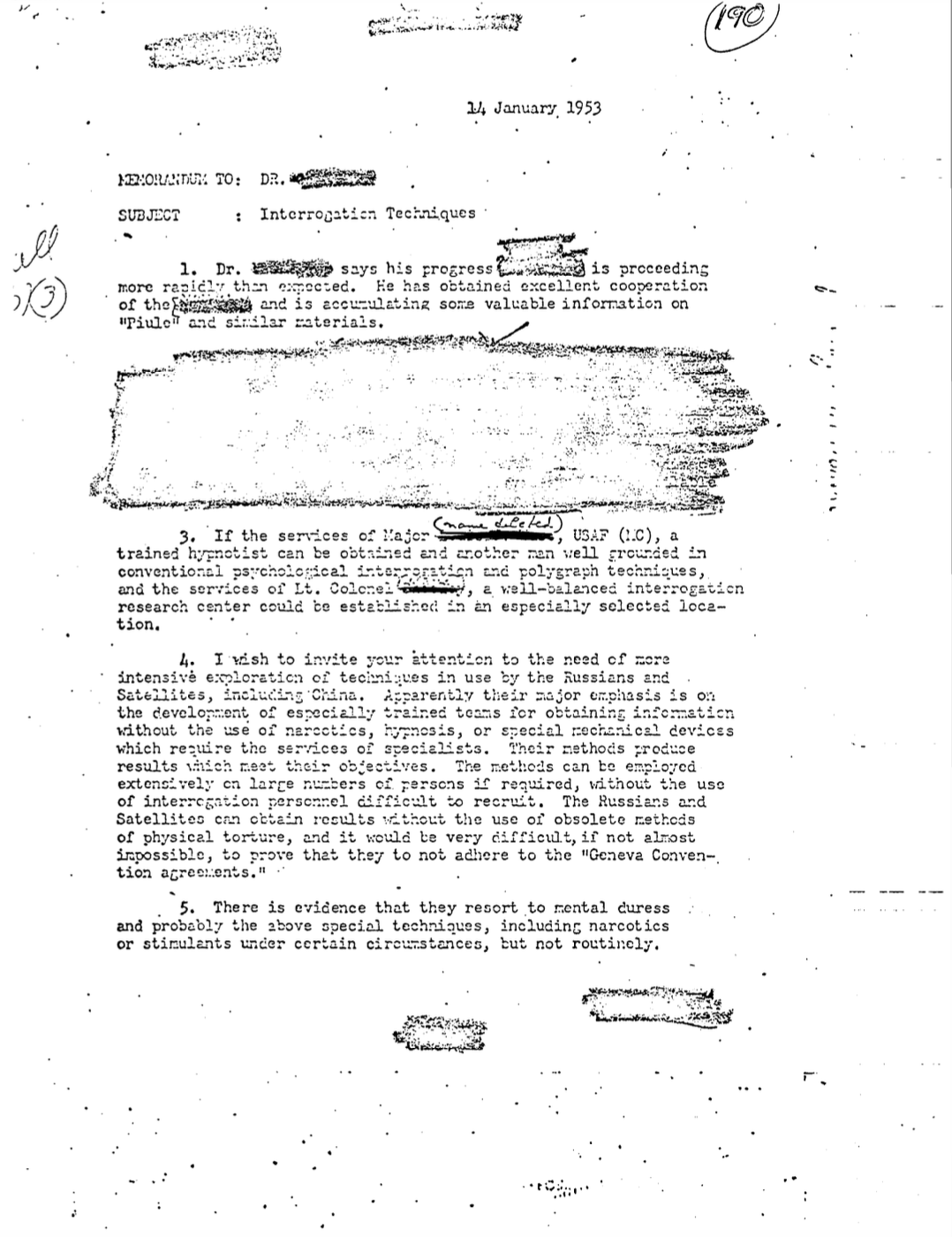
You’ve seen this memo already—I’ve referred to it many times. It’s the one where, in the third paragraph, they’re seeking three people, two of whom are named, for a “well-balanced interrogation research center.” 

The first person, Major REDACTED, USAF (MC), is Louis J. West, without question. If you zoom in on the paragraph, you can actually see the word Louis at the front of his name, and you can make out other key letters too. They describe him as being “a trained hypnotist,” which is a colossal understatement. He was chief of the Psychiatric Division at Lackland Air Force Base in San Antonio. Maybe the writer of the memo figured his audience already knew that part?

The second person, who is not named, is described as “another man well grounded in conventional psychological interrogation and polygraph techniques.” 

And the third person, Lt. Col. REDACTED, isn’t described at all. The only thing they say is that they’re hoping that “the services of Lt. Col. REDACTED” can be obtained, along with the other two men, for their well-balanced interrogation research center.

So this fits too. Lt. Col. Switzer’s name would be there because A. Pharo Gagge wanted it there. They don’t specify the services he’d provide because they’re leaving the possibilities open. I probably would have called him a liaison/researcher. You’ll see why in a second.

March 5, 1953

The last memo I’m sharing with you has to do with one of the regularly scheduled Artichoke meetings—this one having occurred on February 19, 1953. For some reason, the only participant whose name isn’t redacted is Sidney Gottlieb, representing OTS. (Many thanks to the redactionist for this act of kindness!)

Because these minutes cover a lot of territory, we’re only going to concentrate on two sections. The memo is also difficult to read, so I’ve typed a transcript of the entire document in case you’re interested.

First is section 2B., the first paragraph of which reads as follows:

REDACTED pointed out that REDACTED and REDACTED had come aboard and both REDACTED and REDACTED discussed the project at REDACTED involving REDACTED and the using of his facilities for a testing and research ground for our material. It was pointed out that REDACTED was to be our liaison between Headquarters and REDACTED since he knows REDACTED personally and has numerous contacts in the essential city.

The writer is discussing three people, which we’ll call person 1, person 2, and person 3. The first sentence describes persons 1 and 2 coming on board and how they’d be working together on a testing and research ground at someone’s facility “for our material.” (By “material,” I’m pretty sure they mean mind-altering chemicals.) I believe strongly that Louis Jolyon West is person 1 and, based on letters that I have between him and Sidney Gottlieb, the facility they’re speaking about would be at Lackland AFB. As for person 2, I believe that he is Donald W. Hastings, another psychiatrist, who was at the University of Minnesota’s Hospital, and who was very gung ho about the program. I don’t have time to discuss him today, but he’s mentioned in the letters between Jolly West and Sidney Gottlieb, which I’ve included copies of at the end of this post.

Person #3, I believe, is St. Clair Switzer. If I try to fill in the blanks of the second sentence in that paragraph, I believe they’re saying that Switzer was to serve as a liaison between the CIA’s Headquarters and the USAF Surgeon General’s Office since he knows General Gagge personally and has numerous contacts in….Dayton? Could Dayton be the “essential city” because it’s home to Wright Patterson AFB and ASTIA?

Section 2B. continues:

REDACTED pointed out that REDACTED [a consultant] was to be used in a very broad survey of the entire field. He also pointed out that REDACTED was not going to be used specifically to dig into one particular field but would study all ideas across the board and in connection with REDACTED, Dr. Gottlieb and REDACTED would help determine where important lines of interest lie and whether or not discoveries in the scientific and medical field are worthy of our interest, research and study.

The writer appears to be elaborating on Person #3. It’s here that he says that he’ll be used as a consultant to conduct a broad survey of all of the potential areas of interest regarding Project Artichoke. And get a load of who’s going to help him: Sidney Gottlieb plus another person whose name is redacted.

Now let’s jump to section 11, where the group is discussing the Research and Development Board’s Ad Hoc Study Group’s Report. As you’ll recall in my last post, people who were up to their necks in Project Artichoke weren’t enamored with the RDB Report because A. they disagreed with some of the members’ views, and B. it wasn’t focused on the sorts of operational things that they were already doing. Here’s what they had to say:

Following the above, a general discussion was held concerning the RDB Report and the REDACTED Reports. REDACTED pointed out certain differences in the point of view of the members of the Ad Hoc Committee and those engaged in actual operation work. REDACTED stated that the RDB Report was an overall survey of projects going on in the field and was not pointed at the type of work ARTICHOKE is engaged in since this was at the operations level and not in the broad research-experimental field.

Immediately following those comments, the REDACTED Report was brought up—what I believe to be the Switzer Report. Here’s that part of section 11:

During the discussion, REDACTED pointed out to REDACTED and  REDACTED that he anticipated receiving from Dr. Gottlieb the bibliography attached to the REDACTED Report soon and he would have it photographed and would turn over a copy to REDACTED for study. Dr. Gottlieb stated he expected the report soon and he would turn it over to REDACTED when he received it. (Bibliography is now being processed.)

So there we have it. Sidney Gottlieb, who was now in charge of all research pertaining to Project Artichoke, had taken a great interest in Doc Switzer’s PSB Report. Surely, he would have followed up with Doc to discuss the report as well as the accompanying bibliographies. And once that door was opened, who knows what other areas of collaboration might have come to pass.

******

As an added bonus, here are the letters between Louis Jolyon West and Sidney Gottlieb, who disguised his name as Sherman Grifford. These letters are part of West’s papers that are held at the UCLA Archives, which I visited a few summers ago. In these letters, West and Gottlieb discuss how to create a research facility at Lackland AFB involving hypnotizing human subjects. At the end of his letter dated July 7, 1953, West adds this:

“It makes me very happy to realize that you can consider me “an asset.” My interest in the entire body of work on which you are engaged is a keen and perhaps even a relatively enlightened one. Any services that I can render, along the lines you have indicated or in any other way, are gladly and eagerly offered. Surely there is no more vital undertaking conceivable in these times.”

The OTHER report: How I think Doc Switzer spent the summer of ’52

On February 18, 1952, a Monday no less, H. Marshall Chadwell was fuming. The previous Friday, Chadwell, who was no slouch—he was the assistant director of the CIA’s Office of Scientific Intelligence (OSI), for heaven’s sake—had been summarily snubbed by his contact for Army intelligence, and, needless to say, he was piiiiiiiiissssssed.

The issue had to do with Project Artichoke. Since March 1951, OSI had been placed in charge of this highly confidential, wildly controversial project, which was all well and good, except for one thing. As far as Chadwell was concerned, they didn’t have access to the necessary brainpower with which to lead such a project. In April 1951, several members of the Intelligence Advisory Committee (IAC) agreed to assist the CIA with its program. These included Army intelligence, whose shorthand name is G-2; Naval intelligence, or ONI; and Air Force intelligence, or A-2. For nearly a year, the CIA representatives and IAC designees had been meeting on an as-needed basis on Artichoke matters. An advisory panel of outside experts was also created, but the panel lacked direction and momentum. Chadwell felt as if OSI could use more help.

His reasoning was that Project Artichoke was way out of OSI’s bailiwick. It was focused on studying phenomena related to the human mind, including the feasibility of a little-understood technique called brainwashing that was appearing in news stories about U.S. prisoners of war. Because this was new territory for the OSI, Chadwell thought it would be beneficial to obtain guidance from people who understood how brains actually worked. He wanted to pick the brains, so to speak, of the Research and Development Board’s Committee on Medical Sciences. As we’ve discussed in another blog post, the Research and Development Board, or RDB, was the Department of Defense’s (DoD’s) powerful arm that directed all research and development for the entire military.

The RDB’s Committee on Medical Sciences “is the only group with the requisite security clearance which has the technical competence to advise on this problem,” Chadwell wrote.

But this couldn’t be done with a phone call. The CIA and the DoD were sprawling bureaucracies.  Chadwell would need to navigate the correct path in order to get the green light. Their agreed-upon plan was that the OSI would draft a memo from the director of central intelligence (DCI), who was Walter Bedell Smith, to the chair of the RDB, who was Walter G. Whitman. Once the draft was written, they’d run it by various CIA offices, getting their needed approvals. After that, they’d pass the memo to the IAC’s designees for G-2, ONI, and A-2, who would take it to their superiors for their OK as well. Then, once eeeeeeeeveryone had given their blessing, Walter Bedell Smith would sign the memo and off it would go to Walter Whitman, who hopefully, fingers crossed, would say OK, and, bada bing, bada boom, Chadwell would get some long-needed help from the medical specialists. 

WELL, everything was going along as planned, the memo was making its way up the chain, when the G-2 designee decided that he needed more input from on high. Instead of handing off the memo to his boss and maybe his boss’s boss, he decided to give it to the Joint Intelligence Committee, or JIC, which was an intelligence advisory committee to the Joint Chiefs of Staff, and 100% unrelated to the question at hand. It would be as if you were attempting to get your driver’s license renewed and your local DMV insists that you need to have your application approved by your auto mechanic before your renewal form can be processed. 

So now Chadwell was faced with this ridiculously unnecessary new step that the G-2 had inserted that would only slow things down.

Moreover, Project Artichoke was highly classified. As in C-O-N-F-I-D-E-N-T-I-A-L. As in the fewer the number of people who knew about it, the better. He didn’t want people to be passing Artichoke memos around willy nilly, especially to groups outside the CIA. 

Of course, Chadwell wasn’t having it. In his February 18 memo, he asked Walter Bedell Smith to kindly ignore the goofball from G-2, not to mention the JIC, and sign the memo, which eventually happened on March 5, 1952. On March 13, 1952, RDB chair Walter Whitman agreed to provide assistance, although, rather than committing his Medical Sciences committee, he offered to create an ad hoc study group which he felt could devote their full attention to the issue. 

So hooray, right? One big hurdle had been cleared. Not so fast. They now had to find a study group chair, plus some members, plus obtain the necessary security clearances for those individuals before they could actually start meeting in person, which, it turns out, was no easy prospect. That seemingly straightforward task would wind up taking months.

There was something else going on at the CIA. At the same time in which representatives were pulling together the ad hoc study group, the reins for Project Artichoke were being handed over from OSI to the Inspection and Security Office (I&SO) whose director was Sheffield Edwards. The I&SO Technical Services Staff (TSS), which was overseen by Willis Gibbons, would be responsible for working with the new RDB ad hoc study group. This change was made official in September 1952. 

The person whose role seemed to be the least affected by the changeover was Morse Allen, whose position was with I&SO as part of the Security Research Staff (SRS). (Yeah, I know, the CIA’s organizational structure gets confusing.) While everyone else was busy bringing their successors up to speed, Morse could go on doing what he was already doing. 

Interestingly for us, the transition hadn’t yet occurred before OSI’s project coordinator for Artichoke, Commander Robert J. Williams, had been informed by Morse Allen that two of Clark Hull’s protégées, St. Clair Switzer and Griffith Wynne Williams (no relation to the commander), would make excellent scientific consultants for Artichoke. Oh, sure, the names Clark Hull, St. Clair Switzer, Griffith Williams, and even Morse Allen are redacted, but I’m confident that those individuals were indeed mentioned. Hopefully, one day, the CIA will finally reveal the names of those men, all of whom have been dead for ages and whose disclosure would have zero effect on anyone’s safety and security. As you’ll recall, Morse Allen’s memo was dated March 25, 1952, which was 12 days after Whitman had given Chadwell the OK for an ad hoc study group for Project Artichoke.

On August 15, 1952, six months after Chadwell’s draft memo, the Ad Hoc Medical Study Group had their first meeting. The members were:

Haha. Just kidding. The CIA still won’t let us see the membership of the ad hoc group for the same reason they won’t let us see the names on the March 25 memo. They don’t feel like it.

By the time of the ad hoc group’s first meeting, Project Artichoke had evolved. Although it had originally been created to focus on special interrogations concerning POWs, its purpose was now broader.

As someone in Chadwell’s OSI operation put it in a July 1952 memo, “in spite of various interim definitions, the scope of Project Artichoke is research and testing to arrive at means of control, rather than the more limited concept embodied in ‘special interrogations.’”

So the goal was now control.

As for the RDB’s ad hoc study group, their purpose was: “to determine whether effective and practical techniques exist, or could be developed, which could be utilized to render an individual subservient to an imposed will or control.” Also: “Complete effectiveness of such techniques would require the individual to be subsequently unaware of their use.” 

So the goal is control, and P.S.: don’t let anyone know they’re being controlled.

The RDB Ad Hoc Medical Study Group Report

The RDB’s ad hoc study group met a grand total of four times—in August, October, November, and December of 1952. Although a summary report of their meetings is light on detail, it didn’t sound like they did much work between those meetings. The most productive meeting was the one in October, which included presentations and discussions on POWs, interrogation, LSD 25, and other redacted topics. They’d started producing drafts of their report in November, and by December, they felt they’d seen all they needed to see.

On January 15, 1953, the study group released their report, which turned out to be, in the viewpoint of Artichoke’s insiders at the CIA, a real clunker. Its 14 pages, two of which are the title page and the table of contents, take about 20 minutes to read. There’s also a 3-page appendix that includes a chart of pertinent military-funded projects, a membership roster (which, of course, is blank), and a meeting schedule. That’s it. That’s what four months of dialogue among a roomful of experts produced. 

Here ya go: Ad Hoc Medical Study Group Report

In all fairness, they weren’t given much material to work with. Their analysis was limited to six measly studies. Also, it can be difficult to get a group of people to agree on anything, so 14 pages may be a stunning feat in that regard. Still, they offer no citations to back up why they believe something to be true. With all due respect, their report possesses the in-depth analysis and higher-order thinking of a high school book report. One of my favorite lines—and it truly is only one line—addresses the extremely important question of how to safeguard information from being intercepted by an enemy. Here’s their esteemed response that occupies the entirety of section 1.7:

“The only sure method of safeguarding secret information is to limit the amount possessed by any one person and to prevent those who must know much from coming under the influence of the enemy.”

🤣

That’s it? Couldn’t they at least suggest, I don’t know, speaking in pig latin or something?

In a January 23, 1953, memo, a blacked-out name was reported as saying “the RDB study was not of optimum use in view of the fact that much information on classified work in progress had not been made available to the group.”

The chief of the Technical Branch, which is under SRS in I&SO (I know, I know—so confusing!) was less forgiving. Although his name is blacked out, I’m sure this person is Morse Allen, since I’ve found other documents corroborating that this was his job title at another point in time, though I haven’t yet found anything documenting his job title for this time period. 

On February 16, the branch chief wrote: “In general, the writer agrees in [sic] the overall statements set out by the BLANK group, but wishes to point out certain elements in the BLANK report that are subject to dispute.” He then went through his litany of grievances, which included that he didn’t think the group had been sufficiently informed about Project Artichoke and some of the techniques that were already in use; they were too focused on long-range planning versus short-term workable strategies; and he disagreed strongly with their assertions that “drugs, hypnosis, and brain-damaging processes” are “elaborate, impractical, and unnecessary” in interrogations or that hypnosis can’t make someone do something that goes against their beliefs. Who but Morse Allen would be this defensive about Project Artichoke—his beloved baby?

But honestly? I don’t think he was as upset as he comes across. Several months before the Ad Hoc Medical Study Group had issued their 14-page final report, another report had been making the rounds among a specialized audience in D.C. This report was far more detailed about Artichoke’s main interest areas. It exceeded 84 pages. It also included an appendix containing bibliographies—plural—that cited actual research studies that could support comments made within each chapter. Whereas the RDB study group report was likely already collecting dust on office shelves in Langley, this report was in high demand—so much so that people were having trouble hanging onto their personal copies. 

“Unfortunately, copies of the Report itself are so limited that I must request return of same when you have finished with it,” the Technical Branch chief (aka Morse Allen, I’m quite sure) instructed the chief of the Psychiatric Division on May 7, 1953. 

If you’re wondering why they didn’t make more copies on the agency’s photostat machine, I have no idea. But apparently this was exactly the kind of information that everyone affiliated with Project Artichoke was hungering for.

The OTHER report

The report that was surpassing expectations was produced on September 5, 1952, for the Psychological Strategy Board, or PSB. The PSB was created on April 4, 1951, by President Truman “to authorize and provide for the more effective planning, coordination, and conduct, within the framework of approved national policies, of psychological operations.” Any initiatives designed to influence the enemy psychologically were in their purview. This would include propaganda, like sending leaflets in balloons over enemy territory through Crusade for Freedom, for example. But it would include other activities too. Needless to say, Project Artichoke would have interested them quite a bit.

The PSB’s members were the undersecretary of state, the deputy secretary of defense, and the director of central intelligence or “their appropriate designees,” as well as other agency representatives as needed. Officials representing the Joint Chiefs of Staff and the Mutual Security Agency took part, as did the PSB director, Gordon Gray, and his staff. The PSB reported to the National Security Council (NSC). 

How the PSB initially got involved in Artichoke is anyone’s guess. Here’s mine: when the chair of the RDB, Walter Whitman, was asked by CIA Director Walter B. Smith for some assistance, he likely told his boss, Robert A. Lovett, who was deputy secretary of defense. Lovett probably thought this sounded, um…pertinent?…to the PSB’s mission, and brought it before the group. 

“The military has been funding technical studies for a while now,” he may have said. “Let’s pay a consultant to produce a report of our own that summarizes the applicable studies in psychiatric and psychological research! All in favor?” 

“AYE!!,” they’d respond.

He might have followed up with: “Does anyone know someone good?”

A second possibility is that Walter B. Smith may have brought it up to the group instead. It really makes no difference. Two key players who knew that the CIA was in need of relevant background research in the PSB’s area of responsibility were seated in the same room. Whoever raised the topic first is almost a moot point.

We’ve discussed the PSB report before. Very little of it has survived: a title page, a preface, and a table of contents. The highly sought-after meat of the report and its accompanying bibliographies are long gone. The subjects in the table of contents are: hypnosis (narcohypnosis and narcoanalysis); comments on certain drugs; transorbital lobotomy; electric shock and memory; communism and communists (some thoughts in attempted analysis); psychology and psychiatry in the U.S.S.R.; prisoner treatment; and sleep deprivation.

Here it is: the PSB Report.

As some of you recall, I’ve theorized that the report was written by St. Clair Switzer—even going so far as to suggest that people back then used to call it “The Switzer Report” informally. The preface was what sold me. The verbiage just sounded as if it had been written by Switzer, especially the part about the assistance he’d received “so cheerfully given.” I know, on its own, that’s pretty weak. 

Today, I’m presenting several additional pieces of evidence regarding why I’m more convinced than ever that St. Clair Switzer was indeed the author. Moreover, I believe that Switzer was the only person on the planet with the ideal credentials for doing what the powers-that-be felt needed to be done. It was his moment to shine, and, apparently, shine he did.

The timing

We already know that Switzer’s name was likely being bandied about ever since he was mentioned in the March 25, 1952, memo from Morse Allen to Commander Robert J. Williams. That memo was written 12 days after the RDB had been asked for assistance with Project Artichoke. It could be that Commander Williams brought his name up to Marshall Chadwell, suggesting him for the RDB’s Ad Hoc Medical Study Group, and Chadwell alerted RDB chair Walter Whitman. That seems pretty feasible.

But you know what? Even if that’s how Switzer came to the RDB’s attention, I no longer think that Switzer was on their ad hoc study group. For a reason that I’ll be getting to in a second, I think there was something unique about him that made people in the DoD think that they could use him in a more productive way. Perhaps they thought he could help bolster whatever the RDB’s ad hoc group came up with. After all, more information can’t be a bad thing, can it? 

In addition, as any professor knows, one of the true perks of being in academia is to have summers off. Doc Switzer would have been free to work on this research project from early June until classes started back up in September. Interestingly, the PSB report was completed exactly two weeks before the start of classes at Miami, giving Switzer time to prepare for the 1952-53 academic year. The timing couldn’t have been more perfect.

His whereabouts

In the summer of 1952, Doc Switzer was in Oxford, Ohio, which seems as though it would have put him at a disadvantage for conducting research for the PSB. But the opposite was true.

In May 1951, Secretary of Defense George Marshall issued a directive to consolidate all military libraries into one agency, which he called the Armed Services Technical Information Agency, or ASTIA. He assigned oversight responsibilities to the U.S. Air Force and the RDB.

I’ll give you one guess where its headquarters was located. 

Yep! Wright Patterson Air Force Base. What’s more, it wasn’t even located on the base itself, but in downtown Dayton, at 4th and Main Streets. The building was known as the United Brethren (UB) Building at the time, which later became the Knott Building, and is now the Centre City Building. Whatever its name, it’s 42 miles from Oxford.

Although ASTIA had an office at the Library of Congress, in Washington, D.C., all technical resources were provided through the Dayton facility. According to a June 29, 1952, article in the Dayton Daily News, “More than 900 individual military and government agencies and industries depend on ASTIA to keep them abreast of developments in the field of foreign technical progress. During the past four years, the organization has abstracted, catalogued, and filed more than 150,000 highly technical documents, dealing with 65 fields of knowledge.”

Need more proof? In the preface, the consultant has this to say: “Several librarians have devoted from part to nearly full time in aiding various parts of the research.”

In 1952, there was exactly one library building that contained all of the military’s technical studies and that library was located in Dayton, Ohio. Whatever you’re inclined to believe about the consultant who wrote the PSB report, I think we can all agree on this: he was working out of the UB Building in Dayton, Ohio, during the summer of 1952.

The people he knew

The consultant closes his preface with this: “The helpfulness and many kindnesses from the P.S.B. staff are gratefully acknowledged.”

Before I knew about ASTIA, I thought the consultant might have been working in the offices of the PSB, but we now know this wasn’t the case. He was working out of a brick building in Dayton, and any interactions he had with the PSB staff would primarily be by mail or telephone. 

I’m sure the staff were helpful, since the PSB was paying the consultant for his services. But I also think that there was one more person who helped grease the wheels for him. 

That person was Sidney Souers, a 1914 graduate of Miami University (born in Dayton!), who’d maintained strong ties with the university. During WWII, Souers was an officer in the U.S. Navy, serving in increasingly responsible posts in Naval intelligence. In 1945, he was awarded the rank of Rear Admiral. 

In January 1946, Souers was named the first director of the Central Intelligence Group, forerunner to the CIA, a position he held for five months. He then served as the first executive secretary of the NSC from 1947 to 1950. From 1950 to 1953, he served as an adviser to President Truman. It was while he was working in this role that Souers helped create the PSB in 1951. He maintained a connection with the PSB at least through the spring of 1952, when he was consulted for a one-year report for President Truman on the group’s organization and achievements.

Switzer’s connection to the university that Souers loved, in a city that Souers also loved, could be a real boost to his dealings with the PSB—don’t you think?

What do you think? Did St. Clair Switzer write the PSB report?

I don’t think Louis Jolyon West wrote the research proposal to develop a hypnotic messenger after all*

*But that doesn’t mean we should throw out our entire theory

When you’ve read as many MKULTRA documents as I have lately, you get to know people. You learn what their favorite subjects are. Their pet words and phrases. You recognize their go-to stats and data points when they’re sharing their expertise with a new audience or making a pitch for research dollars. You learn how they like to format a page as soon as they’ve cranked a sheet of onionskin paper into the old Smith Corona. You develop a feel for their gloriously, uniquely idiosyncratic THEM-ness. 

Sometimes, if a person has authored a lot of works and those documents have made their way into the public arena, we can identify something else they’ve written, even without being told who the author was. Even if their name is blacked-out. We can tell because it has their DNA all over it, figuratively speaking.

For example: let’s say that a person in the future stumbles upon an old document. The writer in question is going on and on about the topic of Ronald Tammen, her FOIA requests to the FBI and CIA that have been largely ignored, and a missing interview with Carl Knox’s former secretary. Some of her other quirks include a predilection for the word “ostensibly”; a tendency to use “who” even if “whom” is probably correct (but who the heck really knows?); and an unapologetic fondness for the Q&A format. If the document finder has ever been to this blogsite, I think they could easily conclude that the author was yours truly. This is who (whom?) I’ve become, DNA-wise. 

(NOTE: We won’t be discussing AI-generated content at this time, which, as I’m sure you can imagine, is a topic that I find concerning. Please be assured that every word on this blogsite is written by yours truly. Personally, I think writing is a craft that should be performed by an honest-to-goodness human if other humans are supposed to relate, deep down, to what they have to say. Besides, isn’t human-to-human connection what writing—not to mention life here on planet earth—is all about? Controversial, I know. OK, moving on.)

And so, Good Man readers, after getting to know several key MKULTRA players a lot better lately, I find myself forced to modify my initial theory by reporting to you that Louis Jolyon West did not, I repeat did not, write the proposal to develop a hypnotic messenger during the summer of 1957.

George Hoben Estabrooks did.

I can see you have questions.

Who’s George Hoben Estabrooks?

George Hoben Estabrooks (his friends called him Esty, so we will too) was born in 1895 in Saint John, New Brunswick, Canada, a beautiful and vibrant city on the Bay of Fundy, which is known for its primo whale watching. His education was about as stellar as you can get. He received his undergraduate degree from Acadia University, in Nova Scotia; he attended Oxford University as a Rhodes Scholar; and he earned his Ph.D. from Harvard. He became a psychology professor at Colgate University in Hamilton, NY, specializing in both educational psychology and abnormal psychology. He was named chair of the department in 1938. 

Esty Estabrooks had a passion for hypnosis, a skill he’d developed during WWII when he ostensibly worked in intelligence in the U.S. Army. (Interestingly, Colgate University’s president, George Cutten, had a similar passion. According to a December 1997 article in The Ottawa Citizen, Cutten had written a book on the psychology of alcoholism, for which he studied the use of hypnosis as a possible treatment.)

In 1943, when the United States was still very much at war, Esty Estabrooks published the book Hypnotism,which explained the concept of hypnosis to a general audience. He viewed hypnosis as having tremendous potential for a number of practical purposes and wanted to allay the fear and stigma attached to it. Truth be told, he was a pretty good communicator with lay audiences,  employing analogies and everyday language and even humor to help keep readers interested. (One story he shared involved a group of people who Esty was going to hypnotize using a recording he’d made of himself giving the instructions for going into a trance. When he discovered that he’d loaned his record out, he put on another record to hold the group’s attention, while he fetched the hypnosis record. When he returned, he discovered one subject had fallen into a trance-like state while listening to the other recording, which happened to be of a Swiss yodeler. I mean, that’s pretty funny, right??) As a result, Esty’s book did very well, and was even recommended reading by the Book-of-the-Month Club. In 1957, he published a revised edition, which is the version I have. Chapter 9, Hypnotism in Warfare, is a topic that was especially near and dear to his heart. We’ll discuss portions of that chapter momentarily.

The name Estabrooks may sound familiar to you. I mentioned him in my blog post titled MKULTRA and ‘U.’ His name is frequently tied to the term “Manchurian Candidate” by people who study this topic because, in a May 13, 1968, interview with the Providence (R.I.) Evening Bulletin, he very nearly admitted to creating one. (The original article isn’t available online so I’m linking to sources who have quoted him.) 

Here’s the quote that’s attributed to Esty Estabrooks: “The key to creating an effective spy or assassin rests in splitting a man’s personality, or creating multipersonality, with the aid of hypnotism. This is not science fiction. This has and is being done. I have done it.” And then he added: “It is child’s play now to develop a multiple personality through hypnotism,” which is decidedly not funny—not even a little bit.

Granted, it’s unclear if he was (merely?) admitting to splitting a man’s personality or to going all-in with the creation of an assassin, aka a Manchurian Candidate. But in 1971, he published an article that appeared in Science Digest in which he readily admitted to having created hypnotic couriers that were used as spies during WWII. I find this admission especially surprising since, in chapter nine of the 1957 edition of Hypnotism, he only says that the idea of a hypnotic courier is a proposed use of hypnosis—a possibility, as in we’re just brainstorming here. If the development of a hypnotic courier was already old hat by WWII—I mean, let’s ponder on that for a moment: he claims they were using hypnotic couriers as well as multiple personalities during World War TWO!—I’m guessing he wouldn’t have been shy about taking it to the next level and creating an assassin soon thereafter.

In a quote in the 1997 article of the Ottawa Citizen Sun, author, psychiatrist, and MKULTRA researcher Colin Ross, M.D., said, “In terms of Manchurian Candidate experimentation, he’s the number one person.”

All the while that Estabrooks was being incredibly chatty about his endeavors, particularly between 1957, when he published the second edition of his book, and 1971, when he admitted to creating the hypnotic courier during WWII, the CIA was attempting to keep its MKULTRA-related matters hidden. In the same Providence Evening Bulletin article, Estabrooks revealed that he’d consulted for the FBI and the CIA, which I’m sure pleased both organizations to no end. It also tends to make me question his assertion, since, in my experience, people who brag about being employed by the CIA are generally quite full of it. What’s more, in 1942, the FBI had already scolded Esty about making pronouncements that he was affiliated with the Bureau when they hadn’t even requested his help, which, in that case, had to do with research he was conducting on crime and hypnosis. Yet, in 1968, there he was again…bragging to a reporter about his FBI ties…while J. Edgar Hoover was still alive and well and cranky as all get out. His eagerness to go public on such highly sensitive matters as well as his tendency to state his abilities with so much swagger surely led at least several people from both agencies to view him leerily. I’ll show you what they had to say in a minute.

How do you know he wrote the proposal and not Louis Jolyon West?

Now that I know George Esty Estabrooks far better than I used to, I’m 100% positive that he was the author of the February 1957 proposal to develop a hypnotic messenger. I’m actually a little embarrassed that it took me this long to figure it out, since so many of his go-to words, phrases, and fun facts are scattered throughout the proposal, which was long on promises and short on details. (I think I’ve mentioned before that it would be considered a “trust me” proposal in research circles—a three-pager that basically says “You know me. I’m the best person to do this so can I please have $10K asap?”)

That said, it’s not as if Louis Jolyon West didn’t have an interest in developing a hypnotic courier for use by the military. He most definitely did, and he said so on page one, item #5, of his short-term goals in a six-page letter he wrote to the CIA’s Sidney Gottlieb (S.G.) in June 1953.

Page 1 of a letter written by Louis Jolyon West to Sidney Gottlieb

Also, the title of the February 1957 proposal adheres to the formula Jolly used for titling his own research proposals, which was always “Studies in blibbity blobbity blah blah blah.” Also Major Jolly West had recently ended his obligatory service in the U.S. Air Force at Lackland Air Force Base when the proposal was submitted. Who but a military guy with expertise in hypnosis would write a proposal on the application of hypnosis in the military? Nevertheless, for the reasons I list below, I can tell you with 100% certainty that the hypnotic messenger proposal was written by George H. Estabrooks and not Louis Jolyon West.

Here’s the link to the proposal, with special thanks to The Black Vault for making these MKULTRA documents available to all.

Hypnotism

One of the telltale words in the proposal is “hypnotism,” which was rather out-of-date by then. People still used it sometimes, but just not so much. But Esty used the word hypnotism all the time. That’s what he titled his book, including the 1957 version, and he uses it throughout the book as well. He used the word hypnosis too, but hypnotism was his preference. West, on the other hand, was using the term “hypnosis” in all of his documents from that era. So if he’d been using “hypnosis” in 1953, why would he refer to “hypnotism” in 1957? He wouldn’t. But Esty would.

Psychology

In the first sentence, the author says that “Hypnotism is now a recognized branch of the science of psychology…” yada yada yada. Why would Jolly West open his proposal with a reference to psychology instead of psychiatry? Answer: He wouldn’t. If you’re going to spend all of the time and money required to pursue a degree in psychiatry you wouldn’t lead with a field in which you didn’t pursue a degree. Furthermore, in his budget on page 3, the author says that a “psychiatrist should also be available.” Jolly West was a psychiatrist. If he was the author of the proposal, he would have made himself available. (How did I not catch that earlier?) For this reason, I believe the proposal’s author was a psychologist, namely George “Esty” Estabrooks.

Hypnotic messenger

On June 22, 1954, George H. Estabrooks submitted a memo to someone within the CIA titled “The Military Application of Hypntism [sic].” In that memo, he describes the creation of a courier, but refers to it as a “hypnotic messenger,” adding “if I may use the phrase.” That sounds as if he feels he coined the term. In his book Hypnotism, Esty refers to the hypnotic messenger almost exclusively when discussing the topic. A comparison of the wording and subject matter between the 1954 memo, which is still redacted, and Estabrooks’ book tells us that he wrote the 1954 memo, just as the similarity between those two documents and the proposal tells us that he wrote the proposal too. Oddly enough, in his 1971 Science Digest article, he didn’t call it a messenger but instead referred to it as a courier. He also cut way back on his use of the word “hypnotism” for that article, though not entirely. What can I say? People change. As for Jolly West, in his 1953 letter to Sidney Gottlieb, he used the word “courier.”

The statistic

Esty Estabrooks had one statistic that he used more than any other, and that statistic was that one out of every five adults was capable of going into the deepest hypnotic trance, which he referred to as somnambulism. He never cites the source—which probably means that he’s the source—but that statistic permeates his book to an annoying degree. (One of my chief criticisms of his book is that he’s very, very, VERY repetitive.) On page 44, he states it most strenuously: 

“One out of every five subjects will, on the average, go into deep hypnosis or somnambulism and no operator, whatever his skill, can better this average.” 

Does Esty’s mantra appear in the February 1957 proposal? Oh, you betcha. You can find it in the second paragraph, line two of the Introduction. Honestly, the moment I read that line after having read Esty’s book, I knew Esty had written the proposal. “One out of every five” was the singular phrase that sealed the deal for me.

The sign-off

We all have a favorite way of signing off in a letter. The proposal writer’s cover letter closed with a friendly and less common “Cordially yours.” Jolly West was strictly a “Sincerely” or a “Sincerely yours” kind of guy. I don’t think I’ve ever seen him swerve from that sentiment even once. But Esty? He preferred “Cordially yours.” It’s all over his letters in the file that the FBI kept on him. Sure, he occasionally slipped in a “Sincerely yours”—who among us hasn’t?—but “Cordially yours,” just like “hypnotism,” just like “hypnotic messenger,” was Esty’s M.O.

The file number 

Something I’ve started focusing on lately are the numbers and letters at the top righthand corner of the lion’s share of the MKULTRA documents. They begin with an A/B, a notation that Colin Ross, M.D., says means Artichoke/Bluebird, which makes sense. The A/B is followed by a number from 1 through 7, which is sometimes written as a Roman numeral. I’m not sure of the meaning of those numbers but it appears to be some type of grouping. The grouping that interests me most is group 5, or V, which appears to include various academics and others with whom the CIA may have consulted. The number after that has the broadest range. I’ve seen them reach upwards into the 300s. Following that number, sometimes after a slash mark, is another number that isn’t very big and seems to progress in numerical order. So you may find a document marked 353/1, another one marked 353/2, and so on.

Let’s direct our attention to the tops of the pages of MKULTRA document 147025 and concentrate only on the last two numbers. You’ll see a series of documents, beginning with the first, which is numbered 90/4, the next is 90/5, and the next is 90/6. (You can ignore the last two pages since they appear to have been misfiled. They have nothing to do with the preceding memos.)

Now look at the notations on the proposal. They are A/B, 5, 90/8. There’s that 90 again. I think the second-to-last number—the 90 in this case—is assigned to a particular person, and I think the last number—the 4, 5, 6, and now 8—is the number assigned to the particular piece of communication that pertains to that particular person. If Esty was the subject of the three memos from 1954, and I strongly believe he was, then I believe someone at the CIA assigned the number “90” to Esty’s records, which means that I also believe that he’s the author of the proposal.

By the way, when you have a chance, I recommend that you read the three 1954 memos. You’ll see that the CIA guys weren’t that impressed with him. Neither was the FBI for that matter.

Wow. This is a big shift in your theory.

Yes, it is, and I’m not going to lie, it bummed me out big time when I figured it out. But if we’re going to solve this mystery, we need to let go of the things that aren’t true. It’s taken me a week or so, but I’ve managed to do that and I’m hoping you’ll be able to do it too.

Does anything strike you as weird about Esty’s proposal?

As a matter of fact, yes! If Esty had indeed created a hypnotic messenger during WWII, as he claimed in 1971, I wonder why he didn’t mention that fact in his proposal. Here he was, a known braggart, and he didn’t think to mention this to his potential funder? Why did he make it sound as if this would be the first time? 

Incidentally, another copy of the proposal can be found here, and the person Esty was writing to was Morse Allen. Apparently, they were on a first-name basis, or at least Esty felt as if they were. (Morse may have felt differently.) Louis Jolyon West’s communications, on the other hand, were usually directed to the man on top—Sidney Gottlieb.

Do you think St. Clair Switzer worked with George Estabrooks instead of Louis Jolyon West in the summer of 1957?

Here’s what we know: St. Clair Switzer had been approved for a sabbatical for academic year 1956-57. However, the researcher he’d originally been planning to work with, Marion A. “Gus” Wenger (no relation), a UCLA psychologist, had decided at the last minute to travel to India to study yogis instead. There’s no way Switzer would have returned to Miami that year—not after waiting so long for his sabbatical. Not after writing in a December 1954 letter to Gus that “It’s quite a job to break out of this teaching straitjacket.” He was working with someone.

We also now know that George Estabrooks had someone working with him for the summer who was “thoroughly familiar with hypnotism at the theoretical level.” That could certainly describe Switzer, since he’d assisted Clark Hull with his 1933 book, “Hypnosis and Suggestibility,” which was both an experimental and theoretical study of hypnosis. Also, a CIA staffer had made the notation “H/B-6” next to that person’s crossed-out name, which I believe indicates that Esty’s helper was a military officer who was affiliated with a military base with an on-site hospital. Again, that could apply to Lt. Col. Switzer, particularly if he was working closely with Wright Patterson AFB.

On the other hand, Jolly West was deep into his research on POWs that year. The focus of that research—interrogation methods—happened to be the reason Switzer’s expertise in hypnosis and drugs was likely being sought by the CIA and military. As you know, I believe the January 14, 1953, memo on “Interrogation Techniques” mentions both Louis Jolyon West (I’m 100% sure) and Switzer (I’m pretty sure) for a “well-balanced interrogation research center.” So it could be that Switzer was at the University of Oklahoma helping West in the use of hypnosis and drugs for the interrogation of POWs, while Esty Estabrooks was across the country working on his hypnotic messenger.

I guess what’s really throwing me off right now are the two letters.

What two letters?

Around the time that Esty submitted his hypnotic messenger proposal to Morse Allen, someone who sounded a lot like St. Clair Switzer wrote two letters to a colleague of his, Griffith Wynne Williams, who was a renowned hypnosis expert and professor of psychology at Rutgers University. (Here’s a link to the December 6, 1956 letter. Here’s a link to the February 8, 1957 letter.) Williams and Switzer both studied under Clark Hull at the University of Wisconsin. Their time with him overlapped when Williams was pursuing his doctorate degree and Switzer was working on his master’s. The letters are congenial, if a little on the obsequious side, and they’re filled with extremely specific questions on hypnosis that quickly enter into the realm of the disturbing. 

The letter writer appears to be working with another researcher on a project of great importance. He makes it clear that the subject is “very highly classified” (December 6, 1956) and “sensitive” (February 8, 1957) and instructs Williams to destroy both letters immediately after he’s read them. Thankfully, we know for sure that Williams is the recipient even though his name is redacted because the CIA staffer with the black pen accidentally forgot to redact the word “Rutgers” (December 6, 1956) and he or she also allowed the word “arthritis” (February 8, 1957), which Williams was burdened with for much of his life, to remain exposed. I love when that happens.

So here’s where the letters are throwing me: in some ways they might support a collaboration between Switzer and Estabrooks, while at other times, they might be more indicative of a collaboration between Switzer and Jolly West, or someone else of his stature.

Do the letters pertain to Estabrooks’ research…

The letters are written around the time of Esty’s proposal, with the second letter being written just two days after the proposal was written. So that might lead us to presume that they were related to a collaboration between Esty and Switzer. 

Also, the letters indicate that the two secretive researchers had visited with Williams in person, once in his office, though they suggested a less visible place for their second meeting, such as the local hotel. It would be a lot easier for them to make a 4-hour drive from upstate New York to New Brunswick, N.J. than if they were traveling from Oklahoma. Of course, I’m sure the CIA could afford the plane fare, but I’m inclined to think that their interest in having multiple in-person meetings instead of talking by phone makes it sound as if it was relatively easy for them to do so. 

Or do they pertain to a researcher of higher stature, such as Jolly West?

At first, the questions that the letter writer asks in the December 1956 letter could be considered relevant to the development of a hypnotic messenger—such as the ones having to do with the production of amnesia (#1), concealed induction methods (#2), and problems with post-hypnotic control (#5). But the other questions go way beyond the scope of a hypnotic messenger, including the series of questions that are focused upon the hypnotizing of large groups of people through various means, such as TV broadcasts, speaking techniques, lighting, stage effects, and so on.

In addition, the letter writer appears open to any guidance that Williams could provide in 12 areas. But in the second edition of Esty’s book, which came out after the December letter was written, he said that the carotid artery technique (he calls it a “neck nerve”) is being done with jujitsu, and has nothing to do with a hypnotic trance, and that of course people can be hypnotized to do something that goes against their beliefs. Therefore, if it was Esty’s project, I can’t see him even asking questions #10 and #12.

Lastly, as mentioned earlier, the letter writer makes a very big deal of the fact that this is a secret project. He even uses the term “very highly classified.” Did you read what the guys in the CIA had to say about Estabrooks behind his back? Plus, you also know what a chatterbox this guy was. I’m just asking: Would those guys have given George Estabrooks a Secret or Top Secret classification? 

They had no problem designating the Top Secret classification to Louis Jolyon West, however.

******

P.S. I’d like to share one additional piece of evidence that St. Clair Switzer wrote the letters to Griffith Williams. You can find most of my reasoning in this blog post, and I’ll let those reasons stand as-is. 

However, one thing I mentioned in that post is the letter writer’s use of the term “Ph.D. thesis” in his December 6, 1956, letter. For most of us who don’t have a Ph.D., we think of a “master’s thesis” and a “doctoral dissertation,” and those terms are absolutely correct. But for some odd reason, some academics with doctoral degrees, not all of them, but some, will refer to a Ph.D. thesis. I don’t know why they do it, but they do.

Here’s a piece of evidence that St. Clair Switzer did it too.

In a letter he wrote to psychologist Ernest (Jack) Hilgard, St. Clair Switzer refers to his dissertation as a thesis. (See page 2, second paragraph.)

Some mothers are a bit more…complicated

A meditation on mothers and Manchurian Candidates

It’s Mother’s Day, and like you, I’ve been spending the day poring over MKULTRA documents. Oh, you haven’t been doing that today? I’m the only one? Well, not for long!

Because today, I’ll be sharing a document that could very well be the official start of the whole Manchurian Candidate thing. What’s more, it’s a true account—of the non-fiction variety.

As you may already know, “The Manchurian Candidate” was a novel by Richard Condon that came out in 1959. The movie, which starred Angela Lansbury, Laurence Harvey, and Frank Sinatra, was released in 1962. The film is so good that it has a permanent home on my DVR.

The story is about an American POW from the Korean War who was hypnotically programmed to assassinate a U.S. presidential candidate when given a special trigger. He was also instructed to promptly forget what he’d done afterward through a post-hypnotic suggestion. I won’t tell you any more than that, just in case you haven’t seen it yet. Lansbury, the programmed assassin’s mother, is phenomenal. (Spoiler alert: Jessica Fletcher, she is not.) The “Manchuria” reference is based on the fact that POWs passed through that region between China and Russia after being freed from North Korea. (Here’s a map to help you picture it.)

As the world would learn decades later, that wasn’t too different from what the CIA was dreaming up through Projects ARTICHOKE and MKULTRA. What’s more, some of the people in charge probably wouldn’t have felt the need to stop at just one Manchurian Candidate. Once they had the bugs worked out, they could…well, to quote one redacted expert who was bragging to U.S. intelligence officers: “Two hundred trained [BLANK] operators, trained in the United States, could develop a unique, dangerous army of hypnotically controlled agents.” (See document from March 4, 1952.)

I suppose I considered Condon to be incredibly prescient to have written his book 20 or so years before everyone else discovered that a Manchurian Candidate was a thing, of sorts, or at least something that some people within our government had set their sights on. But as John Marks, author of “The Search for the Manchurian Candidate: The CIA and Mind Control,” footnoted, “Condon consulted with a wide variety of experts while researching the book, and some inside sources may well have filled him in on the gist of a discussion that took place at a 1953 meeting at the CIA on behavior control.”

That’s the meeting that I was reading about as I was blearily clicking on some documents from July 1953 this morning. The meeting had occurred on June 18, 1953, two months after the first POWs had been exchanged with the North Koreans and Chinese (called the Little Switch), yet before the war had ended. I’m linking to the full document here, thanks to The Black Vault.

Probably after the first hour had passed in the meeting, someone had this to share:

Click on image for a closer look.

As Marks noted in his book, “The CIA and military men at this session promised to seek more information but the matter never came up again in either the documents released by the Agency or in the interviews done for this book.”

What do Manchurian Candidates have do with Ron Tammen’s story? Probably, hopefully, nothing. But the fact that these issues were being discussed at the same time that Louis Jolyon West (for sure) and St. Clair Switzer (I strongly believe) were being sought after for their expertise in hypnosis and drugs means that this topic, as well as all other related topics, automatically becomes our business.

Part 2: Desperately seeking Dorothy

Before we conduct our search for Dorothy Craig, let’s think a little about how unusual it was for Dorothy’s name to be written at the top of Carl Knox’s notepad. In those dwindling days before Ron Tammen disappeared, all of his other check-writing or check-cashing or check-depositing activities pertained to businesses or organizations: places like Cleveland Trust, Delta Tau Delta, Shillito’s, and whatever entity had given him a loan. But Dorothy Craig wasn’t a business. She was a person. And weirder still, Dorothy Craig happened to be a female person. 

In the year 1953, women weren’t generally known for their business transactions. Women were known for getting married. And once a woman was married, her identity was pretty much subsumed by her husband’s. Even her name. Once she was married, her signature would no longer begin with the name she was lovingly given on day 1 of her life—be it Helen, Margaret, Sadie, and, yes, Dorothy. Rather, she was now expected to use her husband’s name with the title “Mrs.” slapped in front. She was now Mrs. William this or Mrs. A.K that. 

A woman in the 1950s was frequently told not to worry her pretty little head about something she was worried about. She would be asked to leave the room so the men could discuss something that was way too complicated for her cute, loveable brain. Actually, men in the 1950s were pretty ingenious. By telling women over and over (and over) that their place was in the home, they’d essentially removed half of the competition for the jobs they were vying for. Plus after a long, hard day of glad-handing and 2-hour lunches, they could come home to a clean house with sparkling children, not to mention dinner and a cocktail. Brilliant, boys…brilliant.

Sorry. I realize that last part comes off as a bit harsh, and I also realize that it doesn’t hold true for every ‘50s-era man. However, if you’ve read as many articles and ads from back then as I have lately, well, it can make a girl cranky. 

Back to Dorothy Craig. What could this female person of the feminine persuasion have to do with Ronald Tammen that would have warranted her writing him a check? Conversely, what good or service could Ronald Tammen have provided in order to have earned said check?

As I began my search for Dorothy Craig, I soon realized that lots of women back then were named Dorothy. The surname of Craig was also common. I needed to establish some criteria. Here’s what I came up with:

First, she must be at least 18 years old in 1953 in order to have her own checking account.

Second, because the check was written on Oxford National Bank, which had no branches, she should live relatively close to Oxford, preferably within an hour’s drive.

And third, although this isn’t a requirement, I think it would be helpful if she had a job outside the home, since she would need some form of income in order to have her own checking account. Look at it this way: If Dorothy Craig had been single and living on her own, she would have needed a job—and a checking account—until she got married, that is. But if she were married and not working outside the home, Dorothy Craig would likely be the second name listed on a joint checking account. And if that had been the case, then Carl Knox would in all probability have written her husband’s name at the top of his notepad. See how it worked back then? If a man’s name had been anywhere near that check, even if Dorothy had written the check and signed it at the bottom, he would be given top billing and Dorothy would be largely ignored.

Keeping the above in mind, I conducted a search of the 1940 and 1950 censuses for all of the relevant counties and, if available, 1953 city directories for the tri-state area of Ohio, Kentucky, and Indiana. I looked for anyone named Dorothy Craig who fit the first two criteria, and I also kept track of each contender’s employment status. I also checked Miami University’s 1953 student directory as well as the alumni database to see if Dorothy Craig could have been a fellow student. (Answer: no.) I also checked the census forms of any Miami students in the 1953 directory who had the last name of Craig to see if their mother’s name might be Dorothy. (Answer: again, no.) Then I made an interactive map. 

So let’s interact, shall we? Here’s how:

  1. Click on the map above, which links to the interactive map.
  2. In the legend at the left, there are three categories. The first category is the location of unemployed Dorothy Craigs. The second category is the location of employed Dorothy Craigs. The third category is the location of Miami University.
  3. Start by checking the box next to each list so you can see all of the Dorothys at once and where they were located in comparison to Miami University.
  4. Now uncheck the Dorothys who were employed to see only the stay-at-home Dorothys and their location in comparison to Miami University. Click on each pin or the address in the legend to learn a little more about each person.
  5. Now uncheck the Dorothys who were unemployed and check the Dorothys who were employed and their location in comparison to Miami University. Click on each pin or the address in the legend to learn a little more about those Dorothy Craigs.

The best I can tell, there were 10 Dorothy Craigs that fit the criteria. Four Dorothy Craigs lived in Cincinnati; one lived in Newport, Kentucky, but worked in Cincinnati; one lived in a rural township in Montgomery County that later merged with the small town of Clayton; one lived in Dayton; one lived in Hamilton; one lived in Covington, Kentucky; and the last lived in Richmond, Indiana. 

Let’s start by discussing the unemployed Dorothy Craigs. I don’t know about you, but I’m having trouble imagining how Ron’s life would have intersected with a random home-bound housewife whose husband worked in a factory or on a farm. It might happen if Ron were selling something door-to-door, but I’ve seen zero evidence of that—especially if said door was 40 miles away. 

I know what you’re thinking. You’re thinking that, if Dorothy had anything to do with Ron’s disappearance, she might have been covertly working for a government agency—the CIA perhaps—and had purposely sought Ron out. Where better to conduct clandestine activities than a farmhouse in Randolph Township, Ohio?

Well, maybe. But she herself would have to be discovered by the CIA in the first place. If Dorothy were married to a mechanic or salesman and living in a brick bungalow in Cincinnati, well…I don’t think she would have been hobnobbing with the sorts of people who might have approached her with an opportunity filled with mystery and intrigue. If Roscoe Craig, husband to the Dorothy in Dayton, had been working for Wright Patterson Air Force Base, I suppose it would be somewhat possible, but he wasn’t. He was a maintenance worker at General Motors. I could be wrong, but I just don’t see how a housewife named Dorothy Craig could have sashayed her way into the CIA.

Only three Dorothy Craigs were employed. One was a single woman of 24 who worked at a drugstore in Cincinnati. The second was a 34-year-old married mother of four sons under 12, who commuted to Cincinnati from Kentucky to work for Gibson Art, forerunner to Gibson Greeting Cards. The third was a 51-year-old married mother of three adult children who worked at a paper mill in Hamilton.

Speaking of children, one issue that I began to consider a potential dealbreaker was the issue of offspring. Raising kids can be a lot of work, or so I’ve been told. They can take up a lot of their parents’ time and resources, particularly if they’re school-aged. No matter if Dorothy Craig was employed or unemployed, I think it would be way more difficult for her to have the motive, means, and opportunity to develop some sort of business relationship with Ron Tammen if she was raising one or more children under the age of 12 or 13. If Ron had been known to make some side money through babysitting, then maybe, but we have no evidence of that.

Which Dorothy Craig was it?

Let’s imagine that we have a bunch of ping pong balls, and each ball represents a different Dorothy Craig on our list. Now imagine that each individual ball is magically weighted according to how well that particular Dorothy Craig meets the criteria we’ve set for Ron’s Dorothy plus a few bonus attributes. The heavier the ball, the better the candidate. If we put the balls into one of those wire Bingo cages, and turned the crank, the heaviest ball would tumble out first, which would indicate that the Dorothy Craig it represents is more likely than the rest to have written the check to Ronald Tammen. And the most likely candidate to tumble out first is…

…51-year-old Dorothy Craig, on Carmen Avenue, in Hamilton, Ohio!

Here’s why:

She lived and worked roughly 12 miles from Oxford, Ohio.

The Dorothy Craig on Carmen Avenue was the closest of all the Dorothy Craigs to Miami University—roughly 17 miles closer than the second-closest Dorothy Craig, who lived in Richmond, Indiana. It would have been more convenient for her to open a checking account at Oxford National Bank in comparison to the others. Likewise, it wouldn’t have been too out-of-the-way for her to make periodic in-person visits if she needed to make a deposit or withdrawal. 

For those of you who are in your 20s, 30s, or, good grief, even your 40s, this may be new information to you, but that was something that people used to do in those days. They would make a trip to the bank, in person, all the time, especially on pay day. There was no such thing as direct deposit. There were no ATMs. What’s more, banking hours were super tight in those days. In that part of the state, the commonly observed hours of operation back then were 9 a.m. to 2:30 p.m. Monday through Friday and from 6:30 to 8:00 p.m. Friday nights for people who weren’t able to get there during the day. There were no Saturday hours.

If my experience as a bank teller in the late 1970s and early ‘80s is any indication, we used to see the same customers routinely—some every day, others weekly. We knew people by name. We had conversations with them that had nothing to do with banking. We had our favorites and they had theirs. From the sound of it, Dorothy Craig was a friendly, likeable woman, and Oxford was a tiny little town. I’d venture to say that one or more of the cashiers at Oxford National Bank had probably gotten to know her by face and name as well.

She had an income.

Dorothy Craig didn’t just have an income—she had a good income.

This is despite the fact that, in her youth, Dorothy Mueller (her maiden name) had dropped out of high school after the 10th grade. At first, it seemed odd to me that she would end her education so soon, but I don’t judge. Apparently, people, especially women, did that a lot more back then. (See paragraph two.) I mean, if a young girl was constantly being told that a woman’s place was in the home, would she really need to learn about Euclidian geometry?

But Dorothy had ambition. She mastered the skill of stenography and landed herself a good-paying job at the local paper mill. For many years, she worked as an order clerk in the General Scheduling Division at the paper mill, a job for which accuracy would be imperative. From what I gather, Dorothy and her colleagues in Scheduling helped ensure that enough paper was being manufactured from pulp in order to meet the demand of customer orders. That seems important.

In 1939, Dorothy had earned $1300, which was $180 more than her husband Henry, a laborer at a stove foundry, had earned. Although that may not sound like a big difference, salaries back then were distributed along a much narrower spectrum. A person earning a salary of $5000 was at the upper end of the pay scale, according to the U.S. census. In the 1940 census, if you made more than that—if, for example, you were the boss of a major corporation or if, say, you were the beloved exuberant singer of show tunes known as Ethel Merman—your salary was marked down as “$5000+.” 

Back at the paper mill, a secretary with two years of college had earned $1000 in 1939, $300 less than Dorothy. An order clerk with two years of college had earned $1800 that year, just $500 more than Dorothy, and he was male, which was always more lucrative. Another high school classmate of Dorothy’s—also male—with a bachelor’s degree and a lofty post in personnel at the paper mill, made $2000—just $700 more than Dorothy had earned that year. So she was well compensated. In 1949, her salary had nearly doubled to $2500. 

By 1951, all three of Dorothy’s children were married and living their own lives. She and Henry were officially empty nesters, which allowed her to concentrate more on her work as well as the outside activity that seemed to buoy her most: her church. In the 1955-56 Hamilton city directory, Dorothy was listed as an order editor, which ostensibly was a promotion from clerk. In 1960, Henry passed away after a lengthy illness, but Dorothy kept working. In 1961, she was listed as an office secretary at the paper mill. According to her obituary, she retired in 1967 after 30 years of service. She died at the age of 80 in 1982.

Dorothy didn’t just work at any paper mill. She worked at THE paper mill.

It was probably sometime around 2012, not long after reading Carl Knox’s note for the first time, that I’d found Dorothy Craig of Hamilton in the 1940 census. So I’ve known about her for a while. When the 1950 census was released last year, I’d looked her up there too. Both said she worked at a paper mill, and my reaction was, “?” I figured she must be the wrong Dorothy Craig. I couldn’t imagine Ron Tammen ever bumping into someone who worked as a stenographer at a paper mill, just as I couldn’t imagine a stenographer at a paper mill writing a check to Ron Tammen.

But that changed last month. As I’ve mentioned earlier, in his book Baseless, Nicholson Baker described a person who was high up in the CIA—Col. Kilbourne Johnston, the assistant director of the CIA’s Office of Policy Coordination, AKA covert activities, from 1950 to 1952. Shortly after his time at the CIA, Johnston had joined the Champion Paper and Fibre Company, one of the most successful paper manufacturers in the country. He started at their Texas location in 1955, and in 1957, he moved to their headquarters, which was based in Hamilton, Ohio, and worked as director of operations programming staff. (He chose to go by “Pat” instead of Kilbourne now.) He was named vice president in 1962. 

Col. Kilbourne Johnston aka Pat Johnston, credit: The Log, November 1958; Fair Use

“Hold on,” thought I, “The number two guy in the CIA’s covert activities division moved to Hamilton, Ohio?”

I love Hamilton. It’s an easy-going, walkable city that celebrates its art, music, and history—everything I adore in a town. It has a fantastic library too. You should go there sometime.

Could I picture the assistant director of the CIA putting down roots there in the mid-1950s? Not really. I knew that St. Clair Switzer would have loved having a fellow military officer and former CIA guy living close by. I wondered who or what might have lured Johnston there.

Several weeks later, when I set out on my Dorothy Craig search, I reread the census forms for the Dorothy Craig who lived in Hamilton, and was reminded that she’d worked for a paper mill. Those words had suddenly taken on new relevance. I wanted to know which paper mill, since there was more than one in Hamilton. Sure enough, Dorothy Craig had worked at Champion Paper and Fibre. In the company’s vernacular for all of its valued employees, Dorothy Craig was a Champion.

I have no idea how well Dorothy Craig and Kilbourne Johnston knew one another. Nevertheless, I’m 100 percent confident that the two of them were sharing the same hallways for years, beginning when he arrived in Hamilton in 1957. That realization led me to ask if anyone else of importance was sharing those hallways with her in the days before Dorothy Craig wrote the check to Ronald Tammen.

It’s Sunshine Week! Let the Sunshine In

It’s March 12, 2023, the first day of Sunshine Week, a time when journalists, authors, bloggers, documentarians, archivists, librarians, historians, students, teachers, and inquisitive citizens of all stripes pay homage to our right to review government files. Whether they’re old or new, hard copy or electronic, sleep-inducing or eye-opening, pristine or heavily redacted to the point of being laughable, public records can help us develop a better understanding of how our tax dollars are spent. It’s a way of holding public officials accountable.

In writing this, I’ve been humming that one song from the musical HAIR—starting with “Aquarius” and ending with “Let the Sunshine In.” As the lyrics have been going through my head, I’m like “Dang, gurl! These lyrics are apropos to Sunshine Week in a trippy sort of way!” But song lyrics are copyrighted. If I print them on my blog site, I’ll be going straight to song lyric jail, and I don’t think I’d last very long there. (Titles are OK though.)

Here’s what we’re going to do: I’m including a link to the lyrics here and you can fill in the blanks in your heads as you read along, Mad Libs–style.

Does everyone have the two web pages open, so you can toggle back and forth? Good. Let’s begin by focusing on PARAGRAPH 3 of the lyrics.

*************************

Thanks to our right to seek public records through the Freedom of Information Act (FOIA) and state sunshine laws, 

we can achieve _____________________________________________,

PAR 3, LINE 1

__________________________________________________________,

PAR 3, LINE 2

__________________________________________________________,

 PAR 3, LINE 3

maybe even the occasional____________________________________,

 PAR 3, LINE 4

plus, if we’re lucky, __________________________________________,

 PAR 3, LINE 5

and, ultimately, if the CIA finally comes clean about what’s still hiding in the MKULTRA documents,

__________________________________________________________.

 PAR 3, LINE 6

What then? Maybe, just maybe, if our ongoing quest for transparency inspires our government institutions to do their jobs ever more responsibly, and more responsively, for the citizens it serves, 

__________________________________________________________,

PAR 1, LINE 3   

__________________________________________________________!

PAR 1, LINE 4

*************************

Clearly, we have a ways to go.

Incidentally, if you’ve never heard the above sung by a Broadway cast, it’s time. I’m posting two renditions that were performed in NYC’s Ed Sullivan Theater. The first aired on March 30, 1969, on the Ed Sullivan Show, and the second was performed 40 years later, on April 30, 2009, on the Late Show with David Letterman. If you have a little time, consider watching both, paying close attention to the audiences’ reactions at the end. Fellow Boomers, I know we get mocked a lot these days, but if there’s one thing we’ve managed to accomplish, it was that, on our watch, people loosened up a bit more. 

That was fun, but, in all seriousness, transparency in our public institutions is extremely important. We’d never have gotten as far as we have in our fact-finding mission on Ronald Tammen without FOIA and Ohio’s Public Records Act.

And now, in the spirit of Sunshine Week, I’d like to make several announcements on the topic of FOIA and public records requests as they pertain to Ron’s story. Announcement #1 is enlightening, #2 is vindicating, #3 is…what it is, and you’re not going to believe how cool announcement #4 is.

Announcement #1

You should totally read:

 “Baseless: My Search for Secrets in the Ruins of the Freedom of Information Act,” by Nicholson Baker

Thanks to a reader’s recommendation, I recently finished reading Baseless (etc.), by Nicholson Baker, and maaaan, could I relate with the frustration he’s experienced when submitting FOIA requests to the CIA and Air Force. It appears that he has similar views about how the CIA treats its FOIA requesters—they’re just waiting for us to die. 

For years, Baker has been studying whether there’s truth to the rumors—which U.S. officials have summarily denied—that the United States had deployed biological weapons during the Korean War. He presents a strong case that they did. On the face of it, it might appear as if bioweapons research has little to do with the mind control research that we’re interested in, however, it is related. As you may recall, Frank Olson, who’s discussed in Baker’s book, was a prominent bioweapons researcher at Camp Detrick (later named Fort Detrick), in Maryland, in 1953. He’d had a bad reaction to some LSD that had been slipped into his drink at a CIA-sponsored retreat that took place November 18-20, 1953, and, on November 28, just two days after Thanksgiving, he fell (read: was likely pushed) out of a tenth-story hotel window in Manhattan. His case is directly linked to MKULTRA. 

I also learned a few things that are tied somewhat to Ron’s story, or, more specifically, to Ron’s former psychology professor, St. Clair Switzer.

First, Baker discusses several organizations that I’ve been bumping into in my research on Switzer. He has a lot to say about the Department of Defense’s Research and Development Board (RDB) as well as the Psychological Strategy Board (PSB), both of which were advocating for the use of bioweapons during the Korean War. In my post from May 20, 2021, I discuss Switzer’s possible relationship with both the RDB and the PSB. Don’t get me wrong, I’ve seen no evidence that links Switzer to possible bioweapons research—I still believe he was focused mostly on interrogation techniques, such as hypnosis and drugs, and the possible development of a hypnotic messenger—but he may have been running in the same circles as people who were.

Second is a random factoid that I find particularly fascinating. A man who has received a sizable word count in Baker’s book is Frank Wisner, the former director of the CIA’s Office of Policy Coordination (OPC), the epicenter for the CIA’s covert operations. Wisner had his hand in pretty much all of the CIA’s misdeeds at that time, including the importation of Nazi scientists after WWII through Operation Paperclip and the CIA’s overthrow of the democratically elected president of Guatemala in 1954 because they felt like it. He was a huge supporter of the use of bioweapons, and, naturally, he was involved in MKULTRA too. 

The person I find even more compelling was Wisner’s assistant director, Col. Kilbourne Johnston, who was an expert on biological and chemical warfare and who, according to Baker, was employed with the Air Force at the same time he was with the CIA. 

Let me just say that Baker has some seriously mad research skills, because I’ve found no online sources linking Kilbourne Johnston to the Air Force—only documents pertaining to his stint with the Army Service Forces during WWII. But Baker found hard copies of documents that identify a Mr. Johnson—which was Johnston’s original surname—in the Air Force who had the same phone number as the CIA’s Kilbourne Johnston. According to Baker’s citations in the back pages of his book, Johnston was in the Air Force’s Air Targets Division, which, well…I think we have a pretty good notion of their area of expertise.

After an extended illness following a trip to Asia in May 1952, Johnston left both the CIA and the Air Force and started a lithograph business. (I don’t care who you are;  when your inner voice tells you that life’s too short and that you need to start something new, like lithography, for example, it’s best to heed the call.) In 1955, at the still-youthful age of 48, he signed on with the Texas Division of Champion Paper, a name that probably rings a bell for readers who are familiar with the paper mill that used to occupy 601 N. B Street in Hamilton, Ohio. And for good reason. Because in the late 1950s, this highly decorated Air Force colonel and assistant director of the CIA moved to Hamilton to work at the headquarters of Champion Paper, and in 1962, he was named vice president. He remained in that position until 1966. 

In other words, this Army/Air Force colonel who knew everything there was to know about what the CIA was up to in the early 1950s was living 10 miles from Miami University not too long after he left the Agency. Did he and Lt. Col. Switzer ever meet up for coffee or a cold one to, you know, talk about sensitive stuff? If Switzer had known who was living nearby, I think he would have conjured up a way.

The third take-home I learned from Baker’s book could turn out to be a game-changer. It has to do with a more efficient, more effective way to search for CIA documents that are posted in their Electronic Reading Room. If you visit the search page for the CIA’s FOIA Electronic Reading Room and type in a word or term such as “hypnosis,” you’ll probably bring up a huge number of pages to wade through, most of which have no bearing on what you’re actually looking for. But if you type “hypnosis” site:cia.gov into the Google search bar, a more digestible list of documents will pop up, with short descriptions that give you a clue what they’re about and quick links that take you straight to the document instead of an intermediary page that the CIA has set up. It’s usually faster too.

This search technique plus a document that Baker describes in his book concerning the CIA’s sanitization process directly applies to…

Announcement #2

The unredacted July 15, 1952, memo still hasn’t turned up

Remember the CIA memo dated July 15, 1952, in which a group of panelists is named for a [BLANK] Study Group? As I mentioned in my May 20, 2021, blog post, I think that the letters RDB (abbrev-speak for the Department of Defense’s Research and Development Board) occupy the blank next to “Subject” and I also believe, based on the chronology of various related memos, that the RDB’s study group had to do with Project ARTICHOKE.

All of the names listed in the memo are blanked out as well. Here’s that memo: 

In August 2016, I submitted a FOIA request to the CIA asking them to lift the redactions from the list of names. Almost three years later, on May 12, 2019, they responded as follows: “Please be advised that we conducted a thorough and diligent search in an effort to locate a full-text version of the document, but unfortunately were unsuccessful.” 

In other words: Sorry, but we only have the whited-out version.

I appealed on the basis of, well, here’s an excerpt: “I find it inconceivable that a government employee charged with the critical responsibility of declassifying national security documents would be so sloppy and abusive in his or her handling of this information as to somehow misplace or destroy the original document, particularly given the CIA’s already embarrassing history with mishandling documents pertaining to MKULTRA.” 

I also quoted Senator Edward Kennedy, who said the following during the Joint Hearing before the Select Committee on Intelligence on MKULTRA in August 1977:

The intelligence community of this Nation, which requires a shroud of secrecy in order to operate, has a very sacred trust from the American people. The CIA’s program of human experimentation of the fifties and sixties violated that trust. It was violated again on the day the bulk of the agency’s records were destroyed in 1973. It is violated each time a responsible official refuses to recollect the details of the program. The best safeguard against abuses in the future is a complete public accounting of the abuses of the past. [bold formatting added]

On June 11, 2021, they wrote and said that I should receive a ruling sometime around December 8, 2022. I’m not sure what I was doing on December 8, 2022, which was a Thursday, but I know for sure that I wasn’t reading the CIA’s ruling on my appeal, which has yet to arrive.

Last week, I called the CIA and left a message asking for a status update on my appeal. Still no word. 

But in the book Baseless, Nicholson Baker discusses a CIA document from 1975 (the year when the Church Committee was investigating the intelligence activities of the CIA and other agencies) that describes a process by which the CIA sanitized its records in response to requests from members of the House and Senate. Its title, “Workers’ Kit for Sanitizing Documents,” is friendly and adorable and almost sounds as if they could create a child’s version to sell on Amazon. I’m including it here:

In that process, for every original document that was requested, the worker made two Xerox copies. On copy 1, the worker drew lines through words that they felt needed to be covered up, and on copy 2, they put correction tape over those words and typed less specific words to take their place. Then they made more copies of the taped-over version for people up the chain to review and for the worker to keep as a record. I’m sure this protocol is different than the one used in declassification—at least from my experience, they don’t type over their redactions in declassification—but I’m guessing it’s not that different.

If you look at the July 15, 1952, memo, you can see that it’s a copy, and a really bad copy at that. Also, the whited-out parts are super straight, as if it was done with correction tape. My guess is, not only is there an original version, but there are likely several versions of this memo, including the original, the taped-over version, and at least one of several copies that were made of the taped-over version for the higher-ups. They can’t have lost all of those copies, can they? 

Besides, what would it say about the CIA’s declassification process if the original copy—the one containing all the ostensibly classified information—is the one that gets mislaid somewhere while the taped-over copy is the only one they can find?

Speaking of taped-over copies…

Announcement #3

Most of the posts on Carl Knox’s former secretary and/or the Miami Stories Oral History Project have been pulled down

If you’ve been wondering what happened to my posts concerning my search for an interview with Carl Knox’s former secretary—the ones where I talk about edited tapes, missing tapes, the recorded-over tape, and ice hockey—I’ve pulled most of them down for now. They still exist and there may come a time when I repost one or more or all of them, but for now I’ve decided to handle things this way.

If I have something truly significant to share, I will, however, most activity on this topic is now being conducted behind the scenes.

I just don’t want you to feel out of sorts when you run searches for them and come up empty.

But speaking of sorts and searches…(😬 …too lame?)

Announcement #4

For the first time ever, you can download a sortable, searchable MKULTRA index here, on this website!

I’ve saved the best announcement for last. I am totally pumped to let you know that Julie Miles, AGMIHTF reader, frequent commenter, good book recommender (she’s the one who recommended Nicholson Baker’s book to me), and computer sorceress, has taken the CIA’s mammoth index of MKULTRA titles and…

…wait for it….

…made a spreadsheet out of it. 

I’m. Not. Joking.

Anyone who’s explored the MKULTRA collection understands that you have to start with the index to figure out which documents are pertinent to whatever you’re researching. But the index is 84 pages long and incredibly random—dates, topics, you name it, are all over the place. It’s almost as if the CIA made it that way on purpose. Plus, the PDF pages that are posted online aren’t searchable. Until now, you had to scroll through the index, page by page, to figure out which documents you’d like to review, and then you opened one of four folders originally provided by the CIA, now posted on the Black Vault website, and searched for the ID number. In 2018, the Black Vault posted additional MKULTRA documents that they’d obtained from the CIA. 

Now, thanks to Miles, the index is transcribed as a spreadsheet into Google Sheets. You can copy/paste it as-is to your hard drive, or download or copy/paste it to a preferred software, such as Excel. Then, run with it, have fun with it! You can organize it however you’d like: alphabetically, topically, chronologically, etc., which makes it sooooooo much easier to find what you’re looking for. Then you can locate the pertinent document or documents from the Black Vault site.

As far as I can tell, not only has no one attempted this before, but no one has even considered attempting it before. It’s that daunting. But Miles thought it seemed doable, and then she went ahead and did it. 

[Wait for applause.]

Meryl Streep Applause GIF by SAG Awards - Find & Share on GIPHY

And now, without further ado, here’s the link to the MKULTRA index:

LINK TO INDEX

User notes as well as other helpful info can be found at the bottom.

If you prefer to have it in Excel, here you go:

Although I happen to think it looks perfect, Miles says that it’s still a draft, so there may be tiny corrections or style changes in store. If anyone wants to assist in proofing it, please contact me at rontammenproject@gmail.com and I’ll pass along your info. Also, Miles has created an email address specifically related to the MKULTRA index for questions, comments, suggestions, whatever. But please bear in mind that this isn’t her full-time job, so she can’t guarantee a response: mkuitranscribed@gmail.com. Nevertheless, she’s interested in your feedback.

So happy Sunshine Week, y’all! If you have any FOIA stories to share to help us celebrate, please feel free to comment below. Also, this is a reminder that the 70th anniversary of Ron’s disappearance is fast approaching. If you have ideas on how we might observe the date of April 19, 2023, please feel free to suggest those below as well.

Breaking the CIA’s MKULTRA code, part deux

Credit: Photo by Cottonbro Studio at Pexels.com

Happy New Year! 

In celebration of the first day of 2023—the 70th year in which Ron Tammen has been missing not to mention the 70th anniversary of when Allen Dulles formally signed off on MKULTRA—I’d like to offer up the following new meanings for letters in the CIA’s MKULTRA coding system. (For those of you who have no idea what I’m talking about, you may want to read my previous post first.)

The letter D

D is for….a subject matter expert in an area of specialization pertaining to ARTICHOKE, and someone with whom the CIA may wish to follow up. 

I guess we should have figured the whole “let’s use the first letter of the word it represents” thing wouldn’t last. But that doesn’t mean that we can’t give it a D word anyway. And the D word that seems most appropriate is: doyen (pronounced DOI-en or DWI-yan, your choice), which I’d never heard of before, but which showed up in a list of synonyms when I typed in the word “expert.”

I have a feeling that the D label was used somewhat broadly. While it might be used for someone in academia, it might also be used as a reference to a news event in which a person or group of people appeared to possess a desired knowledge or skillset that the CIA wanted to learn more about. An outlier document used Ds to highlight possible interrogation questions.

So even though the D category still seems a little squishy, here’s a link to the document that sealed the deal for me.

In that document, every time you see the letter D, you see a reference to an expert in the field. In this case, the people with Ds next to their blacked-out names knew all about certain drugs.

This document also has a few Ds in front of the names of individuals (page 3) or specific cases (pages 1, 6, and 8) that the CIA could follow up with or investigate further.

And in the case of our March 25, 1952, memo, the doyens are our three hypnosis experts: Clark Hull, St. Clair Switzer, and Griffith W. Williams. The CIA categorizers didn’t seem to care that the writer had said that Hull was feeble and no longer interested in hypnosis. “So? He can’t even answer the phone in the interest of national security?” the categorizers hypothetically countered in their snide little way. “He’s getting three Ds anyway.” (Of course I’m kidding. As you know, I feel nothing but gratitude for the CIA categorizers.)

Page 1 of March 25, 1952, memo; click on image for a closer view

The letter H

The letter H is for…

…wait for it…

…the Department of Defense. (I’m a little flummoxed as to why the CIA categorizers didn’t assign the letter D to the DoD. Would that have been too obvious?)

We’d almost figured it out a few days ago, but I was thinking too granularly (as I am known to do). I’d seen the document with the H next to the paragraph that talked about the pilots, and had immediately thought Air Force. But I couldn’t understand why the other military branches wouldn’t have their own letter as well, since they were doing ARTICHOKE stuff too.

As I focused on the stand-alone H’s in the MKULTRA collection, I started noticing them in places of prominence: next to names cc’d at the bottoms of memos with other higher-ups, and on Louis Jolyon West’s Subproject 43 materials, including in the “From” line of a handwritten memo. As you may recall, West was a major in the Air Force before moving on to head the Department of Psychiatry and Neurology at the University of Oklahoma School of Medicine.

Click on image for a closer view

And then I came upon a memo that we already knew about—one that I’d submitted a Freedom of Information Act request to the CIA about in August 2016 and appealed in 2019. (I’m still waiting to hear back from them, even though the last time they wrote to me, they claimed I’d have an answer by the very specific date of December 8, 2022. I guess someone will be getting a phone call tomorrow.) 

Click on image for a closer view

The heavily redacted memo is a list of the members of a study group that had been commissioned by the DoD’s Research and Development Board (RDB), a board I’d written about in May 2021. The CIA had asked the RDB to investigate the feasibility of using ARTICHOKE techniques and the RDB  chose to conduct its investigation through the ad hoc group of experts. When I reexamined that document closely, I saw that the crossed-out subject of the RDB’s study group name was assigned an H, even though its members were all Cs (consultants) who represented an assortment of Bs (research organizations). That’s when I began to think more broadly.

In another document, I noticed an H next to the black blotch before the word “officers” and I found a handwritten document with an H before the phrase “Man to contact in AF film” (the AF ostensibly refers to the Air Force) on page 1 and, on page 4, another H alongside the words “several service representatives.” Who but the DoD would have access to representatives of several branches of the military service?

Click on image for a closer view

I’m convinced—H on its own stands for the DoD as a whole, one of its service branches, or someone affiliated with the DoD, usually someone at a higher level.

BONUS LETTERS

The letter E

Remember the E that I talked about at the end of my last post? (Alas, I can’t find the document where I’d first seen it.)  I now believe that E stands for…a line item or account with a financial institution of some sort. 

We learn this from Louis Jolyon West’s Subproject 43 materials that say: “I hereby acknowledge receipt of check #”…blah blah blah…“drawn on the BLANK,” the latter of which is marked with an E. It happens in other places in his materials as well.

Click on image for a closer view

Unless I find another use that changes my mind, the E category seems pretty obvious. It’s an account of some sort.

The letters D/H and I

As I was focusing on H’s, I landed on a document that used the letters D/H together in a whole new nefarious way throughout pages 1-5, with the letter H flying solo on page 6. The CIA categorizers threw the letter I into the fray as well.

Page 1 of June 21, 1952, memo on ARTICHOKE Techniques; click on image for a closer view

Based on this document, the letters D/H together appear to signify a test subject who has received drugs and hypnosis. This is in contrast to page 6, where the writer is recommending that, after conducting experiments on the two human subjects (D/H and D/H), the H (DoD) should consider using the ARTICHOKE technique whenever they see fit. In his view, “there will be many a failure but also that every success with this method will be pure gravy,” which is one of the most bizarre sentences I’ve read in the MKULTRA materials.

Page 6 of the June 21, 1952, memo; click on image for a closer view

As for the I, it appears to be a country against whom the CIA is developing its interrogation techniques.

So there you have it, my attempt at cracking the CIA’s MKULTRA code so far. The plan is to post a chart on the homepage to help anyone who is researching the MKULTRA documents.

MKULTRA Shorthand Guide

A                      Agency (CIA)

B                      Research Org/Business

C                      Consultant

D                     Expert/Knowledgeable Source in ARTICHOKE-related topic

E                      Financial Account

F                      Foreign 

G                     CIA Internal Group/Office

H                     Department of Defense

I                       Enemy Country/CIA target for ARTICHOKE method 

J                       ?

D/H                 Human Subject of ARTICHOKE method 

B/1                  ?

B/3                  Military Base

B/6                  Military Officer

H-B/1              ?

H-B/3              Military Base Hospital

H-B/6              Officer/Medical Specialist at Military Base Hospital

S                      ?

(Note: We may never know S, since it only appears at the top of some docs, but not in association with redacted text.)

More evidence that St. Clair Switzer was on the CIA’s payroll

Plus a bonus puzzler: Let’s make a little history and break some CIA code

Have you had enough holiday yet? Same. You want to do something kinda wild during this down week before New Year’s? Me too.

Let’s break some CIA code.

The CIA code I’m referring to can be found on a large number of MKULTRA documents that have already been released to the public. According to Google, the project I’m proposing has never been done before. If we can do this—and I believe that we can—we’ll be ripping open a whole new portal into the top secret world of MKULTRA. 

You heard me right. Us. Remember us? The ones who, I believe, first put two and two together to reveal Commander Robert Jay Williams as the former project coordinator of Project ARTICHOKE? The first ones who let the universe at-large know about St. Clair Switzer’s MKULTRA connections? The ones who discovered—much to the consternation of the FBI—why they’d purged Ron Tammen’s fingerprints 30 years ahead of schedule? We’re qualified to do this. We’re credentialed. The good news is that we won’t even be starting at square one. I do believe I’ve figured out some of the code already. And the better news is that the code I’ve figured out tells me that St. Clair Switzer was indeed working for the CIA at some point of his career. They said so themselves. Let’s do this!

Background

At an unknown point in time, one or more persons within the CIA had gone through every surviving MKULTRA document and, on many of them, had written a letter of the alphabet and sometimes an accompanying number alongside key places of redacted text. The alphabetical list isn’t very long. It starts with the letter A and ends with H.** To the best of my knowledge, only three numbers were used: 3, 6, and, on the rarest of occasions, 1.

The letters or letter-number combos appear to refer to a person who is employed by an organization, the organization as a whole, or, very generally, a place, be it domestic or international. The CIA categorizers, as we shall refer to them, probably did this because lots and lots of names are dropped in CIA memos. It’s useful to have some additional identifying information about who Joe Blow is and what his role is in the grand scheme of things. 

I don’t know who the intended audience is or was of this helpful, categorized information. The CIA staffers of the future? The guys and gals in the business wing at Langley who were keeping the books? (If you’ll recall, most of the MKULTRA docs had been destroyed in 1973, so the only surviving records originated with the people in accounting.) Given the CIA’s distaste for the Freedom of Information Act, I doubt very much that they were doing it to help out you and me. 

But therein lies the poetic justice in all of this: even as someone at the CIA was busily crossing out names and job titles and hometowns and whatnot, someone else at the CIA was actually offering up a clue into a certain person’s identity. Very, VERY cool of you, CIA. 

The puzzle

You know the letter that I believe was written by Louis Jolyon West to the CIA on February 6, 1957? In that letter, the man whom I believe to be Jolly West refers to another man who is spending the 1956-57 academic year helping him with his research. It was (I believe) West’s intention to create a hypnotic messenger during the summer of ‘57 and to have his eminently qualified helper, well, help him. And it’s my hypothesis that his helper was St. Clair Switzer, who was Ronald Tammen’s psychology professor the semester that Tammen disappeared.

At that point in our country’s history, the CIA and U.S. military wanted to learn as much as possible about interrogation techniques that could be used on prisoners of war, such as those involving hypnosis and drugs. They wanted to learn how they could elicit treasure troves of intelligence from POWs that the Americans had captured, and, conversely, how to ensure that American POWs wouldn’t give away the store to their captors. The interrogation aspect of the CIA’s mind control endeavors was known as Project ARTICHOKE, which was later broadened in scope beyond POWs. The creation of a hypnotic messenger—someone who could be hypnotized to deliver a detailed message of high sensitivity to an intended recipient without ever knowing what the message was—would’ve been right up the CIA’s alley back then. 

Let’s begin by reexamining that letter, which was mailed to the CIA’s Morse Allen to accompany the hypnotic messenger proposal. The author (who, again, I believe to be Louis Jolyon West) has the letter C written next to his blacked-out name. The letter-number written next to his associate’s name is H-B/6. If we could figure out the meaning of H-B/6, we could further strengthen, or weaken, our argument that Jolly West’s helper was St. Clair Switzer. 

Document provided thanks to TheBlackVault.com; click on image for a closer view

After rereading a lot of MKULTRA documents—especially those pertaining to Project ARTICHOKE—and comparing notations from one document to the next, I think I’ve figured out the meaning of H-B/6. And (spoiler alert!) I believe that our argument has been strengthened. What’s more, I think I’ve found additional evidence to show that the CIA welcomed St. Clair Switzer to its cadre of hypnosis researchers with open arms.

The letters

The letters and letter-number combinations that the CIA uses throughout the MKULTRA documents, some more frequently than others, are as follows:

A

B

C

D

F

G

H

B/1

B/3

B/6

H-B/1

H-B/3

H-B/6

That list may not seem too terrible, but there’s a reason that (to the best of my knowledge) this project has never been attempted before by a layperson. Reading MKULTRA documents is always irritating. No one does it for fun.

The ones I think we know for sure

Let’s start with the easy letters—the meanings for which I’m 99.9% certain:

A is the Agency itself. Anyone with an A next to his or her name is employed by the CIA. It’s written next to a lot of important job titles in the “To” and “From” lines of a CIA memo, and it’s often written next to an author’s name at the bottom of a CIA-composed letter. It’s written next to the names of CIA staffers whose identities have been revealed—people like Morse Allen and Robert Jay Williams. It’s this simple: if you have an A next to your name, you, my friend, are in the CIA.

B, I believe, stands for a Business or Organization that conducts the type of research in which the CIA was especially interested. And, in the early to mid-1950s, the type of research that the CIA’s ARTICHOKE program was especially interested in pertained to hypnosis and drugs. As you can see on the February 6, 1957, letter, an address at the top right is blacked out and marked with a B, which is likely Jolly West’s business address. 

Here’s a table in which the letter B clearly signifies a Research Organization, versus C, which stands for…

C stands for Consultant. Anyone with a C next to their blacked-out name is employed by another entity, likely a university or research organization. They may be partially supported by the CIA through a grant or contract or some other temporary means for their expertise, although not everyone with a C was paid. Some offered up their expert opinions free of charge. In the February 6 letter, ostensibly, Jolly West was considered a C, but his workplace was categorized as a B.

F is for Foreign. The letter F is used to signify a country whose name has been redacted, sometimes as a location to conduct ARTICHOKE experiments or perhaps to denote other related overseas travel or consultation.

Clever, right? Our friends at the CIA came up with alphabetical shorthand that uses the first letter of the word it represents. I don’t know if that will apply to all of the categories, but it’s a nice way to start. As you can probably imagine, the letters A and C are by far the most frequently ones used in the ARTICHOKE documents.

The tougher ones

The Bs and Hs gave me the biggest trouble, since they appeared alone as well as with numbers. I also knew that the three main branches of the military were heavily involved in ARTICHOKE, but I was having difficulty identifying which branch might be represented by a corresponding letter. I won’t bore you with why I thought this, but for a while, I thought the B might mean Navy, the H might mean Air Force, and the G might be the Army. But that system didn’t play out in the documents.

Just an example of a confusing document; click on image for a closer view

And then I started to think like the bean counters in the CIA. You know what? If they can lump all the research orgs together, and they can lump all the consultants together, and they can lump everyone in the CIA together, then they can certainly lump all of the people in uniform together. I’d concluded that the B/3s and B/6s were part of the military because of their “tour of duty” and war talk and their inclination to measure hours in a day by the hundreds. That’s when I determined that B/3 meant a military base and B/6 meant an officer who is affiliated with a military base. As for the H that precedes the B/3s or B/6s, I figured out what that meant when I read the following two paragraphs from page 5 of a lengthy document in which the writer was kvetching about how no one, particularly researchers affiliated with the military, ever briefed him on any of their ARTICHOKE-related activities. Here are the two most awesome grafs:

So, now we know, and I just want to thank the CIA categorizers for practically handing us the working definitions of an H-B/3 and an H-B/6. H-B/3 ostensibly refers to a hospital or clinic on a military base and an H-B/6 ostensibly refers to an officer, and most likely a medical specialist, who is affiliated with a military base that has a hospital or clinic on site. A hospital on a military site would be considered a huge plus in conducting ARTICHOKE research. You, as an ARTICHOKE researcher, would be among friends. You wouldn’t have to hide what you’re doing nearly as much as if you were in a non-military hospital. 

Aaaaand, guess what? Wright-Patterson Air Force Base had just completed a 314-bed, 7-floor, state-of-the-art hospital facility in June 1956. So, yeah, if psychologist St. Clair Switzer was still active in the Air Force Reserves in 1957, and he very much was, and he was known in the hallways of Wright Patterson AFB, and he no-doubt was, then an H-B/6 next to his name would be apropos. I’d think that having an H-B/6 next to your name would be one of the more glowing attributes in the eyes of Morse Allen, the recipient of (ostensibly) Jolly West’s letter.

The ones that could use more research

Before I get to the most exciting part of this post, here are the categories that I’m still stuck on. If anyone has an inkling to visit The Black Vault’s MKULTRA collection to find occurrences of the following and to help figure out their meaning, I’d be grateful:

D – The March 25, 1952, letter that (ostensibly) refers to Clark Hull, St. Clair Switzer, and Griffith Williams, the Rutgers professor and hypnosis expert who’d also worked under Clark Hull, is studded with handwritten letter Ds. Because Ds weren’t used very frequently in the MKULTRA documents I’ve examined, I haven’t yet figured out a pattern. Perhaps it indicates referrals for consideration, but I don’t know. I don’t think it stands for drugs, since neither Clark Hull nor Griffith Williams had expertise in that area.

G – I think G stands for an internal group within the CIA, such as the gadgetry group mentioned in this memo. (Good Lord, do you think it stands for Gadgetry?) A letter for various separate internal groups makes sense if we’re considering the perspective of an Agency accountant. If they need to expend money from a specific line item for a designated group within the Agency, then that would be an important distinction.

H – I’m most stymied by the letter H when used on its own, with no B/3s or B/6s nearby. At one point I thought it represented hypnosis, but I don’t think so. When I noticed the blurb about the pilots, that’s when I thought it might mean the Air Force. But that would be weird to have a special designation for the Air Force and not the other military branches, wouldn’t it?This one definitely needs to be investigated further. ¯\_(ツ)_/¯

B/1 (H-B/1) – I haven’t seen enough of this designation to ascertain how it differs from the B/3 and B/6 designations, but I think it’s probably similar. I don’t think it matters for our purposes though.

The most exciting part: why I think St. Clair Switzer was on the CIA payroll

In my blog post about how St. Clair Switzer spent his 1956-57 sabbatical, including the summer of 1957, I introduced two letters that I believe were written from St. Clair Switzer to his former colleague under Clark Hull, Griffith Williams. In the letters, Switzer is hoping to obtain guidance from Williams, who was, by then, an internationally recognized expert in the field of hypnosis.

Let’s have another look at those letters with our newfound knowledge.

Document provided thanks to TheBlackVault.com; click on image for a closer view

As you can see, any references to Williams have a C attached to them—in CIA lingo, he was considered a Consultant. But in the December 6, 1956, letter, references to West and Switzer were bestowed with As. They were considered Agency. Curiously enough, in the February 8, 1957, letter, West and Williams were designated as Cs, while the letter writer, whom I believe to be St. Clair Switzer, was an A-lister once again.

You may ask: are you sure that it was Switzer who wrote the two letters? Couldn’t it have been Morse Allen? I honestly don’t think so. First, the letters aren’t written in Allen’s style. Allen wasn’t an academic. The two letters were written by someone who clearly was. His words, “We grant that the above list is long and that any item individually could well deserve a Ph.D thesis,” tells me that the writer held his own doctorate degree, and he was acknowledging that the recipient did as well. He’s comfortably collegiate. In addition, the letter writer is gracious and deferential, both to the recipient, who is unquestionably Williams, but also to the researcher with whom the writer is working. He uses the term “we” quite a bit. Morse Allen worked alone. There was no “we” when he wrote his letters and memos about ARTICHOKE. From what I’ve read, Morse Allen didn’t do gracious. Switzer was no sweetheart either, but he knew how to write as if he were.

If St. Clair Switzer was the letter writer, and I continue to believe that he was, then he wasn’t a wannabe sitting on the sidelines. Switzer was CIA, at least for part of his career. That’s big. I also think he was running in those circles for quite a while.

******

P.S.: This post came to be because of one person’s recent email asking a question about Lackland Air Force Base. His question led me back to the MKULTRA documents, which was when I started fixating on the H-B/6 notation. I’m not sure I would have tried to figure out its meaning without that email. So…thank you…to all of you, for your input. You really do contribute to this process and influence my thinking in new ways.

******

** Late in the process, I noticed a faint S at the top of several documents, and on one document to date, several Js and Es. These are the exceptions to the rule. I’m going to ignore them for this blog post, since they don’t pertain to the question at hand, but I acknowledge their existence. If you can figure out what in the heck they mean, let me know!

More evidence that St. Clair Switzer was involved in something in 1956-57 that he didn’t want to talk about

I’ll keep this short. 

I’ve been thinking more about St. Clair Switzer. 

You know how I have this theory that Doc Switzer was on a sabbatical in academic year 1956-57 with Louis Jolyon (Jolly) West, the world famous psychiatrist and MKULTRA researcher who was at the University of Oklahoma at that time? And you know how I also believe that Jolly West was the author of a February 1957 CIA research proposal seeking funding for himself and a visiting academic (Switzer, imo) who was “thoroughly familiar with hypnotism at the theoretical level” to create a hypnotic messenger that summer for use by the military?

Gosh, when I put it like that, it does seem a wee bit far-fetched, doesn’t it?

Well, I have a little more info to help back it up.

Don’t get too excited—it’s not that big. But it’s not nothing either.

We already know that Switzer had been granted permission for a sabbatical for that academic year. His original plans had been to work under psychophysiologist Marion A. (Gus) Wenger (no relation) at UCLA the prior year, but those plans had to be postponed. Everett Patten, chair of Miami’s psychology department, felt that he needed Switzer around to help with a curriculum change that was taking place at that time, and he suggested that Switzer’s sabbatical be pushed back a year. With this turn of events, Switzer checked with Wenger to see if the change was OK with him and Gus said that the new timeframe should still be fine. But in December 1956—three months into the 1956-57 academic year—Gus wrote to Switzer telling him that he’d decided to travel to India to study yogis instead. He offered a space for Switzer in September 1957, but, because Switzer’s sabbatical would have ended by then, that would be too late.

How do we know that Switzer found somewhere else to go?

We know that Switzer was definitely not working in Miami’s psychology department that year because his earnings sheet shows a total of $00 for the year 1956-57. Here’s the document:

Click on image for a closer view

The stray mark to the right of the “7” had first made me wonder if the earnings line for that year just hadn’t picked up enough inkjet toner, but I don’t think so. To me, it looks more like something had been written there but was erased. For this reason, I think it’s safe to conclude that Switzer made zero dollars and zippo cents that year from Miami.

That’s a little odd, since Clarence Kreger, Miami’s cantankerous provost, had informed Switzer that he could earn half his salary while on sabbatical. (These days, sabbaticals are usually fully paid, but times were different then.) (I feel like I say that a lot on this blog.) (I feel like I use parentheses a lot too.) Anyway, somehow, Switzer was able to make ends meet without needing that little boost. He was out of the office all year, including the summers of 1956 and 1957.

Click on image for a closer view

How do we know that he was gone during the summers too?

We know it because Switzer was a self-promoter. If there was an achievement that he wanted other people to know about, he’d alert one of the local rags, especially the easier ones to get into, like the Miami Student or the Oxford Press. This was especially true when he was an assistant professor in the 1930s. Often the hard-hitting news blurbs were about prize money he’d won for an ad or slogan he’d submitted in a contest, which he did frequently as part of his business psychology course. If he spent the summer doing something prestigious-sounding—like the time he’d worked with prisoners at Northeastern Penitentiary in Lewisburg, PA—you can bet that Switzer would make sure it was brought to the attention of fellow faculty members, administrators, and the surrounding Oxford community. Promotions received, degrees earned, joining the war effort, returning from the war effort—he liked to have such things documented. (As a historical researcher, I’m not opposed to this practice.) 

Later on, as his extracurricular activities became more, um, stealth, he reined in his need for newsprint. 

During the year of his sabbatical, Switzer found two occasions to show off a little for the folks at home. In August 1956, an article appeared in one of the local papers announcing that Switzer had returned from a “tour of duty” at Lowry Air Force Base in Colorado. (According to his military records, his tours of duty averaged 15 days.) During that visit, he’d helped develop the psychology curriculum for the new Air Force Academy, which had been temporarily located there while the permanent school was being constructed in Colorado Springs. A year later, a much shorter article was published saying that he’d just returned home after spending three more weeks at the Air Force Academy. 

What I’m trying to say here is that Switzer had been on a sabbatical for roughly 64 weeks, yet we only get to know what he did for five or six of those weeks. Whatever he was doing between the two Augusts, he wasn’t saying. And trust me, if Switzer was ever presented with the chance to boast about his accomplishments, he seized it. If he’d spent the year conducting psychophysiological research in Gus Wenger’s lab, the world would have heard about it. 

It was uncharacteristic for him to be so tight-lipped in those circumstances, which leads me to wonder if he used the second news item to bookend his time away. Maybe then people wouldn’t ask questions about all that time in between.

How did he manage to find a spot with Louis Jolyon West so soon after Gus Wenger let him down?

This is where the timeline gets murky. Gus Wenger’s letter was dated December 1, 1956, and by the sound of it, it was late in coming. 

“Dear Doc, I have been meaning to write you for some time about our plans,” he said. He then proceeded to describe a number of monkey wrenches that had been thrown into their original arrangements while offering an alternative date that was much too late.

The letter was addressed to Switzer’s office in the Department of Psychology, which Switzer surely wasn’t occupying by then. The department secretary would’ve probably forwarded the letter to Switzer’s home address, but that would have taken even more time away from his eroding sabbatical.

It’s possible that Switzer was biding his time at Wright Patterson as he waited on Wenger. But patience isn’t exactly a virtue that I would ascribe to St. Clair Switzer. Sometime after returning from Colorado, I can see him giving up on the prospect of spending a year in California and seeking assistance from his highly decorated contacts with the Air Force. By late fall, I think they’d put him in touch with Jolly West.

You’ve already seen the letter that I believe Switzer had written to a colleague he knew from his Clark Hull days, Griffith W. Williams, who was then at Rutgers. That letter, dated December 6, 1956, had been a follow-up to a discussion that had taken place between the three hypnosis experts, likely over the phone, on November 27. 

Here it is again:

Document provided with thanks to The Black Vault at https://www.theblackvault.com/

By the time Wenger finally wrote to Switzer on December 1 saying “no can do,” I think Switzer had already moved on.

How about you—what do you think? 

The sabbatical: how I think St. Clair Switzer and a well-known MKULTRA psychiatrist spent the summer of 1957

There’s nothing quite like the fourth wave of a pandemic to put one in the mood to read old MKULTRA documents. For some reason, the prospect of reading indecipherable photocopies with all the good parts blacked out made me want to do anything else BUT that. However, because the delta variant has been keeping me from doing more exciting research, I’ve decided to mosey on back to The Black Vault website. I’m currently rummaging through the stash again—both the documents I’d already been through as well as the ones that were released in 2018. 

It’s been time well spent.

In my recent Facebook post, I describe a newly released document that appears to be written to Griffith Wynne Williams, a hypnosis expert who’d studied under Clark Hull at the University of Wisconsin. Williams and St. Clair Switzer (Ronald Tammen’s psychology professor) would have known one another pretty well back in the day. They were graduate students under Hull at the same time, with Williams receiving his Ph.D. in 1929, the same year that Switzer earned his master’s degree. I’ve brought up Williams’ name before on this blogsite. I believe he’s the third person mentioned in our March 25, 1952, memo, along with Hull and Switzer.

In this newly discovered letter—dated December 6, 1956—the writer mentions the recipient’s workplace, Rutgers, a revelation that somehow escaped the CIA’s black pen. I know of exactly one hypnosis expert from Rutgers during that era. Griffith Wynne Williams.

December 6, 1956 letter

Document provided thanks to TheBlackVault.com; click on image for a closer view

After reading more documents on The Black Vault from that general time period, not only am I even more convinced that the recipient was Williams, but I also believe that the letter writer was St. Clair Switzer. I also think that at the time that he was writing the letter, Switzer was on sabbatical and working with…

wait for it…

Louis Jolyon (Jolly) West.

Those are some bold assertions, I know, but I have evidence. Let’s do it this way: I’ll present two additional documents that I’ve found on The Black Vault website, one that was released in 2018 and the other that had been available on CD-ROM but that has gained new significance now that we know about the two letters. After each document, I’ll submit my arguments for why I’ve reached the above conclusions. Here we go.

February 8, 1957 letter

This letter is from the same person as before, and its recipient is also Griffith Williams. I’m 100 percent confident that it’s Williams because the letter writer refers to the recipient’s recent “attack of arthritis.” Williams had a long history with rheumatoid arthritis. Also, Williams was a respected hypnosis researcher who frequently demonstrated hypnotic phenomena before large audiences. In 1947, he hypnotized members of a theater troupe between the first and second acts to see if it might improve their acting ability, a stunt that brought him national attention. The topics of discussion in both letters were right up Williams’ alley.

Document provided thanks to TheBlackVault.com; click on image for a closer view

Because this letter is tougher to read, I’m including the verbiage here:

8 February 1957

Dear [BLANK],

We were delighted to receive your most interesting letter of 22 January 1957. Sorry to hear of the attack of arthritis and we hope that it is better now. [BLANK] and I have gone over your material and suggestions and find them very useful.

The problem of the use of hypnosis by a public speaker or some related technique which could be used by an individual to control or influence a crowd is of considerable importance and as you have noted there is very little information along these lines anywhere. This area is particularly interesting to [BLANK]. He told me that he will obtain [BLANK’S] book immediately.

Your comments concerning the possibility of making the subjects do something against their ethics or religious convictions were also extremely interesting. Unfortunately, these single tests, without proper conditioning or properly building a background are not too valid. In general, your examples cover most of the experience in the field. However, the next time we see you we will tell you of some unusual work and results with which we are familiar. I found your reaction to the carotid artery technique interests me. Some people insist the technique is very dangerous and your reactions convinced me that this area could stand a great deal of work. I have not tried the technique myself but have been present when it has been done. There is some debate as to whether or not this is true hypnosis or a coma-like condition produced as a result of pressure on the artery. I’ll have to start looking for volunteers.

The rest of your suggestions and ideas are very worthwhile. As I said before I hope to discuss them with you in the near future at some greater length.

[BLANK] and I know that you are very busy what with teaching and the special work you do for the [BLANK]. We were, however, very impressed with you [sic] honesty in this field and the fact that you were willing to spend some of your valuable time with us. Sometime in the near future we will get in touch with you and try to arrange it so that our visit will not interfere with any school work or other work you may be doing. I am very much in favor of informal discussions in this [field?] at some quiet spot and perhaps we can arrange it so that you could come to the local hotel and have dinner with us and talk later.

While I know it is unnecessary for me to again caution you concerning the highly sensitive nature of this material, I will ask you to destroy this letter when you have read it.

With kindest personal regards.

Very sincerely,

[BLANK]

Why I think St. Clair Switzer wrote the 1956 and 1957 letters 

My dear BLANK 

The opening to the 1956 letter, “My dear BLANK,” is pure Clark Hull. I have dozens of Hull’s letters to both Switzer and Everett Patten, Miami’s longtime department chair in psychology, and nearly every single one of them opens with that phrase. It’s cute and endearing. I think Switzer seemed to like it too. He would use it from time to time, depending on the stature of the recipient and his relationship with them. He used it in a letter to Miami University President Upham in 1936. Because he was writing to a fellow Hull student, he probably thought it would be a nice reminder of their former mentor, who’d passed away in 1952.

His use of telltale vocabulary words 

In the 1956 letter, after the list of topics, the letter writer says “We grant that the above list is long and that any item individually could well deserve a Ph.D. thesis…”. In my experience, these are the words of someone who holds a doctoral degree. The general public frequently calls the product of someone’s doctoral research a dissertation. But among doctoral degree holders, they’ll frequently refer to their dissertation as a Ph.D. thesis. These are the words of someone in academia.

A telltale vocabulary word in the February 1957 letter is the reference to “conditioning” when talking about a subject being made to do something against his or her ethics or religious convictions. Clark Hull was a behaviorist who felt that all human behavior could be defined through conditioned responses. Conditioning was part of Switzer’s academic upbringing, probably Williams’ too. Switzer’s first scientific paper was titled “Backward Conditioning of the Lid Reflex.” The czar of conditioning himself—Pavlov!—had requested a reprint of Switzer’s paper back in 1932, which was a major coup. Clark Hull’s (endearing) response was “I think that if Pavlov should ask for anything that I had done I should have some kind of seizure – I don’t know just what!”

The insecure tone

Switzer’s words are gracious and deferential, but also self-important, which isn’t an easy vibe to pull off.  He would be obsequious to those he viewed as “better” or more knowledgeable than he was about a particular subject area or if he needed something, both of which I think applied to Williams. 

As for his self-importance—his repeated cautionary words, his bragging about being privy to insider info—I view Switzer as an insecure academic. He published very little after he returned to Oxford from WWII and he didn’t maintain strong relationships with his academic peers outside of Oxford. Therefore, he seemed to bolster his self-esteem through his association with the military.

He was writing to an old associate from his glory days with Hull

Switzer wasn’t good at making friends with colleagues. He didn’t attend professional meetings. He didn’t go to departmental picnics. He rubbed people the wrong way, especially as he got older. Because he published very little, he probably wasn’t keeping up with the scientific literature either. So, here he is, ostensibly working on a “highly classified” hypnosis project with someone big, and they have some questions about what’s currently happening in the field. Who does this letter writer contact? A person Switzer used to know in grad school.  

He was approved for a sabbatical for the 1956-57 academic year

In his 1957 letter to Williams, the letter writer talks about how busy Williams must be with teaching, which made me wonder: why isn’t this person also busy with teaching? He’s an academic too. As it so happens, Switzer had been approved for a sabbatical that year. Originally, he was planning to go to UCLA to work in the laboratory of Marion A. (Gus) Wenger. (Uncle Gus! Nah…no relation.) However, that fell through at the last minute when Gus decided to go to India to study yogis. 

So what’s a guy to do? Say “oh well” and go back to his regular teaching schedule at Miami? Hardly. That sabbatical had been approved two years earlier by President Millett and if Switzer could get out of a year of teaching, he surely would. I’m certain his friends in the Air Force helped him find a replacement gig, which leads us to the third document.

A proposal for “Studies in the Military Application of Hypnotism: 1. The Hypnotic Messenger”

As I said before, even though this document was included on the original CD-ROM I’d received from the CIA, it takes on new relevance when juxtaposed with the two letters that weren’t available until 2018. 

Document provided thanks to TheBlackVault.com; click on image for a closer view

First, note that it was written just two days before the February 1957 letter. Second, the timeframe is rather, um, ambitious, shall we say? The proposal writer calls the development of a hypnotic messenger “uncomplicated” and claims that he and his associate should be able to complete their project by the end of the summer. That’s a special kind of arrogance. Third, there’s no meat to this proposal. People who oversee federal grants might be inclined to call this a “trust me” proposal, something that a researcher—particularly one who is well known in his or her field—might send to a funding source before the details have all been fleshed out. (Thankfully, funders of today can spot a “trust me” proposal a mile away, and they’ll send it back unfunded.) But this proposal writer appears to be saying: “Hey, you guys, it’s me here. You know I can do the work. Heck, I have a couple other projects waiting in the wings that are MUCH harder. Can I expect the ten grand in the mail ASAP?” (In today’s money, that’s a little over $97,000.)

Why I think Jolly West was the proposal writer and St. Clair Switzer was his associate

  • Both West and Switzer are military officers in academia who have expertise in hypnosis. I don’t believe there would have been a large number of people meeting these qualifications back then.
  • The proposal writer seems to be a big deal. His cover letter is relatively informal, as if he’s on a first-name basis with the recipient. His tone isn’t the least bit deferential. They appear to have an “ask and you shall receive” sort of relationship.
  • The proposal writer’s cover letter also mentions a man he is fortunate to have with him “this year” who is “thoroughly familiar with hypnotism at the theoretical level.” That sounds a lot like St. Clair Switzer to me. The reference to his knowledge of hypnosis theory could certainly be attributed to his experimental work for Clark Hull’s 1933 book, Hypnosis and Suggestibility: An Experimental Approach.
  • On the last page, the proposal writer makes the point that both the principal investigator and his associate are academics and the work needs to be completed by summer. Guess when Switzer’s sabbatical likely ends?
  • West was well known to the CIA at that point. He’d communicated with Sidney Gottlieb, who headed the CIA’s MKULTRA program, about hypnosis research since at least 1953. He had other projects going on too—including his USAF study of interrogation tactics used on POWs during the Korean War and his MKULTRA Research, Subproject 43, “Psychophysiological Studies of Hypnosis and Suggestibility.”
  • The proposal states that volunteers would be recruited from military personnel as opposed to college students. West, who’d concluded his detail at Lackland Air Force Base, near San Antonio, in June 1956 and was now at the University of Oklahoma, had easy access to both demographic groups.
  • In March 1957 West had been given a SECRET security clearance for his POW interrogation research and, according to author Colin A. West, he held a TOP SECRET clearance for his work on Subproject 43. This could certainly explain why the letter writer referred to the information as “highly classified” and insisted that the letters be destroyed after they’d been read.

Since 2019, this blog has been waiting for confirmation on two CIA documents to help prove our theory: a March 25, 1952, memo that I believe recommends St. Clair Switzer and Griffith W. Williams as consultants in their hypnosis studies, and a January 14, 1953, memo that I believe recommends Major Louis J. West and the Lt. Colonel Switzer to lead a “well-balanced interrogation research center” for Project ARTICHOKE. Judging by the contents of these three documents, I don’t think our waiting is going to be in vain.

************

MANY THANKS to TheBlackVault.com for doing the hard work and pursuing the documents that had been missing from the CIA’s earlier release!