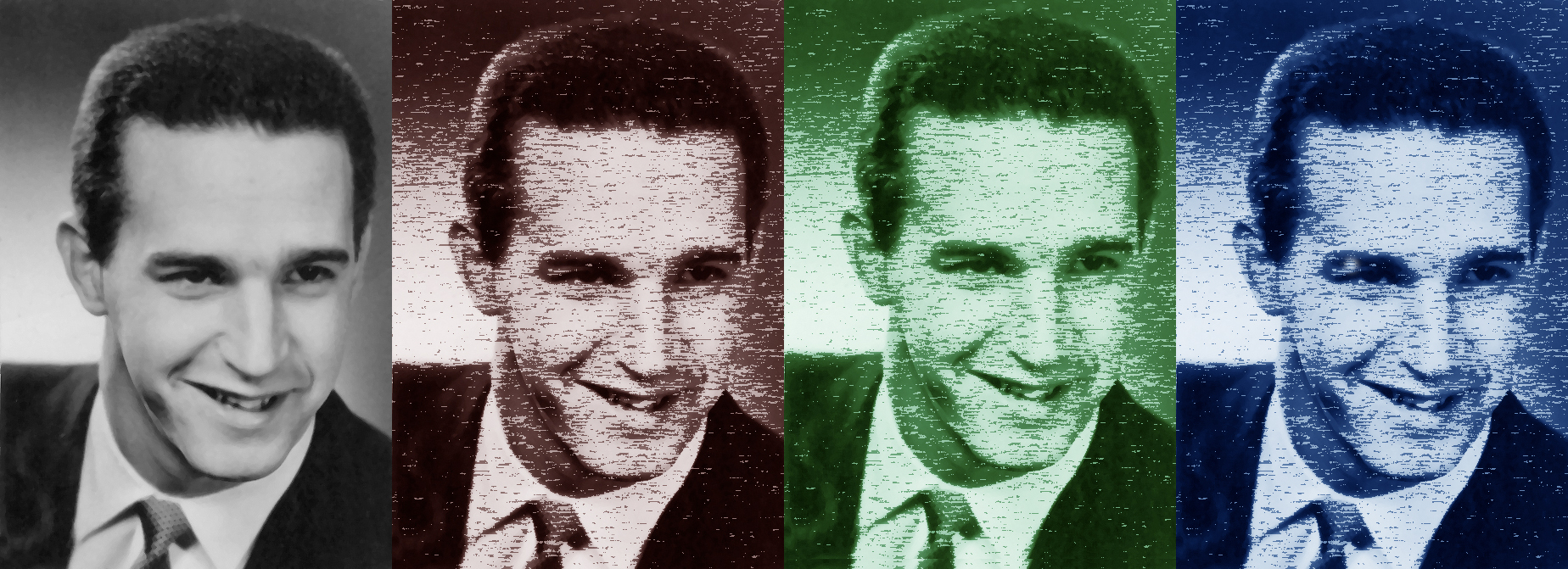
Readers, I am so sorry to announce the news that Robert Tammen passed away last week. Robert was Ronald Tammen’s youngest brother, and the last living member of Ron’s immediate family. He was only 7 years old when Ron disappeared, so he didn’t have many memories of his big brother. Nevertheless, he, like Marcia, never stopped looking for Ron and wondering what might have happened to him. He was a frequent visitor to this website, and an occasional commenter as well. His comments were always insightful. Every so often, he’d email or call me with a new detail about his father or one of his brothers that he’d suddenly recalled, which was always welcome too. It was Robert who’d first told me about how Ron used to carry around a pack of cigarettes even though he didn’t smoke. As you can imagine, this is a huge, heartbreaking loss.
I first met Robert Tammen on Wednesday, October 10, 2012. We met on Crete, a gorgeous Greek island that he’d called home for many years as part of his lifelong career with the U.S. Air Force. He suggested that we meet at Mama’s Place, an open-air restaurant on Stavros Beach, where they filmed the last scene of Zorba the Greek. The restaurant was a short drive from the beautiful home he and his wife—who was also Greek—shared on a hillside covered with olive trees and brilliant pink-flowered shrubs.
It always amazes me when two people who live on different sides of the globe are able to set an 11 a.m. appointment and actually keep it. The day was sunny with a light breeze. The sky was—well, to be honest, I don’t think we have that color of blue in the States. Certainly, not in Ohio. Robert had been afraid that it would rain and that we’d have to change our plans—it had stormed severely the night before—but that wasn’t necessary. It was perfect.
With the Sea of Crete as a backdrop, we sat down at a table and ordered a couple beers. Mind you, this was 2012, so I still had a lot to learn about Ron’s case. Nevertheless, I’d managed to uncover a few surprising details by then and I had a bunch of questions I wanted to run by him. I asked him if he had any idea why Ron was fingerprinted as a child. I asked him if he remembered Ron having dissociative episodes in which he forgot who he was and went wandering. I asked him if he remembered an incident occurring one summer day in 1952—described in a letter as THAT day by Mr. Tammen—when Ron was on the clock working for the city of Maple Heights. I asked him if he thought Ron might have been gay.
He gave each some thought and answered no, no, no, and maybe.
I recited all the theories that had been raised over the years, and asked him what he thought about each. Some he said were feasible; others he considered far-fetched.
We talked about other topics too…about four hours’ worth in all.
So this week, as I was reflecting on what to write about Robert, I decided to revisit that conversation, just to see how things may have changed since that day. Near the end, probably well into our third hour, I asked Robert what he thought had happened to Ron.
Paint me a picture, I said.
I still can’t believe what he said in response. It was nearly 12 years ago, and I was still two years away from finding key documents that support my running theory that Tammen’s former psychology professor, St. Clair Switzer, was recruited by the CIA for Project Artichoke, and he likely had something to do with Ron’s disappearance. Even so, Robert pretty much hit the nail on the head.
Here’s a short excerpt of that conversation that you can listen to as well as read the transcript.
Excerpt of an interview with Robert Tammen
10/10/2012
JW: So…I guess…paint for me, and I know you’ve been kind of going through this. Paint for me the scenario that you see, right now, where do you think what happened…in your mind?
RT: In my mind? One of two things. FBI or CIA got him. CIA? Sent him overseas and he became a spy. FBI? I don’t know what they would have done…States, here? I don’t know. That’s what I consider…
JW: In the book Oblivion, [Richard Cox] did become a spy. He died at NIH, which is wild. He had cancer, and he died at our clinical center, which was like, oh my God! But, the FBI was involved, because they were looking for him, because he was a West Point student. That never happens. And then because he joined the CIA, they were called off. So basically they were like right on his heels and they were called off. And I just wondered if that’s the same kind of thing…Did J. Edgar…
RT: Yeah, those are the only two things that I can think of. I don’t know what else he would have…I don’t see anything else that he would just arbitrarily go off.
JW: He was too responsible.
RT: What would he have done?
JW: I know. Like you said, he was..
RT: Like I say, it’s kind of hard to believe…I can see him staging the room.
JW: Yeah.
RT: But why would you leave your wallet? Your keys, your bass fiddle? I mean that was his money maker.
JW: Yeah, your toothbrush…
RT: And why would he leave the car? Come on, if it’s a staged thing, at least you would take the vehicle. Nothing else. Fine, leave your IDs. But that’s why it’s either got to be…to me, I lean toward the CIA because they would tell you, “just leave your stuff there.” FBI wouldn’t, “no, take your IDs and everything like that. We’ll destroy it.” CIA would just say, walk away from it, and…
JW: We’ll handle it.
RT: But, you know, even when you have temporary lapses of memory, you forget stuff, you don’t forget important stuff like that. And if you do, you go back to get it. Right? Those are the only two scenarios that I can see. He wouldn’t just walk off arbitrarily. And go where?
JW: Right. No body’s been found. I mean it’s like, how can you…?
RT: I know. And at that time, you know the weather wasn’t that great. In fact, it was a little bit chilly, wasn’t it?
JW: It was cold. It was snowing.
RT: So, you mean to tell me that the weather elements, stuff like that, wouldn’t get to him? So…somebody was waiting for him somewhere. Yet how many claims were there even a couple days afterwards that they said that they saw him? Like that woman who said he knocked on the door? When was that?
JW: That was around midnight, that night.
RT: Midnight. But I remember…wasn’t there a couple days later that somebody said they thought they saw him somewhere?
JW: There were, yeah, like hitchhiking…
RT: Up in Hamilton, or some place like that?
JW: Right. Exactly. They disproved those, or they said they did. But if she saw him, that’s what bugs me, because if it was the CIA…
RT: Right, you said Hamilton earlier with this woman [the older woman]. And I’m wondering…hmmm….and nobody knows who this…they don’t know her name, or anything like that?
JW: Nothing.
RT: Maybe she was involved.
JW: Right. I looked to see if there was a missing…anything of a missing woman back in that rough time, and I’m not finding that.
RT: Of course, it doesn’t have to be a missing woman.
JW: Yeah? Exactly. Not if she was a go-between…
RT: If she’s part of the government and doing anything that’s….they’ll never report her missing or anything like that. She’ll be covered. She’s Miss so-and-so from here, or anything like that, but she’s not missing, so. That could be a possibility. But I still think the FBI or CIA were involved.
Note: the woman Robert is speaking of is someone from Hamilton or Middletown that Ron’s freshman roommate had told me about. He said that she was an “older woman” who used to visit Ron as a freshman and drive him places in her car. At this point, I hadn’t yet learned about a woman from Hamilton who’d allegedly driven Ron away from Fisher Hall the night of his disappearance.
********
Over the years, people have asked me what members of the Tammen family have thought about my research and the direction in which it’s been heading. Not only was Robert Tammen receptive to my findings, he was thinking along these lines way before me.
A couple years ago, I took a detour from my Ronald Tammen research to investigate the July 12, 1973, fire that consumed the sixth floor—and the military records that were stored there—at the National Personnel Records Center (NPRC) in St. Louis, Missouri. Based on redacted records from the FBI’s investigation, I hazarded a theory that a 23-year-old Vietnam veteran who’d been honorably discharged due to psychiatric issues had probably started the fire by accident after smoking a cigarette on the sixth floor. I felt this way because the veteran—Terry Gene Davis—wasn’t at work on the day in which the case was going before the grand jury, which happened to be Halloween 1973, and he’d shot and killed himself one day later. I pointed to other evidence that I felt was ironclad as well, the strongest being that someone had written the grand jury’s ruling—“no bill,” or insufficient evidence to indict or investigate further—at the bottom of the memo discussing Terry’s suicide.
Well, guess what? I now have more info, and I’ll be revising my theory. One change is major, one change is a little more nuanced, and, although one part of my theory appears to be holding firm, it’s a lot more complicated than I’d originally thought.
The new info comes to us by way of William Elmore (he goes by Bill), a no-nonsense Air Force veteran who was working as a custodian on the sixth floor of the NPRC at the time of the fire. Bill has gone on to build a formidable career helping fellow veterans. At one time, he ran a small business in which he helped veterans obtain the benefits and services they deserved by locating the necessary paperwork. He’s a founder of the National Coalition of Homeless Veterans. He was an associate administrator of the Small Business Administration, where he oversaw the Office of Veterans’ Business Development. He’s a big deal.
Bill knew Terry Davis pretty well. While Bill wouldn’t say they were the “best of buddies,” they were coworkers. They were also neighbors. Both men were renting cabins on a small road overlooking Twin Islands Lake, a scenic area that’s one county over from St. Louis County. Terry’s cabin was next door to Bill’s. They’d see each other both on and off the clock—working the 4 p.m. to 12:30 a.m. shift at the NPRC and occasionally during their off hours—though both were also quite busy. As part of the federal government’s Veterans’ Readjustment Program, which helped both of them get their jobs at the NPRC, they were required to take college courses during the daytime. Terry was taking classes at Meramec Community College in Kirkwood, Missouri. Bill took his courses at Forest Park Community College in St. Louis.
Sadly, it was Bill who’d discovered Terry’s body on November 5, 1973, several days after Terry’s suicide.
Bill’s recollection of the night of the fire is seared in his memory.
At a little after midnight on July 12, 1973, shortly before the end of their shift, Bill and Terry were standing with other custodians at the guard’s stand near the building’s main entrance waiting to sign out. Custodians and others whose shifts were ending weren’t permitted to leave the building until precisely 12:30 a.m., so they would congregate at one of two doors—the main entrance, which was on the second floor on the west side of the building, and the so-called back entrance, which was on the first floor on the east side. (If your brain, like mine, shuts down as soon as someone starts throwing around directions and asking you to visualize everything in your mind, I’m including a simple diagram of the building that was included with the FBI’s FOIA response documents, with some additional details I’ve provided in red.)
My attempt at a diagram of the building. Note that nothing here is drawn to scale. In fact everything is probably drawn wildly out-of-scale. This is just so you can see various key areas. Click on (wildly out-of-scale) image for a closer view.
According to the FBI documents, at roughly 12:15 a.m., Bill and Terry were standing at the second floor entrance on the building’s west side when they learned about the fire. As Bill tells it, a guy on a small motorcycle had shown up at the main entrance and was frantically trying to open the doors. When a guard opened the outside door to find out what the man was trying to say, Bill remembers hearing him say that the fifth floor of the south wall of the building was on fire.
As it so happens, that same motorcycle man had ostensibly flagged a guard who was in the parking lot inspecting a government car and told him about the fire “on the southwest corner of the Records Center.” With that news, the guard got into the car and drove to the southwest corner of the building. The building itself was enormous—728 feet long from west to east and 282 feet wide from north to south. Peering upward, he guesstimated that the fire started about a third of the way down the building’s south side, and that it was burning “in an eastward direction.” He noticed flames “shooting”—his word—out of the windows directly above the computer cabinets on the fifth floor. “The blaze encompassed three small windows in the top of the sixth floor,” he told an FBI special agent afterward. The guard deduced that the fire was on the sixth floor.
But inside the building, there was still a lot of confusion about where the fire was. According to Bill, one source of confusion was that all of the exhaust fans in the building had been turned off except for the ones on the fifth floor. This caused smoke to billow out of the fifth-floor windows, and was very likely the reason the guard had seen flames there as well. Smoke was pouring into the other floors too, including the fourth floor computer area and corridors and the elevator shafts. The smoke on the fifth floor was so bad that one person said that “you could barely see two feet in front of your face.”
At roughly 12:17 a.m.—after the motorcycle man had banged on the front doors and before the first fire fighters had arrived—Terry, acting on impulse, had decided to run up a stairwell to the sixth floor and investigate, a response he later described to a special agent of the FBI during their investigation. He wanted to “go take a look at the fire,” he told him, and he took the stairwell closest to the guard stand, which was near the northwest corner of the building. A detail that Terry didn’t mention (or that the special agent neglected to write down) was that Bill had decided to follow Terry. Bill was thinking that, when they reached the top of the stairs, he could grab an emergency fire hose hanging on a wall beyond the stairwell door to fight the fire. At least that was his plan.
Little did Bill know that, by then, the fire had already grown fangs. It would require way more than one fire hose to tame it.
After arriving on the sixth floor about a minute behind Terry, Bill opened the door that separated the stairwell from a lobby-type area where the escalator and freight elevator were located. Bill was now facing a set of double doors that opened into a hallway. The hallway was the main dividing line between the office area (on the hallway’s north side) from the file area (on its south side), where the military records were kept. Bill vividly remembers seeing Terry running through the double doors, his eyes fixed on the stairwell door that Bill was coming through. A look of terror was on Terry’s face. A wall of smoke was moving faster than he could run.
Terry’s expression is what stands out most in Bill’s memory. Whatever else Terry might have said or done that night didn’t really register with him. It was the look on his face that he’ll always remember.
I think we’ll do the rest of this as a Q&A:
You said you have a major change to make regarding your theory.
Indeed I did.
What did you get wrong?
It’s rather humongous. It has to do with a custodian who, in the ensuing weeks and months, was talking freely and openly with fellow custodians about having set the fire. When the U.S. attorney presented his case to the federal grand jury on October 31, he produced a signed confession from that person along with the statements of five witnesses who had heard him claiming to have started the fire. At first, none of the witnesses had believed him. He had a reputation for running off at the mouth to get attention. But then, as his claims grew more daring, they wondered if he might be telling the truth.
In my earlier post, I’d presumed that Terry must have been the bold talker in addition to being the sixth-floor smoker. I thought he was the one who was telling the outrageous stories, though I still thought the fire was an accident.
But according to Bill, the person who was making those claims wasn’t Terry.
It was a Black man who happened to be physically and cognitively impaired.
So, mystery solved, right? It was the disabled man who’d been owning up to it all along when he signed the confession.
I wouldn’t say that.
Why not? He admitted it.
Let’s call him “BT,” short for Bold Talker.
You know what’s weird about BT’s signed confession? The confession that he signed doesn’t match any of the stories that the five witnesses described. Not a one. When BT was talking to his coworkers, he never described the act of lighting up a cigarette and having himself a smoke. The way he told the story, he’d carried some matches up to the sixth floor—in some tellings, he found them on the first floor; in other tellings, he’d brought them from home—and lit those matches, even going so far as to purposely light one of the file boxes on fire. It was all about the matches, not the cigarette, which, truth be told, is the whole point of smoking. The way BT told it, he did it out of boredom—“for something to do.” He actually said those words to one witness.
But the confession that BT signed told a different story. In the signed confession, he discusses bringing a cigarette from home, which he stowed in his shirt pocket. He said he brought a book of matches too. He then said that he went to the sixth floor and smoked his cigarette “pretty far” and, when he was done, he used a screw hole in one of the shelving units to put it out. He put the hot end in the hole and he tossed the cigarette butt and spent match on the floor. He didn’t think either one was still hot. He really, truly, honestly did not mean to do it and he felt horrible about it.
But Bill has serious doubts about BT’s signed confession. He always has.
Why?
Years after the fire, he’s not exactly sure when, Bill was at the St. Louis Airport talking to a fellow passenger when he noticed BT walking through the corridor.
“Excuse me,” he told his friend. “I need to talk to that man.”
Bill walked up to BT, they probably exchanged hellos, and then he said, “I have just one question for you. Did you smoke?”
BT’s response was “Nope.”
That’s right. BT wasn’t a smoker.
“None of us had ever seen him smoke,” Bill said to me.
So that’s rather huge, wouldn’t you say? It certainly casts doubt on the crux of BT’s confession. It seems as if the FBI didn’t have a lot of faith in that confession either though. Even though they had a detailed confession signed by BT himself, they claimed in a document dated November 6, 1973, that it was something that Terry had told them that was the strongest evidence implicating BT. In most law enforcement circles, a signed confession would supersede hearsay any day, but there was something about BT’s confession that didn’t feel like a slam dunk to them. Obviously, the federal grand jury wasn’t overwhelmed either, since they decided there wasn’t enough evidence to charge BT with a crime or to investigate further.
But there are other weirdnesses about BT’s confession.
What kind of weirdnesses?
–The car
In his signed confession, BT says that he signed out at 12:30 a.m. then walked up the escalators “which were turned off at the time” to the second floor entrance on the west side “where my car was parked.”
BT had a physical disability that affected his left leg and foot as well as his right arm and hand in a pronounced way. From what I’ve gathered, and to its credit, the state of Missouri didn’t automatically disqualify someone who had both an upper-body and lower-body limb impairment from obtaining a driver’s license in those days. But there would be restrictions. Bill doesn’t remember whether or not BT drove, but he told me that, if he did, his car would’ve had to have been an automatic. A manual transmission would require the use of his left foot to press the clutch when switching gears as well as the use of his right arm and hand to change gears. To Bill, BT’s disability would have made those movements extremely difficult if not impossible. Even an automatic transmission would require some use of his right arm and hand to switch from “drive” to “reverse” to “neutral to “park.”
And although I don’t know the degree to which he was cognitively impaired, he would’ve had to pass a written test as well as a driving test. He would likely have had to provide signed documents from his doctor plus perhaps others who could attest to his capabilities as well. For these reasons, we can’t be at all sure whether BT was able to drive, or if he used an alternative mode of transportation to and from work, be it public transportation, another driver, or a combination of both.
–His confession doesn’t match his earlier statement
Another weirdness is that BT’s signed confession doesn’t match his original statement to the FBI regarding his actions that night.
As we just discussed, in his signed confession, BT says that he signed out on the first floor and then walked up the escalator to the second floor, where he exited to the lot where his car was parked. Here are his exact words:
“At about 12:10 a.m., I went down to the first floor, by the lobby on the east end of the building to wait for time to go home at 12:30 p.m. [SIC: should be 12:30 a.m.]. Some other custodial employees were there too, and we talked for awhile. I then signed out at about 12:30 a.m. on July 12, 1973, and was walking up the escalators which were turned off at the time. I went to the west entrance where my car was parked, and I noticed firetrucks outside. I smelled smoke as I had gone down the corridor, and it occurred to me that maybe I had started a fire, that the cigarette might not have been out.”
But in his earlier statement, which was conducted on July 16, 1973, the FBI summarized BT’s account this way:
“[BLANK] finished his work at about 12:00 Midnight and went to the locker room to clean up. At this time, no one had mentioned anything about a fire. At about 12:15 A.M., July 12, 1973, he went to the second floor to sign out. While he was standing in line waiting to sign out, someone had mentioned that there was a fire upstairs. No mention of the size or exact location was made. [BLANK] stated that he assumed the fire was small and was under control. He thought no more about it, and signed out and left at 12:30 A.M.”
So on July 16, 1973, he said that he went to the locker room near the east entrance on the first floor to clean up and then went straight to the second floor and waited in line to sign out there. However, in his October 12, 1973, confession, he said that he’d signed out on the first floor and then walked up the escalator to leave by way of the west entrance, where his car was supposedly parked. Those aren’t the sorts of details that a person would lie about, since the FBI could have easily checked the two logs to find out which one was accurate. Besides, Bill says that it makes no sense that he would sign out at the east entrance on the first floor and then walk up the escalator to exit the main entrance, since he would have had to sign out on the second floor too. The guards at both entrances would require each person to sign out before they exited the door.
Also, in his confession, he only started smelling smoke as he was walking down the corridor. But in July, he said that “someone had mentioned that there was a fire upstairs” as he was waiting in line to sign out on the 2nd floor.
Interestingly, in his July statement, BT had this to add: “[BLANK] stated it is his opinion that it would be very difficult for an outsider to get into the NPRC-M [NPRC Military Branch] but that it would be easy for any NPRC-M employee to move around freely to any area.”
That’s not something a person who worked inside the building would say if he thought he might have caused the fire, whether accidentally or on purpose.
Lastly, let’s think about BT’s disability again. His left leg had little to no mobility, which made walking for him extremely challenging, since his right leg did most of the work. Custodians were required to take their carts to a designated room on the first floor, near the east entrance, at the end of their shift. If BT could drive, why in the world would he park his car on the west side of the building, which was 728 feet long—well over two football fields away? Why not park his car in the lot on the east side, which was nearest the area where custodians stowed their carts and cleaned up? The only way it makes sense to me is if BT walked to the west entrance after dropping off his cart because that’s where he had to go in order to catch his ride home.
These discrepancies lead me to wonder if BT’s confession was someone else’s story, which he’d been coerced into signing as his own, or if it had been made up out of whole cloth, which, again, he’d been coerced into signing.
With most names being redacted in the FBI documents, how can you be sure that you’re reading BT’s statement from July 1973 and not someone else’s?
In his signed confession, BT described his job as “cleaning the escalators between the first and the sixth floor.” Bill also confirmed that BT was responsible for cleaning the escalators.
When I reviewed all of the custodians’ statements from July 1973, with the exception of one extremely vague, brief statement, I was able to pinpoint where in the building each person had worked on the night of July 11. There is only one statement in which the custodian said that he worked on the escalators. For this reason, I believe this to be BT’s statement. Also, the person’s physical characteristics that aren’t redacted are a perfect match between the two statements—with one small exception. BT had lost 1/2 pound since their conversation in July.
And here’s a comparison of the physical descriptions for each.
These are the characteristics of the escalator cleaner from his July 1973 interview. Click on image for a closer view.These are the characteristics of the man who signed the confession in October 1973. Click on image for a closer view.
Oh, and by the way? BT doesn’t mention a car in his July statement. He just says that “he signed out and left at 12:30 A.M.”
How does this affect your theory on Terry Gene Davis?
This is where things get a little more nuanced. I can’t prove that Terry Gene Davis was the accidental source of the fire on the sixth floor after smoking a cigarette. In fact, after talking to Bill and after going through the documents two or three more times, I don’t believe he was responsible for starting the fire. What I’ve come to believe, however, is that Terry Gene Davis wasworriedthat he may have accidentally started the fire on the sixth floor, which would explain his words and actions afterward.
Here’s why I think so:
—He ran directly to the sixth floor
As we discussed earlier, there was a lot of confusion as to where the fire was among the people who were in the building. The fire marshal himself said that it was initially thought that the fire was on the fourth or fifth floors. Here’s just a sampling of some the comments that had been made to the FBI:
The 3rd floor
At roughly 12:27 a.m., one long-time employee rode a freight elevator to the third floor to try to locate the fire.
The 4th floor
One of the guards at the east entrance was preparing to sign out the employees when he was told there was a fire on the fourth floor. When he got there, he decided it must be on fifth floor but he couldn’t make it further due to all the smoke.
At 12:25-12:35, three firemen arrived on the fourth floor and called the guards to turn on the escalators so more firemen could join them.
The 5th floor
Bill recalls hearing the motorcyclist at the front door saying that the fire was on the fifth floor when he and Terry were standing at the west entrance.
At roughly 12:20 a.m., one custodian at the east entrance recalls hearing someone shouting that there was a fire on the fifth and sixth floors.
A guy who worked on the maintenance crew said that at a few minutes after 12:30 a.m., his supervisor had instructed him and four or five others to go to the fifth floor and put out the fire.
With all of those mixed messages flying around, at that critical moment—12:17 a.m., according to the National Archives’ timeline, which was just two minutes after Terry had ostensibly reached the second floor to sign out—Terry decided to head straight to the sixth floor to investigate. That’s kind of weird though, because A) at that point, people waiting inside were still confused regarding what floor it was on, and B) Terry didn’t even work on the sixth floor. Terry worked on floors four and five. You’d think that if he was going to run anywhere—and by the by, he was in full run, definitely not walking, according to Bill—it would have been to one of those floors. Bill, who cleaned the offices on the northeast part of the sixth floor, followed Terry. His plan was to grab a fire hose when he got there, because why run to a fire without bringing along something to put the fire out? But Terry was more interested in finding the source of the fire. Just as he said to the FBI investigator, he wanted “to go take a look at it.” So that’s kind of weird too.
—He wanted to make sure everyone knew that the smoke and flames weren’t on the southwest side
During his initial interview, which took place on July 17, 1973, there was something that Terry wanted to make sure that the FBI was fully aware of—so much so, that he said it more than once.
The message he wanted to convey to the FBI was that the fire hadn’t started on the southwest part of the sixth floor. No way, no how.
Here’s the first time he said it, which can be found on page 1 of his July statement:
“DAVIS opened a door in the hallway which leads to the file section on the sixth floor in the southwest corner of the building. He walked over to the south side of the building where the windows are located and said that the west one-third of the building on the sixth floor in the file section was not on fire and was relatively clear of smoke. However, as he looked toward the east end of the building, and began walking in this direction, he ran into a solid wall of heavy dense, grayish-black smoke. He estimated that this covered the other two-thirds of the floor. At that time he left the file area and entered into the hallway; and tried to close a few doors that were opened in the file section.”
And here’s the second time, which is on page 2 of his statement:
“DAVIS emphasized on the west one-third of the sixth floor he did not observe any flames and the area was relatively clear of smoke.”
First, I need to point out that the FBI special agent who was taking Terry’s statement got Terry’s location all wrong on page 1. Terry had taken the stairwell in the northwest corner of the building, not the southwest (see red map). Also, Bill doesn’t know what “few doors” in the file section Terry would have closed as he was running away from the fire. There weren’t any doors in the file section–only the one set of double doors at the end of the hallway in the northwest corner of the sixth floor.
Second, Terry’s description of the fire’s location aligns perfectly with the security guard’s description. Both agreed that the first third of the building’s southwest side was clear of smoke and fire.
Nevertheless, he seems a little defensive about the southwest corner. This is just a guess, and I can’t prove it, but I wonder if Terry may have been smoking in the southwest corner of the sixth floor earlier in the evening and he wanted to make sure that everyone was aware that the fire did not start there.
–He gave a weird answer when he told the FBI about his trip to the sixth floor
You know that wall of heavy, dense, grayish-black smoke that Terry ran into as he “walked” eastward on the sixth floor, and how he then “left the file area and entered into the hallway”? I think that’s the moment when Bill opened the stairwell door and saw Terry’s face as he exited the hallway.
But here’s the rub: on page 2 of Terry’s statement, it says:
“He said on his travels to and from the sixth floor he did not observe anyone else.”
Bill is a thoroughly credible source. During our phone conversations, his neurons were firing numbers, names, and dates in real time, to the point where I believe every word he says concerning the fire or anything else for that matter. If Bill saw Terry’s frightened face (and I believe that he did), then I’d have to think that Terry saw Bill’s face too. I mean…maybe Terry didn’t see Bill, considering all the smoke. But Bill had opened the stairwell door that Terry’s eyes were fixed upon—so ¯\_(ツ)_/¯. Bill also thinks that when he saw all the smoke behind Terry, he probably exited quickly, employing some Ninja moves to jump from landing to landing in the stairwell to get down from the sixth floor. (He says he used to be pretty good at that.) But it’s a strange omission, which might be a signal that Terry was nervous about something.
–He missed work on the day the grand jury had met and he killed himself the very next day
Granted, Terry was undergoing a lot of stress at the time of his death. He’d recently been in a minor car accident, he was arrested for riding his motorcycle in a prohibited area, his girlfriend had left him, and his relationship with his parents was on the fritz too. In addition, he may have been experiencing hallucinations from his mental illness. An FBI report said he felt “possessed of a demon” and Bill recalls Terry claiming to see and feel “spirits” of some sort.
Nevertheless, the timing of his suicide can’t be ignored. It was one day after the federal grand jury had returned their decision about the fire in which he was considered the strongest witness against one of his coworkers.
I know what you’re thinking. You’re thinking: even if he was stressing out about the grand jury, why would he kill himself if their decision was not to indict or to investigate further?
That’s a good point. But remember that Terry lived in a cabin out in the boonies, next door to Bill. As it so happens, Bill didn’t have a telephone in his cabin, most likely because there wasn’t a telephone line hooked up to it. And if there wasn’t a telephone line connected to Bill’s cabin, then there wouldn’t have been a telephone line hooked up to Terry’s cabin either. Although Bill wasn’t aware that the U.S. attorney went before the grand jury on October 31, I strongly suspect that Terry—the strongest witness implicating BT—had been informed of the date. What I don’t think he’d been informed of was the grand jury’s decision at the time of his death.
Interesting. You’ve mentioned that BT didn’t smoke. Did Terry?
Bill doesn’t know if Terry smoked cigarettes, and perhaps he didn’t. But Terry did smoke pot. He said so in the third sentence of his suicide note. Here’s the first part of his note:
“There just isn’t any point to any of this. Nobody gives a damn and never has. Blame it on dope. Blame it on parents. But people *** are the cause of all the _______ _______ in the world.
The smoking question is especially interesting though. What’s not stated explicitly in the FBI documents is that smoking cigarettes was permissible anywhere in the NPRC building EXCEPT for the file areas. People could smoke in offices, the corridors, the bathrooms, you name it. There were ashtrays throughout the building. One custodian’s sole responsibility was emptying ashtrays in all of the corridors on all six floors. If a person really needed a cigarette and it was during one of their breaks, they could have gone to the Finance Division on the fourth floor, the only place in the building with the air conditioning still turned on, and sat in the boss’s chair. Or they could have gone to the fifth-floor vending area and had a Coke with their smoke.
So why would anyone go to the sixth-floor file area to have a cigarette, especially in St. Louis in July, when it was so excruciatingly hot up there? There are two main reasons that I can think of: they’d go there if they didn’t want to be seen—the area was super dark at night—and they’d go there for access to the large exhaust fans. Those exhaust fans would have been perhaps the most important draw. Located in the windows all along the south side of the building, the exhaust fans could air out any telltale smoke aromas. They also were the perfect place to flick whatever a person had been smoking outside in the event a guard or supervisor should happen by. My guess? A person would be more inclined to go there to smoke a joint versus a run-of-the-mill cigarette.
What was the evidence that Terry had provided against BT?
This was a puzzler at first, because none of the five witnesses’ personal descriptions matched Terry’s personal description from his July interview. I also couldn’t find a statement from anyone that was considerably stronger than everyone else’s. I still can’t. But I think I’ve figured out how Terry fit into the picture.
I think Terry was the witness that I’ve labeled as #4. He was interviewed on October 15, 1973, three days after BT had signed his confession. The FBI agent described Terry’s hair as being blonde instead of brown, the latter of which was his hair color in his July statement. Although that part threw me off—hair generally gets lighter in the summer, not the fall—the rest fell into place.
Two giveaways that this witness was indeed Terry are 1) the witness was employed in his position at the NPRC since June 1972, which is consistent with Terry’s July statement, and 2) he claimed to have been on the sixth floor the night of the fire, after the fire had started. Very few people that I know of could say that—only Bill and Terry, and it wasn’t Bill. (Even a guard who tried to take an elevator to the sixth floor wasn’t able to get off due to all of the smoke. He couldn’t even open the door from the stairwell because the smoke was so heavy.)
Here’s one telling paragraph. Although the names are redacted in the document, I’ve inserted them here to make it more readable. I’ve put Terry’s last name in brackets, since this is still a hypothesis:
“On October 11, 1973, [DAVIS] said he again discussed the fire with BT and BT repeated that he had started the fire. On this occasion, BT had advised that he had brought matches from home. [DAVIS] said he had pointed out to BT that he had previously stated the matches were found on the first floor. BT merely responded with a ‘Yeah.’ During this conversation, BT said he started the fire near the west end of the 6th floor. [DAVIS] said he at first tended to disbelieve what BT was saying because on the night of the fire [DAVIS] was on the sixth floor after the fire started and he noticed no flames toward the west end.”
Later in his statement, he said “BT had said he was responsible for the fire frequently enough and earnestly enough that he began to ‘seriously wonder if BT may have actually been responsible for the fire.’” In his closing, he said that it appeared that BT was showing concern about what could happen to the person who started the fire, “and that this lent substance to his belief that BT may have, in fact, set the fire at the records center.”
If Terry was genuinely worried that he may have accidentally started the fire, it would have been a huge load off his conscience if it turned out that something or someone else was responsible. And if BT was walking around telling everyone that he was the one who’d done it, well, who was Terry to argue with him?
From the little I know about Terry Gene Davis, he didn’t seem to be a mean or vengeful person, or someone who would lie to protect his own hide. He even weighed both sides of the matter with his FBI interviewer. On the one hand, there were discrepancies to BT’s stories, which led him to disregard them. On the other hand, when BT seemed concerned about how the responsible party would be punished, that’s when Terry became more convinced that BT “may have, in fact, set the fire at the records center.”
There are things about the fire that bother Bill to this day. As I mentioned earlier, Bill doesn’t think that BT started the fire. He doesn’t think Terry started the fire either, and he’s not even convinced that Terry had been on the sixth floor smoking at any time that day.
One thing that he finds perplexing is how intense the fire had become in such a short time. People hadn’t even begun to smell the smoke until around 12:15 a.m., and by that time, it was already too late. Bill and others have pointed out that, although there was paper everywhere in the file area, the files were packed tightly in sturdy boxes on steel shelving units. That’s not generally the best-case scenario in which paper catches fire quickly.
Besides, another sixth-floor custodian had left that floor at 12:05 a.m. and he didn’t see or smell any smoke or fire as he entered the elevator to head down to the first floor to return his cart. But, according to the National Archives’ timeline, the motorcyclist had shown up to alert people in the building about the fire at 12:11 a.m., only six minutes later. And by the time Terry and Bill had made their way to the sixth floor at around 12:17 a.m., that fire had taken over two-thirds of the floor, according to Terry’s July 1973 statement. I’ve tried to start campfires with a Bic lighter and a rolled-up newspaper, and it’s taken me longer than that to get something going.
Another aspect of the case that Bill has been bothered about is the vault that was located across the hallway from the office area on the sixth floor. The vault stored confidential documents pertaining to…well, we don’t really know what they pertained to, which is why they were in the vault. Bill and the other custodians used to refer to it as the “VIP/Secrets” vault or just “VIP vault,” and Bill says that many of the documents pertained to famous people. In addition, documents stored in the vault covered such broad topics as combat operations, courts-martial, publications, research and development, the Air Force, the Army, certain military personnel records, and the largest category of all, “Other.”
On July 14, it was discovered that even the vault had caught on fire at some point, although many documents stored there had ostensibly survived—something to the tune of at least 4,796 cubic feet of them. According to Bill, after the sixth floor had been cleared for a select few people to go back up there, a security guard was posted outside the vault, most likely due to the fact that there was a newly created gaping hole in its back wall, which now opened into the file area.
Five days later, the special agent in charge (SAC) in St. Louis—a guy named Robert G. Kunkel—wrote a memo to FBI director Clarence Kelly describing the records stored on each floor of the building. Kunkel stated that “with the exception of an insignificant percentage of 1973 registry” (which was a portion of the names of Army personnel who had been discharged after January 1, 1972), “the records on the sixth floor were totally destroyed.”
But that was—let’s see, how does one put this delicately?—super untrue. Judging by what the fire marshal had said, documents that were farther away from the fire’s origin may have been singed but they appeared to be “75 percent intact with only the edges burned.” Also, Kunkel had neglected to mention the 4,796 cubic feet of records in the vault that had survived.
So, the inconsistent descriptions of how many classified documents inside the vault had survived the fire and how those documents were handled after the fire are another issue for Bill.
Then there was the question of the fire’s origin. We’ll be going into more detail on this subject in a couple seconds, but let’s just say here that the authorities claimed not to have a definite answer on that. But it was pretty obvious where the site of the most intense heat was located, and that was…wait for it…near the vault. According to the fire marshal’s interview with the FBI, a “great amount of heat had been concentrated” in a region he’d described as being “toward the center of the building.” He later stated that the fire’s origin was in that same central region, “about 75 to 100 feet from the south windows in a northerly direction.” Hello? That’s near the vault. As Bill recalls, office supplies—staplers, telephones, and other paraphernalia—had melted to desks in the office area, which was, again, near the vault. For these and other soon-to-be-reported reasons, Bill has wondered if the fire’s cause had more to do with the vault than with someone’s smoldering cigarette.
But don’t just take my word for it. Bill has written a statement that describes his experience leading up to, during, and after the fire, which I’ve included at the end of this post. You’re going to want to give it a read. His story has never been told in print before.
What else can you tell us about the 6th floor vault?
Is everyone sitting down? Beverages freshened? Good, because I have something pretty huge to lay on you right now.
I agree with Bill—there was definitely something fishy going on with that vault. Of course, you won’t get any help from the FBI on this topic, since, again, then-SAC Robert G. Kunkel (the same Robert G. Kunkel who, months earlier, had made national headlines for doctoring records in D.C.’s field office and being demoted to St. Louis by interim FBI director Patrick Gray) didn’t feel it was worth mentioning in his July 19 memo. But Bill has recently sent me some documents he’d obtained through the General Services Administration (GSA), which managed the building, and which had conducted their own investigation into the fire. Trust me, even though the FBI appears to be in the dark, the vault was getting lots of attention after the fire. Here’s what I can tell you:
— On July 16, 1973, a guard was placed outside the vault to protect the material inside, just as Bill had said. The reason was because Warren B. Griffin, then-acting director of the NPRC, had been up on the sixth floor and determined that “possible compromise of the classified material existed…” which I think may be code for “oh good Lord, there’s a ginormous hole in the back of the vault!”
— On July 19, 1973, an action plan was developed to remove the surviving documents from the vault. (Did you hear that, Robert G. Kunkel? A document written on the same day as your memo says there were surviving documents!) The plan was to remove Top Secret documents first, then the Secret and Confidential files, including Official Military Personnel Files (OMPFs) that contained classified material, then the sensitive material, then the OMPF’s of employees and relatives. Furthermore, they’d said that the Top Secret material was in 22 file cabinet safes and 80 boxes, and that the “material in safes are in wrapped packages or wrapped boxes—all numbered.” But best of all, they said “Our present impression (based on previous visit to vault area) is that this material is in fair to good shape.” That seems like excellent news!
— A July 31, 1973, work plan on the Sixth Floor Vault Project provided a few more details about the surviving files. Most of the records had been moved out of the vault by that date. The two kinds of records that remained were: damp records (from all the water that had been sprayed on them) and records that were “badly burned or otherwise not salvageable.” As for the records that had already been moved out, about 90 percent of the records that were damp but salvageable had been moved to the 3rd floor vault. Still to be moved into the 3rd floor vault were about “17 (5-drawer cabinets) of Air Force ‘Top Secret’” records and “several cabinets of Tech Orders,” all of which were still sitting in a temporary location. Roughly 95% of the badly burned records had been moved to a staging site, where they would eventually be transported to the Metropolitan Sewer District’s incinerator. We would later learn that the total amount of badly burned records in the vault was 2087 cubic feet, which were incinerated in August 1973.
— For those of you keeping track at home, that would mean that, of the 4,796 cubic feet of documents that had once occupied the vault, 2,087 cubic feet of documents were badly burned and unsalvageable, which would result in 2,709 cubic feet of still-usable documents that remained, right?
— Nope! On February 6, 1975, almost two years after the fire, Warren Griffin, who was now the director of the NPRC, provided a somewhat smaller number for the badly burned or water-damaged documents once stored in the 6th-floor vault: 4,557 cubic feet. After subtracting the 2,087 cubic feet of documents that had been incinerated in August 1973, 2,470 cubic feet of documents remained, according to Griffin. It was these documents, which he described as “Air Force Research and Development case files,” that he decided to incinerate on February 6, 1975, 19 months after the July 12, 1973, fire.
“Umm…what’s that now?” you ask.
Me: Oh, yeah. Two years after the fire, the director of the NPRC obtained authorization to incinerate the remaining documents from the 6th floor vault, which were described as 2,470 cubic feet’s worth of Air Force R&D case files.
You:
Me:
You: But why?
Me: Oh, his reason? Though it isn’t clear who the recipient was, Griffin wrote in a memo that: “It has since been determined that the integrity of individual series and cases has been completely destroyed and that the intellectual control over the records is completely lost.”
You: He seems, I dunno…panicked?
Me: He kinda does, doesn’t he? Remember that the man is referring to the Top Secret Air Force documents, which were ostensibly still numbered in cabinet safes and boxes and sitting inside a 3rdfloor vault. So it’s rather illogical that Griffin would have felt all of the sudden that the “integrity “of the series and cases had been “completely destroyed” and the “intellectual control” had been “completely lost.” What could have possibly happened nearly two years after the fire that would have prompted this call to action?
As it turns out, I think I know.
What’s the answer? Why did the director of the NPRC incinerate 2,470 cubic feet of Top Secret Air Force R&D records that were in relatively good condition two years after the fire?
I think Warren Griffins’ verbiage about destroyed integrity and lost intellectual control was code for “oh good Lord, the Senate has put together a committee to study intelligence activities of the CIA, FBI, and military, and they’re going to be coming after these documents.” On January 28, 1975, roughly one week earlier, it was announced that the Church Committee would be studying abuses in intelligence activities that would eventually lay bare Projects Artichoke and MKULTRA, among others, for the world to view.
You know, to be honest, I’d always thought that my research into the St. Louis NPRC fire was a sideline activity…something to do during down periods as I waited on responses to FOIA requests that I’d submitted on Ron Tammen. Now it seems as though the St. Louis fire might have some relevance to Tammen’s case after all. As many of you know, we’ve been talking about Air Force Research and Development for a long time now. Could one of those case files have been Ron’s? Were Doc Switzer or Jolly West mentioned in one or two of them? I wonder.
Whoa…so if BT or Terry didn’t cause the fire, who did?
Great question. Although I don’t know the answer, one document amid the hundreds in the FBI’s collection seems as if it could offer up a clue. Remember how BT was asked how easy it was for an outsider to get into the building, and he said it would be very difficult? The FBI posed that question to several other people as well. Normally it was quite difficult for an outsider to enter the building after hours.
The reason is that both the main (west) entrance and the back (east) entrance were locked at 5 p.m. Everyone during the late shift was basically locked inside the building throughout their workday except for during their half-hour lunch break, when they were permitted to go off site, though most people ate in the fifth-floor vending area. After their shift was over at 12:30 a.m., custodians could exit from both the east and west entrances.
More importantly, however, is that after 5 p.m., no one could enter by way of the east entrance. People could only enter through the main entrance. And because the main entrance was locked, the guard would have to let them in.
Bill told me a rather amusing anecdote concerning how stringent the General Services Administration’s protocol was. When the first fire fighters had arrived, they weren’t permitted inside the building until the guard had called GSA headquarters in Kansas City to get permission to let them in. Bill, having returned from the sixth floor and seen what they would be up against, recalls watching the firefighters standing helplessly outside. Bill got so fed up, he took it upon himself to open the door to let them in.
Got the picture? The building was extremely closed-up, and very tightly locked, and extraordinarily difficult to enter from the outside.
So imagine my surprise when I read an FBI report summing up the notes of one of the firefighter units which described a conversation between two guards who were standing at the east entrance at 3:45 a.m. on July 12. It read:
“The conversation the guards were engaged in concerned two individuals who entered the east door of the center at about 11:45 A.M., July 11, 1973, just prior to the fire being discovered.”
Mind you, the time 11:45 a.m.—as in 11:45 in the morning—on July 11, 1973, was nowhere near “just prior to the fire being discovered.” If the two individuals had truly entered the building at 11:45 a.m., that would have been 12½ hours before the fire was discovered, and no one would have thought twice about someone entering the building at that time. Someone—was it the firefighting unit or the FBI?—had gotten their A.M.s and their P.M.s confused. The guards were actually discussing two people who had entered the building at 11:45 p.m.—roughly one-half hour before the fire was discovered—through a door that no one was supposed to enter after 5 p.m. I’ve since obtained confirmation that the time that the two men entered the building through the wrong door was 2345 hours—which is 11:45 p.m.
Questions? Concerns?
The document proceeds to discuss how the guards tried to find the two individuals and even radioed for help, but they were unsuccessful. One of the guards said that they might have been college students hired for the summer, but that wouldn’t have mattered. Entering the building through the east entrance wasn’t permitted after 5 p.m. by anyone, let alone a couple of temporary college students. And the fact that the guards were still discussing it at 3:45 a.m. tells me that they didn’t think it was nothing either.
Can you post a map of the sixth floor that shows us where the fire originated?
LOL! Sorry, I shouldn’t laugh, but here’s the situation: out of the hundreds of pages of documents that the FBI has sent me regarding their investigation into the fire that destroyed the sixth floor of the NPRC, a schematic of the sixth floor was not included. If you want to see grainy black and white pictures of firetrucks and hoses pouring water all over the roof of the NPRC building, as well as the charred and melted aftermath of the fire, the FBI has scads of those. But an actual drawing of the sixth floor of the building? One that shows the layout of the hallway and the office area and the file area as well as the rest rooms and escalators and the elevators and stairwells and where the vault was and a big X where the fire was thought to have originated? They don’t have that. Or at least, if they did, they don’t think you and I should have access to it. In fact, the only drawing they provided of the building with the approximate location of where the smoke was coming from was produced by our friend the motorcyclist, who’d spotted the smoke from his workplace at Carter Carburetor and who rode to the NPRC to alert everyone inside. I used the motorcyclist’s drawing to make my drawing of key areas in the building because I, like him, believe drawings can be helpful.
Another person who I’m guessing could appreciate the importance of a drawing is the fire marshal. According to an interview typed up by an FBI agent, the fire marshal had arrived shortly after an alarm sounded (which, according to the FBI summary, happened at 12:13 a.m.), however, he was unable to examine the damage on the sixth floor due to the intensity of the heat and smoke. He did the next best thing: he surveyed the damage while looking through the south windows and focused his attention on the area that appeared to have been subjected to the most intense heat. In his interview with the FBI, the fire marshal said that, based on the fire’s intensity, he would have guessed that it had been smoldering since 4 p.m. the previous day, which we know wasn’t the case since people had been working on that floor all night and no one had started to smell smoke until around 12:15 a.m.
Page 1 of the FBI’s summary of the fire marshal’s interview; click on image for a closer view.Page 2 of the FBI’s summary of the fire marshal’s interview; click on image for a closer view.
On page one of his remarks to his FBI interviewer, the fire marshal said that the origin of the fire was “somewhere in the immediate vicinity of upright columns A17 and A20 on the sixth floor of the building.” But on the second page of his remarks, he’d said something different. He said that “based on his survey in the A17 to A20 column area, he believed that the fire had begun in this vicinity approximately 75 to 100 feet from the south windows in a northerly direction,” which is more centrally located. From where he was standing, he couldn’t tell which columns were in the fire’s hottest region, so he was using columns A17 and A20 to demarcate the east-west boundaries and picturing two imaginary lines running north from those columns to guesstimate the general region. While that’s very helpful, imagine how much more helpful his description would have been if only there’d been an accompanying diagram.
Well, we’re in luck!
Thanks to Bill, I can now provide a floor plan of the 6th floor of the NPRC. The letters A-N run from south to north and the numbers 1-33 run from west to east. Therefore, the A columns are closest to the south windows, which makes sense, since that’s where the fire marshal had been standing.
Click on image for closer view. Note that I combined partial images on two pages to get the one graphic. It’s not perfect, but you can at least see the numbers (top) and letters (right) that were used to identify specific columns. Also, you can see the vault at the center top of the schematic.
I’m also providing a map with the area of greatest heat generated marked off. Note that the area is to the immediate south and east of the vault area, and marked off by columns F to H from south to north and 18 to 23 from east to west, which is very close to what the fire marshal had guesstimated on page 2 of his interview.
Click on image for a closer view. This drawing is cut off and is much more difficult to read. However, you can see the “Area of Heaviest Burn,” which is to the immediate southeast of the vault.
What I find especially interesting is that the origin of the fire wasn’t along the south windows, which was where the smoke had been billowing from, and which was also the most likely place in which someone would go to smoke a cigarette, be it tobacco or marijuana. It’s also a different location than what the fire marshal had ostensibly said on page one of his remarks, when he said (again, ostensibly) it was in the “immediate vicinity” of columns A17 to A20. However, the area of heaviest burn corresponds perfectly with the fire marshal’s description of the fire’s origin on page two of his remarks, and those remarks also align with the comments of the firefighters who had the most direct knowledge of the fire’s intensity. Nevertheless, GSA officials chose to ignore the comments of the firefighters as well as the fire marshal when they issued their September 1973 report. The report said “the exact point of origin of the fire cannot be established,” however the writers ventured a guess anyway. Their guess was that it had started in the southeast corner of the building based on comments from six individuals who’d been watching the fire during its “early stages from the south side of the building.”
I also find it fascinating how BT said in his confession that he was standing “at the end of the files near the south end of the building” [bold added]. He continued, “I can’t recall the exact column number, but it was somewhere in the middle of the building, more to the west than the east.” So even if BT was smoking on the 6th floor, and I don’t believe for a minute that he was, he wasn’t doing it where the fire marshal had pinpointed the location of the fire’s origin. And while we’re at it, why are we reading an FBI special agent’s notes from an interview with the fire marshal instead of the fire marshal’s actual report?
Something tells me that the FBI thinks it’s just better to take their word for it.
What did the FBI investigators really find out?
Oh, who the heck really knows? But let’s all keep this in mind: the FBI—ostensibly the most savvy bunch of investigators found anywhere in the world—considered Terry Davis’ even-handed remarks to be THE strongest piece of evidence implicating BT in setting the fire, even over BT’s signed confession, even despite all the discrepancies in BT’s story.
This tells me that either the FBI back then wasn’t as good at conducting investigations as they’d been leading people to believe, or maybe they didn’t care who they pinned it on, as long as they pinned it on someone, and this particular someone seemed the easiest.
So what’s holding firm from your original theory?
I’m not sure how to say this, and I mean it in the nicest possible way, but, you guys? I don’t really trust the FBI. What with their A.M.s instead of P.M.s, their “southwests” instead of “northwests,” and their deafening silence regarding the vault, not to mention all of the other weirdnesses in these documents, I honestly don’t know what to believe.
What’s more, based on Bill’s account and the fire marshal’s description of where the fire had originated, and the sheer size of the building, I don’t even know where Terry ran—and he was definitely running, not walking—when he went to the sixth floor. Remember that the building was over two football fields long from west to east and almost one football field wide from north to south. According to Terry’s statement from his July interview, he “walked” to the south windows and then walked east along the south wall and that’s when he turned around. That only makes sense if he entered the file area from the southwest, which he did not do. Do you know how impossible it would have been for him to make it to the south wall from the northwest corner of the building in the amount of time he had? Bill was barely a minute behind him and Terry was already exiting the main hallway through the double doors.
I guess what I’m trying to say is that, not only is it important to take what’s been written by the various FBI agents with a grain of salt, I’d suggest reading these documents while sitting in a salt cave in the general vicinity of the Great Salt Lake while drinking margueritas with, you guessed it, your trusty shaker of salt at the ready. I believe that FBI agents doctored documents to support their claims about who caused the fire, framing someone whom they knew didn’t do it to the point where they coerced him to sign a false confession. Then, they had the chutzpah to provide their extraordinarily false and doctored evidence to a U.S. attorney to take before a federal grand jury. Thankfully, they were unsuccessful in getting an indictment.
Photo by Tim Hüfner on Unsplash; this is a big pile of salt from Mallorca, Spain, where Flor de sal is produced. When reading FBI documents on the NPRC fire, you may wish to do it from this location, if possible.
I cannot say with confidence that the FBI blamed the fire on BT because of overt racism, since BT was telling people that he’d done it. He was an easy scapegoat. I also don’t know why the FBI felt the need for the cover-up. In my first write-up, I suggested that an FBI agent may have been the source of the culprit cigarette. Now, I think this case has become a whole lot larger than that, which is likely why any serious researcher or reporter who has waded into it seems to not want to investigate any further.
And that brings us back to Terry Davis and his suicide note, which continues to be 100 percent on point. As Terry asked, and I dismally echo: “Where is truth? Where is love? Where is anything that is real?”
In his February 6, 1975, memo, Warren Griffin said that he had assembled “descriptive listings” of all the Top Secret documents that he’d incinerated. I’ve submitted a FOIA request to the GSA for those descriptive listings.
I have also submitted a FOIA request to the National Archives seeking the Standard Form 115 that authorized Mr. Griffin to destroy the 2,470 cubic feet of Top Secret Air Force R&D documents.
I have also contacted the Community Fire Protection District in St. Louis seeking the official report from the fire marshal at that time, James J. Kennedy. The current fire marshal told me that he’d let me know if he found it, although he wasn’t optimistic due to the amount of time that had transpired. Still no word.
I don’t intend to follow this story to the end since I need to concentrate on Ron Tammen, but I will post any additional documents I receive for anyone who’s interested. If you happen to be a credentialed investigative reporter and wish to pursue this story (and I mean truly pursue it, Woodward-and-Bernstein-style), feel free to contact me by way of the menu at the top of the page. I have additional information that I’ll be happy to provide that would serve as a good starting point. And you’re going to want to talk to Bill. Trust me. There’s a story here.
*****
QUICKIE UPDATE (3/26/2024): I now have the fire marshal’s report from the 1973 NPRC fire, and there’s something very, very wrong with it
As I mentioned in the addendum, I’d submitted a public records request to the Community Fire Protection District, in Overland, MO, seeking the fire marshal’s report from that fire. The fire marshal at the time was a man named James Kennedy, who was also the assistant fire chief.
Here ya go!
So…..whadya think? If you’re like our friend Bill Elmore and me, you’re thinking:
Because, you guys, let’s all think about what it would have been like to have been the fire marshal on that date and in that particular fire district. This was in all probability the BIGGEST FIRE he’d ever investigated in his entire career. This fire could have been his shining moment—the pinnacle of his career. And how did he choose to document his once-in-a-lifetime, career-defining fire? He typed up a cover sheet and a two-page narrative, double-spaced no less, that discusses things like pumpers and aerials but that completely avoids any discussion of the cause or origin of the fire, even though that’s one of the primary responsibilities of his position. I don’t want to brag or anything, but I’ve written WAY more about the origin and possible cause of that fire than James Kennedy did.
When I compared Kennedy’s August 9, 1973, report with the interview notes that the FBI special agent had written summarizing their discussion on July 17, 1973, I found some interesting discrepancies. Three of the most prominent ones are:
In the July 17 interview, he talked about standing outside the south windows of the building and eyeballing the region of most intense heat. He talked about how the origin of the fire was in an area between columns A17 and A20, about 75 feet to 100 feet north of the south windows. He described a progression of remains from the area of greatest heat intensity and moving southward, beginning with no ash, to “powdered white ash to heavier gray ash to charred chunks of files to a point near the south windows where the files are approximately 75% intact with only the edges being burned.” But in his August 9 report, written a little over 3 weeks later, he decided to leave out all of those helpful details. How come?
The FBI’s report, released July 30, 1973, has the following subject head, in all caps: “DESTRUCTION OF GOVERNMENT PROPERTY – POSSIBLE ARSON.” It’s the fire marshal’s responsibility to conduct arson investigations, yet that word isn’t included anywhere in his report. Why not?
He never mentions the vault.
Even though Kennedy doesn’t discuss the fire’s origin outright, he does give one additional clue that he hadn’t given in the July 17 interview. He said that the heat was so intense that the masks “began to collapse on the faces of firefighters” when they opened the door to the “corridor.” He’s of course referring to the double doors leading to the main hallway, in the northwest corner of the building. I believe this stray comment supplies additional evidence that the origin of the fire was farther north, not near the south windows, which was where BT’s so-called signed confession claimed he was standing when he put out his cigarette.
As it so happens, on July 13, 1973, another fire marshal, this one representing St. Louis County, is quoted in a news article saying that he was often asked to assist fire districts with determining the cause of a fire. Had Kennedy sought his assistance too? If so, what might he have had to say about the cause and origin of the fire? I don’t know, but in hopes of arriving at an answer, I’ve submitted a public records request to St. Louis County for Fire Marshal James E. Huntinghaus’ investigation. I’ll keep you posted.
ANOTHER QUICKIE UPDATE — 3/28/2024
I’ve already heard back from St. Louis County, MO, concerning my public records request, and they let me know that A) they don’t have a report from Fire Marshal James E. Huntinghaus from the 1973 NPRC fire, and B) the Community Fire Protection District was indeed the lead department in the fire. Therefore, it was Fire Marshal James Kennedy who was standing outside the south windows and counting columns; it was James Kennedy who was eyeballing the origin of the fire based on the region of greatest heat intensity; it was James Kennedy who’d sat down with the FBI on July 17, 1973, and told them about his investigation findings; and it was James Kennedy who, for whatever reason, submitted a watered-down report 3 weeks later, on August 9, 1973. Good to know.
***********
Bill’s Statement
On January 13, 1972, I was notified that my enlistment in the United States Air Force was ending on January 14, 1972, as I was being given an unexpected early out Hardship Discharge based on my father’s paralysis from a fall. I returned home to St. Louis a year early and initially moved into my parents’ basement to better assist them. Within 30 days, I returned to my previous factory job and endured a series of lay-offs at the downsizing DOD contractor.
In May 1972, the Missouri Job Service called me about a Career Conditional Veterans Readjustment Appointment (VRA) position available as a GSA GS1 janitor at the National Personnel (Military) Records Center (NPRC) located just 2 miles from my parents’ home in Overland, Missouri. One requirement of the VRA position was that I also attend college full time in addition to working full time at NPRC, 4 pm to 12:30 am, each night. After I was referred to the NPRC, I was interviewed, given a physical, and hired beginning June 1972. When I reported to NPRC for my first night’s work, I was assigned to clean 1/2 of the office space (approximately 27,000 square feet) on the northeast side of the 6th, or top, floor of NPRC at 9700 Page Blvd. in Overland, Mo.
There were 3 types of workers who made up the 30 to 40 janitors who worked nights at NPRC. Approximately 12 were recently discharged veterans (all VRA appointments like me), approximately 10 or 15 were older black gentlemen that worked as immediate, middle, and top supervisors of the custodial work force, and approximately a dozen were physically or otherwise challenged individuals. On my 266,000 square foot 6th floor, approximately 1/5th was walled off office space where file clerks worked through thousands of individual military records each day. My office space was separated by a central hallway and concrete block wall from the giant open files area where individual DOD military records were kept in cardboard (201) file folders, packed tightly in cardboard boxes, and stored on metal shelving stacked from the floor to the ceiling. The back (or southern) 729-foot-long wall of the files area also contained windows and numerous large exhaust fans. Off the main hallway and jutting into the 200+ foot deep file area were three elevators, stairwells, two industrial-sized bathrooms, a storage room full of toilet paper and hand towels in boxes, and a singular vault with a small office and desk that was unmanned at night, with the bank vault-like door always closed and locked.
There were three janitors who worked on the 6th floor: me, another VRA janitor who cleaned the bathrooms and hallways, and a younger woman who cleaned the northwest section of the north side offices that ran the full width of the building. Later, each floor of the NPRC was described by one of the firemen fighting the 1973 fire as being the size of five football fields. The total NPRC floor space was more than the total floor space of the Empire State Building in NY City, and while the NPRC was air-conditioned, the central air conditioning was turned off each night at 5PM.
July in St. Louis is famously hot and humid, and 6, my floor, was the hottest.
The NPRC Fire started/was discovered on July 12 and was (sort of) finally put out on July 16, 1973. More than 50 million gallons of water were used fighting the fire. Forty-two fire departments were involved, and 381 firemen fought the fire. FBI Arson Investigators were flown in from DC on July 12. GSA (who managed the building) created their own special investigative committee. The future National Archivist of the USA issued their own investigative report. The national Army Reserve Personnel Command occupied much of the building, and the FBI, the OPM (Office of Personnel Management), and numerous other federal agencies had offices in NPRC. More than 2,000 federal employees worked in NPRC.
July 11, 1973, was a typical hot and humid St. Louis summer day, and after attending my classes at the community college, I reported to work at NPRC for my usual 4 pm to 12:30 am night shift. That night (July 11), in addition to the usual three janitors who worked on 6, we also had a “wax crew” made up of a career janitor and 2 or 3 high school students who were mopping and waxing the main hallway and the offices on 6 that night. Because of the hot night and the wax crew working on 6, at about 10:30 pm, and after cleaning my area, I went down to the fourth floor to fellow VRA janitor Terry Davis’ area, as his offices were the only ones I knew that had window AC units that were kept on. At approximately midnight, Terry and I left his area and took our trash carts down to the basement at the northeastern end of the first floor to empty our trash, put our carts away, and then we walked through the main hallway to the northwestern section on the 2nd floor where the main entrance to NPRC was located, locked at night, and guarded. All janitors were required to sign out at 12:30 AM each night as witnessed by the guards at their station.
At approximately 12:11 AM (July 12, 1973), Terry and I were standing chatting with other janitors inside the 2nd set of interior glass doors at the main entrance next to a stairwell door that was across from the guard station waiting for 12:30 AM to sign out. As I was looking out through the double set of glass doors toward the western parking lot, I saw a motorcycle pull up and a guy in brown leathers (who had left work at Carter Carburetor at 12:07 am in neighboring Olivette) get off his bike and run up the 8 or 10 stairs to the (2nd) set of exterior glass doors that were locked. While he was trying to open the exterior doors, one of the guards pushed through the interior set of doors, went to the exterior doors and I heard the motorcycle guy tell the guard that the south (back) wall of the 5th floor was on fire. The Guard then went outside, went to the southwest part of the NPRC grounds to look, then returned to his guard station and called the local fire department to report the fire. At about 12:16 AM, Terry and I were still standing at the 2nd floor stairwell entrance and suddenly, Terry opened the door and ran up the stairs towards 6. Perhaps a minute later, I followed Terry up that same stairwell as I knew where the fire stand hose was. I remember thinking, if the fire was on 6, it was going to be my job the next night to clean it up, so I was intent on getting the fire hose to put the fire out. Before I ran up those stairs, I went over to the guards and informed them that the 5th floor southern wall exhaust fans had been on, and that those running fans might be feeding air to the fire. I then ran up the stairwell stairs and when I got to 6, I began opening the door to the lobby next to the freight elevator and across from the escalator with the intent of getting the rolled-up fire hose off the wall that faced the escalator and go fight the fire. As I began to step out into the lobby between the elevator and escalator, I saw Terry running back toward the double doors that separated the lobby (with the hose) from the main hallway on 6 that bordered the files area on the right and the offices wall on the left. In addition to seeing the scared look on Terry’s face, I noticed he was running back toward that same stairwell door I was just opening, AND there was a wall, floor to ceiling, of thick, mostly grey smoke chasing him, and moving faster than he could run. I pushed the door open and turned around and ran back down the stairwell to the 2nd floor as I knew I could not get the hose and go fight the fire as the smoke was too thick, dangerous, and dense.
Meanwhile, at 16 minutes and 15 seconds after midnight, the North Central County Fire Alarm System received a call from the Olivette Fire Department reporting the fire at the Records Center, and 20 seconds later, North Central received a call directly from the guard at NPRC reporting the fire on 6. When I got back down to 2, and while standing at the interior set of glass doors, I began smelling smoke, then at 20 minutes and 35 seconds after midnight, the first fire trucks and men arrived at that western entrance to NPRC. Of note, initially the guards at the entrance desk did not let the fire men in as they (the guards) were still trying to call GSA Regional managers in Kansas City to wake them up and get permission to let the firemen in. Given that I was smelling smoke on 2 by then, I pushed through the first (interior) set of glass doors and then I pushed open the exterior 2nd set of glass doors as I personally let the first firemen in. Those same firemen then went up the escalator to the 4th floor, then to the 5th floor and they reported heavy smoke but no heat or fire. Then, the firemen went to the 6th floor (at 12:25 am) where they connected their hose to the pipe stand in the lobby and tried to used it for 10 to 20 seconds but because of the extreme heat, their water was vaporizing before ever reaching the flames, and the heat was so intense that they reported it was melting their fireman’s masks on their faces and that their black rubber coats were turning white. This caused them to retreat back to the 5th floor. By 4:54am on July 12, the Deputy Fire Chief on site ordered all the firemen down and out of the building on the double, as he feared the structural integrity of the building was at risk.
At 12:30 am, after we janitors were allowed to sign out, a few of us walked back to the southwest grounds (the grounds at NPRC totaled 70 acres) and we sat on the grass to watch the firemen fight the fire. I remember looking up at that 6th floor southern exterior wall and noting to myself that the flames at that time were steadily burning about 20 to 30 feet wide and that flames were flickering another 20 or 30 feet on each side of the main fire in about the middle of that 729-foot-long back wall of windows, concrete blocks, and fans.
What I thought then and what I still think to this day—and yes, I do understand that I am no fire expert—however, as an eye witness, neither I, nor anyone else I know who worked in the building that night, believe that a simple cigarette or a match, or an electrical short, or whatever else may have started a fire that could have caused the hundreds of feet wide and long area that contained millions of packed 201 files to be in flames so big, so quickly and so intensely without some kind of help beyond simply packed paper.
But there has always the basic question of why? The fire started sometime after 12:05 am, when the last VRA janitor left the 6th floor, and before 12:07 am, when the motorcycle guy first left work in Olivette and saw the flames. He then arrived at NPRC at 12:11 am in neighboring Overland where he reported the fire to the NPRC guard. At 12:16 am, the first fireman arrived at NPRC, and they made it all the way onto the 6th floor by 12:25 am where they were driven back. And then at approximately 12:31 am, there I sat on the lawn and watched the fire burn at the back wall of the massive building.
So, if the fire was not an accident, then why did the massive, perhaps largest fire in American government history occur on my watch, on my floor at the NPRC, in Overland, Missouri, where I grew up and where I went to grade school that was just one mile from that same Records Center? The fire destroyed or damaged some 16,000,000 to 18,000,000 individual veterans historical Department of Defense (DOD) 201 files, and additionally, 1694 files were destroyed or damaged in the GSA VIP/secrets vault that was located in the northern edge of the files section on the 6th floor, some 200+ feet from the south wall I watched burn.
And, how did the fire get so big, so fast? After numerous arson investigations by the FBI experts from DC and by other organizations including GSA, including an effort by the FBI and the Federal Prosecuting Attorney to indict one of the physically challenged janitors was denied by a Federal Grand Jury of citizens in St. Louis, we still don’t know the real story, or as Terry said in his suicide note, what is truth?
After 50-plus years of my own memories, thinking about, discussions with fellow workers, wondering and conducting my own research including hundreds of pages of FBI, GSA, fire department, and other records about the fire, its origins, and its aftermath, I, and we, still don’t know the truth!
— According to eyewitnesses, the fire started between 12:05 am and 12:07 am on July 12.
— Terry and I both ran up to 6, and back down the stairwell at approximately 12:16/17am.
— Terry reported to the FBI, during their arson investigations, that approximately 2/3 of the 6th floor 729′ x 200+’ files area was filled with smoke.
— My belief is that the fire started near the middle of the files section on 6, somewhere behind or near the back of the 6th floor VIP/Secrets vault that jutted into the northern edge of the files section some two hundred feet north of the south exterior window and concrete wall with fans.
— The FBI experts from DC conducted their initial arson investigation.
— After the fire was finally extinguished (on July 16), and after the building was determined to be safe to reenter by structural engineers, all the janitors were recalled and we began working days on the cleanup of the NPRC, and we were instructed to NOT go onto the 6th floor as it was extremely dangerous.
— The entire 6th floor was later scraped off with bulldozers and cranes, removed in large metal containers, and dumped into a landfill, and the NPRC became a 5-story building.
— After we (janitors) returned to work at NPRC, we were given 55-gallon wet vacs and instructed to begin sucking the 50+ million gallons of (funky) water out of the building that contained fiberglass, asbestos, Thymol, charred contents and who knows what else out of NPRC.
— One morning, I snuck up to the 6th floor to take a look at my old office area. When I did, I noticed that the safe-like door to the secrets/VIP vault (which was right across the main hall from the entrance to my office area), was standing open (I had never seen it open before), so I took a peek inside and I noticed that the back concrete block wall of the vault, that jutted back into the northern edge of the files section was collapsed into the files that had been totally destroyed by the fire.
— Also of note to me was the St. Louis County fire marshal’s suggestion that for the fire to have gotten that big that fast, the fire had to smolder in the files for 8 or more hours before finally bursting into flames after midnight, something that those of us who actually worked on 6 that night, know did not happen. There were at least six people who worked on 6th that night between 4PM and until after midnight on July 11/12, and none of us reported any smoke.
— The back wall exhaust fans were on, on 5 that night, not 6. Those fans began pulling smoke down the elevators and the escalator after midnight from the 6th floor.
So what really happened at NPRC and why?
Just a few days before I discovered fellow VRA janitor and neighbor Terry’s body, I had resigned my GSA janitor position (with its federal health insurance coverage) as I was in training to become a Respiratory Therapy tech. (RT) through my community college. Some 3 months after the fire, I applied to St. Joseph Hospital in St. Charles, Missouri, and they hired me as an RT trainee. Four or five days after I started my new job at the hospital, my life changed again. On Friday night, during my 4th night on my new job, the St. Charles County Sheriff visited me at work and escorted me across the street to the Sheriff’s Office where they interviewed me about Terry’s suicide, his note, and their belief that drugs were being stolen from the hospital. The next morning, in Champaign, Illinois, I broke my leg playing rugby against the University of Illinois and I had to quit my (new) job at the St. Charles Hospital. I went from being a full-time college student, and full-time new employee, to becoming unemployed and laying in a hospital bed in mid-Illinois. The next week, a rugby teammate picked me up at the hospital and drove me back home from Champaign to St. Louis in his back seat. He dropped me off at my sister’s home, as my family had moved me out of my rural rented cabin next to where Terry had lived, and I was technically now a homeless veteran with a broken leg. Another of my rugby buddies who was also a veteran, told me about the VA Work Study student program where if approved by VA, you could be paid the federal minimum wage, tax free, for doing volunteer work with veterans for up to 250 hours a semester. Anyway, I contacted the Veterans Affairs office at my community college and inquired, and was told there were no work study slots available on campus, BUT, that a group of veterans from seven different campuses in St. Louis had formed a Veterans Consortium, and they were starting a free walk in “Veteran Service Center” (VSC) near Overland, in an American Legion Post (Post 212), and they had some Work Study slots available if I was interested. Since I needed income, I said yes, and that marked the beginning of what became my unexpected career. For some 21+ years (1974-1995), the VSC helped thousands of veterans address a wide variety of their needs, aspirations and opportunities, and my work leading the VSC led to consulting work for the Carter White House, the US Department of Labor, the Veterans Administration, the FDIC, and other organizations including the Agent Orange Class Assistance Program (AOCAP). I volunteered and served on many committees in Missouri, and in DC, including for various members of Congress. At the end of my career, after many years of volunteer work, including helping draft legislation for Congress, I spent the final 12 years of my career working in DC as the first Associate Administrator for Veterans Business Development in government history. In that position, it was my privilege and my authorized responsibility to initiate, design, create and implement the entrepreneurial and small business development programs, policies, and resources available today supporting America’s entrepreneurial veterans, active service members, Reserve and National Guard members and their immediate family members.
During my time working in St. Louis, and later, while working in DC as a career employee in the Senior Executive Service (SES), and witnessing the Pentagon fire from the attacks on 9/11, the NPRC fire, its inconclusive investigations, and its impacts on potentially millions of veterans and their families continued to bother me as I never believed the fire was somehow just an unexplained accident. The NPRC fire was just WAY TOO BIG, WAY TOO FAST and is still a memorable night 50+ years ago. In addition, my now lifelong work with veterans and their families informed me that perhaps the fire had deprived millions of veterans and their families their opportunity to know their families’ true history of military service and/or that the fire had somehow deprived millions of veterans their chance for a fair and accurate adjudication decision from the US Department of Veterans Affairs because the veterans’ DOD military records no longer existed, weren’t complete, or were only partially reconstructed by the National Archives or the VA from alternative sources that often lacked the necessary details or proof.
Because of my interest in historical research, I frequently visited the SBA history library, the National Archives, and the Library of Congress. One day, while reading a book that included information about the Watergate scandal from 1971, 1972, and 1973, I noticed that the now famous, but then secret Nixon White House Taping system that led to the resignation of the President of the United States of America (POTUS in DC talk) was last used on Thursday, July 12, 1973, the very same day the NPRC fire (was?) started in St. Louis, and one day before it was revealed to investigators of the Senate Watergate Committee.
Let me be clear, I DO NOT KNOW if the Nixon Administration and its infamous “Dirty Tricks” campaign was somehow responsible for the infamous NPRC fire in 1973. But I can tell you that given my reading of now many books on the Watergate investigation, coupled with my 50-year interest in the 1973 NPRC fire itself, I can’t help but wonder.
Now we all know that what is referred to as the “Watergate” scandal was and is a huge and complex historical political story that includes Cuban/CIA Bay of Pigs veterans; “Plumber” veterans’ multiple break-ins; the CIA itself; FBI investigations and firings; Committees of both Houses of our Congress; and officials operating at the highest levels of the White House and Nixon administration. It involved the political use of the IRS; hush money donations; and investigations of antiwar organizations including the Vietnam Veterans Against the War. There wasthe White House Huston Plan; the G. Gordon Liddy/White House Gemstone Plan; the plan to discredit Daniel Ellsberg, leaker of the Pentagon Papers, by burglarizing his psychiatrist’s office; and the proposed plan to firebomb the DC-based Brookings Institution. There were numerous wiretaps, myriad government leaks, frequent undercover investigations of civil rights leaders and groups, the incalculable destruction of government records, etc. etc. etc.
We know that the NPRC fire was massive, that arson was suspected and never proven, that the fire was responsible, at least partially, for one death, that some 16,000,000 to 18,000,000 veterans’ records were destroyed or damaged and thousands of those records are still being reconstructed to this day by the National Archives and Records Administration. We don’t know how many claims have been denied by the VA for now 50+ years based on damaged, destroyed, or unfindable individuals’ military records.
We know that the Adjutant General Center in Washington, DC, created a Master Survey of United States Army Records held in Federal Records in May 1978, a survey that began in 1976, and that includes a report on the examination of holdings and findings in the National Personnel Records Center in St. Louis, Missouri. Included with those holdings were 553,000 cubic feet of US Army retired records. In addition, 5400 linear feet of this collection were security classified. The report states that a large percentage of this material is TOP SECRET, and that “originally, these holdings were stored in the 6th floor vault of the National Personnel Records Center.”
We were informed by an Associated Press article in July 2023 that “there is no definitive list of what was inside the (6th floor) vault in 1973,” even though Warren Griffin said in his February 1975 memo that he’d assembled “descriptive listings” of the incinerated records.
We also know that some records were removed from the 6th floor VIP/Secrets Vault after the fire was finally put out and those records were taken to the local public gas utility under guard and then more records were destroyed in 1975 in the public utilities incinerator. Huh?
We also understand that 2 unidentified gentlemen entered the NPRC at the eastern (or back) entrance at about 11:45 pm on July 11, 1973?
Anyway, given the huge unexplained NPRC fire, the huge Watergate scandal, and the investigations that reached no conclusions, I have many unresolved questions. I applaud the ongoing heroic work still being performed by NARA staff daily on partially burned records that represent the lost heritage of millions of veterans’ families, etc.
I guess for me, in closing, if anyone out there ever finds the real answer to what really happened that night in St. Louis over a half century ago and you can prove it, please let me know as I too would like to find the truth in what happened that night so many years ago.
After my most recent blog post about when Carl Knox stopped investigating Ron Tammen’s disappearance, a reader and I were discussing the 1976 documentary produced and narrated by Ed Hart of Dayton’s Channel 2. For those people who haven’t watched it yet, I encourage you to do so. It isn’t very long—less than 1/2 hour total. I’ve embedded the two parts on my home page, but you can also link to them here:
What’s special about this documentary is that key people tied to the investigation in 1953 have given on-camera interviews in 1976, and what they say is revealing. This got me to thinking that I should transcribe their quotes and post them online. That way we won’t forget the things they said in light of any new information that we’re able to uncover.
As it turns out, creating a transcript of their quotes wasn’t that time-consuming. I recalled that I’d found a transcript of the program in Miami University Archives early in my investigation and had filed it away. I’ll discuss that transcript in more detail a little later, since I believe it reveals something about the person or persons who created it. (Spoiler alert: it wasn’t Ed Hart.)
And so, here you go…the quotes from The Phantom of Oxford along with my thoughts below several of them:
Quotes from The Phantom of Oxford
PART 1
Joe Cella, Hamilton Journal News reporter [0:06]
[Opening]
“I believe Ron Tammen voluntarily walked off campus. I believe he’s somewhere out in the world today…alive, under an assumed name. Everything has been…erased with him…uh…and I believe he’s still out there.”
Oh, man, me too, Joe, with one slight difference: I think Ron was driven off campus. But other than that, I totally agree with you, 100 percent, that Ron Tammen was still very much alive in 1976.
Charles Findlay, Ron Tammen’s roommate [5:40]
[Describing his return to his and Ron’s room in Fisher Hall on Sunday night, April 19, 1953]
“I came back to campus, to Fisher Hall, and went to my room as normal and the light was on in the room. And in the room, the door was unlocked, and Ron’s book was open on his side of the desk. And uh…the desk chair was pulled back as though he got up and went somewhere. So I thought not too much about that and I studied I think till eleven o’clock that night. I got back to school about nine o’clock, went to bed as usual, and got up the next morning and didn’t see Ron in his bed. I still wasn’t too excited about it because I thought he might have spent the night at the fraternity house.”
For the life of this blog, I’ve been reporting that Chuck had arrived back at Fisher Hall at around 10:30 p.m. I’ve reported that time because A) that was the time reported by Joe Cella in his one-year anniversary article in the Hamilton Journal News on April 22, 1954, and B) Carl Knox had written the time 10:30 on one of his note pages along with the words “Light on – Door open but he never returned.” Carl didn’t say what happened at 10:30, but I presumed that’s when Chuck had arrived at the room, as corroborated by Cella. I’m now wondering about that time. This has nothing to do with Cella, by the way, who was an excellent reporter. But it might have something to do with what someone had told Cella when he was writing his one-year anniversary article.
In the video, Chuck says that he returned to Miami at 9 p.m. I figured that, with 23 years having transpired since he’d recounted the story, that detail may have become a little fuzzy. However, when I went back to read the earliest news articles, I found this in the April 28, 1953, Miami Student, which was overseen by journalism professor Gilson Wright, who also reported on the case: “Tammen, a counselor in Fisher Hall, disappeared sometime between 8 and 9 on a Sunday night.” How do they know it was before 9 p.m.? It may just be sloppy reporting, but could Chuck Findlay have arrived at 9, which is how they would have been able to provide that timestamp? And if that’s the case, what would the 10:30 signify in Carl Knox’s note? Of course, it may indeed be the time of Chuck’s arrival, but what if it was something else—such as the time Ron had walked back to the dorms with Paul (not his real name) and Chip Anderson or the time someone may have spotted Ron sitting in a car with a woman before driving off? Something to ponder…
Addendum: I’ve added Carl Knox’s note to the bottom of this post.
Charles Findlay [6:36]
[Describing the next day, Monday, April 20…]
“And it was sometime later that afternoon, the evening, we had a counselors meeting. And that’s when I think we discussed a little more, a little further, as to what, where Ron was and what the situation was.”
Charles Findlay [7:40]
[Describing when it first hit him that Ron probably wasn’t coming back]
“I think probably the first three or four days I wasn’t concerned. But I really realized he wasn’t coming back, he wasn’t coming back as he normally would, when the ROTC was out and they were dragging the pond, I get concerned. Cause I remember sitting at my desk and looking out the window and watching them drag the pond…and that was kind of an eerie feeling.”
Ed Hart: Someone must have thought that there was foul play involved. Did you?
“No, I didn’t. I didn’t think so because at that time, even now, you go back and you think about a college student, what 19, 20 years of age. How do you make an enemy? And who would think that a college student would have much money?”
As we’ve discussed in the past, if Ron was gay, then there was a chance that he could have been the victim of a hate crime. However, because we now have evidence that the FBI expunged Ron’s fingerprints in 2002 due to the Privacy Act, that tells us that Ron was still alive in 2002. (Per the FBI: only the subject of the record can request an expungement of that record.) Therefore, I don’t believe Ron was a victim of foul play.
Jim Larkins, fellow sophomore counselor in Fisher Hall [8:40]
[Describing why he felt it didn’t make sense for Ron to run away]
“He is just the last person that you would ever expect just to merely take off uh… for as far as I was concerned there would be no reason for his having done it. From all that we could…all that we knew about him and could learn about him he just seemed to have everything going for him.”
Carl Knox, dean of men at Miami University, who oversaw the university’s investigation into Ron’s disappearance [9:33]
[Describing students in the 1950s and a little about Ron as a person]
“Much more it was known as the apathetic period of time. It was certainly uh…far different from the Sixties but uh…it was generally a fairly happy time, sort of normal activities taking place. This young man was uh…well appreciated around campus because of his musical talent. He played bass with the Campus Owls uh…he did and was one of few people on campus who had a car permit in order to transport that bass viol around. And one of the oddities of the thing because he prized it so highly was the fact his car was found locked up with the bass inside and uh…no Ron.”
In his role as the dean of men, Carl Knox was responsible for all male students on campus. He made a point of knowing the students, especially the ones who were most active. I’ve been told that he likely knew Ron Tammen, though probably not very well. H.H. Stephenson, who was an employee of Carl’s, would have known Ron a lot better. We’ll get to H.H. in a minute.
Ronald Tammen, Sr., Ron’s father [10:52]
[Describing his perceptions of the last time he saw Ron, who’d been in Cleveland playing with the Campus Owls the weekend before he disappeared]
“He just seemed to have fun the whole time he was there. There was never anything at all that would indicate there was a (laugh) he had a problem or a thing was bothering him. Nothing at all.”
That’s how Ron’s father may have perceived his son, but there was obviously a lot more going on inside that “fun” veneer. If something was bothering Ron, especially if he was dealing with the sorts of stresses that I think he was dealing with—his grades, his finances, his sexuality—I doubt that he would have gone to his father, who was known to be decidedly not fun in certain situations.
Joe Cella [11:25]
[Describing his impression of how the investigation into Ron’s disappearance was conducted]
“I wasn’t too keen on the initial investigation that went on. It was very abruptly done. To me there was no thorough investigation. And that’s the reason I stayed with it. Over a period uh…of years that followed, we were able to accumulate a lot more, much more, than we ever had initially.”
THANK YOU, Joe, for sticking with it! It’s because of the leads you chased down that we’ve been able to get to the place we are now.
PART 2
Dr. Garret Boone, physician and Butler County coroner [0:16]
[Describing his experience when he tried to notify Miami officials at that time about Ron’s visit to his office in November 1952 to have his blood type tested]
“On one occasion…uh…led to some uh…sharp words between a…uh…between me and two Miami University personnel who did not appreciate uh…my uh…being concerned about the problem of his disappearance.”
Ed Hart: Why?
“Well, I really don’t know. Uh…they might have been bored with me and maybe they got fed…been fed up by reporters and TV men, I’m not sure…which.”
Wouldn’t you love to know who the two Miami personnel were? Doc Boone may have given us a couple clues. What I’m getting from his comment is A) he went to the university in person, since he was ostensibly talking with two people at the same time; and B) the personnel seemed to be the types of people who frequently dealt with “reporters and TV men.” Therefore, it sounds as if one of the two persons handled media relations. Was the other person Carl Knox? It’s my understanding that he was a soft-spoken man who employed a velvet-hammer type of leadership style. For this reason, it’s difficult to imagine him engaging in “sharp words” with a public official who was offering to lend his assistance in the investigation.
Ronald Tammen, Sr. [1:20]
[Describing his impressions of the investigation]
“I was happy that we got the FBI to be involved because of the broad coverage. But uh…I can’t say that I’ve ever been happy about anything that’s happened in the case, because nothing’s ever happened.”
Ronald Tammen, Sr. [1:51]
[Describing the effect Ron’s disappearance had on Mrs. Tammen]
“So much with the wife that uh…big problems occurred with her health. It was just beyond her…she just couldn’t take care uh she couldn’t take it and her health started failing and that was…that was the cause, I believe, of her death was his disappearance and no evidence or solutions at any time.”
This is probably Mr. Tammen’s most revealing statement. First, he refers to Mrs. Tammen as “the wife,” which is about as impersonal as he could be. Maybe it was how they talked in the 1950s, but in the ’70s? I’d think he could have spoken more affectionately…how about “my wife,” or “Ron’s mother,” or, best of all, “Marjorie”?
Mr. Tammen’s biggest slip was when he said “she just couldn’t take care uh she couldn’t take it.” As we’ve discussed, Marjorie was an alcoholic for years before Ron disappeared. As you can imagine, his disappearance didn’t help in that regard. When Mr. Tammen said she “couldn’t take care,” I believe he was about to give away too much information about her condition. Was he going to say that she couldn’t take care of herself? Their two younger children, Robert and Marcia? I don’t know. But he caught himself just in time.
Carl Knox [2:40]
[Describing why Ron’s disappearance had stood out for him throughout his career]
“On other campuses where I’ve been located there have been disappearances and there have been tragedies, but nothing which has sort of popped out of…
No background of explanation, no way of reasonable…uh anticipation, but just suddenly happening and there you were with uh…uh…egg on your face, deepfelt concerns and yet uh…no answers for any part of it.”
Ed Hart: And yet something tells you Ron Tammen is alive?
“Yes, I feel this. I feel it…keenly.”
I believe Carl Knox had discovered information about Tammen’s life and disappearance that he was not making public, likely after having been told by someone in a position of authority. Remember how he’d had a buzzer installed on his secretary’s desk for Tammen-related calls? Or how his secretary was given a list of words that she was instructed not to say to reporters? And we’ve since learned that he’d discovered that Dorothy Craig of Champion Paper and Fibre had written a check to Ron shortly before he disappeared. When asked 23 years later if Ron Tammen was alive, he said, “Yes, I feel this. I feel it…keenly.” This tells me that Carl had some indication that Ron was in ostensibly trustworthy hands when he left Miami’s campus. Like the U.S. government’s perhaps?
Barbara Spivey Jewell, daughter of Clara Spivey, who was at her mother’s house in Seven Mile, Ohio, when a young man who looked like Tammen showed up late at night on Sunday, April 19, 1953 [3:33]
[Describing when her mother and she notified the Oxford police about the young man’s visit]
“Well, we saw his picture in the paper about a week afterwards and my mother said, well that’s the boy that was here at our door. And so we went to Oxford to the police station and talked to them. But uh…I was at the door with my mother also and I’m um…positive it was him.”
It was actually two months later, not a week. Also, a third person in the room, Barbara’s eventual second husband, Paul Jewell, told Detective Frank Smith in 2008-ish that he was “absolutely confident” it wasn’t Ron. He thought it was a local ruffian.
Barbara Spivey Jewell [4:07]
[Describing whether she’s still convinced that it was Ron]
“I would still say that it was him. I’m positive. I can still see his dark eyes and his dark hair.”
H.H. Stephenson, Miami housing official who saw a young man who looked like Ron dining in Wellsville, NY, on August 5, 1953 [4:44]
[Describing his experience in the Wellsville, NY, restaurant]
“When my eyes would look toward him I would find he was looking at me. And I had that feeling that uh… that he was sort of looking right through me. Uh… for some reason uh… that I’ll never know I said nothing about uh… the fact that I thought maybe this young man was Ron Tammen. I didn’t speak of it to my wife during the meal. I don’t know why I didn’t.”
H.H. Stephenson (he went by Hi, short for Hiram) knew Ron Tammen, whereas Mrs. Spivey didn’t. In 1953, Hi was the director of men’s housing and student employment. He would have interviewed Ron for his counselor’s position. He also gave Ron his permit to have a car on campus. Most of us wonder why Hi didn’t walk up to the young man when he had the chance, and he obviously would agree. But Hi told his boss, Carl Knox, the next day. Why didn’t the university follow up on that potentially big lead?
Sgt. Jack Reay, Dayton Police Department, Missing Persons [6:30]
[Describing his check on Ron’s Social Security number in 1976]
“When I checked with the state, this uh…Social Security came back negative. There was no record of it, which would indicate that, in the past few years, since we’ve had the computer, uh…and things have been entered into the computer, there’s been no activity with that Social Security number.”
The fact that Ron never used his Social Security number again is incredibly important. This means that he didn’t just run away to be with some forbidden love interest, be they female or male. If he lived—and we have evidence that he did until at least 2002—then he had to have gotten a new Social Security number, which is extremely difficult to do. There is a list of circumstances for which a person can request a new Social Security number and running away to become a new person isn’t on the list.
As I mentioned earlier, there’s a transcript of The Phantom of Oxford in Miami’s University Archives. I’m missing the first page, but I have the rest of the pages, which end at 23. The transcript appears to be written by someone in the business. It’s typewritten in two columns. On the lefthand side is a description of each video clip (photos, videotaped interviews, B-roll, and reenactments) and on the righthand side is a description of the audio (narration and interviews) that accompanies that clip. I’d always thought that the transcript was provided by someone with the TV station to the university, but now I don’t think so. I think someone affiliated with the university typed it up because they only cared about the narrative and the interviews with people tied to the university. There is one person whom they didn’t care about—Sgt. Jack Reay. Even though he wasn’t involved in the Tammen investigation, he was a great resource and had a lot to say about missing person cases. The only words typed on page 21 are “MISSING PERSON THEORY,” which covers all of Sgt. Reay’s air time. I feel that his comments are elucidating too, which is why I’ve included them here.
Sgt. Jack Reay [7:16]
[Describing how rare it is for a person to disappear completely without a trace]
“It’s very difficult for a person to just drop completely out of uh…civilization and not somebody else know who he is or where he is or something about him…or him to relate back to some of his early childhood. I’m not saying it’s impossible, I’m just saying that, percentage-wise, for someone to just completely drop out would be very small in comparison with the missings and runaways.”
Agree. I think it would have been impossible for Ron to have carried it off without A LOT of help.
Sgt. Jack Reay [8:00]
[Describing what kind of person would voluntarily leave family and friends forever]
“If somebody is really set on…getting lost, I think that they can, but they’re going to have to be a very strong individual. And as far as a 19-year-old…I don’t know. It takes an awful lot of willpower to sit back and say, there’s nothing back there that you ever want to be related to again.”
Also agree. But, as we’ve discussed numerous times, the 1950s were different. If Ron was gay, it would have been extremely difficult for him, especially if he was at risk of being outed. I honestly think that, in his 19-year-old brain, he decided that his family would be better off thinking that he was dead as opposed to being gay.
Sgt. Jack Reay [8:29]
[Describing the potential of identifying Ron’s remains decades later if he’d been a victim of foul play]
“If he was a normal individual and never really had any contacts with any type of…law enforcement or any type of identifying thing [mumbled], it would be a little bit difficult to identify that individual today. In fact it would be very difficult.”
Marcia Tammen’s DNA is on file in CODIS, the Combined DNA Index System. If there is ever a discovery of unidentifed human remains, law enforcement should be able to ascertain if it’s Ron. But, as discussed above, I also don’t think he was a victim of foul play.
Ronald Tammen, Sr. [8:42]
[Describing his thoughts with regard to ever seeing his son again]
“I…I have uh…have never lost hope that sometime, somehow something would come up so we’d have some evidence of either his death or his disappearance or the reason, reasons for it or…I’ve never given up. In fact a lot of times I’ve thought that uh…you know, he’s gonna show up. He’s gonna show up here pretty soon.”
😔
Joe Cella [9:20]
[Describing his thoughts with regard to ever finding Ronald Tammen]
“I don’t know whether I would recognize him today if…if I saw him, but uh… Richard gave me a photograph of Ron and uh…he gave it to me 23 years ago, believe it or not. I’ve been carrying it in my wallet…hoping some day in my travels around the country that, you know, who knows…it might be him coming down the street.”
I have it on excellent authority that Joe carried Ron’s photo in his wallet for the rest of his life.
**********
ADDENDUM
Carl Knox’s note in which he’s written the time of 10:30but doesn’t mention Chuck Findlay’s name
You guys, I’ve had a serious change of heart about something pertaining to the Ron Tammen case. It has to do with the length of time that had transpired before Carl Knox, Miami’s dean of men who was tasked with conducting the university’s investigation into Ron’s disappearance, stopped looking for him. This was despite the fact that Ron’s family and friends, not to mention Miami students, faculty, and staff; alumni; people living in the tri-state area; and anyone else who might have happened upon Ron’s story, were still devouring any piece of information the university could provide.
Recently, I had an email conversation with a reader on the topic of Dorothy Craig, and it occurred to me that, even though I’ve probably alluded to my evolved feelings on this website, I hadn’t really put them into actual words. It’s time to fix that.
What I used to think
In the past, I’ve cited two occurrences that enabled us to establish a before/after timeframe to delineate when Carl Knox had stopped looking for Ron. Mrs. Clara Spivey of Seven Mile, Ohio, provided the “before” date, the latest date on record when I believed Carl was still looking for him. Two months after Ron had disappeared, Mrs. Spivey had contacted investigators with the claim that a young man matching Ron’s description had shown up on her doorstep late at night on April 19, 1953, looking disheveled and confused and seeking directions to a nearby bus stop. At first, the time was reported as being around 11 p.m., but then the reporter, Miami journalism professor Gilson Wright, had changed it to midnight for subsequent articles. Mrs. Spivey had come forward shortly after June 20, 1953, after having read a recent article in the Hamilton Journal News in which Wright had basically retold the story and said there were no new leads. Oscar Decker of the Oxford Police had embraced Spivey’s story and the media were thereby alerted.
“It was a blustery night, with some snow flurries, and traffic was light,” Decker said. “He could have easily walked the 11 miles from Oxford to Seven Mile in two and a half or three hours.” (I beg to differ, chief, but please, do go on.)
The paper then paraphrased him saying that “If the youth in question was Tammen, it reinforces the theory that he suffered a sudden attack of amnesia.”
Because the university was publishing this new development in the Miami Student, it appeared to me as if Carl was still looking for clues as late as June 29, 1953.
The “after” date, the earliest date on record when we could conclude Carl was not still looking, was, in my view, one day after Miami housing official H.H. Stephenson had returned from his vacation in upstate New York. On August 5, 1953, Stephenson was having lunch in a hotel restaurant with his wife, in Wellsville, NY, when he was convinced that he spotted Ron, whom he’d actually known at Miami, eating at a table with several other young men. Weirdly enough, H.H. didn’t approach the young man at that moment, and by the time he returned to the dining room to find out if it was indeed Ron, he was too late. The young men had left.
According to a 1976 article by Hamilton Journal News reporter Joe Cella, Stephenson had told university officials—probably Carl himself—about his experience the next day, on August 6. However, as far as I can tell, Carl didn’t follow up on this lead. He didn’t call the hotel in Wellsville or notify the FBI or anything else he might have done to see if he could track down the young man. Likewise, unlike their reaction when Mrs. Spivey had stepped forward, university officials had kept H.H.’s potential sighting away from news reporters. Joe Cella had to chase that lead down himself 23 years later.
As a result, my earlier hypothesis was that Carl Knox had stopped looking for Ron Tammen sometime between June 29 and August 6, 1953, which I felt was surprisingly soon after Ron had disappeared.
What I think now
I think it was way sooner.
Why I’ve changed my mind
Carl was doing all the right things early in his investigation—conducting interviews, compiling notes, coordinating a campus search, talking to bank officials, and working with law enforcement. Best of all, he was following leads. If someone gave him the name of a person who might know something—someone like, oh, I don’t know…Doc Switzer, for example?—Carl would dutifully write down that person’s name on his pad of paper and contact them.
Another example was when Carl had jotted down the name of a girl Ron used to date as a freshman, Joan Ottino, along with the names of two of her family members. Joan had moved to Denver, Colorado, to attend nursing school over one year earlier, but Carl was undeterred by the distance. A week and a day after Ron disappeared—April 27, 1953—Carl had sent a telegram to Joan, asking “SHOULD YOU HEAR FROM, OR SEE, RONALD H. TAMMEN, PLEASE WIRE OR PHONE COLLECT.”
Click on image for a closer view
See what I mean? He’s not simply going through the motions to make it appear as if he’s doing something. He’s really doing something.
On May 4, 1953, an article appeared in the Hamilton Journal News informing readers that several of Ron’s fraternity brothers had recently traveled to Cincinnati in response to a landlord who thought her new tenant looked like Ron’s photo. Unfortunately, she was mistaken. Although the article doesn’t say this, I have it on excellent authority that the person driving those Delts to Cincinnati was Carl Knox. This means that, shortly before May 4, 1953, Carl Knox had been accepting phone tips and contacting his back-up witnesses and hitting the road in search for Ron. I’ve also learned that he was gathering info from his passengers on the drive to Cincy and back as well. It was on that car trip that Carl Knox learned of Paul’s (not his real name) and Chip Anderson’s late-night walk home from the Delt house to Symmes and Fisher Halls after song practice the night Ron disappeared.
But do you know what? That’s also roughly the point in time when the urgency in finding Ron Tammen seemed to wane for Carl. And it wasn’t as if he wasn’t discovering new information. Although we don’t know precisely when he discovered the information about Dorothy Craig’s check, I think it had to have been early in his investigation. Dorothy’s name is written at the top of a page of scribbled notes that establish what Ron was doing before he disappeared. It’s the sort of info an investigator would collect on day one—the condition of the room, an hour-by-hour breakdown of where he was, that sort of stuff. It could be that his note about Dorothy’s check was added at the top on a later date, though, even if that were the case, I’d still think it would have been early on.
Click on image for a closer view
I think Carl was instantly intimidated by Dorothy Craig’s check. Something about it—Was it the amount? Was it her powerful employer?—may have astonished him so much that he immediately stopped putting any further details into writing. I’ve thought for some time that as Carl was being informed by the bank official about the check, it was the pivotal point in which he’d halted his investigation. Now I’m thinking: if Carl had learned about Dorothy Craig’s check before May 4—and my hunch is that he had—maybe he did look into it, and someone else had put a stop to that part of his investigation. Maybe they said something like: “Look, Carl, if you want to drive to Cincinnati to check out the landlord’s tenant, fine, knock yourself out, but don’t go near Dorothy Craig.” No matter what happened or how, I think that Dorothy Craig’s check factored heavily into the reason the university soon lost interest in Ron’s case.
And let’s not forget about Dr. Garret Boone, the cranky Hamilton physician whose office Ron visited in November 1952 to have his blood type tested. In 1973, reporter Joe Cella had revealed that Boone had attempted to notify university officials about Ron’s visit but had been rebuffed. Although we don’t know exactly when Dr. Boone attempted contacting the university, I think it was also early.
An excerpt from the 1953 Hamilton, Ohio, telephone directory with Garret Boone’s entry in bold and all caps; click on image for a closer view
As Boone told Cella, “I offered the information (the medical file card contents) to local authorities at the time, but it was always discounted.”
His use of the phrase “at the time” sounds as if he didn’t wait around for two months until approaching them, as Mrs. Spivey had done. Mrs. Spivey attributed her tardiness to the fact that she hadn’t seen the story in April and had only been reminded of her front-porch visitor after reading Gilson Wright’s June 20 article stating Tammen was still missing and there were no new leads. Dr. Boone’s situation was different though. In addition to being a practicing family physician, Boone was the county coroner, which means that he was an elected official. It was his job to keep up on the news of Butler County, especially anything having to do with a potentially life-and-death matter regarding one of its citizens. He would have seen the April news articles and he knew the importance of stepping forward as early as possible in such cases.
But when he did, university officials—I’m guessing Carl was one of them—had zero interest in what he had to say. That doesn’t sound like the old Carl—the one from before May 4. This tells me Doc Boone likely contacted them shortly after that date, after he’d had time to rifle through his files for Tammen’s medical card.
By then, Carl Knox was assuming a more passive role in the investigation and letting Oxford police chief Oscar Decker take over. When Mrs. Spivey’s potential Tammen sighting was announced on June 29, 1953, it was Decker who was the spokesperson ballyhooing the news.
And so, at the moment, I think Carl Knox and Miami University were no longer investigating Ron’s case by May 4, 1953—two weeks and a day after Ron went missing. Of course, if we ever find evidence that Doc Boone had reached out to university officials earlier than that day, we’re going to have to push our date up even further.
Hi, how goes it? It’s been a while since we last chatted. I’m still researching a bunch of questions in Tammen world and beyond, but I thought…what the hey? Why not provide you with an update regarding a relatively small question to help kick off the weekend? Why not rule out one possible theory in a vexingly long list of them?
This post has to do with Dorothy Craig, the long-time Champion Paper and Fibre employee who’d written a check to Ron Tammen shortly before he disappeared. We don’t know the date of the check. We don’t know the amount of the check. Most significantly, we don’t know why the check was written. However, what we can be sure of is that a representative of Oxford National Bank had told Carl Knox about said check and with that new bit of intel, Carl had scribbled the following question at the top of the ridiculously small notepad that he was using to conduct his investigation: “Where was it cashed?”
Those four words told us that Dorothy had written the check to Ron and not the other way around. So as mad as I am at Carl for not providing any more of the details that he’d no doubt been hearing on the other end of the phone line, he at least managed to put that into writing. I’ve said it before and I’ll say it again: thanks, Carl!
When I presented this information for the first time in April 2023, a few of us threw out some possible reasons for the check, and one of the more popular ideas was that perhaps Dorothy had hired Ron and a few of his musician friends for a gig—maybe she’d rented out a hall for a bash she was throwing or perhaps she hired them for a church thing. Because that was something else we’d learned about Dorothy—in addition to her family and her friends and her job at Champion Paper, she was all about her church.
Dorothy and her husband Henry were members of the St. Paul Evangelical and Reformed Church, located on Campbell Avenue, between North 7th and 8th Streets, in Hamilton. (The building’s still there, but it’s now being used by another congregation.) But Dorothy was no “strictly Sundays” kind of congregant. Church was front and center in her life, and she was called upon frequently to serve.
Credit: Google Maps; The former St. Paul Evangelical and Reformed Church
In 1950, Dorothy was president of their adult Bible study group, which also hosted fundraisers to help pay for the church’s Sunday school equipment and building repairs. For one of the fundraisers, she oversaw the publication of a church cookbook, which couldn’t have been easy, what with her needing to corral content providers, dole out tasks, and make sure deadlines were being met—not to mention, after it was in print, having to get out there and sell sell sell. She planned the group’s annual picnic too. In February of 1953, not long before she wrote the check to Ron, she was elected to the church’s Board of Trustees.
The two take-homes from that previous paragraph are: 1) Dorothy Craig helped write a church cookbook in 1950, and if you happen to see it on eBay or anywhere else, could you pulleeeze let me know so that I can buy it and post it on this website?; and 2) People who attended St. Paul would have known Dorothy Craig quite well—so well, in fact, that many probably called her by her nickname…Dot.
If you’re thinking that that might be how Ron would have known Dorothy, alas, no. I’m not sure how much church Ron attended, but when he did attend, he went to the Presbyterian church in Oxford.
But there was someone else who attended St. Paul—someone whom Dorothy would have been far more inclined to contact if she ever needed to book a band. That person was Franz E. Klaber, a German immigrant who’d made a very big name for himself in Hamilton and throughout the region with his eight-piece Franz Klaber Orchestra. Their forte was polkas and other German folk music, but Franz wasn’t afraid to try other genres too.
The Klaber family had been members of St. Paul beginning at least in the late 1930s, and the family remained members after Franz Sr. passed away in 1963. Of course they’d play for church events. In fact, Franz and his family played at the St. Paul Church lawn social in August 1953. Therefore, hiring a band would have been a no-brainer for Dorothy Craig. I’m quite sure that Franz would be the first person she would’ve asked. To be honest, I think he would have been hurt if she hadn’t.
Franz Klaber’s sons, daughter, grandchildren, and now great-grandchildren are active in the band—now known as the Klaberheads. You can listen to them here. https://youtu.be/PTCO3isgPv8
And where does that leave us regarding Ron Tammen? We still don’t know how a middle-aged woman whose life revolved around family, church, and work at a paper mill 12 miles from Oxford would have intersected with a sophomore business major who was about to become one of the biggest Ohio mysteries of the century.
Nevertheless, this helps us narrow our options with regards to how they might have met. Our only problem is that the one explanation that seemed most feasible of all—the explanation that seemed most reasonable and logical—is no longer on the table.
Hi. I don’t have a lot of time to write this, so I really need to hurry. This is going to be a mini post that’s light on words and heavy on links and jpegs.
But first, I’d like to wish our veterans a happy Veteran’s Day, and to thank you for your service to our country. I’d also like to take this opportunity to discuss my favorite wartime movie. Actually, it’s not just my favorite war movie, it’s the only war movie I ever watch. And that movie is:
It’s so good, it’s on Steven Spielberg’s top five list. If you’ve never seen it before, TCM is airing it on Saturday at 5 p.m. Eastern Time. If you’re busy, DVR it. Then you can watch it whenever you want, and trust me, you’ll want to watch it more than once. I watch it at least once a year. If you’ve seen it before, be sure to mention your favorite parts in the comments. (Mine is when they go out clubbing the night they return home. I mean, does Boone City have an amazing night life, or what??)
OK, back to the real reason I’m writing this mini post—I’d like to focus on two veterans from WWII: Reuben B. Robertson, Jr., and John D. Millett. As you may recall, Reuben Robertson, Jr. was the much-loved, heavily dimpled president of Champion Paper and Fibre, in Hamilton, Ohio, from 1950 to 1960. In 1955, Reuben temporarily stepped down from that post to serve as deputy secretary of defense under Secretary Charles Wilson. In 1957, he went back to being president at Champion but, tragically, three years later, he was assisting a driver whose car was stopped in the middle of a highway and was killed by a drunk driver.
John D. Millett was Miami University’s 16th president. He’d been elected president in March 1953 after a committee that Reuben Jr. was a member of selected him as their preferred nominee. As far as Miami’s presidents go, I’d guess that Millett is considered one of their best. Steven Spielberg puts him in the top five. (Just kidding.) Millett didn’t officially start his duties at Miami until the fall of 1953, but, as president-elect, this was going to be a huge jump for him in his career. Before he came to Miami, he was a full professor at Columbia University. He’d done some impressive things, but from what I can tell, he didn’t have any administrative experience at a university. He likely wanted to hit the ground running. He attended the June meeting of the Board of Trustees. I’m sure he was doing other things to prepare as well.
As my most dedicated readers know, a woman named Dorothy Craig, whom I’ve narrowed down to being one of Reuben Jr.’s employees, wrote a check to Ronald Tammen shortly before he disappeared. Oddly enough, Dorothy Craig’s name was never, ever mentioned in any newspaper articles, even though Carl Knox had written it down in his notes. How did they manage to keep her name out of the papers? I think it may have to do with a friendship that goes back to WWII.
That’s right, just as the headline says, Reuben Robertson, Jr. and John Millett knew each other during the war. How do I know that they knew each other? Because I now have it on excellent authority that both men were working in the same extremely small branch of the same division of the Army Service Forces at the exact same time.
So let’s cut to the chase:
Both Reuben Robertson, Jr. and John D. Millett worked for the Control Division of the Army Service Forces.
The Army Service Forces was the part of the U.S. Army that was responsible for making sure that Army personnel had the necessary supplies and services to do their jobs. The Control Division was the part of the Army Service Forces that focused on improving efficiency. Control Division officers would travel to Army bases and monitor how things were being done. They helped reduce paperwork and whatnot. I’m sure they did more, but I have guests coming at 2 p.m. and I haven’t even started cleaning the downstairs yet.
OK, so where were we? Both men worked in the Control Division. But that’s not all.
Both men were officers in the same branch of the Control Division.
Which branch?
The Administrative Management Branch.
How small of a branch was it?
Really small. We’ll get to that in a minute.
OK, so this is the part where I stop writing words and start showing you pictures.
Here’s the preface to a book titled Organization of the Army Service Forces, a 700-plus page tome written by John D. Millett. In the preface, he describes his role in the Administrative Management Branch of the Control Division.
Here’s a document from Reuben Robertson Jr.’s separation papers that describes his time with the Army. In the first paragraph of the summary section, it describes his time in the Administrative Management Branch of the Control Division, a position he held for 18 months, beginning in March 1943. Although he did go to Georgia later, he was in Washington, D.C., for a portion of that time.
And lastly, here’s a citation from a book on the history of operations research in the Army that tells us how many people worked in the Control Division’s Administrative Management Branch.
We’re talking 28 officers and 3 civilians, all housed in Washington, D.C., in the fall of 1943. Reuben Robertson, Jr. and John D. Millett were two of those officers.
Reuben Jr. was such an extrovert, he could get to know 30 other people really well by lunchtime. John Millett strikes me as a major people person too. You guys, they knew each other.
For this reason, I think Reuben Robertson Jr. probably encouraged John Millett to apply for the presidency at Miami when Reuben was asked to sit on the selection committee. John had Reuben to thank for that very large boost to his career, from professor to president. It would only make sense that Reuben would have John’s ear if he ever needed to keep a bothersome detail out of the paper.
Today, I’d like to elaborate a little more about one of the military guys whom Champion had hired. Recently, I learned something astonishing about him and I think I need to give it more column-inches than a mere mention on Facebook.
His name was Karl Robin Bendetsen. In my April 19 post, I’d reported that, before Karl had arrived at Champion Paper, he’d been the assistant secretary of the Army, and, eventually, undersecretary of the Army, both of which are very high up the climbing rope. As assistant secretary, he was in charge of general management issues, and as undersecretary, he was immediately below the secretary and above two assistant secretaries, one who oversaw research and materiel and the other who oversaw manpower and reserve forces. So, to sum up this paragraph for readers who, like me, have little to no military background, Karl R. Bendetsen was an important person in the U.S. Army before Champion Paper had hired him.
Karl R. Bendetsen; credit: Library of Congress and the U.S. Army Signal Corps
What I hadn’t realized at the time of the earlier writing was that Bendetsen was also famous the world over—infamous actually—at the time that Champion had hired him due to his activities during WWII. After the war, he’d tried to downplay those activities, conveniently glossing over his military past on his resume or in bios. Nevertheless, decades later, when Congressmen asked him about those (infamous) activities, he defended what he did, claiming that he still considered his and others’ actions to have been necessary at that time.
So let’s delve into Bendetsen’s military past now, shall we?
Right after Japan had bombed Pearl Harbor, the Army was concerned that Japanese Americans living on the West Coast might be used as spies and whatnot to assist Japan, a country they no longer lived in or perhaps had never lived in. For this reason, President Roosevelt signed Executive Order 9066, which gave the Army’s officer in charge of the Western Defense Command in San Francisco, a man named Lt. Gen. John DeWitt, the power to declare areas of the region “military zones” in which certain citizens—i.e., people of Japanese ancestry—must be evacuated. Plenty of politicians and Army brass were involved in the decision to institute such a program, but one man was given the dubious distinction of being in charge of said program, and that man was Karl Bendetsen. Indeed, with the job title of commanding officer of the Wartime Civil Control Administration (WCCA), for which he reported to Lt. Gen. DeWitt, Karl was responsible for ousting Japanese Americans and immigrants from their homes and relocating them into primarily 10 concentration camps in California, Utah, Wyoming, Idaho, Colorado, Arizona, and Arkansas.
If you happen to be feeling sorry for Karl, as if he was merely following orders, don’t. Karl was one of the principal authors of Executive Order 9066. He believed strongly in what he was doing. All over the internet, he’s known as the chief architect of the Japanese American internment program, which means that, by and large, he was the mastermind.
And so, as Nazis were forcibly removing people of Jewish ancestry from their homes and herding them into concentration camps, Karl was overseeing the forced removal of people of Japanese ancestry from their homes on American soil and herding them into concentration camps as well.
Without question, the German camps were far worse. Not until the war’s end did the world fully grasp the atrocities that the Nazis had been committing. Six million European Jews died in the Holocaust, as did five million others. For these reasons, Hitler is widely recognized as the personification of evil—the most vile human to have ever lived.
Still, when a government that represents the land of the free imprisons a segment of its populace, not for anything they’ve done, but because of their ancestral heritage, it’s not only immoral, it’s unconstitutional. With FDR’s signing of Executive Order 9066, the inalienable right to life, liberty, and the pursuit of happiness for a subset of Americans was thereby revoked.
In point of fact, at the time that Karl was tearing Japanese-American men, women, and children away from their homes in states along the Pacific Coast and beyond, there wasn’t much dissention in other parts of the country. Perhaps people weren’t aware of what was happening or maybe they were looking the other way, somehow thinking that their government was beyond reproach and that the internment of 120,000 Japanese-Americans, 110,000 by force, was a disturbing though inevitable aspect of war.
But four years after WWII had ended, Americans across the country were taking a more critical view. The public was learning how egregious the government’s actions had been. They learned how, after being physically uprooted, forced to leave nearly everything behind including their pets, families were transported by bus and train, sometimes over state lines, and crammed together in makeshift buildings covered in tar paper with no kitchen or bathroom facilities. The living conditions were deplorable. Doctors and nurses; lawyers and clerks; professors and teachers; Buddhist monks and Shinto priests; artists and musicians; fishermen and farmers; cooks, wait staff, dishwashers, and all the rest were forced to leave their livelihoods, their very lives, behind. Their access to medical care was abysmal, though incarcerated doctors and nurses were known to step in to care for their fellow prisoners. And even though (to the best of my knowledge) no prisoner had been killed outright through the internment program, 1862 people died while being held there, perhaps some as a result of the unsanitary living conditions.
On August 26, 1949, the United States Court of Appeals for the Ninth Circuit had ruled that the government’s internment program was “unnecessarily cruel and inhuman.” In the ruling, Chief Judge William Denman lays out perhaps the most vivid description of how the prisoners were treated at the camp at Tule Lake, California, excoriating Lt. Gen. DeWitt in the process. He said: “The barbed wire stockade surrounding the 18,000 people there was like the prison camps of the Germans. There were the same turrets for the soldiers and the same machine guns for those who might attempt to climb the high wiring.” I encourage you to read it.
Karl Bendetsen was the poster child for all of the above.
In the fall of 1949, just weeks after the Court of Appeals ruling, Karl was being considered for the post of assistant secretary of the Army, which is when his name was making the biggest headlines, and not in a good way. At least 40 civil rights organizations joined together to declare their opposition to the nominee based on his deeply entrenched racist views. The organizations who denounced him included the Japanese-American Citizens League Anti-Discrimination Committee, the NAACP, and other members of the National Civil Liberties Clearing House. A priest from Los Angeles named Father Hugh Lavery who had first-hand knowledge of Bendetsen’s callousness sent an impassioned letter to President Truman hoping to persuade him to rescind the nomination. According to the book The Colonel and the Pacifist, by Klancy Clark De Nevers, and other sources, Father Lavery told Truman of the following exchange:
“Colonel Bendetsen showed himself to be a little Hitler. I mentioned that we had an orphanage with children of Japanese ancestry, and that some of these children were half Japanese, others one-fourth or less. I asked which children we should send to the relocation center.”
Bendetsen had replied “I am determined that if they have one drop of Japanese blood in them, they must all go to camp.”
Continued Lavery in his letter, “Just as with Hitler, so with him. It was a question of blood.”
You’d think that all of that bad press might have affected Karl negatively. You’d think he would have slunk away from the spotlight and found a less newsworthy way to make ends meet. He could put his Stanford law degree to use and set up a respectable practice in a small, out-of-the-way town.
But that’s not what happened. President Truman and the United States Congress waved away the letters and petitions and went through with his confirmation as assistant secretary of the Army anyway, which, in turn, put him on the path to occupying the Army’s second-most-powerful office. Even so, Karl didn’t remain with the Army long. In 1952, he accepted a consultant position at Champion Paper and Fibre’s Texas division, and, from that point on, he went about reinventing himself, banking on the American public’s inability to retain names and faces for very long. Karl Bendetsen would go on to become vice president, president, and, by the time of his retirement in 1972, chairman of the board at Champion International, the company’s new name after it had merged with U.S. Plywood Corporation.
As for how Karl managed to get his foot in the door at Champion Paper at a time when his name was being equated with “little Hitler” in the minds of a large sector of Americans? A former colleague of his described it thusly:
“Kismet.”
I can see that several of you have questions.
********************************************
Q&A
Q: 😮
A: I know. It’s a lot to process. Take your time.
Q: Kismet? Why did he consider it kismet?
A: That’s the word used by B. Joseph Feigenbaum, who used to work in the same San Francisco law firm as Karl Bendetsen, and whose interview is part of the Earl Warren Oral History Project at University of California, Berkeley.
Here’s the juicy gossip regarding how it all went down with Champion Paper in Feigenbaum’s words. Note that the transcriber misspelled Reuben, and I’ve spotted a number of other inaccuracies (which I’ve corrected in bold with my initials). It’s kind of a wild story:
Then comes, as it often does in life, kismet, fate. Secretary of the Army Gordon Gray was supposed to make a speech at the homecoming day at the University of North Carolina, I think it was, at Chapel Hill. And Gray gets some other assignment and can’t go. He gives the speech to Bendetsen (who’s by now Assistant Secretary of the Army, I guess. I don’t know whether he was Assistant Secretary of Defense [JW: there’s no such position, and he was never the deputy secretary of defense either] or Under-secretary of the Army, maybe it was still Army).
He goes down to Chapel Hill, makes the speech, finds himself sitting on the stand next to a prominent alumnus [JW: neither Reuben Jr. nor Reuben Sr. were alumni of the University of North Carolina; Reuben Jr. graduated from Yale, and Reuben Sr. graduated from Yale and the University of Cincinnati Law School], I guess, by the name of Ruben Robertson from Cincinnati who is the head of Champion Paper Company, a more or less family-controlled, but very large company. And as Karl told me the story, after they made their speeches, Mr. Robertson invited him up to his room to chat and drink and he went along, and Robertson says, “You know, some time when you’re out in Cincinnati, look me up. We could use somebody like you around our company.” Karl told me he said to Mr. Robertson, “When you’re in Washington sometime look me up.”
It happened that Robertson’s son at that time or just before had been Under-secretary [JW: deputy secretary] of Defense. Karl looked up Mr. Robertson, or vice versa, left the Army, and became a vice-president of Champion Paper. [JW: He started as a consultant at Champion in 1952, three years before Reuben Jr. was made deputy secretary of defense.] They sent him to a mill outside of Houston, Pasadena, Texas. Karl had never had any paper experience. He’d done a little work for a client of ours in the paper business. And he was there a number of years, did apparently an outstanding job and was called back to Cincinnati, where the company had gotten so big and loose they wanted somebody to pull tag ends together. [JW: I think he’s speaking metaphorically?] He was made one of the executive vice-presidents.
The president now was Ruben Robertson, Jr. Mr. Robertson, Jr., is driving in traffic in Cincinnati and somebody bumps the rear of his car. [JW: Reuben Jr. had hit someone who was stopped, not the other way around.] He opens the door to get out to see what happened and another car comes along and kills him, and two or three weeks [JW: actually, it was two days] later, Karl is the president of Champion Paper.
Q: I’m confused. Which of the Reubens bonded with Karl Bendetsen—was it Reuben Jr. or Reuben Sr.?
A: I’ve been trying to figure that out. The way that Feigenbaum tells the story, it sounds as if he thinks that Bendetsen had met with the father, Reuben Sr., since he refers to Reuben Jr. as “Robertson’s son.” But there’s one major problem: Reuben Sr. had been born and raised in Cincinnati. He received degrees from Yale and the University of Cincinnati, but his home was in Asheville, NC. So the part where Robertson says ““You know, some time when you’re out in Cincinnati, look me up,” sounds more like something Reuben Jr. would say, since he lived in Glendale, which is a Cincinnati suburb.
I still think it was the dad, though, since, of the two Robertsons, the one more likely to speak at a UNC homecoming (or whatever the event—we don’t know if Feigenbaum got that detail correct either), would be the man from Asheville who seemed to have a strong relationship with UNC’s Asheville campus. It could be that, when Karl recounted the story to Feigenbaum, he told him that Robertson had said, “If you’re ever in town, look me up,” and Feigenbaum had presumed he was talking about Cincinnati.
I’ve been consulting with the archivists at UNC Chapel Hill to find out if they have a record of an event where the two men were speaking. If they’re able to find anything, I’ll let you all know.
Q: Do you think it matters which one it was?
A: I think it does. I don’t know much about Reuben Sr.’s personality, but I happen to think Reuben Jr. was a warm human being who genuinely cared about his employees at Champion, treating them like family. For a man who treated his employees like family to have an interest in hiring a man who spent WWII tearing American families away from their homes and businesses seems out of character for Reuben Jr. It seems out of character for Reuben Sr. too, but more so for Reuben Jr., in my opinion.
Q: Do you have any other reasons for thinking it was Reuben Sr. who bonded with Karl Bendetsen?
A: Yes, the timeline. As it turns out, Gordon Gray was secretary of the Army for only one year, from April 28, 1949, to April 12, 1950, therefore that’s the time frame in which the UNC event likely occurred. What’s more, Gray, who was indeed an alumnus of UNC Chapel Hill, was named president of his alma mater in October 1950, so, again, the UNC event couldn’t have taken place after that date. If Bendetsen was assistant secretary of the Army when the UNC event took place, as Feigenbaum suggested, then we’re talking about a window of roughly 8 months after he was publicly described as “little Hitler” that one of the Robertsons told him that the company could really use somebody like him.
But here’s another clue: homecoming. If Feigenbaum is correct that the UNC event had been on homecoming, then it couldn’t have occurred in 1950. Homecoming in 1950 was on October 28, and President Gray was in attendance at the football game that day. The only other homecoming to fit within Gray’s timeline as secretary of the Army was the one in 1949, which occurred on November 26, 1949. Although Bendetsen hadn’t yet been confirmed as assistant secretary of the Army, reports indicate that he was working for Gray in a less official capacity.
If the UNC event occurred on November 26, 1949, then my strong suspicion is that it was Reuben Sr. who’d bonded with Bendetsen, not Reuben Jr. At that time, Reuben Jr. was still an executive vice president for the company. He was important, but he wasn’t the big boss. He wouldn’t be named president until July 1950, when his father was promoted to chairman of the board.
One thing is for certain: if the Robertson-Bendetsen meeting took place on November 26, 1949, it was at the height of the period in which Bendetsen was generating negative headlines about his activities during WWII. Perhaps Robertson was unaware of what Father Lavery had said about Bendetsen at that time, but plenty of other things were being written that could have, and should have, given Robertson pause.
In 1960, after Reuben Jr. died, and Reuben Sr. retired, the whole feel-good “Champion family” culture began to dry up. From what I’ve heard and read, many people point to Karl Bendetsen as the reason. According to a student research paper written by Brannon Ernest Aughe, Bendetsen was responsible for “sealing the end of the paternalistic nature of Champion Paper and Fibre Company.” Aughe went on to say that on March 31, 1961—a little over a year after Reuben Jr.’s death—Bendetsen laid off one-third of the employees in the Canton, NC, mill. That awful day came to be referred to as “Black Friday.”
Q: Are you sure the Robertsons were aware of the things that were being said about Bendetsen, especially Father Lavery?
A: I’m positive. Much of the bad press Bendetsen was receiving occurred in September and October of 1949. Also, even if the UNC event had occurred in November 1949, they would find out in a couple months what Father Lavery had said about Bendetsen.
On February 3, 1950, Drew Pearson, syndicated writer of the newspaper column Washington Merry-Go-Round, had written an article that included Father Lavery’s accusations, word-for-horrifying-word. Pearson said that many senators were opposed to Bendetsen’s nomination and that Lavery’s letter could put him in jeopardy, though, as we know, he was still confirmed.
Drew Pearson was huge in the newspaper field. If you were a politician in the nation’s capital, it didn’t matter if you were right, left, or center, if you were up to no good, he’d find out about it and let his readers know. And his readers were…everyone. His sources were iron-clad and he didn’t mince words, so people felt they were getting the unvarnished truth about the people who were representing them.
Pearson even came down hard on Reuben Jr. once. The article ran in February 1960, after Pearson had discovered that Champion Paper had paid $15K to Admiral Arthur Radford, former chairman of the Joint Chiefs of Staff, to work as a consultant even though he didn’t know anything about papermaking. Pearson had found a number of lucrative consultant gigs for Radford, which led him to question what he was actually doing for all that money. When he tried to reach Reuben Jr. for answers, he wound up getting Bendetsen instead, who, I must say, may be one of the best stonewallers of all time, what with all the “I don’t knows” and “Not my jobs” and “That’s out of my bailiwicks.”
Suffice it to say that it was never a good thing to be mentioned in a Drew Pearson article, which is probably why most people read it. It’s kind of like reading the obituaries—if your name wasn’t there, the day was off to a good start.
As it so happens, we know that both Reuben Jr. and Reuben Sr. had to have been aware of the tumult that Bendetsen’s nomination was causing nationally, since both Reuben Jr.’s newspaper, the Hamilton Journal-News, and Reuben Sr.’s paper, the Asheville Times, carried Pearson’s article the same day.
How anyone could read the accusations that were leveled against Karl Bendetsen in Pearson’s article and think “we need more of THAT on our team” is beyond me. But put in perspective, it might be one more indication that, in the 1950s, Champion Paper could be counted on to support anyone or anything having to do with the U.S. military. Even if a person was a political hot potato. Even if a project resulted in a student who mysteriously disappeared.
At some point in our lives, all of us has learned the valuable lesson that…pardon my French…💩 happens. By this, I mean that not everything is going to go exactly as planned. Sometimes, there’ll be the occasional hiccup, even though no one is really at fault.
As a matter of fact, 💩 happened to me very recently. That’s not surprising for someone who spends a lot of their time doing what I do. But you know what? As all-powerful as the CIA has been throughout its history, sometimes 💩 happens to the CIA too. That’ll play a part in the story that I’ll be sharing with you today.
Let’s do this the fun way…Q&A. The floor is now open.
What was the bad thing that happened to you recently?
You know my Labor Day post on Facebook? The one where I was discussing a memo that I felt was describing Louis Jolyon West to a “T”? (I still feel that’s the case, by the way.) In my post, I made the bold claim that the number at the top of the memo—A/B, 5, 44/14—was an important clue, and that any document with a similar alphanumeric pattern and a number 44 in the second-to-last position would have something to do with Jolly West. Not only that, but I felt that two memos within that classification were probably describing St. Clair Switzer. Unfortunately, I came to realize later on that I’d gotten some details in my theory wrong, including the part about Switzer.
Of course, I felt horrible because I really hate to say wrong things and mislead you all. But then, after doing a lot more digging, I’ve come to believe that I wasn’t that far off the mark. Yes, some things I got wrong, but I also feel confident that I got a number of things right. So I’m feeling a lot better now.
Here’s a copy of the memo, which was written on April 16, 1954, by the CIA’s Technical Branch chief, Morse Allen, to the chief of the CIA’s Security Research Staff. Paragraph 2 is what convinced me that he was referring to West.
The April 16, 1954 memo which shows its A/B classification number. Note that the CIA sometimes used Roman numerals and sometimes they separated the last two numbers by a slash instead of a comma. For consistency, I’ve chosen to use Arabic numerals and a slash between the last two numbers. Click on image for a closer view, thanks to theBlackVault.com.
Why are you so sure that April 16, 1954, memo is describing Jolly West?
I’d like to answer your question a little bit now, and a little more later. Based on documents that I found in UCLA’s Archives, West had become disenchanted with his position at Lackland Air Force Base (AFB) not too long after his arrival in July 1952. Back then, he was a 20-something hot-shot psychiatrist and hypnosis researcher who’d performed his residency training in psychiatry at Cornell University’s Payne Whitney Clinic in NYC. West viewed his time at Cornell with fondness, and he’d thought that he might like to return there one day as a faculty member. However, because the Air Force had made it financially possible for him to take his residency training in psychiatry, he was obligated to serve four years at the hospital on base.
In July 1953, when a neurologist who West didn’t seem to care for at Lackland was promoted to supervisor over both the neurology and psychiatry programs, West felt as if his wings had been clipped. He also worried that this development would jeopardize the plans he was cooking up with Sidney Gottlieb in regard to hypnosis and drug research under CIA’s Artichoke program. The last thing he needed was someone looking over his shoulder, especially when that someone wasn’t a believer in the use of hypnosis on patients.
Fast forward to April 1954, when Jolly was being courted by the University of Oklahoma for the position of professor and head of the Department of Psychiatry, Neurology, and Behavioral Sciences. Five days after Morse Allen had written his memo to the chief of the Security Research Staff, the dean of the University of Oklahoma’s School of Medicine wrote to Surgeon General Harry G. Armstrong, asking him to please relieve Jolly West of his duties with the Air Force so they could hire him. Armstrong wasn’t too keen on the idea at first, but by the end of September, under a new surgeon general named Dan Ogle, Jolly was permitted to begin his transition to the University of Oklahoma. It took some fancy finagling by an Agency representative named Major Hughes (I think it was a pseudonym used by Sidney Gottlieb) to help convince Air Force officials that this move would be in everyone’s best interest.
Before we move on, can we talk about the letters and numbers at the top of the memo? What do you think they mean?
Many (though not all) of the MKULTRA documents have similar notations in the upper righthand corner. The A/B is consistently in the front. According to Colin A. Ross, M.D., a psychiatrist, author, and MKULTRA expert, the A/B stands for Artichoke/Bluebird. After the A/B is a number between 1 and 7, which is sometimes written as a Roman numeral. This number represents a grouping of like files. Although I’m not sure about the meaning of the other numbers, the number 5 appears to represent consultants of some sort. The second-to-last number—in this case, 44—is unique to a person or group of people who seem to be linked somehow. The last number is the number assigned to each document within the category. In 44’s case, the last number runs from 1 to 17, with a couple numbers (9 and 11) being skipped over, probably because the CIA decided we shouldn’t see them. One thing I’ve noticed is that the last numbers weren’t assigned in chronological order. Some seem to run in reverse chronological order. This makes me think that they were numbered by someone after MKULTRA became public in 1977.
This question is a two-parter: What was your hypothesis when you wrote your Facebook post on Labor Day and how has that changed?
It has to do with document A/B, 5, 44/1 (aka # 146319), which has the title “RESEARCH PLAN” typed in all caps at the top of the first page. The document describes a research project in which a team of researchers plans to study a demographic group referred to as criminal sexual psychopaths who were being hospitalized in the same facility. The point of the research was to use narco-analysis (psychoanalysis with the assistance of drugs) and hypnosis to see if the patients would admit to actions that they denied but that were documented through police reports and other records. In other words, they wanted to see if they could get people who made a practice of being deceptive to admit the truth.
What I initially thought
First of all, I knew that Jolly West was named in the January 14, 1953, memo as being part of the “well-balanced interrogation research center.” I also knew that Jolly West had written articles on the topic of homosexuality in the Air Force, and had studied airmen who were gay or who were accused of being gay at Lackland AFB from 1952 through 1956. Because it was the 1950s, I’d thought that perhaps it was an archaic term for gay individuals who’d been incarcerated, but I was mistaken. The term “criminal sexual psychopath” generally was used to describe people who’d committed sexual crimes against children and, what’s more, it wasn’t a term that was used universally back then. Canada used it as did the states of Indiana and Michigan. There may have been others, but I wasn’t seeing it in use in Texas or in the military.
I later learned through old news accounts that the study on criminal sexual psychopaths was conducted by Alan Canty, Sr., a psychologist and executive director of the Recorder’s Court Psychopathic Clinic in Detroit, whose work included the analysis and placement of individuals whose cases had gone through the Wayne County criminal justice system. The selected location for the CIA’s project was Ionia State Hospital, in Ionia, Michigan, where 142 individuals labeled as criminal sexual psychopaths had been residing at that time.
What I think now
Because references to Jolly West can be found in documents occupying the same “44” category as the researchers from Michigan, and because the researchers were receiving assistance from at least one outside consultant, my current hypothesis is that West had been providing guidance to them on occasion. Sidney Gottlieb signed off on the Ionia State Hospital project, listed as MKULTRA Subproject 39, on December 9, 1954. By that date, Jolly was spending roughly one week out of every month in his newly acquired academic role in Oklahoma City.
By the by? I still have my suspicions regarding whether Jolly may have been conducting his own studies on gay airmen stationed at Lackland AFB. In 1953, Air Force Regulation (AFR) 35-66 mandated that homosexuals were not permitted in the Air Force. If someone was caught in the act or if someone reported their suspicions to the authorities, that person would be subjected to a lengthy investigation, a portion of which included a psychiatric examination, which is when Jolly West would enter the picture. What’s more, during the investigative period, these men were placed on “casual status,” and relocated to a special barracks to await the results of their respective investigations and final rulings, a process which could take months. Somehow, I can’t imagine West walking by the special barracks and not thinking that these men sequestered together with little else to do would make good test subjects in the detection of deception.
Now that we know what the criminal sexual psychopath study was about, can I address the rest of the question that you’d asked earlier about how I’m sure that the April 1954 memo is referring to Jolly West?
Yeah, sure. Why else do you think the April 1954 memo is referring to Jolly West?
I’ve researched the primary participants in the criminal sexual psychopath study, and everyone was steadfastly employed in their positions in April 1954. Ostensibly, no one was looking for work elsewhere as evidenced by the fact that no one left. In addition, a psychiatrist and an anesthesiologist from the University of Minnesota whom I suspected had offered guidance to the Michiganders were happy in their jobs as well. To the best of my knowledge, no one directly or peripherally tied to that project was being considered for another job in April 1954. Only Louis Jolyon West.
Interesting. I noticed that you said there were ‘references’—plural—to Jolly West in documents occupying the same ‘44’ category as the researchers from Michigan. Where else have you found a reference to West?
Excellent catch! This is where our story gets fun…and it’s also where, as I noted earlier, the CIA was experiencing some, um, difficulty of the “💩’s a-happenin’” variety.
It all began when I was using the searchable, sortable MKULTRA index that Good Man friend and history buff Julie Miles created, and focusing heavily on the documents that were dated within the window of 1952 through 1954. I noticed that, at some point, a psychiatrist was having a tough time getting through the CIA’s clearance process. I’ve read that CIA clearance is a lengthy process that’s stricter than any of the other federal agencies, so it didn’t surprise me that it wouldn’t be easy. Fleetingly, I may have wondered who it might have been, but I didn’t get all that hung up over it.
Then I read document A/B, 5, 44/3 (#146321), dated July 24, 1953. The document is a memo from Morse Allen, chief of the Technical Branch, to the chief of the Security Research Staff, and he’s seriously worked up over the clearance issue.
Click on image for a closer view, thanks to theBlackvault.com.Click on image for a closer view, thanks to theBlackvault.com.
Apparently, when the CIA’s Special Security Division (SSD) was conducting its preliminary investigation into Morse’s man of interest, they discovered that another entity had conducted an investigation into that same person in mid-June 1953.
The other investigation was described as a “full field investigation,” which is an intensive background check into new government hires in which interviews are conducted with former bosses, family members, neighbors, clergy, you name it, and their comments are written up into summaries called “synopses.” Although full field investigations had been used before in the federal government, they were more notably implemented after Exec. Order 10450 was signed in April 1953. At that point, all civilian federal agencies were required to conduct full field investigations on new hires to make sure they wouldn’t be putting the nation at risk by giving information to the communists. The military required a full field investigation for Top Secret classifications. (As you may recall, the real reason behind Exec. Order 10450 was to purge the federal government of homosexuals because they claimed that they could be blackmailed.)
So, to quickly recap: someone other than the CIA had conducted a full field investigation on Morse Allen’s man of interest and the memo which discusses the findings is labeled under the #44 category.
Moreover, this particular full field investigation had something to do with the military. I believe this is true because, over New Year’s this year, this blog site took advantage of the down time to decode what some of the letters in the margins of the MKULTRA documents mean. For example, we determined that an “A” stands for an Agency employee; a “C” stands for a contractor; and so on. (They didn’t always start with the same letter, but in those cases, they did.) In the July 24, 1953, document, the margins are filled with A’s, C’s, and H’s, the latter of which, we determined, was used for the Department of Defense or one of its military branches.
That’s extremely interesting, because none of the other people associated with the proposed research project at Ionia State Hospital had anything to do with the military. They would have needed to undergo the CIA’s clearance process, but they wouldn’t have to be subjected to a full field investigation by the military in June 1953.
There’s a lot in this memo, which we can discuss in the comments if you’d like. For now, let’s go to my favorite paragraph, which is paragraph number 5:
“You will note that these synopses indicate that REDACTED is ‘talkative,’ somewhat ‘unconventional’ and a ‘champion of the underdog’ but, according to all informants, he does not discuss classified information and can be trusted with Top Secret matters.”
That’s it. That’s the giveaway. Morse Allen is talking about Louis Jolyon West.
Wait—why is that the giveaway? Was Jolly West talkative? Unconventional? Was he a champion of the underdog?
The answers are yes, yes, and, although you may find this surprising, yes he was. But don’t take my word for it. I have a few anecdotes to share.
On being talkative
First, there was his nickname—Jolly West—which is an indicator of his gigantic personality that seemed to match his size 2XL frame. A 1985 Los Angeles Times article on Jolly and his wife Kathryn said: “Psychiatrist West’s nickname, Jolly, seems unlikely to casual acquaintances, for his manner is serious, attentive, concerned. But he lightens up with frequent moments of laughter, and he can convey a measure of humor even in moments of stress.”
That was written when Jolly was a mellow 61. Imagine him when he was 28 and eager to impress his superiors and overpower his competition.
In an article that appeared in the U.K. publication The Independent after his death, a colleague of West’s, Dr. Milton H. Miller, said he was: “above all, a colourful figure, an alive person who loved to be on stage.”
On being unconventional
This is a broad term—what does it even mean? But yes, it’s safe to say that Jolly West wasn’t your run-of-the-mill psychiatrist who’d been sent to medical school by monied parents. His father had immigrated to the United States from Ukraine, and according to The Independent, his mother taught piano lessons in Brooklyn. His family, who’d later moved to Madison, WI, struggled financially, and he had to work hard and think creatively to find his way in the world.
“We were, in fact, quite poor,” West said in the 1985 L.A. Times article. “Some of our neighbors didn’t have jobs. Some had no books. The family across the street had no bathtub. It was strictly the wrong side of the tracks. But in our house there was an attitude of ‘Thank God, we’re in America,’ and there was always a willingness to help others.”
According to that same article, West enlisted in the Army during WWII because, as a Jewish teen, he took Hitler’s fascism personally and he wanted to fight and kill.
“I was a bloodthirsty young fellow,” he said.
Because there was a shortage of Army physicians, the Army steered Jolly West to medical school, first at the University of Iowa, and later at the University of Minnesota. As mentioned earlier, the Air Force had financially supported his residency at Cornell, which is why he was obligated to serve at Lackland AFB for four years before finally severing his military ties.
On being a champion of the underdog
This one is so fascinating, knowing what we now know about West and some of his more questionable actions during the MKULTRA years. But he truly was a believer in civil rights.
A 2001 article on Charlton Heston in the Los Angeles Magazine said that Heston and Louis Jolyon West were best friends(!) and that in the 1950s, after Jolly had moved to the University of Oklahoma, he’d reached out to Heston, and “the two friends teamed up with a black colleague of West’s to desegregate local lunch counters.”
In 1983 and 1984, Jolly flew to South Africa to speak out against apartheid.
“Everybody makes a difference,” he said in the 1985 L.A. Times article. “You can fight city hall. You can change the world. It might not seem like much of a change at the time, but you have the power as an individual to do a great deal.”
West was also fiercely opposed to capital punishment. In 1975, he published a paper in the American Journal of Orthopsychiatry which provided one of the most strongly-worded abstracts I’ve ever read—and I’ve read a lot of them:
“Capital punishment is outdated, immoral, wasteful, cruel, brutalizing, unfair, irrevocable, useless, dangerous, and obstructive of justice. In addition, psychiatric observations reveal that it generates disease through the torture of death row; it perverts the identity of physicians from trials to prison wards to executions; and, paradoxically, it breeds more murder than it deters.”
So, yeah. I can see someone describing Jolly West with the words used in the memo. That the CIA would consider someone being characterized as a “champion of the underdog” as a knock against him kind of tells you all you need to know about the CIA of the 1950s.`
But what about the last part of paragraph 5? The part that said: “according to all informants, he does not discuss classified information and can be trusted with Top Secret matters.” Under what scenario would Jolly West come into contact with “informants”—again, plural—and be in a position to discuss classified information with them?
That line threw me too until I thought about the people West associated with when he was at Cornell. Two of the faculty members that he would have known well were Harold G. Wolff, a personal friend of Allen Dulles, and Lawrence E. Hinkle, who published a study with Wolff titled “Communist Interrogation and Indoctrination of ‘Enemies of the State’” in 1956. They were the CIA’s go-to’s in brainwashing.
In 1955, Wolff created the Society for the Investigation of Human Ecology (later referred to as the Human Ecology Fund), which supported the Ionia State Hospital study. Hinkle, who was also in a leadership role in the society, was one of the primary contacts for the study’s researchers. It’s certainly plausible that Harold Wolff, Lawrence Hinkle, and Jolly West could have discussed national secrets when Jolly was conducting hypnosis studies at Cornell. For Morse Allen to identify Hinkle and Wolff as CIA informants in July 1953 doesn’t seem like a stretch of the imagination. Not in the least.
Oh my gosh. I just thought of something.
What?
Read Paragraph 6 of the July 24, 1953, memo. Morse Allen says the following:
“In further consideration, it should be remembered that REDACTED will be dealing with close personal friends and close professional associates of his in the REDACTED ARTICHOKE work and further if he works with us his professional reputation may conceivably be greatly enhanced by successful development of our program. These elements should be weighed, of course, in the evaluation of REDACTED.”
When you consider paragraphs 5 and 6 together, Morse Allen is saying: yes, I agree, West is currently an immature idealist. But if he could be cleared according to our plan—which is at the Secret level, not even Top Secret—he’ll be in close contact with CIA-sanctioned researchers Harold Wolff and Lawrence Hinkle, which will “greatly enhance” his “professional reputation.” In other words, if Security would just clear him, Morse and his pals could mold Jolly West into the person they desire him to be. Less angry young man—more “this is the way the world works.” Because Wolff and Hinkle were closely tied to the Society for the Investigation of Human Ecology, and the society funded the Ionia State Hospital study, it’s conceivable that Louis Jolyon West played a role in the study too, which was good reason to have his documents marked with a “44.”
Harold G. Wolff (credit: 1957 Annual Report or the Society for the Investigation of Human Ecology) Fair UseLawrence E. Hinkle, Jr. (credit: 1957 Annual Report of the Society for the Investigation of Human Ecology) Fair Use
Very interesting. But how does that impact your hypothesis regarding St. Clair Switzer?
I’m happy you brought this up. You’re absolutely right—that’s why we’re here. We’re trying to understand how Ronald Tammen’s psychology professor St. Clair Switzer might have been used in Project Artichoke and, in turn, what might have happened to Ronald Tammen after he went missing from Miami University’s campus.
I haven’t budged from my belief that, in January 1953, St. Clair Switzer was mentioned in the same paragraph as Louis J. West for a “well-balanced interrogation research center.” In fact, I feel stronger about that hypothesis now more than ever.
Let’s zoom in on the names of the Major and the Lt. Colonel in paragraph 3 of the January 14 memo. When we zoom in on the Major, we can see the letters of West’s first name—the L, the o, the u, the dotted i, and the s—even though it’s crossed out. We can see the J. We can sort of see the West. It’s him. Also, we know that Sidney Gottlieb was having conversations with West about a hypnosis and drug research center in June and early July 1953—roughly the time when the CIA’s Security office was conducting its preliminary investigation into the person who was talkative and unconventional.
The Lt. Colonel’s name is harder to see, but I definitely see a capital S. Without a doubt. I happen to see a w and a z as well. (Oh, who am I kidding? I see all the letters.) And I’ll be honest—I haven’t come across very many lieutenant colonels in the Air Force in 1953 with last names that began with S that were also hypnosis experts. In fact, I only know of one. (Switzer.) We’re still waiting on our Mandatory Declassification Review to see if we can finally remove the redactions and put that question to rest.
But there’s more. Do you recall how, at first, the Air Force Surgeon General’s Office wasn’t entirely on board with having the CIA using one of its bases as a testing ground for hypnosis and drugs? A memo dated September 23, 1952, was focused upon two individuals who were under consideration for the endeavor. Person A, a U.S. commander, had “nothing to contribute in the line of research.” (See paragraph 2.)
Click on image for a closer view, thanks to theBlackvault.com.
As for Person B, a CIA rep said they were “inclined to go easy on him from a security standpoint, because of his propensity to talk.” (See paragraph 3.)
In paragraph 4, a colonel in the Surgeon General’s Office was speaking of Person A (I believe) when he said that “he thinks very highly of REDACTED, and that it will be essential to keep him cut into the picture.” The words “air research” were handwritten above the essential person’s blackened name.
In a former blog post, I argued that Person A, the one whom the colonel thought very highly of, was likely St. Clair Switzer, since he’d recently spent a summer working for the Air Research and Development Command, and he and the surgeon general had a connection with Wright Patterson AFB. Perhaps Switzer’s name was being floated as a liaison between the interrogation research center at Lackland AFB and the Office of the Surgeon General.
Today, I’m adding to that hypothesis. I’d suggest that Person B, who had the “propensity to talk,” was Jolly West. Perhaps the Office of the Surgeon General thought West a wee bit too chatty, and St. Clair Switzer—quiet, conventional, obsequious to the powerful—was brought in to appease the brass.
OK! I think that’s all for today. Questions? Concerns?
**********************
To demonstrate how well Jolly West knew the guys at Cornell, he’s written Dr. Harold G. Wolff’s name as a character reference on a form he’d filled out on November 4, 1955. (I don’t know the purpose of the form.) Wolff’s name is directly below West’s adviser at Cornell, Dr. Oskar Diethelm.
I think it’s time we elaborated a little on our theory about St. Clair (Doc) Switzer and famed MKULTRA researcher Louis Jolyon (Jolly) West. For a while now, I’ve been frantically waving a document in everyone’s faces from January 1953, and using it as evidence that the two men must have known each other and even worked together in some capacity.
So…THEN what, right?
Right. This blog post is all about what happened to Doc and Jolly AFTER the January 14th memo. Admittedly, it mostly has to do with Jolly, but, based on events that came to pass in his career, we can deduce how Doc was affected as well.
But first, let’s have a little recap.
Our running theory
In September 1952, the CIA was rounding up experts to conduct research for Project Artichoke. One of the locations at the top of their list was an Air Force Base—Lackland AFB, to be exact, in San Antonio. The reason they were drawn to Lackland was likely two-fold. First, it was where all incoming basic trainees were psychiatrically screened and where “questionable” Air Force officer candidates and pre-flight cadets were more fully evaluated psychiatrically. That’s a lot of baseline data concerning what was going on inside pretty much every airman’s head.
Second, the new chief of the Psychiatric Service had arrived at Lackland AFB in July 1952—Jolly West. He had just completed his residency at the Payne Whitney Clinic in New York City, which was part of Cornell University Medical College. As it so happens, people in the Payne Whitney Clinic were friends with people in the CIA. Harold G. Wolff, an expert on headache and psychosomatic illness, was one of those people. He would go on to head the Human Ecology Fund, which funded MKULTRA-focused research, and to coauthor a 1956 comprehensive report on communist interrogation and indoctrination methods—aka brainwashing. Jolly, having developed strong skills in hypnosis while at Payne Whitney, was now in charge of the entire psychiatric division at Lackland’s 3700th USAF Hospital. If that’s not a perfect fit for Project Artichoke, I don’t know what is.
At roughly the same time in which the CIA was scrutinizing Jolly West, someone else’s name had made a little ping on their radar. That person was Miami University psychology professor Doc Switzer, who was brought to their attention by way of a memo written on March 25, 1952. Chief among Doc’s selling points were his having worked under noted psychologist and hypnosis expert Clark Hull and for his being a pharmacist before becoming a psychology professor. By September, however, the CIA was having their doubts about someone—Doc, I believe—and, despite his Artichoke-friendly credentials, they didn’t think he had much to contribute toward the research they desired.
As it turns out, Doc could be useful in a different way. Doc was well-connected in the Air Force, whose surgeon general would have to approve whether Lackland could be a site for CIA-funded Artichoke research. Not only had Doc made a name for himself during WWII, but he was on the rolls of the Air Force Reserves, and, most recently, during the summer of 1951, he’d served in a prestigious post at the Air Research and Development Command (ARDC) in Baltimore.
On September 23, 1952, a CIA rep had spoken with a colonel in the Air Force’s Office of the Surgeon General, and the colonel had said that the person whom the CIA was uncertain about—the person I believe to be Doc Switzer—would be “essential” to be “cut into the picture” because they thought very highly of him. Four months later, on January 14, 1953, Jolly (I’m 100% sure) and Doc (I strongly believe) are named in a memo with regards to the creation of a “well-balanced interrogation research center.”
Jolly West; Credit: Oklahoma Department of Public Welfare; Fair use.
The hot shot and his rival
The winter of 1953 turned into the spring of 1953, with all of its happy trappings:
the flowers were blooming…
the birds were singing…
the bees were buzzing…
…and, on April 13…
…the director of the CIA was signing a memo establishing MKULTRA, an amped-up version of Project Artichoke.
(Due to a lack of time, we’ll forgo discussing how, six days later, a certain student from Miami University who had Doc Switzer for his psychology professor seemingly vanished from the face of the earth. We can discuss that little coinkidink another day.)
Our story picks up two months later, in the summer of 1953, when Jolly West and Sidney Gottlieb, who oversaw the CIA’s MKULTRA program, are discussing the to-be-implemented operation at Lackland AFB. Jolly couldn’t have been more gung-ho. On June 11, a 28-year-old West wrote to a 34-year-old Gottlieb a detailed letter about his short-term and long-term goals with regards to the hypnotizing of human subjects—a resource he ostensibly had an endless supply of—as part of his new project for the CIA. Among those readily available subjects were basic airmen, whom he could summon by simply telling the folks in HR to: “Send us 10 high I.Q. airmen at 0900 tomorrow,” he bragged. Other potential subjects would include volunteers who worked on the base, hospital patients, and a miscellaneous category of “others,” including prisoners in the local stockade and returning POWs.
He had the subjects. He had the know-how. He had the drive. He had the space—though he’d need to purchase some suitable new equipment. He could hire the necessary staff.
But there was a problem, Jolly informed Sidney. The problem’s name was Robert Williams, who, by the way, should not be confused with Robert J. Williams, who oversaw Project Artichoke in the CIA’s Office of Scientific Intelligence before it was reassigned to Inspection and Security. Nope, this guy was Robert L. Williams, who was chief of Neurology at Lackland AFB. Jolly informed Sidney that, after Williams had received his certification by the American Board of Neurology and Psychiatry—with coaching from Jolly in preparation for the psychiatry portion of the exam, he pointed out—Williams started eyeing Jolly’s territory. Williams persuaded Colonel Robert S. Brua, commander of Lackland’s 3700th Medical Group, to combine the two divisions into one and to put Williams on top.
As you can imagine, Jolly was fuming over this power grab. Here was someone Jolly described as being “several years my senior professionally although his experience in psychiatry is considerably less than mine” getting in the way of Jolly doing whatever he wanted. He’d be a giant roadblock to the hypnosis research the two men were discussing, Jolly contended.
“This is a most unhappy turn of events from the point of view of our experiments,” he lamented.
“Dr. Williams is extremely acquisitive and will be an uncomfortably close scrutinizer of my activities,” he said. “The fact that I am still Chief of Psychiatry doesn’t alter the fact that it is now merely a section in this new Service, and that many of my administrative and even professional decisions can be hamstrung.”
He later added: “And, most unfortunately, he is one of those conservative traditionalists who actively opposes research or treatment involving hypnosis, states that it is ‘tampering with the soul,’ and spoken out against some of my previous work; he will undoubtedly hamper my efforts in many ways.”
Jolly had some suggestions on how to fix this unlivable situation. Going back to the old organizational structure was one possibility. Transferring Williams the heck out of San Antonio to some other base was another one. Or, geez, maybe Jolly should, you know…leave. That last option wasn’t very realistic though. Because the Air Force had foot the bill for Jolly’s medical training, he was obligated to serve there until June 1956. For him to even entertain the possibility of leaving in July of 1953 was indicative of…what…his immaturity? His arrogance? His bullheadedness? Take your pick—I can’t decide.
“The ultimate solution to the repeated occurrence of this type of situational crisis is, of course, a return to civilian status. If I were back on the staff at Cornell Medical Center where my previous research was done, there would be no problem. I could receive some funds from you disguised as a U.S. Public Health Service grant, or some such thing, gon [sic] onto a half-time research basis, and plub [sic?] away at the problem with considerable independence. This future eventuality we’ll have to discuss at a later date; meanwhile, we have the local problem to solve. If someone in the Surgeon General’s office, or the Surgeon General himself, were in on this whole complicated situation, it might make the solutions a little easier.”
Um, I’m sorry, but has this 28-year-old never had a boss before? I mean, sure, it’s a drag that his division got usurped and all, but who among us hasn’t had something like that happen at our jobs without our feeling the need to run to our boss’s boss’s boss in hopes that they’ll fix it? Plus, some might say that Jolly could have used a little more supervision at that time, don’tya think? (Did I mention he was 28?)**
**Dear 28-year-olds: I have nothing against you. If you happen to be in this age group, that’s fantastic. It’s a super fun age to be. It’s just that, occasionally, people in your age bracket have been known to think they have all the answers when in fact they really don’t. (Not you. Other people.)
Sidney Gottlieb was undeterred by the likes of Robert L. Williams. He asked Jolly for the names and contact information of Lackland’s top brass, which were Col. Brua, Col. Cowles (who oversaw the Human Resources Research Center), and Brigadier General Steele (who commanded the entire base). Although Sidney wasn’t willing to give these men all the goods on MKULTRA just yet, he would explore obtaining Top Secret clearance for each one, just in case. He also would contact Donald Hastings, a psychiatrist at the University of Minnesota who was to collaborate with Jolly on the project. Hastings had been chief of psychiatry for the Army Air Forces during WWII, so he was much more seasoned in dealing with military brass. If anyone could arm wrestle them into acquiescence, he could probably do it without their having to bother the surgeon general over trivial workplace politics.
Sidney closed his letter with “I feel that we have gained quite an asset in the relationship we are developing with you. We will work this thing out one way or another. It is of the greatest importance to do so.”
Less than a year later, Jolly wanted out of Lackland. Maybe he’d predicted correctly, and Robert L. Williams had rained all over Jolly’s MKULTRA plans. Or maybe it was plain old bureaucratic red tape. The laboratory where he needed to conduct his research still hadn’t been built. No matter the reason, at some point along the way, Jolly decided to look elsewhere for a job. As far as his obligation to the Air Force was concerned, he’d have to cross that bridge when he came to it.
In April 1954, he arrived at the bridge. He’d been offered the position of professor and head of the Department of Psychiatry, Neurology, and Behavioral Sciences at the University of Oklahoma, and he would now need to seek approval from the Office of the Surgeon General before he could accept the position. Of course, he’d have to do so strategically and with finesse, since he had no intention of taking no for an answer.
University officials did what they could to get the Air Force to relinquish Jolly. The dean of the medical school promised to build Jolly the laboratory he needed to conduct his “special research assignment” for the CIA and USAF, including technical assistance and equipment. The laboratory was to be called the Air Force Psychosomatic Laboratory, likely as camouflage. Best of all, he would be able to conduct his research as he saw fit, with no questions asked. Still, months went by as Jolly tried to convince the assorted colonels and generals that the Air Force would be better off with him in Oklahoma than in Texas. He proposed transferring to Tinker Air Force Base, in Oklahoma City, where he could split his time between the university and military base, but the Air Force said no. Practically speaking, there was no need for a psychiatrist of his stature there.
Despite the string of disapprovals, the Office of the Surgeon General began coming around to see things Jolly’s way. In August 1954, they offered a compromise in which Jolly would be granted 60 days of unpaid leave per year over and above any accrued leave he had, all of which he could use to work for the university. On September 26, 1954, the university announced that Jolly West would be joining their faculty.
After all was said and done, Brigadier General H.H. Twitchell, in the Office of the Surgeon General, let Jolly know what had gone on behind the scenes that brought about the Air Force’s change of heart.
“It seemed ill advised to establish the Air Force Psychosomatic Laboratory either at Lackland or an Air Force base in Oklahoma only to have to abandon the project upon your release from the service 20 months from now. Therefore, General Powell, Major Hughes, Major Kollar, and myself conferred to discuss the best way to get your special research project underway on a continuing basis. It was decided that the Air Force Medical Service should withdraw from the project as it now stands leaving you and Major Hughes free to organize the program within your department at the University on a contract basis with the Agency that Major Hughes represents. Major Hughes indicated that other than the slight delay involved in establishing your program at the University of Oklahoma this will not seriously interfere with the conduct of the research since the acceptance of your professorship was predicated upon the unquestioned full support of this project. Major Hughes also indicated that he would discuss the details of this matter with you in the near future.”
Hmmm. Major Hughes sure sounds as if he had a lot of sway in the matter, doesn’t he? But who was he? Brigadier General Twitchell and General Powell both worked in the Office of the Surgeon General. Major Kollar worked at Lackland AFB. But this was the first I’d ever heard of Major Hughes.
My guess? I think Major Hughes was our friend Sidney Gottlieb. Here’s why:
Sidney liked to use pseudonyms. In his July 2, 1953, letter to Jolly West, he signed his name Sherman C. Grifford, a pretend person who was affiliated with the pretend organization Chemrophyl Associates. In a meeting with the military men, I can see him taking on a more suitable pseudonym for the occasion—something with a rank that was respectable, but not too high—and a last name that was a little more forgettable than Gottlieb.
Major Hughes was representing an Agency—with a capital A. General Twitchell was being cautious with his wording, but there’s no question that he was referring to the CIA.
Major Hughes seemed to be closely tied to Jolly’s research project. In fact, the way General Twitchell described it, Major Hughes and Jolly would be working together to organize the program in Jolly’s new department.
The person from the CIA with whom Jolly was working most closely on this project since June 1953 was Sidney Gottlieb.
Credit: CIA; Was Sidney Gottlieb Major Hughes?
In December 1954, Jolly wrote to a friend telling him that he’d started at Oklahoma, and by January 1955, he’d submitted a proposal to the Geschickter Foundation (another CIA front organization) for MKULTRA funding. By March 1955, he’d received approval for a $20,000 grant to begin his infamous work which came to be known as Subproject 43.
That pretty much sums things up, except there may be a little more to the story. In an article for the investigative site The Intercept, authors Tom O’Neill and Dan Piepenbring brought to light a gut-wrenching story in which Jolly West played a critical role. It concerns a murder that took place near Lackland Air Force Base at around midnight July 4, 1954. The victim was a three-year-old girl named Chere Jo Horton who’d been playing in the parking lot of a tavern while her parents and brother were inside. (Helicopter parenting was definitely not a thing in the ‘50s.) A search went on, and, tragically, her lifeless body was found in the nearby gravel pit.
The man who was charged with the murder, Jimmy Shaver, had come walking up from the gravel pit before her body had been discovered, almost as if he was in a trance. His body was bloody and scratched from brambles. Chere Jo’s underwear were dangling from his car door. An Associated Press story that ran the following day said that Shaver had written in a statement that he remembered putting her in his car and driving away. His last memory was of removing her from the car, and “then I blacked out.” Shaver was employed at Lackland AFB as a drill instructor. Up until that moment, he’d been a law-abiding citizen.
According to the Waco Times-Herald, Jolly testified at Shaver’s trial that Shaver was “given over to his care two months after the crime.” During that period, Jolly had given Shaver sodium amytal which, according to the paper, “put Shaver into an hypnotic trance.” A United Press wire service story said that West had examined Shaver “under hypnosis and truth serum.”
Jolly stated to the court that Shaver had been ridiculed and abused as a child by a little girl, and when he saw Chere Jo, Shaver was mentally transported back to his childhood. He killed her—a voice in his head had told him to do it—but he thought he was killing the abusive girl, Jolly told the court. Shaver was “insane” at the time of the killing and “did not know right from wrong,” the paper quoted him as saying.
Jimmy Shaver died from the electric chair on July 25, 1958.
It’s a horrible, tragic story that I’ve avoided writing about for a while. Here’s why I want to discuss it now: First, this was all happening while Jolly was trying to leave Lackland AFB. At the time of Chere Jo’s murder, Jolly had already been offered the job, and he was trying to convince the Office of the Surgeon General that he’d be of more use to them in Oklahoma than in Texas. In September, during Shaver’s trial, Jolly’s name, along with the name of Lackland Air Force Base, was being splashed on newspapers across Texas, and beyond. It was precisely at this time when the Office of the Surgeon General gave the green light for Jolly to conduct his research elsewhere.
Could it be that the surgeon general decided to make the Jolly West P.R. problem go away by approving his early move to Oklahoma? They’d allow him to continue with his experiments, but just not on their turf.
The reason I pose this question is that in Tom O’Neill’s and Dan Piepenbring’s piece, they raise the question of whether Jolly West may have actually been conducting hypnotic experiments on Shaver before the murder and perhaps even introduced false memories during his hypnosis sessions after the murder. You can read the story and see the evidence for yourself.
I’d like to focus on one detail. Jolly had said under oath that Jimmy Shaver was “given over to his care two months after the crime.” But in O’Neill’s and Piepenbring’s piece, O’Neill had actually spoken with another psychiatrist at Lackland, a man named Gilbert Rose, who’d taken part in the sessions with Jolly West and Shaver.
In 2002, he said the following:
“[Rose had] also never known how West had found out about the case right away. ‘We were involved from the first day,’ Rose recalled. ‘Jolly phoned me the morning of the murder. He initiated it.’”
If what Rose said is true, then Jolly had committed perjury when he told the court of his later involvement. Why would he say that if he didn’t have something to hide? And again, were any of the Air Force officials knowledgeable?
There’s one last person we need to discuss, and that person is Doc Switzer. Where does Doc factor into all of this?
In our running theory, Doc was considered “essential” by the Office of the Surgeon General in September 1952. At that time, the surgeon general was Harry G. Armstrong. However, when Jolly West received the OK to move to Oklahoma in 1954, the surgeon general was Dan C. Ogle. And once West was doing his work at the University of Oklahoma, the Office of the Surgeon General had purposely written themselves out of the equation.
I have no idea what Surgeon General Harry Armstrong wanted from Doc Switzer. Perhaps he helped keep him up to speed on things. But by the time Jolly West moved his laboratory to the University of Oklahoma, there would have been no need for his services, at least in that regard.
To look at it another way, could it be that the perfect window of time when Doc Switzer was considered “essential” to Project Artichoke happened to coincide with the time that Ronald Tammen disappeared from Miami University?
I’m so sorry to report that we lost a member of our Good Man family recently. He was one of my sources, and he’d spoken with Ron Tammen shortly before Ron disappeared. That person was Bob Schuette (pronounced SHOOT-ee), an Oxford businessman—a legend in that town, really—who passed away at the age of 96 on July 13.
Bob didn’t know Ron well—but then again, I’ve yet to meet anyone who did. Bob seemed to be Ron’s polar opposite. Ron was generally quiet and kept to himself. Bob Schuette—“Shoots” to his friends—was generally not quiet. He was a gregarious go-getter in cream-colored khakis and a white Oxford rolled up past his elbows. He knew everyone and everyone knew him. He was a people magnet who could work a room like nobody else.
Bob pledged Delta Tau Delta the same year as Ron. But Bob was no run-of-the-mill freshman pledge. Born in 1926, he was seven years older than everyone in his class. He’d enlisted in the Navy before he even considered attending Miami University. During WWII, while his fellow pledges were still learning where to find Japan on a map, Bob had been serving in the Naval Construction Battalion—the Seabees—in Okinawa. Of course everyone in the fraternity looked up to him. They’d wanted to make him president of the entire chapter his sophomore year, but that would’ve been unheard of. They made him vice president instead.
We can thank Bob for solving two mysteries for us regarding the Tammen story. One is clear-cut, as in: here’s the question, there’s the answer. The other is still a little blurry, as in: here’s the answer but we still don’t know what it means. Both have contributed to our understanding of the person that Ron Tammen was, even though no one had really known him at the time.
Bob Schuette in May 2017
Mystery #1: Was Ron Tammen asked to step down as the Delt song leader?
I wrote about the first mystery in my June 2017 blog post. In that post, Bob is the person whose pseudonym is “Bill.”
In 1956, journalist Murray Seeger had written an anniversary piece about Ron’s disappearance for the Cleveland Plain Dealer and included a rather strange detail I’d never seen anywhere else. The second-to-last paragraph read as follows:
“About a week before [Ron’s disappearance], the fraternity had asked Ron to drop out as a leader of its singing group because his other activities were so demanding. But this did not seem to upset him unduly—he took a place in the singing group and let someone else direct it.”
Weird, right? To have the entire fraternity ask you to “drop out as a leader” sounds like a big deal. It was as if he was shirking his duties so badly, they’d voted on whether to give Ron the boot, and the “ayes” had carried it.
Well, that’s not what happened at all, and Bob helped straighten things out. The fraternity didn’t ask Ron to step down as song leader. No way. Ron had discovered that he couldn’t be there on the night of the performance—even if he hadn’t disappeared, that is—so he passed the conductor’s baton to someone else.
The singing group Seeger was describing was a group of Delts who would be performing in the Intrafraternity Sing, an annual competition among Miami’s fraternities that was scheduled to occur on Mother’s Day weekend. Bob was in charge of the Delts’ entry in the competition. He was the main contact even though he didn’t sing in the group.
According to Bob, it was Ron who’d approached him. They met for coffee at Coffee Pete’s on a Thursday, and Ron had told him he had a scheduling conflict for the weekend of the big event. He was going to be playing with the Campus Owls at the University of Kentucky on the night of May 9, 1953, and couldn’t lead the Delts in their song. Bob said that Ron had worked everything out, even going so far as to find his replacement—Ted Traeger.
Here’s how Bob described their last interaction to me: “He went through the whole deal, what Traeger was going to do, and when that concluded, we shook hands, and I said, ‘Have a good weekend,’ and he said, ‘You too. Everything will be all right,’ and to be honest with you, that was the last I ever saw Ron.”
Bob’s story checks out despite one minor discrepancy. Whenever he would tell me the story, and he told it to me several times, Bob would recall the time interval between the coffee meeting and the Mother’s Day performance to be days, not weeks. But that’s impossible, since Ron had disappeared three weeks earlier than Mother’s Day weekend. Even so, the date of the Intrafraternity Sing was on the same date in which the Campus Owls had played at the University of Kentucky. Ron indeed had a scheduling conflict that would have needed addressing back then.
Also, what stood out clearest in Bob’s memory was that he and Ron had met at Coffee Pete’s on the Thursday before Ron had disappeared. That would establish their meeting to have occurred on April 16, 1953. Could he have been right that it was the last time that he saw Ron? Absolutely.
Lastly, we can thank Murray Seeger for providing the assist that established that, despite Ron’s no longer leading the singing group, he still attended song practice on April 19. As Seeger had written in his 1956 article, Ron “took a place in the singing group and let someone else direct it.” Because the Delts only practiced on Sunday nights, the only date in which that could have happened was April 19, the night of Ron’s disappearance.
This supports Paul’s story (see June 16, 2017 blog post), who placed Ron at song practice that same night, before he, Ron, and Chip Anderson walked back to the dorms together, just moments before Ron disappeared.
Thanks to Bob Schuette, not only do we know that Ron was simply being responsible when he stepped down as song leader, but, with a little help from Murray Seeger, we have corroboration of Paul’s story.
Mystery #2: Did Ron Tammen sleep over at the Delt house on occasion?
When Charles Findlay, Ron’s roommate, returned to their room on Sunday night to find Ron wasn’t there, he wasn’t that worried, according to news reports.
Gilson Wright, a journalism professor at Miami who had a side hustle as an on-call correspondent for area papers, provided this write-up on April 25, 1953, for the Hamilton Journal-News:
“When his roommate, Charles Findlay, Dayton, also a sophomore, returned later that evening he found the lights on in the room and Tammen’s books open on a study table. He assumed Tammen had gone out for the rest of the evening and when he failed to return he thought perhaps Tammen had decided to spend the night at his fraternity, Delta Tau Delta.”
In November 1953, Wright wrote: “It wasn’t that unusual for Tammen to spend an evening at his fraternity, Delta Tau Delta.”
A year after Ron’s disappearance, on April 19, 1954, Wright similarly wrote:“Findlay had some classes the next morning and again didn’t worry about Tammen. After all, he thought, the lad might have stayed overnight at the Delt house.”
I don’t care what Gilson Wright says, staying overnight at the Delt house seems unusual, especially for a residence hall counselor who’s paid to look after a corridor full of freshman men. That goes double for someone who’s a studious, non-drinking introvert, whose own dorm room is a 10-minute walk away.
Wright’s reporting was different than what Joe Cella had written three days later for the same paper. Cella, a reporter for the Hamilton Journal-News who had uncovered most of the pertinent discoveries of the case, wrote this in a full-page article on April 22, 1954:
“Charles (Chuck) Findlay, 22, a junior in business administration who lives in Dayton, returned to Fisher Hall Sunday night around 10:30 p.m. to find his roommate’s book open on the table, the lights on, and most of Tammen’s personal effects in the room. He assumed his roommate had gone to his fraternity house, Delta Tau Delta.”
It’s one thing for Chuck to assume Ron was at the Delt house at 10:30 p.m., as Cella had written. That’s normally where Ron would be at that hour on a Sunday night because of his weekly song practices, and, according to Paul, that’s exactly where Ron had been walking back from at around that time on April 19. It makes sense for Chuck to make that assumption.
But the way Gilson Wright phrased things, it sounded as if Ron had slept at the fraternity house a few times before and Chuck had simply presumed he was staying there again.
I needed to pin down whether Ron ever stayed all night at the Delt house, and if not, whether Ron had used that excuse before with Chuck. In other words, was it a pretend alibi he used if he was planning to be somewhere that he didn’t want Chuck to know about?
According to Bob Schuette, it’s extremely doubtful that Ron ever stayed all night at the house.
Here’s Bob’s and my conversation about it in our first phone call:
BS: “…We all slept upstairs in bunk beds. We didn’t have a roommate to sleep with or anything. Everybody was up there.”
JW: “Oh, really? You guys all shared this giant room?”
BS: “Yeah, it was almost like the attic. Let me tell you something, it was not plush.”
JW: (laughs) “So it was like a barracks or something, just a giant room with a bunch of bunk beds?”
BS: “Yes, it was just like being up in the attic.”
So if you were a Delt and you lived in the Delt house, you shared a room with someone, but that room would be where you could go to study or to have a little privacy and to store your stuff. But you couldn’t have a bed in your room. All of the beds were up in the attic.
Also, at bedtime, the attic was characteristically loud and rowdy, and Bob, who needed his sleep, would frequently have to yell at his fellow Delts to knock it off and go to sleep.
Bob doesn’t ever recall seeing Ron up there.
And why would he? Why would quiet Ron want to spend the night with a bunch of noisy Delts instead of in his own bed, which was a short walk away? Answer: I don’t think he would.
In late 2014 or early 2015, I was chatting by phone with Charles Findlay. It wasn’t the first time we spoke, and I had a long list of topics I wanted to cover with him. Here’s what Charles was able to recall when I brought up the issue of Ron’s night life:
JW: “So you had mentioned when we were talking last that [Ron] really wasn’t around a lot, right?”
CF: “No, we really didn’t have much contact. We went our separate ways.”
JW: “Yeah…did he stay out of the room a lot…like stay all night elsewhere?”
CF: “Sometimes he would stay at the fraternity house, I’m pretty sure.”
JW: “Uh huh…so he would tell you, ‘I’m going to be staying at the fraternity house’?”
CF: “You know, it’s been so many years ago. You’re trying to build facts or something and I don’t want to sidetrack you. I don’t remember.”
(I totally get that. Chuck wanted to be helpful, but he also wanted to be careful not to say something that wasn’t factual, which I can appreciate.)
JW: “OK. But you thought he was staying at the fraternity house?”
CF: “Yes.”
Several years later, in 2017, I tried reaching out to Chuck again after learning new details concerning the case. That was when I’d learned the sad news from Chuck’s son that Chuck had passed away in May of that year.
So this is where things stand: Chuck Findlay had remembered thinking that Ron had stayed overnight at the Delt house, possibly more than once. However, based on Bob Schuette’s description, the Delt house wasn’t exactly amenable to overnight guests. And neither Bob, nor any other fraternity member I’ve spoken with, remembers Ron every spending the night in the Delt house.
Bob Schuette went on to lead a remarkable life. Every time we talked, he’d share stories about his wife and family, who were the center of his universe. He earned a business degree from Miami in 1955. From the mid-1950s through the early ‘70s, he worked hard in the food service and bar industry, becoming owner of two legendary Oxford establishments, the College Inn and The Purity. In 1972, he went into real estate, and remained active in that field, not just into the ‘90s, when many of his friends were retiring, but into HIS 90s. I don’t know if I’ve met anyone who loved Miami University and the city of Oxford more than Bob Schuette. His office on High Street was a veritable museum filled with some of the most incredible Miami memorabilia and photos I’ve ever seen.
Bob Schuette gives me a tour of his office in May 2017.
But that’s just the froth on the pilsner—there’s so much more to Bob Schuette. When you have a moment, I encourage you to read the beautiful obituary his family wrote. And be sure to play the video montage at the bottom. You’ll see what I mean.