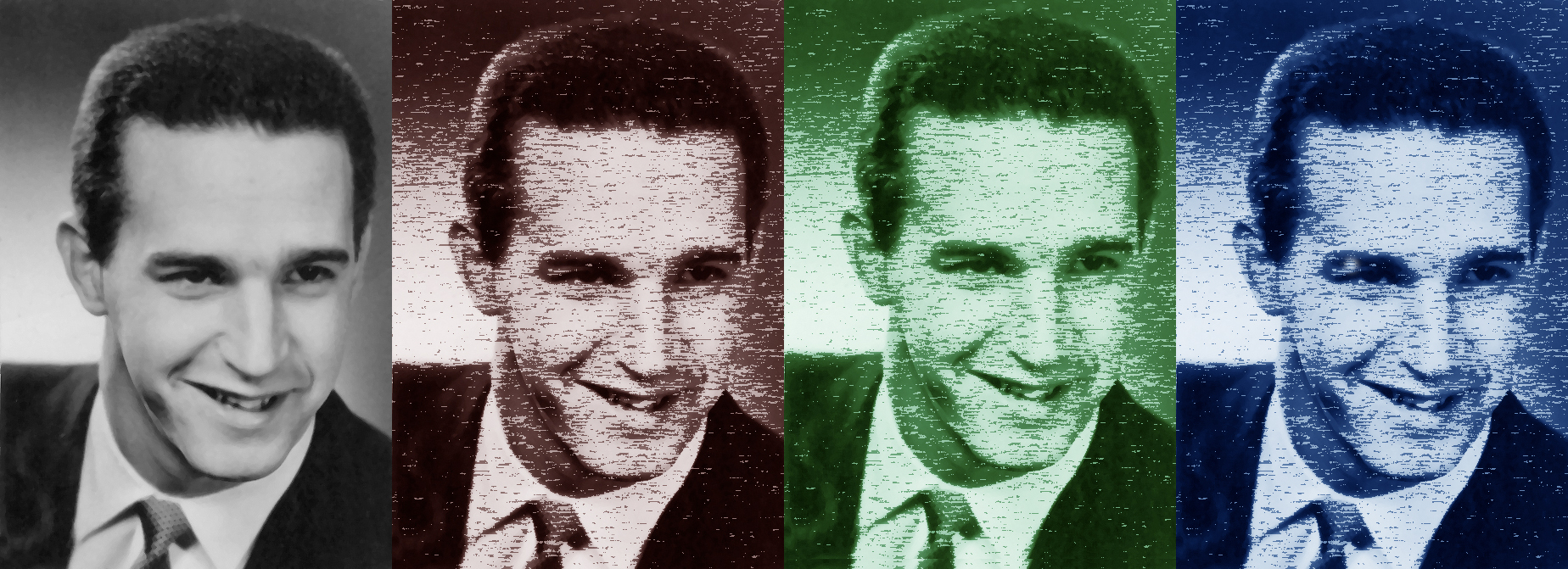
Hello! It’s April 19, a rather momentous date on the calendar, wouldn’t you say? After all, April 19 marks the first day of the Revolutionary War (250 years ago today!). Also the first fatalities of the Civil War were incurred on April 19 (164 years ago today!), as were the deaths and imprisonment of Cuban exiles on day 3 of the failed Bay of Pigs invasion (64 years ago today!). Plus, let’s not forget about the inauguration of the White House bowling alley (78 years ago today!). (I threw in the last one to help lighten the mood.) But you’re not here to discuss any of those events, and neither am I. We’re here to discuss updates on Ron Tammen, who, 72 years ago today, went missing from Miami University on the night of April 19, 1953.
Some of you may be wondering what JFK, the number 10, and an intelligence official with a chic-sounding surname might have to do with Ron Tammen, and to you I say: You must be new here! Thank you for visiting my website, fair and noble recruits! It’s wonderful to have you along, although I’m afraid you have some serious catching up to do. As for you regulars, it’s good to see you too! I think you can guess by the headline where we’re going today. I’m referring, of course, to the missing person documents that the FBI had been keeping on Ron, and all of the stamps and scribbles they’d made on them—stamps and scribbles that I believe hold bona fide clues into what happened to him.
Because the topics we’ll be covering today are, oh, I don’t know…all over the map and occasionally venturing into the weeds, you might say?…I think it’d be best if we did this as a Q&A, which, for you newcomers, happens to be my favorite format. I’ll try my best to keep you in mind as we go. However, if I happen to ramble on about something and you have no idea what I’m talking about, feel free to ask in the comments box at the end.
Lastly, you can click on any of the documents included below for a closer view.
OK! Here we go!
Q: Did you find anything that might pertain to Ron in the latest release of JFK documents?
A: I believe you’re referring to our fairly recent discovery that some of Ron’s stamps and scribbles are the same as those found on a number of people who were investigated for the assassination of President John F. Kennedy? Indeed, I’ve been searching the documents that were made public last month for any of the aforementioned scribbles and stamps and the results have been intriguing.
As of today, I’ve found three FBI documents that fit the bill: one of the documents has an ST-102 stamp, just like Ron’s; one of them has a big number 10 in the righthand corner, just like Ron’s; and one has a series of numbers in the righthand corner, including the number 10 (just like Ron’s), plus, as an added bonus, the names of several FBI agents, two of whom appear to be associated with the number 10.
(For you newcomers, here’s a link to Ron’s FBI documents, so you can see the ST-102 stamps and number 10s. Note that all of the important stuff is on the early documents, ending 5-22-73.)
Here are the new documents I found:
ST-102 stamp
May 1963 CIA document containing a list of members of a “Provisional Government of the Republic of Cuba in Arms”; source is a Cuban exile; ST-102 stamp is on page 2


Number 10
January 1967 FBI memorandum on Santo Trafficante, Jr., a powerful mob boss who oversaw businesses in Florida and Cuba

Series of numbers that includes a 10 (1,2,3,5,6,7,8,9,10,11)
July 1969 National Security Agency (NSA) document on communist nationals traveling to Latin American countries; COMINT stands for communications intelligence

Q: Whoa.
A: Right? I don’t want to get all presumptuous just yet, but there seems to be a theme taking shape here, doesn’t there? And if I had to put that theme into words, I’d say that the same people at the FBI who happened to be keeping an eye on Ron (for whatever reason) were also tracking people affiliated with Cuba—be they pro-Castro, anti-Castro, or mobsters who did a lot of business in Cuba.
Bear in mind that Ron’s documents don’t just have commonalities with Cubans and their associates in the mob. His records have signs and symbols that are shared by famous and infamous people with no Cuban ties as well. You’ll see examples of some of these other people later in this post.
Q: That NSA document seems important. What can you tell us about the names of the FBI agents written on it?

A: When I initially saw the numbers next to several people’s names, I thought that they might be referring to divisions of the FBI, which would have been very mundane and super boring. In other words, I thought that the numbers 9, 10, and 11 were in reference to FBI Divisions 9 (Special Investigative Division), 10 (Inspection Division), and 11 (Legal Counsel), and those people were cc’d. But I don’t think that anymore. Let me correct that: I still think the people listed were cc’d, however I now know that every single person on that list whose name I’m able to decipher was employed with Division 5, or Domestic Intelligence, at that time. That is very exciting news.
Here’s why I’m excited: it now appears that the Domestic Intelligence Division was assigning the numbers to its own people. Maybe the numbers—from 1 to 11—represent traditional units or sections, maybe they represent special teams or squads of some sort, or maybe they represent certain individuals. I believe that these are the groups or individuals who were cc’d in the top right corner of some people’s FBI documents, including Ron Tammen’s.
Here are the last names of the people I’m confident about, along with their full name and one or more of their areas of expertise within Division 5:
Nasca
Vincent (Vince) Nasca
Expert on Cuba, Cuban exiles
*Note that there’s a 5 in front of Nasca’s name, which I think may pertain to the division number. I don’t know why they felt the need to do that, but I think it’s interesting that it appears before his name while the other numbers appear at the end, following a dash. You can see Nasca’s name on the May 1963 CIA document as well.
Harrell
Eugene R. Harrell
Expert on non-Soviet communist countries; also worked on the Daniel Ellsberg case in 1971
F.X. O’Brien
Francis X. O’Brien
Expert on South America
A.W. Gray
Arbor W. Gray
Expert on internal security, i.e., communists and revolutionaries labeled as “new left”
Branigan
William A. Branigan
Expert on counterespionage, Russian intelligence
Wallace – 9
Howard H. Wallace
Expert on counterintelligence
McGuire – 9
James F. McGuire
Worked the night desk, and also worked on Martin Luther King, Jr. assassination investigation (MURKIN)
Of course, wouldn’t you just know that two names of which I’m not 100 percent certain are next to the number 10? I do have my guesses though, which are:
Tansey – 10
Fred Anthony Tansey
Midnight supervisor who took part in a wide range of international cases, including the JFK assassination investigation.
Schwartz – 10
Leon Francis (Frank) Schwartz
In 1969, when the NSA document was produced, he was working as a liaison with the U.S. Air Force and representing the FBI on the U.S. Intelligence Board (USIB). He would become the liaison to the CIA in 1972.
For readers who aren’t sure that this is Frank’s name—if it looks a little too short to you—trust me, I thought it looked a little too short too. However, I think someone else had written the names since they appear to be in the same handwriting, and if so, I wonder if the writer had misspelled Schwartz. It looks as though they’d forgotten to include the c and possibly the t. But what makes me think it’s still Frank is the distinctive, sloppily printed initials over the name, especially the F in the center which connects to a lazy S. Those have Frank’s name all over them.

Here are several examples of Frank’s initials for comparison:


In addition, I’ve checked the FBI’s “Dead List” for every FBI agent with names like Shultz, Schultz, Shay, Sheehy, Skelly, plus any other permutations, and zero possibilities have turned up. The most promising contender was an agent named Henry A. Schutz who’d played a large role in the JFK assassination investigation. However, he was in the General Investigative Division, which is Division 6, not 5 or 10, so I’m thinking it isn’t likely to be his. If Frank Schwartz turns out to be the formidable number 10, that would be consistent with another mark on Ron’s documents: the “lf” mark in the right margin of four of them. In past posts, I’ve proposed that the lf’s were made by Schwartz as well.
R.K.? Doerz? – 11
This last one has me stymied. The FBI’s Dead List and old routing slips weren’t much help either. Of course, I’ll keep at it, but if you’d like to try your hand at figuring out who it might be, feel free!
Q: What do you think the purpose of the numbers was?
I think the numbers in the righthand corner were for internal communication purposes—strictly for FBI staff, and perhaps only for certain key FBI staff. Maybe group 10 dealt with some of the more hot-button cases. Maybe they gave him a 10 for another reason. Unfortunately, we won’t be able to get into the heads of the FBI guys who assigned the numbers, at least not today.
That said, there are a few things we can definitively say about Ron’s 10s:
They came from Domestic Intelligence. We already concluded that Ron’s docs had been floating around the Domestic Intelligence Division when we found his “See index” notation. This just confirms it. Don’t you just love it when we’re right?
Whatever their meaning, those numbers carried a lot of weight to officials within the FBI. Remember all of the 8s that had been given to Lee Harvey Oswald’s docs? Most were written at the top of FBI documents but others were written at the top of other agency documents that had been sent to the FBI, such as those of the State Department or Naval Intelligence. I think we can now conclude that it was the FBI, and only the FBI, that was using the 1-11 numbering system on the documents they produced or acquired.
Sometimes the cases were international while others were domestic. For example, in cases where the State Department had asked the FBI to conduct a security check for someone’s visa application, the FBI would write the number at the top of their copy or, in the case of Marina Oswald’s visa application, in a relevant box. Fittingly, Marina’s 8-1 follows the letters Ci, which likely signifies the Counterintelligence Section within Domestic Intelligence.

One other thing I’ve discovered is that I now believe the numbers were included as part of the FBI’s distribution list for that document. So again, you know Marina Oswald’s visa application that was marked 8-1? I now think that it means that whomever in Domestic Intelligence had been assigned the number 8, that Intelligence staffer or staffers received one copy of Marina’s visa application. A standalone 8 with no dash would indicate that they received one copy as well. If it had said 8-2, they would have received two copies. I think I’ve seen one 3 after a dash, but I’ve never seen a number bigger than that—usually it’s just 1’s and 2’s.
Q: How did you arrive at that conclusion?
A: I remember the exact moment. I was looking through some old FBI documents, which should surprise exactly no one by now. Some of my very best days are spent looking through old FBI documents. (Paradoxically, some of my most mediocre days are spent looking through old FBI documents too. To be honest, I don’t think that I’ve ever experienced a really bad day when reading old FBI documents.)
The documents in question were Message Relay sheets. I was looking at the black-and-white digital versions, but the originals had been made of either a green bond or yellow paper. From what I can tell, these brightly colored cover sheets were used to accompany important memos and teletyped messages that were to be relayed from one of the FBI’s field offices, be it domestic or foreign, to one or more other parties by way of FBI Headquarters. Printed on the Message Relay sheets was a list of federal agencies and officials (e.g., Vice President, President, CIA Director, Attorney General, Secret Service, Secretary of State, etc.) with a square box next to each agency. The boxes would be checked for each intended recipient. At the top of the sheet were two blank areas reserved for Special Agents in Charge (SACS) of the domestic field offices, and Legal Attachés (Legats), stationed in the FBI’s foreign offices. The agent who was filling out the sheet—the message relayer—would write in the names of the recipient offices by hand.
As I was going through the documents, I noticed that the message relayers were also writing the same dashed numbers on the Message Relay sheets that I’d been tracking on the other FBI documents. What’s more, the dashed numbers were written in the same general vicinity where the SACS and Legats were to be written, after the word “TO.” And that’s when it hit me.
“They’re people!” I said to myself.
“They’re people who aren’t already represented on the checklist!” I added.
As for who these people might be, I do have a thought. It has to do with the special agents whose official job responsibilities are to serve as the point of contact for federal agencies, not to mention the FBI’s legal attachés. These employees of the Domestic Intelligence Division are called liaisons. Although I haven’t located a document that tallied the number of liaisons in 1969, the year of the NSA document, it appears to have been 11. (A document from July 1970 stated the number indirectly, and I had to do some math, which is why I’m hedging a little.)
The liaisons would have needed to be kept in the loop regarding anything that the federal agencies whom they covered had received from FBI Headquarters, and yet they weren’t represented on the checklist. That supports our fledgling theory. However, there are aspects to this theory that don’t mesh well with the list of agents on the NSA document. For example, Frank Schwartz was a longtime liaison, but I can’t tell if Wallace, McGuire, or Tansey were. Also, on the NSA document, they’d written down two names each for numbers 9 and 10, and liaisons tended to operate solo. Nevertheless, I think it’s a possibility worth keeping in the backs of our minds.
Here’s one of the Message Relay sheets with the numbers 2-2 and 8-2 near the Legats column.

Here’s a Message Relay sheet in a slightly different format that includes an elusive 10. I’ll tell you who the subject is later. It’s pretty wild.

Q: I remember that you’d also noticed that the term “FD-217” was sometimes written near the numbers in the righthand corner, although it isn’t written on Ron’s documents. Any idea what that’s about?
A: I’m really glad you brought this up. Did you happen to notice the FD-217 on Santo Trafficante’s FBI doc above, next to his 10? I continue to think the reference to FD-217 pertains to the numbers in the upper righthand corner.
As I’ve mentioned in an earlier post, the term “FD-217” is in reference to a special FBI form that I’ve been trying to get my hands on. My hope is that it carries instructions regarding what number to assign to a particular document.
This should be an easy request, but the FBI has already demonstrated that they have no intention of giving me what I’m requesting. Even though the FD-217 form is listed in the Table of Contents of the FBI’s Book of Forms, and I have pointed that out to them, they claim that they can’t find it. That takes a whole lot of chutzpah, wouldn’t you say? In my appeal to the Department of Justice, I wrote:
“I am appealing this request because their response that the FBI is unable to locate a blank copy of form FD-217 is not credible, particularly after I pointed them to the FBI Form Book and the relevant page in the Table of Contents. If it were classified information, that would be a different situation. However they’re claiming not to know where it is, which is clearly a false statement. Under FOIA law, there is no exemption for information that the FBI simply would prefer I not have access to. Therefore, I ask that you remand my request and order them to provide to me what I’m entitled to receive.”
I’m hoping the DOJ does the right thing and remands my FOIA request and the FBI sends me the form ASAP. Irrespective of how they respond, I will be posting all responses in full on this website. I look forward to hearing from them soon.
Q: What if it turns out you’re wrong about what the numbers mean?
As long as we get to the answer, I’m OK with being wrong sometimes. Also, regardless of its meaning, I feel confident that Ron’s 10 was assigned to him by someone in the Domestic Intelligence Division.
Domestic Intelligence.
That is soooo not nothing.
Q: Speaking of Ron’s 10s, you mentioned that you’ve found others?
A: Yes! Here’s my list to date, some of which you’ve already seen. I’ve decided to group them alphabetically by topic. Some 10s are large and jump out at you right away. Others are smaller or very light. Some occur on their own, while others are present in a series. Most are in the top righthand corner, though some are in the right margin. Some are representative samples for a given case. Admittedly, a few are judgment calls. Not all “10” documents are negative…but all seemed to have the FBI as well as one or more federal agencies on high alert. Here you go!
Assassination Attempts (Other than U.S. President/VP)
Pierre Trudeau


Author Seeking Interview on Sensitive Topic
Ron Kessler seeking interview regarding
FBI involvement in 1964 DNC Convention

Bomb Threats
Federal Building, Madison, WI


Bomb threat against Princess Diana and Prince Charles
(Note: I’m including two Message Relay sheets plus the first page of the document that followed each. The second Message Relay sheet is the one that I spoke of earlier.)


Brainwashing/Cults
Margaret Singer, professor and cult/brainwashing expert


(Note: A large number of Margaret Singer documents marked with the number 10, plus some 9’s, can be found on The Black Vault website.)
Communist Nationals
NSA COMINT Report on travel of communist nationals to Latin American countries

Cuba/Cubans/Cuban exiles
Frank Sturgis, U.S. citizen and self-proclaimed soldier of fortune who first assisted Castro, then Cuban exiles


George Spellmeyer, U.S. citizen and owner of fishing boat found traveling between Havana and Cuban prison

Felix Padron Sanchez, et al

Extortion Victims
List of congressmen, senators, agency heads, etc.,
who received a threatening letter

Frank Sinatra, who received a threatening letter from the same person

Kennedy Assassination
Lee Harvey Oswald activities in New Orleans


Mass Murderers
Richard Speck


Sharon Tate et al (aka Charles Manson murders)


(Note: These two are judgment calls, but I thought they were worth including. The 10 in the top document, near several people’s initials, is small and underlined. The bottom 10 is in the right margin. The 1 is light, but if you zoom in close, you can see that it extends past the 0, showing that it is separate.)
Mobsters with Cuban Ties
Santo Trafficante


Salvatore Amarena, et al

Racial Matters
Southern Christian Leadership Conference (Martin Luther King, Jr.)


Sabotage/Sedition, etc.
Kent State students investigated for burning down
the ROTC building on May 2, 1970

(Note: This event preceded the Ohio National Guard taking aim and firing for 13 seconds on unarmed students, killing 4 and wounding 9, on May 4, 1970. You can read the FBI’s investigation, which appears to have been focused heavily on the burning of the ROTC building, in the FBI vault.)
Soviet Spy
Morton Sobell

Subversives
Frank Teruggi


Threats Against the President, Congress
Camilla Hall, Symbionese Liberation Army

Vice President – Possible Assault of


(Note: I think that the agent who signed the top document looks like our friend Russell H. Horner. In a former post, I suggested Horner may have been responsible for the “Hac” notations written at the top of several of Ron’s documents. I’m still waiting on the FBI to send me his personnel file.)
Vice President – Travel Itinerary

(Note: I think it’s interesting that a memo concerning the VP’s international travels is assigned the same number 10 as two memos that concern potential assaults on the VP. I think this could be consistent with our “liaison” theory.)
White House
Sensitive records obtained illegally between 1969 and 1971 through electronic surveillance at request of President Nixon

Q:
A:
Q: I’m kind of speechless. I need to think on this a little more before I ask what I want to ask.
A: Totally fine. It’s a lot. We can move on to the next topic and circle back later.
Q: So who was this L’Allier person, and why do you think he was involved in Ron’s case?
A: Rolland Octave L’Allier was born in Somerset, Wisconsin, on March 2, 1910. His father, Eugene L’Allier, whose parents were both French-Canadian, had been a farmer in Somerset, which appeared to be a magnet for French-Canadians with a yen for farming. Many of their neighbors were also French-Canadian farmers. Tragically, Eugene died much, much too soon—when Rolland was just 2 years of age. As it turned out, his mother remarried another French-Canadian farmer in Somerset (as I said, there were a lot of them), so life didn’t appear to have changed too drastically for him. I think being around so many French-Canadians led Rolland to gravitate to Canada and Canadians, particularly the French-speaking ones. (I know the feeling. I love them too.) According to Rolland’s obituary, he’d attended St. Lawrence College, in Ontario, as well as the University of Montreal.
In 1941, when Rolland was 30, he and his wife, who was French-Canadian by birth, and their young son were living in St. Paul, Minnesota. He was working at the St. Paul Milk Company, though that would soon change. In October of that same year, he would be hired by the FBI and he and his young family would move to the Washington, D.C. area. I’m sure he had a great story to tell his friends about how he’d been living the dream in the milk business in St. Paul, and then, seemingly out of the blue, he was recruited by the FBI, but unfortunately, I haven’t had the chance to hear it.

Rolland L’Allier at a conference at the Harry Truman Presidential Library; photo in public domain
Despite the little I know about Rolland’s early years, I’m positive that he spoke exquisite French. From 1951 through 1959, Rolland was the FBI’s legal attaché in Paris, which sounds like the FBI’s plummest of job opportunities. He would have been the perfect choice. He had a slender build and a likable face. He looked super French, he probably sounded super French, and he had this amazing name that probably rolled off his tongue like a true Quebecois. I’m sure the Parisians ate him up like a profiterole.
In 1960, Rolland L’Allier was 50 years old. He’d been employed with the Bureau for nearly 20 years, which was generally retirement time at the FBI. It appears he wasn’t ready to retire just yet though—he had a little more petrol left in his Renault (so to speak). He moved back to the States, and was named chief of the FBI’s Liaison Section, the section in Domestic Intelligence that we’ve already heard quite a bit about today. He was in charge of all of the liaisons, including Sam Papich, who was a longtime liaison to the CIA before Frank Schwartz. In his position, L’Allier needed to be apprised of everything that the liaisons were learning from and sharing with the federal agencies and legats because he needed to alert the people at the top of the FBI. It was a heavy duty post. Put simply: he knew a lot about what other agencies in the federal government were doing and it was his responsibility to bring his bosses up to speed.
In 1962, L’Allier was tapped to become the first director of the Herbert Hoover Presidential Library in West Branch, Iowa. This might sound weird at first, but it actually makes sense. In his role as chief of the Liaison Section, he’d raised concerns with the FBI leadership regarding what restrictions were being placed on documents that were being made available at the National Archives. He was particularly concerned that not enough restrictions were being implemented for some classified documents. When he was named to his new post, the people at the National Archives likely felt that they were putting the nation’s classified documents in good hands.
I forget the second part of your question. What was it again?
Q: How does a guy with those credentials come into contact with Ron Tammen’s missing person documents?
Oh, right. First let’s do a quick recap of his timeline. From 1951 through 1959, he was in Paris as the FBI’s legal attaché; from 1960 to 1962, he was stationed at FBI Headquarters in Washington, D.C., overseeing the liaisons; and from 1962 through whenever he ended his term as director of the Hoover library, he was in Iowa. By my calculations, there’s a tiny window when I think Rolland L’Allier came into contact with Ron’s missing person documents, and that window is between 1960 and 1962.
Here’s why I think he intersected with Ron’s documents: Rolland L’Allier had a distinctive way of signing his name to FBI documents. Actually, he had two ways. One way he signed them was with a printed L and an accent mark. Like this:

His jazzier signature—his signature signature, in my view—was a large loopy L, an oversized accent mark, and a small, printed capital A to the right of the L, sometimes at a jaunty angle. Here are a couple good examples:


Now, take a look at the signature in the upper righthand corner (near the 10) of page one of Ron’s missing person documents.

There’s the big loopy L, the oversized accent mark, and, the most telling part, what appears to be a small capital A at a jaunty angle. There’s also a squiggly line, which I’ll be addressing below. For now, concentrate on the L, the accent mark, and the A.

Let’s zoom in a little further on that A:

There are three prominent lines: two slanted lines that come together to form the point of the A (at a jaunty angle) and a third horizontal line that crosses them. I believe that Rolland L’Allier signed page one of Ron’s missing person documents alongside the phrase “all files” and the partial date of “5/28.” (Incidentally, don’t you just love the “all files” note? It sounds as though they had enough info on Ron Tammen to fill several file folders, if not an entire filing cabinet! I’m kidding, but it does seem weird.) As mentioned above, there’s also that squiggly line after the A.

Some readers may think that it can’t be L’Allier due to the 5/28 date, which, because it’s lacking a year, implies that it was signed on May 28, 1953, two days after Cleveland had sent in their report about Marjorie’s phone call, and well outside of L’Allier’s 1960-62 window. But perhaps the 5/28 represents a different year or signifies something else? I mean, how many files could there have been on Ron Tammen on May 28, 1953? It was still at least three months before Ron’s Selective Service file would be opened. By my count, there should have been precisely one. So something seems fishy there.
Also, that squiggly line was not generally part of L’Allier’s M.O., which might lead some people to rule him out as being the signer on Ron’s document. Not me though. The way I see it, Rolland might have added that squiggly line for pizzazz. Or, as shown above, occasionally he would sign his initials over his full name, which sometimes looked a little like a squiggle at the end. Like this time, for example:

Maybe a portion of his full signature had been erased. I’m not sure. All I can say is that the big loopy L plus the accent mark plus the small capital A have all the hallmarks of L’Allier’s signature on Ron Tammen’s documents. I think it’s him.
Q: What do you make of all this?
Oh, gosh, so many thoughts. First, I think we can all agree that Ron Tammen was alive and well after he went missing and the folks in the FBI’s Domestic Intelligence Division were keeping their eye on him, for whatever reason. I think we can also safely say that Ron wasn’t leading the tranquil life of a bond salesman, which had been his supposed dream job.
Second, something that I haven’t mentioned to you yet is that Rolland L’Allier was extremely familiar with the CIA, not only when he was overseeing the liaisons, but also when he was the legal attaché in Paris. I’ve learned through newly declassified portions of a famous 1961 memo from Arthur Schlelsinger, Jr. to President Kennedy that the U.S. Embassy in Paris, where L’Allier had been stationed for 9 years, was also home to 123 CIA agents—one hundred twenty-three!—all of whom occupied the top floor of the Paris Embassy. So…there’s that.
Third, if it is L’Allier’s signature on Ron’s missing person documents, and if he signed it between 1960 and 1962, then that would coincide with a significant time period in our nation’s history when the United States and Cuba were butting heads, including, most famously, the Bay of Pigs fiasco and the CIA’s attempts to assassinate Fidel Castro. If Ron was somehow, I don’t know, involved with any of that, it might help explain why Ron’s documents share so many similarities with Cubans, Cuban exiles, and mobsters who were operating out of Florida and Havana, such as Santo Trafficante. Also, don’t forget that James W. McCord, Jr., the former CIA agent and Watergate burglar who shares a few stamps and scribbles with Ron, had close ties to Cuban exiles as well.
How about you guys? What do you make of all this?
Q: Before we go there, I have a question about all of those 10’s you found that match Ron’s.
A: Sure, go ahead.
Q: If the FBI considered Ron to be somehow dangerous, adding him to the Security Index, and lumping him into the same category as mobsters and cases involving extortion, bomb threats, assassination attempts, and mass murderers, why have they been running interference for him by not disclosing his whereabouts for over seven decades? In a sense, haven’t they been putting us all in harm’s way?
A: GREAT question. If anyone from the FBI, DOJ, or CIA would like to weigh in, the floor is now open. Or, feel free to reach out to me through the contact form on this blog site and I’ll protect your identity forever.
******
COMING NEXT WEEK: For anyone in the Oxford/Hamilton/Cincinnati/etc. area, I’ll be discussing Ron’s story at the Butler County Historical Society next Saturday, April 26. If you’ve been a little too busy to keep up with the blog or you’ve been wanting to hear a condensed version of the most important details of the case, this is your opportunity. There will also be some breaking news. The 1 p.m. session is sold out, but there are still some open seats for 3:30 p.m. They do require reservations. It’s free for BCHS members and $5 for nonmembers, payable at the door. Hope to see you there!

******
Many thanks to The Black Vault, the Mary Ferrell Foundation, the National Archives, Governmentattic.org, and National Security Archive for making these documents available.

Between screenwriting full-time, film festival red carpet events, and Hollywood screenplay writing panel presentations, I have been quietly catching up—all this last year.
What an alarming but wondrous rabbit hole this case has evolved into. I was going to make a comment, but whereaboutsstillunknown beat me to it above about Ron’s involvement of executing the MKULTRA experiments and not so much being a victim of its results.
But the stamps and coding of all the FBI documents of Ron’s that appear on others, even up to 1973 is so bewildering and how they corrolate to the groupings of “undesirables.” My head is reeling trying make sense of it all.
And with the latter said, and with the rapid rise of AI advancements, have you tried putting documents in an AI search engine to help decode or explain these discoveries? I know Google has quite a few that are becoming alarming smart with each passing day. In fact, there’s a new TV commercial promoting one of their AI assessment tools that practically knows just about everything.
Hi Brett! Nice to hear from you again, and I’m happy to hear about all of your successes!
Re: Your AI suggestion, I’ve been so leery of AI, however I do realize it’s becoming too big to fight and if it’s used for good, then yeah, ok. I’ll look into it—thanks!
One funny story: a few nights ago, I was writing notes for my presentation and on a whim, I Googled “Clark Hull” AND “CIA,” together. (I’ve wondered if he worked for the CIA before 1952, because they refuse to lift the redactions on his name and he’s been dead since that year.) Up popped this AI description that’s based on my blog, and it was saying that “while the two aren’t directly related,” there’s a possible indirect relationship thru St. Clair Switzer and Ron Tammen! (Or something to that effect.) The wording was cautious, which is good, but Ron was mentioned very matter-of-factly, like everyone should know who that is. 😄🤪
Thanks, Jen. This last year has been a wild ride. Creatively and health wise as I had a serious cancer scare, but after a biopsy, the results were benign and I’m healthy.
Yeah, the “web search AI” is to be taken with a HUGE grain of salt. No matter what the subject that is searched. The other day it stated certain correct things about a subject I was researching. I already knew the correct facts about it, but the web AI stated the wrong time period and a stated the event happened in my local area which is laughably incorrect.
But, using the more “advanced AI search engines” (not the web’s) may be very beneficial and may even help piece together a pattern of perspective from the documents. But I know how you feel. The AI thing is scary and every screenwriter, actor, and voice-over artist knows that studios are freely testing and using it and it could very well replace talent agents, managers, and casting directors sooner than we realize. It’s getting to the point of AI becoming “self-aware.” SKYNET just might become a concerning possibility.
This last weekend, I revisited Oliver Stone’s JFK film after many passing eons. The film is ageless. And I thought about Ron and MKULTRA while watching it this time. Especially during the scenes of “theoretical” what-ifs of the time and place of the assassination shooting in the plaza. The possibility of 3 locations and teams actively working together to commit the crime. Especially the location beyond the grassy knoll and the behind the wood fence where more shots were heard, followed by a blinding flash.
I couldn’t help but think that this event was some sort of MKULTRA/MANCHURIAN CANDIDATE(S) event. People being a part of the killing, yet not realizing it before or after. But participating during.
And especially afterward, when a few bystanders who saw and heard the shots taking place behind the fence said that after the quick flash, everyone watching in the streets remained quiet and still—absolutely motionless—like time was standing still for a short period of time. Something eerily hypnotic that took place.
First, congratulations on getting through your health scare. What a relief. So happy that you’re healthy and back to doing the things you love to do. Also, I’ve been wanting to watch JFK again…plus there’s a new one, JFK Revisited, that I want to see. Thanks for the reminder. I watched the JFK hearing on April 1 that Oliver Stone plus other JFK researchers spoke at. If you didn’t catch it then, it’s available on CSPAN: https://www.c-span.org/program/house-committee/hearing-on-release-of-president-kennedys-assassination-records/657844. That’s how I learned about the extraordinarily large number of CIA agents stationed at the U.S. Embassy in Paris.
Regarding the possibility of a tie between MKULTRA and JFK’s assassination–there’s a document in the Mary Ferrell collection that mentions ZRALERT. The subject heading is “Recent Discovery of Project ZRALERT Documents — A Study of the Use of Psychological Programming for Intelligence Purposes,” and it then refers to the use of “hypnotism in certain operational situations.” The document ties ZRALERT to the Mexico City Field Station in the summer of 1963, and mentions that they planned to discuss whatever records they had with the HSCA Chief Counsel, Robert Blakey. (The memo writer, Bruce T. Johnsons, said that “Special handling of the documents from Mexico City is called for, I believe.”) I haven’t seen any other CIA documents on ZRALERT, but would love to know more about it. You can find the link to the memo with the reference to ZRALERT on the Mary Ferrell website, under Cryptonyms.
I’m about halfway through, but keep getting stuck on Richard Speck, because a minimally-educated, violent, drunken mass murderer seems like an odd choice to file next to revolutionaries, subversives, spies, and assassins. So I suppose my first question is, was Sidney Gottlieb cheerfully spiking random drinkers’ beer with LSD in Chicago in July of ’66? Or did the FBI otherwise have reason to think Speck was MKUltra’d?
Then, too, perhaps they discovered the CIA was keeping tabs on him AFTER the murders. I suppose the now-debunked “XYY Syndrome” theory floating about at the time would have piqued the interest of those guys; they’d probably be thinking along the lines of, “how much easier would it be to make a programmable assassin if the individual was predisposed to aggression?”
I guess I can also see how a guy who killed 8 women living in a single house over the course of 12 hours might be considered a national security threat, since that isn’t exactly normal behavior. I guess I’m just wondering at THEIR rationale behind it: concern over copycats? Potential problems if the guy gets acquitted? Soviet seed of chaos, paid in vodka?
Julie, your comments are always on point—excellent questions! I also was really thrown by the inclusion of Margaret Singer, a highly respected psychologist, who was also a close friend of Louis Jolyon West. (There’s a video of the two of them on YouTube.) The FBI was ostensibly interested in her because of a comment she’d made somewhere concerning the brainwashing of religious cult members. As soon as I saw the word brainwashing, I was all hmmmmm.
Yep, and weird that they redacted the name of the prosecuter/former agent. That should be a matter of public record, so what was the point? It would be highly unusual if he did all the prep work and someone else took it to trial for a number of reasons.
Margaret Singer surprises me somewhat less, since in order to do her cultic brainwashing research, she’d need to talk with a lot of those “filthy hippies” most of the Washington establishment were petrified of.
As far as L’Allier, I’m also reminded of John Dolibois, francophone, formerly of military intelligence in WWII, interrogator of top-brass Nazis, future ambassador to Luxembourg, and running Miami’s alumni association, who somehow managed to exclude most of the 1950s out of his autobiography. Not to suggest they knew each other (although wouldn’t THAT be interesting?) so much as that seem to have a few commonalities.
So much to think about here. You know what we need? We need a big white board with a lot of red string.
SO MUCH red string! Happy Easter!
😄👍 Happy Easter to you too!
Wow!! Just fascinating. I’m inclined to agree with you, but wonder how he could be working for the government but be on their watch list at the same time. My brain screams Manchurian candidate. Have a great time presenting; I hope they record it!!
Thanks! Great point. He was on the FBI/DOJ’s watchlist, but I’m leaning toward him working for the CIA. As for his being an MC… 🤷🏻♀️. I really hope not but I’ll continue to dig. BCHS will be taping, but will post on their YouTube channel at least 30 days after the fact. I will link to it when it’s up.
“Love & Honor”—and Intrigue!
Still following along with your interesting investigative journey, Jen. Unable to attend one of your presentations, but wish you the best of luck. I’m sure it will be fantastic and hope to be able to view it later if it’s recorded.
Thanks so much, Deb!
Hi!
That last question is certainly on my mind too, along with my usual question: if Ron was using a different name, why is there nothing on Ron’s documents that cross references the other name?
Now I am wondering if he didn’t actually change his name but is living under his own identity in another country. If he were in Cuba, for example, it would be hard to find any trace of him online. And if we are still believing he was alive to request his fingerprints be removed, and he hadn’t changed his name, it would almost have to suggest he was serving a loooooong prison sentence or out of the country.
I’m also becoming a little doubtful that he was a victim of MKULTRA experiments. I’m leaning a little more toward the idea that he was recruited to perform the experiments on others and didn’t realize what he was getting himself into. Maybe Switzer knew, though. It could explain why he might have become disenfranchised with the government and associated with some of these people whose names are surfacing now.
Do you think Interpol might have anything on him?
Thanks so much for these thoughts. Brilliant question about Interpol! I honestly have never thought of them. But then…I’m still getting used to the notion that Ron may have been committing crimes, possibly in other countries. I see that DOJ has a page on Interpol Washington and docs that have been released thru FOIA. I’ll look into it!