A chance encounter in Wellsville

One question that’s been floating around for decades is whether housing official Heber Hiram (aka H.H., aka Hi) Stephenson actually bumped into Ronald Tammen at a hotel restaurant in Wellsville, NY, on Wednesday, August 5, 1953. If it did happen to be Ron, the next question would be: who were the men he was with? And third: why were they there?

As I’ve pointed out elsewhere on this blog, these questions could have been fairly answerable back in 1953, after Hi told Carl Knox, dean of men at Miami who oversaw the university’s investigation, about his encounter. Knox could have helped spur the process along by asking H.H. this no-brainer: “Which hotel, Hi?”, and then calling his contact at the FBI. The FBI’s Buffalo office could have chased down some of those details and, if they determined that it was likely Ron, they would have had a super hot lead on their hands. If they decided it wasn’t Ron, they would have reported that info back as well. It’s what they do. But, for some reason, Carl Knox didn’t get that ball rolling. 

For what it’s worth, I believe H.H. saw Ronald Tammen that day. I believe it for three reasons. One is that H.H. knew Ron and, as his son has told me, he never forgot a face. That’s big, in my view—much bigger than a stranger who saw a photo in a newspaper and thought that same person had showed up at her doorstep late at night two months prior. 

My second reason has to do with human behavior. H.H.’s account is consistent with how two people who think they recognize each other in an out-of-context location would normally act. I mean, we stare, don’t we? We wait for eye contact, assessing whether the other person recognizes us too, and if they do, then we say something. And that’s what they both did—they stared at each other. Because it was less than four months since his disappearance, Ron would have looked about the same, as did H.H. And although we wish he would have acted differently, even H.H.’s decision to not approach the young men’s table seems consistent with what many people would have done in that situation. 

OK, perhaps that wouldn’t apply to readers of this blog. Members of our little clique would have likely spoken up. Maybe something like: “Pardon my intrusion, but you look like someone I know. I don’t suppose your name is Ron Tammen?” Or, as one reader pointed out, he would have expected a 1950s version of “WTF, Ron?!?” Either would have been a normal response. But H.H.’s decision to walk out the door and immediately regretting it is normal too. And what did Ron’s lookalike do? He got the heck out of there before H.H. returned. If it were Ron, isn’t that what you’d expect him to do—to run as soon as he had an opening?

The third reason is that H.H. reported his encounter to Carl Knox the next day. If Stephenson had any reservations about who the young man was, he might have said something like, “Wow—I just saw a guy who, if I didn’t know better, looked exactly like Ronald Tammen.” But H.H. fully expected Knox to act on the tip. Considering the fact that they were colleagues and he was putting his credibility on the line, he obviously had no doubt in his mind that it was Ron. 

“I was sure it was him,” he told reporter Joe Cella in April 1976.

There is, however, one thing I learned about Hi Stephenson that doesn’t quite jive with my theory. According to his son, Hi Stephenson kept a journal throughout his life, and, as of our phone conversation in February 2013, his son still had the collection. Needless to say, when his son shared this news with me, I was stoked. To obtain a more complete accounting of that encounter in Wellsville would be amazing, would it not? Maybe Stephenson would have described the table of guys a little more—their appearance, their demeanor. Maybe he’d included the name of the hotel and what the daily special was. (The latter tidbit wouldn’t add much to the mystery, but it’s the sort of color I adore.)

Unfortunately, a couple weeks after we spoke, his son sent me an email saying that, after looking through his father’s journal for the date in question, he couldn’t find an entry regarding the Ron Tammen sighting. Of course I was profoundly disappointed, not to mention surprised. On a day when most of Hi’s time was spent reading road signs and counting miles, how he could have thought to write anything other than “Gadzooks—I just spotted Ron Tammen!” is beyond me. 

In September 2014, I took a little trip to Wellsville myself.

When I’m on one of my typical Ronald Tammen road trips, there’s one song on my playlist that I crank up louder and more often than the others. It’s Brandi Carlile’s The Story. The studio version is great, but the version with the Seattle Symphony is my all-time favorite. The reason I love this song so much is that A.) It allows me to scream like a rock goddess when she hits that high note, and B.) I feel the lyrics apply to my search for Tammen. I mean, I’ve literally or figuratively done all of those things (which I won’t name, for copyright reasons) for Ron. And that thing she says about her, um, creases in her countenance? After dedicating nearly nine years of my life to this project, well, let’s just say that that hits home in a very big way too. 

So there I was, one sunshiny fall Tuesday, blasting Brandi along the highways between my then-home in D.C. and Wellsville, NY. Wellsville is the name of both a village and surrounding town totaling around 7400 people in the southwest part of the state, just eight miles north of the Pennsylvania border. As I neared my destination, I had a strong sense that I was passing the same houses and barns that Ron would have passed by—if indeed it was Ron in that hotel restaurant. 

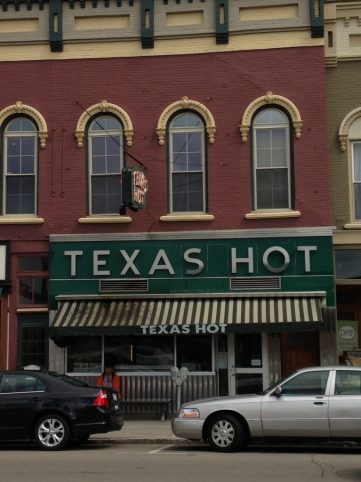
Even a billboard for a restaurant called Texas Hot, which has been serving up chili dogs to Wellsvillians since 1921, looked as if it had been standing along that stretch of road for decades. I knew as soon as I passed it that I’d be eating dinner there that night on the off chance that Ron might have eaten there too. 

Texas Hot is named for a type of hot dog topped with mustard, chili sauce, and chopped onions, all on a soft, steamed bun. They are, culinarily speaking, ridiculously delicious. The iconic restaurant has been owned and operated all these years by the same two families, and is now run by the grandsons of the longtime partners and Greek immigrants who got it all started, James Rigas and George Raptis. If you’re anywhere near Wellsville, you have to go. (No, seriously, promise me.)

Texas Hot in the early years. Used with permission of the Allegany County Historical Society.
Texas Hot in September 2014.

After finishing off the specialty of the house, accompanied by french fries and gravy, I roamed the town and was soon drawn to the old train station located one block north of Main Street on the corner of Pearl and Depot Streets. The red brick building, once bustling with visitors and the people who welcomed them or bid them goodbye, was boarded up and rimmed with weeds. Located in the center of town, it ostensibly had been a pipeline that helped power Wellsville’s prosperity in the early part of the 20th century. 

Wellsville Erie Depot in September 2014.

Most noticeably, the train station was steps away from one of the four hotels that, with the help of a 1953 phone directory, I’d narrowed down as being H.H.’s and Ron’s most likely meeting spots. That was the Hotel Brunswick, at the corner of North Main and Pearl Streets, which now houses a real estate office among other businesses. The other three possible hotels, all of which are no longer standing, were the Fassett Hotel, which was a short walk southeastward on Main Street (55 North Main), Pickup’s Hotel (38-40 North Main), and, a little less than a mile to the north, the Wellsville Hotel (470 North Main), where the Lutheran church now stands. 

The building formerly known as the Hotel Brunswick, September 2014.

The proximity of the train station to the Hotel Brunswick led me to wonder: Could Ron have been journeying by train and stopped off at Wellsville for a quick bite or to spend the night? Before that little epiphany, I’d been operating under the assumption that Ron was temporarily living in Wellsville—that perhaps he and his associates were being prepped for some clandestine purpose in a nearby government facility. But if Ron was traveling by train to parts unknown, then the odds of Ron and Hi Stephenson bumping into one another were even more astronomical than I’d originally thought. 

The next morning, I paid a visit to the office of Craig Braack, Allegany County’s historian, whose building was located one town over in Belmont, the county seat. Braack, who has since retired, seemed genuinely intrigued by the Ron Tammen mystery, and he ventured a guess that the hotel in which the sighting occurred was probably the Fassett or Brunswick, which had been my top two choices at that point as well. In addition to occupying space among the businesses that lined Main Street, both hotels seemed upscale enough that they would offer the type of restaurant that might suit the tastes of a woman in her mid-thirties—Hi’s wife Kay. Then again, the restaurant couldn’t be too fancy, or it might have discouraged a group of young men from eating there, at least one of whom was on the lam and possibly didn’t have a lot of cash on him.

The Hotel Fassett. Used with permission of the Allegany County Historical Society.

Braack wasn’t aware of any government training facility, covert or overt, in Wellsville. He was more inclined to believe that Ron was just passing through town, by road or by rail. He informed me that before the Interstate system, Main Street was part of State Route 17, a major east-west thoroughfare at the time. (State Route 17 has since been replaced by 417, which circumvents Main Street.)

“Route 17 goes parallel to our New York-Pennsylvania state line, so it’s possible that they could have been on that,” he suggested. 

“Sounds reasonable,” I replied, “as long as they had access to a car.” 

I explained that Ron had left his car parked outside of his dorm the night he disappeared, though there was also a chance that he could have been riding in someone else’s vehicle. The other option would have been the train. Braack pointed out that Wellsville’s train station was a major stop along the Erie Railroad, which, like Route 17, ran east and west. Each day, three or four passenger trains would arrive in Wellsville, connecting Chicago to New York City and places in between. 

“If they were taking the train, that would have been a way to easily travel a long distance in a very short period,” he said. “That could also be why he was at the hotel.”

Later that afternoon, I stopped by Wellsville’s Nathanial Dyke museum. I was greeted by Mary Rhodes, who was town historian when I met with her, but who recently moved to South Carolina, and Jane Pinney, then-president of the Thelma Rogers Genealogical and Historical Society. (A September 18, 2018, article in the Wellsville Daily Reporter describes Rhodes’ and Pinney’s commitment to preserving the history of the area and their many contributions.) They agreed with Braack that the Erie Railroad and State Route 17 were the two most likely means by which Ron might have rolled into town, since that’s how most people did it back then. Pinney recounted how neighborhood kids peddling lemonade on Main Street would play the license plate game, making a list of the states that were represented as cars either barreled by or pulled over to make a purchase.

“They had every state in the union by the end of the summer,” she said.

But there were plenty of reasons for people to stay in Wellsville as opposed to just passing through. There were jobs there—lots of them. In the late 1800s, oil was discovered in the region, and a refinery was built, which, in 1953, was owned and operated by Sinclair Oil. The refinery was shut down in 1958 after a fire, but the remnants of oil money are still evident by the string of mansions, oozing with opulence, along the roadside north of town.

“OK. Now the name Wellsville makes sense,” I said. As if by reflex, both women jumped in to correct me, something they’d no-doubt done with out-of-towners many times before. Wellsville wasn’t named for its oil wells, but rather for Gardiner Wells, who was the principal landowner when residents were deciding upon the important matter of what to call themselves.

Other major industries in 1953 were the Air Preheater Company, which produced equipment for improving the efficiency of electrical power plants, and the Worthington Corporation, which produced steam turbines, also used in energy production. According to Pinney and Rhodes, the companies were frequent recipients of federal contracts, especially during WWII, and it wasn’t uncommon for hotels to be filled with clients who wished to tour the facilities, to inspect the product, or to be trained in operations. Pinney recalls driving to her job at 7:00 a.m. each day and seeing 20 or 30 executives who were visiting from China performing their exercises on the sidewalk in front of the Fassett Hotel.

In other words, at the time that Ron was potentially spotted by Hi Stephenson, Wellsville was by no means just a tranquil little town along the Genesee River. It was a player, both nationally and internationally. 

“The place was booming,” said Rhodes. 

Even so, I couldn’t see Ron throwing his old life away to reinvent himself in Wellsville, NY. I mean no disrespect to the good people of Wellsville. It’s just that I don’t understand why there would be any urgency for a young man to run away, cutting off all ties to friends and family to pursue a career in the power industry. I asked if they had any idea which hotel Ron might have been more likely to eat or spend the night in—if, again, it was Ron. Mary said that she thought that the Brunswick was being used as a residence hotel by then, so the sighting probably wouldn’t have been there. Jane’s husband Dave, who’d grown up in Wellsville and who’d joined our conversation by that time, agreed, and added that he didn’t think the Brunswick had a dining room then. The three decided that the Fassett was a more likely candidate. Or Pickup’s. Or the Hotel Wellsville. 

Hotel Wellsville. Used with permission of the Allegany County Historical Society.

Months after my visit, in an email, Mary let me know that she had followed up with one of the town’s residents, who said that the Hotel Brunswick only had a coffee shop and a bar. “Not a real dinner place,” she told me.I decided to eliminate it from consideration, narrowing the options to three.

The coffee shop in the Hotel Brunswick. Used with permission of the Allegany County Historical Society.

In Joe Cella’s 1976 news article, Hi had remarked that “he and his wife walked out of the hotel onto the street” when he told Kay about his possible Ron sighting, which is consistent with the locations of the Brunswick, Fassett, and Pickup’s hotels. The Hotel Wellsville, however, was set farther back from the main road, on landscaped grounds. I eliminated it from consideration as well. I was now down to two possibilities: Pickup’s Hotel and the Fassett Hotel.

Pickup’s might seem a little weird for the name of a hotel, but it was named for the family who bought the building in 1936. Constructed in 1852, it was the oldest building in the Main Street business district, though the owners had modernized it. The building had a big sign that said “RESTAURANT” out front that would have been a draw for travelers. An article describing a 1961 fire that “ravaged” the hotel noted that very little of the building was devoted to hotel space and the “principal business activity…centered around its restaurant on the ground floor.” For these reasons—the prominence of the restaurant, and its nice-but-not-too-nice modern touches—Pickup’s was becoming more appealing to me as the backdrop of Hi’s potential Tammen sighting. Plus, it would have likely been the first restaurant Hi would have seen driving into town.

Pickup’s Hotel. Used with permission of the Allegany County Historical Society.

But the Fassett Hotel had its pluses too. Built in 1870, it was a stately brick building whose ground floor had been updated in the 1940s with eye-catching window treatments. It, too, was a popular place for dining—it advertised a “Dining Room” on the sign facing Main Street—in addition to hosting other events. 

 “You don’t happen to know where I could get my hands on some old hotel registries, do you?” I asked the trio as I was getting up to leave. At once, I felt silly for suggesting that anyone would hold onto 60-year-old hotel registries—even there, in a museum, among people who were fanatical about preserving their town’s history.

Mary said that the former owner of the Fassett Hotel still lived in town and she promised to ask him for me. I thanked her, but I knew the chances were next to nil he would have stored them away somewhere. Unfortunately, I was right. 

And that’s where I’m afraid we’ve hit a dead end. My best guess for where Hi Stephenson saw Ronald Tammen or Tammen’s lookalike is at Pickup’s Hotel or the Fassett Hotel, with my personal choice being Pickup’s. 

Either it was a run-of-the-mill doppelganger sighting, nothing more, or it was a coincidence beyond all coincidences—an encounter whose odds of occurring are so remarkably small that it appears that something or someone bigger than all of us may have stepped in to make it happen. Call it fate. Call it the universe. Call it a supreme being overriding free will and moving a couple human chess pieces himself. I can think of no other explanation for why two people so close to the Tammen mystery—one being Tammen himself—would land 480 miles away from Oxford in the tiny town of Wellsville, on the same day, at the same hour, and in the same hotel restaurant. But that’s exactly what Hi Stephenson believed had happened. 

And Carl Knox? Regardless of whether it was Ronald Tammen or not, the only reasonable explanation for his inaction is that his investigation into Tammen’s disappearance had taken a back seat to his other university responsibilities sometime between June 29, 1953, when newspapers reported Clara Spivey’s possible Ron sighting, and August 6, when Hi Stephenson reported his. Did someone of a higher ranking step in during that period to call off the search? That’s my best guess too.

An ode to Joe on his 98th birthday

joe cella hamilton journal-news early 1950s_1 copy
Joe Cella as a reporter for the Hamilton Journal-News in the early 1950s.

December 23, 2018

If there is one name that’s come to be closely associated with the Ronald Tammen story, it would be that of Joe Cella. Cella was the reporter for the Hamilton Journal-News who’d written some of the more substantive pieces about Tammen’s disappearance. So obsessed was he about the case that he carried Tammen’s photo around with him in his wallet for decades—a photo that Richard Tammen had given him. If you’ve been following this blog for even a short while, you probably already know that the amount of respect I have for him is pretty much off the charts. He’s my idol. Maybe even a borderline crush.

Joseph Anthony Cella was born on this day in 1920 in Bisaccia, Italy, an ancient town in the southern part of the boot, approximately where the ankle would be if the boot was for real. He and his parents immigrated to the U.S. before he was one year of age and settled in Hamilton, Ohio, which is where he lived for most of his life. Sadly, he didn’t live long by today’s standards, passing away during the summer of 1980 at the age of 59, right after I graduated from college. (If only I’d thought to give him a call to discuss the Tammen case when I was a student at Miami. I’m still kicking myself for that missed opportunity.) Nevertheless, his impact was significant.

My admiration for Cella grew as I studied every line of every article he wrote on Ronald Tammen. As the years rolled by, he didn’t give up on Tammen. He didn’t recycle and rehash the same-old, same-old for anniversary stories that he wrote. And he didn’t settle for what university officials or the Oxford police were telling him. Sure, he’d write down whatever information they were doling out, but he had other sources too. Even 23 years after the fact, he was unearthing new information, much of which investigators had known but had opted to keep from the public.

Thanks to Cella, we learned:

  • That “a psychology book which Ronald was reported to have been reading was found on his desk.” (HJN, 4-22-1954)
  • That the psychology book on Ron’s desk had been opened to “Habits.” (HJN, 4-18-1976)
  • That Ron had stopped in at the office of Garret Boone, M.D., in Hamilton, OH, to have his blood typed on November 19, 1952, five months before Ron disappeared. Cella also revealed that Boone felt that he’d been given the “brush-off” by university officials, who, according to Boone, “didn’t want to discuss the case” when he came forward with his information. (HJN, 4-23-1973)
  • That on Friday, April 17, the weekend of his disappearance, Ron had stopped by the home of Glenn Dennison on Contreras Road at around 8:00 p.m. to pay his car insurance. They talked a little about the Campus Owls, but then he was on his way. (HJN, 4-18-1976)
  • That H.H. Stephenson, a housing official who’d given Ron his permit to have a car on campus, thought he’d seen Ron with a group of young men in a restaurant in Wellsville, NY, on August 5, 1953. (HJN, 4-18-1976)

At least three of those findings, and possibly four, factor prominently in the solution of this case, I believe.

“He was always a skeptic,” said one of his sons. “And the reporter that he was, he was always trying to find the answer to the truth…He was always digging to find the answer. It was one of those things where he didn’t really trust anything completely. He was going to find out for himself definitively what the answer was. He did that with a number of stories, and this one, in particular, which lasted, you know, to the day he died.”

“He’s out there,” he used to say about Tammen.

joe cella hamilton journal-news early 1950s
Joe Cella looking out the window of the Hamilton Journal-News with the clock tower of the Butler County Courthouse in the background.

Like Tammen, Cella had movie-star looks. His wife June, who met Joe when he was an usher at the Paramount Theater in Hamilton, often said that he reminded her of Tyrone Power, the dashing leading man of Zorro fame who happened to be from nearby Cincinnati. After serving in WWII, Cella thought he might give Hollywood a try, but it didn’t pan out for him. He and June returned to Hamilton where they would raise a family and Joe would work the rest of his days in news reporting and communications.

joe cella Paramount Theater
Young Joe as an usher at the Paramount Theater, Hamilton, Ohio.

He probably was feeling let down about this turn of events, but I consider it to be a good thing. Hollywood has enough beautiful people. Joe Cella had a gift for journalism. He had an inquisitive mind and a thirst for truth, which, in my book, the world can always use more of.

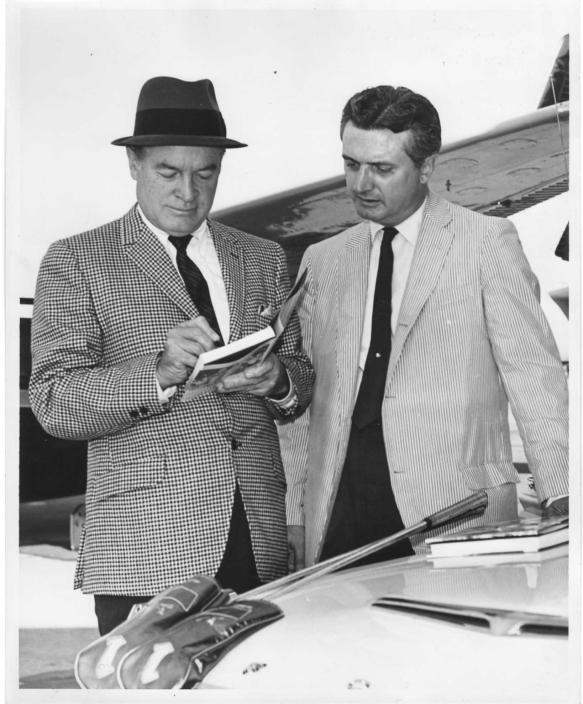
According to his obituary, Cella’s first job in journalism was with the Hamilton Journal-News, where he worked for five years, before moving on to various stints around Cincinnati. These included TV Guide magazine (regional editor), Crosley Broadcasting Corporation (promotion and publicity director), and Avco Broadcasting and WLW radio and television (public relations director). He was an avid golfer and, in 1962, he worked alongside Bob Hope to help organize an annual celebrity golf tournament at a Cincinnati country club, with proceeds benefiting a local charity. He also opened his own advertising and public relations firm.

joe cella bob hope wlw-tv abt 1963
Cella was with TV station WLWT when he worked on a celebrity golf tournament with Bob Hope.

In 1966, Cella rejoined the Hamilton Journal-News, where he worked as a reporter for the next decade, and, as we now know, where he churned out some of his best work on the Tammen case. (I sometimes wondered why I hadn’t seen anything from him on Tammen between 1954 and 1973, and now I know the answer. For much of that time, he was in PR and hanging with the likes of Bob Hope!) Cella received several accolades for the reporting he’d done on other topics during this period. He received two awards from the Associated Press of Ohio—one for his story about Robert Hatton, a young man from Hamilton who could have easily requested a medical deferment from the Vietnam War, but who, instead, fought and died there, and the other for his coverage of the discovery of an unidentified woman’s body in an industrial sludge pit near Hamilton. His third award was from the American Bar Association for his coverage of a mass murder on Easter in 1975 by James Ruppert.

In 1976, Cella assisted with the documentary “The Phantom of Oxford,” produced by WLWD-TV2, in Dayton, which told the story of Ronald Tammen’s disappearance and included on-camera interviews of some of the major players. I’m sure that documentary, for which its producers received regional Emmy Awards, would have never happened without Cella’s zealousness for keeping the case alive, knowledge of every last detail of the story, and well-worn Rolodex.

That same year, Cella stepped down from his job with the Journal-News to run for Butler County commissioner. His platform was to provide “better service to the public” and he proposed to accomplish this through his expertise in communications and public relations. He was a big believer in improving a citizen’s accessibility to the people in charge and having those people in charge engage in a lot less talking and a lot more listening. He won the Democratic primary but, in the main election, he lost to a more seasoned politician named Donald Schirmer, which was devastating for him. I have no idea how Schirmer fared at the job, but I know that Cella would have poured every ounce of himself into it.

Not long afterward, Cella’s health began to decline. He was in and out of the hospital with gastrointestinal issues, which became an ongoing burden for him. Still, he went back to reporting, this time with the Hamilton Sun. On August 13, 1980, while he was covering a Hamilton City Council meeting, Cella slumped over in his chair, unresponsive. He was pronounced dead of a heart attack later that night.

“He died doing what he loved,” his son told me.

Some additional thoughts on Joe Cella in the words of one of his sons:

I guess I wanted to fill in a bit more about my father. I mentioned he was a quiet, gentle person. This is something my girlfriend, now wife, had said she noticed and which in turn, attracted her to me more! He was the opposite of the male Italian head of household stereotype, much different from his father.

He was proud of his Italian heritage and was bilingual. My brothers and I all gravitated to him and his side of the family more because they were a different kind of people from most everyone else in our town. It made us feel kind of special, I guess you’d say.

My father was, as I had said, always interested in finding answers. If something happened, he wanted to know why it happened. He had run for county commissioner back in ’76 and lost pretty badly to an experienced politician. He was in disbelief when the results came in and he kept trying to find out how and why he lost, going over the printouts. I think he took it personally. I had a feeling, though, during the campaigning that he was up against some formidable odds.

I watched him change with the times. He sold off the family station wagon in 1970 and bought two Fiat sport cars, grew his hair longer with sideburns and a moustache (I never cared for it—thought it made him look sinister). His opponent in the election was the clean-cut type. I had been at [Miami University] during some of the upheavals on campus during the Vietnam War and I remember him saying, “This isn’t right,” when comparing it to his experience in the Army Air Corps during WWII. He was against me being drafted  after finding out I had a low number (I wound up getting a 4-F medical deferment my senior year). He became more vocal politically and was influenced by the number of young kids killed in action during that war. As I mentioned, he wrote a story about one soldier who was from Hamilton and his life there. Dad received an AP award for that story.

He was a creative, artistic person, too. I have a few sketches he did of a mockup for an ad for the long gone Surf Club, a  popular jazz spot in Cincinnati where he booked talent. He was big into the jazz scene in the ‘50s and early ‘60s, maybe because he had played trumpet in a band while at Hamilton Catholic High. I recall him taking me, as a preteen, to a hole-in-the-wall jazz bar in Mt. Adams called The Blind Lemon. A trio was playing on the patio that day. I would go back there later on, whenever I could while in town. He turned me on to WNOP, a tiny AM station out of Newport, KY, that was on the air with jazz programming from sun up to dusk. Hardly any kids my age back then were listening to a station like that. His appreciation of that form of music stayed with me.

He was always wanting to be unique, I think, which is why he made several attempts to make a break from Hamilton for the bright lights, big city, but my mother was too tied to her family to move away. I was told once that he did a screen test for Warner Bros. after he came back from the War, having gone to school at Shuster Martin Drama School in Cinci. Through his job in the late ‘50s and early ‘60s as publicity and promotion manager at Crosley Broadcasting, he was finally able to be around the movie and TV personalities, a crowd he had always wanted to be in.

joe cella at wlw-t cincinnati abt 1960
Cella at his PR job at WLWT.

His sudden death from a heart attack while covering a meeting in the Hamilton City Council chambers was a shock, of course, but he had been ill for several years and had been showing it. Still, losing him at age 59 was tragic for us all.

Happy birthday, Joe. Thanks to your healthy skepticism and top-notch reporting, we may finally be able to solve this mystery.

joe cella hamilton journal news abt 1954 copy
Cella at the Hamilton Journal-News, circa 1954-ish.

cfry-Hollycfry-Hollycfry-Holly

A big thank you to members of the Cella family for sharing the above photos with me and for telling me stories about your dad. It’s obvious how important he was in your lives.

Happy holidays, everyone.

A late-night knock at the door

knocker

Clara Josephine Spivey lived with her husband, Carl, in a two-story home on North Main Street in Seven Mile, Ohio. Carl, who was once the mayor of that small town, was an electrician by trade and Clara’s second husband. Her first husband had been tragically killed when, in 1918, a mere five months into their marriage, the delivery truck he was driving collided with a train in nearby Hamilton. Clara married Carl two years later.

By the spring of 1953, Clara was 54 years of age with two grown children. Son Jearl was 32 years old and married. The best I can tell, he was also an electrician living about 20 miles from his parents, in Lebanon, Ohio. Daughter Barbara was 28 and married to a man named Donald Ries. (They would divorce in 1963.) From what I can tell, the couple was also living in Seven Mile.

Late on Sunday, April 19, 1953, reportedly at about midnight, there was a knock on the Spiveys’ front door. Clara was apparently still up at that hour, along with Barbara and at least one other person whom we’ll discuss a little later in this post. Perhaps Clara was emboldened by the presence of the other night owls sitting up with her—safety in numbers, and all that. Or maybe it was just the innocence of the times. Whatever her reason, she went ahead and opened the door.

Thankfully, there was nothing to fear. Standing on her porch was a well-mannered young man with a smudge on his cheek—probably from fixing a flat tire, she presumed—and an embarrassed look on his face. The jacket he had on didn’t seem at all sufficient for the chilly temperatures, in her viewpoint, and he wasn’t wearing a hat either. He had dark, deep-set eyes and close-cropped hair—his most distinguishing characteristics in her mind’s eye. He asked for nothing except some direction.

“What town am I in?” the youth had asked her, according to the earliest news accounts. And then: “Where will I be if I go in that direction?”, pointing northeastward, toward Middletown.

Clara recalled telling the youth that he could catch the bus to Middletown, which just so happened to stop at the nearby corner at that time of night. It wasn’t until the next day that she realized the information she’d given him was in error. The bus schedule for the Oxford Coach Lines had been changed that very day, April 19, and the last run from Oxford to Middletown, which passed through Seven Mile, had been suspended.

Other than perhaps a twinge of regret for having led her visitor astray, Clara didn’t think much about the incident afterward. Then, that June, she learned about Ronald Tammen. She’d somehow missed all the ballyhoo about Tammen when he’d first disappeared, and only became aware of the story by way of a follow-up news article that, in essence, reported that A) he’d been gone for two months, and B) there were no new leads. The article, which featured a large photo of Tammen, appeared in the June 20 issue of the Hamilton Journal-News, Clara’s most likely preferred news source. The same article also appeared in the June 22 issue of the Cincinnati Enquirer. Sometime after seeing the article, she notified the Oxford police, and by June 29, her story was being reported across the Miami Valley as the first real clue in the case. Clara Spivey was convinced that the young man at her doorstep had been Tammen. That photo, which had immediately whisked her back to the night in question, served as proof.

Tammen photo
The photo of Tammen that appeared in the June 20, 1953, Hamilton Journal-News and the June 22, 1953, Cincinnati Enquirer.

Oscar Decker, Oxford’s police chief, welcomed the potential sighting with a great big bear hug. If it happened to be Ron Tammen, he reasoned, that would bolster the amnesia theory very nicely.

“Tammen disappeared about 8:30 or 9 o’clock from his room in Fisher Hall,” Decker was quoted as saying in one of the June 29th articles. (Based on the font and layout, I think it was the Cincinnati Enquirer, though my clipping doesn’t contain a reference.) “If he wandered away, it would have taken him about three hours to walk to Seven Mile.”

Sure, it was cold, it was hilly, it was late, but it was totally doable in his opinion.

Also convincing to Decker was Clara’s description of what Tammen was wearing that night. The June 29th Hamilton Journal-News article said this: “Mrs. Spivey described the youth’s wearing apparel almost perfectly, according to the chief.” Also, the September 18, 1953, issue of the Miami Student said: “Although she could not see under the dim porch light what the man was wearing, Mrs. Spivey declared that he seemed to have on a light-weight coat with a checked pattern and dark trousers.” Investigators had described Tammen as wearing a blue and tan checked or plaid wool jacket (sometimes referred to as a mackinaw) and blue pants when he disappeared.

An article in the July 3, 1953, Hamilton Journal-News stated that Henry Ciesicki, who was identified as president of the Delta Tau Delta fraternity, had interviewed Mrs. Spivey and found that she was indeed positive that the young man she saw was Tammen after looking at photographs of him. However, the article continued, “There were certain discrepancies as to the type of clothing the missing student was wearing and that of the man whom Mrs. Spivey saw, Ciesicki said.” The discrepancies were brought up again in an article by Joe Cella in the April 22, 1954, issue of the Hamilton Journal-News: “[Tammen’s] brother, Richard, maintains that there are some discrepancies in Mrs. Spivey’s story. The type of clothing worn and missing has come up for considerable discussion throughout the investigation.”

Was the visitor on Mrs. Spivey’s porch Ronald Tammen? Before placing your vote, here are some additional points to consider:

The route

If it was Ron who showed up on Mrs. Spivey’s doorstep, he would have most likely traveled State Route 73 East to 127 South, which leads directly into Seven Mile. The terrain is hilly, and it seems as if it would require some fairly purposeful trekking as opposed to the wanderings of someone with amnesia. Moreover, if Ron had been on foot, he would have passed by numerous homes along Main Street on his way to Mrs. Spivey’s. An atlas from 1930, which shows the number of properties that existed in northern Seven Mile at that time and, presumably, a corresponding number of houses, can be viewed below. (Mrs. Spivey’s property is along Hamilton & Eaton Road, aka Main Street, near High Street.)

1930 atlas of Seven Mile
For a closer view, click on image.

An atlas of the northern part of Seven Mile from 1958 is here.

But don’t just take the Butler Co. cartographers’ word for it. Follow the route for yourself in this video, and try to picture a totally out-of-it Ronald Tammen walking these roads on a chilly, snowy night in unsuitable outerwear. Are you as convinced as Oscar Decker that it was Ron? (Uncopyrighted traveling music provided by the YouTube Audio Library. Apologies in advance for my knack for driving over every possible bump in the road.)

 The time of the encounter

As discussed earlier, the first time anyone had heard about the potential Spivey sighting was on Monday, June 29, 1953, when at least two news articles were published. The article that I believe was in the Cincinnati Enquirer reported that the visitor had arrived on Mrs. Spivey’s doorstep at “about midnight,” while the Hamilton Journal-News reported that the time of night was “about 11 o’clock.” The time discrepancy is intriguing, because the author of both articles was Gilson Wright, a Miami journalism professor who was also an on-call correspondent for a number of area papers. (I’m certain that Wright wrote both articles because, even though there isn’t a byline for either article, the Journal-News identifies Wright as the correspondent for its Oxford section on that date, and the two articles, though not identical, have the same phrasing throughout.) That the same reporter would publish conflicting times for the encounter on the same news day is kind of, um, bizarre, considering the significance of the hour to the overall timeline. “About midnight” was the most frequently reported time over the years, including later issues of the Journal-News, which is why I repeated it in the third paragraph of this post. Also, Oscar Decker is quoted directly in the September 18, 1953, article of the Miami Student, saying that the time was “about midnight.” On the other hand, the 11 p.m. time was attributed to Mrs. Spivey (who, after all, would have been the best source), though not as a direct quote. “Mrs. Spivey said the youth came to her door about 11 o’clock…,” Wright stated in that article.

If the June 29th Hamilton Journal-News version is closer to the truth, Ron wouldn’t have had the full three hours that Oscar Decker estimated a walk to Seven Mile would have required. According to this September 2018 fitness article and the Centers for Disease Control and Prevention, a brisk walking pace is considered to be 3 miles per hour or 20 minutes per mile. If the time was midnight, Tammen would have had 180 minutes to walk approximately 11 miles, or a little over 16 minutes per mile. That would have been a pretty good clip, but still doable. But if the time was 11 p.m.? Ron would have needed to be in a full-on run. The latter scenario wouldn’t exactly fit the storyline that everyone was selling, would it? What’s more, if Ron had been at the Delta Tau Delta song practice until around 10:30 p.m., as has been claimed by at least one person, there was no way Ron could have made it to Seven Mile by either 11 p.m. or midnight if he was walking.

But what if Ron Tammen had actually been driven to Seven Mile? If a car was involved, there are a few possible scenarios to consider:

He hitchhiked.
Ron was known to hitchhike from place to place, especially when he didn’t have a car on campus. Granted, it would have been odd for him to choose to hitchhike out of Oxford as opposed to driving his own car. However, if, for some reason, he did so and someone picked him up somewhere between Fisher Hall and Seven Mile, chances are that person would have reported it when the media began publicizing his disappearance. If Oscar Decker had received such a call, you better believe that he would have announced it to the press. From what I can tell, there were no phone calls from anyone who either picked up a hitchhiker or who spotted someone walking alongside that stretch of road on April 19, 1953. One caller did think he’d spotted Tammen in Middletown the week after the Spivey article was published, though that obviously didn’t check out.

He was “kidnapped” and left in Seven Mile as a prank.
As we’ve discussed elsewhere on this site, fraternities back then used to kidnap pledges and drop them off in the middle of nowhere so they would have to find their way home. Many people, including yours truly at one point, have wondered if that might have been what happened to Ron—the whole fraternity-prank-gone-awry theory. But several factors have led me to rule this theory out. First, the men in Ron’s fraternity are wonderful people and they don’t act all weird when I ask them about Ron Tammen. They really would love to know what happened to him. Second, Ron wasn’t a pledge. He was an active member of Delta Tau Delta, which means that he wouldn’t have been a target for such antics. Third, he didn’t live in the fraternity house, which, according to one of his fraternity brothers, was home base from which a guy would have been kidnapped if he were being kidnapped.

Fourth (and perhaps foremost), instead of asking Mrs. Spivey for directions, wouldn’t Ron’s more obvious first question be “Can I use your phone?” According to Carl Knox’s notes, the door to his dorm room was left open and his car keys were in his desk. He could have asked someone from Fisher Hall to pick him up. His roommate, Chuck Findlay, would have been back by then. Also, the questions the visitor asked didn’t pertain to finding his way back to Oxford. In April 1954, Mrs. Spivey would embellish her conversation with the young man to include her pointing the way to Hamilton, Middletown, and Oxford. But that wasn’t the case in June 1953. As described above, the youth asked her what town he was in and where he would be if he went in “that direction,” which was toward Middletown. She’d told him how to catch the bus to Middletown, the crucial detail that enabled her to date stamp the night he’d appeared at her door, since the bus route had ended on April 19. Based on her earliest recollection and, in my view, the one that would have probably been most accurate, there was no mention of Oxford.

Someone who knew him drove him there.
Perhaps someone else could have driven Ron to Seven Mile—someone like the mysterious woman from Hamilton, for example. If that’s true, why he would have gotten out of the car at Mrs. Spivey’s residence isn’t clear, unless, perhaps, he’d tried to escape as the car had slowed down on Main Street. But if he did escape, why (again) wouldn’t he have asked Mrs. Spivey if he could use her telephone to call for help? And where did he go after he left Mrs. Spivey’s? Perhaps someone overpowered him and pushed him back in the car. Still, the young man’s questions for Mrs. Spivey don’t exactly jive with those that might have been asked by someone who was being taken somewhere against his will. At least, they aren’t the sorts of questions that someone would have asked had he been thinking clearly.

The other people in the room

In Joe Cella’s 1976 article in the Hamilton Journal-News, we learned that Clara’s daughter Barbara, whose last name was now Jewell after a second marriage, was also present when the visitor showed up at the door. Though Clara had died in 1975, Barbara stood by her mother’s story. Here’s what Cella wrote:

“Mrs. Spivey has since died but her daughter, Mrs. Barbara Jewell of Seven Mile, remembers the night well. She was there when the knock was answered.

 ‘I still believe it was him,’ said Mrs. Jewell. When her mother viewed a photograph of Tammen at the time, she said, ‘That’s him. I know I’m not mistaken.’”

Barbara Jewell passed away in 1999. However, in 2012, Frank Smith, Butler County’s former cold case detective, informed me of someone else who was present when the visitor showed up at the door. Smith had stopped by a United Dairy Farmers store for a cup of coffee around the time that the Butler County Sheriff’s Office was getting a lot of local press for their work regarding the dead body in Georgia. According to Smith, a guy came out of the store and said he’d been reading in the paper about the Tammen case.

Recounted Smith, “He said, ‘I was there that night when the door was opened too.’”

Smith then added, “And he told me, he said that he absolutely was confident that that was not Tammen that knocked on the door that night. He thought it was one of the local ruffians that lived down the road. But he was absolutely confident.”

According to Smith, the man who approached him—as he recalled, it was Mrs. Spivey’s son—had been in the military and was battling cancer. He also said that he’d passed away shortly after they talked. I accepted this information at face value and didn’t delve further, which turned out to be a mistake. Memories, as I’ve come to learn time and again, aren’t 100 percent foolproof. If I’d done my fact checking a little sooner, I might have been able to speak with the man myself.

Several years ago, as I was doing some online research, I discovered that the man who’d approached Frank Smith couldn’t have been Clara Spivey’s son. Jearl Spivey had died in 1980, long before Smith had gotten involved in the case. Donald Ries, who, along with Carl Spivey, had passed away in the 1970s, could also be ruled out. However, another possible candidate did pop up—Paul Jewell, Barbara’s second husband. Jewell died in 2014, two years after my conversation with Smith. According to his obituary, Jewell had worked at the Champion Paper Company and, later, The Workingman’s Store, a beloved clothing and shoe store for everyday working people that his parents had opened in Hamilton and where he eventually became owner. The obit also said that he’d served in the U.S. Army from 1958 to 1960, and suggested that memorials be given to the American Cancer Society, among other charities. My guess is that Paul Jewell was the man who approached Frank Smith.

There is one puzzling aspect to placing Jewell in Mrs. Spivey’s home late at night on April 19, 1953. Paul Jewell was 13 years younger than Barbara, born in September 1937. In April 1953, Barbara was still married to Donald Ries, whereas Paul would have been 15 years of age and a sophomore at McGuffey High School in Oxford. (He graduated in 1955.) From what I can tell from old city directories, Paul and Barbara were married in the mid-1960s. So one question I have is, if it was Jewell, why would he have been at the Spiveys so late on a Sunday night when the next day was a school day for him? Another big question I have is: again, if it was Paul Jewell who spoke with Frank Smith, did he and Barbara actually see the visitor or did they just hear Clara’s account, like the rest of us, and form their own opinions? Unfortunately, I’m not sure we’ll ever know the answer.

So what do you think? Was it Ronald Tammen at Mrs. Spivey’s door or merely one of Seven Mile’s local ruffians? Feel free to register your vote here:

(Please note that Crowdsignal/Polldaddy is a third-party site that uses cookies. Also, sharing on Facebook and Twitter uses cookies.)

And now, for all you readers in the U.S., please be sure to vote for real if you haven’t already. It’s our right, our privilege, and our obligation and probably way more important than anything else we may have on our plates these days.

***************

Let’s also open up the floor. Feel free to weigh in on anything Tammen-related, especially your thoughts on Mrs. Spivey’s story and why you voted one way or the other in our poll.

The open psych book

Psych book
Cover of 1951 edition of “Psychology–The Fundamentals of Human Adjustment,” by Norman L. Munn, the issue and title of the book that was open on Ronald Tammen’s desk the night he disappeared.

One of the most frequently named items that Ronald Tammen had left behind—apart from his wallet, IDs, and car keys—was the open book on his desk. Remember the book? From what I can tell, it was first brought to the public’s attention on April 25, 1953, when the Hamilton Journal-News reported “books” (plural) being “open on a study table” after he’d disappeared. On May 2, 1953, the books were narrowed down to “a textbook” that “was left open on his desk,” though some reports reverted to the plural form on occasion after that date. In April 1954, we learned from Joe Cella, also of the Hamilton Journal-News, that it was a psychology book, and in 1976, Cella reported that the psychology book was turned to “Habits.” This detail is posthumously corroborated by Carl Knox, dean of men, whose investigative notes say “Psych Book opened to HABITS,” with the last word written in all caps and underscored twice. What’s more, Knox had also noted that Tammen was spotted “Studying Psych” from 3:00 to 4:00 p.m. on the day of his disappearance. How someone might have known the subject matter that Tammen had been studying, we can’t be sure, but that person must have felt reasonably confident of that detail to mention it to investigators.

Carl Knox notes -- HABITS
The HABITS reference, underlined twice, can be seen at the bottom of Carl Knox’s note.
Carl Knox notes -- studying psych
Beneath Tammen’s name is Carl Knox’s notation that Tammen had been “Studying Psych” from 3-4 p.m. that Sunday.

Juxtapose all of the above with what Dick Titus told me Tammen had said to him before Tammen had walked out of Titus’s room the evening of his disappearance: that he needed to study his own subjects. What does all of this tell you? For me, it indicates that one of the last things on Tammen’s mind before he went missing was psychology. In fact, it appears to have been the subject he felt most compelled to study during the afternoon and evening of his final day as a Miami student. The topic of “Habits” is an added bit of intrigue.

Here’s why I find the open psych book so fascinating: Ronald Tammen wasn’t taking a psychology class.

Oh, let me rephrase that. Although Ronald Tammen had been enrolled in psychology the semester that he disappeared, he’d already withdrawn from the course by the time he went missing.

The documents that I’m posting today, which, to the best of my knowledge, have never been posted online before, are Ronald Tammen’s college transcripts. Here they are.

Before we get to the topic of psychology, let’s take a look at Ronald Tammen’s grades. He was a B student—the average of the A’s, B’s, and C’s he had accumulated since he’d arrived at Miami. His much-publicized grade point average of 3.205 was from his freshman year. The A’s were in courses such as Unified Math and General Geology—he was, after all, a math and science guy. The C’s were in American Social and Economic History (first semester) and Freshman Composition (second semester). All things considered, he was doing fairly well academically his first year away from home.

transcripts-p1
Page 1 of Ronald Tammen’s transcripts

Now, let’s turn our attention to Ron’s sophomore year. W’s—withdrawals—had begun popping up like wins in the Brooklyn Dodgers’ 1953 baseball standings. Except Ron wasn’t winning. He was struggling. Juggling. At the start of the first semester of his sophomore year, Ron was carrying a course load of 17 credit hours, which is typical for a full-time student. At its completion, however, he was carrying only 11 hours, having dropped two 3-hour courses—an economics course and General Psychology, PSY 261. Despite the much lighter load, his grade point average had now slipped to 3.178, by my calculations.

That’s where the grades end, because at the conclusion of Tammen’s second semester, we see only a string of I’s (incompletes), a P (passing) in gym, and a W in psychology, the same course he’d dropped the previous semester. The P is of no consequence to this story. It only tells us how badly a person would have to be doing in gym to be given a failing grade. You could fall off the planet five weeks before finals and still pass the course. It’s the lone W in the line-up of I’s that was most curious to me. I needed to know the timeframe by which those I’s and W were handed out.

Our first clue is a statement at the bottom of page 3 of Tammen’s student records (made available for the first time here), that says: “DISAPPEARED FROM RESIDENCE HALL APRIL 19, 1953. GIVEN INCOMPLETES FOR SEMESTER (2ND, 1952-53).”

Ron's student records

In my mind, that would imply that when Ron disappeared, he’d already dropped his psychology course and those I’s only pertained to courses in which he was still enrolled. To make sure my reasoning was correct, I contacted the Miami University Registrar’s Office in October 2010, asking how it could be that Ron had received that W in his psychology course.

Miami’s Registrar, David Sauter, is one of the most responsive administrators I’ve encountered anywhere. He’s also interested in the Tammen case. He got right on it. The next day, an assistant contacted me with information from an old grade card. It said that if a course is dropped after seven weeks, “either ‘WP’ for withdrawn passing or ‘WF’ for withdrawn failing must be entered.”

“The old grade card for that course indicates Mr. Tammen had a midterm grade of ‘C’ for the course in Spring 1953 and that he was dropped with a ‘WP.’  It does not, however, provide a drop date,” she said in her email. She added that she and her colleagues in the Registrar’s Office believed that the reason that there is a lone W on the transcript, and not a WP, was because the columns were only one character wide.

That provided me with one endpoint to my timeframe—Ron must have withdrawn at least seven weeks into the semester. But what about the other endpoint? I contacted Miami’s archivist at that time, Bob Schmidt, who emailed me a page from the 1952-53 issue of Rules and Regulations Governing Students, Student Activities, and Student Organizations for Miami University. In addition to confirming the information that the Registrar’s Office had provided, it said that course withdrawals had to be performed through the student’s adviser, and any withdrawals after eleven weeks resulted in a WF.

So, to recap, thus far:

  • Ron Tammen had indeed already dropped his psychology course by the time he’d disappeared.
  • He’d done it between the seventh and eleventh weeks of the second semester.
  • Ron’s adviser, a professor by the name of Belden J. Dennison, knew it; Carl Knox, in his principal role as dean of men, also likely knew it; and now we know it too.

University calendars for 1952-53 show that Tuesday, February 3, was the date when second-semester classes started at Miami. Not quite seven weeks later, Saturday, March 21, 1953, was the last day a student could withdraw from a course without receiving a grade, and Saturday, April 25, 1953, a little over 11 weeks after the semester’s start, was the last day a student could withdraw from a course without receiving a WF. That means that the timeframe in which Ron had withdrawn from the course was likely sometime between Monday, March 23, and Saturday, April 18. Not only was this “drop” period within weeks of Ron’s disappearance, and possibly only a day or two before, it also overlapped with spring break, which had taken place from noon, Saturday, March 28, until Monday, April 6, with classes resuming on Tuesday, April 7. Ron wouldn’t have been able to drop his psych course during the university’s week off, so he either did it right before spring break or right after. My guess is that it would have been after spring break, because that was also the time period in which Ron had appeared to be showing signs of stress. Carl Knox had noted that Ron had been consulting the Bible several times after spring break and had also spoken of “being ‘tired lately’ since vacation.”

Carl Knox notes -- signs of stress
According to Carl Knox’s notes, Ronald Tammen seemed to be showing signs of stress following spring break.

So I think the question on everyone’s minds is: why would Ronald Tammen be reading a textbook for a class he’d already dropped?

It could be that he had a general, non-school-related question he was pondering—something that led him to crack open an authoritative resource, not unlike how we now crack open our laptops to ask Google What’s romanesco? or How old is Kirk Douglas?

But why look up the very vague and arbitrary topic of habits? If Ronald Tammen had a habit he wanted to break, it would make more sense to research that specific topic somewhere, like a library, or to seek guidance from an expert. Besides, what habit would Ronald Tammen even have that needed breaking? Smoking? He didn’t smoke. Drinking? He wasn’t a drinker either. Was he a nail-biter? I doubt it. To be honest, it’s difficult to imagine what habit Ronald Tammen would want to kick with such urgency that he would interrupt his busy Sunday to consult his former textbook for a dry-as-a-bone description of habits. That would be like looking up the word Italy in an encyclopedia in hopes of finding a really good marinara recipe. It makes no sense.

HABITS

Among the boxes devoted to Ronald Tammen at the Miami University Archives are copies of textbook pages, many of which have the following notation typed on them: “Copy of textbooks left open on Ron Tammen’s desk.” The word “textbooks” is plural, but the pages are from one book: Psychology–The Fundamentals of Human Adjustment, by Norman L. Munn. At the top of one of the pages, someone has made the notation that the book was a 2nd edition, from 1951. I found it puzzling that the archived documents covered a range spanning pages 152 to 295. Typically, if a book is open on a desk, there are only two pages facing upward, not a range of 143 pages.

I purchased the 1951 issue of Munn’s textbook online. When it arrived, one of the first things I did was make sure that the nine copied pages from University Archives corresponded with my version, and they did. I felt confident that I was perusing the same textbook edition that Ron had been spotted studying. The second thing I did was check to see if there was a chapter titled “Habits,” and there isn’t one. I then took a deductive leap, and reasoned that whoever observed that Ron’s book was opened to “Habits” must have noticed the word in a section head or subhead. (We’ll discuss why I think this was the right decision a little later.) I examined each of the 143 pages looking for headings with some form of the word habit written there. I also checked the rest of Munn’s book for any other possible mentions of the word in a section head or subhead.

I found four pages in all, which happened to be among the nine archived pages. They were pages 152 (with the section head Levels of Complexity in Habit Formation), 162 (subhead: Habit Interference), 277 (section head: Man is Primarily a Creature of Habit), and 294 (section head: Force of Habit). Finally, it dawned on me. Whoever had made the archived copies was probably doing what I was doing: trying to figure out which two pages Tammen was studying before he disappeared. (That person even went a little farther than I was inclined to go, making copies of a couple additional pages that included the word habits in the regular text.) But how could I narrow down those four pages, plus the pages they were facing, to just two? If only someone had taken a photo of the open book.

As it so happens, someone had. A few days after the first anniversary of Ronald Tammen’s disappearance—April 22, 1954—the Hamilton Journal-News published an article that included photographs of Ron and Chuck’s room after Ron had disappeared. One of the photos was a close-up of the open book he’d left on his desk and a second photo was of the same book from another angle. Although we can’t be 100-percent certain that the pages in the photos are exactly as Ron had left them—a current of air or an accidental bump could have caused one or two pages to flip—nevertheless, it’s all that we have. Moreover, the article was written by Joe Cella, who likely obtained the photos from investigators. If Cella believed the photos to be accurate, who am I to second guess him?

Unfortunately, I’m not able to obtain enlarged versions of the photos. The originals no longer exist. However, you can access the article here and zoom in on the two photos. [Article is provided with the permission of the Hamilton Journal-News and Cox Media Group Ohio.]

From what I can tell, the left-hand page appears to lack any images or graphics. Therefore, at a minimum, I believe we can rule out two of the two-page spreads on the basis that there were fairly prominent photographs on the left-hand pages. They are pages 152, which had a photo of a memory drum in the upper left-hand corner, and 276, which is opposite the habits reference on page 277, and which had four photos down its left column of a mother rat and her babies. In my view, spreads 152–153 and 276–277 are no longer contenders.

The right-hand page is more difficult to discern in the Journal-News photos. It doesn’t appear to have images either, which would eliminate pages 162–163 on the basis that the latter page has a photograph on the upper left side of a student operating a card-sorter.

But there’s another, more compelling reason to remove pages 162–163 from consideration. As I mentioned earlier, Munn’s book contains both section heads and subheads. The section heads are written in all capital letters, while the subheads are written in bold type with only the first word capitalized. As I’ve already mentioned, when Carl Knox wrote the word “HABITS” in his notes, he did so in all capital letters, accentuated by a double underline. I can’t help but believe that he was imitating the style in which the words were written in the book, perhaps without even realizing what he was doing. In my opinion, Carl Knox was looking at a section head, not a subhead, which would eliminate the page spread 162–163.

HABITS 2

That leaves us with two pages that are composed entirely of text: pages 294 and 295. On the left-hand page is the section head “FORCE OF HABIT,” which Dean Knox could have shortened to “HABITS.” On the opposite page is a subject even more intriguing. Within a section titled “UNCONSCIOUS MOTIVATION” is a discussion on how someone can be influenced to behave in certain ways. The subhead is “Post-hypnotic suggestion.”

I’m not sure why investigators failed to specify the page numbers that the book was turned to or why Carl Knox chose to write “HABITS” in his notes as opposed to the actual section head. As we’ve established, no subhead or section head on any of the pages was simply called “Habits.” It’s also curious that university officials didn’t appear to question why Ron would be studying psychology, since they knew he’d already dropped the course. Did that detail somehow escape them?

Or could it be that investigators had noticed the reference to post-hypnotic suggestion and didn’t want to raise suspicions that Ronald Tammen’s disappearance could have had something to do with that phenomenon? I get it—why get everyone all riled up if it had no relevance to the case? But with Miami’s psychology department employing at least three faculty members who were hypnosis experts—two of them having collaborated with a renowned psychologist on the 1933 seminal book Hypnosis and Suggestibility, and one of those two being Ronald Tammen’s former psych professor—it seems as if that might have been something worth inquiring about.

­­­­­­­­­__________________________________

­­­­­­­­­­­­­

Yep, we’re going to go there in subsequent posts, but we’ll be proceeding slowly and cautiously. I don’t intend to point fingers at a person, department, or agency before all of the evidence is in. I also won’t be disparaging a medical practice that has helped countless people overcome personal difficulties. What I will be doing is posting relevant documents as they become available and asking questions that, as far as I know, haven’t been posed before—at least not publicly.

In the meantime, please join me today on Facebook (https://www.facebook.com/agmihtf/) at 11:30 a.m. ET as I live-stream additional information concerning today’s post. Among other things, we’ll be leafing through the individual pages of Tammen’s psychology book, looking at the habits references. If you’re tied up at that time, or are discovering this website after April 19, no problem. You can access a recording after-the-fact.


Why did Ron Tammen get his blood typed?

donating blood
Photo credit: Library of Congress, Prints & Photographs Division, FSA/OWI Collection, Reproduction number LC-USW3- 029978-E, LOT 820

Something I’ve discovered as I’ve been researching the Ronald Tammen disappearance is that there’s never a straightforward route to a solution. Scads of rabbit holes are lying in wait between point A and point Z, and the minute you start tunneling down one of them, there will invariably be an unrelated side burrow needing to be checked out. It’s kind of like driving from Cleveland to Cincinnati and getting caught up in every roundabout and cul-de-sac along the way. It’s a road trip, and road trips are generally awesome, but who really knows when we’ll be hitting I-275, let alone the Skyline Chili at 7th and Vine?

Case in point: For the past two weeks, I’d been placing calls and sending out emails to the former residents of Fisher Hall following up on our “woman from Hamilton” lead. The conversations have been captivating, and I’m amazed by the large number of octogenarians who are able to retrieve obscure college memories on demand. (Seriously, can you recall the name of your resident assistant from your freshman year of college or reel off the number of your dorm room or your class schedule? Some of these guys honestly can.) And then, during one such conversation, another side burrow came into view: a possible clue related to Ron’s blood type test.

Remember that story? On Wednesday, November 19, 1952—five months before he disappeared—Ronald Tammen had stepped into the office of Dr. Garret J. Boone, a family physician in Hamilton, Ohio, who also happened to be the county coroner. The reason for Ron’s visit was to have his blood typed, which seemed odd to Doc Boone. It was so odd, in fact, that, when he later realized that the young man was the same person who disappeared from Miami, he dug up Ron’s medical record and contacted university officials to see if the new information might help in their investigation. But the officials weren’t interested in what Doc Boone had to say. He was angry by the “brush-off” (his word choice) he’d received, and kept that potential lead to himself until 20 years later, in 1973, when he told Hamilton Journal-News reporter Joe Cella.

Doc Boone’s account left readers scratching their heads. Why a blood type test? It’s not exactly a high-priority medical procedure that warrants a full-fledged doctor’s visit. The two most obvious reasons for having one in those days were probably: a) to donate blood or b) to take a paternity test. (I’d originally thought that blood typing was required if a person wanted to get married, but most information sources state that, back then, the required pre-wedding blood test was for detecting sexually transmitted diseases and other health issues, as opposed to determining blood type.)

So what about a paternity test? A couple years ago, I spoke with a person at the DNA Diagnostics Center, a national paternity testing laboratory and affiliate of the American Pregnancy Association. Paternity tests in the 1950s were generally conducted six months after a baby was born, for the baby’s protection. Six months prior to November 19 would have been May 19, 1952, a ballpark guess for a potential baby’s birthday. Nine months before that date—roughly the time when the alleged baby would have been conceived—is August 1951, when Ron was fresh out of high school. Considering how rarely he dated back then, I’m sure Ron would have been free and clear of any worry that he’d fathered a child.

The second possibility is that he wanted to donate blood. In 1952, the American Red Cross was fairly new to its blood program. According to the organization’s timeline, its first national blood collection program began for the military during WWII and the first collection center for civilians was established in 1948 in Rochester, N.Y. The number of collection centers mushroomed to nearly 1600 the following year. But who would make a special trip—on a Wednesday—to a doctor 14 miles away to have his blood typed for the purpose of giving blood on a future date? Normally, if a person had blood donation on his mind, he’d walk into the collection center, they’d conduct a blood type test for him, free-of-charge, and he’d donate the blood then and there. Why visit a doctor in another town who was unknown to him and who certainly charged a fee? Or, as an alternative, why not get his blood typed at the student health center on campus, again likely for free?

According to the 1973 Hamilton Journal-News article, when Doc Boone asked Ron point-blank why he needed to have his blood typed, Ron responded, “I might have to give some blood one of these days,” which always sounded made up to me. If he really meant to give blood, there wouldn’t have been a “might” or “one of these days”—he would have said, “I want to donate blood.” (Granted, we’re working with a quote that was provided 20 years later from memory, so we can’t be sure of its accuracy, but Doc Boone obviously wasn’t very sold on Ron’s excuse either.) To me, that quote sounded way too secretive. Ron was up to something, I decided, and it had nothing to do with blood donation.

And then, last week, I talked to one of Ron’s fellow residents of Fisher Hall.

As I was asking my source, let’s call him Joe, about a possible woman from Hamilton, he said he hadn’t heard any rumor about her nor could he recall ever seeing Ron with a woman. But then he described one memory that did stand out: He remembered Ron asking him one day if he would accompany him to Dayton to a facility where people were paid to donate blood. (Although we can’t know with 100 percent certainty that the facility was operated by the Red Cross, it’s true that the organization sometimes paid donors during this time period.) Joe remembers being apprehensive about it, but Ron pretty much insisted that he join him.

“It was his nature to find something exciting to do,” said Joe. “If he got an idea to do something, he’d put it into effect.”

Joe needed the money for a pending night out with a girl, so he agreed to go along. He hitchhiked with Ron to Dayton—in the snow—and remembers quite clearly thinking, “This is crazy. This is nuts.” But he looked over at Ron, and Ron seemed fine with it. Joe said it was probably December when they made their trip, which would have been a month or so after Ron’s blood type test, though it could have been a little later.

I asked Joe if he needed to make a special trip to a doctor to have his blood typed beforehand, and he said, no, they probably took care of that at the collection center—either that, or he was already aware of his blood type. Joe was O positive, just like Ron.

Ron and Joe received $25 apiece for the pint of blood they’d each donated, and then they hitchhiked back to Oxford. It was the only time Joe had joined Ron for such an excursion. Other than their trip to Dayton, they had very little contact.

“He went his way and I went my way,” Joe said.

It’s important to understand how substantial $25 was back then. Twenty-five dollars in December 1952 was roughly the equivalent of $230 today, which isn’t chicken feed. In an old Honeymooners episode that first aired in the spring of 1956, Ralph Kramden considered putting his bus driver job in jeopardy and becoming a steam iron salesman for a prospective $40 a day. “Imagine that—$40 a day!” he said to Alice. Twenty-five dollars in one afternoon probably seemed just as huge to Ron Tammen. And compared to the amount Ron earned as a Campus Owl, which was also pretty good money, $25 was a tidy sum that only required that he lie down for a short while.

“I think we got paid about $12-15 for one gig,” one of Ron’s bandmates told me in an email. “One weekend I made $40 when we played three. That was a heck of a lot better than 35 cents an hour scraping dishes in a women’s dorm.”

When Ron first heard of this amazing moneymaking opportunity, he might have felt the need to have his ducks in a row before setting off for Dayton. It would be frustrating to show up at a blood bank more than 40 miles away only to be turned back because he didn’t know his blood type. Or, maybe the collection center only paid for a certain blood type, so he’d need to know if he was eligible before he made the trip. That still doesn’t explain why he chose to visit Doc Boone’s office, but not everything going on in a 19-year-old guy’s head back then is going to make perfect sense today. Who knows—maybe he happened to be in the neighborhood. Furthermore, maybe he chose to hitchhike with Joe to Dayton—in the snow, no less—as opposed to driving his own car so that none of his earnings would be wasted on gas.

By the early 1970s, the practice of paying blood donors became controversial as the opportunity to make good money in a physically undemanding way often drew people who were down on their luck and who were at high risk for diseases such as hepatitis. It was at this time that the American Red Cross switched over to a volunteer-only system.

Could it be that, in the end, Ron Tammen had told Doc Boone the truth—that he “might have to give some blood one of these days”?

The solution to this part of the Ronald Tammen puzzle may end up being just that obvious and that irrelevant to Tammen’s disappearance…and, in the words of Joe, also a little crazy and nuts.