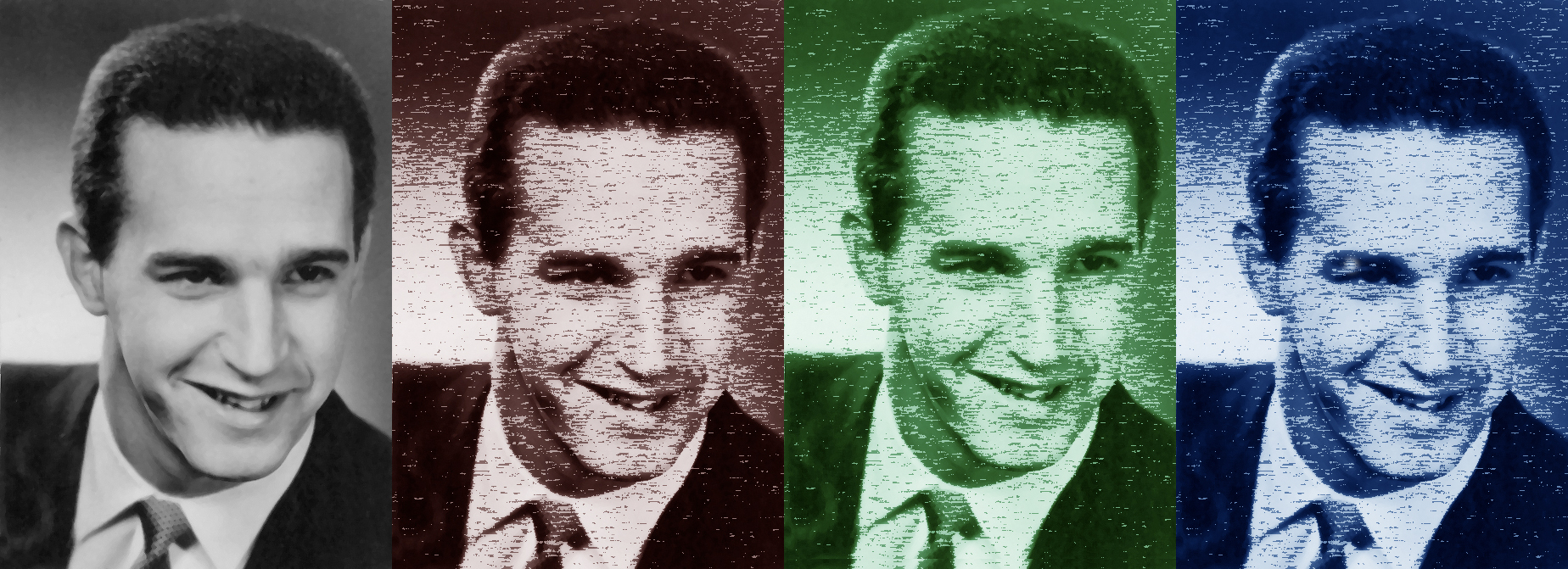
Hey, happy new year. Hope you’re doing OK. I’m going to keep this brief, but I feel the need to tell you about something that I stumbled upon today while doing research into something else. There I was, slogging through section 87 of part II of the FBI’s Manual of Rules and Regulations (years 1960-1968), focusing on the procedures and paperwork involved with the FBI’s Security Index, when I learned about a new form that agents were required to fill out.
The form actually came out in 1965 as part of a presidential protection agreement between the FBI and Secret Service after President John F. Kennedy’s assassination. What I was surprised to learn was that 1) “reports are to be disseminated henceforth to Secret Service in all security index cases,” and 2) they were to “utilize form FD-376, which is designed to serve as a letter of transmittal for both local dissemination and dissemination at the SOG” [Seat of Government].
Here’s the passage in question with my highlights:
Click on image for a closer view
“Interesting!” thought I, and I immediately pulled out my trusty laptop and began Googling “FD-376 AND FBI.”
What popped up surprised me, because I’d seen it before. Do you remember when I told you about the time that there was a bomb threat against Frank Sinatra at the Fontainebleau Hotel in Miami Beach, Florida? Well, that was one of the documents that popped up in my search today, courtesy of The Black Vault website, along with several related records. Two of the records have 10s on them, just like Ron’s 10s.
What follows behind the two “10s” is what surprised me. There in all its splendiferous glory was an FD-376 stipulating why the FBI was forwarding this information to the Secret Service. They chose option #6: “Individuals involved in illegal bombing or illegal bomb-making,” which was the logical choice for the occasion.
Here’s the FD-376:
Credit: The Black Vault; click on image for a closer view
As you’ll recall, my theory has been that the 10s on Ron’s missing person records mean that the FBI’s liaison to the Secret Service had received a copy of those records, which would indicate that the Secret Service did as well. So the fact that the Fontainebleau Hotel bomb threat also carried 10s along with the FD-376 seems consistent with my theory.
But hold on: If reports for anyone on the Security Index were automatically forwarded to the Secret Service, then it seems like less of a big deal. Also, not every Security Index case was given a 10 on their records. Some got 8’s, some got 4’s, some got 2’s, and so on. Some may not have been given a number at all—I don’t know. I haven’t looked into that yet.
But the 10s do seem like much bigger cases, right? The assassinations, both actual and attempted, the serial killers, the bomb threats, etc.—they seem especially well-suited for the Secret Service.
Based on this new information, I’d like to revise my hypothesis:
First, if Ron was indeed on the Security Index (and I am 100% sure that he was), I think we can all acknowledge that Ron’s records had been sent to the Secret Service, along with every other Security Index occupant. So, that’s at least something.
Second, do you think the FBI’s liaison to the Secret Service is going to want to know about every Tom, Dick, and Harry that the FBI was keeping tabs on, a list of people numbering in the tens of thousands? I don’t.
But what if the FBI liaison was only notified of the truly big stuff…the reports that dealt with the most relevant topics at hand? You know, the assassins, the serial killers, the bombers, and, yes, Ronald Tammen.
That’s a theory I’d be able to buy into.
In the near future, I’ll be posting detailed evidence that supports my theory that the two-word phrase on Ron’s and other people’s FBI docs—“see index”— is indeed code-speak for the Security Index. Hopefully, it’ll be a more riveting read than Section 87 of the FBI’s Manual of Rules and Regulations, which lulled me into a two-hour nap this afternoon. Stay tuned!
Season’s Greetings! If you enjoy discovering hard evidence to confirm a theory you happen to believe, then prepare yourselves, dear readers. I’m about to present you with two thoroughly enjoyable rock-hard pieces of evidence that confirms a theory I proposed in November 2023. I discovered the new evidence yesterday at Miami’s University Archives.
I’d driven to Oxford and back for the sole purpose of looking through several boxes that are stored there, one of which I’m reporting on today.
The box in question contained the file of Reuben B. Robertson, Jr., the charismatic president of Champion Paper and Fibre in Hamilton, Ohio, from 1950 to 1960. As you may recall, Robertson had taken two of those years off, from 1955 to 1957, to serve as the U.S. deputy secretary of defense under President Eisenhower. When he returned to Hamilton from that high-profile stint, he was named to serve on Miami’s Board of Trustees. Unfortunately, he didn’t serve his full four-year term. In the early-morning hours of March 13, 1960, he was instantly killed in a hit-and-run accident near his home in Glendale.
The theory that I’d put out in 2023 was that Robertson and Millett had known each other during WWII because both were working for an extremely small branch of the Army known as the Administrative Management Branch, which was housed in the Control Division of the Army Service Forces. There were only 28 officers and 3 civilians in that branch in 1943, and they were based in Washington, D.C. Considering how outgoing both men were, surely they knew each other, I said in my post. I then suggested that, since Reuben was sitting on Miami’s selection committee for a new president, he likely had talked Millett into applying for the job—a job for which Millett was grateful to accept. Although Millett had many impressive credentials in government and the military, he was at that time a full professor at Columbia University and lacked administrative experience in a university setting.
Understandably, John Millett was extremely saddened by the news of Robertson’s death, and he expressed his sadness in two letters within days of the tragedy.
The first letter I found was to Robertson’s widow, which he wrote on March 17, 1960, four days after Reuben’s death.
Here are the words he chose:
Dear Mrs. Robertson:
I wish there were some way that the many expressions of sympathy which you will be receiving at this time could somehow lessen your sense of loss. But all of us who knew Reuben well thought highly of him, and I hope this will provide you some sense of satisfaction.
I first met Reuben in 1942 when he came into the Army. We worked together on two or three projects that first year.
And I shall never forget the Thanksgiving I spent with you and Reuben in 1944 in Atlanta. It was a pleasant occasion, indeed.
When I came out to Ohio in 1953, I was very glad to have the opportunity to see Reuben more often. You may be sure that none of us who knew him well will forget him. And all of us extend our sympathy to you and to the children.
Sincerely yours,
John D. Millett
Credit: Miami University Archives; click on image for a closer view
So there it is: proof that they’d met and worked together in the Army during WWII. Millett said they began working together in 1942, but Robertson’s separation papers say he began in March 1943. I won’t quibble. Moreover, we also know that they maintained their friendship throughout the war, as evidenced by Reuben inviting John to Thanksgiving dinner in 1944 at the Robertsons’ home in Atlanta.
The second letter was to Thomas D. Morris, who at that time was assistant to the president of Champion Paper. This letter was written two days after Reuben’s death:
Dear Tom:
I should like to express to you and through you to the executive staff and the directors of Champion Paper and Fibre Company my great sympathy for the loss you have sustained in the death of Reuben Robertson. As you know, I have been a friend of Reuben’s since 1942. I met him when he first began his military service and we worked together in the same office in Washington for several months.
Later I visited him on two different occasions while he was stationed in Atlanta, and there I had an opportunity to become acquainted with Mrs. Robertson.
In the intervening years, I saw Reuben quite often in Washington and New York. He was instrumental in my coming to Miami University, and I was pleased, indeed, when Governor O’Neill appointed him a member of our Board of Trustees in 1957.
His death is a great personal and official loss to me, but I know this is little compared with what he meant to all of you in the Company.
I have never known a finer person or a more energetic executive than Reuben. His death is a great tragedy.
Sincerely yours,
John D. Millett
Credit: Miami University Archives; click on image for a closer view
Whereas Millett chose the word “instrumental” to describe Reuben’s efforts in bringing him to Miami, I believe a better word would be invaluable. In addition to suggesting that he apply, I’m sure he advocated for Millett to the other committee members, thus helping secure his nomination. In fact, I’d contend that if it weren’t for Reuben Robertson, John Millett wouldn’t have ever found his way to Miami—wouldn’t have even thought to apply for the job. The Board of Trustees elected him to be Miami’s 16th president on March 28, 1953.
You may be asking why this matters. In my November 2023 post, I discussed how an employee of Reuben Robertson’s named Dorothy Craig had written a check to Ron Tammen roughly at the time of his disappearance. To this day, I have no idea what the amount of the check was or why it was written, though I do have some hypotheses regarding the latter.
When news of Tammen’s disappearance hit the papers, Reuben Robertson probably didn’t want Champion Paper linked in any way. But how could he prevent that from happening, especially if investigators learned about the check? Maybe he could call in a favor from his good friend from the war—one who was recently named president of the university Tammen had attended.
On November 22, 1963, five-year-old me walked from my kindergarten classroom to the front steps of my house, just one block away, pushed open the front door, and found my mom sitting in front of the TV set, sobbing. I don’t think I’d ever seen her cry that hard before, let alone in the middle of the afternoon, so I remember being startled. Two days later, my family and I watched on live TV as the person they’d arrested for murdering President Kennedy—a smallish man with three names—was shot in the stomach at point-blank range by a stocky guy in a suit and hat, which was also very startling. The next day, we turned on our TV again, this time to watch our recently alive president now being slowly carried up Pennsylvania Avenue on a horse-drawn wooden cart in a casket draped in an American flag, By that point, the events of the long weekend were probably too much for my overstimulated brain to comprehend and it was also the likely moment when they were socked away somewhere in my cerebral cortex to be ruminated upon later.
Today, I want to discuss some of those ruminations. To say I’m obsessed with the Kennedy assassination would be a stretch, although, over the years, I’ve read several books and articles on the subject, watched some impactful movies and documentaries, and, more recently, waded through some FBI, CIA, and other government records regarding what was going on behind the scenes. But I’m no JFK expert. Today, we won’t be talking about Kennedy’s assassination per se or who the fellow or fellows were who fired on him from the grassy knoll, which was most definitely where the kill shot originated from, and not a topic that’s even remotely up for discussion.** I’ll let the people who’ve been researching the JFK records for decades report on any updates they might have on that question, whenever that may be.
**(If you still need convincing that the shot that killed Kennedy came from the grassy knoll and not the Texas School Book Depository, watch the 1991 Oliver Stone movie JFK as well as his 2021 documentary JFK Revisited: Through the Looking Glass as soon as possible. If neither of those are available to you, find the two-part episode of Seinfeld, Season 3, Episode 17, titled The Boyfriend, and watch that. Then, let’s all join hands and say in unison: “Back…and to the left,” “back…and to the left,” “back…and to the left”…)
Today, we’ll be focusing on a different assassination from that horrifying day: the one of Officer J.D. Tippit, which occurred shortly after Kennedy was killed. That’s the assassination that I believe is pertinent to my theory.
An additional book that warrants your attention is “Harvey & Lee: How the CIA Framed Oswald,” by John Armstrong. At nearly 1000 pages, and weighing at least 10 pounds, that book cannot be read in a day, and in fact, I’ve been using it more as a reference to consult versus reading it cover-to-cover. Armstrong has come up with an elaborate two-Oswald theory in which the two Oswalds, hand-picked by the CIA in the early 1950s, were American Lee Harvey Oswald and his Russian-speaking, Eastern European doppelganger whose alias was Harvey Oswald. He argues that a photo of the Lee Harvey Oswald we think we know is actually a “split-face composite,” with one-half being American Lee Oswald’s face juxtaposed alongside one-half of émigré Harvey Oswald’s face. I guess they wanted to create a photo resembling both men for an ID both could use. Parts of his theory I can be on board with—the split-face photo is compelling—but other parts I’m not convinced of, at least not yet. No matter where you stand on the subject, Armstrong’s research is mind-blowingly thorough.
We haven’t done a Q&A in a while, so, in the interest of time, I’d like to do one today. Also, before we begin, I’m asking everyone to please suspend any disbelief you may be harboring on the virtual hooks in my imaginary cloakroom. You’re welcome to collect your disbelief later, after you’ve read the blog. Please be sure to remember your hook number so you don’t accidentally take someone else’s disbelief home with you.
I just mentioned Armstrong’s two-Oswald theory, but I’m speaking more broadly than that one theory when I say yes, I do think that there were people impersonating Lee Harvey Oswald, the man accused of killing Kennedy, shortly before JFK’s assassination.
For example, there were several incidents of Oswald sightings in and around the Dallas area and elsewhere during the fall leading up to the assassination. The impersonator may have looked like Oswald, or claimed that his name was Oswald, or both. He always seemed to make a scene. There was an incident at a shooting range where he was obnoxiously shooting at someone else’s target. There was an incident at a car dealership when he was test-driving a car too fast and then indignantly telling the salesman that he might “have to go back to Russia to buy a car.” There was the time in Mexico City that a man was photographed visiting the Soviet Embassy claiming to be Lee Oswald. That guy looked more like actor Ed O’Neill (aka Al Bundy aka Jay Pritchett) than Lee Harvey Oswald.
Personally? I don’t think we need to stop at just two Oswalds. For all I know, there could have been five or six or even seven of them running around. But again, I’m no expert.
The Oswald that I’m most interested in is the one who killed J.D. Tippit.
Who was J.D. Tippit?
J.D. Tippit was a police officer who was driving his patrol car in Oak Cliff, a neighborhood south of Dallas, that day. At about 12:45 p.m., an announcement went out over the police radio after a bystander, Harold Brennan, had reported seeing a slender white male who was “approximately 30” and who was around 5’10” and 165 pounds firing a gun from the sixth floor of the Texas School Book Depository.
Not long after hearing that announcement—sometime around 1:14 p.m. Dallas time—Tippit noticed Lee Harvey Oswald (or someone who looked a lot like him) walking on the 400 block of East 10th Street, near the corner of 10th Street and Patton Avenue. The description kind of matched Oswald, though not exactly. Oswald’s military records say that he was 5’8” and 135 pounds when he enlisted in the Marines in 1956. His autopsy examination lists him as being 5’9” and 150 pounds, though his weight was an approximation. Also, he’d just turned 24 in October 1963. But whatever.
The narrative provided by witness testimony to the Warren Commission is that Tippit said something to Oswald through his passenger-side window. Then, things escalated fast. Tippit got out of his car and walked around to the front of his patrol car, while Oswald was standing on the passenger side of the vehicle. Oswald began firing the gun he was carrying, hitting Tippit three times in his chest. Tippit was lying on the ground when Oswald stood over him and shot him one last time, execution style to his head. Page 651 of the Warren Commission Report estimates he died at 1:15 or 1:16 p.m. Officer Tippit was then taken by ambulance to Methodist Hospital, where he was pronounced dead at 1:25 p.m.
That’s a brutal story. The thing is…there’s evidence that the person who shot and killed Officer Tippit wasn’t the Lee Harvey Oswald whom we all have come to know—the one who told everyone that he was a patsy and was later killed by Jack Ruby on national television.
How do we know that the person who killed J.D. Tippit wasn’t Oswald?
First, there’s the timeline. It would have been extremely tight for Lee Harvey Oswald to do all the things he reportedly did after Kennedy’s assassination, while still making it over to the scene of the Tippit murder by 1:14 p.m., the approximate time when Tippit summoned Oswald to his car. According to the Warren Commission Report, after he left the book depository, the real Oswald stopped in at the house where he was renting a room at 1 p.m. (He got there by bus, then a cab, then on foot.) That house, at 1026 Beckley Avenue, was .9 miles from where Tippit was shot.
The report states that: “Oswald had entered the house in his shirt sleeves but when he left he was zipping up a jacket.” The report also asserts that he’d picked up his revolver there and hid it somewhere under his jacket, though that was speculation on their part. Oswald’s housekeeper, Earlene Roberts, didn’t see a gun.
Roberts told the Warren Commission that, when Oswald was still in the house, she saw a police car with two uniformed officers pull in front of the house and give a couple quick beeps, then drive around the corner. At about 1:04 p.m., she saw Oswald standing in front of the house near a northbound bus stop, though she didn’t pay attention to what happened to him after that. It would be weird if he gave up on the bus and then fast-walked over to the scene of the murder—which was in the opposite direction he ostensibly wanted to go—by 1:14 p.m., in time to have his encounter with Tippit. It’s possible that the police car picked him up and dropped him off on 10th Street in time to commit the murder, but that would be even weirder.
Second, let’s talk about that jacket that Oswald ostensibly picked up before heading out the door. Tippit’s shooter was reported by several witnesses to be wearing a white or light-colored jacket with some adding that there was a white t-shirt underneath. After Tippit’s murder, he hoofed it down Patton, dropping bullet cartridges along the way, seemingly like breadcrumbs. He then made a right onto Jefferson Boulevard, and took a couple additional quick turns, eventually (ostensibly) throwing his jacket underneath a car at a nearby Texaco gas station, though no one had witnessed him doing it. Someone had somehow managed to find it. He then walked into the Texas Theater on Jefferson, presumably in the white t-shirt. Here’s the jacket that Tippit’s murderer was ostensibly wearing:
But that’s weird too, because Lee Harvey Oswald was wearing a brown shirt when he was arrested. When Earlene Roberts was asked the make-or-break question—Have you ever seen this jacket before?—she said, “Well, maybe I have, but I don’t remember it. It seems that the one he put on was darker than that.” She was sure that it had a zipper though, which the brown shirt lacks. But there were other discrepancies about that jacket: namely, that it had two laundry tags on the collar. However, when the FBI attempted to identify a cleaning establishment within the Dallas-Fort Worth and New Orleans areas who used those tags, they turned up nothing. So the $10 million dollar question is: was it even Oswald’s jacket?
The most compelling piece of evidence is that there were two men who looked a lot alike who were arrested in the Texas Theater that afternoon. The real Lee Harvey Oswald, wearing the brown shirt, was arrested in the main seating area of the theater before being led out the front door in handcuffs and put in the squad car at roughly 1:50 p.m. The second man, presumably in a white T-shirt, was arrested in the balcony.
What happened to the second guy?
The second guy, whom Douglass and others believe to be Tippit’s shooter, was witnessed exiting the back door of the theater with police. Bernard Haire, owner of a hobby shop two doors down, was watching the excitement as he stood in the alley near the theater’s back entrance. According to Douglass, he told an interviewer that the person he saw being escorted out the back door was wearing a “pullover shirt.” He also said decades later that the man looked so much like Oswald, he’d always thought he was watching Lee Harvey Oswald being arrested that day. It was only after watching the movie JFK that he learned that the person he saw wasn’t Oswald.
Incidentally, don’t get too hung up by his calling the shirt a pullover shirt. That doesn’t necessarily disqualify a t-shirt. In those days, a pullover was a general term that described any shirt that was without buttons that could be pulled over the head. Advertisements in the 1950s and 1960s sometimes referred to t-shirts as “pullover t-shirts.” Unfortunately, from what I can tell, Haire didn’t mention the color of the pullover shirt and the interviewer didn’t ask—I blame the interviewer.
As for the look-alike, the police put him in a police car and drove away, but must have let him go shortly thereafter. I’ll tell you where he ostensibly went in a minute.
According to John Armstrong: “Unfortunately, the identity of the man taken out the rear of the theater remains unknown. There are no police reports that identify anyone, other than Lee Harvey Oswald, who was arrested at the Texas Theater on November 22, 1963.” I’ll be nominating someone later in this post.
What’s the deal with that police car that was parked outside of Oswald’s house on Beckley Street?
As it so happens, Earlene Roberts, Oswald’s street-smart housekeeper, had taken note of the number on the police car, which she provided to the Warren Commission—number 107. But the Dallas Police Department didn’t have a car 107 at that time. They’d sold it to a used car dealer.
Therefore, the illegitimate police car with the two men dressed in uniform beeping in front of Oswald’s rooming house may have been his ride to the Texas Theater.
That would explain how it was that Oswald was already seen at the theater well before Tippit’s shooting. Butch Burroughs, who ran the concessions counter and who also took tickets at the Texas Theater that day, was interviewed by the Warren Commission, though they didn’t dig as deep as they could have and should have. (Shocker.) In an interview with Douglass, Burroughs said that he remembered Oswald arriving sometime between 1 p.m. and 1:07 p.m. and buying popcorn at 1:15 p.m., the same time when Tippit and Tippit’s shooter were in their heated exchange. Another movie goer, Jack Davis, recalled seeing Oswald at the theater in that general timeframe as well. If Burroughs and Davis are to be believed, there’s no way that Lee Harvey Oswald killed Officer Tippit.
Why would the Oswald look-alike kill Officer Tippit?
According to Douglass, the whole point of having an Oswald look-alike kill Tippit was to show that Oswald, in addition to being an alleged Communist (per his attempted defection to the Soviet Union in 1959 and his advocacy for Fair Play for Cuba when he returned to the States), was a cold-blooded killer. It would be a lot easier to sell the story to the world that Oswald had killed Kennedy if he turned around and killed a cop within the hour.
But there’s an additional reason for killing Tippit. After the Oswald look-alike had killed Tippit, he led police straight to the Texas Theater, where the real Lee Harvey Oswald could be found, ostensibly courtesy of the two men driving police car number 107. The real Oswald, whom Douglass and many others believe had been working for the CIA, was behaving as if he’d been instructed to meet someone there. He was sneaking around the near-empty theater, sitting down next to movie goer after weirded-out movie goer, apparently searching for some sort of sign.
Douglass’s theory is that the people who orchestrated JFK’s assassination and its aftermath predicted that the Dallas police would confuse the two Oswalds and then murder the real Oswald for being a perceived cop killer. That would have disposed of the real Oswald nicely and neatly, forever silenced about whatever he knew. However, when the Dallas police didn’t shoot the real Oswald, the planners (Spoiler alert: It was the CIA, OK? The CIA assassinated President John F. Kennedy and, to this day, they are covering up that shameful, despicable deed as if they and only they will ever get to know the full truth) had to move to plan B, which was to call upon mobster Jack Ruby, who was ostensibly already in on the assassination plot, to eliminate Oswald.
Where did the look-alike go?
Fasten your seatbelts, everyone. This is the exciting part. In his book, Douglass describes two same-day sightings of the Oswald look-alike not long after Tippit’s murder. The first sighting was disregarded by the Warren Commission (again, shocker) but later looked into by the House Select Committee on Assassinations. The second sighting wasn’t made public until much later, after the JFK Records Act passed in 1992 and the witness in question felt emboldened to finally speak out.
Oswald look-alike sighting #1 – The guy in a red Falcon in the El Chico parking lot
The first sighting was by a mechanic at a garage across the street from a Mexican restaurant named El Chico, about eight blocks from the Texas Theater. At around 2:00 p.m., when Lee Harvey Oswald was now in the custody of the police, T.F. White, the mechanic, watched a man drive a 1961 red Ford Falcon into the parking lot of El Chico and park it noticeably off-kilter. The man stayed in the driver’s seat and appeared to be trying to hide. With everyone on edge that day, White kept his eye on him, and eventually he walked across the street to have a closer look. There he had an unobstructed view of the man, who was in a white t-shirt, now looking straight at him. White didn’t want to anger a possible assassin, so he walked away, though he made a point of writing down the license plate number on the car: PP 4537. (With all of their meticulous planning, the CIA couldn’t have known that a T.F. White or an Earlene Roberts would be taking detailed notes. Props, T.F. and Earlene! You are true patriots! 🇺🇸) That night, when watching the news and seeing Lee Harvey Oswald for the first time, he told his wife that that was the man he’d seen in the car. Of course, it wasn’t—Oswald was probably still in the police cruiser when this sighting occurred.
A week and a half later, newscaster Wes Wise was giving a talk at El Chico and people began asking questions about the assassination. Mack Pate, owner of the garage and White’s boss, had attended the talk, and at the end, Pate walked up to Wise and told him about White’s strange encounter. Wise walked across the street to speak to White, asking him to tell him the entire story, from start to finish. When Wise wished aloud that White had gotten the license plate number, White produced the piece of paper on which he’d jotted it down.
Wise notified the FBI, who soon discovered that the license plate had been registered to a Carl Amos Mather of Garland, Texas, for his 1957 blue Plymouth. Carl Mather was employed by Collins Radio, a major communications contractor for the CIA. According to Douglass, Mather had outfitted Air Force Two—Vice President Johnson’s plane—with specialized electronics equipment. In fact, he was so connected to the CIA, his security clearance entitled him to refuse to answer the FBI’s questions. Mather’s wife, who did speak with the FBI, provided them with the astonishing detail that J.D. Tippit was Carl Mather’s good friend.
Let’s put this into as few words as possible to drive the message home: on the day of J.D. Tippit’s murder, the man who (ostensibly) killed Tippit and who happened to be the spitting image of Lee Harvey Oswald was seen in a red Ford Falcon with a license plate that belonged to Carl Mather, who was closely tied to the CIA, and who was J.D. Tippit’s close friend. You guys? I don’t know about you, but I have a strong suspicion that, when it comes to the CIA, there’s no such thing as a coincidence.
Oswald look-alike sighting #2—The guy who fled Dallas in a cargo plane with an accidental witness in tow
This next sighting was reported by Robert G. Vinson, a U.S. Air Force sergeant who, in November 1963, was employed by the North American Air Defense Command in Colorado Springs. Vinson had flown to Washington, D.C., on November 20 to seek help in obtaining a job promotion that he’d been promised but that was slow to materialize.
I think it’s important to point out here that Vinson’s name commanded a lot of respect in D.C. A cousin, Fred M. Vinson, was the chief justice of the U.S. Supreme Court from 1947 through his death in 1953. Another relative, Carl Vinson, served as a member of the U.S. House of Representatives from 1914 to 1965, the longest serving member of the House of Representatives for the state of Georgia. The Supreme Court justice’s son, Fred M. Vinson, Jr., was a highly connected DC lawyer who would be named assistant attorney general for the DOJ’s Criminal Division in 1965. I’m thinking that maybe those lofty family connections opened some doors for Robert, with one of those doors being found on the side of a mysterious cargo plane sitting on the tarmac at Andrews Air Force Base on Friday, November 22, 1963.
That morning, Vinson had arrived early at Andrews hoping to fly on the first available flight to Denver or Colorado Springs. At first, he was told that there was nothing available that day, which struck him as strange. Then, almost abruptly, he was notified that he was in luck. There was a flight to Lowry Air Force Base in Denver after all.
The plane he was told to board, a C-54, had no identifying words—just a “rust-brown graphic of an egg-shaped earth, crossed by white grid marks.” (I’ve been unable to find an example online.) The pilot and co-pilot didn’t acknowledge his presence. They didn’t take his name, didn’t do the normal log-in protocol, nothing. He was the only passenger on a cargo-less plane, and he sat over the right wing for safety. In the book “Flight from Dallas,” Vinson shared that, somewhere over Nebraska, “one of the two men in the cockpit announced in a flat, unemotional voice over the loudspeaker that the president had been shot at 12:29. That’s all he said.” The plane then took a hard left turn southward, and, sometime after 3:30 or 4 p.m. Central Time, landed in a sandy area south of Dallas along the Trinity River.
Several minutes later, two men came running for the plane: a taller one, who appeared to be Cuban, and a shorter one, who was a white male. I suppose it would have been too perfect if they’d arrived in a red Ford Falcon and the shorter one was wearing a white t-shirt. Instead, they were both wearing coveralls that Vinson described as being off-white or beige and were dropped off by someone in a yellow Jeep. Still, this is the CIA we’re talking about. The men could have thrown on the coveralls over their other clothes—hence the name coveralls. (Who knew that we’d be discussing 1960s men’s fashion so much in this post?) Then they could have dropped off the Falcon, jumped into the Jeep, and be driven away to the rendezvous point.
The men boarded the plane and sat up front, behind the cockpit. They didn’t speak to anyone, not even each other. Vinson estimated the taller man to be about 6’0”-6-1” and about 180-190 pounds while he guessed the shorter man was 5’7”-5’9” and about 150-160 pounds. Vinson thought the next stop would be Lowry AFB in Denver, but he would be wrong. Instead, their next stop would be Roswell, New Mexico, because of course it was. When they arrived at the Air Force base there, it was on lockdown, and had ostensibly been awaiting the arrival of their plane, which Vinson would later learn belonged to the CIA. The two men, the pilot, and the copilot wordlessly hurried from the plane and went on to whatever else the CIA and/or Air Force had in store for them while keeping mum on the whole sad, sordid affair. Vinson had to take a bus home.
Just as it was with T.F. White, after watching the news, Vinson immediately thought that Lee Harvey Oswald was the white male with whom he shared a flight. But again, it couldn’t have been Oswald, who by that time was sitting in a jail cell in Dallas.
But the story didn’t end there for Vinson. Imagine what the people in charge must have thought as the two men, the pilot, and the co-pilot were being debriefed, and they each mentioned the guy sitting in the cabin over the right wing. Soon, the CIA was hot on Vinson’s heels, checking out his background, offering him a job, and then, after he politely declined, insisting that he accept one anyway. He remained under the CIA’s watchful eye until his retirement in October 1966. Of course, he was too terrified to repeat his story to anyone, which is clearly why the CIA wanted him close by. It was after the President John F. Kennedy Assassination Records Collection Act of 1992was passed by Congress (thanks to Oliver Stone’s movie JFK) that he began to feel compelled to tell his story. In 1993, he decided to go public.
Interesting.
I know. I think Douglass’s theory meshes so well with my new theory.
OK, so tell us your new theory. We know you’re dying to.
I would like to hereby nominate Ronald H. Tammen, Jr., as a candidate for Oswald’s look-alike, the man who was wearing, and then ostensibly discarding, a light-colored jacket; the man who walked out the back door of the Texas Theater in a (presumably white t-shirt style) pullover; the man who drove a red Falcon into El Chico’s parking lot while wearing a white t-shirt; one of the two men who boarded a CIA plane on a landing strip south of Dallas and who walked past astonished passenger Robert G. Vinson; and most significant of all, the man who shot and killed Officer J.D. Tippit.
Seriously?
It sounds crazy when I say it out loud. But, given what we now know about Ron, I think it’s possible.
What makes Ron Tammen a good candidate for the second Oswald?
I have a few key reasons for feeling this way:
1) They looked alike
A while ago, several of you commented that Ron looked kind of like Lee Harvey Oswald, and I didn’t disagree, though I think I downplayed it a little. To be honest, I wasn’t ready to go there at that point. Plus, I wasn’t sure how Ron Tammen could have had anything to do with the JFK assassination. But I’m ready to go there now, with all of the things we’ve learned about Ron and after reading Douglass’s book. Suddenly, it makes sense.
Their builds
In September 1951, when he was a freshman at Miami University, the Health Services physician, Dr. Paul Shumacher, had measured Ron to be 69 1/4”, or 5’9 1/4” tall, and weighing 145 pounds. In April 1953, after Ron disappeared, his mother told the FBI that Ron was 5’9” tall and now weighed 175 pounds. Occasionally, I’ve seen articles in the news that gave Ron an extra inch in height, saying that he was 5’10”.
When Oswald enlisted in the Marines in 1956, he was reported to be 68 inches tall—5’8”—and he weighed 135 pounds. (The photo at the bottom looks as if the top of his head is reaching the 5’9” mark, but I’m no doctor.) The medical examiner at his autopsy wrote that he was 5’9” with an estimated weight of 150 pounds. Both men were of a rather small build, though Oswald appears to have been slightly smaller.
A page from Lee Harvey Oswald’s enlistment papers for the Marines; click on image for a closer view
Their ages
Their ages were relatively close, though Oswald was younger than Ron. Oswald was born on October 18, 1939, whereas Ron was born on July 23, 1933. I find it interesting how the announcement that went out over the police radio did a better job of describing Ron Tammen than Lee Harvey Oswald. Recall that they said the person on the sixth floor of the book depository was 5’10” tall and weighed roughly 165 pounds and was approximately 30. Oswald had just turned 24, and he didn’t exactly look older than his age. But do you know who was approximately 30? Ron Tammen. He’d just turned 30 that July.
Their hair
Both men had brown, wavy hair, which they usually parted on the left side.
Their eyes
Both men had hazel eyes, which is one of the rarer eye colors. According to a 2014 survey by the American Academy of Ophthalmology, roughly 18% of the U.S. population and only 5% of the world population has hazel eyes, whereas 45% of the U.S. population has brown eyes and 27% of the U.S. population has blue eyes. As a fellow hazel-eyed person, I remember being a little surprised when I first realized that Ron had hazel eyes too. Then, when I learned that Lee Harvey Oswald’s eyes were also hazel, I knew I needed to add it to the growing list of coincidences.
From Oswald’s enlistment papers, we learn that Oswald had hazel eyes, just like Ron; click on image for a closer view
Their faces
Ron was better looking than Lee Harvey Oswald. He was more chiseled. He had a nicer smile. But they did have features in common—similar hairlines (though Ron had more hair), similar ears, somewhat similar noses. If you happened to know either one of them, there’s no chance that you would mistake one for the other. But the sightings didn’t involve people who knew Lee Harvey Oswald or his look-alike. They were total strangers who’d caught brief glimpses of a similar-looking man under strange, stressful circumstances. That might have been enough to cause those witnesses to look at the TV screen or the newspaper shortly thereafter and believe that they saw Oswald.
A younger RonA self-conscious high school-aged Ron poses outside in his band uniformGlammed-up Ron on the evening of his high school promRon’s senior picture, Maple Heights H.S., class of 1951
On the cover of John Armstrong’s book “Harvey & Lee” are the photos of Oswald and the Eastern European émigré that had been combined as a split-face composite. Whenever I look at the cover of that book, I see Ron Tammen. Once, I glanced at my copy from across the room, when most of the cover was hidden from view except for the top photo. It took me a second to realize I wasn’t looking at Ron’s photo. I’m not saying that Ron is the man whom Armstrong refers to as Harvey Oswald. I’m saying that both Oswald and the Eastern European individual had facial features that looked like Ron Tammen, especially when their faces were combined. It makes me wonder if anyone from the CIA noticed the resemblance and thought they could put it to use.
For copyright reasons, I don’t think I can post the image of the book cover, but click on the link and let me know what you think. Does the top image remind you of Ron? The cut-off photo on the left, down below the top photo, also looks like him to me.
2) Ron’s FBI documents match those of known or would-be assassins
Ron Tammen had some seriously heavy-duty marks on his FBI records, which indicates that he’d been living a life of violence after he’d disappeared. Somehow, some way, our “Good Man” had become a bad boy. Even so, it doesn’t appear that he’d ever been arrested. FBI records and other communications I’ve obtained have stated that the FBI only had one set of fingerprints on file for Ron, the ones that were taken when he was in the second grade. Those prints were later purged in June 2002, most likely due to a conflict with the Privacy Act, indicating that Ron had made the request himself. If Ron had ever been arrested, they would have taken a new set of fingerprints every time.
Let’s review the four most significant markings on Ron’s FBI records, starting with the one with the broadest application and ending with what I consider to be the most specific and most serious:
The “see index” notation written in the left margin of the first page of Ron’s records indicates that Ron Tammen was on the FBI’s Security Index and/or its successor, the Administrative Index. People who were added to the Security Index were considered dangerous or a threat to national security. Communists or suspected Communists were added as were mobsters, murderers, and other high-profile criminals. Admittedly, famous people and politicians might be added to the Security Index as well. If you were on the Security Index, the FBI was keeping tabs on your whereabouts. They did this so they could round you and the other “listers” up in the event of a national emergency. Therefore, because he was on the list, we know that the FBI was well aware of Ron’s whereabouts for a long time, though they neglected to mention this fact to Ron’s concerned parents.
Also on the first page of Ron’s FBI records, beneath the “see index,” is the notation 2-D. Based on other FBI records I’ve studied, I’ve deduced that this notation tells us that the Department of Justice—with the D standing for Department—received two copies of Ron’s records, or at least two copies of the top record. This wasn’t normal for a missing person case.
In fact, it was pretty extreme for any case. The DOJ generally stayed out of the FBI’s day-to-day business. Only once in a while would they receive a copy of an FBI report. If I see any D at all on an FBI report, it’s usually a 1-D. The 2-Ds are far less frequent. In addition to Ronald Tammen’s 2-D, Jack Ruby warranted a 2-D, as did James W. McCord, Jr., the Watergate burglar, and his entourage, and Thomas Peasner, the Korean War POW who was allegedly brainwashed by his Communist captors and high on the U.S. Army’s and FBI’s radar when he returned. Peasner was also of interest to the House Select Committee on Assassinations for being a pianist at Jack Ruby’s Carousel Club and for going missing after purchasing an assault rifle on November 9, 1963.
Ron’s FBI record dated 5/9/73 from the Cincinnati Field Office to Acting Director William D. Ruckelshaus contains a stamp that says “SEALED ENCL.” Sightings of this stamp are rare. The word “SEALED” signifies that whatever enclosures were included, they were of the “hot potato” variety and not for just anyone to see.
Here are the records I could find in which the FBI used the SEALED ENCL. stamp, in addition to Ron Tammen’s:
Patricia Hearst kidnapping
Atlanta Child Murders
I’ve also found one record for each of the following people or cases that has the word “Sealed” handwritten over the stamped word “Enclosure”:
Richard Colvin Cox
Carlos Marcello
Hank Greenspun
Kensalt (RFK assassination)
U.S. Supreme Court bomb threat
A record for the following person has a typewritten notation to please forward in “Sealed Envelope”
It’s the 10s in the upper-right corner of Ron Tammen’s FBI records that I think are by far the most prominent telltale sign that Ron Tammen was capable of assassinating J.D. Tippit. The 10s are found on records that seem to occupy the highest danger level—code red sort of stuff. Yes, a few Communists were given 10s, but I don’t think Ron got his 10s for embracing Communism. Judging from everything I’ve learned about him, he would have ascribed to the “better dead than red” philosophy.
Many of the 10s dealt with assassinations or assassination plots against holders of high offices, domestic or foreign. Others dealt with bombings or bomb plots. Others with mass murders. Others concerned politicians and other officials who’d been threatened with personal or widespread harm if they didn’t accede to the perpetrator’s demands. Others were Cuban exiles intent on overthrowing Fidel Castro. In the assassination category, I’ve found 10s on FBI reports for Robert F. Kennedy’s assassination. There are 10s on assassination plots against Spiro Agnew and Canadian Prime Minister Pierre Trudeau. There are 10s on Jean Rene Souetre’s records when he was being investigated for the Kennedy assassination. Recently, I found a 10 on the attempted assassination of George Wallace by Arthur Bremer.
So far, I’ve been floating the theory that the 10s signify that the FBI’s liaison to the U.S. Secret Service was likely cc’d, which means that the Secret Service was too. However, not all FBI records that involved the Secret Service received a 10. I could still be wrong. Still, the 10s are important and they signify something that could be considered a threat to the U.S. president, the vice president, and others in their circle of dignitaries, the very people that the Secret Service is responsible for protecting.
While it’s possible that Ron was involved in bomb plots or extortion plots, he may have been capable of assassination as well.
3) Ron already had an ‘in’ with the CIA
It’s not as if Ron Tammen didn’t know someone affiliated with the CIA. Ron’s psychology professor, Lt. Col. St. Clair Switzer, was identified in March 1952 as a potential consultant to the CIA for Project Artichoke and I strongly believe he was named along with Major Louis J. West for a well-balanced interrogation research center in January 1953. For a period of time, Switzer appeared to be serving as a liaison to the USAF surgeon general for experiments conducted by Louis Jolyon West for Project Artichoke. Additional evidence tells us that he was assisting a high-level hypnosis researcher—possibly West—during the 1956-57 academic year on topics that were skirting the edge if not completely out of bounds of what’s ethical. We also have anecdotal evidence that Ron Tammen was being hypnotized before his disappearance in April 1953.
Therefore, it isn’t too far-fetched to think that, if the CIA had something to do with Ron Tammen’s disappearance, and I believe that they did, they would have maintained that relationship for as long as they needed him. As we heard from Robert G. Vinson, the CIA isn’t easy to say no to. In November 1963, it had been over ten years since Tammen was driven away from Fisher Hall. I imagine that he would’ve become quite adept at whatever they’d been training him to do by then.
Are there other people who might qualify as the second Oswald?
In his 1976 book “The Taking of America,” author Richard E. Sprague suggests that the Oswald look-alike who shot J.D. Tippit was William H. (Billy) Seymour. I still need to read Sprague’s book. (As I said, it’s difficult to keep up with all of the JFK books that are out there, but it’s on the list.) Seymour was closely associated with Loran Eugene Hall, who is frequently mentioned in the JFK files, and both were linked to the Cuban exiles in Miami, Florida.
I’ve done some looking into Seymour’s FBI files, and, to be honest, I think Ron’s files are more incendiary than Seymour’s. Of course Seymour and Hall were included on the Security Index. That’s no surprise. However, whereas Ron had a bunch of 10s on his FBI records, Seymour and Hall had 5’s and 9’s. Seymour and Hall also had a 1-D, as opposed to Ron’s 2-D. Seymour was on their radar, to be sure, but, from what I can tell, it was mostly as Hall’s accomplice. I can’t help but feel that Ron had attained a heightened level of concern.
Here’s a little background intel on Seymour, courtesy of the FBI. Note that Ancestry.com lists his birthdate as January 12, 1937, so I’m pretty sure he was 26, not 23.
Some background info on William (Billy) Seymour; click on image for a closer view
Admittedly, Seymour looked kind of like Oswald too. Kind of. But he was listed as 5’6” tall—two or three inches shorter than Oswald, and three inches shorter than Ron. That’s noticeably short for an American male, so noticeable that it would likely be the first characteristic a witness would think to mention. Other features were that his eyes were blue and he weighed 140 pounds. I wouldn’t say that he matched the description given by Vinson (5’7”-5’9”, 150-160 pounds). Also, he certainly didn’t match the 5’10”, 165 pound, approximately 30 description that was read over the Dallas police radio, which ostensibly led J.D. Tippit to summon Oswald’s look-alike to his car.
From what I can tell, Sprague doesn’t mention the red Ford Falcon sighting in his book, and Robert Vinson hadn’t come forward yet.
Billy Seymour sounds as though he was involved in the assassination plot somehow—he certainly was hanging around with the right people. Also, he has been linked to a different sighting involving a woman named Sylvia Odio. However, I still think it’s worth considering Ron Tammen as a candidate for the Tippit murder.
Are you thinking what I think you’re thinking?
Maybe? I am now proposing that Ron Tammen may have been an assassin, but not just any assassin. I am proposing that he was a hypnotic assassin—otherwise known as a Manchurian Candidate, employed by the CIA. Before he disappeared, Ron was a sweet, kind, studious guy whose lifelong dream was to earn a nice living and to find his place in society. How does that guy wind up on the FBI’s Security Index with marks on his records that are sure to get the attention of the people who were tasked with protecting the country’s top leaders?
We also have anecdotal evidence that, before he disappeared, he was being hypnotized by someone who later was assisting with Project Artichoke. Although Project Artichoke began as a program dedicated to interrogation research for the military through the use of hypnosis and drugs, it quickly drifted into the darker territory of creating hypnotically programmed assassins. According to Jeffrey Kaye and H.P. Albarelli, Jr., “…it is Project Artichoke that encapsulates the CIA’s real traveling road show of horrors and atrocities, not MK/ULTRA which, although responsible for its own acts of mindless cruelty, pales in comparison.”
Honestly, say what you will about this idea, but is it possible that Ron may have been a government-sanctioned human weapon—not a bomb plotter, but the bomb itself? It’s the only way that I can see Ron Tammen receiving those scribbles and stamps on his FBI documents without ostensibly ever having been arrested. It’s also the only way that I can see a person like him having the audacity to kill someone—a cop of all people—in cold blood and in broad daylight.
But it’s just a theory.
Is there any way to find out if your theory is correct?
Granted, that light-colored jacket is old, and I’m sure any DNA that might be on it (through shed skin cells, a loose hair, a crumb of food the look-alike had been eating, I don’t know) is likely to be degraded as well as contaminated by the people who handled it. Maybe the DNA is still good on the inside of the jacket if no one tried it on—I’m no DNA technician. I think the blood on Oswald’s sweater seems more likely to still be viable versus whatever DNA might be on the brown shirt, but again, I’m not a DNA technician.
But hey, this is all we have. If there isn’t a match between the light-colored jacket and the black sweater, the brown shirt, or both, then I would suggest that they test the jacket against Marcia Tammen’s DNA, which is in CODIS, to see if there might be a match there.
The J.D. Tippit murder is central to the entire JFK assassination story. It was referred to as the Rosetta Stone by Warren Commission assistant counsel David Belin, and one of the chief reasons for proclaiming Oswald’s guilt for Kennedy’s assassination.
What do you think? Would the NARA archivists be up for solving this decades-old question? Who do I need to call to make it happen?
Why are you doing this? Aren’t you afraid that people will make fun of you?
If anyone should put Ron’s name out there as a contender, I guess it should be me. It’s OK. I’m willing to take the jabs, though I do reserve the right to block any unnecessarily mean people and garden-variety trolls.
What are your thoughts on the Warren Commission?
Oh, I think they were bending the narrative to their liking. We know they were ignoring some potentially important witnesses. And, who knows, they may have even been altering deposition testimony of the people they did speak with.
Why do you think that?
Take a look at this exchange after Earlene Roberts finished her deposition. The whole reason for a person who was deposed to sign their transcript is to ensure its veracity. Judging by this exchange, Earlene Roberts did not verify that her deposition transcript was accurate. In fact, Joseph A. Ball, senior legal counsel to the Warren Commission, was pushing for her not to return to review the transcript and sign it. Why? Did he see a problem with something she’d said?
Mr. BALL. Now, Mrs. Roberts, this deposition will be written up and you can read it if you want to and you can sign it, or you can waive the signature.
Mrs. ROBERTS. Well, you know, I can’t see too good how to read. I’m completely blind in my right eye.
Mr. BALL. Do you want to waive your signature? And then you won’t have to come back down here.
Mrs. ROBERTS. Well, okay.
Mr. BALL. All right. You waive it then?
Mrs. ROBERTS. Yes. Do you want me to sign it now?
Mr. BALL. No; we couldn’t, because this young lady has to write it up and it will be a couple of weeks before it will be ready.
Mrs. ROBERTS. Well, will you want me to come back or how?
Mr. BALL. Well, you can waive your signature and you won’t have to come back to do that-do you want to do that?
Mrs. ROBERTS. Okay, it will be all right.
Mr. BALL. All right. The Secret Service will take you home now.
Mrs. ROBERTS. All right.
Mr. RAZL. Thank you for coming.
Mrs. ROBERTS. All right.
Considering that the killing of Officer Tippit was the “Rosetta Stone” of the JFK assassination, I’d think that, of all the witnesses, the testimony of the last person to see Lee Harvey Oswald roughly 10 minutes before that killing took place would be something that they’d want to get 100 percent right. But then again, I’m no expert.
Disclaimer: I did my best to provide you with the most accurate details I could find pertaining to the Tippit murder. But with all of the inconsistencies in the Warren Report, it’s hard. If you happen to be a JFK expert and you notice a discrepancy in something I’ve said, please let me know. But also, please go easy on me. I really did try.
Hi guys. As you may recall, I mentioned in a recent post that the podcast Bizarre Butler County would be airing an upcoming episode on Ron Tammen, which was scheduled for release sometime in October. As it turns out, they’ve been experiencing technical difficulties, and likely won’t be posting that episode until December. During our July interview, I provided Taylor Powers and Sarah Kennel with some breaking news about how I think St. Clair Switzer was spending his sabbatical during the 1956-57 academic year. I was planning to release this blog post shortly after the Tammen episode had dropped so I wouldn’t be stepping on their scoop. However, Taylor and Sarah have graciously given me the green light to post it now, before the Tammen episode airs. I’ll be sure to give you the heads up as soon as it does.
So…what’s the big reveal that I’ve been sitting on since July?
It has to do with the two letters
It all starts with those two letters we’ve discussed in past posts. The letters are dated December 6, 1956, and February 8, 1957, and, even by MKULTRA standards, I’m sure they’ve raised their fair share of eyebrows over the years. In the December letter, one researcher poses a dozen questions on the topic of hypnosis to another researcher. These aren’t your typical questions that might be posed by someone interested in using hypnosis in a clinical setting to help a patient improve his or her life. These are jarringly bold questions about using hypnosis to control people, and they get more and more outrageous as they go, beginning with (1) how to produce amnesia in someone on a regular basis and (2) how to induce hypnosis in someone without their knowing it, all the way to (11) possible experiments that might be considered “too dangerous, too shocking, too ‘unusual’ for routine testing” and, finally, (12) how to hypnotize someone by force. Ostensibly, nothing was out-of-bounds. Everything was on the table.
In the February letter, the writer thanks the recipient for his responses to those jarringly bold questions, which, sadly, aren’t included within the MKULTRA documents that have been released to the public. He is also hoping to schedule some additional time with the recipient. In both letters, the writer cautions the recipient to destroy the letters on his end because the topics are “most sensitive and are very highly classified” (letter 1) and “highly sensitive” (letter 2). Fortunately for us, someone decided against destroying the two letters on the writer’s end of things; otherwise we wouldn’t have the evidence that I’m about to present.
But first, I’d like to take this moment to express my gratitude to the CIA for allowing us to see in letter 1 that the recipient was a professor at Rutgers University and in letter 2 that he suffered from arthritis, thus enabling us to claim with 100 percent certainty that the recipient was Griffith Wynne Williams, an esteemed psychology professor and prolific hypnosis researcher. (The Rutgers info is an obvious giveaway, and I’d learned about Williams’ health condition from someone who knew him.) See how good it feels to embrace transparency in government, CIA? Let this be an inspiration for you to continue down this path!
If, on the other hand, those two tidbits of PII were left uncovered as a mistake, well…words can’t express the joy one feels when an agency that considers itself untouchable stumbles a little. God Bless Human Error!
I’m also convinced that the letter writer is St. Clair Switzer. I believe this because:
A) Switzer had known Griffith Williams during his days working under Clark Hull at the University of Wisconsin, when Williams was a doctoral candidate and Switzer was a master’s student.
Something Switzer was known to do while he was a professor at Miami was to ask for occasional assists from the superstar psychologists he’d met during his days with Hull. These included M.A. (Gus) Wenger (no relation), E.R. (Jack) Hilgard (also no relation), and Hull himself (if we were related, I would’ve told you that a long time ago). It makes total sense that Switzer would ask Williams for guidance about some uncomfortable, dare I say unethical, questions regarding hypnosis, now that Williams had become renowned in the field. I mean…he couldn’t exactly go to a total stranger with those sorts of questions, could he?
B) The letters contain telltale Hull-isms.
One example is his use of the opening “My Dear” in letter #1 when addressing his colleague, which is pure Clark Hull.
The opening to the December 6, 1956, letter to Griffith Williams sounds a lot like Clark Hull; click on image for a closer view
That’s how Hull began every single letter to Drs. Switzer and Patten, whether typed or handwritten, and probably to everyone else he knew, including Williams.
Here are just several of Hull’s “My dears” over the years. I have many more examples on my laptop.
Switzer had been known to use that opening as well, inspired, no doubt, by his graduate school adviser. In 1930, after earning his master’s degree under Hull, he used it in a saccharine letter to Alfred H. Upham, then-president of Miami University.
St. Clair Switzer’s awkward attempt at prose in a letter to President Upham. “Neither tongue nor checkbook…” may be one of my favorite cringe phrases ever. Click on image for a closer view.
I think Switzer must have decided against using “My Dear” in letter #2 because it would have been too over-the-top for this purpose. I mean, good Lord, we’re talking about MKULTRA here. A little gentility is fine, but a double dose would have been too weird.
Another example is the writer’s use of the term “Ph.D. thesis” instead of “dissertation” in the paragraph following the jarringly bold questions. This was also a practice favored by Hull.
This phrase found in the December 6, 1956, letter to Griffith Williams sounds a lot like Clark Hull and also St. Clair Switzer; click on image for a closer view
Although the usage is correct according to Merriam Webster, the conventional practice is to call a person’s culminating research a thesis when they’re pursuing a master’s degree and to reserve the word dissertation for the Ph.D. That’s how most people talk, at least. I’ve found that users of the word thesis when applied to the doctoral degree are generally academics who probably have a Ph.D. themselves—including Drs. Switzer and Hull. Here are highlighted examples from both men.
Clark Hull refers to a “doctor’s thesis” in a letter to Switzer; click on image for a closer view.In this letter to Switzer, Clark Hull refers to a thesis three times. Two are in reference to a doctoral thesis, while one is in reference to Switzer’s master’s thesis after it had been published. Click on image for a closer view.This is the second page of a letter from St. Clair Switzer to Jack Hilgard. He mixes it up a little, first referring to people hurrying to get their doctoral thesis in on time. He later refers to the final chapter of his dissertation.In another letter to Jack Hilgard, Switzer discusses research that he plans to reference in his doctoral thesis. Click on image for a closer view.
I can’t help but think that, four years after Hull’s death, Switzer was trying to woo Williams with a little nostalgia for their former mentor’s endearing idiosyncrasies. It’s as if he’s saying: “Don’t worry too much about my newfound interest in controlling large groups of people by surreptitiously hypnotizing them. I’m the same old lovable Doc.”
C) The timing couldn’t be better.
Switzer was on a sabbatical from the fall of 1956 through May or June of 1957, a timeframe within which the two letters originate. Because the writer was a professor (per the “Ph.D. thesis” reference), there’d be no other time that someone in academia could commit to helping a major researcher with their “very highly classified” research than while they were on sabbatical. Otherwise, he’d be too busy with his own research, not to mention courses, office hours, faculty committees, and other demands related to the “teaching straight-jacket” that Switzer referred to in a letter to Gus Wenger (still no relation) when he’d begun making plans for his sabbatical. Those plans ultimately fell through, thus freeing up Switzer to work with someone else.
Was it Jolly? Was it George?
As you probably know, I’ve struggled with the identity of the person whom I believe Switzer was assisting regarding the very highly classified research that year. In my first post on the subject of Switzer’s sabbatical, I suggested that he was working with Louis Jolyon West, who by then was at the University of Oklahoma. At the youthful age of 32, West was becoming one of the foremost heavy hitters doing Artichoke and MKULTRA research at that time. And this is an important point: he was already doing it. He already was working on very highly classified research. In March 1955, he’d begun his infamous MKULTRA research project known as Subproject 43, Psychophysiological Studies of Hypnosis and Suggestibility. According to Colin A. Ross, M.D., he was given Top Secret clearance for this work. In February 1956, he’d submitted a proposal for a continuation of that research. Although the CIA records don’t indicate it, I’m fairly sure he received the money. I feel this way based on notes that had been scribbled in response to the CIA’s receipt of West’s proposal.
Front page of notes on Jolly West’s proposal for an extension to Subproject 43; click on image for a closer view.Back page of notes on Jolly West’s proposal for an extension to Subproject 43; click on image for a closer view
Here’s one of the more telling excerpts on the back page:
To me—The budget is out of line for what we have in mind, namely, testing effects and influences of certain drugs on hypnotizability.
In fairness to [REDACTED], all this should be gone over thoroughly with him—in detail. Will do within next 2-3 wks.
At the top of page one is the following sloppy note, circled and in slightly different handwriting, signed by S.G., whom I believe to be Sidney Gottlieb.
“Feel this should be [word??] to drugs & induction of hypnosis—and scaled down accordingly—”
A close-up of Sidney Gottlieb’s comment about Jolly West’s proposal; click on image for a closer view.
Although the fifth word or words is maddeningly illegible—Is it limited to? Knocked to? Or maybe “less and keep” to?—I know what Sidney is saying. He wants Jolly West to stick to drugs and the induction of hypnosis and to scale things down, especially the budget. So it seems to me that Jolly West did receive a second year of grant money, especially since someone else was planning to go over the parameters thoroughly with him within the next 2-3 weeks.
But, OK, just for fun, let’s say that West didn’t get his extension on Subproject 43. He still had plenty of research dollars coming in for sensitive, highly classified research. On July 1, 1956, he signed a $32,800 contract between the Air Force Personnel and Training Research Center at Lackland AFB and the Oklahoma Medical Research Foundation. The contract was titled “Research Involving Psychological Reaction to Stresses Encountered in Military Captivity,” and he’d obtained a Secret clearance to conduct that research.
To the best of my knowledge, no remnants of the actual research studies he’d conducted exist online. Most notably, I can’t find a Materials and Methods section anywhere that tells us what research methods were being used on his POW subjects—not even in the contract itself, which I obtained from the UCLA Archives. Do I think that hypnosis was somehow used in conducting that research? I do! After all, that’s what interrogation research was all about—hypnosis and drugs. Even more convincingly, his Subproject 43 extension proposal discusses “a number of ways in which hypnotic suggestions can bring about states of marked psychological stress,” which was the focus of his Air Force contract.
Part 3 of Jolly’s proposal indicates that Jolly was hypnotizing POWs to create psychological stress; click on image for a closer view.
Maybe Sidney Gottlieb and his gang weren’t all that impressed with Jolly’s “psychological stress” talk in part 3 of his proposal—someone labeled it as “meaningless” on the front page of their notes—but I, for one, am happy it’s in there. I’m also happy that the CIA redactors didn’t blacken it out.
Once again, thank you, CIA! This is what democracy looks like!
Therefore, at the time the two letters were written to Griffith Williams, Louis Jolyon West was swimming in research dollars and was conducting very highly classified research having to do with hypnosis, at least on POWs, but perhaps on a broader audience as well.
But between you and me? I think he got the MKULTRA extension too.
I’m saying all of the above because of another document, this one written two days before the second letter to Williams, on February 6, 1957. The document is a proposal on developing a hypnotic messenger, and, initially, I thought it had been written by West. I thought this because a) its timing fits snugly between the two letters; b) I knew that West had an interest in developing a hypnotic courier; and c) the proposal’s author stated that he was being assisted by a man for the year—an academic who “is thoroughly familiar with hypnotism at the theoretical level”—which made sense if his assistant was on a sabbatical and which also sounded a lot like Switzer. But the proposal’s request of $10K seems below West’s going rate, and it was written in a more layperson-friendly sort of way than a West proposal.
It was after reading George H. Estabrooks’ book “Hypnotism” that I realized that Estabrooks had written the hypnotic messenger proposal. A few of the giveaways were his preference for the word hypnotism over hypnosis as well as his use of the term “hypnotic messenger” (also a favorite) and the early appearance of his most oft-repeated statistic that one in five adults can be hypnotized into a somnambulistic (deep hypnotic) state.
And that’s where things have stagnated for a while: with me feeling 99 percent sure that Switzer wrote the two letters to Griffith Williams, which means that he was potentially helping a big-deal researcher such as Louis Jolyon West on highly classified hypnosis research. However, it could also mean that he was potentially helping George Estabrooks on his hypnotic messenger project. I couldn’t determine which one it was. Or was it both? Adding to this conundrum is the fact that West was at the University of Oklahoma while Estabrooks was at Colgate University in Hamilton, NY, which logistically seems tough to pull off for a guy living in Oxford, Ohio. Estabrooks would have been closer, but Switzer did have access to Wright Patterson AFB. He could have flown to Oklahoma now and again. Likewise, West could catch a flight to Dayton if need be.
The word that gives it all away
Then, as I was preparing to tape the podcast Bizarre Butler County with Taylor and Sarah, I decided to read through those two letters one more time.
“The problem of the use of hypnosis by a public speaker or some related technique which could be used by an individual to control or influence a crowd is of considerable importance and as you have noted there is very little information along these lines anywhere. This area is particularly interesting to [REDACTED]. He told me that he will obtain [REDACTED]’s book immediately.”
“Hold on,” thought I. “Did he just say REDACTED’s book? If the REDACTED he’s referring to is the REDACTED I’m thinking it is, then that is an enormous clue!”
In February 1957, there was probably one book and only one book on hypnosis that would have been of utmost interest to a person seeking surreptitious ways to control a crowd through hypnosis. That would be George Estabrooks’ book “Hypnotism,” which, as luck would have it, was being published that very year as a new and revised edition.
My beat-up, dog-eared 1957 copy of Hypnotism, by George H. Estabrooks; click on image for a closer view
“Hypnotism” first came out in 1943 and was written in a friendly, nontechnical, plain-language sort of way. It was a huge best seller. It was even recommended reading by the Book-of-the-Month Club.
But that doesn’t mean it didn’t get into the nitty gritty of how hypnosis could potentially be used in surreptitious ways. Whereas other hypnosis researchers would write about conventional issues pertaining to hypnosis, Estabrooks went straight to the controversial. You want to hypnotize someone without their knowledge? No problem! You want to give them a posthypnotic suggestion to do something that goes against their morals? Piece of cake!
One of the more noteworthy chapters is Hypnotism in Warfare, in which he discusses the creation of the Super Spy, not unlike the hypnotic messenger he was hoping to create in the summer of 1957. Another chapter titled Hypnotism and Human Affairs gets into how dictators employ the principles of hypnosis to get crowds of people to give them their allegiance and do their bidding.
Of course, George Estabrooks covered the less controversial topics in his book as well, but he made those chapters wildly readable too. By 1957, certainly other books had been published on the topic of hypnosis. But as I told Taylor and Sarah, two books that were sure to occupy the bookshelves of most hypnosis researchers were Clark Hull’s Hypnosis and Suggestibility, published in 1933, and George Estabrooks’ Hypnotism, first published in 1943. If you needed to consult a stodgy classic textbook about what hypnosis is, scientifically speaking, or how suggestibility can be measured in a laboratory, then you turned to Hull. If you were more in the mood for a lively book that describes all the possible ways in which hypnosis can be used out in the real world—in medicine, in criminal justice, and even in war—then Estabrooks was your guy.
Because the writer of the February 8, 1957, letter says that the major hypnosis researcher with whom he’s working will be obtaining the book “immediately,” it appears that it must already be out. So the question is: when was the publication date of the newly revised version of Hypnotism? My copy only says that it was published in the year 1957. When I spoke with Taylor and Sarah, I’d found sources that said it was published on January 1, 1957. I’ve since learned that a customary practice for when the date isn’t known is to use January 1 as a placeholder.
Here’s the copyright date on my copy of Hypnotism. Click on image for a closer view.
Later, courtesy of the New York Times, I learned that the new and revised edition of Hypnotism was published on May 1, 1957. This was confirmed in a later printing of the second edition, which stated the publication date was May 1957. So we have our answer—May it was!
The new revised version of Hypnotism, by G.H. Estabrooks, was published in May 1957. Click on image for a closer view.
Granted, the major hypnosis researcher could go out and buy the book immediately, in February. However, it would be the first edition that he’d be buying, which had been out for 14 years. The most recent printing was in 1955. If he’s going to go to the trouble of buying a copy, I think he should wait till May….and I think he likely did.
One possibility is that the letter writer had some inside information about the new book that was coming out. Maybe he’d been in touch with Estabrooks and was letting Williams know about the book in an indirect way, though he got a little ahead of himself as far as when it would be available.
But that’s not what I think happened. I think that in his response to the December 1956 letter, Griffith Williams probably gave a heads up to the letter writer that Estabrooks’ new and revised book was going to be coming out soon. Williams would have been on the inside track for information like that. I don’t know if Williams and Estabrooks talked much, but news of a forthcoming book would have made its way into newsletters of their professional societies and by word of mouth at conferences. So I can see Williams telling the letter writer (likely Switzer) that Estabrooks’ book will be out soon, and Switzer erroneously jumping to the conclusion that it would be available immediately. The sentence “He told me that he will obtain [REDACTED]’s book immediately,” sounds as if they’re promising to follow up on a recommendation that Williams had made to them.
What’s especially clear to me is that the major hypnosis researcher who is conducting very highly classified research from December 1956 through February 1957 and beyond is not George Estabrooks. Therefore, I think we can surmise two things:
1) I believe the two letters involve four men: the letter writer (likely St. Clair Switzer), the letter recipient (Griffith Williams), the major hypnosis researcher (still unknown, though possibly Louis Jolyon West), and George Estabrooks, the writer of the hypnotic messenger proposal and author of the book Hypnotism.
2) The letter writer—whom I believe was St. Clair Switzer—is working with the major hypnosis researcher. He might be helping Estabrooks too, since Estabrooks’ hypnotic messenger proposal fits within Switzer’s sabbatical and also was dated within two days of the second letter. But if we have to choose between the two researchers, I believe that St. Clair Switzer was working with the researcher with boatloads of funding and Secret or Top Secret clearance—the one who also had lots of questions about how far they could take hypnosis experimentation, no matter how dangerous, shocking, or unusual.
The last time you and I discussed the July 12, 1973, National Personnel Records Center (NPRC) fire in St. Louis, we learned something curious. We learned that, nearly two years after the firetrucks had driven away and the firefighters had gone back to their homes, after all the soggy and charred debris had been cleaned up and disposed of, after surviving files had been reshelved for safekeeping and calm and normalcy had been restored, the NPRC director felt the need to burn up some more files.
The files in question had been described in a February 1975 memo as 2,470 cubic feet of Top Secret “Air Force Research and Development case files.” They’d been housed in the now-destroyed vault on the building’s sixth floor and moved to a third-floor vault soon after the fire. The reason NPRC Director Warren B. Griffin provided for their necessary destruction now, two years later, was as follows:
“It has since been determined that the integrity of individual series and cases has been completely destroyed and that the intellectual control over the records is completely lost.”
His dire assessment confused me. I had no idea what he was talking about with regard to the “integrity of individual series and cases,” but how was intellectual control completely lost over files that had been safely secured in a third-floor vault since July 1973?
I thought and I thought, and I came up with a slightly different, albeit more cynical, explanation: I suggested that Air Force officials were afraid of what was about to be revealed by the Church Committee as it was beginning its investigation into abuses by the CIA, FBI, and U.S. military in their intelligence activities. I reasoned that the Air Force decided to burn the evidence beforehand and Griffin was the foot soldier who was assigned the unscrupulous task.
But that was just a hypothesis.
In March 2024, I submitted two FOIA requests to the National Archives and Records Administration (NARA), which now oversees the NPRC. (The General Services Administration had employed the National Archives staff at the time of the fire, but that ended in 1985.) One FOIA request was for the descriptive listings of the records that were to be incinerated, and one was for the Standard Form (SF)-115, which would authorize their destruction, both of which were alluded to in Griffin’s memo. I attached a copy of Griffin’s memo to help them in their search. I then went for a run.
On August 20, 2025, NARA sent me 21 pages. I just read them yesterday. (Don’t judge. I was slammed that week, and truth be told, when I saw their email come in, I pretty much assumed I was in for a letdown. I figured that I’d have to determine what my next move would be, so I let their email sit in my inbox. Imagine my surprise when I finally opened the email and found actual responsive records. Good on them!)
I’m only going to share the SF-115 with you today. I’ll need to spend some time with the other documents, and I also happen to think the SF-115 is a big deal.
First here’s what the records to be destroyed consisted of, per the form signed by Herbert G. Geiger, who headed up the Information Management and Resources Division for the National Archives at that time:
“Fire and water damaged research and development records consisting of contractual and procurement documents, drawings, technical progress summaries, technical reports, testing documents, scientist notebooks, correspondence, and various other materials which were accumulated and maintained primarily at the Air Force Systems Command (Wright-Patterson Air Force Base). ca. 1951-63.”
So that’s new information, right? Those 2,470 cubic feet of R&D records that Warren Griffin wanted destroyed ASAP originated from Wright-Patterson AFB, a base that’s 50-some miles from Miami University, and was a home away from home to St. Clair Switzer, Ron Tammen’s psychology professor. But get a load of the years: 1951 to 1963!
Of all the Air Force bases in all the world whose records had to be purposely incinerated for questionable reasons, did they have to choose ourAir Force base for the years that we happen to be most concerned about?
Before we move on to the SF-115’s next paragraph, let’s talk quantity. What does 2470 cubic feet of R&D records even look like? According to the National Archives one cubic foot of records equals approximately 2500 sheets of paper. Granted, it’s just an estimate, but by my calculations, Griffin had felt he’d lost intellectual control over roughly 6 million pages of Top Secret Air Force records. No wonder he was feeling a little panicky.
According to the SF-115, the reason that the Wright-Patterson AFB records needed to be immediately destroyed was stated similarly to Griffin’s memo, though Geiger didn’t want to stop there. He didn’t want people to forget about the fire and the water that the documents had withstood. Also, we learned of another vault that was housing a portion of the surviving records:
“Approximately 1530 cubic feet of the above records are presently located in the third floor vault in the Military Personnel Records Center, St. Louis. The remaining 940 cubic feet are in the vault in the Civilian Personnel Records Center, St. Louis. At the time of the fire at the St. Louis Center on July 12, 1973, these records were in the 6th floor vault. The 6th floor was completely destroyed. The records are damaged by fire and water. The integrity of individual series and cases is completely destroyed. Intellectual control over these records is completely lost. In their present arrangement, they are not serviceable. Their value for archival research is limited, and does not justify the time and labor required to reconstruct cases and series.”
“Disposition: Destroy Immediately.”
There’s also a handwritten note at the bottom: “These records are scorched, burned, and water-damaged. Because of their brittle condition, they disinte-grate if handled,” followed by the initials pL 1//7/75. The word “easily” is added below the “disinte” part of disintegrate, as if to underscore the point and ward off any potentially diehard archivists who would argue against their destruction.
Click on image for a closer view
Which sounds believable, right? There was a big fire. LOADS of documents were destroyed by the heat and flames and water. Why not these documents too?
I guess I could see what Geiger and pL were saying, except for one minor detail: it’s not true.
Two years earlier, when staff of the NPRC were in clean-up versus cover-up mode, they were keeping meticulous records of how they were handling the classified records that had been in the sixth-floor vault. We learned in one July 1973 memo, for example, that the Top Secret Air Force records were stored in 17, five-drawer file cabinets. The word damp is used to indicate that those records were being handled along with the damp-but-salvageable records, though they’d put that word in quotation marks when it came to the Air Force records. It’s as if they were saying they’re in the damp-but-salvageable group, but they’re not really “damp” per se. In an earlier memo, we learned that those Top Secret file cabinets were described as “safes.” They also shared some great news: “Material in safes are in wrapped packages or wrapped boxes—all numbered. Our present impression (based on previous visit to vault area) is that this material is in fair to good shape.”
So let’s see. We now know that the Top Secret Air Force files had been protected by wrapping of some sort not to mention the surrounding metal of the file cabinet safe, which sounds even sturdier than a typical file cabinet. Also, the contents were assessed to be in “fair to good shape.” Yet, two years later, Geiger and pL had decided that the materials were in terrible condition—scorched, burned, and water-damaged, and, if given the chance, they’d disintegrate easily in their hands.
What’s more, in addition to Griffin’s worry about losing intellectual control over the files, both he and Geiger had claimed that “integrity of individual series and cases has been completely destroyed.” But how could that have been possible if all of those wrapped packages and boxes were numbered in their respective file cabinet drawers? It sounds to me as if the integrity of the individual series and cases was still very much intact.
But Warren and Herb bring up an interesting point worth delving into a little. What exactly did they mean by the word “cases”? In his memo, Warren had described the Air Force files as “Research and Development case files.” I’m no expert, and correct me if I’m wrong, but the word case has a human ring to it, doesn’t it? When I think of aeronautical research, I don’t think of the study of turbines and jet propulsion engines and who knows what else as “cases.” Those investigations are usually called studies or projects. But cases? Cases tend to involve human beings…people who are research subjects. We already know that Wright-Patt researchers conducted studies on pilots, such as for instrument design, oxygen thresholds, etc. I’m guessing any of those records from 1951 through 1963 would have been intentionally burned in 1975, unfortunately. But who knows, maybe there were other human studies that would’ve been burned at the same time—perhaps they were the reason behind the burning. I’m thinking of Projects ARTICHOKE and MKULTRA, for example?
I have one last piece of news to share. Remember the study I told you about called Project Rabbit on which I could find no information? One astute reader then straightened me out and said that it’s not Project Rabbit, it’s Project “Rabbit”—with the all-important quotation marks. Project “Rabbit” was a CIA and U.S. Air Force collaboration in which human intelligence or HUMINT agents known as “Rabbits” would parachute behind enemy lines during the Korean War for intelligence gathering and other clandestine purposes.
I’d written a FOIA request to find out more about a Project “Rabbit” conference that was held at Wright-Patterson AFB on December 23, 1952.
I heard back from their representative last Monday. He told me that “A thorough search reasonably calculated for any segregable, releasable information in existence and relevant to this Freedom of Information Act request was conducted. During that analysis, no responsive records were discovered.”
Gosh, let’s see…a conference at Wright-Patterson AFB involving a Top Secret project in which human agents were trained to carry out intelligence activities in enemy territory in 1952? I can’t imagine what happened to those records.
****
Comments? Questions? If so, I’d love to hear them.
Well, hello! Lately, I’ve been doing some behind-the-scenes work on the Ron Tammen case, and haven’t had much time to think up, let alone write, a blog post. That’s probably a good thing since I’m not really at liberty to talk about most of what’s going on anyway. There will come a day when I’m able to go public with what it is I’ve been doing, but alas, today’s not that day.
Still, I’ve recently made a few discoveries that I am able to divulge, two of which I’ll be divulging now. They have to do with the years 1956 and 1957, when St. Clair Switzer took time off from his professorship at Miami University to go on a sabbatical. I’m intensely interested in this period because I’m trying to figure out what he was doing during that sabbatical and who he was doing it with.
The two discoveries are as follows:
1) We were right! The ARTICHOKE researcher whose personality was so off-putting to Air Force brass that he was required to work through a hand-picked liaison to the Surgeon General was Louis Jolyon West!
Back in September 2023, I posted about how it appeared that a young Louis Jolyon West had a personality that didn’t exactly mesh with buttoned-down military types, even though he himself was a major in the U.S. Air Force’s Medical Corps. In a memo dated July 24, 1953, Morse Allen, who was chief of the Technical Branch in the CIA’s Office of Security, was describing how a promising ARTICHOKE researcher whose name was redacted had elicited several red flags during a recent full-field investigation. Allen reported to his boss that, sure, the guy was “‘talkative,’ somewhat ‘unconventional’ and a ‘champion of the underdog’ but, according to all informants, he does not discuss classified information and can be trusted with Top Secret matters.” (I have a question though: what were those aforementioned informants doing chit-chatting about classified intel with this young researcher before he had clearance? Sounds to me as if they’re the ones who couldn’t be trusted with Top Secret information, ya’ know?)
Later in that post, I shared a CIA memorandum written months earlier, on September 23, 1952. In that memo, whose author’s name is redacted, two individuals were being discussed, one of whom had a “propensity to talk.” The other was described as having “nothing to contribute in the line of research,” however it appears that he had redeeming qualities too. When addressing how to ameliorate their talker problem, the author stated that “I could assure Col. REDACTED that any project involving REDACTED would be coordinated with him. In accordance with the new procedures for handling ARTICHOKE, OTS [Office of Technical Service] will be obligated to check with OS [Office of Security] and OS would automatically check with REDACTED in view of the fact that REDACTED is a consultant of, and of primary interest to the Surgeon General.”
The memo went on to say that a colonel who’d spoken with a representative of the Office of the Surgeon General had called to say that the new protocol successfully allayed their concerns. What’s more, the representative “had advised him that he thinks very highly of REDACTED and that it will be essential to keep him cut into the picture.”
In that post, I hypothesized that the talker was Jolly West and the Surgeon General’s proposed liaison who was to be “cut into the picture” was St. Clair Switzer. I pointed to the words “air research” that had been written above the liaison’s name as supporting evidence, since Switzer had worked in the Air Research and Development Command in Baltimore in the summer of 1951.
Click on image for a closer view.
In another post, I zoomed in on the scratched out name of the proposed liaison, which clearly started with the letter S and had roughly the same number of letters as Switzer. Here, I’ll show you again:
Click on image for a closer view.
The Surgeon General at that time was Harry G. Armstrong, who had close ties to Wright Patterson AFB, which is how I think he’d come to know and trust Lt. Col. Switzer. But again, this was all just a hypothesis.
Two years have gone by since I made those bold assertions, and so far, they’ve been sitting quietly on my blogsite with barely a mention from anyone. (It’s fine. I’m fine.) Today, I’m presenting supporting evidence that Jolly West indeed had to work through a liaison with the Surgeon General’s Office, even though the new evidence is a document from 1956, three and a half years after the September 1952 memo, when Harry G. Armstrong was no longer the Surgeon General.
My new evidence is Jolly West’s proposal for a second year of funding for his now infamous MKULTRA Subproject 43, Psychophysiological Studies of Hypnosis and Suggestibility. His cover letter was addressed to SG—Sidney Gottlieb—who, as head of the Chemical Division of the Office of Technical Service, had been put in charge of MKULTRA. Near the end of the letter, West mentions work he’d been doing for the Air Force and says that he may be traveling to Washington, D.C., very soon. “REDACTED will know about it before I will; if you want to see me, get in touch with him and find out whether the Surgeon General is going to be calling me up there next week.”
Thanks to MuckRock for making this document available. Click on image for a closer view.
Interesting, isn’t it? By that time, Louis Jolyon West was chair of the Department of Psychiatry, Neurology and Behavioral Sciences at the University of Oklahoma School of Medicine; he’d just completed his first year overseeing his major MKULTRA subproject (which was considered admirable back then); and he was in charge of a project requested by USAF Headquarters to develop recommendations on “training for survival and resistance to interrogation” (also impressive). Still, apparently, there were channels he was expected to go through, and he needed to wait for someone else to tell him if the Surgeon General wanted to see him or not.
And so, there we have it. In February 1956, a few months before Switzer’s sabbatical began, the system that had been worked out in 1952 was ostensibly still in place. West would communicate with Gottlieb’s Office of Technical Service. Gottlieb would consult with someone presumably from the CIA’s Office of Security, who would touch base with a contact sanctioned by the Surgeon General’s Office as to whether the Surgeon General would be summoning Jolly West for a sit-down. Granted, this is just one-half of my hypothesis. We still don’t know if St. Clair Switzer was the other half, though, if he was in 1952, I’m thinking he wasn’t in 1956. (I’ll tell you why in a second.) But any amount of corroboration is good corroboration and I think worth mentioning.
2) I have more proof that St. Clair Switzer was an employee of the CIA!
What was perplexing to me was the letter “A” next to the writer’s redacted name. In the 2022 post, I’d attempted to crack the CIA’s code of letters and numbers written on MKULTRA documents and concluded that A stood for Agency, since people who were known CIA employees consistently had an A by their name, whether their name happened to be redacted or not. The letter C, which is next to Williams’ redacted name, stood for consultant, I’d deduced.
If you’d like to see what I mean, here are a couple examples of memos in which known CIA officials Morse Allen and R.L. Bannerman have As by their names as opposed to the Cs, which are next to blackened names of people with whom they were consulting:
Sample 1
Document provided thanks to TheBlackVault.com; click on image for a closer view
Sample 2
Document provided thanks to TheBlackVault.com; click on image for a closer viewDocument provided thanks to TheBlackVault.com; click on image for a closer view
And so…because I was 99.9 percent positive (and still am) that the two letters were written by Doc Switzer and because the letter writer had an A next to his name, then logic would dictate that Switzer was an Agency insider.
And there that blog post sat for three years with nary a peep from anyone. (Again, it’s fine. I’ve come to terms with the fact that people have interests outside of Ron Tammen. I don’t understand it, but I’ve come to terms with it.) Incidentally, this is also why I don’t think Switzer was the Surgeon General’s liaison in 1956. In Jolly West’s cover letter for his MKULTRA proposal, the person who is supposedly the Surgeon General’s liaison has a C next to his name. Note that Jolly West also has a C next to his name.
Aaannnnnyyyway…remember the hypnosis expert I recently wrote about who liked to use the word “injunction” when he described giving a hypnotic subject a basic command like “relax” or “go to sleep”? Until I came across that person’s missives, I’d only seen the word injunction used to describe an order that was handed down in a court of law by a judge or magistrate. To date, I’ve found no other hypnosis experts during that time period or any time period who have ever used the word injunction when describing that part of the hypnotic process. And trust me, I’ve looked. In fact, I’ve never come across anyone who has used that word in that way at all.
Nevertheless, I found this very rare usage of the word injunction in three Project ARTICHOKE documents. It first appears in a write-up dated March 28, 1952, three days after St. Clair Switzer’s name (I’m 100% positive) was proposed by Morse Allen as a possible consultant for ARTICHOKE. Griffith Williams was another suggested name (I’m quite sure).
Then, in October 1955 and February 1956, several months before Switzer’s sabbatical, the word popped up several times in two reports discussing the covert, or disguised, induction of hypnosis. Based on my inability to find any other hypnosis expert occupying the planet at the time who used that word in that way, I hypothesized that all three documents had been written by the same person.
But here’s what’s intriguing about that hypothesis: the author of the March 1952 write-up was clueless about Project ARTICHOKE. He’d ostensibly been given a few broadbrush details about what they were looking to do in the area of hypnosis and the collection of information from an enemy and he did a little brainstorming. He then hand-delivered a write-up of his ideas to someone whose office was within driving distance who obviously did know about the program, even though they ostensibly weren’t with the CIA. According to their cover letter dated October 1, 1952 (Happy Anniversary, by the way!) to the official now in charge of ARTICHOKE, injunction guy was still very much in the dark. For these reasons, I think we can state with 100 percent certainty that the March 1952 writer was not an Agency insider.
Do you know who was an Agency insider? The person who wrote the February 1956 report. He had an A next to his name.
I still think that the three documents were written by the same person. However, my theory has evolved and branched out. I now think that, sometime between 1952 and 1956, injunction guy was hired by the CIA—not unlike the person who wrote the two letters to Griffith Williams during the 1956-57 academic year, whom I also believe was CIA.
This could be evidence that we’re talking about one person and one person only, St. Clair Switzer.
Wouldn’t it be so great if, despite everything that the CIA has done to try to withhold the identities of its long-dead ARTICHOKE and MKULTRA actors, what with its over-the-top use of redactions and the deceptive games it likes to play with the American people, pretending to comply with FOIA and all…wouldn’t it be great if the singular feature that would help us identify one of its own would be someone’s inflated ego? I can just picture him then, seated at his typewriter, marveling at his importance, striving to impress. How could he, someone who viewed himself a writer, have known that his instinct to use a fancy word that no one ever uses in that context instead of a more typical word that would enable him to blend in would ultimately lead to his unmasking? I’d call that poetic justice.
Coming later this month, another interesting discovery about Switzer’s sabbatical
This past July, I was interviewed again by Miami Student journalists Taylor Powers and Sarah Kennel for their podcast Bizarre Butler County. In that discussion, the three of us talked more about the Tammen mystery, and I provided a little breaking news that I hadn’t shared with anyone. I still haven’t shared it with anyone.
I’ll give you a hint: It has to do with Doc Switzer’s sabbatical and a small clue regarding who he may have been working with. Because I like to honor the breaking news that I provide to fellow journalists, I won’t be breaking it here. You’ll need to wait until that podcast episode, which I’ve been told is going to air later this month. I’ll let you know the date as soon as I know. I’ll also write up a blog post with supporting documentation to accompany that episode after it drops.
Today we’re going to talk about the word injunction. Whenever I stumble upon the word, I think of a legal order, handed down by a court of law, telling someone that they need to do something or to stop doing something. In fact, it’s often used alongside the word court, as in a court injunction. Wikipedia has a very nice write-up on the word injunction, which you are welcome to read at your leisure.
But our friend Merriam Webster has provided a second meaning for the word injunction, as if we needed one. And that meaning is: an order or admonition.
P.S. Of any kind.
P.P.S. No court of law required. Just, you know…someone gives you an injunction to do something (or to not do something) and you do it (or not). The thing is: No one uses it this way.
No, seriously, I’ve been living on earth for a while now, and I’ve even been in the presence of some very smart people with very large vocabularies, and not a soul has ever used the word injunction in this way when I was with them.
Like have you ever heard a kid say: “My dad gave me an injunction last night to do my homework or else.”
Or has your boss ever said: “I need you to have the report on my desk by the end of the week. That’s an injunction.”
Or, after visiting the dentist, have you ever told someone, “The appointment went fine, except she kept giving me injunctions to open my mouth wider.”
Exactly. No one talks that way. That would be weird.
Except, there once was a person who did use the word injunction in this way…sometimes repeatedly.
This person was a hypnosis expert in the 1950s, when the federal government was on the prowl for as many hypnosis experts as it could find. Even though I’ve found no other hypnosis experts of that time period (or ever) who used the word injunction to describe a hypnotic instruction, command, or suggestion, it was this person’s go-to. For example:
“…a man might be given hypnotically (with injunction to ‘forget’ the incident) a strong compulsion to keep a secret diary.”
Or
“Injunctions to forget the hypnotic indoctrination might be tried.”
OR
“Injunction to accept subsequent non-hypnotic instructions from an ‘agent’ might be tried out.”
Those three injunctions were found on page one of a two-page write-up dated March 28, 1952, on how hypnosis might be used to gather intelligence from an enemy. While most hypnosis experts were never tempted to use the word even once in that way throughout their careers, he or she (Who am I kidding? It’s the CIA in the early ‘50s—I’m pretty sure it’s a he) found reason to use it three times in one two-pager.
Click on image for a closer view
We’ll talk more about this write-up shortly, because I find its timing to be noteworthy in addition to the route it took to reach the people in charge of Project Artichoke.
But right now, let’s jump to 1955…October 25, 1955, to be exact. On this date, an expert in hypnosis is writing a summary on the various ways in which the CIA could induce a hypnotic trance within a subject without their knowing it—what he refers to as disguised induction. In the memo, he discusses using such methods as anxiety-reducing drugs as well as medical instruments that serve as an object of fascination for the subject while providing an excuse for an operator to encourage the subject to relax without raising suspicion. Among the medical instruments he mentioned were an electrocardiograph (EKG), which measures electrical activity of the heart, and an electroencephalograph (EEG), which measures electrical activity in the brain.
In paragraph 7, he says this about the EKG and EEG: “These machines offer a situation where the subject is in a resting condition and amenable to direction of his sensory powers at the machine (fascination) which coupled with relaxation injunctions may result in achieving hypnosis.”
Click on image for a closer view
Relaxation injunctions? Could this be the same guy as the one on March 28, 1952?
Four months later, on February 28, 1956, someone is writing an interim report titled Hypnosis and Covert Operations. Disguised induction of hypnosis is still the end game. Among other techniques, the report leads with the use of the polygraph as a disguised pretest of someone’s hypnotic susceptibility, as well as a way to measure a person’s physiological changes as they are entering and exiting a hypnotic trance.
In paragraph 6, which discusses a far riskier technique involving a subject’s carotid arteries, the author says this: “It is possible to combine a stern injunction of ‘sleep!’ with carotid pressure to obtain hypnosis…,” before cautioning the reader about how dangerous the method is, how it requires a lot of practice and perfect timing, and in no way could it be considered a disguised induction of hypnosis. I mean, good grief, he’s got his hands around the subject’s neck!
Click on image for a closer view
In the very next paragraph, he’s back to describing medical instruments, and is singing the praises of a BMR machine, which measures basal metabolic rate. In addition to diverting the subject’s attention and helping them to relax, “the BMR has the added advantage of control of inspired air. Breathed through a mask (which is the measuring device), the amount of oxygen and carbon dioxide inhaled can be controlled. With the oxygen decreased, the subject is rendered more susceptible to hypnosis. This can be coupled with injunctions to ‘relax,’ ‘go to sleep if you like,’ ‘sleep,’ [sic] so that induction might be accomplished.”
Click on image for a closer view
I don’t know about you, but I generally don’t permit just anyone to control my oxygen intake, especially if someone with the CIA happens to be in the room. But hey, we’ve found one more “relax” injunction and three “sleep” injunctions, so that’s good news. Also, is it me, or is this guy beginning to sound as if he’s trying to make the word “injunction” catch on? Despite his efforts, I haven’t seen any evidence that it did.
I know what you’re thinking. You’re thinking: sure, it’s weird that the word keeps popping up from time to time, and it does appear that the writer in October 1955 and February 1956 is the same person, since he’s writing about the same topic. But how can we be sure that it’s the same person as the writer of the two-pager of March 1952? And if it is the same person, how can we figure out who the person is?
Two great questions. I suggest we address them backwards. First, I’m going to tell you who I think it is, and then I’m going to tell you why.
I think it’s St. Clair Switzer. (But I think you already knew that.)
My reason has to do with three clues:
Clue #1: The number/letter combo in the top right of the October 1955 and February 1956 memos
As we’ve discussed in the past, many, but not all, of the CIA’s MKULTRA documents that were released to the public have a combination of numbers and letters in the top right corner. Here’s an example:
Click on image for a closer view
Here’s another one:
Click on image for a closer view
The series starts with an A/B, which, according to Colin Ross, M.D., stands for Artichoke/Bluebird. Then, there’s a single number, often written as a Roman numeral, which I believe represents a major grouping. The range for these numbers is I (1) through VII (7). Then there are two numbers separated by either a comma or a slash. The first of the two numbers is a smaller category within the large grouping, while the second represents a document’s number in a series within that category.
The October 1955 memo has the following number/letter combo: III, 6/15
Click on image to link to the full document
The February 1956 memo has the following number/letter combo: III, 6/19
Click on image to link to the full document
Picture it like this: Think of a file cabinet with seven drawers. The III group occupies the third file drawer, and within the III drawer are (from my count) seven file folders. Each file folder within the III drawer contains a stack of documents, which vary in number. The thickest stack is in folder #2. It contains at least 135 documents. Within the #6 folder is a much smaller stack, numbered from 1 to 19, though several documents are missing. The October 1955 memo and the February 1956 memo both occupy the III file drawer in the #6 folder.
Do you know what other record occupies the III file drawer in the #6 folder? The March 25, 1952, memo in which Morse Allen tells Cmdr. Robert J. Williams that he’s spoken with legendary hypnosis expert Clark Hull, and Hull suggested that they contact his two prized former assistants, namely St. Clair Switzer and Griffith W. Williams. (The names are redacted, but I’m positive of this.)
Click on image to link to the full document
The number at the top of the March 25, 1952, memo is III, 6/9. In other words, whoever did the numbering decided that the three memos have something in common and should be categorized accordingly. Note that I don’t think all of the memos in the #6 folder involved St. Clair Switzer, but I believe these three memos do.
Clue #2: The date of the March 28, 1952, two-pager
Three days after St. Clair Switzer and Griffith Williams were identified as individuals to be contacted for Project Artichoke, someone typed up the two-pager about possible ways to use hypnosis to obtain information from the enemy. What’s intriguing about this write-up, other than its over-the-top usage of the word injunction, is that it’s forwarded to someone at the CIA by way of a memo written by a third party. The cover memo is dated roughly six months later. We’ll get to that memo in a second.
Because Morse Allen wasn’t the type to sit around and wait, I think that he or perhaps another official reached out to both Switzer and Williams on or around March 25 (a Tuesday). By March 28 (a Friday), someone—it seems logical to infer that it would’ve been one of those two men—had typed up the document after giving the matter some serious thought. Based on what I know about Doc Switzer, my money is on him. He would have treated a phone call from Morse Allen or another official as an assignment to be handled with utmost urgency. (An injunction, if you will!) I’ve seen his response time in other situations—he could turn around a lengthy request from a person in a high place within a day. What the two-pager’s author did next offers up another important clue to his identity.
Clue #3: The date of the cover memo introducing the March 28, 1952, two-pager
Whoever wrote the two-pager had hand delivered it to someone who was in-the-know about Project Artichoke. Strangely, the cover memo is dated 1 October 1952, which seems like a long time for that entity to be sitting on something that the CIA and military were clearly interested in.
Here’s a copy of the cover memo:
Click on image to link to the full document
It’s short, so I’m going to write it up here as well.
Memorandum for: [REDACTED]
Subject: Matter Possibly Related to Project ARTICHOKE
1. Attached hereto is a memorandum delivered to this office by [REDACTED]. This was one of a number of operational suggestions that Mr. [REDACTED] brought to this office which he understood was interested in new ideas. He has no knowledge of Project ARTICHOKE and has been informed that his suggestion has been forwarded to the interested office.
2. The memorandum is being forwarded to you since it is understood that your office has assumed overall direction of Project ARTICHOKE and the matter appears to be related to some aspects of Project ARTICHOKE.
Who I think wrote the cover memo
Unfortunately, the writer and their workplace are both redacted, but I still think I know its origin. I believe the cover memo writer was someone on a military base. Think about it: the only insiders regarding Project Artichoke were a select group of people within the CIA and the military, and no one would dare pull a pop-in at the CIA.
As for which military base, I think I know that too. We discussed above that the two most likely authors were either St. Clair Switzer or Griffith W. Williams. And of those two men, the only one who had an association with a military base was St. Clair Switzer.
Therefore, I think the origin of the cover letter was someone at Wright-Patterson AFB—most likely the Wright Air Development Center’s (WADC’s) Aero Medical Laboratory, where Switzer was well known. The person who called him on or around March 25 likely gave a broad description of the kinds of questions that they were seeking answers to, but they wouldn’t have given him the full details of the program—not yet. They certainly hadn’t disclosed the name Artichoke. They were probably assessing his interest and availability regarding a classified project having to do with hypnosis, and he wanted to show them just how interested and available he was.
Why I think it was so late
So why would someone at Wright Patt wait until October 1 to forward Switzer’s memo to the officials overseeing Project Artichoke?
I can think of two reasons. First, on September 30, 1952—the day before the cover memo was written—Project Artichoke was officially transferred from the Office of Scientific Intelligence to the Inspection and Security Office (I&SO), where Morse Allen was employed, with research support from the Office of Technical Services and Medical Sciences staff. (They’d been discussing this transfer for months, but this appears to be the final word.) The changeover involved a major reorganization in which duties were transferred from one person to another and copious files were handed over as well. To forward a memo on the first day of Artichoke’s new management structure doesn’t seem late at all. In fact, it seems really on the ball.
Click on image to link to the full document
Second, a memo that was probably fresh in their brains, dated September 23, 1952, may have also played a role. In the last paragraph, it was mentioned that the Surgeon General of the Air Force—a man named General Harry G. Armstrong—had requested that someone be “cut into the picture” for Project Artichoke. Of course, that person’s name was redacted, but in my September 19, 2023 post, I go deep into why I think Switzer was the person named in that memo. Namely, Armstrong had strong ties to Wright Patterson Air Force Base, so they shared that connection. What’s more, Switzer had been stationed for a portion of the previous summer at the Air Research and Development Command (ARDC) in Baltimore, which oversaw the Wright Air Development Center. I think that carried a lot of weight, since someone had handwritten “air research” above the person’s redacted name.
My theory is: the people at Wright-Patterson AFB probably hadn’t waited six months to send the two-pager to the CIA. They’d likely forwarded it in March 1952 to someone at OSI. However, when Project Artichoke was switched over to I&SO’s purview, someone at Wright Patt probably thought it wouldn’t hurt to forward the two-pager to them as well, especially now that they knew that the Office of the Surgeon General would approve.
If I’m correct that St. Clair Switzer had written the injunction memos of 1952, 1955, and 1956, you can be sure that this will open up new areas of study. It also confirms one guess I’d made a long time ago concerning two other documents that I believe Switzer wrote. But we’ll save that discussion for another day.
Any thoughts? Have you ever used the word injunction in this way before? If not, try it out on your friends, coworkers, and anyone else you know and tell us about it!
Many thanks to The Black Vault for making these documents accessible.
It’s been a long time since you and I have chatted about Wright-Patterson Air Force Base (aka Wright Patt) and its ostensible ties to Project Artichoke and/or MKULTRA. If you’re new here, Wright-Patterson AFB is located about 55 miles north of Oxford, Ohio, home of Miami University. Ron Tammen’s psychology professor, Dr. St. Clair Switzer (aka Lt. Col. St. Clair Switzer), knew it and its brass well. I’ve hypothesized that Wright Patt was stop number one after Ron was (ostensibly) driven from Miami’s campus late at night on April 19, 1953. A couple days ago, I decided to check to see if any new information had been posted online concerning the people who worked at Wright Patt in the 1950s and the experiments that they conducted there.
And so…into the weeds I hopped…
…and then I became Energized…
Because, although my attempts to find new information on hypnosis and drug experiments at the Dayton facility came up empty (for now), I discovered a document that told me of another Top Secret project that researchers at Wright Patt and the CIA were collaborating on. Its name?
Have you heard of it? Neither have I! No, seriously, I’m finding nothing about a Project Rabbit online anywhere that fits what this memo is talking about. There’s info on a past program of the Departments of Defense and State involving the processing of visas for refugees from Afghanistan. There’s a book with the title Project Rabbit Hole, which is on a different topic. There’s an album with that title too. But I’m finding no Project Rabbits anywhere, and trust me, I’ve checked—and rechecked—all of my go-to places.
Here’s the document that I’ve found, dated December 18, 1952, that mentions Project Rabbit. This memo was made public as part of the JFK releases—first in 2017 and 2018, and then in 2022, with the latest version disclosing the name of the second guy in a list of three.
The 2022 release of the December 18, 1952 memo; click on image for a closer view
Because it’s difficult to read, I’ll rewrite it here:
*******************
18 December 1952
Commanding General
Wright-Patterson Air Force Base
Dayton, Ohio
Attention: PMGO [? I’m not 100% sure about these letters; I’ll explain my logic later, below], Air Force Development Center
Subject: CHRIST, David L.
HEYERT, Martin
DRISCOLL, Walter G.
Dear Sir:
We have been requested to advise you of the security clearances granted by this Agency to the above mentioned persons, who are scheduled to attend a conference at your Command on 23 December 1952 in connection with Project “Rabbit.”
Please be advised that, based on full field investigations and National Agency name checks, the above mentioned persons were granted security clearance for access to CIA information classified through Top Secret on the dates set forth opposite their names below:
CHRIST, David L. 24 November 1950
HEYERT, Martin 11 June 1952
DRISCOLL, Walter G. 25 May 1951
If we can be of further service in this matter, please advise.
I don’t want to dwell too long on this topic since I don’t think it has a ton to do with Ron Tammen or the people with whom he came into contact. However, I’m sharing it because I think it shows that the higher-ups at Wright Patt—the PMGO, if you will, and whoever else—were in communication with one of the more controversial groups at the CIA in the 1950s. I’m talking about TSS, aka the Technical Services Staff, the same people who were up to their eyeballs in Project Artichoke and MKULTRA.
The three people who are mentioned in this memo—David L. Christ, Martin Heyert, and Walter G. Driscoll—were in the Applied Physics Division of TSS. They were experts in things like radio signals and transponders and other topics about which I know very little. Let’s put it this way: to the best of my knowledge, they weren’t conducting hypnosis and drugs research, unlike the folks in the Chemical Division, headed by Sidney Gottlieb. However, it’s within reason to think that they were developing the tools and technologies that the folks over in Chemical (plus anyone else, for that matter) needed to do the things they were doing. In 1967, Gottlieb was put in charge of the entire TSS operation, but in 1952, a guy named Willis A. Gibbons, who’d formerly been in the rubber manufacturing business, oversaw TSS. Gibbons was Gottlieb’s immediate boss. His signature is at the bottom of many of the MKULTRA Subprojects.
So who were these three guys who were planning a trip to Dayton, Ohio, to discuss matters of utmost secrecy, camouflaged by the name of an adorable woodland creature, two days before Christmas? (No seriously, what was so urgent about Project Rabbit that the head honchos at Wright Patt thought December 23 would be the perfect day to talk about highly sensitive and probably scary stuff of national import, thus forcing the attendees to drive or fly back to their homes and families roughly 24 hours before Christmas, while their wives were expected to hold down their respective forts while doing all the last-minute preparations for the big day? I’m sorry, but that’s just bizarre—and thoughtless—even for the fifties.)
Back to the three guys…
David L. Christ
Yowza—talk about kicking things off with a bang. David Lamar Christ is probably the reason that this Wright-Patterson memo was released with the JFK assassination records. David Christ was a radio and audio engineer, which was a useful skill for people who liked to listen in on other people’s convos without their knowledge. Because CIA operatives loved their pseudonyms, he also went by the name Daniel Carswell as well as Philip Alpher.
One noteworthy thing about David L. Christ, Daniel L. Carswell, and Philip L. Alpher was that he’d been imprisoned in Cuba for three years—beginning with his arrest in September 1960 and ending with his release through a prisoner exchange in April 1963. Apparently, he’d been setting up audio surveillance equipment in a Chinese news agency in Havana and got caught. After a military trial, and a couple stopovers at Cuba’s military intelligence headquarters and a prison in Havana, he and two other Americans were soon performing hard manual labor on the Isle of Pines. He remained there until his release.
Also, remember the three so-called tramps who were spotted in the boxcar of a stopped train near the Texas School Book Depository and marched across Dealey Plaza immediately after JFK’s assassination? According to Alan J. Weberman and Michael Canfield, coauthors of “Coup d’Etat in America: The CIA and the Assassination of John F. Kennedy,” David L. Christ (or Daniel L. Carswell or Philip L. Alpher) was one of the tramps. The other two were (allegedly) Frank Sturgis and E. Howard Hunt, two people we’ve become very familiar with on this website. As we’ve discussed in earlier posts, Frank Sturgis and Ron Tammen both share the distinction of having the number 10 scribbled in the top right corner of several of their FBI records.
So, 8-plus years before all of that ☝️ ☝️ ☝️occurred, David L. Christ, THE David L. Christ, was sitting in a conference room at Wright-Patterson AFB in Dayton, about an hour away from Oxford, Ohio, discussing Project Rabbit.
Martin Heyert
I don’t know a lot about Martin Heyert, but I do know a few things. I know he was a physicist who had expertise in such subjects as radar systems and devices for locating targets. I know that, in 1953, he attended a radio engineering convention in New York along with about 10 other people in TSS, including David Christ and Walter Driscoll. And I’m pretty sure that I know why the CIA had redacted his name in the 2017 and 2018 JFK releases of the December 18, 1952, memo, but unredacted it in 2022.
Either the 2017 or 2018 version of the December 18, 1952, memo; click on image for a closer view
Whereas David L. Christ had died in 1985 and Walter G. Driscoll had died in 1993, Martin Heyert passed away only recently, at the age of 94, in 2022, the same year that the CIA released his name to the public. So I think that they withheld his name while he was still alive and then released it after he died.
What I find interesting about that is that they cited exemption 3 when they redacted his name. Exemption 3, which is also referred to as exemption (b)(3) in the Freedom of Information Act, says that a federal agency can withhold information that is exempted in another statute, which is a super vague catch-all category. They used exemption (b)(3) when they exempted Clark Hull’s and St. Clair Switzer’s names in the March 25, 1952, memo too, for example. Why they didn’t lift the redactions on Hull’s and Switzer’s names after they died is because the (b)(3)’s were accompanied by (b)(1)’s in the March 25 memo, which is more specific and has to do with information “to be kept secret in the interest of national defense or foreign policy.”
March 25, 1952, memo with Clark Hull’s and St. Clair Switzer’s names redacted. Note all of the (b)(1)’s and (b)(3)’s in the righthand margin; click on image for a closer view
Does the CIA overuse national defense as a reason for keeping information classified? You betcha! For example, they’ve kept the (b)(1) designation next to the title of Clark Hull’s 1933 classic book (paragraph 2, lines 5 and 6), which is:
[ ] (b)(1).
Just kidding! It’s “Hypnosis and Suggestibility: An Experimental Approach.” Martin Heyert is buried in Baltimore’s National Cemetery.
Walter G. Driscoll, Ph.D.
Physicist and biomedical engineer Walter G. Driscoll, Ph.D., probably had the most distinguished career of the three men. From 1940 to 1946, he was working for the FBI as chief of the Chemistry and Physics Laboratories, solving crimes through the analysis of paint, wood, soil, you name it. After receiving his Ph.D. in engineering in 1951, he began his brief stint with the CIA. I can’t tell if he was embarrassed by his association with the CIA or if he was instructed not to tell a soul about it, but his online bio omits his time at Langley as if it never happened. In a publication of the Institute of Electrical and Electronics Engineers (IEEE), he described his past position as chief of the Applied Physics Division as if it was with the Department of Defense instead of the CIA.
But make no mistake: he worked at CIA Headquarters from at least May 1951, when he received his Top Secret security clearance, through 1953. It was during that period that he’d become aware of some of the things his colleagues in the CIA were doing through Project Artichoke. Case in point (see the Mary Ferrell Foundation website for all the details): there was an incident described in a January 1952 memo written by Morse Allen in which “our people” (I presume the CIA) had sent a Bulgarian expat to a U.S. military hospital in Panama because they were concerned that he would become a double agent. They declared to the hospital staff that he was psychopathic, even though they knew it was a lie. The man, named Dimitrov, though the CIA referred to him as Kelly, was so angry about his treatment that the CIA considered using the “Artichoke approach” to help foster in him warm, fuzzy thoughts toward the United States. (A memo from 1977 says that it didn’t happen.) It was Walter Driscoll who’d provided information about this controversy to Morse Allen, perhaps the most in-the-know foot soldier for Project Artichoke ever. And if Walter Driscoll is bringing Morse Allen up to speed on issues pertaining to Project Artichoke, he must have known a lot. Roughly 12 months after that conversation with Morse Allen, Driscoll was attending a meeting on Project Rabbit at Wright Patt.
Shortly thereafter, Driscoll made the decision to get out of the spook business. In 1954, he moved to Cambridge, MA, and became director of research for Baird Associates, a manufacturer of scientific instruments. He continued moving up the ladder, being named director of university research at his alma mater, Boston College, and later, director of research and facilities development at St. Vincent Hospital in Worcester, as well as director of its new Department of Biomedical Engineering. See what I mean? He was a solid researcher who led a distinguished career who just so happened to know something about Wright Patterson AFB and Project Rabbit.
You know what we haven’t done in a little while? A Q&A!
What are you hoping to achieve by telling us about Project Rabbit, since it doesn’t appear to pertain to Ron Tammen?
I’m telling you this because A) even though Project Rabbit most likely doesn’t pertain to Ron, I believe that Wright-Patterson AFB and the CIA’s Technical Services Staff most likely do pertain to him. And B) at the very least, we’re helping humankind by uploading Project Rabbit into the great Googlesphere. From this point forward, if anyone should conduct a search for “Project Rabbit,” they’re going to wind up here. I want to help that person or persons get started on their journey.
You’d mentioned earlier that you had a guess as to what PMGO stood for. What’s your guess?
Although I’m not 100 percent positive, I think that the letters after the word “Attention” are PMGO, and if so, they likely stand for Provost Marshal General’s Office, even though that’s an Army term, not the Air Force’s. As it turns out, the writer of the memo, Ermal P. Geiss, had been a lieutenant colonel in the Army, so he may have written it out of habit in describing the number one person in charge of policing and security at a military facility.
As long as we’re on the subject, I believe that Ermal got the name of the center wrong too. He called it the Air Force Development Center, which didn’t exist at Wright Patt. The facility he was attempting to contact was the Wright Air Development Center, aka WADC, which was the center in which all research and development was conducted on the base. The WADC was a subsidiary of the Air Research Development Command, or ARDC, located in Baltimore, which was the R&D hub for the entire Air Force. As you may recall, St. Clair Switzer spent a portion of the summer of 1951 working at the ARDC.
Are there any clues regarding what Project Rabbit was about?
Yes! You’ll notice at the bottom of the memo that one of the carbon copies went to the Security Officer of the Armament Laboratory at Wright-Patterson AFB. The Armament Laboratory was one of 12 laboratories at WADC. Another laboratory, the Aero Medical Laboratory, was where the biological and psychological experiments were conducted. The Aero Medical Laboratory was also responsible for supervising research and development into biological warfare.
Based on the notation at the bottom of the memo, I believe that Project Rabbit had something to do with research coming out of the Armament Laboratory at Wright Patt. I know, I know. If you’re anything like me, who has zero interest in armaments and armament-related accessories, you may have briefly dozed off just now. But armaments can be interesting too, especially armaments that involve Top Secret knowledge courtesy of the CIA. I have additional thoughts concerning what that Top Secret knowledge might pertain to, but I’ll hold off until I have more information.
Do you plan to do anything more with this info?
I’ve submitted a FOIA request to Wright-Patterson AFB asking for all materials—agenda, attendees list, abstracts, and proceedings—of the Project Rabbit conference of December 23, 1952. I’ll post their response as soon as I receive it.
Hey, wasn’t Ron Tammen’s birthday yesterday?
Correct! It was! Yesterday — July 23, 2025 — was Ron’s 92nd birthday. Happy Belated Birthday, Ron Tammen, wherever you may be. 🎂 If you’re alive, reach out!
As you probably know, I’ve been spending untold hours comparing the stamps and scribbles on the FBI’s JFK, MLK, and RFK records with the markings on Ron’s FBI missing person records. My aim is to see if I can find any similarities among them and hopefully some accompanying clues regarding how Ron spent his adult years, post-disappearance.
Last night, I decided to look up someone who some JFK researchers have theorized was the shooter on the grassy knoll on November 22, 1963. I wanted to see if the FBI had a file on him and, if so, what kinds of marks they’d made all over his records. I could only remember that he was French and that he was supposedly an assassin. I looked up his name online and plugged it into the Mary Farrell Foundation search bar to see what his FBI records looked like.
That man’s name is Jean Rene Souetre.
Jean Rene Souetre
And wow. There’s quite a lot of info on this person.
Here are a few specifics, which I obtained with special thanks to the exhaustive research conducted by J. Gary Shaw and a couple other sources:
He was born on October 15, 1930, and he died June 18, 2001.
He’d been a captain in the French Army, serving in Algeria from 1955 to 1959.
Soon thereafter, he deserted the French Army and joined an extreme-right-wing group called OAS (Secret Army Organization), which was vehemently opposed to President Charles de Gaulle’s signing of the Evian Accord, thus granting independence to Algeria.
He ostensibly was thought to have two aliases—Michel Roux and Michel Mertz—though, as it turns out, those names belonged to other individuals.
During the time period of March 4 – March 13, 1964, Monsieur Souetre was on the FBI’s radar in a big way.
Jean Rene Souetre
The excitement started when the legal attache (Legat) in Paris had contacted the FBI’s New York field office seeking information on Souetre, in addition to his (mistaken) aliases of Roux and Mertz. The Legat had received word that Souetre had been in Fort Worth and Dallas on November 22, 1963, and, 18 hours later, had been expelled from the United States to either Canada or Mexico. Their concern stemmed from the fact that de Gaulle was planning a trip to Mexico in the spring, and they wanted to know why Souetre was expelled and where he was going when he left the United States.
The FBI first tracked down a dentist in Houston named Lawrence Alderson who’d met Souetre when he was in the Army stationed in France in 1953. Since that time, Alderson had traded Christmas cards with Souetre every year, but he hadn’t heard from him for over a year. So no leads there.
It was when the FBI caught up with a man named Leon Gachman, of Fort Worth, that they were able to clear up the confusion. Michel Roux, who was, presumably, a very nice, very non-violent person, was working in a hotel in Paris when Leon was visiting the City of Lights in October 1963. When Michel told Leon of his dreams to open a hotel or restaurant in the United States, Leon magnanimously invited Michel to look him up if and when he came to America. One month later, on November 20, 1963, Michel did just that, and he telephoned Gachman from Houston. Roux arrived in Fort Worth on November 21, and attended classes with Gachman’s son at Texas Christian University on November 22. They’d learned of Kennedy’s assassination when they were eating in a café. Michel went back to Houston, and then, shortly thereafter, to Mexico City to find work until he could secure a visa to live in the United States. That must not have panned out, however, because he soon moved back to Paris to be with his family.
I could be wrong, but based on the documents that have been released, it doesn’t appear that Souetre was in the United States during Kennedy’s assassination. Not only did we learn that, but we also deduced that Lawrence Alderson , D.D.S., could have probably been a little more selective in the choosing of his friends. Also, I mean no disrespect to poor Michel Roux, but wow. His timing for taking a risky leap at career advancement was…not awesome. But it doesn’t matter. None of it matters where we’re concerned. What does matter is that the FBI had thought that French terrorist and assassination plotter Jean Souetre had been in Dallas on November 22, 1963, when they were doing their investigative work in March 1964. The scribbles in the righthand corners on those documents? From the heart.
They gave him 10’s.
Just like Ron’s.
As a reminder, I think that the records with 10s signify that the FBI’s liaison to the Secret Service was cc’d on that document, which likely means that the Secret Service was notified as well. Sometimes there were other numbers, such as 9 and 7. But if there was only one number, it was always number 10.
Who but the Secret Service would want to be alerted if a would-be presidential assassin had been in a country on the Friday that the country’s president had been assassinated?
I can’t think of anyone else.
Here are Souetre’s 10’s:
Click on image for a closer viewClick on image for a closer viewClick on image for a closer viewClick on image for a closer viewClick on image for a closer viewClick on image for a closer viewClick on image for a closer viewClick on image for a closer viewClick on image for a closer view
It’s the fourth of July, and we’ve reached the end of our week-long journey. So what have we learned? We learned that I consistently wait until around 9 or 9:30 at night to get these bad boys out. We learned that I can’t help but get all wordy even when I say I’m going to keep things brief. On a personal level, I’ve learned that I should probably hold off on making promises that require a week-long effort, especially if it involves sitting in my sweats and writing a blog post on a morning when I really should be sleeping in or having breakfast in bed. (Happy birthday to me!) And, oh yes. We learned that Ron Tammen’s FBI documents have proven themselves to be seismic in their significance.
Today I’m going to present several additional documents I’ve recently found to be interesting. Each will be accompanied by a few sentences of background info, which is more in line with how I wanted these posts to be when I started this series last Saturday. We won’t be coming to any big conclusions right now. Observations, maybe; conclusions, hardly. Here we go!
1. Hey look! It’s L’Allier
In my April 19, 2025, post, we learned all about Rolland L’Allier, the FBI’s French-speaking legal attaché in the 1950s who headed up the Domestic Intelligence Division’s Liaison Section in 1960-62. I raised the question of whether he may have scribbled on the first page of Ron’s FBI records based on his distinctive abbreviated L’A. Here’s his full signature, written in regular pencil, on one of Carlos Marcello’s records.
Click on image for a closer view; L’Alllier’s signature is on the bottom left, as well as the bottom right.
2. Hey look! It’s that Ci notation from a while ago
When we first began discussing the numbers in the upper-righthand corner, I pointed out a notation on a visa application for Marina Oswald. The document originated with the State Department, but this was the FBI’s copy, because it has marks all over it that are distinctively FBI. In the box midway down, on the righthand side, the words “VISA SECURITY CASE” are typed, and above that are the letters Ci and the numbers 8-1. Recently, I found a couple more Ci’s, which are written in blue pencil on Carlos Marcello’s records. It might be a person, but I’m thinking it may also stand for Counterintelligence, which was part of the Domestic Intelligence Division.
Marina Oswald’s Ci
Click on image for a closer view
Carlos Marcello’s Ci’s
Click on image for a closer viewClick on image for a closer view
3. Someone has circled Carlos Marcello’s ST- and REC- numbers on a couple of his documents; also, the word “classifying” is written nearby in blue and underlined in green
I’m thinking that these two docs tell us that the FBI indeed views the ST- and REC- numbers as a unit or complementary pair, just like we’d surmised. For the most part, they belong together. Have I seen an REC- number by itself? I have. Have I seen two different REC-numbers on one record? Not gonna lie, I’ve seen that too. But I’ve never, ever seen an ST- number without an accompanying REC- number. Also, the fact that someone wrote “classifying” nearby indicates that the pair of circled ST- and REC- numbers has something to do with how the FBI’s Classifying Unit, which is in the Records Division, categorized the case.
Click on image for a closer viewClick on image for a closer view
4. Like Ron, Carlos Marcello had a sealed enclosure too, but the word “Sealed” is handwritten.
I don’t see many FBI records with the word “Sealed” on them, which tells me that they’re especially secret. Here’s one for Carlos Marcello.
Click on image for a closer view
5. So far, I’ve found only two people who have the same “SEALED ENCL” stamp as Ron Tammen.
I believe that the sealing of an enclosure was considered a big deal for the FBI, and for someone to have the foresight to use the “SEALED ENCL” stamp means that it wasn’t just an afterthought. I think they meant to seal those contents from the get-go. Here are two people on which the FBI used the same stamp as Ron’s. One you met on Day 2 of this series. The other one was famously kidnapped by the Symbionese Liberation Army on February 4, 1974.
Ron Tammen
Click on image for a closer view
Wayne B. Williams
Click on image for a closer view
Patty Hearst
Click on image for a closer view
OK, I think that covers it for today. Have a happy Fourth, everyone. Get your rest, stay hydrated, and let’s keep fighting the good fight for democracy.