How did Doc Switzer get tangled up with the CIA? All roads lead to the RDB

You know what’s really hard? Trying to figure out the precise way in which something happened nearly 70 years ago is really hard. I mean, you find a couple memos that are riddled with black blotches, you hear a few tales from way back when, you stumble upon several additional details that seem apropos of the situation, and all of the sudden, you think you know how everything went down. But do you know what else can happen? Nuances can happen—like the Sliding Doors phenomenon, where things play out wildly differently depending on whether Gwyneth Paltrow makes the subway or just misses it, or when a butterfly in Zimbabwe flaps its wings and causes a hurricane in south Texas…those sorts of unpredictables. 

The question we’ll be delving into today is what’s the most likely way in which St. Clair Switzer, a lieutenant colonel in the Air Force Reserves and Ron Tammen’s psychology professor, wound up dabbling in Project Artichoke?

Here’s the sequence of events as I initially pictured them: 

On Tuesday, February 12, 1952, Morse Allen, a career CIA guy, went bounding off to his job in the Office of Security. He was super stoked about what he’d been tasked to do, which was to handle all the day-to-day operations in pursuit of controlling the minds of the nation’s and world’s citizenry—or at least certain unlucky members thereof. 

On that particular morning, between 10:20 and 11:45 to be exact, he was on the receiving end of an earful from one Commander Robert J. (R.J.) Williams. Williams was in the CIA’s Office of Scientific Intelligence and he was the project coordinator for Artichoke. He was also frustrated with how things were progressing. At the top of Williams’ wish list was a cadre of scientists with whom to consult who had expertise in the latest and greatest of a wide range of possible Artichoke techniques. Meanwhile, Allen and the crowd he ran with had been tinkering with only two of them: hypnosis and truth drugs. 

On March 25, in response to R.J.’s concerns, Allen typed up a memo describing a conversation he’d recently had with one of the foremost experts in hypnosis. This was no stage act hypnotist, mind you. He’d spoken with the big kahuna himself—Clark Hull, a renowned psychologist and academician who’d written the seminal book on hypnosis, Hypnosis and Suggestibility: An Experimental Approach. Alas, Hull was old (he was only 68, but they wore their ages differently back then) and sickly (he died a little over six weeks later). What’s more, he had absolutely zero interest in hypnosis after he’d published his book. 

My guess is that it was during this conversation or maybe in a follow-up, after he’d given it some thought, that Hull had passed along to Allen the names of two of his top protégées as possible resources for the CIA’s hypnosis studies. In his third and fourth paragraphs, Allen tells R.J. about the two promising experts, who were by then psychology professors in their own right. Although their names have been redacted, they were St. Clair Switzer (I’m 100% positive), at Miami University, and Griffith Wynne Williams (I’m pretty sure), at Rutgers. Switzer’s added bonus was that he’d been a pharmacist before he studied psychology, which means that he also happened to know a lot about drugs.

What happened next was where I relied on logic and intuition. I figured that Switzer was probably contacted by someone with the CIA, because, by fall, he appeared to be embarking on some sort of hypnosis study or studies on Miami’s campus. There were students being recruited on the front lawn of Fisher Hall that September for a hypnosis project coordinated by the psychology department. Three Ohio youths had wandered off with amnesia around that time and then, happily, returned. One psychology student was told by the department chair that Ron Tammen had a proneness to dissociation. Things were happening in Oxford that appeared to be relevant. 

Nevertheless, the evidence was admittedly thin and some pieces didn’t quite fit. For example, I’ve often wondered what research questions concerning hypnosis Dr. Switzer was pursuing at that time. His name has never been linked with CIA-sponsored research, such as the MKULTRA subprojects, which came later, beginning in April 1953. What could the CIA have been asking of him beginning in the spring of 1952?

As it happens, I no longer think that Dr. Switzer received a call from the CIA in March 1952. In my revised screenplay, there was no “Allen Dulles is on line two” defining moment.

I know what you’re thinking: Aren’t we still talking about Project Artichoke? If not the CIA, then who?

Me: You guys, I think Dr. Switzer was approached by someone with the RDB.

You: 🤨

Me:. You know, the RDB? Short for the Research and Development Board?

You: 

You make an excellent point. The name is so nothing. So benign. So deadly dull. But that’s deceptive. The RDB was the research arm of the Department of Defense (DoD), created through the National Security Act of 1947 to coordinate the military’s research endeavors. On the DoD’s 1952 organizational chart, the RDB was on the same level as the Joint Chiefs of Staff, both of which answered directly to the Secretary of Defense, who happened to be Robert A. Lovett. 

In order to make its important research and development decisions, the RDB would oversee expert committees and panels, which, in the spring of 1950, involved some 1500 people, mostly volunteers.  (The volunteers would have been experts who were already paid a salary by their military or civilian employers, and it would have been considered an honor to serve.) By the mid-1950s, the RDB’s permanent full-time staff totaled 315. To spell it out as simply as possible, OMG, the RDB was a BFD.

At the top of the RDB sat seven people: a civilian chairperson, who in 1952 was Walter G. Whitman, head of MIT’s chemical engineering department. The other six posts were held by members of the military’s three branches: Army, Navy, and Air Force. In 1948, the two Air Force representatives were Joseph T. McNarney, commanding general of Wright Patterson Air Force Base, and L.C. Craigie, director of the Research and Development Office, who relocated to Wright Patterson AFB in September as commandant of the U.S. Air Force Institute of Technology. Hence, both of the Air Force reps were with Wright Patt that year.

In 1949, Karl Compton, another MIT dignitary, chaired the RDB. The Air Force was represented by McNarney again, as well as Donald L. Putt, then stationed in Washington, DC, as deputy chief of staff for materiel, which is military-speak for supplies, equipment, and weapons—everything the military buys. Putt was from Sugarcreek, OH, also called “Little Switzerland of Ohio,” which is home to the “World’s Largest Cuckoo Clock.”

This clock looked a lot bigger when I was younger.

Putt was also a longtime friend of Wright Patterson AFB. He started at Wright Field as a test pilot, then as a student at the Air Corps Engineering School, and following WWII, he headed intelligence for the Air Technical Service Command and later, the Engineering Division. In 1952, the two Air Force representatives were Roswell Gilpatric, the undersecretary of the Air Force, and Putt, who was working concurrently as a vice commander of the Air Research and Development Command (ARDC) in Baltimore as well as commander of the Wright Air Development Center (WADC), at, you guessed it, Wright Patt. 

So Wright Patterson was well known among the bigwigs of the RDB. But that makes perfect sense since Wright Patterson was at the center of research and development for the Air Force. R&D was Wright Patt’s jam.

But let’s get back to R.J. Williams, coordinator of Project Artichoke. A couple weeks before he and Morse Allen had their tête-á-tête, a memo dated January 28, 1952, had been drafted by the OSI for the signature of Allen Dulles, who was deputy director of central intelligence at that time. The memo was written to the secretary of defense asking for help with Project Artichoke. The OSI was seeking the assistance of the RDB, and suggested one of its ongoing committees, the Committee on Medical Sciences, to tackle an overriding problem. The problem was defined as: “Whether or not, and to what extent, any agent or procedure can be used to cause an individual to become subservient to an imposed control; and subsequently that individual be unaware of the event.” They were especially interested in discovering the feasibility of such methods because it was rumored that the Soviets were already using such tactics in their interrogations.

I don’t know if the January 28 memo was ever sent. However, on March 7, another memo was drafted, this one asking the director of central intelligence (Walter Bedell Smith) to seek technical assistance directly from the chairman of the RDB (Walter G. Whitman) regarding the “problem.”

At a meeting on March 12, Whitman told a small group of individuals (whose names are all redacted) that the RDB “will be pleased to undertake the study as requested and feel that it is something they should be doing.” However, he also said that he’d rather not put his acceptance in writing “if this conference could be considered as confirming his acceptance of the responsibility.” Whitman also said that he’d rather not use his Medical Sciences committee for such a task, but would prefer to assign the problem to an ad hoc committee.

On March 25, Allen wrote his memo to R.J. offering up the names of St. Clair Switzer (for sure) and Griffith Wynne Williams (maybe). Of special note is this partial sentence: “…his two principal research assistants are still active in psychology and would prove particularly valuable as consultants on a research project on hypnotism.”

I’ve probably read that memo a thousand times, and for 999 of those times, I was thinking much more broadly about the “research project on hypnotism.” I thought he was speaking about Project Artichoke in general, like: “Hey, if you want an expert on hypnosis to consult at some point, here are a couple good prospects.” Now, based on the events leading up to this memo, I think that Allen was suggesting the names of St. Clair Switzer and Griffith Williams for the RDB’s study.

A month later—April 26, 1952—R.J. wrote a 9-page memo to his boss, the assistant director of Scientific Intelligence, bringing him up to speed on Artichoke. Under the subhead “New items uncovered,” he discussed the RDB study, which the OSI would be monitoring: 

“As an alternate measure to provide the best possible professional advice for the project, the Research and Development Board, at the request of the DCI, has undertaken a study of the technical feasibility of Artichoke-type techniques. Although the Study is designed ostensibly to provide CIA with a better basis for evaluating Soviet capabilities in this field, it can be useful in evaluating and guiding our own program. The committee members have been selected, and, subject to their availability and clearance, should be working on the subject in the near future.”

In May, the same memo was repurposed with the subject head “Special Interrogations,” and sent up the chain from the assistant director of OSI to Allen Dulles. Everyone was reassuring their bosses that things are being done in this area.

To be sure, there was a lot riding on the RDB’s shoulders. Until the technical feasibility study was completed, the CIA wouldn’t be able to do much else toward Project Artichoke.

On June 4, a memo was written by someone affiliated with the military. (The 1100 and 1200 hours were the giveaways.) They wanted to expedite the “setting up of the special committee to study Special Interrogation techniques.” Because the special committee wouldn’t be able to start meeting until August, they agreed to set up an “executive group” from the ad hoc committee as well as perhaps another group. (Unfortunately, the names are blacked out, though I’m certain the ad hoc committee is one of the groups.) “This group could do the spadework and actually represent an action group in being, pending the arrival of [the ad hoc committee] in August, the memo’s author wrote. 

Are you interested in knowing who served on the RDB ad hoc study group? Me too. Here you go.

Yeah…fun times. In August 2016, I submitted a FOIA request to the CIA asking them to lift the redactions on the list of names of their study group. (I mean…come on, right?) On April 10, 2019, their FOIA office wrote me back and said “Please be advised that we conducted a thorough and diligent search in an effort to locate a full-text version of the document but unfortunately were unsuccessful.”

In short: we have the blacked-out version, but we can’t find the version with the words on it.

Here’s what I wrote in my appeal:

“The classification and declassification of national security information is a highly regulated process, most currently outlined by Executive Order 13526. It is my understanding that MKULTRA documents that hadn’t been destroyed in 1973 underwent a declassification review and those documents were released digitally, in CD-ROM form, in 2004. It is also my understanding that the redactions are put in place during this declassification review. I find it inconceivable that a government employee charged with the critical responsibility of declassifying national security documents would be so sloppy and abusive in his or her handling of this information as to somehow misplace or destroy the original document, particularly given the CIA’s already embarrassing history with mishandling documents pertaining to MKULTRA. I also feel it necessary to remind you of the following statement, provided by Senator Edward Kennedy during the Joint Hearing before the Select Committee on Intelligence on MKULTRA in August 1977:

The intelligence community of this Nation, which requires a shroud of secrecy in order to operate, has a very sacred trust from the American people. The CIA’s program of human experimentation of the fifties and sixties violated that trust. It was violated again on the day the bulk of the agency’s records were destroyed in 1973. It is violated each time a responsible official refuses to recollect the details of the program. The best safeguard against abuses in the future is a complete public accounting of the abuses of the past. [bold formatting added]”

Because we’re now nearing the two-year mark since they thanked me for my appeal and told me they’d get back to me, I gave them a call to see how things were going. (Of course I’m taking Covid into account, but two years is a long time, and I felt it was worth a check-in.) The person who answered took down my reference number, put me on hold for several minutes, and then returned to say, and I quote directly, “your case is still being worked on.” I’m pretty sure they’re waiting for me to die. 

The ad hoc committee met four times in 1952—August 15, October 1, November 11, and December 9. They released their report on January 15, 1953, one day after the memo was written on “Interrogation Techniques,” the one in which I believe that Switzer and Louis Jolyon West are mentioned in paragraph 3 in setting up a “well-balanced interrogation research center.” The ad hoc produced a typical “more research needed” report, signed off by the people who conduct the research, thus ensuring job security for all concerned. 

But there was another report produced by one of the RDB’s foot soldiers—on September 5, 1952—and one for which we only have a cover page, preface, and a table of contents. This report—referred to as the [BLANK] report—appears to have been passed around so much that they ran out of copies. It also had a bibliography, which the ad hoc committee report appears to lack. As the chief of the CIA’s technical branch wrote to the chief of their psychiatric division in May 1953: “We have just received this back after loaning it out sometime ago and since I promised to loan it to you, I am sending it with the understanding that, after you and your associates have finished reading it, you will return it to me since at the present time it is the only copy we have for our files.”

The report was produced with resources supplied by the Psychological Strategy Board (PSB), which was an elite group that reported to the National Security Council on topics pertaining to psychological operations. The same cast of characters in the upper echelons of the CIA and the Defense Department attended the PSB meetings along with the undersecretary of state. 

Here’s the report’s preface:

Here’s the TOC:

You guys? I think St. Clair Switzer wrote this report. Why do I think so?

  • Based on Allen’s letter to R.J., I believe that Switzer was invited to sit on the ad hoc committee. In addition, two members of the committee were asked to start the ball rolling early as part of the “executive group,” as mentioned in the June 4 military memo.
  • The person who produced the PSB report appears to be addressing the very question the RDB was asking, so it pertains to the ad hoc committee’s charge.
  • The preface reeks of Switzer, who had the habit of brown-nosing his superiors while acting too busy to be bothered by everyone else. (Adorable.) He also minored in English, so he fancied himself a writer. The line “It has been possible to cover these large areas solely because of the great amount of valuable assistance, cheerfully given” sounds so much like the smarmy letters he wrote to President Upham and others who could help him climb the ladder. I doubt the national security adviser, the secretary of defense, and the CIA director cared one iota about how cheerfully assistance was given.
  • In his TOC, he leads with hypnosis. He follows with drugs. Those were his two favorite topics.
  • The author refers to himself as a consultant, which is how Allen described Switzer’s possible role in his March 25 memo to R.J.
  • The name that’s blacked out looks to be of the same length as Switzer. 

Do I know why the report was produced by or for the PSB instead of the RDB? I don’t. But let’s look at it this way: the PSB was an interagency board that was above the RDB in rank, since it was established by President Truman. Also, one of the chief architects of the PSB was Sidney Souers, the first director of central intelligence, and a 1914 Miami graduate. Sidney was still an adviser to President Truman in 1952, and, though he didn’t sit on the PSB, it was his baby, so he kept close watch over it. Had he stepped in for some reason to assist? 

This much we know: St. Clair Switzer’s name was advanced at a time when the CIA was seeking technical assistance from the RDB. R.J., eager to show progress, could have called RDB chair Walter G. Whitman straight away, saying that he had a couple nominees for their ad hoc committee. Whitman would have shared those names with his board members, at least one of whom would be very familiar with Switzer’s credentials. 

Would Switzer have been eager to be involved? I have no doubt. Will I be asking the CIA to lift the redaction from the name at the bottom of the preface? Oh, you better believe it.

The floor is now open.

***********************

ADDENDUM: Supporting evidence that the author of the September 5, 1952, report was St. Clair Switzer

So sorry! That was rude of me to ask you to just trust me when I told you about how smarmy Switzer’s letters were to his superiors. I am now posting several letters that were either typed or handwritten by Doc Switzer to Alfred Upham, president of Miami University, or A.K. Morris, vice president of Miami. I include the letters in their entirety. If you have any questions about the who’s, where’s and why’s, feel free to ask. Otherwise, just sit back and enjoy the smarm.

I’m including Switzer’s letters to V.P. Morris because they also show how high up in the military he was during WWII. He had an office at the Pentagon and was in charge of placing servicemen at the end of the war. I think he enjoyed bragging to Morris about how truly important he was, as if to say “You’ll get me when the Air Forces say you’ll get me.”

And now, with a huge thank you to astute reader and commenter Stevie J, I attach some additional typing that was performed by Doc Switzer on his Miami U typewriter in 1951, one year before he would have produced the 9-5-52 report for the RDB (if it was Switzer, of course). Switzer filled out this application for a post at the Air Research and Development Command (ARDC) in Baltimore, for which he served from August to December 1951.

Among other anomalies, Stevie J has pointed out that, in the Preface of the report, “every lower case y is way left of center. Every single time.”

O.M.G.–the wayward ‘y’ that hugs its preceding letter. Do you see it? I’m freaking out. Freaking out on a Friday night. Pay special attention to the section at the bottom, under “Present Position,” especially the word Psychology.

What do you think? Is this the author of the 9-5-52 RDB report?

Here it is: the document that allowed the FBI to expunge Ron Tammen’s fingerprints 30 years ahead of time

This is just a quick update, but it’s significant, so I thought it was worthy of being an official blog post.

I was getting ready to FOIA the FBI for their 1988 records schedule–hoping to find the meaning of N1-65-88-3, Item 1 a–when I found myself on a new page for the National Archives and Records Administration (NARA): the Records Control Schedules. Before that moment, I’d only seen the schedules referred to as Records Schedules, which was how I must have missed this page earlier.

Click on this link for all the records control schedules for the FBI.

Then scroll until you get to N1-065-88-003. Note that they’ve placed zeros before the 65 and the 3, which is probably why it wasn’t turning up in Google.

And here it is, you guys: the document that the FBI (through a NARA spokesperson) cited as its reason for expunging Ron Tammen’s fingerprint file 30 years ahead of time.

Click on document for a closer view.

We’ve seen this language before in similar documents. As Item 1 reads:

Case files or any portion of their contents, including specific information within documents, whose continued maintenance by the FBI may conflict with the provisions of the Privacy Act of 1974, 5 U.S.C. 552a, as amended, or whose destruction is mandated by court order.

Note that Ron’s scenario is described in Item 1 A, which ends with this fateful decree: DESTROY immediately.

That’s so interesting that the FBI may have felt that continued maintenance of the fingerprints of a person who’d been missing since 1953 might have been in conflict with the provisions of the Privacy Act. I wonder: Did they feel the need to expunge all missing persons’ fingerprints for the same reason?

Lately, I’ve been reading up on the Privacy Act and things of that ilk. Someday, we may have a longer discussion on the topic, once I’ve had all my questions answered. However, at this stage, I can say this: I’ve been living under the Privacy Act rules for the past 11 years as I’ve been filing FOIA request after FOIA request. And this question stands out:

Q: When does a person’s privacy protections pretty much go out the window (with certain caveats, such as with HIPAA and FERPA)? 

A: When they die. Once a person has died, a whole world of information opens up to us through FOIA. The ticket for entry is proof of death.

Several of you have said that it sounds more likely that Ron was alive in 2002 in order for them to have reason to expunge his fingerprint records. Although we still can’t rule out the court order, I believe a potential Privacy Act conflict supports this theory. 

**************

I’d like to thank you for your astute questions and observations to date on this topic–you’ve been extremely helpful. The floor is now open.

Finally, an answer: Why Ronald Tammen’s fingerprints were expunged and why it makes so much sense

Photo by Bill Oxford on Unsplash

I am shaking. Shaking! You’re not going to believe the news I have for you today. After all we’ve been going through over the years trying to find out why the FBI expunged Ron Tammen’s fingerprint record in 2002, I now have an answer for you.

But first: do you know how I came to find the answer? The FBI, you say? Oh, you kidder, you. No, I arrived at the answer thanks to our awesome friends at the National Archives. 

If you’ll recall in the blog post Purged, we learned that if the FBI had been following their own records retention policy in 2002, they should have held on to Ron’s fingerprints until he was at least 99 years of age. And then, near the end of that post, I said that I was planning to tattle to the National Archives and Records Administration (NARA) regarding the FBI’s (alleged) unauthorized disposition of Ron’s fingerprints.

Well guess what? I did that. And guess what else? They got back to me yesterday. In a brief email that arrived at around 4 p.m., and in the most low-key manner imaginable, they explained to me why the FBI was permitted to expunge Ron’s records from their system before the normal period was up. The reason: N1-65-88-3, Item 1a.

I couldn’t believe it—someone actually gave me a reason. 

I spent the next few hours Googling N1-65-88-3 (let’s forget the “Item 1a” part for now). From what I gathered, the “65” refers to the FBI, the “88” refers to the year in which that particular records schedule was first implemented, and the “3”…well, in the few documents online in which a 3 follows the 88, I found only one reason for it to be there: a court order. That’s right—we’re back to the court order explanation. 

This is one of the few documents online that has the same citation as Ron’s: N1-65-88-3 as a reason for expungement. In it the author says: “The records described on it are already covered by Job. No. N1-65-88-3, which authorizes the Federal Bureau of Investigation to destroy immediately those temporary files whose destruction is mandated by court order.”

As it turns out, it could be that the number 3 refers to a type of court order. For example, I found that N1-65-88-1 refers to a court order for the destruction of background investigations by a certain year. N1-65-88-2 refers to visa applications, though it doesn’t mention a court order to do so.

As for Ron’s court order, the Federal Register, a daily government publication that announces proposed and final policies of federal agencies, has cited N1-65-88-3 only four times since the year 1994. And when they did so, it was to describe a court order for the “Federal Pre-Trial Diversion Program.” What’s the federal pre-trial diversion program, you ask? Apparently, it’s when the government decides not to prosecute someone—a first-time offender, for example—but enrolls them in a supervised program of some sort. So someone commits a crime, they’re enrolled in the program, and then, if they’re successful, the charges are dismissed and their fingerprints are expunged. I have no idea if this applies to Ron’s situation. I’m only saying that the same number they used for Ron was used to explain an expungement four other times in the Federal Register. Interestingly, another records disposition authority request cites N1-65-88-3 and the Federal Pre-Trial Diversion Program as the reason for the expungement of documents. (Note that it also references Item 1B. I have yet to see an Item 1a. )

Last night, I sent a follow-up email to a department of the National Archives that handles questions about records schedules. In it, I ran through my definition of each number—the 65, 88, and 3—and then asked them what “Item 1a” referred to.

Here’s the lion’s share of their response: 

“Thanks for your question. The FBI Records Officer and/or FOIA officer are your best resource for questions concerning records expunging. The schedule provides the authority to dispose of the records, but more detailed information on specific records can only be answered by the FBI. The schedule allows the FBI to dispose of already scheduled temporary records earlier when there is a court order or a privacy act conflict…”

Frankly, a privacy act conflict for a guy who went missing in 1953 would be fascinating too. But if it’s all the same to you, I’m going to hold off on writing the FBI right now. As you know, the FBI and I have a rather (ahem) strained relationship, and I’ll need to figure out the best way to approach them, especially since the Office of Government Information Services (OGIS) is looking into my other FOIA request with them for Ron’s Additional Record Sheets. I need to mull over my strategy. There are other avenues I can take as well.

In the meantime, let’s look at what we do know and how this new revelation makes so much sense. 

The word “expunge” fits.

First, the word “expunge” carries legal implications that the word purge does not. It means to delete records as if they never existed—as in the expunging of criminal records. If there was a court order to erase Ron’s fingerprints from existence, then I believe the word we want to use from here on out is most definitely expunge. As you may recall, this was the word choice used by the FBI’s spokesperson the first time he told me that Ron’s fingerprints were removed from their system in 2002. Interestingly, the term he didn’t use when explaining the possible reasons for expunging fingerprints was a “court order.”

We’d already ruled out the other two possible reasons.

Again, in Purged, I wrote that it occurred to me that, based on the 2002 records retention protocol, we could no longer presume that Ron was dead. Even if they had confirmed him to be dead, they’d need to keep his fingerprints until he was at least 99 years of age. Therefore, the remaining option would be a court order. This finding supports that conclusion.

Ron’s case is special.

If Ron’s fingerprints were expunged by a court order, potentially due to some special court-approved diversion program, it confirms to us that Ronald Tammen is not your run-of-the-mill missing person. He was special. But, then, we already knew that, didn’t we?

***************

What do you think? Is this the big deal I think it is?

Lies, deceit, and why I’ve come to believe that Ron Tammen’s story is bigger than we realize

Today, I want to discuss lies, a topic on which I’ve become somewhat of an expert. It’s not that I myself do much lying, other than the usual stuff everyone lies about. You know, like when you say that you like someone’s haircut when you really don’t or when you tell someone that you’re too busy to attend some function, when you’re not. We’re not talking about those kinds of lies. We’re also not talking about the little half-truths that people tell online. You know, like when a commenter on a blog post isn’t on the up and up about who they are. Truth be told, even the pretenders have asked some great questions or made some valid points. Whether you’re real or fake, you’ve probably contributed to the greater good in some way, so no harm, no foul.

No, we’re talking about the bigger lies. Like when someone who knows something useful about Ron Tammen’s case tells you something that’s 100 percent not true. Or when someone chooses not to tell you something that they know is pertinent to the question at hand. Or when someone says or does something to purposely steer you in the wrong direction or to stop you cold from whatever you’re currently investigating.

Before I get into the most recent example in which I’ve been intentionally deceived during this investigation, I need to tell you about a lie I once told. I do this out of a great deal of shame and embarrassment, but, as you’ll soon see, I’m telling this story because it illustrates an important point. I’ve kept this lie to myself since I was in the sixth grade. Only one person has heard this story, and that’s my running partner, and I only told her just recently. My sister and brother have never heard this story before, and neither has my husband—current or ex. Thank God, both of my parents are gone, so they’ll never have to know.

My lie has to do with the science fair. As I said, I was in the sixth grade, and, for my project that year, I was growing plants under fluorescent lights. As much as I like and respect science now, I didn’t really understand it then. I didn’t “get” the whole scientific method, and how you first need to come up with a question and then figure out how you can answer that question by designing an experiment. I was just growing plants under lights, and the only reason I chose that project was it also happened to be my dad’s hobby at the time. (My dad always played a major role in helping us choose our science fair project.) I titled my project “Moon Farming,” and I felt that it demonstrated how society could exist on the moon through artificial lighting. I did all the work and wrote up a report, and I felt pretty well prepared on the big day when I’d soon be standing in front of my project and explaining it to a judge.

Before I left for school, my sister, who is four years older, wished me luck, and then she passed along some sisterly intel: the judges don’t like it if you spend a lot of money on a project. She wasn’t telling me to lie, just to tread carefully around the money issue. Besides, I had no idea if my fluorescent lights cost a lot—my father had paid for them. But good to know. I thanked her and went on my way.

What do you think? Is moon farming feasible? Photo by NASA on Unsplash

Sure enough, as I was explaining my project to the judge, she asked me about the cost of the lights. “Oh, there was no cost,” I lied to the judge. “No?” she asked. “We already had those lights,” I lied again, as if we had a stockpile of fluorescent lights in some corner of the house, waiting to be put to use. She gave me a “good” on my project, which I think was one notch up from “fair” which was another notch up from “poor.” Her stated reason: “It doesn’t seem possible.”

The next day, my teacher, a male who was in serious need of some sensitivity training, was leading the class in a debriefing over how everything had transpired with our science projects. When I remarked that I felt the judge’s reason for my “good” seemed a little unfair, my teacher told me—in front of the whole class—that the reason for my mediocre evaluation was because I’d lied about the lights. He said that I’d told the judge that we’d already had the lights when, on Day 1 in my report, I’d described removing the lights from the box they came in to set up my moon farm. I was mortified and embarrassed and probably a little miffed at myself for incorporating that level of detail into my report. (Judging by the wordcount of some of my blogposts, my love for detail hasn’t waned.) To save face, I had to lie again—because that’s what lies demand that we do—repeating that our family already had the lights in our possession when I began my project. It was a horrible, shameful moment in my young life, but perhaps it was also the turning point in which I became the avid truthteller who stands before you today. 

It also illustrates why I love archival documents so much. That first entry in my report—one that I’d probably written months before and then forgotten about—told the truth about the fluorescent lights, not the 11-year-old girl who’d done all the watering and measuring but who, in her mind, had a motive to deceive. If a human being and a document are at odds about something that happened, I’ll side with the document pretty much every time. 

In the university’s case, I’m still trying to get to the bottom of their recent actions concerning the interview someone conducted with Carl Knox’s secretary. Do I feel in my gut that I’m being misled? I do. But I’m not ready to say outright that a cover-up that started in 1953 is ongoing. I’m still trying to find documents that might lead us to the answer, either way. Nevertheless, I’ve also decided to do most of my musing offline from here on out. When I finally track down the person who conducted the interview—and, trust me, I’m giving it all I’ve got—I’ll need to be able to promise anonymity to him or her should they request it. If I were to continue writing about every new development in real time, that promise would be harder to keep as the list of possible candidates would shrink. Therefore, mum’s going to be the word for now.

Instead, I want to talk about our friends at the FBI and the Department of Justice (DOJ) and the lengths to which they’ve gone to twist the truth about what they have on Tammen. Because when you think about it, the university may have any number of possible explanations for its behavior, not the least of which is that they may honestly have no idea where that piece of paper in the Ghosts and Legends folder came from. The CIA, if given its druthers, would never disclose anything to the public, as evidenced by the praline recipe that was classified for 50 years. It’s the FBI’s actions over everyone else’s that have brought me to the point where I think the Ronald Tammen story is a lot bigger than Ronald Tammen. 

My saga begins with my most recent FOIA requests to the FBI. Lately, I’ve been requesting copies of various people’s Additional Record Sheets, the jotted-down records explaining actions taken on someone’s criminal fingerprints when the FBI’s Identification Division was still using its manual system. The most relevant of these FOIA requests concerns Richard Colvin Cox. In 1950, Cox, a sophomore cadet from Mansfield, Ohio, disappeared from the United States Military Academy at West Point in a similar fashion to Tammen. As readers of this blog know, the two cases possess several interesting parallels, and I’ve wondered if they might be related. (For the fun of it, I’m also seeking the Additional Record Sheets for Lee Harvey Oswald, James Earl Ray, and Charles Manson, who have also been potentially tied to the CIA and/or MKULTRA. I mean, how cool would it be if we could put to rest all the lingering questions pertaining to those cases as we await the final word on Tammen’s psychology professor? We’re multi-taskers, y’all!) 

On April 14, I submitted my FOIA request on Cox, and on April 21, I received the FBI’s response. It was eerily familiar-sounding—only a slight variation to the response I’d received when I submitted my request for Ronald Tammen’s Additional Record Sheets: Sorry, per your settlement agreement, you can’t ask us about Richard Colvin Cox ever again.

“Ummm…I beg your pardon?” thought I.

via GIPHY

To refresh your memories, in 2011, I’d submitted a separate FOIA request with the FBI seeking everything they had on Richard Cox’s case. At first, they sent me 24 pages, and I accepted them with gratitude and waltzed away. (I know. I should have appealed. I was new at this, you guys!) Two years later, after reading the book Oblivion and a series on Cox written by Mansfield News Journal reporter Jim Underwood, I discovered that I’d been shorted that first time by at least 1200 pages. I submitted a new request, asking for the documents that they’d received. Soon thereafter, I received three CDs with, by my count, over 1600 pages on them. (Always appeal.)

But make no mistake: I’d never requested any documents on Richard Cox for my lawsuit, and I hadn’t requested them for my settlement either. Why was the FBI tying the two cases together?

I consulted my old lawsuit emails, the bone-dry exchanges between my lawyer and the DOJ attorney as they discussed the terms of my lawsuit and a possible settlement. The moment in question happened during the month of March in 2013. We hadn’t even decided to settle at that point—we were just entertaining the possibility. 

Here’s the setting: two Washington, D.C., lawyers are in discussions regarding the FBI’s recent discovery of a new Tammen-related report (the name of which I’m not permitted to say out loud) that no one other than law enforcement generally has access to. The DOJ attorney has suggested that, if I choose to settle, I might be able to get my hands on a portion of that report. 

In another corner of the city, on a Sunday afternoon, I electronically submit my totally unrelated and completely separate FOIA request on Richard Cox to the FBI. The day is March 3rd, overcast with a high of 43 degrees. There’s no sign of precipitation, unless we’re talking about how my right to submit a FOIA request soon precipitated the DOJ to put the screws to yours truly.

As you may know, I love a good timeline, and this one doesn’t disappoint:

Sunday, March 3, 2013: I submit my second FOIA request on Richard Cox.

Saturday, March 23, 2013: I hadn’t received an acknowledgement from the FBI regarding my new FOIA request, which I generally receive within a day or two. I send them a friendly email reminder.

March 27, 2013—the following Wednesday: Three working days after I’d sent that nudgy email  to the FBI’s FOIA office, it’s now in the hands of the DOJ’s attorney. I mean, what could be the downside of having your name so well-known around the FBI’s FOIA office that they immediately fast track your separate, unrelated FOIA request to their parent agency’s lawyers? 

12:41 p.m.: In advance of a pending deadline in which the DOJ attorney needs to submit a status report on my Tammen lawsuit to the judge, she writes to my attorney. In the first line of her email she says this: 

“Re the status report – To this point, 3000 pages have been found on Cox and rolling releases are commencing, with the 1st release to go out on 3/28/13 (about 500 pages with some 6 and 7(c) redactions). I will put this information in a status report and file it on Monday, if it’s ok with you.”

The DOJ attorney raises the issue of Richard Cox with my lawyer: A) as if my lawyer had any clue regarding what in the blue blazes she was talking about, and B) as if Cox is some household name—no need to even say which Cox. You know, good ol’ Cox, that ol’ hellraiser rapscallion Cox with the 3000 pages. She then informs my lawyer that she’s going to be wallpapering my home with those 3000 pages in rolling releases. Lastly, and ever so surreptitiously, she says that she plans to talk about the 3000 pages in the status report to the judge, which she’ll file Monday “if it’s ok with you.”

At 12:45 p.m., my attorney forwards her email to me and asks me to think about it. He also lets me know that he’ll be out of the office Thursday and Friday due to a death in his family.

At 7:41 p.m., I respond to my attorney. I was still working full-time then, and as a personal rule, I attended to lawsuit-related matters during my off hours. I responded with a short list of comments and questions, including this: “The Richard Cox request is totally unrelated to the Tammen request…is it strange that my request went straight to the lawyer, or is that how they usually handle these matters?”

At 8:25 p.m., my lawyer tells me that he’ll give me an analysis of my questions next week.

OK by me. Honestly, I didn’t know what the DOJ attorney was up to. I was happy to be getting the Cox documents in an expedited manner, albeit two years late. But I felt uncomfortable with the sudden flurry of activity on Cox, when I wanted my lawsuit to be focused on Tammen. Still, we had until Monday to figure things out before the DOJ attorney submitted her status update to the judge on my Tammen lawsuit. Or so I thought from her email.

But no, we didn’t. Turns out, she’d already filed her update to the judge at 5:30 p.m. the same day. I didn’t even have time to make my commute home when she’d already sent the update to the judge. If it wasn’t due till Monday, what was her hurry? 

Here’s what she wrote in her status update:

“Defendant reports on behalf of the parties that approximately 3000 pages of documents have been located in connection with one aspect of the case and a rolling release of approximately 500 pages, with redactions, will commence on March 28, 2013.” (She accidentally left out the part about the pages being responsive to another FOIA request I’d submitted in 2011. Also, it was more like 1600 pages by my count, but why split hairs.)

Let’s look at it another way: The previous weekend, I’d nudged the FBI to send me an acknowledgement of my FOIA request for some documents I should have received in 2011, and three working days later, a judge is being told of their existence and how I will be receiving them in rolling releases. Talk about customer service!

The following week, I sent my lawyer a detailed email letting him know that I was concerned about her actions and the motives behind them. I wrote:

“Is XXXX trying to make the FBI look super responsive to my Tammen request by handing over 3000 pages on a different case that I just requested last month? And how does she know that it’s related? What if I happen to be writing two books? I just don’t want the judge to rule in favor of her because of this potentially unrelated case.”

 “I reread the complaint and you are right,” he said. He also said that he’d get back to me, though I have no record of whether he did or not. I also don’t know if he’d given her the OK to submit that status update. It wasn’t like him to do so without my OK, and I certainly didn’t approve it. 

If you’re thinking that she outwitted me, and I should give up, don’t be sure. Why not? Documents.

In her March 27 email to my lawyer, the first paragraph led with the phrase “Re the status report,” at which point she discussed the 3000 Cox pages. But status reports aren’t settlements, as she makes clear in her second paragraph. That paragraph led with this phrase: “Re possible settlement, not to be included in the status report” (bolded type hers). She then proceeded to negotiate with my lawyer by offering me a portion of the report not to be named—the narrative—“if you are willing to dismiss the action.” Again, surreptitiously, she added this sentence: “Of course, if we agree to settle the case, the rolling releases on Cox will continue until concluded.”

Look, it’s obvious what the DOJ’s lawyer was up to. She was trying her mightiest to link the 3000 pages on Richard Cox to the settlement agreement. But she can’t. Why? 

There were only two things that my lawyer and I had requested through our settlement: a written declaration that spelled out their search for Tammen-related records as well as the narrative from the report that shall not be named. Unless I signed the settlement agreement, I wouldn’t be getting diddly squat from them. On January 29, 2014, I signed the settlement agreement, and on February 7, 2014, I received the declaration and the narrative. 

Meanwhile, the FOIA office was busily sending me their rolling releases of Richard Cox documents, beginning March 28, 2013, and, cleverly enough, ending January 29, 2014, the same date on which I signed the settlement. 

You have to wonder why a DOJ lawyer would be so deceptive in her dealings with a nobody like me. Why the rush to add the “3000 pages” verbiage to her status update to a sitting judge? I’d grown used to seeing their previous status updates which did little more than request an extension. Also, why did she feel the need to preemptively strike against both the Tammen and Cox cases at one time? I never mentioned Ronald Tammen in any of my FOIA requests on Richard Cox. Do they indeed know of a connection “with one aspect of the case” as she’d informed the judge? 

I’ve appealed the FBI’s decision on my recent FOIA request. Here’s a taste of the mood I was in:

“To play these games makes a sham of the FOIA process, and showcases how derisively the FBI treats ordinary taxpaying citizens who are trying to seek the truth. It certainly makes this ordinary taxpaying citizen wonder what it is the FBI doesn’t want me to see.”

I’ll keep you posted.

*********************

Have you been living with a lie since grade school that you need to get off your chest? How about a science fair project story that’s hilarious? We want to hear from you!

68th anniversary bonus post: What does Ron Tammen’s handwriting say about his personality?

Surprise! I mean, seriously, what kind of blogger would I be if I posted something a week before the anniversary of Ron Tammen’s disappearance and then had nothing for you to ponder on the 19th? This bonus post is something I’ve been keeping in my back pocket since 2013: an analysis of Ron Tammen’s handwriting as well as the handwriting of his father.

Mind you, I didn’t have much for the handwriting specialists to work with. The sample from Ron Sr. is far more helpful, since I have the letter he’d handwritten in the fall of 1952 granting Ron Jr. permission to take over his own finances. For Ron Jr., the best thing I had at the time were two signatures: one from his junior yearbook and the other from his senior yearbook, which I’d purchased on eBay. As luck would have it, the yearbooks were originally owned by an extremely outgoing classmate of Ron’s who, during their senior year, asked every single person in her class to sign their senior photo, and managed to get a respectable number of signatures during her junior year as well. Impressive hustle, Mary Ellen Kleckner!

As is often the case, I need to provide some caveats:

First, I don’t know very much about handwriting analysis. When I consider my own handwriting, I know that it’s changed substantially since high school, and now, no one can read it, myself included. Seriously, I can’t imagine what someone would say about my personality after reading a grocery list or birthday card from me other than “she doesn’t write very well.” 

Second, the skill seems fairly subjective, which is why I approached two people to look at Ron’s signature. I figured that if they said the same thing, that might carry more weight. (Maybe. I really don’t know.) One expert provided a quick assessment free of charge, and the other provided a more thorough assessment that I paid for. I’m not including the analysts’ names in this blog, only their assessments, however it appears to me that both hold strong credentials in their field.

Third, for the most part, I’m only including what the analyst said about the writing itself. If, for example, she shared her opinion of what might have happened to Ron based on some old news stories she found online (this was before my blog), I’ve left that part off. However, the analysis for Ron Sr. does discuss the content of the letter in addition to his style of writing. I’m letting it stand, but just be aware that it gives the analyst a head start when assessing his personality.

On the left is Ron’s junior yearbook and on the right is his senior yearbook. How fast can you find his signature on the left-hand page?

Ron Jr.

Analyst #1 had this to say:

A signature only reveals what the writer wants the world to think about him and isn’t very useful without additional writing to compare to. It would be important to know how congruent the signature and the writing are before being able to determine what it all means. 

As I said, a signature by itself doesn’t say much. The large capitals and clear writing suggest someone who thought a lot of himself, was probably ambitious and proud. He had an analytical mind and would dig for the facts of a matter. It’s hard to say for sure because this is a copy, but I wonder from the way the ink flows if he was ill. He may have had a problem in the abdominal area. [She later said this was due to the ink blobs in spots and how it was uneven in other areas.] He seems to have been open and outgoing, fairly consistent in his behavior.

Analyst #2 said this:

Note: The signature is representative of the public self image and shows how the writer would like to present himself to others and is not representative of the total personality. 

Mr. Tammen’s signature is clear and legible which indicates that he presents himself in an honest fashion. He has large capital letters showing a degree of confidence with the inflated capital R indicating a lot of emotional energy. The letters are all connected revealing that he is was a logical thinker with some analytical ability as seen in the pointed strokes in his m’s. His a’s and o’s are clear and closed showing that he is honest, but discreet in his communications. The loop in the “d” reveals some sensitivity to personal criticism while the higher second leg on the capital H shows that he had an ambitious nature. The squared r’s indicate good manual dexterity and the full “y” loop can be interpreted as ample energy and financial motivation.

She then said that her first impression of his signature was that it made her wonder about Ron’s sexual orientation.

Ron Sr.

Only Analyst #2 analyzed Mr. Tammen’s handwriting. Here’s a link to Mr. Tammen’s letter, and here’s what she said:

His writing indicates that he was a highly intelligent man who was concentrated and analytical in his thinking. He had a very logical and rational mind and could be skeptical and opinionated in his viewpoint. To convince him, a person would have to give very specific details and provide substantiated proof of their claims. He was not one to base his decision on intuition or emotion.

He operated more from intellect than ego and perhaps was self actualized and not looking for attention or recognition for his accomplishments. He was controlled and moderate in his display of self confidence and maintained his personal space and distance from others making him a bit unapproachable. He may have been somewhat aloof due to his station in life and could be tenacious in getting the results he desired.

As a father, he could be a firm, yet fair, but highly requiring. He had a domineering nature, but not in an aggressive or hurtful way. He may have set standards that he expected his children to achieve and could hand down stern reprimands if his expectations of them were not met. He could be discreet and diplomatic in his communications and, although not highly verbal, could probably rise to the occasion when he felt something needed to be said. He could be strict and controlling in managing both business and family.

His small, tight writing shows an intense and frugal nature, yet he was highly motivated by financial gain. His numbers reveal that he was very good with financial information and the only place he makes full loops in his writing is in the lower extensions of the y’s and g’s which represent his material and physical drive. It could be said that he had a lot of “money bags” in his writing.

In regard to what we have discussed about his son’s personality, it would be very hard for Ronald Tammen, Sr. to accept anything less than the standards of behavior and achievement he expected of his namesake.  

Honestly, I don’t know how much faith to put into handwriting analysis. I’d probably say that I possess a healthy skepticism, which is why I’ve been holding onto these assessments for so long. But people have asked me in the past if I’d tried it, so I wanted to at least show you all that I have. Also, the analyses are interesting, and some points do ring true, though there are other parts that I’m not sure about at all. (Case in point: the comment about Ron’s possible abdominal issues is kind of out there. Also, I would never draw conclusions regarding Ron’s sexual orientation based solely on his handwriting.) Just thought you might find this of interest too. If you have thoughts to share, feel free.

Purged: All about the OTHER document that used to be inside Ron Tammen’s fingerprint jacket…

…and how it could tell us more about what happened to Ron

It’s (almost) April 19th again, which means that 68 years have come and gone since Ronald Tammen went missing from Miami University, in Oxford, OH. In the four years in which this blogsite has been in existence, and that’s counting that one year we were on a hiatus, we’ve experienced a lot of firsts together, wouldn’t you say?

Remember when we all found out about Ron dropping his psychology course weeks before his disappearance even though that was the textbook laying open on his desk? That was a first! Or when we learned about the woman from Hamilton or about Ron’s walk home from Sunday night song practice? Two more firsts! Or that Dick Titus was the guy who put the fish in Ron’s bed and that Commander Robert Jay Williams was the project manager of ARTICHOKE in March 1952? That adds up to five firsts! And of course there are the two memos that I believe link Ron’s psychology professor, St. Clair Switzer, to the CIA’s drugs and hypnosis studies

In that same vein, my devoted subscribers, occasional drop-ins, and public at large, I’d like to present our topic du jour, which is also a first. It has to do with the “Additional Record Sheets” that the FBI’s Identification Division used to keep in fingerprint jackets with the fingerprint cards when they were still using their manual system. As we’ve established here (in another first!), Ron Tammen’s fingerprints were on file at the FBI from 1941 through 2002, but then the FBI purged them, though no one seems to know (or want to admit) why. This past summer, I submitted a Freedom of Information Act (FOIA) request for Ron’s Additional Record Sheets thinking they might help answer that very question.

At this point in the blog post, I’d like to ask you to do something. Try Googling the term “Additional Record Sheets” plus “FBI” plus “fingerprint” all on the same search bar and see what happens. With the FBI using their manual system for 75 years (from 1924 to 1999), one might think that hundreds of archival documents on their website along with other related websites would turn up. I’d expect to see sample Additional Record Sheets, training booklets, and other records from the agency’s bureaucratic past, some signed by J. Edgar himself. But that’s not what happens. At the time of this writing, eight results turn up, though that number should soon skyrocket to nine with the addition of this blog post. Currently occupying the top and second-place positions is content written by yours truly. In third place is a document posted by someone at the National Archives—and let me just add a great big THANK YOU! to whomever posted that gem, as you’ll soon understand why. What I’m trying to say is, other than you, me, and the former staffers of the FBI’s Identification Division, I don’t think very many people know about Additional Record Sheets. What’s more, I don’t think I’m overstating things when I say that this may be the first time in the history of the universe that anyone has submitted a FOIA request (and an appeal, and now the next thing, which I’ll be getting to shortly) on Additional Record Sheets, let alone written an entire blog post on them. We’re trailblazers, y’all!

Before I get to the next steps, I wish to address a question with you: namely, how is it that you and I have even come to know about the elusive and unironically named Additional Record Sheets when the rest of the world seemingly does not? If you thought that one of my sources from the Identification Division (later renamed Criminal Justice Information Services, or CJIS) was casually tossing around the term as I was questioning them about their fingerprint protocol, you would be mistaken. Not one person mentioned Additional Record Sheets or their abbreviated term, ARS, even once. And honestly, where would the challenge have been if they had? 

So how did I get here, where I’m so sure about the existence of Ronald Tammen’s Additional Record Sheets that I’m willing to continue traveling down this lonesome FOIA road, much to the annoyance of the FBI, in hopes of getting my hands on them? Adding two and two probably wouldn’t have cut it. Rather, this particular discovery required the use of an equation in which statements made by person 1 and person 2 were juxtaposed with an observation provided by person 3, and, after a translation to the standard vernacular supplied by a 2008 Fax, the sum of those key terms were then subdivided and reapportioned by way of the aforementioned 2004 National Archives document, made available courtesy of an online search algorithm commonly known as Google. Who said we’d never use new math in our adult lives?

Here’s an excerpt from the conversation I had with the two people who got the ball rolling:

Me: Do you think it’s still odd that they would have purged his prints?

Person #1 (speaking to Person #2): Would they have put things on microfiche?

A little later in the conversation:

Person #2: When they purged the files, they used to put them on microfiche. There should be a record somewhere if those were microfiched.

Me: But would they have told Butler County that they don’t have them even if they had them on microfiche? [I was referring to the year 2008, when the Butler County cold case detective, Frank Smith, had requested a “hand search” for Ron’s fingerprints from CJIS in Clarksburg, WV, and was told they weren’t anywhere to be found.]

Person #1: You see, that doesn’t add up to me.

Person #2: There should be a way for them to identify that they have the prints on microfiche. None of that sounds normal to me.

Me: Which aspect doesn’t sound normal?

Person #2: The fact that they said: we just threw it away. If it went through a process, there should have been a record of the process. Just like these documents here, saying, “removed from FBI file…” So there’s a reason why that happened. I don’t know what that reason would be.

What I learned during this exchange was that A) Under the manual system, the FBI didn’t just destroy fingerprints and be done with them. They required records to be made describing the process by which the fingerprints were destroyed, including the reason for their destruction. Also, B) purged fingerprints weren’t actually purged purged. They were put onto microfiche—a purged print purgatory, of sorts, where they would sit around just in case someone might need them someday. It’s like when you accidentally delete an email. At least for a while, it’s not really deleted—it’s just sitting in a different place (i.e., the trash) so you can retrieve it if you need to. Or when you store documents in the cloud—if your laptop crashes, nothing is really lost. Same concept goes for the purged fingerprint cards.

And so, in theory, if a fingerprint card is purged, they should still have the microfiche and they should still have the records. At the time of our conversation, I was picturing the microfiche in labeled boxes in a dusty storage room, but where were the records kept? We know from an FBI memo that Ron’s fingerprint jacket had exactly one fingerprint card in it in 1973, when they compared his prints to the man from Welco Industries, in Blue Ash, OH. There was no mention of an accompanying record.

Some months went by, and I found myself talking to another FBI retiree about Ron’s missing fingerprints. I asked that person what they would have done with Ron’s prints if he’d died. Here’s what that person said to me:

Person #3: “…even if a print had been identified as deceased, in that jacket, there still would have been information written in there by hand that it had been identified as deceased individual such and such. So all that would have been automated along with the actual fingerprints themselves that were digitized.”

Again with the record-keeping talk. But where were these notes being written? On the fingerprint jacket itself? I was imagining scribbles on a folder. The person specified that the notes were made “in that jacket.”

Their biggest reveal, however, was how the notes were “automated” along with the digitized fingerprints. In other words, all of those explanatory notes wouldn’t have been lost when the FBI changed over from their manual system to the Integrated Automated Fingerprint Identification System (IAFIS) in 1999. The notes would have been digitized too.

I went online to see if I could learn more about the FBI’s record-keeping system for purged fingerprints. The keywords I chose were pretty basic—something like FBI, fingerprint, purge, and microfiche. Nothing useful turned up.

At some point, I must have been reminded of the Fax written by the person from CJIS to Frank Smith, and I retrieved it from a manila folder in my research files. It was this Fax that I was referring to when I spoke with persons 1 and 2 about how CJIS couldn’t locate Ron’s fingerprints after Smith had requested them. Here’s what the CJIS rep had written, or SHOUTED, to Smith in February 2008:

“A SEARCH OF OUR CRIMINAL AND CIVIL FILES HAS FAILED TO REVEAL ANY FINGERPRINTS FOR YOUR SUBJECT. A COMPLETE SEARCH OF OUR ARCHIVE MICROFILM FILES HAS FAILED TO REVEAL ANY FINGERPRINTS FOR THIS MISSING SUBJECT AS WELL.”

“Ah, yes, microfilm,” said I, with a palm smack to my forehead. Microfilm is another word for microfiche. When I used it alongside the other search terms, up popped the glorious 2004 National Archives document.

Why is the document so glorious, you ask? As it so happens, federal agencies are required to submit such documents to the National Archives to ensure the proper management of government records. This particular Request for Records Disposition Authority had been submitted by the FBI describing their record retention protocol under IAFIS. The description it contained for Additional Record Sheets was exactly as persons 1, 2, and 3 had told me:

Additional Record Sheets (ARS): Prior to automation, CJIS maintained fingerprint files in a manual jacket. The cards were two-hole punched and attached to a file back by the use of a two-pronged clasp. The file back was known as the ARS back. One side of the ARS back contained employee identification numbers and dates that indicated when a file was pulled for some action. The other side of the ARS back was used primarily to record any disseminations of the record, including notations of expungements or purges of record entries, such as deletions of arrests for non-serious offenses. ARS backs were only maintained for criminal fingerprint cards. CJIS is in the process of converting these cards to electronic format.

Granted, the above paragraph is a little confusing, since it refers to fingerprint “files” instead of cards, and ARS “backs” or “cards” instead of sheets. Here’s how I picture it: Inside the fingerprint jacket was a fingerprint card and behind that card, attached with a two-pronged clasp (remember those things?), was another card, called the ARS back (because it was in the back, get it?), where notes would be written on both sides. 

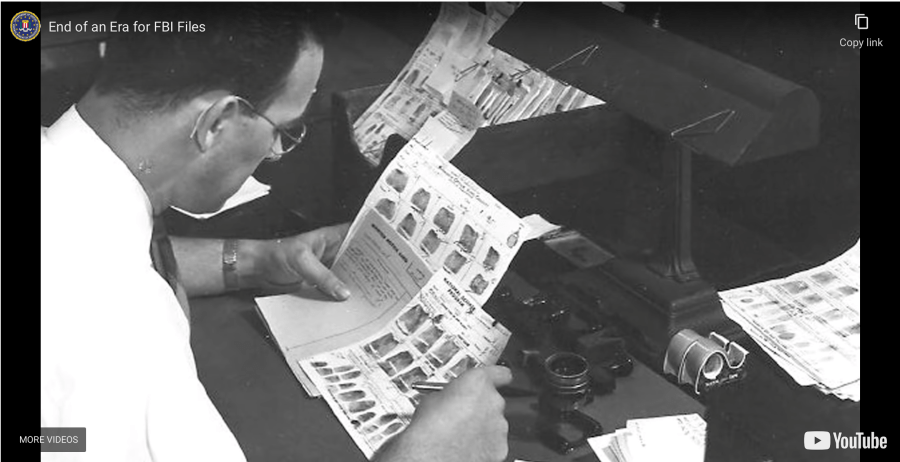
But you’re in luck. The FBI has posted a video on YouTube that discusses the digitization of their hard copy fingerprints, and on that video is a photo of a long-ago staffer reviewing someone’s fingerprint cards along with—YES!—their Additional Record Sheet. And now, without further ado, I present a screen grab of an Additional Record Sheet, in full view, outside its protective fingerprint jacket.

A closer, albeit blurrier view of an Additional Record Sheet

GED

How does the National Archives document apply to Ron Tammen? 

The 2004 disposition authority request submitted by the FBI to the National Archives has a lot to say about how long the FBI should retain criminal and civil fingerprints under IAFIS, not to mention the Additional Record Sheets and microfilm. Below is a link to the document as well as a timeline to help show where Ron factors in, and why, to quote person #1, his case “doesn’t add up.”

1941 – Ron Tammen is fingerprinted in Fairview Village (now named Fairview Park), OH, along with his second-grade classmates, and the fingerprint card is sent to FBI Headquarters. Ron’s fingerprints would have likely been held in the civil file at this point.

1953 – Ron Tammen disappears from Miami University on April 19. Mrs. Tammen soon contacts the FBI’s Cleveland office and they send a report to headquarters, where his fingerprints are discovered. His prints would have been moved into the criminal file at this time, since that’s where missing persons’ fingerprints were routinely maintained. 

1958 – The FBI begins its microfilm program as a space-saving measure. In a 1991 booklet on the Identification Division of the FBI, the duties of the Microfilm Unit are described as primarily to thin out the fingerprint jackets of repeat offenders. The unit also microfilmed the fingerprints of subjects who’d died.

1973 – Tammen’s fingerprint card is reliably in its jacket when Tammen’s prints are compared to the guy who worked for Welco Industries in Blue Ash, OH, near Cincinnati. The date in which they pulled his card for comparison would have been included on Ron’s ARS back along with a brief description of actions taken.

1992 — The Identification Division’s name is changed to Criminal Justice Information Services (CJIS).

1995 – CJIS relocates to Clarksburg, WV.

1999 – This is a big year for the folks in fingerprinting. They begin converting from a manual system to IAFIS, digitizing all of their fingerprint cards along with the Additional Record Sheets. They also stop putting fingerprints onto microfilm because they no longer need to worry about all those fingerprint cards exceeding their cabinet space. Nevertheless, they retain the 38,000-plus microfilm rolls they have, which contain roughly 50 million prints.

It should be mentioned here that the fingerprint cards are NOT destroyed immediately after they’ve been scanned. According to the 2004 disposition authority request: “At the present time, CJIS maintains a dual recordkeeping system consisting of an electronic fingerprint identification system (IAFIS) as well as a paper based repository of criminal master fingerprint cards. In 1995, CJIS and the [FBI’s] Laboratory Division signed a Memorandum of Understanding (MOU) agreeing that CJIS would continue to maintain the paper file until both parties approve its destruction.” It goes on to say that the two divisions signed the MOU because the IAFIS fingerprint scans didn’t meet the Laboratory’s resolution specs. So that’s interesting.

2002 – Three years after the rollover to IAFIS, Ronald Tammen’s fingerprints are purged from the system with seemingly no explanation. Because we now know that the FBI had both electronic and hard copy versions of fingerprints in their care at this time, we also know that it probably wasn’t just a computer glitch or human error that caused Ron’s fingerprints to disappear. Someone had to make a special trip over to the manual files, seek out Ron Tammen’s fingerprint card, and purposely destroy it as well. Did it happen on the same day? We don’t know that. But with the window of time being between 1999, when his fingerprints would have ostensibly been digitized, and 2008, when Frank Smith requested the hand search, I’d say the chances are good that whatever inspired someone to delete Tammen’s electronic prints in 2002 would have been enough motivation for them to destroy his manual file at that time as well.

July 2, 2004 – The FBI submits its disposition authority request to the National Archives. In a nutshell, it says that the FBI should retain fingerprints until the individual reaches 99 years of age or seven years following notification of the subject’s death for both electronic and paper records. Same for the Additional Record Sheet scans. It also adds this powerful phrase for all of the above: “whichever is later.” This means that 99 years of age is the YOUNGEST a person should be before these records can be deleted. If he or she should die an untimely death, say, at a youthful 98 1/2, the FBI would, in theory, be required to wait an additional seven years before the fingerprints and Additional Record Sheets could be deleted. Here are the specifics:

  • Criminal Subject Master File (scanned fingerprints): DELETE/DESTROY when the individual is 99 years of age or 7 years after notification of an individual’s death, whichever is later.
  • Additional Record Sheets: Hard copy files: DESTROY after verification of a successful scan. Scanned version: DELETE when the individual has reached 99 years of age, or 7 years have elapsed since notification of individual’s death, whichever is later.
  • Criminal Fingerprint Cards/Records (hard copy fingerprints): DESTROY when the records indicate that the individual has reached 99 years of age or 7 years have elapsed since notification of individual’s death, whichever is later.
  • Microfilm Library: The entire microfilm collection will be maintained until the birth date of the most recent set of fingerprints (i.e., born in 1981) reaches 99 years of age. DESTROY in 2080.

February 2008 – Detective Frank Smith contacts CJIS requesting a hand search for Ronald Tammen’s fingerprints. Not only don’t they have his prints as a scan or hard copy, they’re not on microfilm either. 

What does it all mean?

Just this: When the FBI decided to purge Ronald Tammen’s fingerprint files, they broke the retention rules that had been approved by the National Archives. In federal lingo, this means that one or more persons within the FBI (allegedly) committed an unauthorized disposition of federal records

I know what you’re thinking. You’re thinking: Jenny, this document was from 2004, and Ron’s fingerprints were purged in 2002. How do you know that these rules were in effect two years earlier?

I know this because the document says on its cover page that it consolidates four disposition authority requests from previous years (1990, 1995, 2000, and 2002) “into one comprehensive document.” As back-up, I also have all four of the earlier disposition authority requests. Below is the document that establishes the 99-year/”whichever is later” rule, as you can see by the handwritten notes. You guys, they’d been doing it this way since at least 1995.

You may also notice on the 2004 document some crossed-out paragraphs that were superseded in 2010 by new language. Below is the document from 2010, which now stipulates that they should maintain everything until a person reaches the age of 110, period, whether they lived or died. They don’t mention the seven years after confirmed death and they no longer mention “whichever is later.” If there’s a document that supersedes this one, it isn’t referenced here, as far as I can tell.

I know what else you’re thinking. You’re thinking: Jenny, I’m sure they hadn’t finished scanning those millions of fingerprint cards in 1999. Is it possible that they were about to scan Ron’s fingerprints in 2002, noted how many years had passed since he’d disappeared, and decided to purge them at that time?

I mean…it’s possible, but that’s not how it was described to me in 2015 when the FBI spokesperson had written the following: “Jennifer — We ran the FBI# and discovered it was expunged from our system in 2002. No other info available.” “Expunged from our system” tells me that Ron’s fingerprints had already been scanned into IAFIS (the “S” in IAFIS stands for “system”) and was later expunged, or purged, a term the spokesperson later used. Also, even if it happened that way, it would have still been against protocol, since Ronald Tammen wouldn’t have been 99 years of age.

Here are the take-homes:

  • According to their own rules, the FBI should have been able to produce Ronald Tammen’s fingerprints, both the electronic and hard copy versions, when Frank Smith requested them in 2008. Also, based on the 1995, 2004, and 2010 disposition documents, they should be able to produce them today. Even if Ronald Tammen were known to be dead, the FBI should have his fingerprints on file until at least the year 2032, 99 years after Tammen was born. Or if they’re going by the 2010 disposition protocol, they should have them until the year 2043.
  • Those who have been following this blog for a while are keenly aware that I’d thought that Ron Tammen had probably died in 1995, when I was informed that his fingerprints were purged in 2002. I thought this because I’d been told by the FBI’s spokesperson that the FBI purged fingerprints at 110 years of age or seven years after confirmed death. It was presented as an either-or scenario and, because Ron was nowhere near 110, I chose door B. If the FBI had been following their IAFIS protocol, even if Tammen were dead, those fingerprints should have been there in 2002, in 2008, and many years hence. So, guess what this means? It means we still don’t know if Tammen is alive or dead, and I have no idea what compelled them to purge his prints in 2002.
  • As for the missing microfilm, if Ron had died before 1999, the FBI might have also microfilmed his fingerprints. However, if he died after 1999, they likely wouldn’t have—they were purportedly done with microfilming. You’d think that it would be a much more involved process to delete a set of fingerprints if they’re buried somewhere within an entire roll of microfilm. I don’t think there’s much we can do to find out. You know the title of that Frozen song that’s really fun to crank up and sing your heart out to when you’re alone in a car? I think that sentiment applies here.
  • And what of the Additional Record Sheets? The hard copies would have been destroyed after they scanned them, as described in the 2004 retention protocol, but the electronic versions should be around until at least 2032 and possibly 2043. If I were a gambling person, I’d bet that they deleted the scans at the same time that they were deleting his electronic fingerprint file. I mean, if they’re going to break one rule, they might as well break all the rules, right? Nevertheless, it’s a question worth pursuing, and pursue it, we will.

Next steps

Before I tell you the next steps, I need to fill you in on some stuff. On March 23, the Department of Justice ruled on my appeal for the Additional Record Sheets and I lost. In the DOJ’s eyes, because of my 2012 lawsuit, I have no right to ask them about Ronald Tammen ever again, even if I’m asking them about documents that they’d never searched or thought to search before we signed our settlement in 2014. That’s despite the fact that the same DOJ division had ruled in my favor in 2016 when I used the same argument about another Tammen file that they hadn’t searched before. I thought lawyers loved precedent, but apparently not in Ronald Tammen’s case.

If you’re hoping to hear that a new lawsuit against the DOJ is now in full swing, prepare to be let down. The lawyer who represented me in my 2012 lawsuit, a FOIA expert who advised me that my 2014 settlement wouldn’t preclude me from submitting future FOIA requests on Tammen if I should discover relevant files that the FBI hadn’t yet searched, is no longer in private practice. Lately, I’ve been trying to find another FOIA lawyer to represent me, however, one expert had an alternative opinion about the settlement provisions and another might be ghosting me. But don’t feel bad—I have a feeling that this is all just part of the game when you’re dealing with FOIA law and the FBI. (You know in the Frozen song where she sings about not letting anyone see her cry? Some days, that fits too.) In the meantime, I’ll continue looking. 

But there’s another step I can take before I need to start shelling out some of my sad little savings for a lawsuit, if indeed that time comes. It involves our friends at the National Archives, the holder and purveyor of government records. I’m approaching them in two ways. First, the Office of Government Information Services (OGIS) was started in 2009 to serve as a mediator of FOIA requests, and they’re considered a next stop before a lawsuit. So far, I’ve sent them a detailed email explaining why I should have the chance to see Ronald Tammen’s Additional Record Sheet scans if they still exist and asking them to help make it happen. I’ll let you know how it goes.

Second, I’m reaching out to another division of the National Archives—the people who oversee unauthorized disposition cases. That’s right, readers, I have in my arsenal a weapon known as “tattling,” commonly wielded by individuals of the 6-year-old variety, and by golly, I’m wielding it too. Yes indeed, I’ve recently informed them of what I perceive to be the FBI’s mishandling of Ronald Tammen’s fingerprints. I don’t know what types of policing powers the nation’s archivists hold. They don’t immediately spring to mind when one thinks of feds who enforce the laws of the land SWAT-team-style—you know, like the FBI? Judging by their web page, they appear to handle such cases through polite correspondence with the agency in question. Nevertheless, I think that someone should register their displeasure. Why not me?

Of course, if Ron Tammen had been working as an undercover operative for the CIA, his fingerprints might have fallen outside the purview of the FBI’s sanctioned fingerprint protocol. When I asked my FBI sources how fingerprints were maintained for people whose identities had been changed by a government agency, such as the CIA, they let me know that they weren’t sure how those cases would have been handled.

“That never was anything that I was, I guess, supposed to know. So I don’t,” one of them said to me.

Just a thank you

Whew—what a year, right, guys? I know we’re not out of the woods yet, but things are definitely looking up, and I am so ready to take to the road again, once it’s safe to do so.

Last year at around this time, just as Covid cases had started popping up everywhere and communities were going into lockdown, I decided to write a Ron Tammen update for the anniversary—the one on Wright Patterson Air Force Base. For the entire previous year, from April 2019 to April 2020, we were on our hiatus, and I was quietly doing my research while writing short updates on Facebook. I didn’t think I had much more to tell you, so I just, you know, withdrew a bit. But once Covid struck, I decided to start back up with the blog, and then we taped the podcast episodes, and everything picked up again. I found that, as we were waiting on ISCAP to rule on the big question, there were numerous other questions needing to be addressed, many of which were posed by you.

Recently, I half-jokingly told a friend that, if it weren’t for her, I think I would have surely perished this year. Thanks to our morning runs and deep and sometimes hilarious convos, I’ve managed to stay healthy and sane throughout this ordeal. I feel the same way about you all. You helped me focus on something other than my mortality. I hope you managed to get through this year in good health as well, and hopefully the blog gave you something else to think about. Anyway, big, big thanks. Also, here are a couple photos of how I spent the pandemic—one in podcasting mode and the other in pre-run mode. Feel free to share photos of yourselves and how you managed to get through this year of insanity as well. Or share a vaccination pic of yourself, and don’t forget to tell us which team you’re on. (Go, team Pfizer!) Of course, if you have thoughts on today’s post, I’d love to hear those as well. The floor is now open.

That cryptic note about H.H. Stephenson? It was probably written in 1976, NOT 1953

By now, you know that my aim is to post only truthful statements about the Ron Tammen case on this blog site. If I can’t provide supporting evidence—if the best I can do is speculate about some finding, for example—I’ll attempt to do so as transparently as possible, using the necessary qualifiers. That’s how we roll. Conversely, if I should discover I’ve jumped to a conclusion that is even the slightest bit untrue, it’s my belief that I should announce the correction loud and clear, and, if it’s significant enough, with fanfare. 

Music from https://www.zapsplat.com

So, you know how I’ve been harping on Carl Knox for writing that cryptic note regarding H.H. Stephenson? The note looks like this:

That H.H.S. note has always bothered me. Not only did Knox appear to ignore Stephenson’s possible Ron sighting when Stephenson returned from his vacay in Wellsville, NY, but it seemed as though, by only jotting down Stephenson’s initials, he didn’t want anyone else to find out about it.

Today, I’m announcing that it’s my strong belief that neither Carl Knox nor one of his assistants wrote that note in August 1953. My reason for thinking so has to do with the name that’s written above that note, on the same piece of paper. It’s the contact information for one James E. Larkins, who was then an associate professor at Wright State University. (The note erroneously says Larkins is affiliated with Wright-Patt.) I’ve blackened the phone number because I don’t know who owns it now, and, well, who needs to experience the fresh hell of having their phone number published online?

As it so happens, James (Jim) Larkins was a sophomore counselor in Fisher Hall with Ron, which is where he would have been in 1953, not teaching Spanish at Wright State. Therefore, the note had to have been written much later. 

But when was it written, and why was it written, and who wrote it?

Here’s the timeline I’ve pieced together:

In November 1975, Larkins wrote a letter to Everett Lykins, who was Miami’s assistant dean of student life at that time. Although the letter is dated November 3, 1975, it’s stamped “RECEIVED” by the Office of the Vice President for Student Affairs on January 12, 1976. That seems late, but maybe the holidays had something to do with it.

In the letter, Larkins relays his experience regarding Ron’s disappearance, including a wild story about being shot at while trying to chase down the strange “phantom” voice that students occasionally heard after Tammen disappeared. Larkins also mentions Joe Maneri, who was the head of Fisher Hall at the time Ron disappeared. 

As luck would have it, 1976 was a busy year in Tammen world. In April 1976, Joe Cella, reporter for the Hamilton Journal News, revealed that H.H. Stephenson, a housing official who had known Ron, believed he saw him on August 5, 1953, in Wellsville, NY. People first read about Stephenson’s encounter in Cella’s news article on April 18, 1976, and then heard the story straight out of Stephenson’s mouth in the Phantom of Oxford, which aired the next night, on the 23rd anniversary of Tammen’s disappearance. [Stephenson is in Part 2, at the 04:15 mark.]

You know who else was interviewed in the documentary? Jim Larkins. [Larkins is in Part 1, at the 08:30 mark.]

Here’s what I think happened: 

Jim Larkins wrote his letter, which Dean Lykins likely received in January 1976. 

Around that same time, Joe Cella and Channel 2 producer Ed Hart, who were collaborating on the Phantom of Oxford, probably contacted the university seeking spokespersons to be interviewed on camera. Dean Lykins might have said, “Hey, I have this letter. We could put them in touch with Jim Larkins and Joe Maneri.” 

Someone then pulled together the contact info for both Larkins and Maneri, who worked at the Columbus Technical Institute at that time. This seems like a no-brainer, since the contact info for both men are written on similar pieces of paper in the same handwriting. Apparently, Jim Larkins said yes to the documentary, but Joe Maneri wasn’t able. (Unfortunately, both men are now deceased—Maneri in 2007 and Larkins in 2015. Although Maneri had already passed away by the time I began my research, I did have the opportunity to speak with Larkins.)

Meanwhile, Stephenson, who still worked in Housing at Miami and therefore answered to Dean Lykins, may have heard about the documentary project and stepped forward with his story about seeing Ron in Wellsville—first to Lykins, and then to Cella, or possibly vice versa. Even though the H.H.S. note isn’t in the same handwriting as the Larkins and Maneri notes, its position below the Larkins note indicates it was written during the same period in 1976.

But in 1976, Carl Knox was no longer at Miami. He’d left Oxford in 1959, so he couldn’t have been the H.H.S. note’s author.

What does all of this mean? In my view, the Larkins/Maneri/H.H.S. notes tell us a trifle more about how the Tammen saga played out over the years—nothing earth shattering, but something more to ponder during a pandemic on a Friday night. Still, two questions stand out. First, there’s this old chestnut: why did the note writer use Stephenson’s initials instead of writing out his full name? And now a new one: did Carl Knox do anything at all when Stephenson first told him about his encounter in Wellsville?

A Friday night insurance payment

A commenter recently asked about Joe Cella’s 1976 revelation that, on the Friday night before Tammen disappeared, he’d stopped by the home of Glenn Dennison to pay his car insurance. She was wondering why Ron would show up at his insurance agent’s house on a Friday night to pay his premium. Who does that, right?

It’s a really good question. There were other aspects to that visit that were curious too—aspects that I haven’t discussed with you yet. So let’s talk about them now. 

According to Cella’s April 18, 1976, Hamilton Journal News article, “Mrs. Dennison, who had never reported the visit to authorities, recalled Tammen came to their home Friday, April 17, 1953, about 8 p.m. to pay his car insurance premium.” Cella verified that the payment—totaling $17.45—had been made on that date through old records produced by Mrs. Dennison, who assisted her husband with his insurance business.

Dennison’s house, located on Contreras Road, is out beyond where the Taco Bell and  LaRosa’s Pizza is now, and a couple miles from where Fisher Hall once stood. Also, Dennison’s business was out of his home, so it wasn’t all that weird that Tammen would show up at the house. A 1960 ad in the phone book lists his business address at Contreras Road, though it doesn’t include the house number.

Glenn Dennison’s insurance ad from the 1960 Oxford, O. telephone book

What was weird was the time—8 p.m. on a Friday. Don’t most college students generally have more fun places to be on Friday nights? Why did Ron think it was so important to pay his premium then, when it wasn’t even due until April 24? He was a week early.

Here are the two things I haven’t shared with you about that visit and perhaps why Tammen might have ended up at the Dennison home at that time:

Everett Patten, the chair of Miami’s psychology department, lived on Contreras Road too. In the 1952-53 Miami Directory, his address is listed as R.R. 1, short for Rural Route 1, which tells us nothing about where he actually lived. In 1956, the Oxford telephone book listed Patten at R.D. 1, which I believe means Rural Delivery 1, and again, tells us nothing about his location. Thankfully, the 1958 Oxford phone book specified an actual house number. (By the way, if you’re thinking that he moved, I don’t think so. That was the same year in which St. Clair Switzer’s house was given a number, from his former designation of R.D. 2.)

So Everett Patten lived on the 6400 block of Contreras Road and Glenn Dennison lived and worked on the 6100 block of  Contreras Road—less than a mile apart. It’s actually .4 miles. 

Let’s imagine that Ron is at Dr. Patten’s house that night for some reason. We’ve already established that Patten seemed to know a lot about Ron—like Ron having dissociation in his background, for example—and we also know that the psychology department was hypnotizing students at that time. It would make a lot of sense for them to conduct their hypnosis sessions off campus, to avoid drawing attention. If Ron’s at Patten’s home on a Friday night for a hypnosis session, wouldn’t it make sense for him to stop off at Glenn Dennison’s house to pay his car insurance as long as he’s in the neighborhood? Whether coming or going, it would have been on the way.

The second thing I need to tell you is that the Campus Owls had a gig that night. According to the newspaper the Palladium Item of Richmond, IN, the Campus Owls played that Friday night from 8 to 11:30 p.m. at Short High School in Liberty, IN, which is about a 20-minute drive from Oxford.

In Cella’s article, Mrs. Dennison says, “He stayed about a half hour, talking about the Campus Owls in which he played and talked about other things.”

Of course, the times may be a little off, since Mrs. Dennison was recalling events from 23 years prior, however it still seems strange to me that Tammen would be so chatty on a night he was supposed to be in Indiana—at 8 p.m. My guess is that he didn’t go at all. And why would Ron, a guy who was forever looking for ways to earn money, choose not to go to a gig to make some additional cash? 

Maybe he had something else to do that would also bring in money—something that would soon take precedence over everything else.

[NOTE: Be sure you read the comments. Stevie J raises a point about Indiana time zones that makes the Owls gig much more doable. However, a member of the Campus Owls has also provided some background intel that, in my view, makes it unlikely that Ron was going to a gig. I know we’re always being cautioned not to read the comments on other websites, but on this site, thanks to the savviness of you readers, I highly encourage it.] 🙂