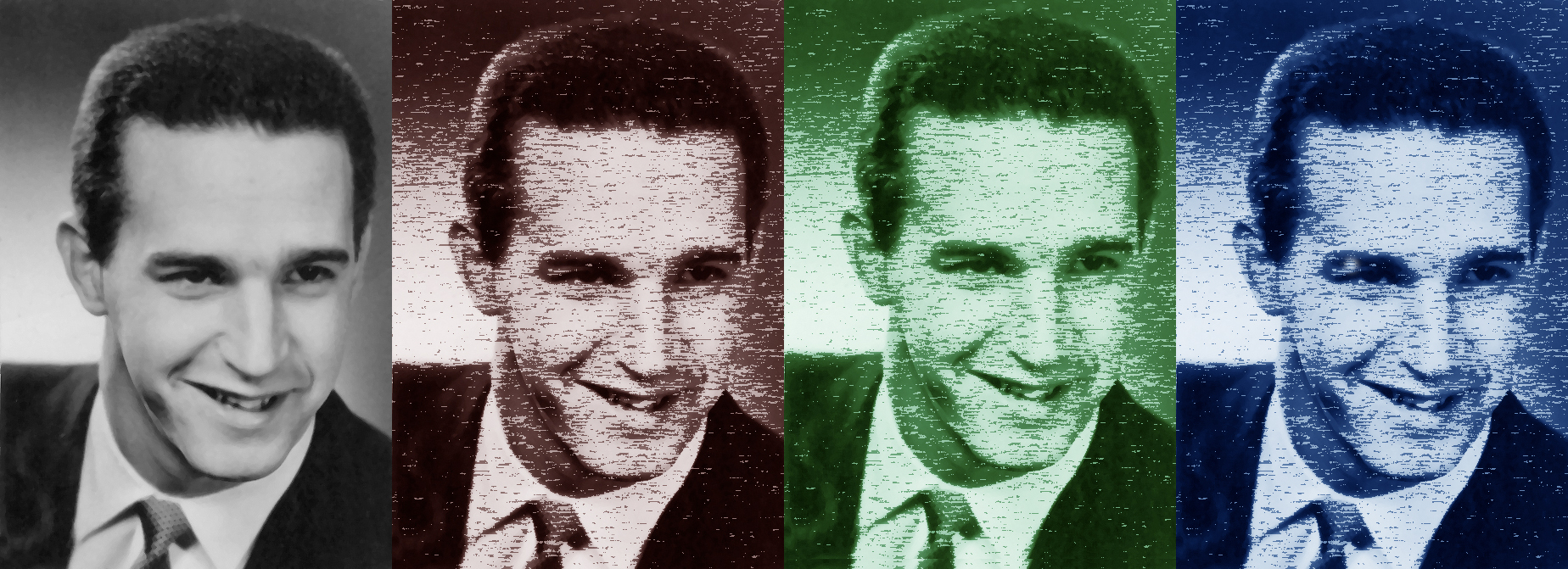
Season’s Greetings! If you enjoy discovering hard evidence to confirm a theory you happen to believe, then prepare yourselves, dear readers. I’m about to present you with two thoroughly enjoyable rock-hard pieces of evidence that confirms a theory I proposed in November 2023. I discovered the new evidence yesterday at Miami’s University Archives.
I’d driven to Oxford and back for the sole purpose of looking through several boxes that are stored there, one of which I’m reporting on today.
The box in question contained the file of Reuben B. Robertson, Jr., the charismatic president of Champion Paper and Fibre in Hamilton, Ohio, from 1950 to 1960. As you may recall, Robertson had taken two of those years off, from 1955 to 1957, to serve as the U.S. deputy secretary of defense under President Eisenhower. When he returned to Hamilton from that high-profile stint, he was named to serve on Miami’s Board of Trustees. Unfortunately, he didn’t serve his full four-year term. In the early-morning hours of March 13, 1960, he was instantly killed in a hit-and-run accident near his home in Glendale.
The theory that I’d put out in 2023 was that Robertson and Millett had known each other during WWII because both were working for an extremely small branch of the Army known as the Administrative Management Branch, which was housed in the Control Division of the Army Service Forces. There were only 28 officers and 3 civilians in that branch in 1943, and they were based in Washington, D.C. Considering how outgoing both men were, surely they knew each other, I said in my post. I then suggested that, since Reuben was sitting on Miami’s selection committee for a new president, he likely had talked Millett into applying for the job—a job for which Millett was grateful to accept. Although Millett had many impressive credentials in government and the military, he was at that time a full professor at Columbia University and lacked administrative experience in a university setting.
Understandably, John Millett was extremely saddened by the news of Robertson’s death, and he expressed his sadness in two letters within days of the tragedy.
The first letter I found was to Robertson’s widow, which he wrote on March 17, 1960, four days after Reuben’s death.
Here are the words he chose:
Dear Mrs. Robertson:
I wish there were some way that the many expressions of sympathy which you will be receiving at this time could somehow lessen your sense of loss. But all of us who knew Reuben well thought highly of him, and I hope this will provide you some sense of satisfaction.
I first met Reuben in 1942 when he came into the Army. We worked together on two or three projects that first year.
And I shall never forget the Thanksgiving I spent with you and Reuben in 1944 in Atlanta. It was a pleasant occasion, indeed.
When I came out to Ohio in 1953, I was very glad to have the opportunity to see Reuben more often. You may be sure that none of us who knew him well will forget him. And all of us extend our sympathy to you and to the children.
Sincerely yours,
John D. Millett
Credit: Miami University Archives; click on image for a closer view
So there it is: proof that they’d met and worked together in the Army during WWII. Millett said they began working together in 1942, but Robertson’s separation papers say he began in March 1943. I won’t quibble. Moreover, we also know that they maintained their friendship throughout the war, as evidenced by Reuben inviting John to Thanksgiving dinner in 1944 at the Robertsons’ home in Atlanta.
The second letter was to Thomas D. Morris, who at that time was assistant to the president of Champion Paper. This letter was written two days after Reuben’s death:
Dear Tom:
I should like to express to you and through you to the executive staff and the directors of Champion Paper and Fibre Company my great sympathy for the loss you have sustained in the death of Reuben Robertson. As you know, I have been a friend of Reuben’s since 1942. I met him when he first began his military service and we worked together in the same office in Washington for several months.
Later I visited him on two different occasions while he was stationed in Atlanta, and there I had an opportunity to become acquainted with Mrs. Robertson.
In the intervening years, I saw Reuben quite often in Washington and New York. He was instrumental in my coming to Miami University, and I was pleased, indeed, when Governor O’Neill appointed him a member of our Board of Trustees in 1957.
His death is a great personal and official loss to me, but I know this is little compared with what he meant to all of you in the Company.
I have never known a finer person or a more energetic executive than Reuben. His death is a great tragedy.
Sincerely yours,
John D. Millett
Credit: Miami University Archives; click on image for a closer view
Whereas Millett chose the word “instrumental” to describe Reuben’s efforts in bringing him to Miami, I believe a better word would be invaluable. In addition to suggesting that he apply, I’m sure he advocated for Millett to the other committee members, thus helping secure his nomination. In fact, I’d contend that if it weren’t for Reuben Robertson, John Millett wouldn’t have ever found his way to Miami—wouldn’t have even thought to apply for the job. The Board of Trustees elected him to be Miami’s 16th president on March 28, 1953.
You may be asking why this matters. In my November 2023 post, I discussed how an employee of Reuben Robertson’s named Dorothy Craig had written a check to Ron Tammen roughly at the time of his disappearance. To this day, I have no idea what the amount of the check was or why it was written, though I do have some hypotheses regarding the latter.
When news of Tammen’s disappearance hit the papers, Reuben Robertson probably didn’t want Champion Paper linked in any way. But how could he prevent that from happening, especially if investigators learned about the check? Maybe he could call in a favor from his good friend from the war—one who was recently named president of the university Tammen had attended.
As promised, I’m back with the seventh and final “goodie” from my last post.
Let’s look back to the halcyon days of 2020 when, during lockdown, I discovered a photo I’d taken of a summary of an interview that had been conducted with a woman who’d been Carl Knox’s secretary at the time of Ron Tammen’s disappearance. The summary is undated and unsigned and lives in a box stored at Miami’s University Archives.
A typed summary of an interview that had been conducted with a woman who’d been Carl Knox’s secretary in 1953. I’ve redacted the woman’s name.
As you probably know by now, I think the interview with Carl Knox’s former secretary had been conducted relatively recently, within the last 20 years, and I also think that she may have disclosed some pertinent information about Carl Knox’s investigation, particularly the forbidden words described in bullet 3. Needless to say, I really, really want to find the person who conducted the interview.
Recently, I had the opportunity to speak with the one person who I was totally convinced could have shone a big bright light on the whole mystery. I thought that if anyone knows anything about that interview, this person would. But guess what? The person with whom I spoke didn’t know anything about the interview with Carl Knox’s former secretary. In fact, they had no idea that the person who was interviewed had been Carl Knox’s secretary in 1953. In addition, this person didn’t really know the woman who’d been Carl Knox’s secretary very well—definitely not well enough to know that she’d been Carl Knox’s secretary in 1953.
I believe this person. This person is very credible.
While this was surprising news to me, it should in no way be mistaken for bad news. This new info has caused my search to take an abrupt turn which could lead us closer to finding the person who conducted the interview.
I’m going to turn off comments for this one, since I don’t want to speculate further. I’ll keep you posted if I have updates.
P.S. If the author of the interview summary happens to be reading this post, I’d be so grateful if you’d reach out to me through the contact link on this blog. If you’d like me to protect your anonymity, I promise to do so into perpetuity.
You guys, I’ve had a serious change of heart about something pertaining to the Ron Tammen case. It has to do with the length of time that had transpired before Carl Knox, Miami’s dean of men who was tasked with conducting the university’s investigation into Ron’s disappearance, stopped looking for him. This was despite the fact that Ron’s family and friends, not to mention Miami students, faculty, and staff; alumni; people living in the tri-state area; and anyone else who might have happened upon Ron’s story, were still devouring any piece of information the university could provide.
Recently, I had an email conversation with a reader on the topic of Dorothy Craig, and it occurred to me that, even though I’ve probably alluded to my evolved feelings on this website, I hadn’t really put them into actual words. It’s time to fix that.
What I used to think
In the past, I’ve cited two occurrences that enabled us to establish a before/after timeframe to delineate when Carl Knox had stopped looking for Ron. Mrs. Clara Spivey of Seven Mile, Ohio, provided the “before” date, the latest date on record when I believed Carl was still looking for him. Two months after Ron had disappeared, Mrs. Spivey had contacted investigators with the claim that a young man matching Ron’s description had shown up on her doorstep late at night on April 19, 1953, looking disheveled and confused and seeking directions to a nearby bus stop. At first, the time was reported as being around 11 p.m., but then the reporter, Miami journalism professor Gilson Wright, had changed it to midnight for subsequent articles. Mrs. Spivey had come forward shortly after June 20, 1953, after having read a recent article in the Hamilton Journal News in which Wright had basically retold the story and said there were no new leads. Oscar Decker of the Oxford Police had embraced Spivey’s story and the media were thereby alerted.
“It was a blustery night, with some snow flurries, and traffic was light,” Decker said. “He could have easily walked the 11 miles from Oxford to Seven Mile in two and a half or three hours.” (I beg to differ, chief, but please, do go on.)
The paper then paraphrased him saying that “If the youth in question was Tammen, it reinforces the theory that he suffered a sudden attack of amnesia.”
Because the university was publishing this new development in the Miami Student, it appeared to me as if Carl was still looking for clues as late as June 29, 1953.
The “after” date, the earliest date on record when we could conclude Carl was not still looking, was, in my view, one day after Miami housing official H.H. Stephenson had returned from his vacation in upstate New York. On August 5, 1953, Stephenson was having lunch in a hotel restaurant with his wife, in Wellsville, NY, when he was convinced that he spotted Ron, whom he’d actually known at Miami, eating at a table with several other young men. Weirdly enough, H.H. didn’t approach the young man at that moment, and by the time he returned to the dining room to find out if it was indeed Ron, he was too late. The young men had left.
According to a 1976 article by Hamilton Journal News reporter Joe Cella, Stephenson had told university officials—probably Carl himself—about his experience the next day, on August 6. However, as far as I can tell, Carl didn’t follow up on this lead. He didn’t call the hotel in Wellsville or notify the FBI or anything else he might have done to see if he could track down the young man. Likewise, unlike their reaction when Mrs. Spivey had stepped forward, university officials had kept H.H.’s potential sighting away from news reporters. Joe Cella had to chase that lead down himself 23 years later.
As a result, my earlier hypothesis was that Carl Knox had stopped looking for Ron Tammen sometime between June 29 and August 6, 1953, which I felt was surprisingly soon after Ron had disappeared.
What I think now
I think it was way sooner.
Why I’ve changed my mind
Carl was doing all the right things early in his investigation—conducting interviews, compiling notes, coordinating a campus search, talking to bank officials, and working with law enforcement. Best of all, he was following leads. If someone gave him the name of a person who might know something—someone like, oh, I don’t know…Doc Switzer, for example?—Carl would dutifully write down that person’s name on his pad of paper and contact them.
Another example was when Carl had jotted down the name of a girl Ron used to date as a freshman, Joan Ottino, along with the names of two of her family members. Joan had moved to Denver, Colorado, to attend nursing school over one year earlier, but Carl was undeterred by the distance. A week and a day after Ron disappeared—April 27, 1953—Carl had sent a telegram to Joan, asking “SHOULD YOU HEAR FROM, OR SEE, RONALD H. TAMMEN, PLEASE WIRE OR PHONE COLLECT.”
Click on image for a closer view
See what I mean? He’s not simply going through the motions to make it appear as if he’s doing something. He’s really doing something.
On May 4, 1953, an article appeared in the Hamilton Journal News informing readers that several of Ron’s fraternity brothers had recently traveled to Cincinnati in response to a landlord who thought her new tenant looked like Ron’s photo. Unfortunately, she was mistaken. Although the article doesn’t say this, I have it on excellent authority that the person driving those Delts to Cincinnati was Carl Knox. This means that, shortly before May 4, 1953, Carl Knox had been accepting phone tips and contacting his back-up witnesses and hitting the road in search for Ron. I’ve also learned that he was gathering info from his passengers on the drive to Cincy and back as well. It was on that car trip that Carl Knox learned of Paul’s (not his real name) and Chip Anderson’s late-night walk home from the Delt house to Symmes and Fisher Halls after song practice the night Ron disappeared.
But do you know what? That’s also roughly the point in time when the urgency in finding Ron Tammen seemed to wane for Carl. And it wasn’t as if he wasn’t discovering new information. Although we don’t know precisely when he discovered the information about Dorothy Craig’s check, I think it had to have been early in his investigation. Dorothy’s name is written at the top of a page of scribbled notes that establish what Ron was doing before he disappeared. It’s the sort of info an investigator would collect on day one—the condition of the room, an hour-by-hour breakdown of where he was, that sort of stuff. It could be that his note about Dorothy’s check was added at the top on a later date, though, even if that were the case, I’d still think it would have been early on.
Click on image for a closer view
I think Carl was instantly intimidated by Dorothy Craig’s check. Something about it—Was it the amount? Was it her powerful employer?—may have astonished him so much that he immediately stopped putting any further details into writing. I’ve thought for some time that as Carl was being informed by the bank official about the check, it was the pivotal point in which he’d halted his investigation. Now I’m thinking: if Carl had learned about Dorothy Craig’s check before May 4—and my hunch is that he had—maybe he did look into it, and someone else had put a stop to that part of his investigation. Maybe they said something like: “Look, Carl, if you want to drive to Cincinnati to check out the landlord’s tenant, fine, knock yourself out, but don’t go near Dorothy Craig.” No matter what happened or how, I think that Dorothy Craig’s check factored heavily into the reason the university soon lost interest in Ron’s case.
And let’s not forget about Dr. Garret Boone, the cranky Hamilton physician whose office Ron visited in November 1952 to have his blood type tested. In 1973, reporter Joe Cella had revealed that Boone had attempted to notify university officials about Ron’s visit but had been rebuffed. Although we don’t know exactly when Dr. Boone attempted contacting the university, I think it was also early.
An excerpt from the 1953 Hamilton, Ohio, telephone directory with Garret Boone’s entry in bold and all caps; click on image for a closer view
As Boone told Cella, “I offered the information (the medical file card contents) to local authorities at the time, but it was always discounted.”
His use of the phrase “at the time” sounds as if he didn’t wait around for two months until approaching them, as Mrs. Spivey had done. Mrs. Spivey attributed her tardiness to the fact that she hadn’t seen the story in April and had only been reminded of her front-porch visitor after reading Gilson Wright’s June 20 article stating Tammen was still missing and there were no new leads. Dr. Boone’s situation was different though. In addition to being a practicing family physician, Boone was the county coroner, which means that he was an elected official. It was his job to keep up on the news of Butler County, especially anything having to do with a potentially life-and-death matter regarding one of its citizens. He would have seen the April news articles and he knew the importance of stepping forward as early as possible in such cases.
But when he did, university officials—I’m guessing Carl was one of them—had zero interest in what he had to say. That doesn’t sound like the old Carl—the one from before May 4. This tells me Doc Boone likely contacted them shortly after that date, after he’d had time to rifle through his files for Tammen’s medical card.
By then, Carl Knox was assuming a more passive role in the investigation and letting Oxford police chief Oscar Decker take over. When Mrs. Spivey’s potential Tammen sighting was announced on June 29, 1953, it was Decker who was the spokesperson ballyhooing the news.
And so, at the moment, I think Carl Knox and Miami University were no longer investigating Ron’s case by May 4, 1953—two weeks and a day after Ron went missing. Of course, if we ever find evidence that Doc Boone had reached out to university officials earlier than that day, we’re going to have to push our date up even further.
The last time we talked (which could be 5 minutes ago, 5 days ago, or 5 weeks ago—it’s totally your call), we were discussing the life of Reuben B. Robertson, Jr., the president of Champion Paper and Fibre Company from 1950 to 1955 and from 1957 to 1960. During the interim two years, Robertson was deputy secretary of defense under Secretary Charles Wilson.
I know what you’re thinking. You’re thinking that the part about his being the deputy defense secretary is impressive and all, but that was two years after Ron Tammen disappeared. Come to think of it, all of those hires he’d made of top-tier military and intelligence personnel happened during or after his Department of Defense (DoD) gig. What was he doing on a national level in the spring of 1953?
You make a good point. In the spring of 1953, Reuben Jr. had just returned from a trip. In February, he’d been named by President Eisenhower and Harold Stassen, director of the Mutual Security Agency, to lead a team of businessmen on a tour of Germany to assess the effects of U.S. spending there. The Mutual Security Agency was created in 1951 to facilitate the military and economic recovery of America’s allies after WWII. As director of the MSA, Stassen was a member of the National Security Council. He was also a member of Eisenhower’s cabinet. For this trip, 55 businessmen traveled to 14 Western European countries, and Reuben Jr. had led the German contingent, which included six other men. After two days of training, they arrived in Germany on February 16, 1953. Although news articles that I’ve read don’t state how long the trip lasted, I’m guessing that they were back by the end of February or early March.
One month earlier, in January 1953, Reuben Jr. had been elected to serve as one of four vice chairmen on the executive committee of the Business Advisory Council. The Business Advisory Council, now called the Business Council, was, at that time, an esteemed advisory group to the U.S. Department of Commerce, which was headed by the newly-appointed Secretary Sinclair Weeks. President Eisenhower had selected a number of his other cabinet posts from individuals who sat on the BAC, including Defense Secretary Charles Wilson, who was formerly president of General Motors.
So, in a nutshell, in the spring of 1953, Reuben Jr. was in Hamilton, while he was also helping out two of President Eisenhower’s cabinet members when he was asked, which seemed to be on a regular basis. He was traveling in powerful circles and making headlines while doing so.
Because I’m writing this on a deadline, and because much of this post involves speculation, I think we’ll go back to a Q&A format. Hope you’re cool with that?
Yeah, that’s fine. So you say he was making headlines. Is that how Miami University officials came to know him?
Headlines and word of mouth certainly contributed to his visibility in southwest Ohio. If you have a strong business school—and Miami University certainly does—you’re going to notice the most successful businesses in your area, especially if the company president’s network of friends and associates extends as broadly as Reuben Jr.’s did. People in the business school did take notice. In May of 1951, the School of Business Administration sponsored an industrial management conference and Reuben was the luncheon speaker. He spoke on wage stabilization, a topic he knew well, since his appointment on the federal Wage Stabilization Board was coming to an end in June.
Max Rosselot, an assistant professor of secretarial studies and office management in Miami’s School of Business Administration, spent the summer of 1952 working with Champion’s pool of stenographers, immersing himself in the company’s business practices to enhance his courses for future stenographers and secretaries. Rosselot would later go on to become Miami’s Registrar in the early- to mid-1960s.
Champion had noticed Miami too. In 1947, a staff member in Miami’s Psychology Department, R.C. Crosby, director of student counseling, taught a course in business psychology to 24 Champion employees. According to the December 1947 issue of The Log, “This course deals with some general principles of the psychology of human relationships and their application to business and industrial groups.” If you’re wondering why St. Clair Switzer wouldn’t be teaching the course—after all, business psychology was his baby—this was at a time when Switzer was still counseling veterans after the war and he hadn’t yet gone back to teaching courses at Miami. I’m sure he would have been interested though.
Another way that Miami officials would have known about Reuben Jr. was through his aunt.
His aunt? Who was Reuben Jr.’s aunt?
Reuben Robertson, Jr.’s aunt was Mary Moore Dabney Thomson, wife of Alexander Thomson, who, in turn, was Reuben Robertson, Sr.’s brother-in-law. (If you need to work that through your heads a minute, I can wait.) Alexander Thomson was a longtime executive with Champion Paper and Fibre, and was chairman of the board from 1935 until his death in 1939.
But Mary Moore Dabney Thomson did stuff too. From 1933 to 1941, she was a member of the Western College for Women’s Board of Trustees, and during the years 1941 though 1945, she was president of the college. As many of you know, Western College for Women was across the street from Miami University and, in 1974, it became part of the university. In fact, Thomson Hall was named for Mary Moore Dabney Thomson.
But here’s the rub: you know how I discussed in part 2 that women in those days tended to relinquish their first names when they got married? One case in point is Mary Moore Dabney Thomson, who was often referred to in the press as Mrs. Alexander Thomson. Seriously. She was president of a prestigious women’s college, and people still referred to her by her husband’s name, even when he was no longer alive. I say this with all due respect, but what the bloody hell is up with that, members of the 1930s…’40s…and ‘50s press?
Mary Moore Dabney Thomson was well-known in the Oxford community before the Champion Coated Paper Company merged with Champion Fibre Company in 1935, and well before her nephew Reuben Jr. arrived in Hamilton in 1937. I’d even bet that it was through her that some Miami officials became familiar with the Thomson and Robertson names.
In what can only be described as pure coincidence, Mary Moore Dabney Thomson’s portrait was revealed on April 18, 1953, in Western’s Clawson Hall, the day before Ron Tammen disappeared.
You mentioned previously that Reuben Robertson, Jr., sat on Miami’s Board of Trustees from 1957 until his death in 1960. Did Miami officials seek his input on anything earlier than that, such as when Ron was still a student?
Yes, they sure did. Shortly after President Ernest Hahne died in November 1952, Reuben Robertson, Jr., was asked by the vice president of Miami’s Board of Trustees to sit on the committee that would select the next president. Reuben Jr. represented the public on the six-member committee, which included the president of the Board of Trustees as an ex-officio member. Several months later, that committee decided upon John D. Millett, who was affirmed by the 27-member board in March 1953.
President Millett must have been equally impressed with Reuben Robertson, Jr. In 1956, he would invite him to be a commencement speaker, and, at that time, Reuben was bestowed an honorary law degree.
So…what’s your theory?
I’m thinking that someone contacted Lt. Col. Reuben Robertson, Jr., for help in funding research that was being conducted by Lt. Col. Switzer in Miami’s Department of Psychology. (Using military rank might go a long way when making the ask.) The asker might have come from Miami University, from the military, or from somewhere else. Reuben Robertson, Jr., knew a lot of people.
The reason that someone may have asked for his help is that universities are usually strapped for cash and the restrictions placed on the government’s spending of taxpayer dollars are tight. Perhaps they asked Reuben Jr. if he’d be willing to support students taking part in a university study that would benefit national security. That doesn’t sound too different than asking him if he’d be willing to buy a box of cookies to support the Girl Scouts. Reuben Robertson, Jr., believed strongly in education and national security. He was also a busy man. Maybe that’s all he felt he needed to know.
How might Dorothy Craig have fit into the picture?
Dorothy Craig was a loyal employee of Champion Paper and Fibre Company. In 1953 she’d been working there for 16 years as an order clerk, a job that carried a lot of weight. She was well-liked, and, like Reuben Jr., she treasured her family. Her main activity outside of work was church.
Even though Dorothy Craig dropped out of high school after her sophomore year, she still attended her alumni reunions—that’s how much of a people person she was. In a Hamilton Journal-News photo of their 45th class reunion, which took place in the summer of 1965, Dorothy is standing on the far righthand side of the third row. When I first saw the picture, I was hoping that Dorothy was the woman who was standing two people to her left. The other woman was tall with short, jet black hair, white-rimmed glasses with dark lenses, and dark lipstick. She looked like a spy who wouldn’t take sass from anybody. Dorothy, on the other hand, looked a little more motherly—a gentle woman with a genuine, sweet smile. If someone needed a go-between to provide payments to Ron Tammen—someone who could handle an errand without asking too many questions—Dorothy Craig would have been perfect. Besides, she probably would have wanted to help support college students and protect national security too.
(I tried to obtain permission to post the photo, but I haven’t heard back from my contact. If I ever do, I’ll post it. In the meantime, if you have access to Newspaperarchives.com, you can view it here.)
What do you find most telling about the check from Dorothy Craig?
The quiet…always the quiet. When Carl Knox wrote his note about Dorothy, he didn’t include any additional information about the check—the date, the amount, and where it was cashed—even though I’m sure that information was provided to him. He didn’t include contact information for Dorothy Craig either, even though that information would have been given to him as well. And he kept Dorothy’s identity to himself or among a very small circle of people. Neither he nor the Oxford PD ever mentioned her in the news. If someone had contacted her, and her transaction with Ron was deemed inconsequential, they could have still provided an update to news reporters while protecting her anonymity. Something like: “An area woman had written a check to Ron for X dollars, but it turned out to be for (fill in the blank).”
Likewise, Dorothy Craig had just written a check to Ronald Tammen, a smart, serious-minded college student who disappeared shortly afterward. The news coverage would have been hard to miss, especially for someone who happened to be sitting in a roomful of order clerks at a paper company. Early and often, investigators lamented the lack of clues in the case. If I were Dorothy? I think I would have come forward and told someone about that check, be it the university, the Oxford PD, or even the FBI when they stepped in. Something like: “I just saw him on Saturday when I wrote him a check for (fill in the blank). He seemed OK.”
That is, unless I was instructed not to.
Do you think Dorothy Craig was the ‘woman from Hamilton’?
Let’s put it this way: I think Dorothy Craig was a woman from Hamilton who may have been acting as a liaison to help compensate Tammen for some activity he was involved with, such as a university study, perhaps. Whether she was the woman from Hamilton who I believe drove Ron away from Fisher Hall, I really don’t know.
You know what I’m thinking?
No, what?
I’m thinking that this new Hamilton connection could make Ron’s blood type test a little more significant.
Whew! This concludes today’s posts. I’d love to hear any comments or questions you might have about Dorothy Craig, Reuben Robertson, Jr., or any other topic you feel like discussing concerning Ronald Tammen’s disappearance.
Hamilton, Ohio, may seem like a long way from our nation’s capital, but in the 1950s, Champion Paper and Fibre Company had garnered the attention of some powerful people at the top. “What people?” you ask. Oh, only Presidents Truman and Eisenhower. Both Harry and Ike had a lot of respect for Champion Paper. They or people in their administrations would frequently turn to the company’s leadership for their expertise in business and matters pertaining to national defense.
You heard me. National defense.
Mostly, it had to do with the company’s president, Reuben Buck Robertson, Jr. Reuben Jr. was intelligent, innovative, and oh my gosh, the man had charm. He had looks too, especially in his youth. His dimples could stop traffic. (He was probably told that a lot.) You could say that he attained his position as a birthright—his father, Reuben Sr., had preceded him as company president—but Reuben Jr. was very good at his job. Exceptional, really.
Before I tell you anything more about Dorothy Craig’s larger-than-life boss, let’s have a quick run-down on the company’s history and how Reuben Jr. got where he was.
The Champion Paper and Fibre Company had its official start in 1893 as the Champion Coated Paper Company. Its founder, Peter G. Thomson, was a bookstore owner, publisher, and printer from Cincinnati. Because of Thomson’s love for the printed word, he had a high regard for paper as well. When printers started using halftones—tiny dots of ink—to reproduce illustrations instead of hand-drawing or etching them, Thomson knew that the paper needed to be coated to create a smooth surface that would hold the ink in place. If the paper weren’t coated, the ink would sink into little crevices and spread. In 1891, Thomson purchased 200 acres in Hamilton to build a coating mill, and in 1894, his new business was up and running. But there were a few snags: in order to operate a fully-functioning coating mill, he needed sufficient quantities of paper to coat. As a remedy, he constructed a paper mill in town. Next Thomson discovered that, in order to operate a fully-functioning paper mill, he needed a consistent supply of wood pulp. Thomson found an ideal spot in Canton, North Carolina, an area so thick with pine trees, it probably smelled like the world’s best car freshener 24/7. The pulp mill was constructed in 1908, and, with that addition, Thomson now had a self-sufficient paper-manufacturing operation that would continue to develop and grow.
The pulp mill in North Carolina was named the Champion Fibre Company, and Thomson’s son-in-law was put in charge. That son-in-law was Reuben Buck Robertson, and his marriage to Peter’s daughter Hope Thomson would be the start of the Thomson-Robertson dynasty of Champion Paper. Peter’s three sons, Peter Jr., Alexander, and Logan Thomson, would all assume positions of leadership in the company, as would other family members, including Reuben’s son, Reuben Robertson, Jr., who was born in Asheville, North Carolina, in 1908.
Reuben Jr. graduated from Yale Sheffield Scientific School in 1930 with a degree in chemical engineering. That same year, he started working at Champion Fibre for his father. Reuben Jr. was the ultimate Undercover Boss. He started low—as a laborer in the woodyard—and worked his way up the ladder. He toiled and sweated along with everyone else. He asked a ton of questions. In doing so, he developed a keen understanding of every aspect of the papermaking business and the people on whose backs the business relied upon.
In 1935, the two companies were merged to form Champion Paper and Fibre Company, which included adding a new paper mill in East Texas. With the merger, Logan Thomson was made president, Reuben Jr. was vice president, and Reuben Sr. was executive v.p. Two years later, Reuben Jr. moved from North Carolina to work in the General Office Building in Hamilton, a stately building on North B Street that housed roughly 75 Champion office staff. That same year, Dorothy Craig was hired by Champion to work in its General Office Building as an order clerk.
Seventy-five people is a relatively small number of occupants, and Reuben Jr. was a people person. He would make a point of knowing his employees—both those in the office building, and those in all the other buildings too. Dorothy strikes me as a people person too.
Why do I think that? A man named Bill McDulin used to write a folksy column for the Hamilton Journal-News titled “Got a Minute?” that shared newsy tidbits for the locals. McDulin’s guiding principle seemed to be to leave people with a good feeling about themselves and their community. Because they happened to be neighbors, Dorothy Craig, of Carmen Avenue, was mentioned several times in McDulin’s column. In one of his “Remember when” blurbs from 1976, he asked his readers “Remember when Charlie Betz was a member of the Hamilton police department?…Mrs. David (Geraldine) Adkins started writing poetry?”…[and so forth, and then]…Dorothy Craig worked at Champion?”
Literally thousands of people worked at Champion Paper and Fibre Company. For Bill McDulin to have singled out Dorothy over everyone else seems…well, it seems like she must have been known by quite a few people. So without question, Dorothy and Reuben Jr. would have known each other, and not just to say “hello.” Reuben Jr. would have asked Dorothy about Henry and the kids, or sometimes he likely would’ve wanted to know “How are the orders coming in today, Dorothy?” Dorothy would have felt at ease with Reuben Jr. and could answer him honestly, without sugarcoating, even if the news was less than favorable.
Reuben Jr. got his first taste of policymaking on the national stage in 1942, when he was asked to serve on the War Production Board. Although its name sounds as if it was a small group of men in suits sitting around a table and talking about war stuff, the War Production Board was an entire agency tasked with readying the country for WWII. The War Production Board was responsible for converting a variety of domestic manufacturing plants into weapons manufacturers. They’re the agency that coordinated the collection and recycling of aluminum, tin, rubber, steel, and other materials to be used for military purposes. For its part, the Champion Paper and Fibre Company had developed a paper substitute for the aluminum liner that went inside packs of cigarettes. They were brainstorming to that level of detail. And even though people today don’t normally think of foods like coffee and meat as commodities with implications for combat, the War Production Board did, and they formulated strict rules to ration certain foods to conserve resources.
But serving on the War Production Board didn’t stop Reuben Jr. from taking part in the war itself. He also enlisted. From 1942 to 1945, he was an officer in the Control Division of the Army Service Forces, advancing to lieutenant colonel by V-J Day.
Shortly after Reuben Jr.’s return to Hamilton, the Champion Paper and Fibre Company experienced another musical-chairs-style shift in leadership. Logan Thomson died in 1946, and with his death, Reuben Sr. became president. Four years later, Reuben Jr. would be elected president of the company, and his father would be elevated to chairman of the board.
Even with Reuben Jr.’s added responsibilities in running the entire company, Washington continued to call. Over the next five years, he was asked by the Truman and Eisenhower administrations to serve in the following ways:
In 1953, he was appointed by President Eisenhower and Mutual Security Director Harold Stassen to lead a team of businessmen to evaluate the effects of U.S. spending in Germany.
From 1953 to 1955, he served as vice chair of the Secretary of Commerce’s Business Advisory Council.
So, yeah. The people in the highest posts of all the land were interested in hearing what Reuben Jr. had to say. And…are you ready for this? In 1955, President Eisenhower asked Reuben Jr. to serve as deputy secretary of defense under Secretary Charles Wilson. Which. Was. Huge. Reuben’s company would continue to be in good hands while he was away, since Reuben’s father would take over as president in the interim.
Some have described the deputy secretary of defense as the secretary’s alter ego. The deputy secretary knows everything the secretary knows, including issues pertaining to national security. I would hasten to remind readers that the U.S. was now engaged in the Cold War, so there was a lot to know, national-security-wise. I would quickly add that, on an org chart, the deputy secretary is immediately below the secretary and above anyone else having to do with the Department of Defense (DoD), including the Joint Chiefs of Staff, the Research and Development Board, the heads of all the military branches, you name it. It was Reuben Jr.’s job to oversee the day-to-day matters involved with managing the largest agency in the federal government. Of course, he was a natural.
Still, while he was in that awesomely important role at the DoD in the middle of the Cold War, Reuben Jr. would commute between Hamilton and D.C. by plane almost daily, according to a knowledgeable source. This was made possible thanks to an airstrip on his home property in Glendale, a small community about 12 miles from Hamilton. With that airstrip, plus the use of the company’s fleet of aircraft maintained at Lunken Airport, and Champion’s team of licensed pilots, Reuben Jr. could rub elbows with the nation’s top brass in the morning and still be home in time for dinner with wife Peggy and their six kids.
Oops, my bad. Did I neglect to mention that Reuben Jr. was an amazing husband and dad? Well, dude was an amazing husband and dad. There’s a photo in the company newsletter, The Log, in which he’s walking hand in hand with two of his children, who were dressed like a cowboy and a cowgirl, and he’s beaming away, dimples fully deployed. It’s so clear that Reuben’s children adored their father, just as Reuben’s employees adored their boss.
You may be wondering what papermaking could possibly have to do with the nation’s defense (other than the manufacture of paper liners for cigarette packs, that is). It had to do with the times they were living in. Back then, paper was—let’s see, I need to be careful not to overstate this—paper was everything. If someone from the DoD had an idea they wanted to put into motion, then they were going to need a sh*t-ton of paper to get that idea across to other people. It’s how the government communicated. It was how information was disseminated. After all, they didn’t earn the name “paper pushers” for nothing. Those ration books? Paper. The Uncle Sam posters asking people to bring in their toothpaste and shaving cream tubes for the tin? Paper. And maps. Millions of paper maps. In an August 1995 article, Jim Blount, a former editor for the Hamilton Journal-News who was also a treasured local historian for many years, shared this information that he’d found in a Champion newsletter concerning the importance of paper during WWII:
“For army maneuvers in 1942 in the Carolinas, 95 tons of paper went into 4.5 million maps. Every soldier in that operation received 21 maps covering the 12,000-square-mile area.
‘All ration cards and instructions must be printed on paper, and there is hardly a branch of this defense wherein paper is not used wholly or in part,’ noted The Log, a Champion publication. ‘It is necessary to plotting systems, giving instructions for air raid precautions, first aid instructions, communications and records of all kinds. Bonds, tax stamps, notes, orders, correspondence, even money itself is paper required by the Treasury Department, and the chances are that the bond you buy or the revenue stamp which is canceled on the can of tobacco is made by Champion.’
The 1942 article said ‘in this greatest of all wars in the history of mankind, there is needed for this year alone, 18 million tons of paper.’”
And that was just WWII. The United States needed paper during the Cold War too, for which 1950 was a banner year. On June 27, 1950, which happened to be Reuben Jr.’s 42nd birthday, the United States had entered the Korean War. On September 4, 1950, then-General Eisenhower—he wouldn’t be president until January 1953—kicked off Crusade for Freedom, a CIA-backed endeavor to raise funds for Radio Free Europe, which, at that time, was a U.S. propaganda tool based in West Germany. Even though it was said to be supported privately by everyday Americans, government dollars were also invested into the printing of stamps, posters, and leaflets by the millions. Some leaflets were used for fundraising at home and abroad. Others were dropped from balloons behind so-called Iron Curtain countries, such as East Germany, Czechoslovakia, and Poland, denouncing communism and advertising radio wavelengths and program schedules. Crusade for Freedom, which ran from 1950 to 1960, was a paper-palooza, and Champion Paper was there for it. Reuben Sr. oversaw the crusade’s two-state region of North and South Carolina. You can watch a 5-minute video on the Crusade for Freedom on C-Span’s Classroom program.
There was talk that Reuben Jr. would become defense secretary after Charles Wilson stepped down, but Reuben wasn’t interested. He wanted to be more present for his family, and he tendered his resignation in 1957. But that doesn’t mean he didn’t still have an avid interest in defense. In 1955, the same year in which he started at the DoD, Reuben Jr. kicked off the Chapaco Council—“Chapaco” being the initial letters from the three words Champion, Paper, and Company—which was a series of retreats for company management at Lake Logan in North Carolina. The line-up of speakers was a mix of military might with big names in business, industry, higher education, and journalism.
Speakers representing the U.S. government for the five years in which the retreats were held were:
Reuben Jr. also hired some of the highest military and intelligence officials the country had to offer to work for Champion Paper and Fibre Company. Conversely, one man, Thomas D. Morris, would be propelled from Champion to the DoD. Here’s the list that I’ve been able to assemble of Reuben’s most decorated hires. To keep things brief, instead of including their entire resume, I included the last position(s) held before they made their career change.
Col. Kilbourne “Pat” Johnston
Assistant director of CIA’s Office of Policy Coordination, 1950-52
Assistant for materiel program coordination to the commander, Wright-Patterson Air Force Base, August 1952
Deputy director of supply and services, WPAFB, November 1952
Director of supply and services, WPAFB, May l954
Awarded the Distinguished Service Medal, the highest military award during peacetime, 1959
Accepted position at Champion Paper and Fibre, 1959
I’d challenge anyone to find a similarly elite cadre of military brass working together at one civilian business anywhere. I have to believe that Reuben Robertson, Jr., was the reason.
Look, there’s no easy way to tell you what happened next. In the early hours of Sunday morning, March 13, 1960, Reuben Jr. was driving home with his wife Peggy from a social engagement in Cincinnati. On a dark stretch of highway, the Robertsons were startled by a car that was sitting in the center lane, unable to move. According to an Associated Press account: “Robertson swerved his Cadillac, but he clipped the stalled car and grazed a passenger who was standing outside.” Evidently, the other car had run out of gas. Of course, Reuben got out of his car to talk to the people in the disabled vehicle, probably to find out if they were OK and to tell them that his insurance would cover the damage to their car. I wouldn’t be surprised if he also offered to bring them back some gas. Suddenly, a drunk driver came careening down the road and knocked into Reuben, throwing him 50 feet into the air. Reuben Buck Robertson, Jr., died almost instantly at the age of 51.
Oops, sorry. Did I neglect to mention that Miami University had known Reuben B. Robertson, Jr., quite well? My bad.
**************
UPDATE: Two readers have asked for more details about the accident, wondering if its cause could have been more nefarious in nature. The driver of the car that killed Reuben Jr. was Willie Lee Griffin, age 31, of Rockdale Avenue, in Avondale, Ohio, which is part of Cincinnati. Oddly, he was only charged with drunk and reckless driving even though he killed someone. Vehicular manslaughter, a felony, was definitely a charge that could have been brought against him at that time. Later, in 1967, Ohio law divided the category into first and second degree vehicular manslaughter, with drunk and/or reckless driving considered to be first degree offenses, and therefore, still a felony. I don’t know why they didn’t hold him accountable for Reuben Jr.’s death.
Before we conduct our search for Dorothy Craig, let’s think a little about how unusual it was for Dorothy’s name to be written at the top of Carl Knox’s notepad. In those dwindling days before Ron Tammen disappeared, all of his other check-writing or check-cashing or check-depositing activities pertained to businesses or organizations: places like Cleveland Trust, Delta Tau Delta, Shillito’s, and whatever entity had given him a loan. But Dorothy Craig wasn’t a business. She was a person. And weirder still, Dorothy Craig happened to be a female person.
In the year 1953, women weren’t generally known for their business transactions. Women were known for getting married. And once a woman was married, her identity was pretty much subsumed by her husband’s. Even her name. Once she was married, her signature would no longer begin with the name she was lovingly given on day 1 of her life—be it Helen, Margaret, Sadie, and, yes, Dorothy. Rather, she was now expected to use her husband’s name with the title “Mrs.” slapped in front. She was now Mrs. William this or Mrs. A.K that.
A woman in the 1950s was frequently told not to worry her pretty little head about something she was worried about. She would be asked to leave the room so the men could discuss something that was way too complicated for her cute, loveable brain. Actually, men in the 1950s were pretty ingenious. By telling women over and over (and over) that their place was in the home, they’d essentially removed half of the competition for the jobs they were vying for. Plus after a long, hard day of glad-handing and 2-hour lunches, they could come home to a clean house with sparkling children, not to mention dinner and a cocktail. Brilliant, boys…brilliant.
Sorry. I realize that last part comes off as a bit harsh, and I also realize that it doesn’t hold true for every ‘50s-era man. However, if you’ve read as many articles and ads from back then as I have lately, well, it can make a girl cranky.
Back to Dorothy Craig. What could this female person of the feminine persuasion have to do with Ronald Tammen that would have warranted her writing him a check? Conversely, what good or service could Ronald Tammen have provided in order to have earned said check?
As I began my search for Dorothy Craig, I soon realized that lots of women back then were named Dorothy. The surname of Craig was also common. I needed to establish some criteria. Here’s what I came up with:
First, she must be at least 18 years old in 1953 in order to have her own checking account.
Second, because the check was written on Oxford National Bank, which had no branches, she should live relatively close to Oxford, preferably within an hour’s drive.
And third, although this isn’t a requirement, I think it would be helpful if she had a job outside the home, since she would need some form of income in order to have her own checking account. Look at it this way: If Dorothy Craig had been single and living on her own, she would have needed a job—and a checking account—until she got married, that is. But if she were married and not working outside the home, Dorothy Craig would likely be the second name listed on a joint checking account. And if that had been the case, then Carl Knox would in all probability have written her husband’s name at the top of his notepad. See how it worked back then? If a man’s name had been anywhere near that check, even if Dorothy had written the check and signed it at the bottom, he would be given top billing and Dorothy would be largely ignored.
Keeping the above in mind, I conducted a search of the 1940 and 1950 censuses for all of the relevant counties and, if available, 1953 city directories for the tri-state area of Ohio, Kentucky, and Indiana. I looked for anyone named Dorothy Craig who fit the first two criteria, and I also kept track of each contender’s employment status. I also checked Miami University’s 1953 student directory as well as the alumni database to see if Dorothy Craig could have been a fellow student. (Answer: no.) I also checked the census forms of any Miami students in the 1953 directory who had the last name of Craig to see if their mother’s name might be Dorothy. (Answer: again, no.) Then I made an interactive map.
So let’s interact, shall we? Here’s how:
Click on the map above, which links to the interactive map.
In the legend at the left, there are three categories. The first category is the location of unemployed Dorothy Craigs. The second category is the location of employed Dorothy Craigs. The third category is the location of Miami University.
Start by checking the box next to each list so you can see all of the Dorothys at once and where they were located in comparison to Miami University.
Now uncheck the Dorothys who were employed to see only the stay-at-home Dorothys and their location in comparison to Miami University. Click on each pin or the address in the legend to learn a little more about each person.
Now uncheck the Dorothys who were unemployed and check the Dorothys who were employed and their location in comparison to Miami University. Click on each pin or the address in the legend to learn a little more about those Dorothy Craigs.
The best I can tell, there were 10 Dorothy Craigs that fit the criteria. Four Dorothy Craigs lived in Cincinnati; one lived in Newport, Kentucky, but worked in Cincinnati; one lived in a rural township in Montgomery County that later merged with the small town of Clayton; one lived in Dayton; one lived in Hamilton; one lived in Covington, Kentucky; and the last lived in Richmond, Indiana.
Let’s start by discussing the unemployed Dorothy Craigs. I don’t know about you, but I’m having trouble imagining how Ron’s life would have intersected with a random home-bound housewife whose husband worked in a factory or on a farm. It might happen if Ron were selling something door-to-door, but I’ve seen zero evidence of that—especially if said door was 40 miles away.
I know what you’re thinking. You’re thinking that, if Dorothy had anything to do with Ron’s disappearance, she might have been covertly working for a government agency—the CIA perhaps—and had purposely sought Ron out. Where better to conduct clandestine activities than a farmhouse in Randolph Township, Ohio?
Well, maybe. But she herself would have to be discovered by the CIA in the first place. If Dorothy were married to a mechanic or salesman and living in a brick bungalow in Cincinnati, well…I don’t think she would have been hobnobbing with the sorts of people who might have approached her with an opportunity filled with mystery and intrigue. If Roscoe Craig, husband to the Dorothy in Dayton, had been working for Wright Patterson Air Force Base, I suppose it would be somewhat possible, but he wasn’t. He was a maintenance worker at General Motors. I could be wrong, but I just don’t see how a housewife named Dorothy Craig could have sashayed her way into the CIA.
Only three Dorothy Craigs were employed. One was a single woman of 24 who worked at a drugstore in Cincinnati. The second was a 34-year-old married mother of four sons under 12, who commuted to Cincinnati from Kentucky to work for Gibson Art, forerunner to Gibson Greeting Cards. The third was a 51-year-old married mother of three adult children who worked at a paper mill in Hamilton.
Speaking of children, one issue that I began to consider a potential dealbreaker was the issue of offspring. Raising kids can be a lot of work, or so I’ve been told. They can take up a lot of their parents’ time and resources, particularly if they’re school-aged. No matter if Dorothy Craig was employed or unemployed, I think it would be way more difficult for her to have the motive, means, and opportunity to develop some sort of business relationship with Ron Tammen if she was raising one or more children under the age of 12 or 13. If Ron had been known to make some side money through babysitting, then maybe, but we have no evidence of that.
Which Dorothy Craig was it?
Let’s imagine that we have a bunch of ping pong balls, and each ball represents a different Dorothy Craig on our list. Now imagine that each individual ball is magically weighted according to how well that particular Dorothy Craig meets the criteria we’ve set for Ron’s Dorothy plus a few bonus attributes. The heavier the ball, the better the candidate. If we put the balls into one of those wire Bingo cages, and turned the crank, the heaviest ball would tumble out first, which would indicate that the Dorothy Craig it represents is more likely than the rest to have written the check to Ronald Tammen. And the most likely candidate to tumble out first is…
…51-year-old Dorothy Craig, on Carmen Avenue, in Hamilton, Ohio!
Here’s why:
She lived and worked roughly 12 miles from Oxford, Ohio.
The Dorothy Craig on Carmen Avenue was the closest of all the Dorothy Craigs to Miami University—roughly 17 miles closer than the second-closest Dorothy Craig, who lived in Richmond, Indiana. It would have been more convenient for her to open a checking account at Oxford National Bank in comparison to the others. Likewise, it wouldn’t have been too out-of-the-way for her to make periodic in-person visits if she needed to make a deposit or withdrawal.
For those of you who are in your 20s, 30s, or, good grief, even your 40s, this may be new information to you, but that was something that people used to do in those days. They would make a trip to the bank, in person, all the time, especially on pay day. There was no such thing as direct deposit. There were no ATMs. What’s more, banking hours were super tight in those days. In that part of the state, the commonly observed hours of operation back then were 9 a.m. to 2:30 p.m. Monday through Friday and from 6:30 to 8:00 p.m. Friday nights for people who weren’t able to get there during the day. There were no Saturday hours.
If my experience as a bank teller in the late 1970s and early ‘80s is any indication, we used to see the same customers routinely—some every day, others weekly. We knew people by name. We had conversations with them that had nothing to do with banking. We had our favorites and they had theirs. From the sound of it, Dorothy Craig was a friendly, likeable woman, and Oxford was a tiny little town. I’d venture to say that one or more of the cashiers at Oxford National Bank had probably gotten to know her by face and name as well.
She had an income.
Dorothy Craig didn’t just have an income—she had a good income.
This is despite the fact that, in her youth, Dorothy Mueller (her maiden name) had dropped out of high school after the 10th grade. At first, it seemed odd to me that she would end her education so soon, but I don’t judge. Apparently, people, especially women, did that a lot more back then. (See paragraph two.) I mean, if a young girl was constantly being told that a woman’s place was in the home, would she really need to learn about Euclidian geometry?
But Dorothy had ambition. She mastered the skill of stenography and landed herself a good-paying job at the local paper mill. For many years, she worked as an order clerk in the General Scheduling Division at the paper mill, a job for which accuracy would be imperative. From what I gather, Dorothy and her colleagues in Scheduling helped ensure that enough paper was being manufactured from pulp in order to meet the demand of customer orders. That seems important.
In 1939, Dorothy had earned $1300, which was $180 more than her husband Henry, a laborer at a stove foundry, had earned. Although that may not sound like a big difference, salaries back then were distributed along a much narrower spectrum. A person earning a salary of $5000 was at the upper end of the pay scale, according to the U.S. census. In the 1940 census, if you made more than that—if, for example, you were the boss of a major corporation or if, say, you were the beloved exuberant singer of show tunes known as Ethel Merman—your salary was marked down as “$5000+.”
Back at the paper mill, a secretary with two years of college had earned $1000 in 1939, $300 less than Dorothy. An order clerk with two years of college had earned $1800 that year, just $500 more than Dorothy, and he was male, which was always more lucrative. Another high school classmate of Dorothy’s—also male—with a bachelor’s degree and a lofty post in personnel at the paper mill, made $2000—just $700 more than Dorothy had earned that year. So she was well compensated. In 1949, her salary had nearly doubled to $2500.
By 1951, all three of Dorothy’s children were married and living their own lives. She and Henry were officially empty nesters, which allowed her to concentrate more on her work as well as the outside activity that seemed to buoy her most: her church. In the 1955-56 Hamilton city directory, Dorothy was listed as an order editor, which ostensibly was a promotion from clerk. In 1960, Henry passed away after a lengthy illness, but Dorothy kept working. In 1961, she was listed as an office secretary at the paper mill. According to her obituary, she retired in 1967 after 30 years of service. She died at the age of 80 in 1982.
Dorothy didn’t just work at any paper mill. She worked at THE paper mill.
It was probably sometime around 2012, not long after reading Carl Knox’s note for the first time, that I’d found Dorothy Craig of Hamilton in the 1940 census. So I’ve known about her for a while. When the 1950 census was released last year, I’d looked her up there too. Both said she worked at a paper mill, and my reaction was, “?” I figured she must be the wrong Dorothy Craig. I couldn’t imagine Ron Tammen ever bumping into someone who worked as a stenographer at a paper mill, just as I couldn’t imagine a stenographer at a paper mill writing a check to Ron Tammen.
But that changed last month. As I’ve mentioned earlier, in his book Baseless, Nicholson Baker described a person who was high up in the CIA—Col. Kilbourne Johnston, the assistant director of the CIA’s Office of Policy Coordination, AKA covert activities, from 1950 to 1952. Shortly after his time at the CIA, Johnston had joined the Champion Paper and Fibre Company, one of the most successful paper manufacturers in the country. He started at their Texas location in 1955, and in 1957, he moved to their headquarters, which was based in Hamilton, Ohio, and worked as director of operations programming staff. (He chose to go by “Pat” instead of Kilbourne now.) He was named vice president in 1962.
Col. Kilbourne Johnston aka Pat Johnston, credit: The Log, November 1958; Fair Use
“Hold on,” thought I, “The number two guy in the CIA’s covert activities division moved to Hamilton, Ohio?”
I love Hamilton. It’s an easy-going, walkable city that celebrates its art, music, and history—everything I adore in a town. It has a fantastic library too. You should go there sometime.
Could I picture the assistant director of the CIA putting down roots there in the mid-1950s? Not really. I knew that St. Clair Switzer would have loved having a fellow military officer and former CIA guy living close by. I wondered who or what might have lured Johnston there.
Several weeks later, when I set out on my Dorothy Craig search, I reread the census forms for the Dorothy Craig who lived in Hamilton, and was reminded that she’d worked for a paper mill. Those words had suddenly taken on new relevance. I wanted to know which paper mill, since there was more than one in Hamilton. Sure enough, Dorothy Craig had worked at Champion Paper and Fibre. In the company’s vernacular for all of its valued employees, Dorothy Craig was a Champion.
I have no idea how well Dorothy Craig and Kilbourne Johnston knew one another. Nevertheless, I’m 100 percent confident that the two of them were sharing the same hallways for years, beginning when he arrived in Hamilton in 1957. That realization led me to ask if anyone else of importance was sharing those hallways with her in the days before Dorothy Craig wrote the check to Ronald Tammen.
According to Carl Knox’s notes, shortly before Ronald Tammen disappeared, he cashed a check from Dorothy Craig. He doesn’t say the date or the amount of the check. He doesn’t say why the check was written. He doesn’t say where Ron cashed it. And he doesn’t say who Dorothy Craig was. Why do I even bother to mention it here? I mention it because of all the information he did say. Despite the ambiguity, he still managed to tell us quite a bit.
Here are the exact words that Carl Knox had written at the top of one of his note pages:
Oxford Natl
Dorothy Craig
Where was it cashed
For this first blog post of the 70th anniversary of Ron’s disappearance, I think I’m going to return to my favorite format—good ol’ Q&A—because Q&As are the cotton blend joggers of journalism, the baggy shorts of blogging, which is to say that they’re my comfort zone. You get to bounce around from topic to topic without an outline or even a game plan and yet, in the end, you still end up with something reasonably cohesive. Also, the topic we’re about to discuss just naturally raises a bunch of questions. It just does.
I should probably also let you know that I was a bank teller at one time. I wasn’t the head teller or even the back-up head teller when the head teller was sick or on vacation. I was just a run-of-the-mill teller in her late teens to early 20s who was trying to figure out her life’s purpose and, during that time, cashed checks for people. It’s just kind of hilarious that I’m having to tap into that forgettable part of my past now as I try to figure out this aspect of Ron’s case.
OK, let’s do this.
How do you know that Dorothy Craig wrote the check to Ron and not the other way around?
Four words: Where was it cashed. (He left off the question mark.) I love Carl’s question soooo much. We know that Dorothy Craig wrote the check to Ron Tammen because Carl wouldn’t care where the check was cashed if Ron had written the check to Dorothy. He might have asked “Who’s Dorothy Craig?” or “Why did Ron write the check to Dorothy?” but not “Where was it cashed?” Carl Knox cares where the check was cashed because it’s an obvious question to ask when you’re busy looking for a missing person. If Carl found out where Dorothy’s check was cashed, he might have learned something about Ron’s whereabouts.
Which bank was the check written on?
As you’ll soon see why, I’m convinced that the check was written on an account from “Oxford Natl,” short for Oxford National Bank. In 1953, the Oxford National Bank was located at 7 West High Street, where Rapid Fired Pizza is now located. The building was impressively bank-like in appearance, constructed of etched stone and, according to a picture in the 1957 Miami Recensio, a lit sign that provided the time and temperature to passersby. There were no branches in nearby cities and towns—the building on High Street was all there was.
To say that the Oxford National Bank had close ties to its collegiate community would be a colossal understatement. Sure, both Miami and the Western College for Women had bank accounts there. But more than that, several individuals affiliated with Oxford National Bank concurrently held high positions at Miami University.
Take A.K. Morris, for example. According to the Dayton Daily News, Morris was president of Oxford National Bank from 1932 until 1960. But that wasn’t all he did for a living. Beginning in 1922, he’d worked in a variety of roles, including alumni relations, as an assistant to Miami University Presidents Raymond Hughes and Alfred Upham. In 1937, Morris was named vice president of Miami, and in 1946-47, he became acting president of the university—again, while serving as president of Oxford National Bank. At the time of Ron’s disappearance, Morris was working solely at the bank, though he undoubtedly knew Miami’s leadership well.
Two other individuals with an Oxford National Bank/Miami University connection were Philip D. Shera and his brother Donald. Their father, Caleb, had founded the bank in 1902. For 12 years, until his death in 1942, Philip was treasurer of Miami’s Board of Trustees while also serving as vice president and cashier at the bank. Donald Shera was named to the post of treasurer of the Board of Trustees in 1949, also while serving as vice president and cashier at the bank. You might remember Don Shera’s name from an earlier blog post. He was corresponding with Carl Knox about how to apply Ron’s bank balance of $87.25 to Ron’s outstanding university bills after he’d disappeared. Don Shera replaced E. Bruce Ferguson, who died unexpectedly, and who was a treasurer for the Board of Trustees from 1942 to 1949 while also an assistant cashier for the bank.
If you think these dual appointments seem unusual and, quite frankly, a conflict of interest, I agree with you. But I’m so happy that they didn’t see it that way back then. As a result of Oxford National Bank’s close ties to Miami University, we can feel confident that Carl Knox had first-hand knowledge of Ron’s bank account information, not to mention Dorothy Craig’s.
How do you know that Carl was talking to someone from Oxford National Bank about Dorothy Craig’s check?
We already know that Ron banked there, since we have Don Shera’s letters to Carl Knox about Ron’s balance after Ron disappeared. Carl Knox certainly would have contacted someone there early in his investigation to learn as much as he could about Ron’s finances.
At the top of the same note that held Dorothy Craig’s information is a note about a $15 deposit to the Cleveland Trust Co. that Ron had written concerning an American Express account. Therefore, it’s logical to conclude that the source was someone from Oxford National Bank. I suspect that, in those frantic early days, Carl’s source was Don Shera or A.K. Morris.
What makes you think that Dorothy had a checking account at Oxford National Bank?
It’s true that the words “Oxford Natl” above Dorothy Craig’s name could be interpreted in a few ways. While one interpretation is that it refers to Dorothy’s checking account, another view could be that it’s in reference to Carl’s source—the person he’s speaking with—and a third might be that Oxford National was the institution who cashed Ron’s check for him. There may be other interpretations as well.
Here’s why I believe the first interpretation is the correct one:
We know that Carl is speaking with someone from Oxford National Bank because of the information about the $15 deposit to Cleveland Trust. We know that Dorothy wrote the check because of Carl’s question, “Where was it cashed.” And we also know that Ron had cashed the check versus depositing it, again because of Carl’s question.
If Shera or Morris had told Carl “We recently cashed a check for Ron Tammen from someone named Dorothy Craig,” then Carl might have jotted down the bank’s name above Craig’s in response, but he also would have had his answer regarding where the check had been cashed. In other words, if Oxford National Bank had cashed Ron’s check, Carl wouldn’t have even written the question down. Therefore, we can conclude that Ron had cashed the check somewhere else.
But here’s the kicker: If Ron had cashed the check somewhere else, and if Dorothy’s check had been written on another bank account, then Oxford National Bank officials wouldn’t have even known about the check. They would have been bypassed completely. But they did know about the check so the check must have been written on an Oxford National Bank account—Dorothy Craig’s.
Carl’s brilliantly simple 4-word question gave us two key pieces of intelligence: that Dorothy Craig had written a check to Ron Tammen and that Dorothy’s checking account was with Oxford National Bank, which happened to be an annex of sorts to Miami University.
Why wouldn’t Ron have cashed the check at the Oxford National Bank?
¯\_(ツ)_/¯ Not sure. It’s where he banked. It was conveniently located on High Street and he could have cashed it when he was depositing another check. Of course, in those days, bankers would frequently call it a day at 2:30 p.m.—something known as bankers’ hours—so maybe the bank had closed and Ron decided to cash the check elsewhere. Or perhaps he did it for another reason.
Is it possible that Dorothy alerted the university that she’d written the check to Ron?
Unlikely. If she’d notified the university, there would have been more info in Carl’s notes concerning who she was, why she’d written the check, how she knew Ron, perhaps his disposition when she last saw him—things like that. Carl’s note was about a check, not a person. It came from a bank official.
Do you think Carl got an answer to his question of where the check was cashed?
Carl’s notes don’t indicate whether he’d received an answer to his question, though he should have. No matter where Ron cashed the check, the Oxford National Bank, as the drawing bank, would have received the check back from the establishment that had cashed it, likely for deposit, or from the establishment’s bank. Officials could have easily told Carl where the check was cashed as well as the date of the check and the check’s amount, just as they did for another check that Ron had cashed at a drugstore up the street, which you’ll hear about in a second.
Do you remember how newspaper reports said that Ron had $11 or $12 on him when he disappeared? Could that be the value of Dorothy’s check?
Interesting theory. Actually, newspapers credit Charles Findlay with that guesstimate, which is all I think that it was. I don’t think he was basing that number on any prior knowledge regarding Ron’s check-cashing activity. For example, Carl Knox had written a note saying that, on April 16, Ron cashed a $5.00 check at John Minnis Drugstore. Does that mean that Dorothy’s check was for $6.00 or $7.00? I doubt it. My guess is that Dorothy’s check was for a larger amount.
Did Carl Knox try to track down Dorothy Craig?
This, I believe, is the crucial question, since, In the eyes of university officials, this could have been a big clue. Carl had undoubtedly been told by students and the Oxford Police about a woman from Hamilton who was spotted driving Ron away the night of April 19. Was this our girl? Regardless of whether she was or wasn’t, Carl should have been interested in tracking her down. He could have done so easily thanks to the contact information that she would have supplied when she opened her bank account—information that Morris or Shera could have given to him. So far, I’ve seen no evidence that a conversation took place, however.
If the check was written by Dorothy Craig to Ron, and he cashed it somewhere else, how did bank officials manage to flag it?
I think it could have happened like this: Carl Knox appears to have had at least two conversations with officials of Oxford National Bank concerning Ron’s bank transactions. In the first conversation, which appeared to occur very early in Knox’s investigation, officials reported on checks that the bank had received by April 6, 1953. In other words, when Carl first contacted them, let’s say sometime around April 22 perhaps, the bank had only received checks that Ron had written up through April 6, 1953. (Things obviously moved at a slower pace back then.)
After their initial conversation, however, several additional checks had arrived at the bank. In the second conversation, officials had reported on checks that the bank had received later—most of which were written during the week prior to Ron’s disappearance. Among those checks was the check written by Dorothy Craig to Ron.
Here’s a timeline of Ron’s banking activity according to Carl Knox’s notes:
Conversation #1
Knox wrote down the words “$10 check $30 check” and beside that: “Playing Jobs,” in reference to a couple of Ron’s gigs. Ron had either cashed or deposited those checks, likely the latter.
Knox wrote “$100 check on a Loan,” which evidently would have been a check that Ron had written to help pay off one of his loans.
Beneath those two notes, Knox had written “No activity in Bank Account since April 6th,” which supports the conclusion that this information came from the first of two conversations.
Conversation #2
On Monday, April 13, Ron wrote two checks. One was for $24.45 to Delta Tau Delta, Ron’s fraternity, and the other was to Shillito’s, a Cincinnati-based department store for which Oxford had a small outlet, for $4.07.
On Wednesday, April 15, he wrote the $15.00 check for deposit to the Cleveland Trust Company, which had to do with an American Express account.
On Thursday, April 16, he wrote a $5.00 check payable to “cash” at John Minnis Drugstore.
(Note: In 1976, we learned from Joe Cella, reporter for the Hamilton Journal-News, that on Friday, April 17, Ron had paid a car insurance premium of $17.45 by personal check to Glenn Dennison. I’m not sure why Carl Knox hadn’t learned of this check during his second conversation, although, perhaps it hadn’t arrived at the bank yet.)
It was sometime during this second conversation that Carl Knox would come to learn that Ron had cashed the check from Dorothy Craig. This is further confirmation that the check had been written on the Oxford National Bank and had made its way back to them by way of the establishment that had cashed it or the establishment’s own bank. The check’s amount would be withdrawn from Dorothy’s account and Dorothy would receive the canceled check with her next statement. (Can you imagine being Dorothy Craig and reading all of the headlines about Ronald Tammen going missing and you’re sitting there with a canceled check with his signature on it? Too bad they didn’t have eBay back then.)
Although I don’t know exactly how bank officials managed to flag it, my guess is that, by the time it had arrived, they were on high alert for anything with Ronald Tammen’s name on it. Still, I think we’re fortunate that someone did catch it and let Carl Knox know.
What isn’t clear is why Carl Knox didn’t write down the date and amount of Dorothy’s check as he had been doing for every other check during that second conversation.
So who was Dorothy Craig and why did she write a check to Ron Tammen?
Hey there! Good to see you. I imagine you’re checking this blog site because it’s the 70th anniversary of Ron Tammen’s disappearance from Miami University. In recognition of this day, I’m happy to report that we—you and I—are now in the number three spot whenever someone Googles “Ronald Tammen”—which floors me, since I’ve done absolutely nothing special to achieve that position other than post updates when I have them. If you Google the more familiar “Ron Tammen,” we’re at number two, and that’s really amazing too. What I’m trying to say is that this is on you, Good Man readers. Your visits and clicks and comments and likes have put us near the top of the search engine heap, and I thank you so, so much.
If Ron’s still alive, he’d be 89 years old. And, by the way, if he is still living and he’s landed here after Googling his former name, I only ask that he leave a comment below, no matter how strange or out-of-the-blue it might feel to him. Ron, if you’re reading this, the door is wide open, and we would love to hear from you. But no pressure.
Speaking of which, I was beginning to feel a little pressure myself about a month ago when I was thinking about what to write about today. Things have been happening research-wise, the wheels are still turning, but I just didn’t feel like I had anything new to report just yet.
Well, I do have something new to report, thanks to reader Julie Miles, the same Julie Miles who recently created a searchable, sortable MKULTRA index that’s available on the homepage of this blog site. (If you haven’t explored it yet, I encourage you to download it and have a look around. If you ever feel the desire to go through some of the CIA’s MKULTRA documents, the Miles index—should we call it that? I think we should!—will give you a ginormous head start.)
Back to today’s news. Last month, I read a book by Nicholson Baker—a book that Miles had recommended to me—in which he describes his experiences with the Freedom of Information Act. On page 231, Baker shared a fact that, although relatively minor in the grand scheme of his narrative, struck a major chord for me. A few days later, as that new piece of information was rolling around somewhere in my brain, I reread a note that Carl Knox had jotted down in 1953 and revisited some U.S. Census forms from 1940 and ’50. That’s when a neuron must have fired, which caused a synapse to form, and so on down the line, resulting in the aha moment that was the inspiration for today’s post.
Some of you may recall how, for other Tammen milestones, I’ve given away T-shirts, Christmas ornaments, and key chains with Ron’s face on them. We’ve had quizzes and a Twitter chat and beers at Mac and Joe’s. On anniversary number 65, I did a Facebook Live Stream from my sister’s kitchen, and nervously leafed through a copy of the psychology textbook that Ron would have used, giving you my best guess of the page it was opened to when he stepped away from his desk for the last time. We’re not going to do any of those things this time. God knows the planet could use a few less promotional items, and livestreaming still scares the crap out of me.
Besides, I believe that what you want is information—new, compelling information about the Tammen case. So that’s what I’ve decided to give you this year. What’s more, you know how great it is to be able to binge a TV series in one night as opposed to having to wait each week for a new episode to drop? Well, THAT, my friends, is what we’re doing this year. Today, I’m dropping four fairly major blog posts all at the same time. They’re separate, but related, and you can read them whenever you’d like—binge them all now or read them one at a time, whenever. It makes no difference to me. There are no rules. Well, you may want to read them in order. That would probably help.
Two important final points:
I’ll be discussing several people by name, especially two key people. Please keep in mind that the year was 1953, at the height of the Cold War. If someone—anyone—back then were asked to do something for national security, most would probably do it. If they were asked to keep quiet about it, again, for national security’s sake, a typical person would do that too. The two people I’ll be focusing on were very nice, wonderfully admirable human beings, as you’ll soon learn. I just think they may have known something more about Ronald Tammen when the news broke that he’d disappeared.
When I present my hypothesis, please recognize it as just that—a hypothesis. There’s always the chance that I could be wrong.
We’re still in wait mode regarding the two hockey tapes, which means that I’m biding my time working on other questions pertaining to the Ron Tammen mystery. In fact, just a couple days ago, as I was going through photos from my last trip to University Archives, I noticed a new detail that was screaming to be investigated.
The item had to do with something a volunteer researcher had found on the second day of our visit this past June. In a box holding Tammen-related materials are notes that had once belonged to Dr. Phillip Shriver, president emeritus of Miami University and a historian who had done so much to keep the Tammen mystery alive on Miami’s campus. The notes were typewritten on index cards in outline format, and the purpose of these cards was to provide Dr. Shriver with a scaled-down version of his renowned Miami Mysteries talk. In order to keep his talk to 50 minutes, he decided to skip over the part about H.H. (Hi) Stephenson. Nevertheless, Dr. Shriver had elected to include one important detail in line #6, and that rarely disclosed detail was the name of a hotel, which was the Adirondack Inn.
Click on image for a closer view
I couldn’t believe it when I saw it. So was this our answer? Was the Adirondack Inn the hotel in Wellsville, NY, where Hi Stephenson thought he saw Ron Tammen? You’re probably brimming with questions about this discovery too, which is why I’ll now be switching over to Q&A format.
Q: So, is that the answer? Did the serendipitous meet-up happen at a restaurant in an establishment called the Adirondack Inn?
Oh, there’s no way.
Q: How can you be so sure?
Several reasons. According to Manning’s Directory for May 1953, there was no hotel by that name in the village of Wellsville, NY. Or Andover. Or Belmont. Or Scio. Those are four towns in Allegany County in order of population size. Wellsville was by far the biggest town in the county and it was also a major stopping point for travelers. If you were going to stop for dinner anywhere between New York and Ohio, Wellsville would have been a choice spot.
Under the category of “Hotels,” Manning’s listed five of them, all in Wellsville, all off of route 17, which, in town, was known as Main Street:
Al-Ha-Mar Motel, 475 N. Highland Avenue (Route 17)
Brunswick Hotel, 173-177 North Main
Fassett Hotel, 55 North Main
Pickup’s Hotel, 38-40 North Main
Wellsville Hotel, 470 North Main
Therefore, one of the reasons that it couldn’t be the Adirondack Inn is that there was no such hotel in or around Wellsville. I could go on.
Q: Please do.
I’ve also looked up the terms “Adirondack Inn,” “Adirondack Hotel,” and “Hotel Adirondack” in newspapers from that era to see if anything popped up that’s close to Wellsville. The only Adirondack Inn that I was able to find was the one at Sacandaga Lake in upstate New York. It was beautiful in its heyday, and I’m sure they had a nice restaurant, but it was 4 hours and 21 minutes from Wellsville.
There’s also the Adirondack Hotel, which is in Long Lake, NY. It, too, is nice, but it was over 5 hours from Wellsville. And that sums up our options.
It’s worth pointing out that the Adirondack Inn and the Adirondack Hotel are both located in the Adirondack Mountain region, which makes so much sense. What makes less sense is for a hotel in a town near the border of Pennsylvania to be named for a mountain range that’s 325 miles away.
Q: Where do you think Dr. Shriver got the name?
These things happen innocently. Phil Shriver surely would have known Hi Stephenson. Phil had arrived in Oxford in 1965 and Hi had already been working at the university since the 1940s. Hi retired in 1977. Phil stepped down from the presidency in 1981 and retired from teaching in 1998. Hi passed away in 2006 and Phil died in 2011. So I’m sure there were plenty of opportunities for Phil to ask Hi the question that I’d always wondered if Carl Knox had asked him—“What was the name of the hotel, Hi?”
The problem is…people’s memories have a way of jumbling things up over time. It could be that Hi accidentally told Phil the wrong name. Hi and his wife Kay had been vacationing in upstate New York before driving home through Wellsville. Maybe they even stayed in the Adirondack Inn, and, when he was talking to Phil, he accidentally confused the two hotel names. Or maybe Phil had gotten the details wrong. He’d mixed up other details about Hi’s story before, as a matter of fact.
Q: Really? What makes you say that?
On another note card, Phil has written some additional details regarding Hi’s story, several of which are inaccurate. In ink, he wrote the following:
“N.B. Hi & Kay Stephenson were returning from Connecticut and stopped in Waynesboro, PA.” Above that line he wrote, “Hi recalls young man’s piercing eyes.”
Click on image for a closer view
From what I can determine, the “N.B.” is a Latin phrase meaning “Nota bene,” or “Note well.” He’s saying that this is important, and I can totally see Phil Shriver using that terminology to do so. The man had panache.
But the locations—Connecticut and Waynesboro, PA—don’t agree with Joe Cella’s April 18, 1976, article in the Hamilton Journal-News. Joe was quoting Hi directly in that article, so that’s the source I’m going to go with factually: that the Stephensons were vacationing in upstate New York and they dined in Wellsville on the way back. (By the way, I checked and there’s no Adirondack Inn in Waynesboro, PA, either.)
But don’t be too critical of Phil or Hi. They couldn’t instantly fact check some fuzzy detail like we do now. If the information wasn’t stored securely in their brain or a file folder somewhere, it could get muddled up or completely lost.
Q: So where does that leave us? Are you still unsure about which hotel it was?
Well, funny you should ask, because when I revisited Joe Cella’s article I noticed an additional detail that could help us further narrow things down.
Let’s listen to Joe tell the story again, paying close attention to the last paragraph:
On Aug. 5, 1953, five months after Tammen was gone, Stephenson, who was in charge, and still is, of housing assignments and campus permits at Miami University, was returning with his wife from a short vacation in upper New York State.
Stephenson recalled they stopped for the evening in Wellsville, N.Y. At dinner that night, in a hotel dining room, he said he noticed three or four men sitting a few tables away. At once he said he became aware one of the men looked exactly like Tammen. He said he knew Tammen.
“When my eyes looked toward him, I would find he was looking at me. He was sort of looking right through me. For some reason that I’ll never know, I said nothing to my wife about the fact that this young man was Ron Tammen. I was sure it was him.”
After finishing dinner, Stephenson said he and his wife walked out of the hotel onto the street. He then told his wife. At her urging, they went back inside, but the men, one of whom Stephenson thought to be Ron Tammen, were gone. There was no trace of them in the lobby or anywhere else.
Thanks to Joe’s clues, I have three criteria to narrow things down. I’d had the first two criteria for a while now. The third one is new.
The hotel had to have a restaurant that served dinners. This may seem like a no-brainer, but two of Wellsville’s five hotels weren’t serving regular meals.
The hotel had to be on the street.
The hotel had to have a lobby near its restaurant.
Regarding criterion #1: The Al-Ha-Mar Motel was a typical 1950s-style one-story motel in which all overnight guests had their own street-level entrance. They didn’t have a restaurant.
The Brunswick Hotel had a coffee shop and a bar. According to local historians, they weren’t serving meals then. So those two hotels can be ruled out.
Regarding criterion #2: The Hotel Wellsville was a stately old building about one mile north of the center of town on Main Street. It also had a restaurant. However, the hotel was set back away from the road, nestled among trees. For this reason, I don’t think it was the Hotel Wellsville.
And finally, criterion #3. The Fassett Hotel was a striking red brick building with spectacular windows. They had a dining room that served breakfast, lunch, and dinner all week as well as Sunday afternoon. And importantly, the Fassett Hotel was right on North Main Street and had a lobby that owners made use of by frequently featuring the work of local artists.
Pickup’s Hotel wasn’t as aesthetically pleasing as the Fassett, but it had a coffee shop, a cocktail lounge, and a dining room, where they served meals. It was also on North Main Street. What isn’t clear is if there was a hotel lobby near the dining area. If there was one, I don’t think it was big. A 1961 article on a fire that had broken out had said that “Principal business activity in the building centered around its restaurant on the ground floor.”
Although it’s possible that Pickup’s Hotel was where Hi Stephenson saw Ron or Ron’s look-alike, I now strongly believe that the encounter happened at the Fassett Hotel. And doesn’t it sort of fit that, given a choice between a cobbled-together medley of wood, stone, and whatever else, and an elegant building of red brick, H.H. Stephenson and Ronald Tammen, Miamians through and through, would have been drawn to the latter?
***************
Update 10/5/2022: Before posting the above write-up, I had emailed several historians from Allegany County to see if anyone had heard of an Adirondack Inn anywhere near there. Today, I heard back from Craig Braack, Allegany County’s official historian. Craig had asked a few local “old-timers” about a possible Adirondack Inn in Allegany County and no one knew a thing about it. This is one more piece of evidence that the Adirondack Inn was not the name of the hotel where Hi Stephenson thought he saw Ron Tammen.
By now, you know that my aim is to post only truthful statements about the Ron Tammen case on this blog site. If I can’t provide supporting evidence—if the best I can do is speculate about some finding, for example—I’ll attempt to do so as transparently as possible, using the necessary qualifiers. That’s how we roll. Conversely, if I should discover I’ve jumped to a conclusion that is even the slightest bit untrue, it’s my belief that I should announce the correction loud and clear, and, if it’s significant enough, with fanfare.
So, you know how I’ve been harping on Carl Knox for writing that cryptic note regarding H.H. Stephenson? The note looks like this:
That H.H.S. note has always bothered me. Not only did Knox appear to ignore Stephenson’s possible Ron sighting when Stephenson returned from his vacay in Wellsville, NY, but it seemed as though, by only jotting down Stephenson’s initials, he didn’t want anyone else to find out about it.
Today, I’m announcing that it’s my strong belief that neither Carl Knox nor one of his assistants wrote that note in August 1953. My reason for thinking so has to do with the name that’s written above that note, on the same piece of paper. It’s the contact information for one James E. Larkins, who was then an associate professor at Wright State University. (The note erroneously says Larkins is affiliated with Wright-Patt.) I’ve blackened the phone number because I don’t know who owns it now, and, well, who needs to experience the fresh hell of having their phone number published online?
As it so happens, James (Jim) Larkins was a sophomore counselor in Fisher Hall with Ron, which is where he would have been in 1953, not teaching Spanish at Wright State. Therefore, the note had to have been written much later.
But when was it written, and why was it written, and who wrote it?
Here’s the timeline I’ve pieced together:
In November 1975, Larkins wrote a letter to Everett Lykins, who was Miami’s assistant dean of student life at that time. Although the letter is dated November 3, 1975, it’s stamped “RECEIVED” by the Office of the Vice President for Student Affairs on January 12, 1976. That seems late, but maybe the holidays had something to do with it.
In the letter, Larkins relays his experience regarding Ron’s disappearance, including a wild story about being shot at while trying to chase down the strange “phantom” voice that students occasionally heard after Tammen disappeared. Larkins also mentions Joe Maneri, who was the head of Fisher Hall at the time Ron disappeared.
As luck would have it, 1976 was a busy year in Tammen world. In April 1976, Joe Cella, reporter for the Hamilton Journal News, revealed that H.H. Stephenson, a housing official who had known Ron, believed he saw him on August 5, 1953, in Wellsville, NY. People first read about Stephenson’s encounter in Cella’s news article on April 18, 1976, and then heard the story straight out of Stephenson’s mouth in the Phantom of Oxford, which aired the next night, on the 23rd anniversary of Tammen’s disappearance. [Stephenson is in Part 2, at the 04:15 mark.]
You know who else was interviewed in the documentary? Jim Larkins. [Larkins is in Part 1, at the 08:30 mark.]
Here’s what I think happened:
Jim Larkins wrote his letter, which Dean Lykins likely received in January 1976.
Around that same time, Joe Cella and Channel 2 producer Ed Hart, who were collaborating on the Phantom of Oxford, probably contacted the university seeking spokespersons to be interviewed on camera. Dean Lykins might have said, “Hey, I have this letter. We could put them in touch with Jim Larkins and Joe Maneri.”
Someone then pulled together the contact info for both Larkins and Maneri, who worked at the Columbus Technical Institute at that time. This seems like a no-brainer, since the contact info for both men are written on similar pieces of paper in the same handwriting. Apparently, Jim Larkins said yes to the documentary, but Joe Maneri wasn’t able. (Unfortunately, both men are now deceased—Maneri in 2007 and Larkins in 2015. Although Maneri had already passed away by the time I began my research, I did have the opportunity to speak with Larkins.)
Meanwhile, Stephenson, who still worked in Housing at Miami and therefore answered to Dean Lykins, may have heard about the documentary project and stepped forward with his story about seeing Ron in Wellsville—first to Lykins, and then to Cella, or possibly vice versa. Even though the H.H.S. note isn’t in the same handwriting as the Larkins and Maneri notes, its position below the Larkins note indicates it was written during the same period in 1976.
But in 1976, Carl Knox was no longer at Miami. He’d left Oxford in 1959, so he couldn’t have been the H.H.S. note’s author.
What does all of this mean? In my view, the Larkins/Maneri/H.H.S. notes tell us a trifle more about how the Tammen saga played out over the years—nothing earth shattering, but something more to ponder during a pandemic on a Friday night. Still, two questions stand out. First, there’s this old chestnut: why did the note writer use Stephenson’s initials instead of writing out his full name? And now a new one: did Carl Knox do anything at all when Stephenson first told him about his encounter in Wellsville?