
Happy Valentine’s Day, a day of celebration for the oligarchs of candy making, flower arranging, teddy bear stuffing, and the manufacture of paper doilies. A day when Americans of all stripes—young and old, short and tall, single and buddied-up—are pressured into dipping into whatever leftover savings they have from the holidays to shower the objects of their affection with, um, more objects…preferably of the pink and frilly variety. Call me cynical, but what if, instead of shelling out more cash in a mandatory declaration of love for someone, we just did some really kind deeds for them…plus anyone else who happens to be in their vicinity? What if, instead of giving that one special person a box of assorted chocolate goodies that will last a moment on their lips and a lifetime on their hips, we treated them to goodies of a different type—something for their brains to chew on for a while? What if we treated them to new knowledge?
And so, dear reader, in honor of St. Valentine, Patron Saint of “affianced couples, bee keepers, engaged couples, epilepsy, fainting, greetings, happy marriages, love, lovers, plague, travellers, and young people,” I’ll be treating you to an assortment of brand new bits of information concerning Ronald Tammen’s case that I haven’t disclosed to anyone yet. Some are big, some are small, some are deliciously decadent, while others could be likened to those weird maple cream-filled ones, which I suppose is better than nothing. But I think all are important in some way. So go ahead—indulge!
Goodie #1: I was wrong about Ron’s two missing person numbers…but only partly.
Back in November 2022, I wrote a blog post about Ron Tammen having two missing person numbers—one that I believed was assigned in 1953 and the other in 1973. I came to this conclusion when I discovered on page one of Ron’s FBI documents the words “MP #17699 Posted 6-2-53,” followed by the letters “Jh.” I knew that Ron’s missing person case number was 79-31966 (79 is the classification number for missing persons), so I figured that this other missing person number—#17699, minus the 79—had been assigned to him on day one, in 1953, and that, for whatever reason, the FBI had found reason to retire it at some point. I also claimed rather boldly that the new number had been assigned in 1973, after the Cincinnati Field Office had sent in the man from Welco Industries’ fingerprints and asked them to compare them to Ron’s prints.
Well, it turns out that my inference was incorrect about MP #17699. I learned this when I found that Richard Cox, who’d disappeared from West Point Academy on January 14, 1950, had been given an MP# too—#13550—even though his actual missing person case number was 79-23729. Interestingly, Cox’s MP# and Ron’s MP# had had been written by the same person—a person with impeccable penmanship whose initials appeared to be Jh.


I then consulted some old issues of the Law Enforcement Bulletin, the FBI’s publication for law enforcement officers around the country, and found that all those sad missing faces had MP numbers too. Apparently, that was a thing that the FBI did for missing persons. They’d assign a missing person number when the Identification Division’s Posting Section posted the notice for law enforcement. But the case number—the one that starts with the 79—was reserved for when the missing person documents were filed in the FBI’s Central Records System.
Here are a couple examples:


So I got that part wrong, and I hate when that happens. I’m very sorry for the error.
Here’s what I don’t think I got wrong: Ron’s missing person case number—79-31966—falls chronologically within the same timeframe as people who went missing in the early 1970s. Specifically, his number falls between Don L. Ray, who disappeared in December 1972, and Ronnie Durall York, who disappeared in January 1975. (You can find the list on my blog post.) Granted, there are some inconsistencies in the case numbers, especially three cases that fall immediately after York’s. I think those discrepancies may have something to do with when a person had been reported to the FBI as missing. I don’t know. But, by all appearances, the Cincinnati Field Office didn’t have access to Ron’s missing person case number when they wrote up their report on May 9, 1973, which they absolutely should have. Instead, they referenced his Selective Service violation number, a case that had been dismissed in 1955. Therefore, even if the number that I thought was Ron’s first missing person case number is incorrect, I still think Ron’s missing person case had been assigned a number that had been retired before the Cincinnati Field Office had contacted FBI Headquarters in May 1973…or perhaps he’d never even had a missing person case number until 1973, which would be even weirder.
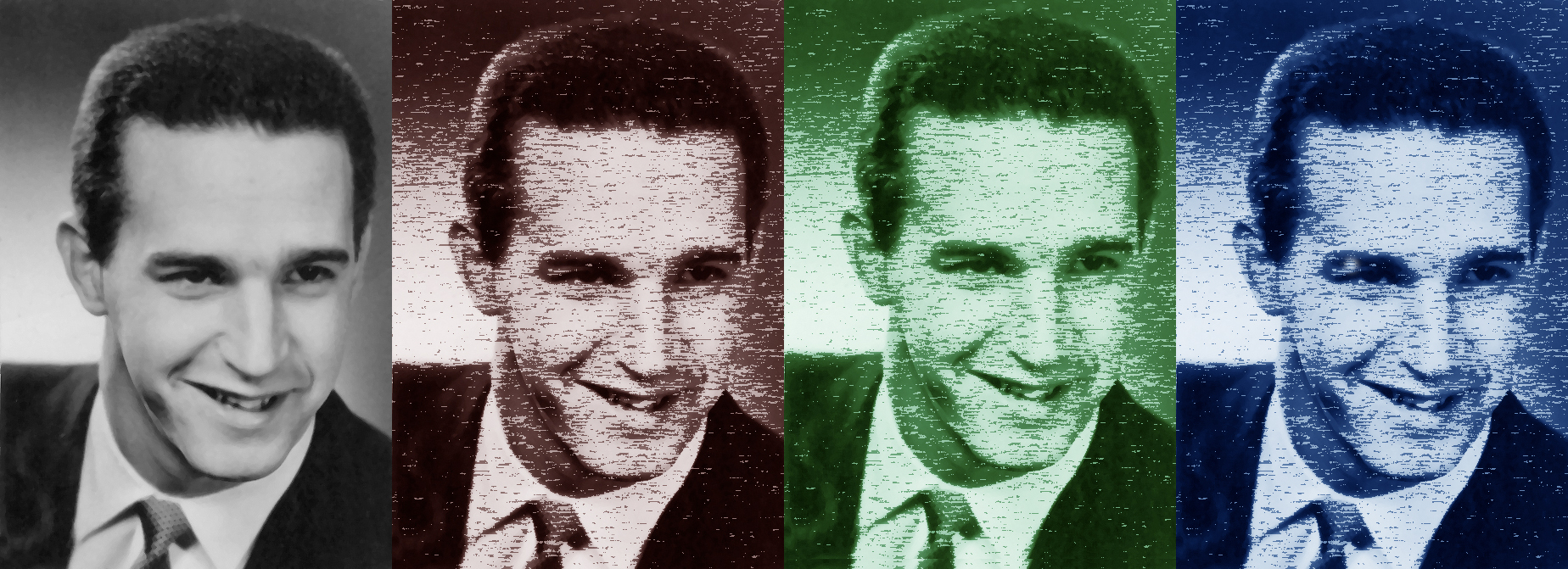
Goodie #2: Do you remember the misleading photo that a Cincinnati paper had published in April 1953 identifying some jock in a West Point sweatshirt as Richard Cox? I recently learned something else that’s intriguing about that photo.
This past Halloween, I posted a write-up on a photo that had been published in the Cincinnati Times-Star FAMILY Magazine that was supposed to be Richard Cox. It’s definitely not him. In my write-up, I concluded that, by April 1953, when the Cincinnati paper published Gilson Wright’s story, the search for Cox had been called off by the U.S. Army and the FBI for over three months, and, for whatever reason, someone in the press office of the Army and/or West Point had decided to send a doctored photo of the wrong guy.


Recently, I found that the Associated Press had published the same doctored photo as early as March 1950. That seems really early.
What could it mean?
I suppose it could mean that 1) It really is Richard Cox and he was just having a bad hair day, not to mention a bizarro face day (it’s not him, so I’m ruling this one out from the get go); 2) the Cincinnati newspaper had acquired its photo from the Associated Press and just neglected to credit them (also a no, since the AP would have demanded credit, and besides, it’s just good journalistic protocol); or 3) the aforementioned press officer had sent the misleading photo to the AP sometime before March 18, 1950 (the dateline of the accompanying article), at a time when every person who was working the case in the Army’s Criminal Investigation Division, West Point Academy, and the FBI would have looked at that photo and known instantly that it was definitely NOT Richard Cox.
Here’s what’s strange about the photo: the AP wire service already had a perfectly great photo of Cox in his military uniform which they’d published shortly after he’d disappeared. The Cleveland Plain Dealer had published the AP’s accurately identified Cox photo on February 6, 1950. A month later, the AP opted to go with a more casual photo of a guy in a West Point sweatshirt who looked nothing like Richard Cox.
Goodie #3: Even though FBI Director J. Edgar Hoover had instructed his agents to call off their search for Richard Cox in January 1953, the FBI was keeping track of him well into the 1970s.
As I announced on August 30, 2024, Richard Cox, who, like Ron, was missing, had been added to the FBI’s Security Index at some point. We know this because we can see the phrase “see index” written on his FBI document from January 31, 1950. To be added to the Security Index meant that the FBI considered you somehow dangerous or a threat to national security and they were tracking your whereabouts every six months or so. That would be especially hard to do if the person had, in fact, vanished.
Recently, when I reexamined the handwriting of Richard Cox’s “see index” and I compared it to other people’s “see index” notations, I found one that looks remarkably similar to Cox’s. As it so happens, I’m quite sure that it was written by the same person who wrote the phrase on one of Charles McCullar’s documents in 1976.
Here’s Richard Cox’s:

And here’s Charles McCullar’s:

I’m aware that people often worked for 20 or 25 years with the FBI, but there’s no way that I can see the same person making nearly identical marks on documents for that length of time. People change. They move to other jobs. If he (I’m guessing it was a he) is anything like me, his handwriting would have deteriorated over time—certainly after 10 or 15 years. But the “see index” notation on Richard’s and Charles’ docs practically look as if they were written on the same day. That tells me that Richard Cox continued to hold an interest for the FBI well into the 1970s despite the fact that the FBI’s search for him had been terminated by J. Edgar Hoover in 1953.

It’s important to remember that, after 1971, the Security Index had been renamed the Administrative Index, though its purpose was pretty much the same as before: keeping tabs on the people they perceived to be subversives. I also happen to think that, except for using a lowercase i instead of the capital I above, the handwriting on Richard Cox’s and Charles McCullar’s documents look a lot like the handwriting on Ron’s and Hank Greenspun’s docs, not to mention Tom Peasner’s.
Goodie #4: I’m pretty sure I now know what the first phrase says at the bottom lefthand corner of Ron’s 5-9-73 missing person document.
During the Walking Tour Afterparty in October 2024, we played a game that involved figuring out what certain words said on Ron’s FBI document from 5-9-73. Only one person ventured some guesses (shoutout to whereaboutsstillunknown!) and during various quiet moments since that party, I’ve sat staring at those inscrutable letters, which have defiantly stared right back at me.
The phrase that I’ve finally figured out is “Not ____ matter” with four letters occupying the space between Not and matter. Whereabouts and I agreed that the last three letters are FPS, and I thought the first letter was an O, indicating an office within an agency perhaps. Now I see that it’s not an O, but an L, as in “Not LFPS matter.” At the FBI, LFPS stands for the Latent Finger Print Section, which makes sense, since the stamp that’s scribbled over on that same document is LFP. I’d mentioned on that same post that I thought it was odd that they’d send Ron’s docs to the Latent Fingerprint folks, since they had a perfectly fine set of ten prints from when Ron was fingerprinted in the second grade. So it appears that the Latent Fingerprint folks thought it was odd too.

Goodie #5: Major Hughes, the guy who fast-tracked Louis Jolyon West’s move from Lackland Air Force Base to the University of Oklahoma, was an actual guy, and not a pseudonym for Sidney Gottlieb, as I’d theorized.
In my blog post from August 2023, I discussed how Louis Jolyon West had been lamenting his situation at Lackland Air Force Base because he’d felt that his immediate boss at the base would seriously impede his work on Project Artichoke. But, according to a letter from Brigadier General H.H. Twitchell to West in September 1954, it was the problem-solving skills of a man referred to as Major Hughes who greased the wheels so that West could transition out of Lackland that December, 1 ½ years earlier than what he’d originally been obligated to.
I’d theorized that Major Hughes might have been a pseudonym for Sidney Gottlieb, since we know that Gottlieb had a fondness for pseudonyms (see Joseph Scheider, Joseph Schneider, and Sherman Grifford), but it appears I was wrong about that too.
In his book “A Terrible Mistake: The Murder of Frank Olson and the CIA’s Secret Cold War Experiments,” H.P. Albarelli, Jr., has included a whole chapter on a mysterious guy named Allan F. Hughes. As Albarelli describes, Allan Hughes was formerly with the Army Counterintelligence Corps (CIC) and was an expert in electronic surveillance and interrogation. He worked for Sidney Gottlieb’s Technical Services Staff from 1953 to 1955, and, in fact, he was one of the persons in attendance at the 1953 cabin retreat in which Frank Olson was given LSD. (The itinerary posted on the Frank Olson Project website lists A. Hughes as one of the participants.) From what I can tell, no one has said outright that “Major Hughes” is in fact “Allan F. Hughes,” or vice versa, but it does seem probable. (If you know of a website, article, podcast, or anything else that makes that claim, please let me know.) Needless to say, I’ll be looking more into Allan Hughes, as he seemed to run in the same circles as James W. McCord, who, as we’ve discussed many times on this blog, has FBI documents with the same scribbles and stamps as Ron Tammen.
If Allan F. Hughes turns out to be Major Hughes, we can state definitively that Major Hughes is not Sidney Gottlieb’s pseudonym since both men attended the cabin retreat where LSD was given to Frank Olson.
Goodie #6: I’ve learned a little more about the numbers written in the upper righthand corner of State Department and FBI documents, including someone else who received a 10.
On November 22, 2024, I blogged about the number 10 that sits in the upper righthand corner of ten pages of Ron’s FBI docs, and we discussed how another person sporting the 10 was Frank Sturgis, of CIA fame among others. Today, I’d like to share a few additional updates about the numbering system and another person who shares the number 10:
FD-217
Recently, I’ve found several documents in which the term “FD-217” is written adjacent to the number in the upper righthand corner, usually in the same handwriting. FD-217 is an FBI form and, although it has a benign-sounding title: Notification of Bureau File Number, I’m wondering if perhaps it’s the source of the number in the righthand corner. Unfortunately, I can’t find this form anywhere online, whether completed or blank. Also, I’ve found no other forms that are cited near the upper-corner numbers, so it seems important. I’ve submitted a FOIA request for this form to see if I can learn anything more about the numbering system. In the meantime, here are a few of the documents in which someone has written FD-217 near the various numbers.


A mark that Ron has in common with the redacted case
In the above report dated 8-29-74, which has a redacted title, someone’s initials (I presume) appear next to the 4 and the FD-217. Those initials look like Lei or maybe it’s a Lu with a dot over the u. It’s hard to tell. Guess who else has one of those Lei/Lu-dot things near his 10? Ron. This is the first time I’ve ever seen another one of those marks other than Ron’s.

Other documents carrying 10s
Frank Teruggi
Two FBI documents that carry 10s in the right corner are those of Frank Teruggi, a former Peace Corps volunteer and journalist who became an activist in support of Latin American revolutionaries. Teruggi was murdered by Augusto Pinochet’s military in Chile in 1973, though, in 1999, it was disclosed by the State Department that “U.S. intelligence may have played an unfortunate role.” I’ll keep looking for 10s and will let you know whenever I find more.


Goodie #7: TBA
I have a seventh goodie that I was planning on sharing with you, but I’m seeking someone’s OK first. So, stay tuned. I’ll post it separately as soon as I’m able.
[UPDATE: You can read the seventh goodie here!]
I guess that’ll do it for now. Happy Valentine’s Day, everyone!
**************************
2-15-2025
ADDENDUM:
You guys? I believe I’ve found another FBI document that has FD-217 written near the upper-corner number, which is an 8. This is an important one. The document’s subject is Marina Oswald and it’s dated July 25, 1962. That’s one month after she’d arrived in the United States with Lee and their daughter. It’s not perfectly written. The F appears to be backwards, or maybe it’s written in cursive. The left arm of the D is invisible except for a dot, and the 2 has been cut off as well. But I’m seeing FD217…are you?


Here it is blown up. See the dot in the left arm of where a capital D would be? Also, I think the two parallel horizontal lines are part of a 2 that’s been cut off.


