Hi guys. As you may recall, I mentioned in a recent post that the podcast Bizarre Butler County would be airing an upcoming episode on Ron Tammen, which was scheduled for release sometime in October. As it turns out, they’ve been experiencing technical difficulties, and likely won’t be posting that episode until December. During our July interview, I provided Taylor Powers and Sarah Kennel with some breaking news about how I think St. Clair Switzer was spending his sabbatical during the 1956-57 academic year. I was planning to release this blog post shortly after the Tammen episode had dropped so I wouldn’t be stepping on their scoop. However, Taylor and Sarah have graciously given me the green light to post it now, before the Tammen episode airs. I’ll be sure to give you the heads up as soon as it does.
So…what’s the big reveal that I’ve been sitting on since July?
It has to do with the two letters
It all starts with those two letters we’ve discussed in past posts. The letters are dated December 6, 1956, and February 8, 1957, and, even by MKULTRA standards, I’m sure they’ve raised their fair share of eyebrows over the years. In the December letter, one researcher poses a dozen questions on the topic of hypnosis to another researcher. These aren’t your typical questions that might be posed by someone interested in using hypnosis in a clinical setting to help a patient improve his or her life. These are jarringly bold questions about using hypnosis to control people, and they get more and more outrageous as they go, beginning with (1) how to produce amnesia in someone on a regular basis and (2) how to induce hypnosis in someone without their knowing it, all the way to (11) possible experiments that might be considered “too dangerous, too shocking, too ‘unusual’ for routine testing” and, finally, (12) how to hypnotize someone by force. Ostensibly, nothing was out-of-bounds. Everything was on the table.
In the February letter, the writer thanks the recipient for his responses to those jarringly bold questions, which, sadly, aren’t included within the MKULTRA documents that have been released to the public. He is also hoping to schedule some additional time with the recipient. In both letters, the writer cautions the recipient to destroy the letters on his end because the topics are “most sensitive and are very highly classified” (letter 1) and “highly sensitive” (letter 2). Fortunately for us, someone decided against destroying the two letters on the writer’s end of things; otherwise we wouldn’t have the evidence that I’m about to present.
But first, I’d like to take this moment to express my gratitude to the CIA for allowing us to see in letter 1 that the recipient was a professor at Rutgers University and in letter 2 that he suffered from arthritis, thus enabling us to claim with 100 percent certainty that the recipient was Griffith Wynne Williams, an esteemed psychology professor and prolific hypnosis researcher. (The Rutgers info is an obvious giveaway, and I’d learned about Williams’ health condition from someone who knew him.) See how good it feels to embrace transparency in government, CIA? Let this be an inspiration for you to continue down this path!
If, on the other hand, those two tidbits of PII were left uncovered as a mistake, well…words can’t express the joy one feels when an agency that considers itself untouchable stumbles a little. God Bless Human Error!
I’m also convinced that the letter writer is St. Clair Switzer. I believe this because:
A) Switzer had known Griffith Williams during his days working under Clark Hull at the University of Wisconsin, when Williams was a doctoral candidate and Switzer was a master’s student.
Something Switzer was known to do while he was a professor at Miami was to ask for occasional assists from the superstar psychologists he’d met during his days with Hull. These included M.A. (Gus) Wenger (no relation), E.R. (Jack) Hilgard (also no relation), and Hull himself (if we were related, I would’ve told you that a long time ago). It makes total sense that Switzer would ask Williams for guidance about some uncomfortable, dare I say unethical, questions regarding hypnosis, now that Williams had become renowned in the field. I mean…he couldn’t exactly go to a total stranger with those sorts of questions, could he?
B) The letters contain telltale Hull-isms.
One example is his use of the opening “My Dear” in letter #1 when addressing his colleague, which is pure Clark Hull.
The opening to the December 6, 1956, letter to Griffith Williams sounds a lot like Clark Hull; click on image for a closer view
That’s how Hull began every single letter to Drs. Switzer and Patten, whether typed or handwritten, and probably to everyone else he knew, including Williams.
Here are just several of Hull’s “My dears” over the years. I have many more examples on my laptop.
Switzer had been known to use that opening as well, inspired, no doubt, by his graduate school adviser. In 1930, after earning his master’s degree under Hull, he used it in a saccharine letter to Alfred H. Upham, then-president of Miami University.
St. Clair Switzer’s awkward attempt at prose in a letter to President Upham. “Neither tongue nor checkbook…” may be one of my favorite cringe phrases ever. Click on image for a closer view.
I think Switzer must have decided against using “My Dear” in letter #2 because it would have been too over-the-top for this purpose. I mean, good Lord, we’re talking about MKULTRA here. A little gentility is fine, but a double dose would have been too weird.
Another example is the writer’s use of the term “Ph.D. thesis” instead of “dissertation” in the paragraph following the jarringly bold questions. This was also a practice favored by Hull.
This phrase found in the December 6, 1956, letter to Griffith Williams sounds a lot like Clark Hull and also St. Clair Switzer; click on image for a closer view
Although the usage is correct according to Merriam Webster, the conventional practice is to call a person’s culminating research a thesis when they’re pursuing a master’s degree and to reserve the word dissertation for the Ph.D. That’s how most people talk, at least. I’ve found that users of the word thesis when applied to the doctoral degree are generally academics who probably have a Ph.D. themselves—including Drs. Switzer and Hull. Here are highlighted examples from both men.
Clark Hull refers to a “doctor’s thesis” in a letter to Switzer; click on image for a closer view.In this letter to Switzer, Clark Hull refers to a thesis three times. Two are in reference to a doctoral thesis, while one is in reference to Switzer’s master’s thesis after it had been published. Click on image for a closer view.This is the second page of a letter from St. Clair Switzer to Jack Hilgard. He mixes it up a little, first referring to people hurrying to get their doctoral thesis in on time. He later refers to the final chapter of his dissertation.In another letter to Jack Hilgard, Switzer discusses research that he plans to reference in his doctoral thesis. Click on image for a closer view.
I can’t help but think that, four years after Hull’s death, Switzer was trying to woo Williams with a little nostalgia for their former mentor’s endearing idiosyncrasies. It’s as if he’s saying: “Don’t worry too much about my newfound interest in controlling large groups of people by surreptitiously hypnotizing them. I’m the same old lovable Doc.”
C) The timing couldn’t be better.
Switzer was on a sabbatical from the fall of 1956 through May or June of 1957, a timeframe within which the two letters originate. Because the writer was a professor (per the “Ph.D. thesis” reference), there’d be no other time that someone in academia could commit to helping a major researcher with their “very highly classified” research than while they were on sabbatical. Otherwise, he’d be too busy with his own research, not to mention courses, office hours, faculty committees, and other demands related to the “teaching straight-jacket” that Switzer referred to in a letter to Gus Wenger (still no relation) when he’d begun making plans for his sabbatical. Those plans ultimately fell through, thus freeing up Switzer to work with someone else.
Was it Jolly? Was it George?
As you probably know, I’ve struggled with the identity of the person whom I believe Switzer was assisting regarding the very highly classified research that year. In my first post on the subject of Switzer’s sabbatical, I suggested that he was working with Louis Jolyon West, who by then was at the University of Oklahoma. At the youthful age of 32, West was becoming one of the foremost heavy hitters doing Artichoke and MKULTRA research at that time. And this is an important point: he was already doing it. He already was working on very highly classified research. In March 1955, he’d begun his infamous MKULTRA research project known as Subproject 43, Psychophysiological Studies of Hypnosis and Suggestibility. According to Colin A. Ross, M.D., he was given Top Secret clearance for this work. In February 1956, he’d submitted a proposal for a continuation of that research. Although the CIA records don’t indicate it, I’m fairly sure he received the money. I feel this way based on notes that had been scribbled in response to the CIA’s receipt of West’s proposal.
Front page of notes on Jolly West’s proposal for an extension to Subproject 43; click on image for a closer view.Back page of notes on Jolly West’s proposal for an extension to Subproject 43; click on image for a closer view
Here’s one of the more telling excerpts on the back page:
To me—The budget is out of line for what we have in mind, namely, testing effects and influences of certain drugs on hypnotizability.
In fairness to [REDACTED], all this should be gone over thoroughly with him—in detail. Will do within next 2-3 wks.
At the top of page one is the following sloppy note, circled and in slightly different handwriting, signed by S.G., whom I believe to be Sidney Gottlieb.
“Feel this should be [word??] to drugs & induction of hypnosis—and scaled down accordingly—”
A close-up of Sidney Gottlieb’s comment about Jolly West’s proposal; click on image for a closer view.
Although the fifth word or words is maddeningly illegible—Is it limited to? Knocked to? Or maybe “less and keep” to?—I know what Sidney is saying. He wants Jolly West to stick to drugs and the induction of hypnosis and to scale things down, especially the budget. So it seems to me that Jolly West did receive a second year of grant money, especially since someone else was planning to go over the parameters thoroughly with him within the next 2-3 weeks.
But, OK, just for fun, let’s say that West didn’t get his extension on Subproject 43. He still had plenty of research dollars coming in for sensitive, highly classified research. On July 1, 1956, he signed a $32,800 contract between the Air Force Personnel and Training Research Center at Lackland AFB and the Oklahoma Medical Research Foundation. The contract was titled “Research Involving Psychological Reaction to Stresses Encountered in Military Captivity,” and he’d obtained a Secret clearance to conduct that research.
To the best of my knowledge, no remnants of the actual research studies he’d conducted exist online. Most notably, I can’t find a Materials and Methods section anywhere that tells us what research methods were being used on his POW subjects—not even in the contract itself, which I obtained from the UCLA Archives. Do I think that hypnosis was somehow used in conducting that research? I do! After all, that’s what interrogation research was all about—hypnosis and drugs. Even more convincingly, his Subproject 43 extension proposal discusses “a number of ways in which hypnotic suggestions can bring about states of marked psychological stress,” which was the focus of his Air Force contract.
Part 3 of Jolly’s proposal indicates that Jolly was hypnotizing POWs to create psychological stress; click on image for a closer view.
Maybe Sidney Gottlieb and his gang weren’t all that impressed with Jolly’s “psychological stress” talk in part 3 of his proposal—someone labeled it as “meaningless” on the front page of their notes—but I, for one, am happy it’s in there. I’m also happy that the CIA redactors didn’t blacken it out.
Once again, thank you, CIA! This is what democracy looks like!
Therefore, at the time the two letters were written to Griffith Williams, Louis Jolyon West was swimming in research dollars and was conducting very highly classified research having to do with hypnosis, at least on POWs, but perhaps on a broader audience as well.
But between you and me? I think he got the MKULTRA extension too.
I’m saying all of the above because of another document, this one written two days before the second letter to Williams, on February 6, 1957. The document is a proposal on developing a hypnotic messenger, and, initially, I thought it had been written by West. I thought this because a) its timing fits snugly between the two letters; b) I knew that West had an interest in developing a hypnotic courier; and c) the proposal’s author stated that he was being assisted by a man for the year—an academic who “is thoroughly familiar with hypnotism at the theoretical level”—which made sense if his assistant was on a sabbatical and which also sounded a lot like Switzer. But the proposal’s request of $10K seems below West’s going rate, and it was written in a more layperson-friendly sort of way than a West proposal.
It was after reading George H. Estabrooks’ book “Hypnotism” that I realized that Estabrooks had written the hypnotic messenger proposal. A few of the giveaways were his preference for the word hypnotism over hypnosis as well as his use of the term “hypnotic messenger” (also a favorite) and the early appearance of his most oft-repeated statistic that one in five adults can be hypnotized into a somnambulistic (deep hypnotic) state.
And that’s where things have stagnated for a while: with me feeling 99 percent sure that Switzer wrote the two letters to Griffith Williams, which means that he was potentially helping a big-deal researcher such as Louis Jolyon West on highly classified hypnosis research. However, it could also mean that he was potentially helping George Estabrooks on his hypnotic messenger project. I couldn’t determine which one it was. Or was it both? Adding to this conundrum is the fact that West was at the University of Oklahoma while Estabrooks was at Colgate University in Hamilton, NY, which logistically seems tough to pull off for a guy living in Oxford, Ohio. Estabrooks would have been closer, but Switzer did have access to Wright Patterson AFB. He could have flown to Oklahoma now and again. Likewise, West could catch a flight to Dayton if need be.
The word that gives it all away
Then, as I was preparing to tape the podcast Bizarre Butler County with Taylor and Sarah, I decided to read through those two letters one more time.
“The problem of the use of hypnosis by a public speaker or some related technique which could be used by an individual to control or influence a crowd is of considerable importance and as you have noted there is very little information along these lines anywhere. This area is particularly interesting to [REDACTED]. He told me that he will obtain [REDACTED]’s book immediately.”
“Hold on,” thought I. “Did he just say REDACTED’s book? If the REDACTED he’s referring to is the REDACTED I’m thinking it is, then that is an enormous clue!”
In February 1957, there was probably one book and only one book on hypnosis that would have been of utmost interest to a person seeking surreptitious ways to control a crowd through hypnosis. That would be George Estabrooks’ book “Hypnotism,” which, as luck would have it, was being published that very year as a new and revised edition.
My beat-up, dog-eared 1957 copy of Hypnotism, by George H. Estabrooks; click on image for a closer view
“Hypnotism” first came out in 1943 and was written in a friendly, nontechnical, plain-language sort of way. It was a huge best seller. It was even recommended reading by the Book-of-the-Month Club.
But that doesn’t mean it didn’t get into the nitty gritty of how hypnosis could potentially be used in surreptitious ways. Whereas other hypnosis researchers would write about conventional issues pertaining to hypnosis, Estabrooks went straight to the controversial. You want to hypnotize someone without their knowledge? No problem! You want to give them a posthypnotic suggestion to do something that goes against their morals? Piece of cake!
One of the more noteworthy chapters is Hypnotism in Warfare, in which he discusses the creation of the Super Spy, not unlike the hypnotic messenger he was hoping to create in the summer of 1957. Another chapter titled Hypnotism and Human Affairs gets into how dictators employ the principles of hypnosis to get crowds of people to give them their allegiance and do their bidding.
Of course, George Estabrooks covered the less controversial topics in his book as well, but he made those chapters wildly readable too. By 1957, certainly other books had been published on the topic of hypnosis. But as I told Taylor and Sarah, two books that were sure to occupy the bookshelves of most hypnosis researchers were Clark Hull’s Hypnosis and Suggestibility, published in 1933, and George Estabrooks’ Hypnotism, first published in 1943. If you needed to consult a stodgy classic textbook about what hypnosis is, scientifically speaking, or how suggestibility can be measured in a laboratory, then you turned to Hull. If you were more in the mood for a lively book that describes all the possible ways in which hypnosis can be used out in the real world—in medicine, in criminal justice, and even in war—then Estabrooks was your guy.
Because the writer of the February 8, 1957, letter says that the major hypnosis researcher with whom he’s working will be obtaining the book “immediately,” it appears that it must already be out. So the question is: when was the publication date of the newly revised version of Hypnotism? My copy only says that it was published in the year 1957. When I spoke with Taylor and Sarah, I’d found sources that said it was published on January 1, 1957. I’ve since learned that a customary practice for when the date isn’t known is to use January 1 as a placeholder.
Here’s the copyright date on my copy of Hypnotism. Click on image for a closer view.
Later, courtesy of the New York Times, I learned that the new and revised edition of Hypnotism was published on May 1, 1957. This was confirmed in a later printing of the second edition, which stated the publication date was May 1957. So we have our answer—May it was!
The new revised version of Hypnotism, by G.H. Estabrooks, was published in May 1957. Click on image for a closer view.
Granted, the major hypnosis researcher could go out and buy the book immediately, in February. However, it would be the first edition that he’d be buying, which had been out for 14 years. The most recent printing was in 1955. If he’s going to go to the trouble of buying a copy, I think he should wait till May….and I think he likely did.
One possibility is that the letter writer had some inside information about the new book that was coming out. Maybe he’d been in touch with Estabrooks and was letting Williams know about the book in an indirect way, though he got a little ahead of himself as far as when it would be available.
But that’s not what I think happened. I think that in his response to the December 1956 letter, Griffith Williams probably gave a heads up to the letter writer that Estabrooks’ new and revised book was going to be coming out soon. Williams would have been on the inside track for information like that. I don’t know if Williams and Estabrooks talked much, but news of a forthcoming book would have made its way into newsletters of their professional societies and by word of mouth at conferences. So I can see Williams telling the letter writer (likely Switzer) that Estabrooks’ book will be out soon, and Switzer erroneously jumping to the conclusion that it would be available immediately. The sentence “He told me that he will obtain [REDACTED]’s book immediately,” sounds as if they’re promising to follow up on a recommendation that Williams had made to them.
What’s especially clear to me is that the major hypnosis researcher who is conducting very highly classified research from December 1956 through February 1957 and beyond is not George Estabrooks. Therefore, I think we can surmise two things:
1) I believe the two letters involve four men: the letter writer (likely St. Clair Switzer), the letter recipient (Griffith Williams), the major hypnosis researcher (still unknown, though possibly Louis Jolyon West), and George Estabrooks, the writer of the hypnotic messenger proposal and author of the book Hypnotism.
2) The letter writer—whom I believe was St. Clair Switzer—is working with the major hypnosis researcher. He might be helping Estabrooks too, since Estabrooks’ hypnotic messenger proposal fits within Switzer’s sabbatical and also was dated within two days of the second letter. But if we have to choose between the two researchers, I believe that St. Clair Switzer was working with the researcher with boatloads of funding and Secret or Top Secret clearance—the one who also had lots of questions about how far they could take hypnosis experimentation, no matter how dangerous, shocking, or unusual.
Well, hello! Lately, I’ve been doing some behind-the-scenes work on the Ron Tammen case, and haven’t had much time to think up, let alone write, a blog post. That’s probably a good thing since I’m not really at liberty to talk about most of what’s going on anyway. There will come a day when I’m able to go public with what it is I’ve been doing, but alas, today’s not that day.
Still, I’ve recently made a few discoveries that I am able to divulge, two of which I’ll be divulging now. They have to do with the years 1956 and 1957, when St. Clair Switzer took time off from his professorship at Miami University to go on a sabbatical. I’m intensely interested in this period because I’m trying to figure out what he was doing during that sabbatical and who he was doing it with.
The two discoveries are as follows:
1) We were right! The ARTICHOKE researcher whose personality was so off-putting to Air Force brass that he was required to work through a hand-picked liaison to the Surgeon General was Louis Jolyon West!
Back in September 2023, I posted about how it appeared that a young Louis Jolyon West had a personality that didn’t exactly mesh with buttoned-down military types, even though he himself was a major in the U.S. Air Force’s Medical Corps. In a memo dated July 24, 1953, Morse Allen, who was chief of the Technical Branch in the CIA’s Office of Security, was describing how a promising ARTICHOKE researcher whose name was redacted had elicited several red flags during a recent full-field investigation. Allen reported to his boss that, sure, the guy was “‘talkative,’ somewhat ‘unconventional’ and a ‘champion of the underdog’ but, according to all informants, he does not discuss classified information and can be trusted with Top Secret matters.” (I have a question though: what were those aforementioned informants doing chit-chatting about classified intel with this young researcher before he had clearance? Sounds to me as if they’re the ones who couldn’t be trusted with Top Secret information, ya’ know?)
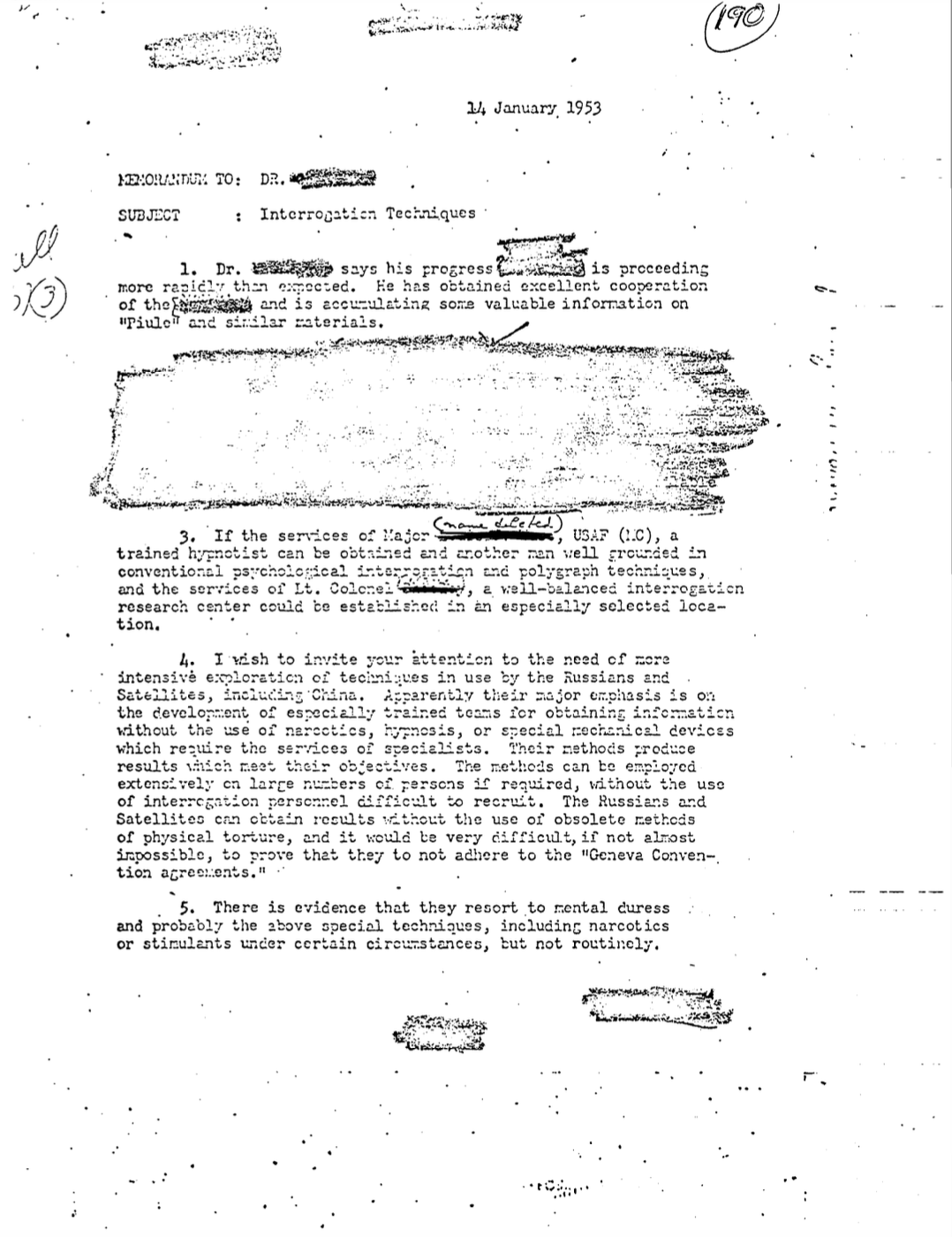
Later in that post, I shared a CIA memorandum written months earlier, on September 23, 1952. In that memo, whose author’s name is redacted, two individuals were being discussed, one of whom had a “propensity to talk.” The other was described as having “nothing to contribute in the line of research,” however it appears that he had redeeming qualities too. When addressing how to ameliorate their talker problem, the author stated that “I could assure Col. REDACTED that any project involving REDACTED would be coordinated with him. In accordance with the new procedures for handling ARTICHOKE, OTS [Office of Technical Service] will be obligated to check with OS [Office of Security] and OS would automatically check with REDACTED in view of the fact that REDACTED is a consultant of, and of primary interest to the Surgeon General.”
The memo went on to say that a colonel who’d spoken with a representative of the Office of the Surgeon General had called to say that the new protocol successfully allayed their concerns. What’s more, the representative “had advised him that he thinks very highly of REDACTED and that it will be essential to keep him cut into the picture.”
In that post, I hypothesized that the talker was Jolly West and the Surgeon General’s proposed liaison who was to be “cut into the picture” was St. Clair Switzer. I pointed to the words “air research” that had been written above the liaison’s name as supporting evidence, since Switzer had worked in the Air Research and Development Command in Baltimore in the summer of 1951.
Click on image for a closer view.
In another post, I zoomed in on the scratched out name of the proposed liaison, which clearly started with the letter S and had roughly the same number of letters as Switzer. Here, I’ll show you again:
Click on image for a closer view.
The Surgeon General at that time was Harry G. Armstrong, who had close ties to Wright Patterson AFB, which is how I think he’d come to know and trust Lt. Col. Switzer. But again, this was all just a hypothesis.
Two years have gone by since I made those bold assertions, and so far, they’ve been sitting quietly on my blogsite with barely a mention from anyone. (It’s fine. I’m fine.) Today, I’m presenting supporting evidence that Jolly West indeed had to work through a liaison with the Surgeon General’s Office, even though the new evidence is a document from 1956, three and a half years after the September 1952 memo, when Harry G. Armstrong was no longer the Surgeon General.
My new evidence is Jolly West’s proposal for a second year of funding for his now infamous MKULTRA Subproject 43, Psychophysiological Studies of Hypnosis and Suggestibility. His cover letter was addressed to SG—Sidney Gottlieb—who, as head of the Chemical Division of the Office of Technical Service, had been put in charge of MKULTRA. Near the end of the letter, West mentions work he’d been doing for the Air Force and says that he may be traveling to Washington, D.C., very soon. “REDACTED will know about it before I will; if you want to see me, get in touch with him and find out whether the Surgeon General is going to be calling me up there next week.”
Thanks to MuckRock for making this document available. Click on image for a closer view.
Interesting, isn’t it? By that time, Louis Jolyon West was chair of the Department of Psychiatry, Neurology and Behavioral Sciences at the University of Oklahoma School of Medicine; he’d just completed his first year overseeing his major MKULTRA subproject (which was considered admirable back then); and he was in charge of a project requested by USAF Headquarters to develop recommendations on “training for survival and resistance to interrogation” (also impressive). Still, apparently, there were channels he was expected to go through, and he needed to wait for someone else to tell him if the Surgeon General wanted to see him or not.
And so, there we have it. In February 1956, a few months before Switzer’s sabbatical began, the system that had been worked out in 1952 was ostensibly still in place. West would communicate with Gottlieb’s Office of Technical Service. Gottlieb would consult with someone presumably from the CIA’s Office of Security, who would touch base with a contact sanctioned by the Surgeon General’s Office as to whether the Surgeon General would be summoning Jolly West for a sit-down. Granted, this is just one-half of my hypothesis. We still don’t know if St. Clair Switzer was the other half, though, if he was in 1952, I’m thinking he wasn’t in 1956. (I’ll tell you why in a second.) But any amount of corroboration is good corroboration and I think worth mentioning.
2) I have more proof that St. Clair Switzer was an employee of the CIA!
What was perplexing to me was the letter “A” next to the writer’s redacted name. In the 2022 post, I’d attempted to crack the CIA’s code of letters and numbers written on MKULTRA documents and concluded that A stood for Agency, since people who were known CIA employees consistently had an A by their name, whether their name happened to be redacted or not. The letter C, which is next to Williams’ redacted name, stood for consultant, I’d deduced.
If you’d like to see what I mean, here are a couple examples of memos in which known CIA officials Morse Allen and R.L. Bannerman have As by their names as opposed to the Cs, which are next to blackened names of people with whom they were consulting:
Sample 1
Document provided thanks to TheBlackVault.com; click on image for a closer view
Sample 2
Document provided thanks to TheBlackVault.com; click on image for a closer viewDocument provided thanks to TheBlackVault.com; click on image for a closer view
And so…because I was 99.9 percent positive (and still am) that the two letters were written by Doc Switzer and because the letter writer had an A next to his name, then logic would dictate that Switzer was an Agency insider.
And there that blog post sat for three years with nary a peep from anyone. (Again, it’s fine. I’ve come to terms with the fact that people have interests outside of Ron Tammen. I don’t understand it, but I’ve come to terms with it.) Incidentally, this is also why I don’t think Switzer was the Surgeon General’s liaison in 1956. In Jolly West’s cover letter for his MKULTRA proposal, the person who is supposedly the Surgeon General’s liaison has a C next to his name. Note that Jolly West also has a C next to his name.
Aaannnnnyyyway…remember the hypnosis expert I recently wrote about who liked to use the word “injunction” when he described giving a hypnotic subject a basic command like “relax” or “go to sleep”? Until I came across that person’s missives, I’d only seen the word injunction used to describe an order that was handed down in a court of law by a judge or magistrate. To date, I’ve found no other hypnosis experts during that time period or any time period who have ever used the word injunction when describing that part of the hypnotic process. And trust me, I’ve looked. In fact, I’ve never come across anyone who has used that word in that way at all.
Nevertheless, I found this very rare usage of the word injunction in three Project ARTICHOKE documents. It first appears in a write-up dated March 28, 1952, three days after St. Clair Switzer’s name (I’m 100% positive) was proposed by Morse Allen as a possible consultant for ARTICHOKE. Griffith Williams was another suggested name (I’m quite sure).
Then, in October 1955 and February 1956, several months before Switzer’s sabbatical, the word popped up several times in two reports discussing the covert, or disguised, induction of hypnosis. Based on my inability to find any other hypnosis expert occupying the planet at the time who used that word in that way, I hypothesized that all three documents had been written by the same person.
But here’s what’s intriguing about that hypothesis: the author of the March 1952 write-up was clueless about Project ARTICHOKE. He’d ostensibly been given a few broadbrush details about what they were looking to do in the area of hypnosis and the collection of information from an enemy and he did a little brainstorming. He then hand-delivered a write-up of his ideas to someone whose office was within driving distance who obviously did know about the program, even though they ostensibly weren’t with the CIA. According to their cover letter dated October 1, 1952 (Happy Anniversary, by the way!) to the official now in charge of ARTICHOKE, injunction guy was still very much in the dark. For these reasons, I think we can state with 100 percent certainty that the March 1952 writer was not an Agency insider.
Do you know who was an Agency insider? The person who wrote the February 1956 report. He had an A next to his name.
I still think that the three documents were written by the same person. However, my theory has evolved and branched out. I now think that, sometime between 1952 and 1956, injunction guy was hired by the CIA—not unlike the person who wrote the two letters to Griffith Williams during the 1956-57 academic year, whom I also believe was CIA.
This could be evidence that we’re talking about one person and one person only, St. Clair Switzer.
Wouldn’t it be so great if, despite everything that the CIA has done to try to withhold the identities of its long-dead ARTICHOKE and MKULTRA actors, what with its over-the-top use of redactions and the deceptive games it likes to play with the American people, pretending to comply with FOIA and all…wouldn’t it be great if the singular feature that would help us identify one of its own would be someone’s inflated ego? I can just picture him then, seated at his typewriter, marveling at his importance, striving to impress. How could he, someone who viewed himself a writer, have known that his instinct to use a fancy word that no one ever uses in that context instead of a more typical word that would enable him to blend in would ultimately lead to his unmasking? I’d call that poetic justice.
Coming later this month, another interesting discovery about Switzer’s sabbatical
This past July, I was interviewed again by Miami Student journalists Taylor Powers and Sarah Kennel for their podcast Bizarre Butler County. In that discussion, the three of us talked more about the Tammen mystery, and I provided a little breaking news that I hadn’t shared with anyone. I still haven’t shared it with anyone.
I’ll give you a hint: It has to do with Doc Switzer’s sabbatical and a small clue regarding who he may have been working with. Because I like to honor the breaking news that I provide to fellow journalists, I won’t be breaking it here. You’ll need to wait until that podcast episode, which I’ve been told is going to air later this month. I’ll let you know the date as soon as I know. I’ll also write up a blog post with supporting documentation to accompany that episode after it drops.
Today we’re going to talk about the word injunction. Whenever I stumble upon the word, I think of a legal order, handed down by a court of law, telling someone that they need to do something or to stop doing something. In fact, it’s often used alongside the word court, as in a court injunction. Wikipedia has a very nice write-up on the word injunction, which you are welcome to read at your leisure.
But our friend Merriam Webster has provided a second meaning for the word injunction, as if we needed one. And that meaning is: an order or admonition.
P.S. Of any kind.
P.P.S. No court of law required. Just, you know…someone gives you an injunction to do something (or to not do something) and you do it (or not). The thing is: No one uses it this way.
No, seriously, I’ve been living on earth for a while now, and I’ve even been in the presence of some very smart people with very large vocabularies, and not a soul has ever used the word injunction in this way when I was with them.
Like have you ever heard a kid say: “My dad gave me an injunction last night to do my homework or else.”
Or has your boss ever said: “I need you to have the report on my desk by the end of the week. That’s an injunction.”
Or, after visiting the dentist, have you ever told someone, “The appointment went fine, except she kept giving me injunctions to open my mouth wider.”
Exactly. No one talks that way. That would be weird.
Except, there once was a person who did use the word injunction in this way…sometimes repeatedly.
This person was a hypnosis expert in the 1950s, when the federal government was on the prowl for as many hypnosis experts as it could find. Even though I’ve found no other hypnosis experts of that time period (or ever) who used the word injunction to describe a hypnotic instruction, command, or suggestion, it was this person’s go-to. For example:
“…a man might be given hypnotically (with injunction to ‘forget’ the incident) a strong compulsion to keep a secret diary.”
Or
“Injunctions to forget the hypnotic indoctrination might be tried.”
OR
“Injunction to accept subsequent non-hypnotic instructions from an ‘agent’ might be tried out.”
Those three injunctions were found on page one of a two-page write-up dated March 28, 1952, on how hypnosis might be used to gather intelligence from an enemy. While most hypnosis experts were never tempted to use the word even once in that way throughout their careers, he or she (Who am I kidding? It’s the CIA in the early ‘50s—I’m pretty sure it’s a he) found reason to use it three times in one two-pager.
Click on image for a closer view
We’ll talk more about this write-up shortly, because I find its timing to be noteworthy in addition to the route it took to reach the people in charge of Project Artichoke.
But right now, let’s jump to 1955…October 25, 1955, to be exact. On this date, an expert in hypnosis is writing a summary on the various ways in which the CIA could induce a hypnotic trance within a subject without their knowing it—what he refers to as disguised induction. In the memo, he discusses using such methods as anxiety-reducing drugs as well as medical instruments that serve as an object of fascination for the subject while providing an excuse for an operator to encourage the subject to relax without raising suspicion. Among the medical instruments he mentioned were an electrocardiograph (EKG), which measures electrical activity of the heart, and an electroencephalograph (EEG), which measures electrical activity in the brain.
In paragraph 7, he says this about the EKG and EEG: “These machines offer a situation where the subject is in a resting condition and amenable to direction of his sensory powers at the machine (fascination) which coupled with relaxation injunctions may result in achieving hypnosis.”
Click on image for a closer view
Relaxation injunctions? Could this be the same guy as the one on March 28, 1952?
Four months later, on February 28, 1956, someone is writing an interim report titled Hypnosis and Covert Operations. Disguised induction of hypnosis is still the end game. Among other techniques, the report leads with the use of the polygraph as a disguised pretest of someone’s hypnotic susceptibility, as well as a way to measure a person’s physiological changes as they are entering and exiting a hypnotic trance.
In paragraph 6, which discusses a far riskier technique involving a subject’s carotid arteries, the author says this: “It is possible to combine a stern injunction of ‘sleep!’ with carotid pressure to obtain hypnosis…,” before cautioning the reader about how dangerous the method is, how it requires a lot of practice and perfect timing, and in no way could it be considered a disguised induction of hypnosis. I mean, good grief, he’s got his hands around the subject’s neck!
Click on image for a closer view
In the very next paragraph, he’s back to describing medical instruments, and is singing the praises of a BMR machine, which measures basal metabolic rate. In addition to diverting the subject’s attention and helping them to relax, “the BMR has the added advantage of control of inspired air. Breathed through a mask (which is the measuring device), the amount of oxygen and carbon dioxide inhaled can be controlled. With the oxygen decreased, the subject is rendered more susceptible to hypnosis. This can be coupled with injunctions to ‘relax,’ ‘go to sleep if you like,’ ‘sleep,’ [sic] so that induction might be accomplished.”
Click on image for a closer view
I don’t know about you, but I generally don’t permit just anyone to control my oxygen intake, especially if someone with the CIA happens to be in the room. But hey, we’ve found one more “relax” injunction and three “sleep” injunctions, so that’s good news. Also, is it me, or is this guy beginning to sound as if he’s trying to make the word “injunction” catch on? Despite his efforts, I haven’t seen any evidence that it did.
I know what you’re thinking. You’re thinking: sure, it’s weird that the word keeps popping up from time to time, and it does appear that the writer in October 1955 and February 1956 is the same person, since he’s writing about the same topic. But how can we be sure that it’s the same person as the writer of the two-pager of March 1952? And if it is the same person, how can we figure out who the person is?
Two great questions. I suggest we address them backwards. First, I’m going to tell you who I think it is, and then I’m going to tell you why.
I think it’s St. Clair Switzer. (But I think you already knew that.)
My reason has to do with three clues:
Clue #1: The number/letter combo in the top right of the October 1955 and February 1956 memos
As we’ve discussed in the past, many, but not all, of the CIA’s MKULTRA documents that were released to the public have a combination of numbers and letters in the top right corner. Here’s an example:
Click on image for a closer view
Here’s another one:
Click on image for a closer view
The series starts with an A/B, which, according to Colin Ross, M.D., stands for Artichoke/Bluebird. Then, there’s a single number, often written as a Roman numeral, which I believe represents a major grouping. The range for these numbers is I (1) through VII (7). Then there are two numbers separated by either a comma or a slash. The first of the two numbers is a smaller category within the large grouping, while the second represents a document’s number in a series within that category.
The October 1955 memo has the following number/letter combo: III, 6/15
Click on image to link to the full document
The February 1956 memo has the following number/letter combo: III, 6/19
Click on image to link to the full document
Picture it like this: Think of a file cabinet with seven drawers. The III group occupies the third file drawer, and within the III drawer are (from my count) seven file folders. Each file folder within the III drawer contains a stack of documents, which vary in number. The thickest stack is in folder #2. It contains at least 135 documents. Within the #6 folder is a much smaller stack, numbered from 1 to 19, though several documents are missing. The October 1955 memo and the February 1956 memo both occupy the III file drawer in the #6 folder.
Do you know what other record occupies the III file drawer in the #6 folder? The March 25, 1952, memo in which Morse Allen tells Cmdr. Robert J. Williams that he’s spoken with legendary hypnosis expert Clark Hull, and Hull suggested that they contact his two prized former assistants, namely St. Clair Switzer and Griffith W. Williams. (The names are redacted, but I’m positive of this.)
Click on image to link to the full document
The number at the top of the March 25, 1952, memo is III, 6/9. In other words, whoever did the numbering decided that the three memos have something in common and should be categorized accordingly. Note that I don’t think all of the memos in the #6 folder involved St. Clair Switzer, but I believe these three memos do.
Clue #2: The date of the March 28, 1952, two-pager
Three days after St. Clair Switzer and Griffith Williams were identified as individuals to be contacted for Project Artichoke, someone typed up the two-pager about possible ways to use hypnosis to obtain information from the enemy. What’s intriguing about this write-up, other than its over-the-top usage of the word injunction, is that it’s forwarded to someone at the CIA by way of a memo written by a third party. The cover memo is dated roughly six months later. We’ll get to that memo in a second.
Because Morse Allen wasn’t the type to sit around and wait, I think that he or perhaps another official reached out to both Switzer and Williams on or around March 25 (a Tuesday). By March 28 (a Friday), someone—it seems logical to infer that it would’ve been one of those two men—had typed up the document after giving the matter some serious thought. Based on what I know about Doc Switzer, my money is on him. He would have treated a phone call from Morse Allen or another official as an assignment to be handled with utmost urgency. (An injunction, if you will!) I’ve seen his response time in other situations—he could turn around a lengthy request from a person in a high place within a day. What the two-pager’s author did next offers up another important clue to his identity.
Clue #3: The date of the cover memo introducing the March 28, 1952, two-pager
Whoever wrote the two-pager had hand delivered it to someone who was in-the-know about Project Artichoke. Strangely, the cover memo is dated 1 October 1952, which seems like a long time for that entity to be sitting on something that the CIA and military were clearly interested in.
Here’s a copy of the cover memo:
Click on image to link to the full document
It’s short, so I’m going to write it up here as well.
Memorandum for: [REDACTED]
Subject: Matter Possibly Related to Project ARTICHOKE
1. Attached hereto is a memorandum delivered to this office by [REDACTED]. This was one of a number of operational suggestions that Mr. [REDACTED] brought to this office which he understood was interested in new ideas. He has no knowledge of Project ARTICHOKE and has been informed that his suggestion has been forwarded to the interested office.
2. The memorandum is being forwarded to you since it is understood that your office has assumed overall direction of Project ARTICHOKE and the matter appears to be related to some aspects of Project ARTICHOKE.
Who I think wrote the cover memo
Unfortunately, the writer and their workplace are both redacted, but I still think I know its origin. I believe the cover memo writer was someone on a military base. Think about it: the only insiders regarding Project Artichoke were a select group of people within the CIA and the military, and no one would dare pull a pop-in at the CIA.
As for which military base, I think I know that too. We discussed above that the two most likely authors were either St. Clair Switzer or Griffith W. Williams. And of those two men, the only one who had an association with a military base was St. Clair Switzer.
Therefore, I think the origin of the cover letter was someone at Wright-Patterson AFB—most likely the Wright Air Development Center’s (WADC’s) Aero Medical Laboratory, where Switzer was well known. The person who called him on or around March 25 likely gave a broad description of the kinds of questions that they were seeking answers to, but they wouldn’t have given him the full details of the program—not yet. They certainly hadn’t disclosed the name Artichoke. They were probably assessing his interest and availability regarding a classified project having to do with hypnosis, and he wanted to show them just how interested and available he was.
Why I think it was so late
So why would someone at Wright Patt wait until October 1 to forward Switzer’s memo to the officials overseeing Project Artichoke?
I can think of two reasons. First, on September 30, 1952—the day before the cover memo was written—Project Artichoke was officially transferred from the Office of Scientific Intelligence to the Inspection and Security Office (I&SO), where Morse Allen was employed, with research support from the Office of Technical Services and Medical Sciences staff. (They’d been discussing this transfer for months, but this appears to be the final word.) The changeover involved a major reorganization in which duties were transferred from one person to another and copious files were handed over as well. To forward a memo on the first day of Artichoke’s new management structure doesn’t seem late at all. In fact, it seems really on the ball.
Click on image to link to the full document
Second, a memo that was probably fresh in their brains, dated September 23, 1952, may have also played a role. In the last paragraph, it was mentioned that the Surgeon General of the Air Force—a man named General Harry G. Armstrong—had requested that someone be “cut into the picture” for Project Artichoke. Of course, that person’s name was redacted, but in my September 19, 2023 post, I go deep into why I think Switzer was the person named in that memo. Namely, Armstrong had strong ties to Wright Patterson Air Force Base, so they shared that connection. What’s more, Switzer had been stationed for a portion of the previous summer at the Air Research and Development Command (ARDC) in Baltimore, which oversaw the Wright Air Development Center. I think that carried a lot of weight, since someone had handwritten “air research” above the person’s redacted name.
My theory is: the people at Wright-Patterson AFB probably hadn’t waited six months to send the two-pager to the CIA. They’d likely forwarded it in March 1952 to someone at OSI. However, when Project Artichoke was switched over to I&SO’s purview, someone at Wright Patt probably thought it wouldn’t hurt to forward the two-pager to them as well, especially now that they knew that the Office of the Surgeon General would approve.
If I’m correct that St. Clair Switzer had written the injunction memos of 1952, 1955, and 1956, you can be sure that this will open up new areas of study. It also confirms one guess I’d made a long time ago concerning two other documents that I believe Switzer wrote. But we’ll save that discussion for another day.
Any thoughts? Have you ever used the word injunction in this way before? If not, try it out on your friends, coworkers, and anyone else you know and tell us about it!
Many thanks to The Black Vault for making these documents accessible.
It’s April 19, 2024—71 years since Ronald Tammen disappeared from Miami University—and it’s wonderful to see you again. I’m truly honored that you’ve made a point to stop by this website on this day to see if there are any updates concerning the story of Ronald Tammen. It’s taken us seven years to develop the level of trust we have going on here and I will do my best not to disappoint.
And we do have updates.
Today’s topic has to do with an elephant that’s been occupying the room since this time last year, when I broke the news that, shortly before he disappeared, Ronald Tammen had cashed a check written on Oxford National Bank by a woman named Dorothy Craig, a long-time employee at Champion Paper and Fibre Company, in Hamilton, Ohio. My theory was, and still is, that someone from Champion—quite possibly its President Reuben B. Robertson, Jr.—had helped fund the work of St. Clair Switzer in Miami’s Department of Psychology and had assigned check-writing duties to Dorothy.
But, as I say, there’s a ginormous question wafting in the breeze that’s in need of some attention. It concerns how a person who’d been politely described by one colleague as “somewhat brusque”; another colleague as “difficult,” “very private,” “very military,” and “not overly friendly,”; and another colleague as “not one of everybody’s favorites” would have intersected with the warm, gracious, and perpetually personable Reuben Robertson, Jr., whose principal interest was papermaking and whose office was 11 or so miles from Oxford on North B Street in Hamilton.
No, I’m serious—how did the paths of these two total opposites cross?
Doc Switzer’s life consisted mainly of his faculty position at the university as well as periodic stints with the Air Force Reserves. Otherwise, as far as I can tell, he didn’t socialize much. He wasn’t a member of any men’s groups like the Kiwanis Club or the Rotary Club or the Y. He didn’t seem to have outside hobbies, such as woodworking or photography, nor did he engage in sports like bowling or tennis. He didn’t mentor young children or some other noble cause that would put him in touch with fellow members of his community.
When he was an undergraduate at Miami, St. Clair Switzer had joined a fraternity, Sigma Alpha Epsilon, and according to a bio written after he died, he served for a time as president. Letters he wrote to mentors and fellow grad students during his young and hungry years sound perfectly congenial. He even had a sense of humor. But people change as they grow older. Some people mellow. Others become full of themselves. Still others, resentful. I think Doc had developed into a toxic blend of the latter two by the time he reached 50, when Ron was a student at Miami.
Doc Switzer wasn’t a chit chatter. He didn’t confide. One of his students said he gave off impatient vibes when she stepped into his office seeking advice. Maybe I’m being too harsh, but I can’t exactly picture him smiling at a stranger on the street or taking a quick break from whatever he was doing to pat a dog on the head. Switzer’s social interactions consisted mainly of the everyday maneuverings of work, whether in Old Main (aka the old Harrison Hall), where the psychology department was located, or on some military base. At the university, he attended departmental meetings, he served on committees, and he taught. While doing so, he tended to make lower-level people feel smaller while kowtowing to the bigwigs.
But despite Doc’s deference to people in power, I can’t envision him picking up a phone and cold-calling Reuben Robertson, Jr., to see if he might be willing to support a government project involving Ron Tammen. He was more of a letter writer than a cold caller, and this wasn’t the sort of ask that could be put into writing. Plus, how would he have known that Reuben Robertson might be a good fit?
No, in order for Doc Switzer to come into contact with Reuben B. Robertson, Jr., or one of the top-tier managers at Champion Paper, I’m inclined to think that it would’ve happened in a manner that was more organic and less, um…weird. Put simply, I think someone probably served as a go-between.
But who? For starters, I think the middleperson would have to be someone who did get out into the community. They’d be someone who genuinely liked people and enjoyed reaching out to a fellow human and getting to know them. In addition to their general outgoing nature, I can think of three primary criteria for this person: 1) I think they’d have to be familiar with Doc Switzer or at least have a warm spot in their heart for Miami’s psychology department; 2) It would be helpful if they served in the military—WWII ideally—with bonus points if they had connections at the tip top levels of national security or intelligence or even the White House; and 3) Most of all, I think they’d have to be on a first-name basis with one or more officials at Champion Paper and Fibre.
I can think of two such individuals.
Before we continue, I’d like to state unequivocally that the two people I’m about to name, now deceased, were well known and highly respected in their fields. Also, we don’t know for sure whether one of these persons stepped in as a middleperson between St. Clair Switzer and Champion Paper and Fibre. We only know that, given their visibility and business connections, it’s possible that one of them was involved. Also, if either of them did provide a personal link between Switzer and Champion Paper, they would have believed they were doing so in service to the U.S. government, as their patriotic duty. Plus, there’s no law against it.
And so, here we go: let’s talk about the two common denominators who had the means and wherewithal to help Doc Switzer get from Point A, a prickly psychology professor in need of funding for a secret government project involving Ronald Tammen, to Point B, or, rather, North B Street, in the Office of the President at Champion Paper and Fibre.
The two people we’ll be discussing today are John F. Mee and John E. Dolibois (pronounced DOLL-uh-boy], both of whom were esteemed alumni of Miami University. Interestingly, both men also happened to be psychology majors when St. Clair Switzer was a member of the faculty.
Note that we’ll be primarily focusing on the period of time leading up to 1953, when Dorothy Craig wrote a check to Ron Tammen. To learn more about each man’s life, both of which were full and fascinating, I’ve provided links to their university bios below their background write-ups.
First, a little background on John F. Mee and John E. Dolibois:
John Frederick Mee
John F. Meewas born on July 10, 1908. He grew up on a farm in Darrtown, Ohio, a rural community about 5 miles outside of Oxford. His family was wealthy, thanks in large part to Mee’s grandfather and namesake, who raised stock (cattle and such) and was good with money. But just as money has never solved everything, it managed to instill some father-son tension between Mee and his dad. Mee’s father, R. Kirk Mee I, was a cowboy-hat-wearing character who enjoyed rubbing elbows with politicians great and small. (He looked almost exactly like Boss Hogg from the Dukes of Hazzard, which is kind of amazing since he predated that show by more than three decades.) FDR visited their house when Roosevelt was a nominee for vice president. Although Kirk Mee held respectable positions—he was the sergeant at arms for the Ohio Senate under two governors and he even ran for the Ohio Senate himself in 1942—his son John, perhaps unfairly, felt that his father lacked the drive to pursue a career in which he would generate his own wealth. He was always closer to his mother. (You can find photos of the Mee family, including R. Kirk Mee I and John F. Mee as a young man on this webpage.)
Mee was six years and one day younger than St. Clair Switzer, who was born in 1902. As an undergrad at Miami, he’d been an assistant in the psychology department’s experimental laboratory, which is how he and Switzer had gotten to know each other. They were practically contemporaries. Mee graduated from Miami in 1930, just as Switzer was completing his first year as an instructor. Thinking he wanted to be a psychology professor too, Mee went on to obtain a master’s degree in psychology at the University of Maine. He was on track to pursue a Ph.D. in psychology at Ohio State, when something fluky happened. He was visiting the campus to sign up for graduate courses, but first stopped off at the business school to say hello to someone. As it turned out, the business school professors liked him and made an offer he couldn’t refuse. He took classes while serving as placement director at Ohio State. In 1939, Mee was hired as the placement director at Indiana University’s School of Business in Bloomington as well as assistant professor of management. Strangely enough, he didn’t earn his Ph.D. from Ohio State until 20 years later, in 1959, which was…unbelievably late. (To be honest, I thought it was a typo in his bio, but I guess life had gotten in the way for him. That, plus the rules were laxer back then.) Nevertheless, it didn’t seem to tarnish his career, as you’ll soon see.
John E. Doliboiswas born on December 4, 1918, in Luxembourg, the youngest of eight children. Tragically, his mother had died of the Spanish flu shortly after his birth, so he never really knew her. Though he recalled his childhood as a happy one, the family experienced a lot of hardship. In 1931, his father decided to start a new life in the United States. John’s oldest sister had moved to the States after marrying an American soldier she’d met during WWI, and his father decided that he and young John should join them. Their ship arrived in New York Harbor on the most iconic day possible—the fourth of July. John and his father settled in the North Hill community of Akron, Ohio, a historically multicultural neighborhood that had been a welcoming destination for immigrants and refugees since WWI. It still is.
Dolibois was a quick study in his new country. He mastered English early on through the sink-or-swim method, and, by high school, he’d managed to rise to the top of his class. He was voted senior class president, and, come graduation time, he was also named valedictorian. (He graduated in 1938 at the age of 19, so he was a little older than his classmates.) Dolibois never passed up an opportunity to praise the organization that he believed helped him adapt so well to his new country: the Boy Scouts. He adored scouting. He became an Eagle Scout—the president of Goodyear Tire and Rubber pinned on his badge—and he went on to help mentor other Boy Scouts for the rest of his life. In an interview conducted in September 2006, he proudly stated that he was still involved in scouting—he was 87—and was the oldest registered “scouter” in his community.
Dolibois continued to excel after high school. His brains and exceptional people skills helped him obtain a four-year scholarship to Miami University. He joined the fraternity Beta Theta Pi, where he would become president of that organization too. Although he was a psychology major, he decided to load up on business courses during his senior year, and, after his graduation in 1942, he was hired as a management trainee with Procter and Gamble.
But the year 1942 had other plans in store for men of a certain age. John Dolibois and John Mee, not to mention St. Clair Switzer and Reuben B. Robertson, Jr., would leave their positions to serve their country in WWII. That momentous war, which we’ll discuss more shortly, would be a turning point for both men.
Criterion 1: Ties to Doc Switzer and Miami’s psychology department
John Dolibois
It’s unclear how well John Dolibois might have known Doc Switzer during his undergraduate years. The only thing we know for sure is that Dolibois was a psychology major, so he most likely knew the department chair, Everett Patten, as well as a few other professors in the department. Although it’s probable that he would have met Switzer then, it doesn’t really matter. In 1947, Dolibois was hired as the first alumni secretary for Miami University. It was in his job description to know the university’s programs inside and out as well as any of its funding needs. It was also his job to tie potential alumni donors to those needs. So even if John Dolibois didn’t know St. Clair Switzer all that well from his undergraduate days, and we don’t know that that’s the case, he would have at least been acquainted with him through his position at the university. And if Doc Switzer was experiencing a funding need, John Dolibois would have likely been brought into the loop.
John Mee
We already know that John Mee and St. Clair Switzer knew each other at least somewhat, since Mee was an assistant in the psychology laboratory when Switzer was a newly hired instructor. But I also have evidence that he and Switzer were friends, and that friendship continued until at least July 1950, when Mee wrote a letter to Doc. Among other details, Mee told Switzer that he’d be visiting Darrtown for three weeks in August, and that he planned to help Switzer paint his house during that time. He credited Switzer with influencing his career path in management, telling him with an implied wink, “Looks like you may have started me on a steady job.” In addition, Mee let Doc know that he’d provided a “glowing letter of recommendation” to the University of Tennessee for him, so apparently Doc was putting out feelers again. Finally, Mee had just edited a book, titled “Personnel Handbook,” and Doc had authored the chapter on testing. Mee wanted to bring him up to speed on that endeavor as well.
In 1961, after receiving a promotion to be the Mead Johnson Professor of Management at Indiana University, John Mee donated $1000 to Miami’s psychology department, an amount that would exceed $10,000 in today’s dollars. According to a news article, an accompanying letter he’d written to Switzer and Patten said that: “While he had ‘some very superior teachers’ in many fields at Miami as an undergraduate, ‘the giant step in my education and eventual decision to enter the academic profession’ had resulted from his association with Switzer and Patten in the psychology laboratory.” In 1962, he donated another $500 to Miami’s psychology department.
So, I think we can say with confidence that both John Dolibois and John Mee were well acquainted with St. Clair Switzer and/or Miami’s Department of Psychology at the time that Dorothy Craig wrote a check to Ronald Tammen.
Moving on to Criterion 2…
Criterion 2: Ties to WWII and national security, intelligence, or the White House
John Dolibois
John Dolibois had perhaps one of the more extraordinary experiences during WWII, as he would eventually come face to face with some of the most notoriously hard-core Nazis the world has known. Because of his language skills—he was fluent in German, as well as French and Luxembourgish—he was transferred to military intelligence (known as G-2) and sent to Camp Ritchie in the Blue Ridge Mountains of Maryland, to receive specialized training in the interrogation of prisoners of war. (He was one of the celebrated “Ritchie Boys.”) Dolibois was soon part of the Army’s elite group known as the IPW (Interrogation Prisoners of War), and he became so expert in the methods of interrogation that he was called upon to train others in the skill as well.
Credit: Department of Defense
In May 1945, after V-E Day, Dolibois was chosen for a special assignment: to interrogate some of the highest-level Nazi prisoners in preparation for the first trial at Nuremberg. Working for the Nazi War Crimes Commission, he was stationed at the Central Continental Prisoners of War Enclosure 32, which, serendipitously, was a location he knew well as a child. The POW enclosure had formerly been a resort known as the Palace Hotel of Mondorf-de-Bains, in Luxembourg. When Dolibois arrived, the once magnificent edifice had been made over into a bare-bones prison, with armed guards, barbed wire, and the sparest of accommodations. In an open swipe to the people who were interred there, it was given the nickname Camp Ashcan. Dolibois’ job was to engage with the Nazi prisoners, encouraging them to talk about their horrific deeds throughout the war so that the War Crimes Commission could determine who should be tried before the International Military Tribunal. Dolibois’ people skills came through for him again. Referring to himself as Lieutenant John Gillen—he decided it probably wouldn’t be a good idea to give the Nazis his actual name—he came to be known as a listening ear, earning the prisoners’ trust, and often getting them to dish on each other. Among the prisoners he would come to know were Hermann Goering, Karl Doenitz, Hans Frank, Joachim von Ribbentrop, Robert Ley, Julius Streicher, Alfred Jodl, and Alfred Rosenberg.
The Nazi prisoners at Camp Ashcan, many of whom interacted with John Dolibois on a regular basis. Hermann Goering, the head of Luftwaffe, the German Air Force, is seated in the front center. Credit: Public Domain
After 24 prisoners had been identified for indictment, they were moved to Nuremberg Prison in preparation for the first trial. Dolibois was transferred there as well and put in charge of prisoner morale. Because of his translation skills, his overall likability, and perhaps a little of the psychology he’d learned in college, he assisted Army psychiatrist Douglas M. Kelley as Kelley analyzed the prisoners to ensure they were mentally fit to stand trial. (Kelley’s tragic story is detailed in the book The Nazi and the Psychiatrist, by Jack El-Hai, which is currently being made into a film starring Russell Crowe and Rami Malek.) Dolibois left Nuremberg Prison in October 1945, ahead of the first trial, though he attended several of the sessions.
Interestingly, during his time at Camp Ashcan, Dolibois also got to know a man named General “Wild Bill” Donovan, director of the Office of Strategic Services (OSS), which oversaw U.S. intelligence activities during the war. In his post-wartime role, Donovan became involved in the interrogation procedures that Dolibois and others were doing. In his book “Pattern of Circles,” Dolibois said that Donovan “spent a lot of time with us. He stressed the techniques of getting and evaluating information. We were urged time and again to study closely the personal relations of the various internees with a view of playing them off against each other.” Donovan, who had a degree from Columbia Law School, also served as assistant to Robert H. Jackson, a Supreme Court justice who was the chief prosecutor at the Nuremberg trials. After the war, the OSS was disbanded, but reemerged in 1947 as the CIA, though Donovan had moved on to other legal pursuits.
After Dolibois’ time in the war had ended, he went back to Procter and Gamble. He’d been placed in their Fatty Acid Division to handle personnel matters, but his heart wasn’t in it. He was an extrovert of the highest magnitude, and he needed his innate skills as a networker extraordinaire to be put to use. He was approached by a friend with strong Miami connections about a new position that he felt Dolibois would be perfect for: alumni secretary. Dolibois threw his hat into the ring, and of course he got the job, beginning May 1, 1947. Because this was the first time the university had such a position, the people in charge of the purse strings didn’t understand why he’d need a budget to cover the costs of travel and refreshments—two essential line items for anyone who hoped to foster fruit-bearing relations between a university and its graduates. Dolibois soon began giving talks about his experiences in WWII—with provocative titles such as “Recollections of an Interrogator” and “I Knew the Top Nazis”—and donating his speaker earnings to his alumni activities. In doing so, he also managed to build a highly visible brand for himself in communities throughout the tri-state area and well beyond.
Several news articles describing Dolibois’ WWII experiences mentioned that he held a reserve commission as captain, including one article that was written on February 27, 1953. I presume he still held his reserve commission at the time that Dorothy Craig wrote a check to Ronald Tammen.
John Mee
John Mee’s experience in WWII focused less on Nazis per se and more on the staffing of a U.S. Army that, in the build-up to America’s entry into the war, had been multiplying exponentially. After stepping away from his responsibilities at Indiana University in the spring of 1941, he was doing for the Army what he did for IU’s graduating business majors: finding the right person for the job. Specifically, his role was the commissioning of officers, which he did in the Office of the Adjutant General in Washington, D.C.
Mee, who started out at the bottom of the ladder, found a way to quickly move up: by making himself into an authority. He studied up on pertinent topics that no one else knew much about…topics like whether a person could become an officer if they’d been convicted of a felony or if they weren’t a natural-born citizen. In an oral history interview he gave in 1985, he said “…then I learned something that I didn’t know. You know, I was a psychologist. People, when they got accustomed to coming to you for one thing, they started coming to you for other things.” As a result of his self-made indispensability, he was put in charge of the appointments section, which, according to Mee, was responsible for the commissioning of officers for the entire Army, “from the military cadets at West Point to the ROTCs to the training courses,” etc.
Mee eventually tired of D.C. though. He didn’t want to have to go back to Indiana University without having seen some overseas action. He requested to be transferred to the Army Air Corps and was named assistant chief of staff in charge of personnel at the European Wing of the Air Transport Command. He later went on to become chief of military personnel in the entire Air Transport Command. By the war’s end, he was a colonel who’d been stationed in Europe, India, China, and the Philippines.
When Mee returned to Indiana after the war, things had changed for him and the other faculty members who’d served. He could no longer live the simple, genteel life of a professor in a quaint college town. Once the military knew where he lived, they didn’t forget.
Said Mee: “…they traipsed up and down the corridors, knocking on the doors, see, because here’s where the knowledge was. And they drew those college professors out of those classrooms to give them knowledge in psychology, botany, _____ business, anything, see. And the college professors came back to their classrooms and offices, but the doors remained open, see. And today, see, in many areas the college professors have one foot on the campus and one foot in the government, or one foot in the firms, you see, and all this. See, the World War II spoiled the dreamy life of a college professor.”
He said that in 1985. Imagine what it was like in 1953.
In 1950, Mee was approached by someone he’d met while he was in the Air Transport Command, a man by the name of Donald Dawson. Although Dawson was born the same year as Mee, he was rather low in the Army’s hierarchy, a second lieutenant compared to Mee’s lieutenant colonel. Nevertheless, Mee was nice to Dawson.
“I took care of him,” he said, and Dawson hadn’t forgotten about that kindness.
After FDR died early in his final term of office, Harry Truman became president. Truman apparently didn’t give a rat’s patooty about military hierarchy as far as the Oval Office was concerned. Somehow, some way, Donald Dawson became one of his six principal assistants.
After his election to a second term, Truman felt he needed new ideas for presidential appointees. He wanted to put politics aside and find the names of actual experts in the various areas of specialization. He turned to Dawson to head up a group that would propose and vet the experts’ names, and in May 1950, John Mee was called upon to serve as the staff director. The group was referred to as the Little Cabinet, and it included such heavy hitters as the deputy undersecretary of state, the assistant attorney general, the assistant secretary of labor, the assistant secretary of the Air Force, and the assistant secretary of the Army.
According to Mee, the group needed to find people to fill hundreds of posts, including the head of the Atomic Energy Commission, the Civil Service Commission, and many others. Mee would scour his contacts and his contacts’ contacts for the right people with the right credentials and give the name or names to Dawson. Then this convo would happen:
“He’d say, ‘Do you know him?’”
“And I’d say, ‘Yah.’”
“’Well, call him up and see if he’ll serve,’ you see.”
“So I’d call the guy up and he’d…of course, they all say ‘yes’ and that, because everybody wants to have a presidential appointment. And then they’d come in and meet Dawson. And if Dawson approved them, they’d get about ten minutes with President Truman, and never see him again, you see, but then start off to be these other things.“
Donald S. Dawson, who oversaw Truman’s Little Cabinet; John F. Mee served as staff director under Dawson from May 1950 until the end of Truman’s second term in office; Credit: Harry S. Truman Presidential Library
Mee served in this capacity from May 1950 until the end of Truman’s second term, which was officially January 1953, likely a few months before Dorothy Craig wrote a check to Ronald Tammen. But that doesn’t mean Washington had forgotten about John Mee or that he’d stopped caring about topics of national import. In early July 1954, Mee was under consideration for the position of assistant secretary of the Air Force. I kid you not. He’d traveled to D.C. to meet on the matter with Secretary of Defense Charles Wilson and Air Secretary Harold Talbott, an aviation engineer and industrialist with strong ties to Dayton, Ohio. (Talbott had worked alongside Orville Wright!) Mee would have accepted the job too—he said so when his possible nomination was made public. To quote the news article:
“’It depends upon my clearance and the approval of the two senators from Indiana,’ Mee said. ‘If everything goes through, and it is agreeable with Indiana University, I will accept.’”
Something must have gotten in the way though because, as it turns out, he didn’t get the job. A guy named Lyle Garlock became assistant secretary instead.
One last thing: Remember John Mee’s letter to Doc Switzer? It was written on July 30, 1950. So, John Mee, who was serving as the staff director of President Truman’s Little Cabinet, had written a letter to Doc Switzer at that time, letting him know that A) he’d be spending three weeks in Darrtown in August, and B) he was still planning to help Doc paint his house. Props for that.
Moving along to Criterion 3…
Criterion 3: Ties to Champion Paper and Fibre
Perhaps the most critical question we need to ask on this blog post is: did John Dolibois and/or John Mee know someone important at Champion Paper and Fibre at the time in which Dorothy Craig wrote a check to Ronald Tammen? Because without a previous relationship, there’s no introduction to St. Clair Switzer, and with no introduction to Switzer, well, there’s no check from Dorothy.
John Dolibois
Obviously, Miami University officials knew all about Champion Paper and Fibre Company. The earliest example of a working relationship that I’m able to find is that Alexander Thomson, Sr.—chairman of the board of directors at Champion, son of Champion founder Peter G. Thomson, and husband of Mary Dabney Thomson—was a member of Miami’s Board of Trustees beginning in June 1938. His term was supposed to last until 1947, however he abruptly died from complications of pneumonia one year later, in June 1939. Then there’s Mary Dabney Thomson, who was connected to Champion by way of her marriage to Alexander Thomson, Sr., and who’d served as president of the Western College for Women, just across the road from Miami University, from 1941 to 1945. But those obvious ties precede John Dolibois’ hiring as alumni secretary in 1947, and I doubt that Dolibois knew Alexander and Mary Dabney Thomson when he was a student at Miami.
But Dolibois did know several officials at Champion Paper, and he knew them quite well, thanks to the Boy Scouts. Despite evidence of earlier attempts by others, Dolibois is credited with organizing the first Boy Scout troop in Oxford—Troop #30—soon after he arrived at Miami in the fall of 1938. In 1939, he was named its scoutmaster. (He would have been named scoutmaster sooner, but there was a rule that you had to be 21.) In the summers of 1940 and 1941, during Dolibois’ junior and senior years, he was the camp director for the Fort Hamilton Boy Scout Camp, a 50-acre rental property near Somerville. During that same period, he was hired as a “cubbing commissioner,” and he traveled around Hamilton and organized Cub Scout packs in the elementary schools. He’d been hired for both positions by the Fort Hamilton Boy Scout Council, which oversaw all scout troops in the region, and which, at that time, was led by two Champion officials: Calvin Skillman, who was president of the executive committee, and Alexander Thomson, Jr., who was vice president.
This is probably a very good time to say that Champion Paper LOVED the Scout program. The company believed so hard in scouting that it sponsored its own Boy Scout and Girl Scout troops, and it even had its own camp on Darrtown Pike, Camp Chapaco. The company’s news magazine, The Log, celebrated scouting’s 40th and 50th anniversaries with splashy spreads that drew praise from the Boy Scouts of America’s (BSA’s) PR director and the regional executive of the BSA’s National Council.
Let’s get back to 1940 and 1941 when Dolibois was by and large working for Calvin Skillman and Alexander Thomson, Jr. It’s pretty obvious who Alexander Thomson, Jr., was: he was Alexander Thomson, Sr.’s and Mary Dabney Thomson’s son, and a vice president of Champion Paper and Fibre. As it turns out, Alexander Sr. had also been a big proponent of scouting, so Alexander Jr. had ostensibly picked up the reins from his father. Sadly, Alexander Jr. passed away from a recurring illness in 1944, five days before his 36th birthday.
Dwight Thomson, son of Alexander Sr.’s brother Logan Thomson and another of Peter G. Thomson’s grandsons, would carry on the Boy Scout tradition—perhaps more enthusiastically than anyone else in the family. In 1950, he served on the development committee for the Fort Hamilton Council’s new camp lodge at Camp Myron Kahn, the council’s official camp that had opened in 1942, and he spoke at its dedication on Sunday, June 24, 1951. He was president of the executive board in 1954 and ‘55, both of which Dolibois sat on. Throughout the 1950s and 1960s, both Thomson and Dolibois sat on the executive boards of the Fort Hamilton Boy Scout Council and, after 1959, the Dan Beard Council, based in Cincinnati, when the two councils had merged. In 1965, Dwight Thomson was named president of the Dan Beard Council. By that time, his credentials included serving as chair of region IV, which encompassed Kentucky, Ohio, and West Virginia, and sitting on the National Executive Board.
What I’m trying to say here is that John Dolibois and Dwight Thomson were both very passionate about scouting in the 1950s and 60s (and beyond), and even though I haven’t been able to locate any pics of them sitting at the same table at some 1952 chicken dinner or solemnly standing side by side at some circa 1953 awards ceremony, I have documents putting them on the same council in 1954, with Thomson serving as president. Do I think that John Dolibois, former director at the Fort Hamilton Boy Scout Camp, attended the dedication of Camp Myron Kahn’s new lodge in June of 1951? I do! Do I wish a newspaper photographer had snapped a candid shot of him chatting away with Dwight Thomson as evidence? I wish that very much! Nevertheless, I’m positive they knew each other by the time Dorothy Craig wrote a check to Ronald Tammen.
As for Calvin Skillman—Cal to his friends and colleagues—he’d managed to work his way up into the upper echelons of the company despite his not having the last name of Thomson or Robertson. In 1940, while he was presiding over the Fort Hamilton Boy Scout Council, he was the personnel manager at Champion. In 1945, he was supervisor of employee relations. In 1949, he was named assistant director of public relations, working directly under Dwight Thomson, who was vice president in charge of Industrial and Public Relations. Skillman was also serving in an editorial role for The Log during those years. In 1947, he was managing editor, in 1948, he was editor, and in April 1953, at the time when Dorothy Craig wrote a check to Ron Tammen, Cal Skillman was still assistant director of PR and one of three editorial advisors for The Log. The other two were Reuben B. Robertson, Jr., and Dwight Thomson.
Something else I find interesting about Cal Skillman is that he was in the same class as Dorothy Craig at Hamilton High School—the graduating class of 1920. Granted, Dorothy dropped out after her sophomore year, but I’m sure that the two of them knew each other fairly well, especially since they’d worked for the same employer, in the same building, for years.
I’ve made a couple other discoveries worth noting about Champion Paper and Miami University—discoveries that happened long after Dorothy Craig wrote a check to Ron Tammen. One is that Champion Paper and Fibre was a leading fundraiser for Miami University’s Hamilton campus in 1966. Remember Karl Bendetsen, the man who’d overseen the deplorable internment camps that imprisoned Japanese Americans during WWII, who went on to become president of Champion Paper after Reuben B. Robertson, Jr., was killed in a traffic accident? Bendetsen organized a fundraising effort in which Champion Paper offered matching funds of up to $250,000 toward the university’s million-dollar campaign.
Another fascinating tidbit is that Karl Bendetsen’s former home, which had been nearly decimated in a fire on January 24, 1961, was rebuilt and, according to information gleaned from two news articles, had been donated to the Miami University Foundation in 1969 by the Champion Paper Foundation, a charitable arm of the company that was established in 1952. The university used Bendetsen’s former home as a conference center for several years before selling it in 1973.
We’ve already established that John Mee was the director of placement in the business schools of two large state universities—first at The Ohio State University and then at Indiana University, where he was also a professor of management. The job of a placement officer is to get to know people in corporations and industries where students can seek employment. He was from SW Ohio. He would have made it his business to know whom to call on at Champion Paper and Fibre.
Also, featured on page 777 of John Mee’s “Personnel Handbook” is a reproduced letter from Reuben Robertson, Sr., to “All Champion Employees.” The letter was used as an example of the proper way for a business to communicate with its employees about controversial issues. (In Reuben Sr.’s case, he was discussing the Taft-Hartley Act.) So again, John F. Mee was well acquainted with the powers that be at Champion Paper.
I know what you’re thinking. You’re thinking, “Of course he was. But did he know anyone there really well, on a first-name basis?”
I believe he did, and evidence indicates that he knew the big cheese himself, Reuben Robertson, Jr. What’s more, I’d venture to say that, if John Mee had contacted Reuben Robertson, Jr., in early 1953 about the possibility of funding a government project led by his friend Lt. Col. St. Clair Switzer, Reuben might have felt as if he actually owed John a favor.
Here’s why:
John Mee had been named staff director for Truman’s Little Cabinet beginning in May 1950. Shortly thereafter, he was in Washington, D.C. brainstorming names for presidential appointees to run by Donald Dawson. In November 1950, the Wage Stabilization Board was completed. Do you remember who was appointed to the Wage Stabilization Board? Reuben Robertson, Jr., for one.
I believe that John Mee was the person who suggested Reuben Robertson, Jr.’s name for consideration to that board, and I also believe that John Mee was the person who called Reuben on the phone to ask if he’d be interested in serving. I also believe that this appointment made Reuben Robertson, Jr., much more of a household name to other agencies in need of smart and savvy people. After serving on the Wage Stabilization Board, Reuben was invited to be part of the Commerce Department’s Business Advisory Council (January 1953), the Mutual Security Agency’s lead representative in Germany to assess the economic situation there (February 1953), a member of a Hoover Commission task force to study the organization of the Department of Defense (January 1954), and last but not least, deputy secretary of defense (July 1955).
Martin L. Whonow?, you may be asking. Sorry, I realize I’m introducing his name late in the game, but Martin L. Friedman was Donald Dawson’s go-to assistant on the Little Cabinet. Don’t worry—this takes nothing away from John Mee, who was still the staff director and still very much overseeing the process by which the names of potential appointees were added to the pool of candidates. According to an oral interview, Friedman appeared to handle most of the security issues—running the names of prospective nominees by the FBI and figuring out what to do based on the results. The reason I’m bringing up his name now, so late in the post, is that most of Friedman’s file folders have to do with the commissions and boards that required the Little Cabinet’s input. In box 7 is the Wage Stabilization Board.
So, I think it’s safe to conclude that the Little Cabinet was responsible for the presidential appointees on the Wage Stabilization Board, which means that John Mee was the person who called Reuben Robertson on the phone and asked him if he wanted to join. You might say that Reuben Robertson, Jr., entered the national arena thanks to John Mee.
I’m going to start wrapping things up here, even though I’m skipping over one additional criterion—that of a potential association with Oxford National Bank. In part 1 of my April 19, 2023, post, I talked about how both A.K. Morris (president of the bank) and Don Shera (vice president) had extremely close ties to Miami University that, at times, ventured into conflict-of-interest territory. There were a couple other people at the university with close ties to the bank as well, one of whom was Ron Tammen’s academic adviser, J.B. Dennison, who was on the bank’s board of directors when Ron disappeared.
I’d simply like to add that John F. Mee’s grandfather had been one of the founders of the Oxford National Bank. John’s younger brother, R. Kirk Mee II, would sit on its board of directors beginning in 1956.
There’s one final discovery about Oxford National Bank that I can’t keep to myself, even though it’s a little off topic. And that discovery is: At the time that Ron Tammen disappeared, one long-time Oxford National Bank employee had two sons, both of whom had very close ties to the FBI. One son had worked as a special agent in the Cincinnati field office for two years before quitting in 1952, the year before Ron disappeared. The other son, who was older, had become a special agent for the FBI in the late 1940s and he would continue his life-long career with them in Washington, D.C.
You’d think that they’d have an interest in Ron’s story, especially since both men were Miami graduates.
OK, I’ve probably said too much.
****
As always, I welcome your comments about any of the above. Because we are discussing people who are well known and because lots of people will be reading this post, I will be a little more selective in posting comments publicly. If I don’t post your comment on the website, I will respond to you directly by email. Thank you!
I think it’s time we elaborated a little on our theory about St. Clair (Doc) Switzer and famed MKULTRA researcher Louis Jolyon (Jolly) West. For a while now, I’ve been frantically waving a document in everyone’s faces from January 1953, and using it as evidence that the two men must have known each other and even worked together in some capacity.
So…THEN what, right?
Right. This blog post is all about what happened to Doc and Jolly AFTER the January 14th memo. Admittedly, it mostly has to do with Jolly, but, based on events that came to pass in his career, we can deduce how Doc was affected as well.
But first, let’s have a little recap.
Our running theory
In September 1952, the CIA was rounding up experts to conduct research for Project Artichoke. One of the locations at the top of their list was an Air Force Base—Lackland AFB, to be exact, in San Antonio. The reason they were drawn to Lackland was likely two-fold. First, it was where all incoming basic trainees were psychiatrically screened and where “questionable” Air Force officer candidates and pre-flight cadets were more fully evaluated psychiatrically. That’s a lot of baseline data concerning what was going on inside pretty much every airman’s head.
Second, the new chief of the Psychiatric Service had arrived at Lackland AFB in July 1952—Jolly West. He had just completed his residency at the Payne Whitney Clinic in New York City, which was part of Cornell University Medical College. As it so happens, people in the Payne Whitney Clinic were friends with people in the CIA. Harold G. Wolff, an expert on headache and psychosomatic illness, was one of those people. He would go on to head the Human Ecology Fund, which funded MKULTRA-focused research, and to coauthor a 1956 comprehensive report on communist interrogation and indoctrination methods—aka brainwashing. Jolly, having developed strong skills in hypnosis while at Payne Whitney, was now in charge of the entire psychiatric division at Lackland’s 3700th USAF Hospital. If that’s not a perfect fit for Project Artichoke, I don’t know what is.
At roughly the same time in which the CIA was scrutinizing Jolly West, someone else’s name had made a little ping on their radar. That person was Miami University psychology professor Doc Switzer, who was brought to their attention by way of a memo written on March 25, 1952. Chief among Doc’s selling points were his having worked under noted psychologist and hypnosis expert Clark Hull and for his being a pharmacist before becoming a psychology professor. By September, however, the CIA was having their doubts about someone—Doc, I believe—and, despite his Artichoke-friendly credentials, they didn’t think he had much to contribute toward the research they desired.
As it turns out, Doc could be useful in a different way. Doc was well-connected in the Air Force, whose surgeon general would have to approve whether Lackland could be a site for CIA-funded Artichoke research. Not only had Doc made a name for himself during WWII, but he was on the rolls of the Air Force Reserves, and, most recently, during the summer of 1951, he’d served in a prestigious post at the Air Research and Development Command (ARDC) in Baltimore.
On September 23, 1952, a CIA rep had spoken with a colonel in the Air Force’s Office of the Surgeon General, and the colonel had said that the person whom the CIA was uncertain about—the person I believe to be Doc Switzer—would be “essential” to be “cut into the picture” because they thought very highly of him. Four months later, on January 14, 1953, Jolly (I’m 100% sure) and Doc (I strongly believe) are named in a memo with regards to the creation of a “well-balanced interrogation research center.”
Jolly West; Credit: Oklahoma Department of Public Welfare; Fair use.
The hot shot and his rival
The winter of 1953 turned into the spring of 1953, with all of its happy trappings:
the flowers were blooming…
the birds were singing…
the bees were buzzing…
…and, on April 13…
…the director of the CIA was signing a memo establishing MKULTRA, an amped-up version of Project Artichoke.
(Due to a lack of time, we’ll forgo discussing how, six days later, a certain student from Miami University who had Doc Switzer for his psychology professor seemingly vanished from the face of the earth. We can discuss that little coinkidink another day.)
Our story picks up two months later, in the summer of 1953, when Jolly West and Sidney Gottlieb, who oversaw the CIA’s MKULTRA program, are discussing the to-be-implemented operation at Lackland AFB. Jolly couldn’t have been more gung-ho. On June 11, a 28-year-old West wrote to a 34-year-old Gottlieb a detailed letter about his short-term and long-term goals with regards to the hypnotizing of human subjects—a resource he ostensibly had an endless supply of—as part of his new project for the CIA. Among those readily available subjects were basic airmen, whom he could summon by simply telling the folks in HR to: “Send us 10 high I.Q. airmen at 0900 tomorrow,” he bragged. Other potential subjects would include volunteers who worked on the base, hospital patients, and a miscellaneous category of “others,” including prisoners in the local stockade and returning POWs.
He had the subjects. He had the know-how. He had the drive. He had the space—though he’d need to purchase some suitable new equipment. He could hire the necessary staff.
But there was a problem, Jolly informed Sidney. The problem’s name was Robert Williams, who, by the way, should not be confused with Robert J. Williams, who oversaw Project Artichoke in the CIA’s Office of Scientific Intelligence before it was reassigned to Inspection and Security. Nope, this guy was Robert L. Williams, who was chief of Neurology at Lackland AFB. Jolly informed Sidney that, after Williams had received his certification by the American Board of Neurology and Psychiatry—with coaching from Jolly in preparation for the psychiatry portion of the exam, he pointed out—Williams started eyeing Jolly’s territory. Williams persuaded Colonel Robert S. Brua, commander of Lackland’s 3700th Medical Group, to combine the two divisions into one and to put Williams on top.
As you can imagine, Jolly was fuming over this power grab. Here was someone Jolly described as being “several years my senior professionally although his experience in psychiatry is considerably less than mine” getting in the way of Jolly doing whatever he wanted. He’d be a giant roadblock to the hypnosis research the two men were discussing, Jolly contended.
“This is a most unhappy turn of events from the point of view of our experiments,” he lamented.
“Dr. Williams is extremely acquisitive and will be an uncomfortably close scrutinizer of my activities,” he said. “The fact that I am still Chief of Psychiatry doesn’t alter the fact that it is now merely a section in this new Service, and that many of my administrative and even professional decisions can be hamstrung.”
He later added: “And, most unfortunately, he is one of those conservative traditionalists who actively opposes research or treatment involving hypnosis, states that it is ‘tampering with the soul,’ and spoken out against some of my previous work; he will undoubtedly hamper my efforts in many ways.”
Jolly had some suggestions on how to fix this unlivable situation. Going back to the old organizational structure was one possibility. Transferring Williams the heck out of San Antonio to some other base was another one. Or, geez, maybe Jolly should, you know…leave. That last option wasn’t very realistic though. Because the Air Force had foot the bill for Jolly’s medical training, he was obligated to serve there until June 1956. For him to even entertain the possibility of leaving in July of 1953 was indicative of…what…his immaturity? His arrogance? His bullheadedness? Take your pick—I can’t decide.
“The ultimate solution to the repeated occurrence of this type of situational crisis is, of course, a return to civilian status. If I were back on the staff at Cornell Medical Center where my previous research was done, there would be no problem. I could receive some funds from you disguised as a U.S. Public Health Service grant, or some such thing, gon [sic] onto a half-time research basis, and plub [sic?] away at the problem with considerable independence. This future eventuality we’ll have to discuss at a later date; meanwhile, we have the local problem to solve. If someone in the Surgeon General’s office, or the Surgeon General himself, were in on this whole complicated situation, it might make the solutions a little easier.”
Um, I’m sorry, but has this 28-year-old never had a boss before? I mean, sure, it’s a drag that his division got usurped and all, but who among us hasn’t had something like that happen at our jobs without our feeling the need to run to our boss’s boss’s boss in hopes that they’ll fix it? Plus, some might say that Jolly could have used a little more supervision at that time, don’tya think? (Did I mention he was 28?)**
**Dear 28-year-olds: I have nothing against you. If you happen to be in this age group, that’s fantastic. It’s a super fun age to be. It’s just that, occasionally, people in your age bracket have been known to think they have all the answers when in fact they really don’t. (Not you. Other people.)
Sidney Gottlieb was undeterred by the likes of Robert L. Williams. He asked Jolly for the names and contact information of Lackland’s top brass, which were Col. Brua, Col. Cowles (who oversaw the Human Resources Research Center), and Brigadier General Steele (who commanded the entire base). Although Sidney wasn’t willing to give these men all the goods on MKULTRA just yet, he would explore obtaining Top Secret clearance for each one, just in case. He also would contact Donald Hastings, a psychiatrist at the University of Minnesota who was to collaborate with Jolly on the project. Hastings had been chief of psychiatry for the Army Air Forces during WWII, so he was much more seasoned in dealing with military brass. If anyone could arm wrestle them into acquiescence, he could probably do it without their having to bother the surgeon general over trivial workplace politics.
Sidney closed his letter with “I feel that we have gained quite an asset in the relationship we are developing with you. We will work this thing out one way or another. It is of the greatest importance to do so.”
Less than a year later, Jolly wanted out of Lackland. Maybe he’d predicted correctly, and Robert L. Williams had rained all over Jolly’s MKULTRA plans. Or maybe it was plain old bureaucratic red tape. The laboratory where he needed to conduct his research still hadn’t been built. No matter the reason, at some point along the way, Jolly decided to look elsewhere for a job. As far as his obligation to the Air Force was concerned, he’d have to cross that bridge when he came to it.
In April 1954, he arrived at the bridge. He’d been offered the position of professor and head of the Department of Psychiatry, Neurology, and Behavioral Sciences at the University of Oklahoma, and he would now need to seek approval from the Office of the Surgeon General before he could accept the position. Of course, he’d have to do so strategically and with finesse, since he had no intention of taking no for an answer.
University officials did what they could to get the Air Force to relinquish Jolly. The dean of the medical school promised to build Jolly the laboratory he needed to conduct his “special research assignment” for the CIA and USAF, including technical assistance and equipment. The laboratory was to be called the Air Force Psychosomatic Laboratory, likely as camouflage. Best of all, he would be able to conduct his research as he saw fit, with no questions asked. Still, months went by as Jolly tried to convince the assorted colonels and generals that the Air Force would be better off with him in Oklahoma than in Texas. He proposed transferring to Tinker Air Force Base, in Oklahoma City, where he could split his time between the university and military base, but the Air Force said no. Practically speaking, there was no need for a psychiatrist of his stature there.
Despite the string of disapprovals, the Office of the Surgeon General began coming around to see things Jolly’s way. In August 1954, they offered a compromise in which Jolly would be granted 60 days of unpaid leave per year over and above any accrued leave he had, all of which he could use to work for the university. On September 26, 1954, the university announced that Jolly West would be joining their faculty.
After all was said and done, Brigadier General H.H. Twitchell, in the Office of the Surgeon General, let Jolly know what had gone on behind the scenes that brought about the Air Force’s change of heart.
“It seemed ill advised to establish the Air Force Psychosomatic Laboratory either at Lackland or an Air Force base in Oklahoma only to have to abandon the project upon your release from the service 20 months from now. Therefore, General Powell, Major Hughes, Major Kollar, and myself conferred to discuss the best way to get your special research project underway on a continuing basis. It was decided that the Air Force Medical Service should withdraw from the project as it now stands leaving you and Major Hughes free to organize the program within your department at the University on a contract basis with the Agency that Major Hughes represents. Major Hughes indicated that other than the slight delay involved in establishing your program at the University of Oklahoma this will not seriously interfere with the conduct of the research since the acceptance of your professorship was predicated upon the unquestioned full support of this project. Major Hughes also indicated that he would discuss the details of this matter with you in the near future.”
Hmmm. Major Hughes sure sounds as if he had a lot of sway in the matter, doesn’t he? But who was he? Brigadier General Twitchell and General Powell both worked in the Office of the Surgeon General. Major Kollar worked at Lackland AFB. But this was the first I’d ever heard of Major Hughes.
My guess? I think Major Hughes was our friend Sidney Gottlieb. Here’s why:
Sidney liked to use pseudonyms. In his July 2, 1953, letter to Jolly West, he signed his name Sherman C. Grifford, a pretend person who was affiliated with the pretend organization Chemrophyl Associates. In a meeting with the military men, I can see him taking on a more suitable pseudonym for the occasion—something with a rank that was respectable, but not too high—and a last name that was a little more forgettable than Gottlieb.
Major Hughes was representing an Agency—with a capital A. General Twitchell was being cautious with his wording, but there’s no question that he was referring to the CIA.
Major Hughes seemed to be closely tied to Jolly’s research project. In fact, the way General Twitchell described it, Major Hughes and Jolly would be working together to organize the program in Jolly’s new department.
The person from the CIA with whom Jolly was working most closely on this project since June 1953 was Sidney Gottlieb.
Credit: CIA; Was Sidney Gottlieb Major Hughes?
In December 1954, Jolly wrote to a friend telling him that he’d started at Oklahoma, and by January 1955, he’d submitted a proposal to the Geschickter Foundation (another CIA front organization) for MKULTRA funding. By March 1955, he’d received approval for a $20,000 grant to begin his infamous work which came to be known as Subproject 43.
That pretty much sums things up, except there may be a little more to the story. In an article for the investigative site The Intercept, authors Tom O’Neill and Dan Piepenbring brought to light a gut-wrenching story in which Jolly West played a critical role. It concerns a murder that took place near Lackland Air Force Base at around midnight July 4, 1954. The victim was a three-year-old girl named Chere Jo Horton who’d been playing in the parking lot of a tavern while her parents and brother were inside. (Helicopter parenting was definitely not a thing in the ‘50s.) A search went on, and, tragically, her lifeless body was found in the nearby gravel pit.
The man who was charged with the murder, Jimmy Shaver, had come walking up from the gravel pit before her body had been discovered, almost as if he was in a trance. His body was bloody and scratched from brambles. Chere Jo’s underwear were dangling from his car door. An Associated Press story that ran the following day said that Shaver had written in a statement that he remembered putting her in his car and driving away. His last memory was of removing her from the car, and “then I blacked out.” Shaver was employed at Lackland AFB as a drill instructor. Up until that moment, he’d been a law-abiding citizen.
According to the Waco Times-Herald, Jolly testified at Shaver’s trial that Shaver was “given over to his care two months after the crime.” During that period, Jolly had given Shaver sodium amytal which, according to the paper, “put Shaver into an hypnotic trance.” A United Press wire service story said that West had examined Shaver “under hypnosis and truth serum.”
Jolly stated to the court that Shaver had been ridiculed and abused as a child by a little girl, and when he saw Chere Jo, Shaver was mentally transported back to his childhood. He killed her—a voice in his head had told him to do it—but he thought he was killing the abusive girl, Jolly told the court. Shaver was “insane” at the time of the killing and “did not know right from wrong,” the paper quoted him as saying.
Jimmy Shaver died from the electric chair on July 25, 1958.
It’s a horrible, tragic story that I’ve avoided writing about for a while. Here’s why I want to discuss it now: First, this was all happening while Jolly was trying to leave Lackland AFB. At the time of Chere Jo’s murder, Jolly had already been offered the job, and he was trying to convince the Office of the Surgeon General that he’d be of more use to them in Oklahoma than in Texas. In September, during Shaver’s trial, Jolly’s name, along with the name of Lackland Air Force Base, was being splashed on newspapers across Texas, and beyond. It was precisely at this time when the Office of the Surgeon General gave the green light for Jolly to conduct his research elsewhere.
Could it be that the surgeon general decided to make the Jolly West P.R. problem go away by approving his early move to Oklahoma? They’d allow him to continue with his experiments, but just not on their turf.
The reason I pose this question is that in Tom O’Neill’s and Dan Piepenbring’s piece, they raise the question of whether Jolly West may have actually been conducting hypnotic experiments on Shaver before the murder and perhaps even introduced false memories during his hypnosis sessions after the murder. You can read the story and see the evidence for yourself.
I’d like to focus on one detail. Jolly had said under oath that Jimmy Shaver was “given over to his care two months after the crime.” But in O’Neill’s and Piepenbring’s piece, O’Neill had actually spoken with another psychiatrist at Lackland, a man named Gilbert Rose, who’d taken part in the sessions with Jolly West and Shaver.
In 2002, he said the following:
“[Rose had] also never known how West had found out about the case right away. ‘We were involved from the first day,’ Rose recalled. ‘Jolly phoned me the morning of the murder. He initiated it.’”
If what Rose said is true, then Jolly had committed perjury when he told the court of his later involvement. Why would he say that if he didn’t have something to hide? And again, were any of the Air Force officials knowledgeable?
There’s one last person we need to discuss, and that person is Doc Switzer. Where does Doc factor into all of this?
In our running theory, Doc was considered “essential” by the Office of the Surgeon General in September 1952. At that time, the surgeon general was Harry G. Armstrong. However, when Jolly West received the OK to move to Oklahoma in 1954, the surgeon general was Dan C. Ogle. And once West was doing his work at the University of Oklahoma, the Office of the Surgeon General had purposely written themselves out of the equation.
I have no idea what Surgeon General Harry Armstrong wanted from Doc Switzer. Perhaps he helped keep him up to speed on things. But by the time Jolly West moved his laboratory to the University of Oklahoma, there would have been no need for his services, at least in that regard.
To look at it another way, could it be that the perfect window of time when Doc Switzer was considered “essential” to Project Artichoke happened to coincide with the time that Ronald Tammen disappeared from Miami University?
Once upon a time, a person that we both know set out to write a book.
It started out as an idea—a random, what-if, out-there sort of idea that the person happened to think up one day, and then…as time wore on…became accustomed to.
After all, lots of people have written books. Why not this person? This person knew some things. They had a perspective to provide. And besides, they liked to write.
And so…outlines were drafted. Notes compiled. Words typed. Pages paginated.
It wasn’t long before the book began to dominate the person’s thoughts and even how they were feeling on a given day. On days when they could work on the book non-stop, they’d feel satisfaction and, if things were going particularly well, exhilaration. If a day or two slid by with no progress, they’d feel frustration and guilt.
It goes without saying that the book became their go-to answer when someone asked them how they were doing.
As the years rolled by, the topic of the book became a little embarrassing. After all, a person can only talk about the book they’re writing for so long without there being, well, an actual book to point to.
That’s why, in 1937, I’m sure St. Clair Switzer was feeling the heat. By then, he’d been talking about his book for nearly three years with nothing to show for it.
Oh, wait. Did you think I was talking about my book? Nah…we’re talking about Doc Switzer’s book. Mine is…you know…still in the works.
Switzer had started talking about writing a book since at least September 1934, shortly after he’d earned his Ph.D. under psychologist Clark Hull. He’d already had some experience in book publishing, having assisted Hull with Hypnosis and Suggestibility: An Experimental Approach, which had been published in 1933.
The page-turner Switzer envisioned would focus on the topic of conditioned reflexes. After all, the title of Switzer’s dissertation was “The Modifiability of the Conditioned Reactions,” and it yielded publications such as this, this, and oh yeah this one too in scientific journals. His master’s degree had something to do with eyelids and the blinking of said eyelids upon the presentation of some sort of stimulus. So he had the requisite expertise to write about conditioning—forward conditioning, backward conditioning, all the different directions of conditioning.
What are forward and backward conditioning, you ask? Remember Pavlov’s dogs, where a bell is rung before the dogs were given their food to the point where the ringing bell alone would cause the dogs to salivate, even if no food arrived? That’s forward conditioning. If Pavlov had used backward conditioning instead, the bell would ring after the dogs were given their dinner. Because the dogs wouldn’t associate the bell with a soon-to-arrive dinner, a ringing bell alone wouldn’t cause the dogs to salivate. It might bring about some very annoyed doggy looks though.
Whew! Fun, huh? I’m sure there’s a lot more to the subject—there’s got to be—but I don’t think we need to dig any deeper for this blog post. (You’re welcome.)
At first, Doc thought he might like to coauthor the book with a fellow psychology professor at Miami University who’d received his Ph.D. from the University of Wisconsin two years before Switzer had gone there. Hull knew that person too, but, for some reason, didn’t care for him. I know this because I’ve read letters that Hull had written to Switzer that are on file at the National Museum of Psychology, in Akron, Ohio, and some of his comments were mean and petty.
When Doc wrote to Hull in September 1934 telling him of his plans, Hull was unenthusiastic. Not about the book, mind you. Hull had nothing but encouragement for Doc’s book. He said his choice in book topics was “extremely fashionable,” and that he genuinely felt that Doc was wholly qualified to write it. He just didn’t think he should write it with the other professor, whom he viewed as Switzer’s competitor, or worse, his nemesis, who would take all the credit while doing little of the work.
“Surely you have turned out as much experimental work on conditioned reflexes as Hilgard or Razran, and I am sure you are able to write more readily and more effectively than either one of them,” said Hull.
That was quite the compliment. Agewise, Ernest (Jack) Hilgard and Gregory Razran were peers of Switzer’s (Hilgard was actually two years younger than Doc and Razran was a year older) but they were well on their way to becoming world authorities on conditioning and other psychological principles. Switzer had become friends with Hilgard during his time at Yale when Hilgard was still an instructor there, before he moved on to Stanford. Switzer had hoped to work in Hilgard’s lab at Stanford the following academic year with the assistance of a fellowship from the National Research Council. Unfortunately, in April 1934, Doc learned that the fellowship hadn’t come through. Two months later, he learned of Hilgard’s intention to write a book on conditioning. Switzer encouraged Hilgard in his letter, though, for some reason, he didn’t mention that he, too, was contemplating such a book. Who knows, maybe he was still mulling things over.
“I think you are just the man to give the subject a sane and lucid treatment,” Doc had told Jack.
It’s important to point out here that, fashionable as the topic was, in 1934, there was still plenty of room for someone to make a name for himself or herself by publishing a definitive work on conditioning. Russian psychologist Ivan Pavlov had published his landmark book, Conditioned Reflexes, relatively recently, in 1927, and Razran, who’d emigrated from Russia to live in the U.S., had published Conditioned Responses in Children in 1933. But America’s heaviest hitters still hadn’t published. You’ve heard of B.F. Skinner? His first book, The Behavior of Organisms, An Experimental Analysis, wouldn’t be published until 1938. Hilgard’s book, Conditioning and Learning, which he coauthored with another Yale guy, Donald Marquis, didn’t come out until 1940. In September 1934, Switzer had the opportunity to truly become a household name in conditioned reflex circles both domestic and abroad, and Hull was doing all he could to push him in that direction.
“I suggest that you go after that,” encouraged Hull in his letter written September 27, 1934. “Anything that we have here or that we are likely to have should be available to you, and I will undertake to use what influence I have to help you get a publisher. As a matter of fact, a book written as well as you can write one should not need any influence.”
Clark Hull was being his usual magnanimous self. Without question, if St. Clair Switzer had written his book on conditioned reflexes, Clark Hull would have helped him secure a good publisher. And if that had happened, if the book were as good as Clark Hull had predicted, then Switzer’s name might have been likened to the names of Jack Hilgard, Donald Marquis, and Gregory Razran. Maybe even Clark Hull himself.
But Switzer fretted and stewed. He didn’t want to step on anyone’s toes, certainly not Jack Hilgard’s or Donald Marquis’. Or maybe he didn’t want to compete with those two. How would it look if their book took off and his tanked?
“My dear Switzer,” Hull began in a letter written November 13, 1934—the same way that he began all his letters to Switzer. “Yesterday Marquis was in and told me that you were worrying about the propriety of your going ahead and writing your book on conditioned reflexes. He asked me if I wouldn’t write you and assure you that you should go ahead with it. As you know, I have felt all along that there was no ethical question involved in any number of people writing books on any subject at all. Surely you have as much right as anyone else to write a book on conditioned reflexes.”
He went on to say this about Marquis, who seems to be a very above-board kind of guy: “He believes, as I myself do, that while an increase in the number of books will doubtless cut down the royalties which should be received from anyone, it is a distinctly wholesome thing for the development of this branch of science that a number of good works should be published. From all indications this seems assured.”
The Marquis-Hull intervention must have worked. For the time being, Doc stuck with it.
In September 1935, Hull had this to say to Doc:
“I was under the general impression when I talked with you at Ann Arbor that you were a little despondent about the progress of your book. I am writing this letter mainly to remind you in a somewhat emphatic manner that the writing of a good book will make a tremendous difference in the possibilities of your getting into a better job without waiting for some perfectly healthy person to die off. I wonder if you get my meaning?”
Oh, Clark Hull, I believe I do get your meaning. I could be wrong, but I think Hull was referring to the professor on Miami’s faculty whom Hull didn’t like very much. I sincerely doubt that he was referring to Everett Patten, Miami’s psychology department chair and a former Hull student whom Hull did like very much. But let this be a lesson to readers: be careful what you put in writing, because it might end up in an archive somewhere and everyone may see the darker side of you. As it turns out, the person whom I believe Hull was referring to died unexpectedly of a heart attack in 1940 at a very young age.
In November 1935, Hull wrote this to Doc:
“I am very happy to know about the encouraging prospects of your book. You must set your teeth into that and stick to it until it is done. I believe that the publication of this book may do you a lot of good. After that you must get back into the laboratory, if you hope to save your scientific soul!”
He sounds, I don’t know…exasperated? Hull was probably sort of kidding around, but for him to tell Switzer that he was in danger of losing his scientific soul is harsh. I’m sure Doc cringed over that line.
And that’s it. That’s the last time Clark Hull had anything to say to Doc Switzer about his book according to my records, which tells me that Doc had either told him that he’d given up or he’d just stopped talking about it.
About a year and a few months later, on February 20, 1937, Hull had one thing and one thing only to say to Switzer and he did it in a letter that contained one terse sentence. He said:
“A day or so ago I heard that Hilgard has a leave of absence from Stanford for the last quarter, and is coming here to finish the book on conditioned reflexes by himself and Marquis.”
Was he scolding Switzer? Was he trying to shame him into finishing his own book? The answer, I think, could be a little of both. It was as if he was saying, “See? This is what authoring a book actually looks like.”
As I mentioned earlier, Hilgard’s and Marquis’ book came out in 1940. It’s now a classic. That same year, Hull was part of a team that published a 329-page book titled Mathematico-deductive Theory of Rote Learning. Three years later, he published his classic, Principles of Behavior.
But by then, Doc was doing something else entirely. In 1942, he did an about-face and enlisted in the Army Air Forces to do his part during World War II. There, he was warmly welcomed for his skills in psychological testing, which involved assessing and placing Army Air Forces personnel according to their vocational strengths. By the war’s end, he’d worked himself into a lofty post at the Pentagon, where he was chief of the demobilization procedures section, and, according to a letter Doc wrote to Miami’s vice president, was “partly responsible for speeding up the release of a quarter million Air Forces men.” After the war, Doc was given the rank of lieutenant colonel, and he became a member of the Air Force Reserves. From that point on, he had two bosses: Miami University and the United States Air Force.
So there would be no book on conditioned reflexes. But that doesn’t mean Doc didn’t think he had a book inside him.
On June 30, 1951, as Doc was writing to Major H.G. Rollins of the Air Research and Development Command (ARDC) about a temporary job opportunity in Baltimore, he had this to say:
“Incidentally, I can be reached at my office at the university in the mornings. The number is 277-J. I am in the midst of writing a text on INDUSTRIAL PSYCHOLOGY and my afternoons are taken up with that task, which I carry on at home. The home phone is 487-M.”
A book on industrial psychology would have been perfect for Doc. He’d developed the business psychology course at Miami and, as with conditioning, he knew the subject backwards and forwards. And even though he seemed to be out of touch with his former mentor, Clark Hull, I’m sure there were no hard feelings between them. If Hull could have helped him get it published, I believe he would have. Also, even though Miami University didn’t have its own publishing operation at that time, other universities did. If he’d finished his book, I’m confident that he could have found a publisher.
But he didn’t finish that one either. From what I can tell, he didn’t work on his book during his sabbatical in 1956-57, and by his retirement in June 1966, he didn’t mention any plans to complete his book when asked how he’d be spending his newfound time.
No, after Doc Switzer worked for the ARDC in 1951, he seemed to lose all interest in publishing a book on a topic he’d been passionate about for so long.
Could it be that he became busy doing other things? Depending on what those other things were, and who they were for, not only is it possible that Doc had lost his scientific soul, but there’s a chance that he ended up selling it to the devil.
In the spring of 1951, St. Clair Switzer was in a predicament. The war was on in Korea, and he’d been ordered to report to Maxwell Air Force Base, in Montgomery, Alabama, for a four-day processing period to determine his eligibility for active duty as an instructor at Air University. Making matters worse, he’d received his orders at around noon on April 14, a Saturday, and he was expected to show up at Maxwell by 2 p.m. on Monday, April 16, which isn’t a whole lot of notice. Although he may have managed to make the trip to Alabama for the required four days, there wasn’t enough time for him to obtain a written statement from Miami officials as to whether they approved his release for active duty or if they would request a delay. On April 21, Ernest Hahne, Miami University’s president, wrote a letter to George C. Kenney, commanding general of Air University, scolding him for the ridiculously tight turnaround, and letting him know how important Dr. Switzer was at Miami, what with his teaching and advising responsibilities and all.
“It is our urgent request that Professor Switzer be released from this call to duty at this time,” Hahne wrote.
Hahne’s letter worked. Switzer didn’t become an instructor at Air University in 1951.
Nevertheless, the Air Force didn’t put Switzer’s name at the bottom of the pile either. In June of that same year, Major H.G. Rollins, chief of the Military Training Branch at the Air Research and Development Command (ARDC) in Baltimore, Md., had reached out to Switzer, seeking assistance. Rollins had been placed in charge of a high-level project that involved the recruitment of scientific personnel, and a friend of Switzer’s from his WWII glory days had volunteered his name as someone who could potentially help in that cause. As usual, Doc Switzer was ready and willing to hightail it out of Oxford. (Truth be told, I think he’d have been happy to relocate to Alabama too if President Hahne hadn’t interceded.) Doc submitted his lengthy application one day after receiving the form, and by August 6, 1951, he was on the government’s payroll, working in the Sun Building at 5 West Baltimore Street.
I’m sure he loved it. Who among us doesn’t adore that gritty city with its glittery Inner Harbor, its memorial to master poet and writer of scary stories Edgar Allan Poe, and its crab cakes? (My God, the crab cakes.) As for his living arrangements, he was staying in room 1022 of the iconic Emerson Hotel. Niiiiice, Doc.
According to records I’ve obtained, Switzer worked for the ARDC from August 6 through the pay period ending September 22, 1951, and he was paid $35 per day. That may not sound like much, but during that month and a half period, Switzer earned a gross income of $910, which translates to roughly $10,679 in today’s dollars. That’s pretty good in this girl’s opinion, especially when you factor in the prestigiousness of the position.
Because, make no mistake, working for the ARDC was pretty huge. It was officially established in April 1951 to oversee all research and development for the Air Force.
I probably need to say that last part once more with the caps lock turned on: the ARDC oversaw ALL RESEARCH AND DEVELOPMENT FOR THE AIR FORCE.
As in all of it.
As in every last bit.
Although its initial home was Wright Patterson Air Force Base, near Dayton, Ohio—a place I’ve mentioned before on this blogsite—in June 1951, an “advanced echelon” was moved to Baltimore and “charged with recruiting additional scientific personnel,” according to that month’s Air Corps Newsletter.
Click on image for a closer view.
So if the ARDC was started in April of 1951 and an advanced echelon of the ARDC had moved to Baltimore in June of 1951, then St. Clair Switzer, who’d been approached by Major Rollins also in June of 1951, was getting in on the ground floor. As far as Switzer’s role in the operation goes, he submitted the following blurb to a Miss Marshall for publication in the autumn 1951 issue of Benton Bulletin, a newsletter that was ostensibly written for university administrators occupying Miami’s Benton Hall:
“Prof. S.A. Switzer spent August and the first part of September as a civilian consultant with the headquarters of the Air Research & Development Command in Baltimore. Dr. Switzer assisted in formulating the long-range training program for Reserve officer scientists who have research and development assignments in the Air Force.”
Doc went on to tell Miss Marshall that “I am enjoying this work very much, and I believe that I am being much more useful to the Air Force in this assignment than I would have been in the one for which they planned to call me to active duty last June.”
He’s probably referring to the Air University gig in that last comment. Sadly, nowhere in his four-page letter does he mention the crab cakes.
So, in sum, the ARDC was very big and very important and, consequently, it would have had the attention of big and important people within the Air Force.
With all of this in mind, let’s now direct our attention to a CIA memo that had been written on September 23, 1952.
Click on image for a closer view.
The memo was written almost a year to the day after St. Clair Switzer had ostensibly stopped working for the ARDC. I say “ostensibly” because there were signs that he had some sort of ongoing working relationship with them. On January 2, 1952, again, ostensibly after his ARDC stint was over, he’d applied for a Social Security account number and listed the Air Force as his employer. For his employer’s address, he wrote down ARDC’s address on West Baltimore Street. (If you’re wondering why he didn’t already have a Social Security number, he hadn’t needed one before that time. Then as now, Miami University employees were enrolled in a separate public retirement system.)
St. Clair Switzer’s Social Security application; click on image for a closer view.
The number assigned to Doc Switzer was 216-32-8226, with the “216” prefix designated for Baltimore applicants. Based on the history of how Social Security numbers were assigned in those days, his number tells me that he must have been in Baltimore the day after New Year’s in 1952, when Miami U was still on break, to submit his application. He would’ve had to get back on the road soon, however. Classes were scheduled to start the next day.
So the question of whether he continued working for ARDC every so often—be it remotely, at Wright Patterson AFB perhaps, or through some other arrangement—or if his work ended in September 1951 remains a small mystery.
Back to the memo of September 23, 1952, which is four paragraphs long. I’d now like to dissect this memo, paragraph by paragraph, to see if anything new can be gleaned from it. But first, to help with our dissection, I’ve isolated a couple letters that were typed within that same memo which I think will come in handy in certain places.
Here’s a capital S.
And here’s a lower-case r.
Let’s go!
Paragraph 1 – The transfer
Click on image for a closer view.
We really don’t care about paragraph 1. When the memo was written, Project Artichoke had been handed over to the Inspection and Security Office by the Office of Scientific Intelligence, and they were busily working through the logistics of that transfer. No big revelations here.
Paragraph 2 – The doctor who had ‘nothing to contribute’
Paragraph 2 focuses on a doctor whose redacted name is mentioned in the first line. The consensus concerning the doctor was that he had “nothing to contribute in the line of research.” Above the noncontributing doctor’s name are the words “U.S. commander,” which is a clue to his identity.
A “commander” could be someone in the Navy or the Coast Guard as is shown on the below chart.
Click on image for a closer view.
But if you look above those lines on the chart, you’ll see that the rank of commander is the equivalent of a lieutenant colonel in the Army, Marines, or Air Force. Indeed, in military speak, lieutenant colonels are also considered commanders, in that they are put in command of various types of squadrons. The person who wrote the term above the doctor’s crossed-out name could have been referring to a Naval officer, sure, but they also could have been using the term generically.
We can whittle down the possibilities even further since only the Army, Navy, and Air Force were involved with Project Artichoke. I happen to believe the person with the pen was referring to someone in the Air Force. You’ll see why in the next section.
Next, if you zoom in on the redacted name of the U.S. commander, a few letters appear to stand out, with some standing out more than others. Do I think the first letter of the first name looks a lot like a capital S? I do, but, admittedly, it’s iffy. Does there appear to be a second capital S beneath the “n/d” in commander? There kinda does, but again, I wouldn’t stake my life on it. We’re going to go the conservative route here and say that it appears that the last letter in his last name is an r.
Click on image for a closer view.
Finally, as we discussed in a previous post, someone from OTS—the Office of Technical Service, which was run by Sidney Gottlieb—may have visited the doctor/U.S. commander on September 19, 1952, to explore the question of whether he might be able to contribute to Artichoke research.
To summarize, I believe the 2nd paragraph is telling us that a commander in the U.S. military (which will be narrowed down further in the next paragraph) whose last name ends with an r had been considered for Artichoke research, though the consensus was that he had nothing to contribute. Someone affiliated with Sidney Gottlieb’s group may have explored that question with him during a visit on September 19, 1952. Moving on…
Paragraph 3 – The colonels
Click on image for a closer view.
Although there are still areas of uncertainty, I think we can put together a few more pieces to the puzzle that is paragraph 3.
The first thing we notice is that the term Col. is placed in front of a number of names throughout paragraphs 3 and 4, which means we can eliminate the Navy. The Navy doesn’t have colonels. Therefore, the writer is speaking about people from the Army or Air Force. And because we already know from paragraph 3 of the January 14, 1953, memo that a major in the USAF’s medical corps (whom I believe to be Louis J. West) is being considered for a well-balanced interrogation research center in addition to a certain lieutenant colonel (whom I believe to be St. Clair Switzer), I think we can safely conclude that they’re talking about the Air Force in this memo too. So Air Force it is. On this I will stake my life.
If it’s the Air Force we’re talking about (and it is), then the surgeon general who’s referenced in paragraph 3 has to be the Air Force’s surgeon general at that time, Major General Harry G. Armstrong.
Major General Harry George Armstrong
In order to be a surgeon general, you need to have a medical degree, and Major General Armstrong had received his in 1925 from the University of Louisville, Kentucky. He was the second person to serve as surgeon general of the Air Force, succeeding his mentor, General Malcom Grow, in 1949.
In 1939, Armstrong published Principles and Practice of Aviation Medicine, which was groundbreaking at the outset andremained the field’s authoritative text for decades. According to a write-up in the February 2011 issue of Aviation, Space, and Environmental Medicine, his research focused on protecting the body against the dangers of high altitudes, such as extreme temperatures and reduced oxygen levels. After General Grow successfully spearheaded the creation of the Aero Medical Laboratory at Wright Patterson AFB, Armstrong became its first director, overseeing the laboratory from 1934 to 1940. I’m sure when he moved to the Surgeon General’s Office, in Washington, D.C., in 1949, he continued to have a soft spot for his old stomping ground in Dayton, Ohio.
Despite the above accomplishments, Armstrong and Grow were the men whose brains had conjured up Operation Paperclip. As you may recall, Operation Paperclip was the infamous military operation in which Nazis with strong scientific credentials were brought to the United States, many to Wright Patterson AFB, so that the U.S. could benefit from their expertise. Operation Paperclip was also viewed as a defensive move, to prevent the Soviets from getting to those scientists first. The name originates from the sanitized cover sheets that were paperclipped to the Nazis’ papers to help move the process along.
So…there’s that.
Back to paragraph 3. Let’s skip over the first part, especially the part about the person they were going to go easy on from a security standpoint because he had a “propensity to talk.” I still don’t have an inkling of who that person was, and I can’t understand why someone from the CIA would want to go easy on anyone who had such a propensity.
Instead, let’s focus on the last sentence of paragraph 3.
Without worrying too much about the owners of the names that have been redacted, let’s first concentrate on what the writer is saying: According to the new Artichoke protocol, OTS (aka the Office of Technical Service, which was led by Sidney Gottlieb) “will be obligated to check with OS” (aka the Office of Security, led by Sheffield Edwards) and OS (the Office of Security) “would automatically check with REDACTED in view of the fact that REDACTED is a consultant of, and of primary interest to the Surgeon General.”
In other words, according to the last sentence of paragraph 3, even though Harry G. Armstrong’s name has never been officially linked to Project Artichoke, certainly not to the degree in which Sidney Gottlieb’s has, he appears to have had veto power over Sidney Gottlieb when it came to the Air Force’s involvement in Project Artichoke.
So…there’s that too.
And what of the person with whom the Office of Security was supposed to check? That person’s name—likely his surname—began with the letter S. Clearly. There is no other letter that fits.
Click on image for a closer view.
Paragraph 4—the person who needed to be ‘cut into the picture’
Click on image for a closer view.
In 1952, the USAF’s Office of the Surgeon General was composed of the following people:
Click on image for a closer view.
The colonel from that office—the one with whom another colonel had recently spoken—was in all probability Col. Jack Buel, who was in charge of special projects for the Surgeon General’s Office. (The other colonel in the office was an assistant for veterinary service, so it couldn’t have been him.) As it so happens, Jack Buel had earned a Ph.D. in psychology from UC Berkeley in 1935, one year after Switzer had earned his Ph.D. at Yale. Before his time with the Office of the Surgeon General, Buel had published articles on finger mazes and polygraphs. A few of his later publications are listed on the National Library of Medicine’s biomedical research website known as PubMed.
I believe that it was Col. Buel who advised the other colonel whose name is redacted that “he thinks very highly of REDACTED and that it will be essential to keep him cut into the picture.” As I’ve stated in a previous post, I think that Doc Switzer is the person that the Surgeon General’s Office thought very highly of and whose involvement they wished to retain. But I was having a tough time figuring out how they would have known him. As you may recall, I thought perhaps Switzer had conducted behind-the-scenes book research for the Air Force or CIA since he lived so close to the Armed Services Technical Information Agency, in downtown Dayton. Who knows, maybe he still did that. I also thought the word “research” above the person’s redacted name was how they wished for him to be used in the Artichoke project—to do book research for them perhaps.
I guess what bothered me about that theory was the illegible word in front of the word “research” above the redacted name. It appeared to be a short word of three letters. The letters are light and slanty and difficult to decipher.
But after spending some time zooming in on those letters very closely, I now believe I know what’s written there. Air. As in Air Research.
Where have we seen that phrase before?
OK, so let’s put together everything we’ve learned to see if we can make sense of things:
A doctor—maybe an M.D., maybe a Ph.D.—who was also a lieutenant colonel in the Air Force and whose last name ended with an r had been considered by the CIA for possible Artichoke research. However, the consensus was that they didn’t feel he could contribute.
On another front, according to a new protocol, a person whose name starts with the letter S was to be the USAF surgeon general’s point person for Project Artichoke. The CIA’s Office of Technical Service would first check with the Office of Security, which, in turn, would approach the surgeon general’s point person, a Mr.—or Dr.—S for his input and approval.
Finally, an official in the Office of the Surgeon General whom I believe to be Jack Buel made it clear to a fellow colonel that someone that the CIA was on the fence about—quite feasibly the doctor/lieutenant colonel from paragraph 2—was essential to the program. And the reason was because Buel (and, by extension, Harry G. Armstrong) thought highly of this person, who had experience in “air research.”
And what do we know about air research? We know that if a person had experience with air research, then they likely had connections to the ARDC, since the ARDC oversaw all research and development for the Air Force.
Final thoughts
There are still plenty of details we can’t be sure about. We don’t know if the doctor/lieutenant colonel whose name ends in r is the same guy as the surgeon general’s point person whose name starts with S.
We don’t even know if the surgeon general’s point person whose name starts with S is the same person as the consultant who was of “primary interest to the Surgeon General.”
With that being said, I think it’s likely that the doctor/lieutenant colonel (whose name ends in r) was the person that the CIA was considering cutting out of the picture, and therefore, the person that Jack Buel stood up for. For that reason, I think the doctor/lieutenant colonel was the same person who had work experience with the ARDC.
Was this person St. Clair Switzer? If it was, then Doc Switzer had the ear of the USAF Surgeon General’s Office, and they had requested him as their liaison to Project Artichoke.
What’s more, I think Sidney Gottlieb (or someone who worked for him) was on Miami’s campus in September 1952
Remember the game “Six Degrees of Kevin Bacon”? (If you don’t, you can read about it here.) Back in the 90s, my brother and his partner, who live in NYC, had two Akitas named Oscar and Chanel. Oscar was the smaller of the two, a chocolaty brown color, while Chanel was big and white, a chaise lounge on four furry legs. They were sweet, mellow doggies. When they went out on their walks, everyone knew them by name. “Hi Oscar! Hi Chanel!” people would say to them, and Oscar and Chanel would say hi back in their sweet, mellow way. Two of the people who used to say hello to them on a regular basis were Kevin Bacon and Kyra Sedgwick. No lie. According to the game, that would make Oscar and Chanel one degree of separation from Kevin Bacon. And because I, too, was a friend of Oscar and Chanel’s, that would make me two degrees of separation from Kevin Bacon, which, to this day, is something I’m enormously proud of. I can’t believe we haven’t talked about this before.
Oscar and Chanel’s baby pics ❤️
So, what if we were to play the same game with the father of MKULTRA, Sidney Gottlieb? Most people would hope for as many degrees of separation as possible from that guy. And in 1953, anything fewer than 10 degrees would be much, much too close. But, as I’ll be showing you today, St. Clair Switzer was, I strongly believe, one degree of separation from Dr. Gottlieb, which means that he knew the man. And because Ronald Tammen knew St. Clair Switzer, that would place Ron at two degrees of separation from Sidney Gottlieb, which, in 1953, is uncomfortably close for anyone, let alone a vulnerable college student who respected persons of authority. And that’s presuming that they didn’t meet. There’s a chance that Ronald Tammen and Sidney Gottlieb actually did meet.
I have a lot of info to share, and not much time today in which to write it all down. Let’s do it this way. I’ll be posting several documents that explain why I believe St. Clair Switzer was of vital importance to the CIA in the days of MKULTRA. I’ll also be showing you how Sidney Gottlieb and St. Clair Switzer likely came into contact with one another as well as the actual date when I believe Sidney Gottlieb or one of his associates paid a visit to Switzer in Oxford, Ohio. For each case, first I’ll post the document, and below that, I’ll include a brief narrative regarding why I think it’s important, pointing out some of the can’t-miss parts. Of course, the documents are heavily redacted—you won’t see anyone’s name except for Sidney Gottlieb’s—but that doesn’t mean they don’t have their clues.
Sound fun? Let’s go!
Setting the stage
As we discussed in my last blog post, someone whose writing style had a Switzer-y ring to it had written a report for the Psychology Strategy Board (PSB), a high-level group of military and intelligence officials who oversaw the military’s psychological operations. The report was a thorough review of Artichoke-related research findings to date with extensive bibliographies for each chapter, except for two. For some reason, the researcher’s thoughts on lobotomy and electric shock and memory had no bibliography. The report was dated September 5, 1952, which happened to be exactly two weeks to the day before the start of the fall semester at Miami University.
At the time of the PSB report, the CIA had been seeking guidance from the Department of Defense’s (DoD’s) Research and Development Board (RDB) regarding the feasibility of using hypnosis, drugs, and other mind-altering methods as part of the process of interrogating prisoners of war. Because the PSB membership had many of the same people as the CIA and DoD, someone in that group likely figured that the PSB could lend a hand in providing a literature review, which is how I believe the PSB report and its accompanying bibliographies came to be.
In the blog, I argue that St. Clair Switzer was indeed the report’s author, since he was in the perfect place in which to write it—Dayton, Ohio, home of the Armed Services Technical Information Agency, or ASTIA, which contained all of the technical studies funded by every branch of the U.S. military. In addition, Switzer was supremely qualified to conduct such a study. His name had recently been given to Commander Robert J. Williams, of the CIA’s Office of Scientific Intelligence, who at that time was the project coordinator of Artichoke. Switzer was an Air Force lieutenant colonel who had studied under the eminent psychologist and hypnosis expert Clark Hull and who had earned a pharmacy degree to boot. Switzer had another connection. Sidney Souers, adviser to President Truman and the creator of the PSB, was a Dayton native and Miami University graduate. Needless to say, the PSB study was well-received by both the military and intelligence people. Switzer’s report and its accompanying bibliographies were in high demand.
Therefore, in the fall of 1952, I’m guessing that St. Clair Switzer was feeling rather full of himself. People who held our nation’s most sensitive jobs were clambering for his report. From what I can tell, they were even referring to the report by his name—the Switzer Report.
September 23, 1952
Credit: Thanks to The Black Vault for use of this document. Click on image for a closer view.
This memorandum describes a couple conversations that had taken place concerning Artichoke on September 22 and 23, 1952, a Monday and Tuesday. In the first paragraph, the writer is discussing the transition that’s been in the works for a while. The oversight of Project Artichoke had been passed from the Office of Scientific Intelligence (OSI) to the Inspection and Security Office (I&SO, or just plain OS), and therefore, a couple staffers were planning to spend some time in OS on the 24th to help them process files. They also said they’d keep an eye out for anything that might be of interest to OTS, which stands for the Office of Technical Service, the office that was now responsible for overseeing Artichoke research. Even though OTS was headed by Willis Gibbons, the office’s point person on Project Artichoke was Sidney Gottlieb, who ran OTS’s Chemical Division. When MKULTRA officially kicked off on April 13, 1953, Gottlieb would be put in charge. However, according to Poisoner in Chief author Stephen Kinzer, even though Gibbons was Gottlieb’s boss on paper, Gottlieb answered to Richard Helms, who was the chief of operations in the Directorate of Plans, the extremely powerful group that directed all of the CIA’s covert activities. When you see an OTS in these memos, think of Sidney Gottlieb, since he was running the show in the area of Artichoke research.
It’s paragraphs 2, 3, and 4, that interest me the most, especially 2 and 4. In paragraph 2, the writer is discussing a person whose name is crossed out, above which I believe someone has written “U.S. commander.” Here’s the full paragraph:
On the subject of Dr. REDACTED, REDACTED thinks that the consensus is that he has nothing to contribute in the line of research. I asked him whether Dr. REDACTED might not have been exploring this further on the occasion of his 19 September visit and, although Mr. REDACTED does not believe this to be the case, he will check with OTS.
Here’s why I think they’re talking about Doc Switzer:
Switzer had just produced a noteworthy document for the CIA and military, and his background would have seemed a perfect fit for Project Artichoke. It would be normal for them to wonder if they could continue using his services in some way.
In the Air Force, the term “U.S. commander” can be translated to lieutenant colonel, which is Switzer’s rank. If you’re wondering if they could have been discussing Commander R.J. Williams, we know that they aren’t, since Williams was neither an M.D. nor a Ph.D.
It’s true that Doc Switzer didn’t have the same research capabilities as, say, a Louis Jolyon West, who’d moved to Lackland Air Force Base, in San Antonio, in July 1952. West had access to a laboratory and other facilities for conducting the sort of testing that the CIA was interested in, whereas Doc Switzer’s role at Miami University was that of a professor.
On the date of September 19, 1952, a Friday, someone associated with OTS had visited with the person they’re discussing. The writer asks if perhaps they were exploring the person’s research capabilities, and the other person said they’d check with OTS.
As I’ve mentioned, September 19, 1952, was the first day of classes at Miami University. Oddly enough, a few days prior to that, several men were reportedly on the front porch of Fisher Hall recruiting students for a hypnosis study through the Psychology Department. Could someone from OTS—possibly Sidney Gottlieb himself—have notified Dr. Switzer that he would be paying a visit, and in preparation, people affiliated with the Psychology Department were rounding up volunteers for the OTS representative’s visit? I mean…it’s possible, right?
Paragraph 3 is harder to discern. The writer is discussing the Surgeon General’s Office. You may not know this (I certainly didn’t) but each branch of the military (Army, Navy, and Air Force) has its own Surgeon General in addition to the “main” Surgeon General, which is the Surgeon General of the U. S. Public Health Service. Because of documents that I’ll be providing momentarily, I believe they were referring to the Surgeon General of the Air Force. The CIA writer in the Office of Security is discussing working with them, and he also said that they plan to go easy on someone’s security clearance because they’re a talker, which doesn’t sound like Switzer at all. I’m still trying to figure out this paragraph and whether it’s relevant. Let’s skip it for now and move on to the fun stuff.
Paragraph 4 seems more clear, especially in light of the January 14, 1953, memo below. As luck would have it, the person who would have had to give his OK to interrogation research on an Air Force Base was a guy by the name of A. Pharo Gagge. (The A stood for Adolph. I’m sure you can understand why a WWII officer would avoid using it.) Before he was in his position as chief of the Human Factors Division in the USAF Directorate of Research and Development, he was chief of the Medical Research Division of the Surgeon General’s Office, and before that, he was director of research and acting chief of the Aero Medical Laboratory at Wright Patterson Air Force Base in Dayton, Ohio. He was born in Columbus, Ohio. Without question, he would have known Doc Switzer.
It makes sense that the CIA would refer to anyone in the Directorate of Research and Development as being part of the Surgeon General’s Office, since the directorate was directly overseen by the Surgeon General’s Office. In addition, A. Pharo Gagge was a Ph.D. and a colonel. Here’s the paragraph that I adore:
On 23 September, Col. REDACTED called to say that he had talked to Col. REDACTED of the Surgeon General’s Office and that REDACTED had advised him that he thinks very highly of REDACTED and that it will be essential to keep him cut into the picture. I advised REDACTED of my conversation with Mr. REDACTED and of the procedure outlined by him. Col. REDACTED is very pleased with this arrangement and considers that this coordination will give him maximum CIA support.
Here’s why I think they’re talking about Switzer again:
From what I can tell, there’s only one person in this memo that the CIA was considering dropping, and that person was the man in paragraph #2, the person I believe to be St. Clair Switzer. And if it is indeed Switzer that they were considering not using further, someone in the Surgeon General’s Office put an end to that talk. The word they used was essential—as in, it would be “essential to keep him cut into the picture.” After the writer seemed to assuage the colonel’s concerns, he was “very pleased,” and the CIA was that much closer to moving forward on their project.
Above the person’s scratched-out name on line three of the fourth paragraph, it appears as though someone has written the word “research.” I can see Pharo agreeing to the use of Switzer in this capacity—the book kind of research, versus the laboratory kind—which is an idea that was reinforced later on.
January 14, 1953, page 1
Credit: Thanks to The Black Vault for use of this document. Click on image for a closer view.
You’ve seen this memo already—I’ve referred to it many times. It’s the one where, in the third paragraph, they’re seeking three people, two of whom are named, for a “well-balanced interrogation research center.”
The first person, Major REDACTED, USAF (MC), is Louis J. West, without question. If you zoom in on the paragraph, you can actually see the word Louis at the front of his name, and you can make out other key letters too. They describe him as being “a trained hypnotist,” which is a colossal understatement. He was chief of the Psychiatric Division at Lackland Air Force Base in San Antonio. Maybe the writer of the memo figured his audience already knew that part?
The second person, who is not named, is described as “another man well grounded in conventional psychological interrogation and polygraph techniques.”
And the third person, Lt. Col. REDACTED, isn’t described at all. The only thing they say is that they’re hoping that “the services of Lt. Col. REDACTED” can be obtained, along with the other two men, for their well-balanced interrogation research center.
So this fits too. Lt. Col. Switzer’s name would be there because A. Pharo Gagge wanted it there. They don’t specify the services he’d provide because they’re leaving the possibilities open. I probably would have called him a liaison/researcher. You’ll see why in a second.
The last memo I’m sharing with you has to do with one of the regularly scheduled Artichoke meetings—this one having occurred on February 19, 1953. For some reason, the only participant whose name isn’t redacted is Sidney Gottlieb, representing OTS. (Many thanks to the redactionist for this act of kindness!)
Because these minutes cover a lot of territory, we’re only going to concentrate on two sections. The memo is also difficult to read, so I’ve typed a transcript of the entire document in case you’re interested.
First is section 2B., the first paragraph of which reads as follows:
REDACTED pointed out that REDACTED and REDACTED had come aboard and both REDACTED and REDACTED discussed the project at REDACTED involving REDACTED and the using of his facilities for a testing and research ground for our material. It was pointed out that REDACTED was to be our liaison between Headquarters and REDACTED since he knows REDACTED personally and has numerous contacts in the essential city.
The writer is discussing three people, which we’ll call person 1, person 2, and person 3. The first sentence describes persons 1 and 2 coming on board and how they’d be working together on a testing and research ground at someone’s facility “for our material.” (By “material,” I’m pretty sure they mean mind-altering chemicals.) I believe strongly that Louis Jolyon West is person 1 and, based on letters that I have between him and Sidney Gottlieb, the facility they’re speaking about would be at Lackland AFB. As for person 2, I believe that he is Donald W. Hastings, another psychiatrist, who was at the University of Minnesota’s Hospital, and who was very gung ho about the program. I don’t have time to discuss him today, but he’s mentioned in the letters between Jolly West and Sidney Gottlieb, which I’ve included copies of at the end of this post.
Person #3, I believe, is St. Clair Switzer. If I try to fill in the blanks of the second sentence in that paragraph, I believe they’re saying that Switzer was to serve as a liaison between the CIA’s Headquarters and the USAF Surgeon General’s Office since he knows General Gagge personally and has numerous contacts in….Dayton? Could Dayton be the “essential city” because it’s home to Wright Patterson AFB and ASTIA?
Section 2B. continues:
REDACTED pointed out that REDACTED [a consultant] was to be used in a very broad survey of the entire field. He also pointed out that REDACTED was not going to be used specifically to dig into one particular field but would study all ideas across the board and in connection with REDACTED, Dr. Gottlieb and REDACTED would help determine where important lines of interest lie and whether or not discoveries in the scientific and medical field are worthy of our interest, research and study.
The writer appears to be elaborating on Person #3. It’s here that he says that he’ll be used as a consultant to conduct a broad survey of all of the potential areas of interest regarding Project Artichoke. And get a load of who’s going to help him: Sidney Gottlieb plus another person whose name is redacted.
Now let’s jump to section 11, where the group is discussing the Research and Development Board’s Ad Hoc Study Group’s Report. As you’ll recall in my last post, people who were up to their necks in Project Artichoke weren’t enamored with the RDB Report because A. they disagreed with some of the members’ views, and B. it wasn’t focused on the sorts of operational things that they were already doing. Here’s what they had to say:
Following the above, a general discussion was held concerning the RDB Report and the REDACTED Reports. REDACTED pointed out certain differences in the point of view of the members of the Ad Hoc Committee and those engaged in actual operation work. REDACTED stated that the RDB Report was an overall survey of projects going on in the field and was not pointed at the type of work ARTICHOKE is engaged in since this was at the operations level and not in the broad research-experimental field.
Immediately following those comments, the REDACTED Report was brought up—what I believe to be the Switzer Report. Here’s that part of section 11:
During the discussion, REDACTED pointed out to REDACTED and REDACTED that he anticipated receiving from Dr. Gottlieb the bibliography attached to the REDACTED Report soon and he would have it photographed and would turn over a copy to REDACTED for study. Dr. Gottlieb stated he expected the report soon and he would turn it over to REDACTED when he received it. (Bibliography is now being processed.)
So there we have it. Sidney Gottlieb, who was now in charge of all research pertaining to Project Artichoke, had taken a great interest in Doc Switzer’s PSB Report. Surely, he would have followed up with Doc to discuss the report as well as the accompanying bibliographies. And once that door was opened, who knows what other areas of collaboration might have come to pass.
******
As an added bonus, here are the letters between Louis Jolyon West and Sidney Gottlieb, who disguised his name as Sherman Grifford. These letters are part of West’s papers that are held at the UCLA Archives, which I visited a few summers ago. In these letters, West and Gottlieb discuss how to create a research facility at Lackland AFB involving hypnotizing human subjects. At the end of his letter dated July 7, 1953, West adds this:
“It makes me very happy to realize that you can consider me “an asset.” My interest in the entire body of work on which you are engaged is a keen and perhaps even a relatively enlightened one. Any services that I can render, along the lines you have indicated or in any other way, are gladly and eagerly offered. Surely there is no more vital undertaking conceivable in these times.”
On February 18, 1952, a Monday no less, H. Marshall Chadwell was fuming. The previous Friday, Chadwell, who was no slouch—he was the assistant director of the CIA’s Office of Scientific Intelligence (OSI), for heaven’s sake—had been summarily snubbed by his contact for Army intelligence, and, needless to say, he was piiiiiiiiissssssed.
The issue had to do with Project Artichoke. Since March 1951, OSI had been placed in charge of this highly confidential, wildly controversial project, which was all well and good, except for one thing. As far as Chadwell was concerned, they didn’t have access to the necessary brainpower with which to lead such a project. In April 1951, several members of the Intelligence Advisory Committee (IAC) agreed to assist the CIA with its program. These included Army intelligence, whose shorthand name is G-2; Naval intelligence, or ONI; and Air Force intelligence, or A-2. For nearly a year, the CIA representatives and IAC designees had been meeting on an as-needed basis on Artichoke matters. An advisory panel of outside experts was also created, but the panel lacked direction and momentum. Chadwell felt as if OSI could use more help.
His reasoning was that Project Artichoke was way out of OSI’s bailiwick. It was focused on studying phenomena related to the human mind, including the feasibility of a little-understood technique called brainwashing that was appearing in news stories about U.S. prisoners of war. Because this was new territory for the OSI, Chadwell thought it would be beneficial to obtain guidance from people who understood how brains actually worked. He wanted to pick the brains, so to speak, of the Research and Development Board’s Committee on Medical Sciences. As we’ve discussed in another blog post, the Research and Development Board, or RDB, was the Department of Defense’s (DoD’s) powerful arm that directed all research and development for the entire military.
The RDB’s Committee on Medical Sciences “is the only group with the requisite security clearance which has the technical competence to advise on this problem,” Chadwell wrote.
But this couldn’t be done with a phone call. The CIA and the DoD were sprawling bureaucracies. Chadwell would need to navigate the correct path in order to get the green light. Their agreed-upon plan was that the OSI would draft a memo from the director of central intelligence (DCI), who was Walter Bedell Smith, to the chair of the RDB, who was Walter G. Whitman. Once the draft was written, they’d run it by various CIA offices, getting their needed approvals. After that, they’d pass the memo to the IAC’s designees for G-2, ONI, and A-2, who would take it to their superiors for their OK as well. Then, once eeeeeeeeveryone had given their blessing, Walter Bedell Smith would sign the memo and off it would go to Walter Whitman, who hopefully, fingers crossed, would say OK, and, bada bing, bada boom, Chadwell would get some long-needed help from the medical specialists.
WELL, everything was going along as planned, the memo was making its way up the chain, when the G-2 designee decided that he needed more input from on high. Instead of handing off the memo to his boss and maybe his boss’s boss, he decided to give it to the Joint Intelligence Committee, or JIC, which was an intelligence advisory committee to the Joint Chiefs of Staff, and 100% unrelated to the question at hand. It would be as if you were attempting to get your driver’s license renewed and your local DMV insists that you need to have your application approved by your auto mechanic before your renewal form can be processed.
So now Chadwell was faced with this ridiculously unnecessary new step that the G-2 had inserted that would only slow things down.
Moreover, Project Artichoke was highly classified. As in C-O-N-F-I-D-E-N-T-I-A-L. As in the fewer the number of people who knew about it, the better. He didn’t want people to be passing Artichoke memos around willy nilly, especially to groups outside the CIA.
Of course, Chadwell wasn’t having it. In his February 18 memo, he asked Walter Bedell Smith to kindly ignore the goofball from G-2, not to mention the JIC, and sign the memo, which eventually happened on March 5, 1952. On March 13, 1952, RDB chair Walter Whitman agreed to provide assistance, although, rather than committing his Medical Sciences committee, he offered to create an ad hoc study group which he felt could devote their full attention to the issue.
So hooray, right? One big hurdle had been cleared. Not so fast. They now had to find a study group chair, plus some members, plus obtain the necessary security clearances for those individuals before they could actually start meeting in person, which, it turns out, was no easy prospect. That seemingly straightforward task would wind up taking months.
There was something else going on at the CIA. At the same time in which representatives were pulling together the ad hoc study group, the reins for Project Artichoke were being handed over from OSI to the Inspection and Security Office (I&SO) whose director was Sheffield Edwards. The I&SO Technical Services Staff (TSS), which was overseen by Willis Gibbons, would be responsible for working with the new RDB ad hoc study group. This change was made official in September 1952.
The person whose role seemed to be the least affected by the changeover was Morse Allen, whose position was with I&SO as part of the Security Research Staff (SRS). (Yeah, I know, the CIA’s organizational structure gets confusing.) While everyone else was busy bringing their successors up to speed, Morse could go on doing what he was already doing.
Interestingly for us, the transition hadn’t yet occurred before OSI’s project coordinator for Artichoke, Commander Robert J. Williams, had been informed by Morse Allen that two of Clark Hull’s protégées, St. Clair Switzer and Griffith Wynne Williams (no relation to the commander), would make excellent scientific consultants for Artichoke. Oh, sure, the names Clark Hull, St. Clair Switzer, Griffith Williams, and even Morse Allen are redacted, but I’m confident that those individuals were indeed mentioned. Hopefully, one day, the CIA will finally reveal the names of those men, all of whom have been dead for ages and whose disclosure would have zero effect on anyone’s safety and security. As you’ll recall, Morse Allen’s memo was dated March 25, 1952, which was 12 days after Whitman had given Chadwell the OK for an ad hoc study group for Project Artichoke.
On August 15, 1952, six months after Chadwell’s draft memo, the Ad Hoc Medical Study Group had their first meeting. The members were:
Haha. Just kidding. The CIA still won’t let us see the membership of the ad hoc group for the same reason they won’t let us see the names on the March 25 memo. They don’t feel like it.
By the time of the ad hoc group’s first meeting, Project Artichoke had evolved. Although it had originally been created to focus on special interrogations concerning POWs, its purpose was now broader.
As someone in Chadwell’s OSI operation put it in a July 1952 memo, “in spite of various interim definitions, the scope of Project Artichoke is research and testing to arrive at means of control, rather than the more limited concept embodied in ‘special interrogations.’”
So the goal was now control.
As for the RDB’s ad hoc study group, their purpose was: “to determine whether effective and practical techniques exist, or could be developed, which could be utilized to render an individual subservient to an imposed will or control.” Also: “Complete effectiveness of such techniques would require the individual to be subsequently unaware of their use.”
So the goal is control, and P.S.: don’t let anyone know they’re being controlled.
The RDB Ad Hoc Medical Study Group Report
The RDB’s ad hoc study group met a grand total of four times—in August, October, November, and December of 1952. Although a summary report of their meetings is light on detail, it didn’t sound like they did much work between those meetings. The most productive meeting was the one in October, which included presentations and discussions on POWs, interrogation, LSD 25, and other redacted topics. They’d started producing drafts of their report in November, and by December, they felt they’d seen all they needed to see.
On January 15, 1953, the study group released their report, which turned out to be, in the viewpoint of Artichoke’s insiders at the CIA, a real clunker. Its 14 pages, two of which are the title page and the table of contents, take about 20 minutes to read. There’s also a 3-page appendix that includes a chart of pertinent military-funded projects, a membership roster (which, of course, is blank), and a meeting schedule. That’s it. That’s what four months of dialogue among a roomful of experts produced.
In all fairness, they weren’t given much material to work with. Their analysis was limited to six measly studies. Also, it can be difficult to get a group of people to agree on anything, so 14 pages may be a stunning feat in that regard. Still, they offer no citations to back up why they believe something to be true. With all due respect, their report possesses the in-depth analysis and higher-order thinking of a high school book report. One of my favorite lines—and it truly is only one line—addresses the extremely important question of how to safeguard information from being intercepted by an enemy. Here’s their esteemed response that occupies the entirety of section 1.7:
“The only sure method of safeguarding secret information is to limit the amount possessed by any one person and to prevent those who must know much from coming under the influence of the enemy.”
🤣
That’s it? Couldn’t they at least suggest, I don’t know, speaking in pig latin or something?
In a January 23, 1953, memo, a blacked-out name was reported as saying “the RDB study was not of optimum use in view of the fact that much information on classified work in progress had not been made available to the group.”
The chief of the Technical Branch, which is under SRS in I&SO (I know, I know—so confusing!) was less forgiving. Although his name is blacked out, I’m sure this person is Morse Allen, since I’ve found other documents corroborating that this was his job title at another point in time, though I haven’t yet found anything documenting his job title for this time period.
On February 16, the branch chief wrote: “In general, the writer agrees in [sic] the overall statements set out by the BLANK group, but wishes to point out certain elements in the BLANK report that are subject to dispute.” He then went through his litany of grievances, which included that he didn’t think the group had been sufficiently informed about Project Artichoke and some of the techniques that were already in use; they were too focused on long-range planning versus short-term workable strategies; and he disagreed strongly with their assertions that “drugs, hypnosis, and brain-damaging processes” are “elaborate, impractical, and unnecessary” in interrogations or that hypnosis can’t make someone do something that goes against their beliefs. Who but Morse Allen would be this defensive about Project Artichoke—his beloved baby?
But honestly? I don’t think he was as upset as he comes across. Several months before the Ad Hoc Medical Study Group had issued their 14-page final report, another report had been making the rounds among a specialized audience in D.C. This report was far more detailed about Artichoke’s main interest areas. It exceeded 84 pages. It also included an appendix containing bibliographies—plural—that cited actual research studies that could support comments made within each chapter. Whereas the RDB study group report was likely already collecting dust on office shelves in Langley, this report was in high demand—so much so that people were having trouble hanging onto their personal copies.
“Unfortunately, copies of the Report itself are so limited that I must request return of same when you have finished with it,” the Technical Branch chief (aka Morse Allen, I’m quite sure) instructed the chief of the Psychiatric Division on May 7, 1953.
If you’re wondering why they didn’t make more copies on the agency’s photostat machine, I have no idea. But apparently this was exactly the kind of information that everyone affiliated with Project Artichoke was hungering for.
The OTHER report
The report that was surpassing expectations was produced on September 5, 1952, for the Psychological Strategy Board, or PSB. The PSB was created on April 4, 1951, by President Truman “to authorize and provide for the more effective planning, coordination, and conduct, within the framework of approved national policies, of psychological operations.” Any initiatives designed to influence the enemy psychologically were in their purview. This would include propaganda, like sending leaflets in balloons over enemy territory through Crusade for Freedom, for example. But it would include other activities too. Needless to say, Project Artichoke would have interested them quite a bit.
The PSB’s members were the undersecretary of state, the deputy secretary of defense, and the director of central intelligence or “their appropriate designees,” as well as other agency representatives as needed. Officials representing the Joint Chiefs of Staff and the Mutual Security Agency took part, as did the PSB director, Gordon Gray, and his staff. The PSB reported to the National Security Council (NSC).
How the PSB initially got involved in Artichoke is anyone’s guess. Here’s mine: when the chair of the RDB, Walter Whitman, was asked by CIA Director Walter B. Smith for some assistance, he likely told his boss, Robert A. Lovett, who was deputy secretary of defense. Lovett probably thought this sounded, um…pertinent?…to the PSB’s mission, and brought it before the group.
“The military has been funding technical studies for a while now,” he may have said. “Let’s pay a consultant to produce a report of our own that summarizes the applicable studies in psychiatric and psychological research! All in favor?”
“AYE!!,” they’d respond.
He might have followed up with: “Does anyone know someone good?”
A second possibility is that Walter B. Smith may have brought it up to the group instead. It really makes no difference. Two key players who knew that the CIA was in need of relevant background research in the PSB’s area of responsibility were seated in the same room. Whoever raised the topic first is almost a moot point.
We’ve discussed the PSB report before. Very little of it has survived: a title page, a preface, and a table of contents. The highly sought-after meat of the report and its accompanying bibliographies are long gone. The subjects in the table of contents are: hypnosis (narcohypnosis and narcoanalysis); comments on certain drugs; transorbital lobotomy; electric shock and memory; communism and communists (some thoughts in attempted analysis); psychology and psychiatry in the U.S.S.R.; prisoner treatment; and sleep deprivation.
As some of you recall, I’ve theorized that the report was written by St. Clair Switzer—even going so far as to suggest that people back then used to call it “The Switzer Report” informally. The preface was what sold me. The verbiage just sounded as if it had been written by Switzer, especially the part about the assistance he’d received “so cheerfully given.” I know, on its own, that’s pretty weak.
Today, I’m presenting several additional pieces of evidence regarding why I’m more convinced than ever that St. Clair Switzer was indeed the author. Moreover, I believe that Switzer was the only person on the planet with the ideal credentials for doing what the powers-that-be felt needed to be done. It was his moment to shine, and, apparently, shine he did.
The timing
We already know that Switzer’s name was likely being bandied about ever since he was mentioned in the March 25, 1952, memo from Morse Allen to Commander Robert J. Williams. That memo was written 12 days after the RDB had been asked for assistance with Project Artichoke. It could be that Commander Williams brought his name up to Marshall Chadwell, suggesting him for the RDB’s Ad Hoc Medical Study Group, and Chadwell alerted RDB chair Walter Whitman. That seems pretty feasible.
But you know what? Even if that’s how Switzer came to the RDB’s attention, I no longer think that Switzer was on their ad hoc study group. For a reason that I’ll be getting to in a second, I think there was something unique about him that made people in the DoD think that they could use him in a more productive way. Perhaps they thought he could help bolster whatever the RDB’s ad hoc group came up with. After all, more information can’t be a bad thing, can it?
In addition, as any professor knows, one of the true perks of being in academia is to have summers off. Doc Switzer would have been free to work on this research project from early June until classes started back up in September. Interestingly, the PSB report was completed exactly two weeks before the start of classes at Miami, giving Switzer time to prepare for the 1952-53 academic year. The timing couldn’t have been more perfect.
His whereabouts
In the summer of 1952, Doc Switzer was in Oxford, Ohio, which seems as though it would have put him at a disadvantage for conducting research for the PSB. But the opposite was true.
In May 1951, Secretary of Defense George Marshall issued a directive to consolidate all military libraries into one agency, which he called the Armed Services Technical Information Agency, or ASTIA. He assigned oversight responsibilities to the U.S. Air Force and the RDB.
I’ll give you one guess where its headquarters was located.
Yep! Wright Patterson Air Force Base. What’s more, it wasn’t even located on the base itself, but in downtown Dayton, at 4th and Main Streets. The building was known as the United Brethren (UB) Building at the time, which later became the Knott Building, and is now the Centre City Building. Whatever its name, it’s 42 miles from Oxford.
Although ASTIA had an office at the Library of Congress, in Washington, D.C., all technical resources were provided through the Dayton facility. According to a June 29, 1952, article in the Dayton Daily News, “More than 900 individual military and government agencies and industries depend on ASTIA to keep them abreast of developments in the field of foreign technical progress. During the past four years, the organization has abstracted, catalogued, and filed more than 150,000 highly technical documents, dealing with 65 fields of knowledge.”
Need more proof? In the preface, the consultant has this to say: “Several librarians have devoted from part to nearly full time in aiding various parts of the research.”
In 1952, there was exactly one library building that contained all of the military’s technical studies and that library was located in Dayton, Ohio. Whatever you’re inclined to believe about the consultant who wrote the PSB report, I think we can all agree on this: he was working out of the UB Building in Dayton, Ohio, during the summer of 1952.
The people he knew
The consultant closes his preface with this: “The helpfulness and many kindnesses from the P.S.B. staff are gratefully acknowledged.”
Before I knew about ASTIA, I thought the consultant might have been working in the offices of the PSB, but we now know this wasn’t the case. He was working out of a brick building in Dayton, and any interactions he had with the PSB staff would primarily be by mail or telephone.
I’m sure the staff were helpful, since the PSB was paying the consultant for his services. But I also think that there was one more person who helped grease the wheels for him.
That person was Sidney Souers, a 1914 graduate of Miami University (born in Dayton!), who’d maintained strong ties with the university. During WWII, Souers was an officer in the U.S. Navy, serving in increasingly responsible posts in Naval intelligence. In 1945, he was awarded the rank of Rear Admiral.
In January 1946, Souers was named the first director of the Central Intelligence Group, forerunner to the CIA, a position he held for five months. He then served as the first executive secretary of the NSC from 1947 to 1950. From 1950 to 1953, he served as an adviser to President Truman. It was while he was working in this role that Souers helped create the PSB in 1951. He maintained a connection with the PSB at least through the spring of 1952, when he was consulted for a one-year report for President Truman on the group’s organization and achievements.
Switzer’s connection to the university that Souers loved, in a city that Souers also loved, could be a real boost to his dealings with the PSB—don’t you think?
What do you think? Did St. Clair Switzer write the PSB report?
*But that doesn’t mean we should throw out our entire theory
When you’ve read as many MKULTRA documents as I have lately, you get to know people. You learn what their favorite subjects are. Their pet words and phrases. You recognize their go-to stats and data points when they’re sharing their expertise with a new audience or making a pitch for research dollars. You learn how they like to format a page as soon as they’ve cranked a sheet of onionskin paper into the old Smith Corona. You develop a feel for their gloriously, uniquely idiosyncratic THEM-ness.
Sometimes, if a person has authored a lot of works and those documents have made their way into the public arena, we can identify something else they’ve written, even without being told who the author was. Even if their name is blacked-out. We can tell because it has their DNA all over it, figuratively speaking.
For example: let’s say that a person in the future stumbles upon an old document. The writer in question is going on and on about the topic of Ronald Tammen, her FOIA requests to the FBI and CIA that have been largely ignored, and a missing interview with Carl Knox’s former secretary. Some of her other quirks include a predilection for the word “ostensibly”; a tendency to use “who” even if “whom” is probably correct (but who the heck really knows?); and an unapologetic fondness for the Q&A format. If the document finder has ever been to this blogsite, I think they could easily conclude that the author was yours truly. This is who (whom?) I’ve become, DNA-wise.
(NOTE: We won’t be discussing AI-generated content at this time, which, as I’m sure you can imagine, is a topic that I find concerning. Please be assured that every word on this blogsite is written by yours truly. Personally, I think writing is a craft that should be performed by an honest-to-goodness human if other humans are supposed to relate, deep down, to what they have to say. Besides, isn’t human-to-human connection what writing—not to mention life here on planet earth—is all about? Controversial, I know. OK, moving on.)
And so, Good Man readers, after getting to know several key MKULTRA players a lot better lately, I find myself forced to modify my initial theory by reporting to you that Louis Jolyon West did not, I repeat did not, write the proposal to develop a hypnotic messenger during the summer of 1957.
George Hoben Estabrooks did.
I can see you have questions.
Who’s George Hoben Estabrooks?
George Hoben Estabrooks (his friends called him Esty, so we will too) was born in 1895 in Saint John, New Brunswick, Canada, a beautiful and vibrant city on the Bay of Fundy, which is known for its primo whale watching. His education was about as stellar as you can get. He received his undergraduate degree from Acadia University, in Nova Scotia; he attended Oxford University as a Rhodes Scholar; and he earned his Ph.D. from Harvard. He became a psychology professor at Colgate University in Hamilton, NY, specializing in both educational psychology and abnormal psychology. He was named chair of the department in 1938.
Esty Estabrooks had a passion for hypnosis, a skill he’d developed during WWII when he ostensibly worked in intelligence in the U.S. Army. (Interestingly, Colgate University’s president, George Cutten, had a similar passion. According to a December 1997 article in The Ottawa Citizen, Cutten had written a book on the psychology of alcoholism, for which he studied the use of hypnosis as a possible treatment.)
In 1943, when the United States was still very much at war, Esty Estabrooks published the book Hypnotism,which explained the concept of hypnosis to a general audience. He viewed hypnosis as having tremendous potential for a number of practical purposes and wanted to allay the fear and stigma attached to it. Truth be told, he was a pretty good communicator with lay audiences, employing analogies and everyday language and even humor to help keep readers interested. (One story he shared involved a group of people who Esty was going to hypnotize using a recording he’d made of himself giving the instructions for going into a trance. When he discovered that he’d loaned his record out, he put on another record to hold the group’s attention, while he fetched the hypnosis record. When he returned, he discovered one subject had fallen into a trance-like state while listening to the other recording, which happened to be of a Swiss yodeler. I mean, that’s pretty funny, right??) As a result, Esty’s book did very well, and was even recommended reading by the Book-of-the-Month Club. In 1957, he published a revised edition, which is the version I have. Chapter 9, Hypnotism in Warfare, is a topic that was especially near and dear to his heart. We’ll discuss portions of that chapter momentarily.
The name Estabrooks may sound familiar to you. I mentioned him in my blog post titled MKULTRA and ‘U.’ His name is frequently tied to the term “Manchurian Candidate” by people who study this topic because, in a May 13, 1968, interview with the Providence (R.I.) Evening Bulletin, he very nearly admitted to creating one. (The original article isn’t available online so I’m linking to sources who have quoted him.)
Here’s the quote that’s attributed to Esty Estabrooks: “The key to creating an effective spy or assassin rests in splitting a man’s personality, or creating multipersonality, with the aid of hypnotism. This is not science fiction. This has and is being done. I have done it.” And then he added: “It is child’s play now to develop a multiple personality through hypnotism,” which is decidedly not funny—not even a little bit.
Granted, it’s unclear if he was (merely?) admitting to splitting a man’s personality or to going all-in with the creation of an assassin, aka a Manchurian Candidate. But in 1971, he published an article that appeared in Science Digest in which he readily admitted to having created hypnotic couriers that were used as spies during WWII. I find this admission especially surprising since, in chapter nine of the 1957 edition of Hypnotism, he only says that the idea of a hypnotic courier is a proposed use of hypnosis—a possibility, as in we’re just brainstorming here. If the development of a hypnotic courier was already old hat by WWII—I mean, let’s ponder on that for a moment: he claims they were using hypnotic couriers as well as multiple personalities during World War TWO!—I’m guessing he wouldn’t have been shy about taking it to the next level and creating an assassin soon thereafter.
In a quote in the 1997 article of the Ottawa Citizen Sun, author, psychiatrist, and MKULTRA researcher Colin Ross, M.D., said, “In terms of Manchurian Candidate experimentation, he’s the number one person.”
All the while that Estabrooks was being incredibly chatty about his endeavors, particularly between 1957, when he published the second edition of his book, and 1971, when he admitted to creating the hypnotic courier during WWII, the CIA was attempting to keep its MKULTRA-related matters hidden. In the same Providence Evening Bulletin article, Estabrooks revealed that he’d consulted for the FBI and the CIA, which I’m sure pleased both organizations to no end. It also tends to make me question his assertion, since, in my experience, people who brag about being employed by the CIA are generally quite full of it. What’s more, in 1942, the FBI had already scolded Esty about making pronouncements that he was affiliated with the Bureau when they hadn’t even requested his help, which, in that case, had to do with research he was conducting on crime and hypnosis. Yet, in 1968, there he was again…bragging to a reporter about his FBI ties…while J. Edgar Hoover was still alive and well and cranky as all get out. His eagerness to go public on such highly sensitive matters as well as his tendency to state his abilities with so much swagger surely led at least several people from both agencies to view him leerily. I’ll show you what they had to say in a minute.
How do you know he wrote the proposal and not Louis Jolyon West?
Now that I know George Esty Estabrooks far better than I used to, I’m 100% positive that he was the author of the February 1957 proposal to develop a hypnotic messenger. I’m actually a little embarrassed that it took me this long to figure it out, since so many of his go-to words, phrases, and fun facts are scattered throughout the proposal, which was long on promises and short on details. (I think I’ve mentioned before that it would be considered a “trust me” proposal in research circles—a three-pager that basically says “You know me. I’m the best person to do this so can I please have $10K asap?”)
That said, it’s not as if Louis Jolyon West didn’t have an interest in developing a hypnotic courier for use by the military. He most definitely did, and he said so on page one, item #5, of his short-term goals in a six-page letter he wrote to the CIA’s Sidney Gottlieb (S.G.) in June 1953.
Page 1 of a letter written by Louis Jolyon West to Sidney Gottlieb
Also, the title of the February 1957 proposal adheres to the formula Jolly used for titling his own research proposals, which was always “Studies in blibbity blobbity blah blah blah.” Also Major Jolly West had recently ended his obligatory service in the U.S. Air Force at Lackland Air Force Base when the proposal was submitted. Who but a military guy with expertise in hypnosis would write a proposal on the application of hypnosis in the military? Nevertheless, for the reasons I list below, I can tell you with 100% certainty that the hypnotic messenger proposal was written by George H. Estabrooks and not Louis Jolyon West.
Here’s the link to the proposal, with special thanks to The Black Vault for making these MKULTRA documents available to all.
Hypnotism
One of the telltale words in the proposal is “hypnotism,” which was rather out-of-date by then. People still used it sometimes, but just not so much. But Esty used the word hypnotism all the time. That’s what he titled his book, including the 1957 version, and he uses it throughout the book as well. He used the word hypnosis too, but hypnotism was his preference. West, on the other hand, was using the term “hypnosis” in all of his documents from that era. So if he’d been using “hypnosis” in 1953, why would he refer to “hypnotism” in 1957? He wouldn’t. But Esty would.
Psychology
In the first sentence, the author says that “Hypnotism is now a recognized branch of the science of psychology…” yada yada yada. Why would Jolly West open his proposal with a reference to psychology instead of psychiatry? Answer: He wouldn’t. If you’re going to spend all of the time and money required to pursue a degree in psychiatry you wouldn’t lead with a field in which you didn’t pursue a degree. Furthermore, in his budget on page 3, the author says that a “psychiatrist should also be available.” Jolly West was a psychiatrist. If he was the author of the proposal, he would have made himself available. (How did I not catch that earlier?) For this reason, I believe the proposal’s author was a psychologist, namely George “Esty” Estabrooks.
Hypnotic messenger
On June 22, 1954, George H. Estabrooks submitted a memo to someone within the CIA titled “The Military Application of Hypntism [sic].” In that memo, he describes the creation of a courier, but refers to it as a “hypnotic messenger,” adding “if I may use the phrase.” That sounds as if he feels he coined the term. In his book Hypnotism, Esty refers to the hypnotic messenger almost exclusively when discussing the topic. A comparison of the wording and subject matter between the 1954 memo, which is still redacted, and Estabrooks’ book tells us that he wrote the 1954 memo, just as the similarity between those two documents and the proposal tells us that he wrote the proposal too. Oddly enough, in his 1971 Science Digest article, he didn’t call it a messenger but instead referred to it as a courier. He also cut way back on his use of the word “hypnotism” for that article, though not entirely. What can I say? People change. As for Jolly West, in his 1953 letter to Sidney Gottlieb, he used the word “courier.”
The statistic
Esty Estabrooks had one statistic that he used more than any other, and that statistic was that one out of every five adults was capable of going into the deepest hypnotic trance, which he referred to as somnambulism. He never cites the source—which probably means that he’s the source—but that statistic permeates his book to an annoying degree. (One of my chief criticisms of his book is that he’s very, very, VERY repetitive.) On page 44, he states it most strenuously:
“One out of every five subjects will, on the average, go into deep hypnosis or somnambulism and no operator, whatever his skill, can better this average.”
Does Esty’s mantra appear in the February 1957 proposal? Oh, you betcha. You can find it in the second paragraph, line two of the Introduction. Honestly, the moment I read that line after having read Esty’s book, I knew Esty had written the proposal. “One out of every five” was the singular phrase that sealed the deal for me.
The sign-off
We all have a favorite way of signing off in a letter. The proposal writer’s cover letter closed with a friendly and less common “Cordially yours.” Jolly West was strictly a “Sincerely” or a “Sincerely yours” kind of guy. I don’t think I’ve ever seen him swerve from that sentiment even once. But Esty? He preferred “Cordially yours.” It’s all over his letters in the file that the FBI kept on him. Sure, he occasionally slipped in a “Sincerely yours”—who among us hasn’t?—but “Cordially yours,” just like “hypnotism,” just like “hypnotic messenger,” was Esty’s M.O.
The file number
Something I’ve started focusing on lately are the numbers and letters at the top righthand corner of the lion’s share of the MKULTRA documents. They begin with an A/B, a notation that Colin Ross, M.D., says means Artichoke/Bluebird, which makes sense. The A/B is followed by a number from 1 through 7, which is sometimes written as a Roman numeral. I’m not sure of the meaning of those numbers but it appears to be some type of grouping. The grouping that interests me most is group 5, or V, which appears to include various academics and others with whom the CIA may have consulted. The number after that has the broadest range. I’ve seen them reach upwards into the 300s. Following that number, sometimes after a slash mark, is another number that isn’t very big and seems to progress in numerical order. So you may find a document marked 353/1, another one marked 353/2, and so on.
Let’s direct our attention to the tops of the pages of MKULTRA document 147025 and concentrate only on the last two numbers. You’ll see a series of documents, beginning with the first, which is numbered 90/4, the next is 90/5, and the next is 90/6. (You can ignore the last two pages since they appear to have been misfiled. They have nothing to do with the preceding memos.)
Now look at the notations on the proposal. They are A/B, 5, 90/8. There’s that 90 again. I think the second-to-last number—the 90 in this case—is assigned to a particular person, and I think the last number—the 4, 5, 6, and now 8—is the number assigned to the particular piece of communication that pertains to that particular person. If Esty was the subject of the three memos from 1954, and I strongly believe he was, then I believe someone at the CIA assigned the number “90” to Esty’s records, which means that I also believe that he’s the author of the proposal.
Yes, it is, and I’m not going to lie, it bummed me out big time when I figured it out. But if we’re going to solve this mystery, we need to let go of the things that aren’t true. It’s taken me a week or so, but I’ve managed to do that and I’m hoping you’ll be able to do it too.
Does anything strike you as weird about Esty’s proposal?
As a matter of fact, yes! If Esty had indeed created a hypnotic messenger during WWII, as he claimed in 1971, I wonder why he didn’t mention that fact in his proposal. Here he was, a known braggart, and he didn’t think to mention this to his potential funder? Why did he make it sound as if this would be the first time?
Incidentally, another copy of the proposal can be found here, and the person Esty was writing to was Morse Allen. Apparently, they were on a first-name basis, or at least Esty felt as if they were. (Morse may have felt differently.) Louis Jolyon West’s communications, on the other hand, were usually directed to the man on top—Sidney Gottlieb.
Do you think St. Clair Switzer worked with George Estabrooks instead of Louis Jolyon West in the summer of 1957?
Here’s what we know: St. Clair Switzer had been approved for a sabbatical for academic year 1956-57. However, the researcher he’d originally been planning to work with, Marion A. “Gus” Wenger (no relation), a UCLA psychologist, had decided at the last minute to travel to India to study yogis instead. There’s no way Switzer would have returned to Miami that year—not after waiting so long for his sabbatical. Not after writing in a December 1954 letter to Gus that “It’s quite a job to break out of this teaching straitjacket.” He was working with someone.
We also now know that George Estabrooks had someone working with him for the summer who was “thoroughly familiar with hypnotism at the theoretical level.” That could certainly describe Switzer, since he’d assisted Clark Hull with his 1933 book, “Hypnosis and Suggestibility,” which was both an experimental and theoretical study of hypnosis. Also, a CIA staffer had made the notation “H/B-6” next to that person’s crossed-out name, which I believe indicates that Esty’s helper was a military officer who was affiliated with a military base with an on-site hospital. Again, that could apply to Lt. Col. Switzer, particularly if he was working closely with Wright Patterson AFB.
On the other hand, Jolly West was deep into his research on POWs that year. The focus of that research—interrogation methods—happened to be the reason Switzer’s expertise in hypnosis and drugs was likely being sought by the CIA and military. As you know, I believe the January 14, 1953, memo on “Interrogation Techniques” mentions both Louis Jolyon West (I’m 100% sure) and Switzer (I’m pretty sure) for a “well-balanced interrogation research center.” So it could be that Switzer was at the University of Oklahoma helping West in the use of hypnosis and drugs for the interrogation of POWs, while Esty Estabrooks was across the country working on his hypnotic messenger.
I guess what’s really throwing me off right now are the two letters.
What two letters?
Around the time that Esty submitted his hypnotic messenger proposal to Morse Allen, someone who sounded a lot like St. Clair Switzer wrote two letters to a colleague of his, Griffith Wynne Williams, who was a renowned hypnosis expert and professor of psychology at Rutgers University. (Here’s a link to the December 6, 1956 letter. Here’s a link to the February 8, 1957 letter.) Williams and Switzer both studied under Clark Hull at the University of Wisconsin. Their time with him overlapped when Williams was pursuing his doctorate degree and Switzer was working on his master’s. The letters are congenial, if a little on the obsequious side, and they’re filled with extremely specific questions on hypnosis that quickly enter into the realm of the disturbing.
The letter writer appears to be working with another researcher on a project of great importance. He makes it clear that the subject is “very highly classified” (December 6, 1956) and “sensitive” (February 8, 1957) and instructs Williams to destroy both letters immediately after he’s read them. Thankfully, we know for sure that Williams is the recipient even though his name is redacted because the CIA staffer with the black pen accidentally forgot to redact the word “Rutgers” (December 6, 1956) and he or she also allowed the word “arthritis” (February 8, 1957), which Williams was burdened with for much of his life, to remain exposed. I love when that happens.
So here’s where the letters are throwing me: in some ways they might support a collaboration between Switzer and Estabrooks, while at other times, they might be more indicative of a collaboration between Switzer and Jolly West, or someone else of his stature.
Do the letters pertain to Estabrooks’ research…
The letters are written around the time of Esty’s proposal, with the second letter being written just two days after the proposal was written. So that might lead us to presume that they were related to a collaboration between Esty and Switzer.
Also, the letters indicate that the two secretive researchers had visited with Williams in person, once in his office, though they suggested a less visible place for their second meeting, such as the local hotel. It would be a lot easier for them to make a 4-hour drive from upstate New York to New Brunswick, N.J. than if they were traveling from Oklahoma. Of course, I’m sure the CIA could afford the plane fare, but I’m inclined to think that their interest in having multiple in-person meetings instead of talking by phone makes it sound as if it was relatively easy for them to do so.
Or do they pertain to a researcher of higher stature, such as Jolly West?
At first, the questions that the letter writer asks in the December 1956 letter could be considered relevant to the development of a hypnotic messenger—such as the ones having to do with the production of amnesia (#1), concealed induction methods (#2), and problems with post-hypnotic control (#5). But the other questions go way beyond the scope of a hypnotic messenger, including the series of questions that are focused upon the hypnotizing of large groups of people through various means, such as TV broadcasts, speaking techniques, lighting, stage effects, and so on.
In addition, the letter writer appears open to any guidance that Williams could provide in 12 areas. But in the second edition of Esty’s book, which came out after the December letter was written, he said that the carotid artery technique (he calls it a “neck nerve”) is being done with jujitsu, and has nothing to do with a hypnotic trance, and that of course people can be hypnotized to do something that goes against their beliefs. Therefore, if it was Esty’s project, I can’t see him even asking questions #10 and #12.
Lastly, as mentioned earlier, the letter writer makes a very big deal of the fact that this is a secret project. He even uses the term “very highly classified.” Did you read what the guys in the CIA had to say about Estabrooks behind his back? Plus, you also know what a chatterbox this guy was. I’m just asking: Would those guys have given George Estabrooks a Secret or Top Secret classification?
They had no problem designating the Top Secret classification to Louis Jolyon West, however.
******
P.S. I’d like to share one additional piece of evidence that St. Clair Switzer wrote the letters to Griffith Williams. You can find most of my reasoning in this blog post, and I’ll let those reasons stand as-is.
However, one thing I mentioned in that post is the letter writer’s use of the term “Ph.D. thesis” in his December 6, 1956, letter. For most of us who don’t have a Ph.D., we think of a “master’s thesis” and a “doctoral dissertation,” and those terms are absolutely correct. But for some odd reason, some academics with doctoral degrees, not all of them, but some, will refer to a Ph.D. thesis. I don’t know why they do it, but they do.
Here’s a piece of evidence that St. Clair Switzer did it too.
In a letter he wrote to psychologist Ernest (Jack) Hilgard, St. Clair Switzer refers to his dissertation as a thesis. (See page 2, second paragraph.)