Sigh. It would have been so unbelievably cool, wouldn’t it? To be able to say that a CIA Project Artichoke report was typed up on Doc Switzer’s typewriter—a 1947 Smith Crappola, I’m guessing—with its wayward y’s and c’s and capital R’s, would have been too, too cool. A smoking typewriter could have saved this girl a lot of additional sweat and heartache and saved you all from having to read any more 3,000-word blog posts. (Oh, relax. This one’s shorter.) It would have been time for the party planning to begin because we would have attained our goal. Because, you guys, we’ll probably never know for sure what happened to Ron Tammen. The only thing we can probably hope to know is whether St. Clair Switzer indeed had CIA ties. And if the CIA was anywhere near Tammen during the second semester of 1952-53, then they made Tammen disappear. Plain and Simple.
But the report that had been written for the Psychological Strategy Board on September 5, 1952, wasn’t written on St. Clair Switzer’s typewriter. We know this because a forensic document examiner compared the three surviving pages of that report to a job application and letters that Switzer had typed up in 1951. She’s certain that they came from different typewriters, and now, so am I.
In the world of forensic document examination, a questioned document (Q) is compared to a known document (K) to see if they came from the same source. In our case, the Q is the 1952 Project Artichoke report and the K is Switzer’s job application and letters. Our examiner, Karen Nobles, concentrated on the typefaces of the two documents to arrive at her conclusion, and the evidence is compelling.
Here’s what she found:
the uppercase M: the center does not extend to the baseline on the questioned (Q) text, but does extend to the baseline in the known (K) text
the number 2 has a flat base on the Q, but a curvy base in the K
the bottom of the number 3 extends downward in the Q, but curves up in the K; the top of the 3 in the Q is rounded and in the K it is flat
the number 4 in the Q has an open top, but in the K it is closed
the number 5 in the Q has a flag on the top that extends upward and the bottom bowl extends downward; in the K the number 5 is flat on top and curves upward in the bottom bowl
the top of the number 6 extends upward in the Q, but in the K it curves downward and has a ball ending
the number seven may or may not have a downward extension on the top left in the Q but in the K, the 7 has a significant downward extension
the number 8 is much narrower in the Q than in the K
the number 9 extends downward in the Q, but curves upward and has a ball ending in the K
She also created this chart that shows the above differences in the numbers and letters:
So the report wasn’t typed on Switzer’s typewriter after all—OK, fine. That doesn’t mean that Switzer wasn’t on the RDB’s ad hoc committee or even that he didn’t write the report. It only means that our job isn’t over and we need to keep searching for clues.
You know what’s really hard? Trying to figure out the precise way in which something happened nearly 70 years ago is really hard. I mean, you find a couple memos that are riddled with black blotches, you hear a few tales from way back when, you stumble upon several additional details that seem apropos of the situation, and all of the sudden, you think you know how everything went down. But do you know what else can happen? Nuances can happen—like the Sliding Doors phenomenon, where things play out wildly differently depending on whether Gwyneth Paltrow makes the subway or just misses it, or when a butterfly in Zimbabwe flaps its wings and causes a hurricane in south Texas…those sorts of unpredictables.
The question we’ll be delving into today is what’s the most likely way in which St. Clair Switzer, a lieutenant colonel in the Air Force Reserves and Ron Tammen’s psychology professor, wound up dabbling in Project Artichoke?
Here’s the sequence of events as I initially pictured them:
On Tuesday, February 12, 1952, Morse Allen, a career CIA guy, went bounding off to his job in the Office of Security. He was super stoked about what he’d been tasked to do, which was to handle all the day-to-day operations in pursuit of controlling the minds of the nation’s and world’s citizenry—or at least certain unlucky members thereof.
On that particular morning, between 10:20 and 11:45 to be exact, he was on the receiving end of an earful from one Commander Robert J. (R.J.) Williams. Williams was in the CIA’s Office of Scientific Intelligence and he was the project coordinator for Artichoke. He was also frustrated with how things were progressing. At the top of Williams’ wish list was a cadre of scientists with whom to consult who had expertise in the latest and greatest of a wide range of possible Artichoke techniques. Meanwhile, Allen and the crowd he ran with had been tinkering with only two of them: hypnosis and truth drugs.
On March 25, in response to R.J.’s concerns, Allen typed up a memo describing a conversation he’d recently had with one of the foremost experts in hypnosis. This was no stage act hypnotist, mind you. He’d spoken with the big kahuna himself—Clark Hull, a renowned psychologist and academician who’d written the seminal book on hypnosis, Hypnosis and Suggestibility: An Experimental Approach. Alas, Hull was old (he was only 68, but they wore their ages differently back then) and sickly (he died a little over six weeks later). What’s more, he had absolutely zero interest in hypnosis after he’d published his book.
My guess is that it was during this conversation or maybe in a follow-up, after he’d given it some thought, that Hull had passed along to Allen the names of two of his top protégées as possible resources for the CIA’s hypnosis studies. In his third and fourth paragraphs, Allen tells R.J. about the two promising experts, who were by then psychology professors in their own right. Although their names have been redacted, they were St. Clair Switzer (I’m 100% positive), at Miami University, and Griffith Wynne Williams (I’m pretty sure), at Rutgers. Switzer’s added bonus was that he’d been a pharmacist before he studied psychology, which means that he also happened to know a lot about drugs.
What happened next was where I relied on logic and intuition. I figured that Switzer was probably contacted by someone with the CIA, because, by fall, he appeared to be embarking on some sort of hypnosis study or studies on Miami’s campus. There were students being recruited on the front lawn of Fisher Hall that September for a hypnosis project coordinated by the psychology department. Three Ohio youths had wandered off with amnesia around that time and then, happily, returned. One psychology student was told by the department chair that Ron Tammen had a proneness to dissociation. Things were happening in Oxford that appeared to be relevant.
Nevertheless, the evidence was admittedly thin and some pieces didn’t quite fit. For example, I’ve often wondered what research questions concerning hypnosis Dr. Switzer was pursuing at that time. His name has never been linked with CIA-sponsored research, such as the MKULTRA subprojects, which came later, beginning in April 1953. What could the CIA have been asking of him beginning in the spring of 1952?
As it happens, I no longer think that Dr. Switzer received a call from the CIA in March 1952. In my revised screenplay, there was no “Allen Dulles is on line two” defining moment.
I know what you’re thinking: Aren’t we still talking about Project Artichoke? If not the CIA, then who?
Me: You guys, I think Dr. Switzer was approached by someone with the RDB.
You: 🤨
Me:. You know, the RDB? Short for the Research and Development Board?
You:
You make an excellent point. The name is so nothing. So benign. So deadly dull. But that’s deceptive. The RDB was the research arm of the Department of Defense (DoD), created through the National Security Act of 1947 to coordinate the military’s research endeavors. On the DoD’s 1952 organizational chart, the RDB was on the same level as the Joint Chiefs of Staff, both of which answered directly to the Secretary of Defense, who happened to be Robert A. Lovett.
In order to make its important research and development decisions, the RDB would oversee expert committees and panels, which, in the spring of 1950, involved some 1500 people, mostly volunteers. (The volunteers would have been experts who were already paid a salary by their military or civilian employers, and it would have been considered an honor to serve.) By the mid-1950s, the RDB’s permanent full-time staff totaled 315. To spell it out as simply as possible, OMG, the RDB was a BFD.
At the top of the RDB sat seven people: a civilian chairperson, who in 1952 was Walter G. Whitman, head of MIT’s chemical engineering department. The other six posts were held by members of the military’s three branches: Army, Navy, and Air Force. In 1948, the two Air Force representatives were Joseph T. McNarney, commanding general of Wright Patterson Air Force Base, and L.C. Craigie, director of the Research and Development Office, who relocated to Wright Patterson AFB in September as commandant of the U.S. Air Force Institute of Technology. Hence, both of the Air Force reps were with Wright Patt that year.
In 1949, Karl Compton, another MIT dignitary, chaired the RDB. The Air Force was represented by McNarney again, as well as Donald L. Putt, then stationed in Washington, DC, as deputy chief of staff for materiel, which is military-speak for supplies, equipment, and weapons—everything the military buys. Putt was from Sugarcreek, OH, also called “Little Switzerland of Ohio,” which is home to the “World’s Largest Cuckoo Clock.”
This clock looked a lot bigger when I was younger.
Putt was also a longtime friend of Wright Patterson AFB. He started at Wright Field as a test pilot, then as a student at the Air Corps Engineering School, and following WWII, he headed intelligence for the Air Technical Service Command and later, the Engineering Division. In 1952, the two Air Force representatives were Roswell Gilpatric, the undersecretary of the Air Force, and Putt, who was working concurrently as a vice commander of the Air Research and Development Command (ARDC) in Baltimore as well as commander of the Wright Air Development Center (WADC), at, you guessed it, Wright Patt.
So Wright Patterson was well known among the bigwigs of the RDB. But that makes perfect sense since Wright Patterson was at the center of research and development for the Air Force. R&D was Wright Patt’s jam.
But let’s get back to R.J. Williams, coordinator of Project Artichoke. A couple weeks before he and Morse Allen had their tête-á-tête, a memo dated January 28, 1952, had been drafted by the OSI for the signature of Allen Dulles, who was deputy director of central intelligence at that time. The memo was written to the secretary of defense asking for help with Project Artichoke. The OSI was seeking the assistance of the RDB, and suggested one of its ongoing committees, the Committee on Medical Sciences, to tackle an overriding problem. The problem was defined as: “Whether or not, and to what extent, any agent or procedure can be used to cause an individual to become subservient to an imposed control; and subsequently that individual be unaware of the event.” They were especially interested in discovering the feasibility of such methods because it was rumored that the Soviets were already using such tactics in their interrogations.
I don’t know if the January 28 memo was ever sent. However, on March 7, another memo was drafted, this one asking the director of central intelligence (Walter Bedell Smith) to seek technical assistance directly from the chairman of the RDB (Walter G. Whitman) regarding the “problem.”
At a meeting on March 12, Whitman told a small group of individuals (whose names are all redacted) that the RDB “will be pleased to undertake the study as requested and feel that it is something they should be doing.” However, he also said that he’d rather not put his acceptance in writing “if this conference could be considered as confirming his acceptance of the responsibility.” Whitman also said that he’d rather not use his Medical Sciences committee for such a task, but would prefer to assign the problem to an ad hoc committee.
On March 25, Allen wrote his memo to R.J. offering up the names of St. Clair Switzer (for sure) and Griffith Wynne Williams (maybe). Of special note is this partial sentence: “…his two principal research assistants are still active in psychology and would prove particularly valuable as consultants on a research project on hypnotism.”
I’ve probably read that memo a thousand times, and for 999 of those times, I was thinking much more broadly about the “research project on hypnotism.” I thought he was speaking about Project Artichoke in general, like: “Hey, if you want an expert on hypnosis to consult at some point, here are a couple good prospects.” Now, based on the events leading up to this memo, I think that Allen was suggesting the names of St. Clair Switzer and Griffith Williams for the RDB’s study.
A month later—April 26, 1952—R.J. wrote a 9-page memo to his boss, the assistant director of Scientific Intelligence, bringing him up to speed on Artichoke. Under the subhead “New items uncovered,” he discussed the RDB study, which the OSI would be monitoring:
“As an alternate measure to provide the best possible professional advice for the project, the Research and Development Board, at the request of the DCI, has undertaken a study of the technical feasibility of Artichoke-type techniques. Although the Study is designed ostensibly to provide CIA with a better basis for evaluating Soviet capabilities in this field, it can be useful in evaluating and guiding our own program. The committee members have been selected, and, subject to their availability and clearance, should be working on the subject in the near future.”
In May, the same memo was repurposed with the subject head “Special Interrogations,” and sent up the chain from the assistant director of OSI to Allen Dulles. Everyone was reassuring their bosses that things are being done in this area.
To be sure, there was a lot riding on the RDB’s shoulders. Until the technical feasibility study was completed, the CIA wouldn’t be able to do much else toward Project Artichoke.
On June 4, a memo was written by someone affiliated with the military. (The 1100 and 1200 hours were the giveaways.) They wanted to expedite the “setting up of the special committee to study Special Interrogation techniques.” Because the special committee wouldn’t be able to start meeting until August, they agreed to set up an “executive group” from the ad hoc committee as well as perhaps another group. (Unfortunately, the names are blacked out, though I’m certain the ad hoc committee is one of the groups.) “This group could do the spadework and actually represent an action group in being, pending the arrival of [the ad hoc committee] in August, the memo’s author wrote.
Are you interested in knowing who served on the RDB ad hoc study group? Me too. Here you go.
Yeah…fun times. In August 2016, I submitted a FOIA request to the CIA asking them to lift the redactions on the list of names of their study group. (I mean…come on, right?) On April 10, 2019, their FOIA office wrote me back and said “Please be advised that we conducted a thorough and diligent search in an effort to locate a full-text version of the document but unfortunately were unsuccessful.”
In short: we have the blacked-out version, but we can’t find the version with the words on it.
Here’s what I wrote in my appeal:
“The classification and declassification of national security information is a highly regulated process, most currently outlined by Executive Order 13526. It is my understanding that MKULTRA documents that hadn’t been destroyed in 1973 underwent a declassification review and those documents were released digitally, in CD-ROM form, in 2004. It is also my understanding that the redactions are put in place during this declassification review. I find it inconceivable that a government employee charged with the critical responsibility of declassifying national security documents would be so sloppy and abusive in his or her handling of this information as to somehow misplace or destroy the original document, particularly given the CIA’s already embarrassing history with mishandling documents pertaining to MKULTRA. I also feel it necessary to remind you of the following statement, provided by Senator Edward Kennedy during the Joint Hearing before the Select Committee on Intelligence on MKULTRA in August 1977:
The intelligence community of this Nation, which requires a shroud of secrecy in order to operate, has a very sacred trust from the American people. The CIA’s program of human experimentation of the fifties and sixties violated that trust. It was violated again on the day the bulk of the agency’s records were destroyed in 1973. It is violated each time a responsible official refuses to recollect the details of the program. The best safeguard against abuses in the future is a complete public accounting of the abuses of the past. [bold formatting added]”
Because we’re now nearing the two-year mark since they thanked me for my appeal and told me they’d get back to me, I gave them a call to see how things were going. (Of course I’m taking Covid into account, but two years is a long time, and I felt it was worth a check-in.) The person who answered took down my reference number, put me on hold for several minutes, and then returned to say, and I quote directly, “your case is still being worked on.” I’m pretty sure they’re waiting for me to die.
The ad hoc committee met four times in 1952—August 15, October 1, November 11, and December 9. They released their report on January 15, 1953, one day after the memo was written on “Interrogation Techniques,” the one in which I believe that Switzer and Louis Jolyon West are mentioned in paragraph 3 in setting up a “well-balanced interrogation research center.” The ad hoc produced a typical “more research needed” report, signed off by the people who conduct the research, thus ensuring job security for all concerned.
But there was another report produced by one of the RDB’s foot soldiers—on September 5, 1952—and one for which we only have a cover page, preface, and a table of contents. This report—referred to as the [BLANK] report—appears to have been passed around so much that they ran out of copies. It also had a bibliography, which the ad hoc committee report appears to lack. As the chief of the CIA’s technical branch wrote to the chief of their psychiatric division in May 1953: “We have just received this back after loaning it out sometime ago and since I promised to loan it to you, I am sending it with the understanding that, after you and your associates have finished reading it, you will return it to me since at the present time it is the only copy we have for our files.”
The report was produced with resources supplied by the Psychological Strategy Board (PSB), which was an elite group that reported to the National Security Council on topics pertaining to psychological operations. The same cast of characters in the upper echelons of the CIA and the Defense Department attended the PSB meetings along with the undersecretary of state.
Here’s the report’s preface:
Here’s the TOC:
You guys? I think St. Clair Switzer wrote this report. Why do I think so?
Based on Allen’s letter to R.J., I believe that Switzer was invited to sit on the ad hoc committee. In addition, two members of the committee were asked to start the ball rolling early as part of the “executive group,” as mentioned in the June 4 military memo.
The person who produced the PSB report appears to be addressing the very question the RDB was asking, so it pertains to the ad hoc committee’s charge.
The preface reeks of Switzer, who had the habit of brown-nosing his superiors while acting too busy to be bothered by everyone else. (Adorable.) He also minored in English, so he fancied himself a writer. The line “It has been possible to cover these large areas solely because of the great amount of valuable assistance, cheerfully given” sounds so much like the smarmy letters he wrote to President Upham and others who could help him climb the ladder. I doubt the national security adviser, the secretary of defense, and the CIA director cared one iota about how cheerfully assistance was given.
In his TOC, he leads with hypnosis. He follows with drugs. Those were his two favorite topics.
The author refers to himself as a consultant, which is how Allen described Switzer’s possible role in his March 25 memo to R.J.
The name that’s blacked out looks to be of the same length as Switzer.
Do I know why the report was produced by or for the PSB instead of the RDB? I don’t. But let’s look at it this way: the PSB was an interagency board that was above the RDB in rank, since it was established by President Truman. Also, one of the chief architects of the PSB was Sidney Souers, the first director of central intelligence, and a 1914 Miami graduate. Sidney was still an adviser to President Truman in 1952, and, though he didn’t sit on the PSB, it was his baby, so he kept close watch over it. Had he stepped in for some reason to assist?
This much we know: St. Clair Switzer’s name was advanced at a time when the CIA was seeking technical assistance from the RDB. R.J., eager to show progress, could have called RDB chair Walter G. Whitman straight away, saying that he had a couple nominees for their ad hoc committee. Whitman would have shared those names with his board members, at least one of whom would be very familiar with Switzer’s credentials.
Would Switzer have been eager to be involved? I have no doubt. Will I be asking the CIA to lift the redaction from the name at the bottom of the preface? Oh, you better believe it.
The floor is now open.
***********************
ADDENDUM:Supporting evidence that the author of the September 5, 1952, report was St. Clair Switzer
So sorry! That was rude of me to ask you to just trust me when I told you about how smarmy Switzer’s letters were to his superiors. I am now posting several letters that were either typed or handwritten by Doc Switzer to Alfred Upham, president of Miami University, or A.K. Morris, vice president of Miami. I include the letters in their entirety. If you have any questions about the who’s, where’s and why’s, feel free to ask. Otherwise, just sit back and enjoy the smarm.
I’m including Switzer’s letters to V.P. Morris because they also show how high up in the military he was during WWII. He had an office at the Pentagon and was in charge of placing servicemen at the end of the war. I think he enjoyed bragging to Morris about how truly important he was, as if to say “You’ll get me when the Air Forces say you’ll get me.”
And now, with a huge thank you to astute reader and commenter Stevie J, I attach some additional typing that was performed by Doc Switzer on his Miami U typewriter in 1951, one year before he would have produced the 9-5-52 report for the RDB (if it was Switzer, of course). Switzer filled out this application for a post at the Air Research and Development Command (ARDC) in Baltimore, for which he served from August to December 1951.
Among other anomalies, Stevie J has pointed out that, in the Preface of the report, “every lower case y is way left of center. Every single time.”
O.M.G.–the wayward ‘y’ that hugs its preceding letter. Do you see it? I’m freaking out. Freaking out on a Friday night. Pay special attention to the section at the bottom, under “Present Position,” especially the word Psychology.
What do you think? Is this the author of the 9-5-52 RDB report?
By now, you know that my aim is to post only truthful statements about the Ron Tammen case on this blog site. If I can’t provide supporting evidence—if the best I can do is speculate about some finding, for example—I’ll attempt to do so as transparently as possible, using the necessary qualifiers. That’s how we roll. Conversely, if I should discover I’ve jumped to a conclusion that is even the slightest bit untrue, it’s my belief that I should announce the correction loud and clear, and, if it’s significant enough, with fanfare.
So, you know how I’ve been harping on Carl Knox for writing that cryptic note regarding H.H. Stephenson? The note looks like this:
That H.H.S. note has always bothered me. Not only did Knox appear to ignore Stephenson’s possible Ron sighting when Stephenson returned from his vacay in Wellsville, NY, but it seemed as though, by only jotting down Stephenson’s initials, he didn’t want anyone else to find out about it.
Today, I’m announcing that it’s my strong belief that neither Carl Knox nor one of his assistants wrote that note in August 1953. My reason for thinking so has to do with the name that’s written above that note, on the same piece of paper. It’s the contact information for one James E. Larkins, who was then an associate professor at Wright State University. (The note erroneously says Larkins is affiliated with Wright-Patt.) I’ve blackened the phone number because I don’t know who owns it now, and, well, who needs to experience the fresh hell of having their phone number published online?
As it so happens, James (Jim) Larkins was a sophomore counselor in Fisher Hall with Ron, which is where he would have been in 1953, not teaching Spanish at Wright State. Therefore, the note had to have been written much later.
But when was it written, and why was it written, and who wrote it?
Here’s the timeline I’ve pieced together:
In November 1975, Larkins wrote a letter to Everett Lykins, who was Miami’s assistant dean of student life at that time. Although the letter is dated November 3, 1975, it’s stamped “RECEIVED” by the Office of the Vice President for Student Affairs on January 12, 1976. That seems late, but maybe the holidays had something to do with it.
In the letter, Larkins relays his experience regarding Ron’s disappearance, including a wild story about being shot at while trying to chase down the strange “phantom” voice that students occasionally heard after Tammen disappeared. Larkins also mentions Joe Maneri, who was the head of Fisher Hall at the time Ron disappeared.
As luck would have it, 1976 was a busy year in Tammen world. In April 1976, Joe Cella, reporter for the Hamilton Journal News, revealed that H.H. Stephenson, a housing official who had known Ron, believed he saw him on August 5, 1953, in Wellsville, NY. People first read about Stephenson’s encounter in Cella’s news article on April 18, 1976, and then heard the story straight out of Stephenson’s mouth in the Phantom of Oxford, which aired the next night, on the 23rd anniversary of Tammen’s disappearance. [Stephenson is in Part 2, at the 04:15 mark.]
You know who else was interviewed in the documentary? Jim Larkins. [Larkins is in Part 1, at the 08:30 mark.]
Here’s what I think happened:
Jim Larkins wrote his letter, which Dean Lykins likely received in January 1976.
Around that same time, Joe Cella and Channel 2 producer Ed Hart, who were collaborating on the Phantom of Oxford, probably contacted the university seeking spokespersons to be interviewed on camera. Dean Lykins might have said, “Hey, I have this letter. We could put them in touch with Jim Larkins and Joe Maneri.”
Someone then pulled together the contact info for both Larkins and Maneri, who worked at the Columbus Technical Institute at that time. This seems like a no-brainer, since the contact info for both men are written on similar pieces of paper in the same handwriting. Apparently, Jim Larkins said yes to the documentary, but Joe Maneri wasn’t able. (Unfortunately, both men are now deceased—Maneri in 2007 and Larkins in 2015. Although Maneri had already passed away by the time I began my research, I did have the opportunity to speak with Larkins.)
Meanwhile, Stephenson, who still worked in Housing at Miami and therefore answered to Dean Lykins, may have heard about the documentary project and stepped forward with his story about seeing Ron in Wellsville—first to Lykins, and then to Cella, or possibly vice versa. Even though the H.H.S. note isn’t in the same handwriting as the Larkins and Maneri notes, its position below the Larkins note indicates it was written during the same period in 1976.
But in 1976, Carl Knox was no longer at Miami. He’d left Oxford in 1959, so he couldn’t have been the H.H.S. note’s author.
What does all of this mean? In my view, the Larkins/Maneri/H.H.S. notes tell us a trifle more about how the Tammen saga played out over the years—nothing earth shattering, but something more to ponder during a pandemic on a Friday night. Still, two questions stand out. First, there’s this old chestnut: why did the note writer use Stephenson’s initials instead of writing out his full name? And now a new one: did Carl Knox do anything at all when Stephenson first told him about his encounter in Wellsville?
A commenter recently asked about Joe Cella’s 1976 revelation that, on the Friday night before Tammen disappeared, he’d stopped by the home of Glenn Dennison to pay his car insurance. She was wondering why Ron would show up at his insurance agent’s house on a Friday night to pay his premium. Who does that, right?
It’s a really good question. There were other aspects to that visit that were curious too—aspects that I haven’t discussed with you yet. So let’s talk about them now.
According to Cella’s April 18, 1976, Hamilton Journal News article, “Mrs. Dennison, who had never reported the visit to authorities, recalled Tammen came to their home Friday, April 17, 1953, about 8 p.m. to pay his car insurance premium.” Cella verified that the payment—totaling $17.45—had been made on that date through old records produced by Mrs. Dennison, who assisted her husband with his insurance business.
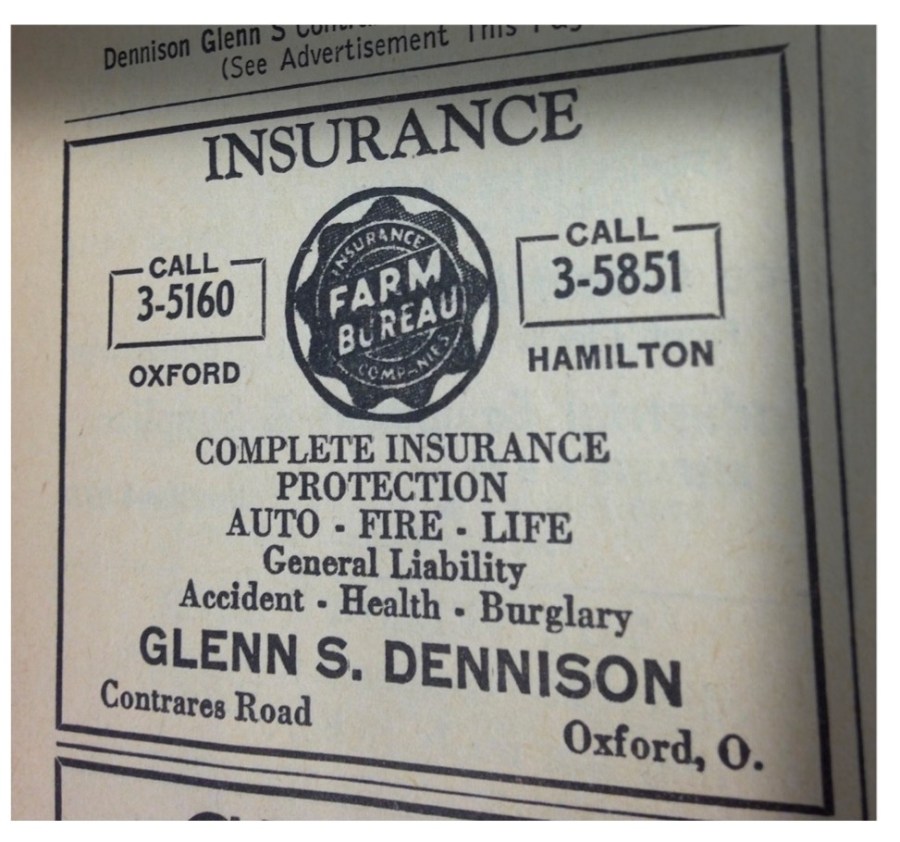
Dennison’s house, located on Contreras Road, is out beyond where the Taco Bell and LaRosa’s Pizza is now, and a couple miles from where Fisher Hall once stood. Also, Dennison’s business was out of his home, so it wasn’t all that weird that Tammen would show up at the house. A 1960 ad in the phone book lists his business address at Contreras Road, though it doesn’t include the house number.
Glenn Dennison’s insurance ad from the 1960 Oxford, O. telephone book
What was weird was the time—8 p.m. on a Friday. Don’t most college students generally have more fun places to be on Friday nights? Why did Ron think it was so important to pay his premium then, when it wasn’t even due until April 24? He was a week early.
Here are the two things I haven’t shared with you about that visit and perhaps why Tammen might have ended up at the Dennison home at that time:
Everett Patten, the chair of Miami’s psychology department, lived on Contreras Road too. In the 1952-53 Miami Directory, his address is listed as R.R. 1, short for Rural Route 1, which tells us nothing about where he actually lived. In 1956, the Oxford telephone book listed Patten at R.D. 1, which I believe means Rural Delivery 1, and again, tells us nothing about his location. Thankfully, the 1958 Oxford phone book specified an actual house number. (By the way, if you’re thinking that he moved, I don’t think so. That was the same year in which St. Clair Switzer’s house was given a number, from his former designation of R.D. 2.)
So Everett Patten lived on the 6400 block of Contreras Road and Glenn Dennison lived and worked on the 6100 block of Contreras Road—less than a mile apart. It’s actually .4 miles.
Let’s imagine that Ron is at Dr. Patten’s house that night for some reason. We’ve already established that Patten seemed to know a lot about Ron—like Ron having dissociation in his background, for example—and we also know that the psychology department was hypnotizing students at that time. It would make a lot of sense for them to conduct their hypnosis sessions off campus, to avoid drawing attention. If Ron’s at Patten’s home on a Friday night for a hypnosis session, wouldn’t it make sense for him to stop off at Glenn Dennison’s house to pay his car insurance as long as he’s in the neighborhood? Whether coming or going, it would have been on the way.
The second thing I need to tell you is that the Campus Owls had a gig that night. According to the newspaper the Palladium Item of Richmond, IN, the Campus Owls played that Friday night from 8 to 11:30 p.m. at Short High School in Liberty, IN, which is about a 20-minute drive from Oxford.
In Cella’s article, Mrs. Dennison says, “He stayed about a half hour, talking about the Campus Owls in which he played and talked about other things.”
Of course, the times may be a little off, since Mrs. Dennison was recalling events from 23 years prior, however it still seems strange to me that Tammen would be so chatty on a night he was supposed to be in Indiana—at 8 p.m. My guess is that he didn’t go at all. And why would Ron, a guy who was forever looking for ways to earn money, choose not to go to a gig to make some additional cash?
Maybe he had something else to do that would also bring in money—something that would soon take precedence over everything else.
[NOTE: Be sure you read the comments. Stevie J raises a point about Indiana time zones that makes the Owls gig much more doable. However, a member of the Campus Owls has also provided some background intel that, in my view, makes it unlikely that Ron was going to a gig. I know we’re always being cautioned not to read the comments on other websites, but on this site, thanks to the savviness of you readers, I highly encourage it.] 🙂
Joe Cella, the Hamilton Journal News reporter who never let the Tammen story die and who unearthed essential details about the case even decades later, would be turning 100 today if he were still alive. In April 1977, Joe was quoted in an article in the Dayton Daily News saying: “The university covered it up. They wouldn’t give you any answers.” On Joe’s centennial birthday, I thought it would be fitting to post some additional evidence that supports his cover-up theory.
For a long, long while, I used to believe that Miami University’s administrators and the Oxford PD didn’t have the slightest notion of what happened to Ron Tammen in the days following his disappearance. When they were quoted in the press bemoaning the lack of clues while actively ignoring, you know, actual clues, I just figured they were letting their inexperience show through. They were new at this, you guys. Cut ‘em some slack.
But then, as I discussed in my post “Proof of a cover-up,” it started appearing as if university administrators were purposely withholding key details. First and foremost: No one seemed to want the psychology book that was open on Tammen’s desk to make its way into a news article. Gilson Wright, the Miami journalism professor who also worked as a stringer for area papers, was how they conveniently managed to keep that info away from the interested public. Wright never mentioned the word psychology in any of his stories—ever—even though he would have known about the open textbook’s subject matter at the very latest by April 1954, when Joe Cella, of the Hamilton Journal News, introduced that detail into his one-year anniversary article. In the first 23 years of Tammen coverage, only two reporters—Cella and Murray Seeger, of the Cleveland Plain Dealer—ever mentioned the psychology book in their articles.
That discovery has led me to ask: what else was the university doing to keep details of the case away from the press, and—OK, I’ll say it—namely one member of the press? Although Seeger wrote a nice piece in 1956, he was primarily a political reporter for the Plain Dealerbefore moving on to bigger outlets, and he wasn’t keeping up with the story like Cella was. Cella was the only non-university-paid reporter who was following the story from the very beginning until 1976, and quite probably until his death in 1980.
Was the university doing anything to keep certain information out of Cella’s hands? For sure.
Last year, before Covid-19 reared its spikey little head, I was spending some time in Miami University’s Archives, and found something I didn’t recall seeing there before. Or, if I had seen it before, it didn’t seem nearly as significant as it does now. Tucked among a hodgepodge of Tammen-related news and magazine articles is an undated, unsourced, one-page sheet that appears innocent enough—a dishy “story behind the story” that someone had typed up on a computer. The font looks like Times New Roman and it was printed on a laser printer. The printer paper looks bright white, not yellowed with age. For these and a few other reasons, which I’ll be getting to in a moment, it appears to have been written fairly recently—long after I graduated from Miami in 1980 and certainly post-Cella. It could have been produced in the last 20 years, or perhaps even more recently than that. It’s too hard to tell.
The write-up has to do with an interview that was conducted with someone who worked for Carl Knox at the time that Ron Tammen disappeared. She was his secretary—that was her official job title—though the write-up refers to her as the “Assistant to the Dean of Men, Carl Knox.” (That’s another clue that the write-up was more recent: over the decades, the terms administrative assistant or administrative professional replaced the word secretary, with the professional association making the change only roughly 20 years ago, in the late 1990s and 2000.)
This memo on an unrelated topic was signed by “AD,” who was employed as Carl Knox’s secretary at the time of Ron Tammen’s disappearance. I won’t be identifying her by name on this blog site.
A sad, albeit surprising aspect of this story is that this person passed away only this year. What I’m driving at here is that it appears that someone who’d worked closely with Carl Knox when Ronald Tammen disappeared was interviewed by someone from the university relatively recently in my estimation, though I don’t know when or by whom. In Tammen world, this was the “get” of all gets. It would have been the closest thing to talking to Carl himself.
I’m not going to share the name of the assistant on this blog site out of respect for the family, who couldn’t recall ever hearing their mother comment on the Tammen case. But I will include the details that this person shared during her interview, which were typed up in bulleted format. The document reads as follows, with the only difference being that I’ve substituted “AD” (short for assistant to the dean) for the woman’s name:
—Beginning—
ADDITIONAL INFORMATION ON RON TAMMEN, Jr.
From an interview with AD, Assistant to the Dean of Men, Carl Knox, at the time of Tammen’s disappearance on April 19, 1953
At the time, Hueston Woods held a work-camp for prisoners who were about to be released; they worked at clearing away brush from the future site of the lake. These prisoners assisted in the search for Ron Tammen.
AD’s office was across the hall from Dean Knox’s, with a bench across from her desk. After the disappearance, news reporters would sit on this bench awaiting any new information. On one occasion, AD called across the hall to Dean Knox that he had a telephone call from New York. Although the call had nothing to do with Ron Tammen, the reporters assumed it did, and this is how the rumor started that Tammen had been found in New York.
As a result of the false New York story (above), a buzzer was installed on AD’s desk so she could notify Dean Knox of his calls without calling out across the hall for the reporters to hear. She was also given a list of words that she should not say aloud in front of reporters.
After Fisher Hall was demolished in 1978, the wells and cisterns under the building were searched, since they had not been easy to search at the time of the disappearance. No signs of Ron Tammen, Jr. were found.
—End—
Before I begin dissecting the summary, please understand that I don’t think AD was in on every single convo surrounding the university’s investigation. Rather, in my view, her comments reflect what Dean Knox and perhaps others would have said to her. That’s what I’m commenting on—the words and actions of AD’s superiors based on her personal account. I’ll also add that the above summary is only someone’s interpretation of what she said during the interview. Unless we have the original transcript or recording, we can’t be sure that whoever wrote these notes did so with 100% accuracy. Plus, they may have left out some important details.
OK, let’s get to it:
1). The date of the interview
The author decided not to add his or her name to the summary, which is aggravating enough for someone like me who likes to contact people who know things about the Tammen case. But it would have been really helpful if they had thought to date it—either typed it in or scribbled it at the top to let us all know when it was written, and in turn, roughly when AD was interviewed. Instead, the first line is so confusing that it takes a couple reads to realize that they’re saying she was the “Assistant to the Dean of Men, Carl Knox, at the time of Tammen’s disappearance,” as opposed to being interviewed at that time, as one Miami staff member had speculated when I’d inquired about it. Based on the evidence I’ve described plus what I’m about to discuss—particularly regarding bullet #3 above—I’ve concluded that it’s a poorly worded phrase, and there’s simply no way the interview happened in 1953. It was later. We just don’t know how much later. I don’t want to get all conspiracy theory–minded on you this early in my blog post, but I mean…did they MEAN to throw us off by not dating it?
Yeah, yawn, we already knew about the prisoners. Good for them. Moving on.
Hueston Woods State Park Credit: Ohio Department of Natural Resources Flickr account
3). The New York rumor
A couple weeks after Ron Tammen disappeared, a rumor had spread across campus about Tammen being spotted in New York. I’ve tried like crazy to find out what the rumor was—it was one of my standby questions for anyone I interviewed who was on campus at the time. No one with whom I spoke could recall the rumor. In fact the only other evidence I’ve had of the rumor was a May 8, 1953, editorial in the Miami Student (p. 2, top left) that stated that a rumor had been circulating that “…Tammen had been located, under conditions that were defamatory to his character.” But according to the same editorial, the rumor was started by an “enterprising student,” and the purpose was to see how fast it would spread. Other than that editorial, which chastised fellow students for disseminating the rumor in the first place (its title was “Must Tongues Wag”), no reporter ever mentioned the New York rumor in an article—not Joe Cella, not Gilson Wright, not even a student reporter.
As we all know, there was another possible New York connection to the Tammen story, though this one came several months later, in August 1953. Could housing official H.H. Stephenson’s potential Ron sighting in Wellsville, NY, have been the basis behind the phone call that Carl Knox had received? Perhaps Cella or Wright or someone else was in the vicinity when the call came in, and Knox was concerned that they’d heard something that he felt shouldn’t be made public. The only person who reported that potential sighting, however, was Cella in 1976, and that article was not based on a rumor or an overheard phone call. It was based on a conversation with H.H. Stephenson, who had worked directly for Carl Knox in 1953. (His title then was director of men’s housing and student employment.)
The summary says that reporters—plural—used to sit on a bench across from AD’s desk waiting for updates. That’s rather hard to imagine, given the fact that there were so few clues to begin with and only two newspaper reporters who were covering the story from the beginning: Gilson Wright and Joe Cella. Wright, being a university employee, seemed to have an inside track with Carl Knox. Why would he have to sit on the bench waiting for updates? Besides, with all the university jobs he was juggling—teaching courses, advising student journalists, heading up the news bureau—he had other places to be.
Perhaps a Miami Student reporter had been occupying the bench. But students have classes to attend, and, moreover, there were no bylined Miami Student articles during the spring of 1953. Also, the early Student articles were similar to the articles Wright was submitting to area newspapers, which has led me to infer that Wright authored those as well.
That leaves Joe Cella, although I’m sure Joe was too busy to plant himself outside of Carl Knox’s office for hours on end. Besides, Joe’s best sources seemed to be the students and staff members who were closest to the action as opposed to seated behind a desk in Benton Hall.
As far as radio and TV coverage, there likely was some of that too, especially early on, though any trace of what was broadcast over the airwaves is gone. However, their reporting would have probably been bare-bones, with most of their info coming from Miami’s news bureau, courtesy of Gilson Wright and company. In short, I can’t imagine they’d be camped out either.
My hunch is that whoever was seated there when the New York phone call came in had set up an interview with Knox and was merely waiting…if a reporter was sitting there at all. More on that theory in a second.
5). The buzzer on her desk
Regardless of who was calling from New York and for what purpose, university administrators had clearly been shaken up about it—so much so that they decided to install a buzzer on AD’s desk.
For what it’s worth, the buzzer technology wouldn’t have been a huge technological feat in those days, according to two electrical engineers who weighed in after I put out a call for help on Facebook. (Thanks, Chris and Travis!) People have been ringing doorbells on a widespread basis since the early 1900s, which would basically accomplish the same thing—pressing a button and having it ring, or buzz, in another room with the aid of an electrical wire. (A similar concept is turning lights on and off using a button or toggle switch, connected to a light source by an electrical wire.) For this reason, AD’s buzzer would have been fairly simple for someone with that skill set to put together.
But seriously, you guys, how many reporters could there have been sitting on AD’s bench, day in and day out, and were they really creating such havoc around the office that it warranted instituting a secret buzzer system?
To be sure, a missing student is a very big deal. But installing a secret desk buzzer seems to be more like the act of someone who wants to play spy or top-secret government insider. Who were they protecting with their desk buzzer? Not Ron. Not the Tammen family. And honestly, so what if someone from the press overheard that Carl Knox had received a call from New York. No reporter worth his or her stripes would file a story based on that meager amount of info. They’d first ask Knox if the call pertained to Tammen, Knox would say no, and the potential misinformation would be squelched then and there, amIright?
I’m going to propose a different scenario: AD may have been told by Knox that her new buzzer system was because of reporters spreading the New York rumor—which, again, never made its way into newspapers—but I think it went beyond that. Remember that Carl Knox had jotted in his notes the name “Prof. Switzer,” Ron’s psychology professor who I believe was working for the CIA at the time Tammen disappeared. Switzer had even told one of my sources that he had indeed spoken with investigators at that time as well. What if Switzer had informed Carl Knox that Tammen’s disappearance involved a classified government program that’s important for protecting the nation’s security? Knox might have decided that a buzzer system would be a simple, effective way to do his patriotic duty. Incoming phone calls—from New York, D.C., or wherever—would be handled with utmost secrecy, no matter who happened to be standing nearby.
7). The list of words that she should not say aloud in front of reporters
OH. MY. LORD. Talk about burying a lede—this one got pushed to the tail end of bullet #3, after the work-camp prisoners but before the cisterns and wells.
Do you have any idea what I would give to know the words AD was instructed not to say in front of reporters? A lot. I would give a lot. Was one of the words “Switzer”? “Psychology”? “Hypnosis”? Or better yet “Post-hypnotic suggestion”? Or how about “MKULTRA” or “Project ARTICHOKE”? I mean, did AD’s interviewer think to ask the obvious follow-up question: What words were on the list? And if they did ask that question, why would they leave the most important part out of their summary page? Why indeed.
You guys, I’ve worked in several press offices in my career, and have fielded calls on topics that were considered political hot potatoes in their day. But I can’t think of a single time when I was instructed not to say certain words. Were they trying to protect Ron’s reputation? To avoid putting the university in an embarrassing light? Would the words have steered reporters too close to a probable cause for his disappearance? Whatever the reason, if the university was prohibiting the use of certain words to prevent a reporter from learning an inconvenient but potentially significant truth, that’s a cover-up.
Incidentally, I’m quite certain that AD would have never mentioned the forbidden words list back in 1953, when she was working for Carl Knox and the investigation was in full swing. That’s another reason that I feel that the interview was relatively recent.
One word that I’m pretty sure wasn’t on the forbidden list? Cisterns.
8). The cisterns
Speaking of cisterns, in part one (2:47) of the two-part segment on Ron Tammen last month from WXIX (Cincinnati), we were introduced to the concept of open cisterns on Miami’s campus by a Miami University spokesperson. Cisterns are generally described as large tanks that store water, though the cistern that was shown in the news segment was built in the 1800s and looked like a large open hole leading to a bricked-in area underground. I’ll tell you here and now, I had no idea that they were considered a safety problem back then. But I’m not sure students in those days felt that way either. If you type the search term “cistern” (singular) into the Miami Student digital archive for the time period of 1900 to 2020, two articles will pop up, one from 1903 and one from September 1986. The 1986 article discusses a cistern that the university had installed under Yager Stadium to conserve water when maintaining the athletic fields. The 1903 article was about a wrongly translated Latin passage and had nothing to do with cisterns on campus. The term “cisterns” (plural) yielded an article from 2000 about brick cisterns that were discovered during the construction of a park in uptown Oxford.
What AD said, however, was that they’d checked the wells and cisterns under Fisher Hall after the building was torn down in 1978 because they were difficult to get to. Of course, I don’t want to leave any stone unturned in my research, and that includes learning more about the university’s cisterns. Earlier this month, I emailed the spokesperson seeking background materials or a conversation on the topic, and so far, I haven’t heard back from him. I’ll keep you posted.
9). The full interview
Although the “Cliff Notes” version of AD’s interview is better than nothing, I really want to read the full transcript. Or better yet, I’d love to hear the recording. At the very least, I want to know when the interview was conducted and by whom so I can reach out to the interviewer for a conversation about all they remember that AD said, including, hopefully, at least one or two choice forbidden words.
I’ve reached out to senior administration officials for Miami University Libraries as well as Marketing and Communications, including the News Office, for assistance. Currently, the head of the libraries’ department that oversees Special Collections, Preservation and The University Archives is having his staff look for the source materials, though it may take a while due to Covid-19 restrictions. I’ll be touching base with them every so often for updates.
Here’s why I believe the university should still have the source materials: AD and her husband were well known, beloved figures at the university for many years. Although I still don’t know the reason behind the interview, it would make sense if someone had requested it for historical purposes. If that were the case, then tossing the original tape or transcript would be very, very strange, to put it mildly. I can’t say that that’s what happened at this point, but it’s a concern of mine.
Furthermore, as someone who believes in transparency in our public and governmental institutions, let me be transparent regarding my current thinking. In discussing the possibility of a university cover-up, I always gave the people in later administrations a pass. How could they have been privy to information that Carl Knox and his team were discussing off-the-record and in real time? If there was a cover-up, I used to think, it would have been the people who were making those judgment calls back then. Once they died, any evidence of wrongdoing would have died with them.
However, if someone who’d been around at that time briefed someone fairly recently, filling them in on forbidden words, for example, and any other pertinent intel from 1953, and if that interview was reduced to a few tamed-down bullet points and the original source materials were discarded to prevent someone like me from finding them? Well, the cover-up would live on. Is that what’s happening? I sincerely hope not. That’s why finding the source materials is so important.
I can only imagine what the late, great Joe Cella would say to me about the possibility of an ongoing cover-up. Probably something like: “Welcome to my world.” And then he’d add, “Keep on it.”
Post-Script:
In light of the new revelations, I rewatched the 1976 documentary “The Phantom of Oxford” to listen again to what Carl Knox had to say 23 years after Tammen had disappeared. By then, Knox had moved to Boca Raton, Florida, and was serving as professor of education and vice president for student affairs at Florida Atlantic University.
In Part 1 (9:18), Knox briefly discusses Tammen having left his car behind with his bass inside, which is 100% true, but it doesn’t add anything to today’s topic. In Part 2 (2:40), he says this:
Carl Knox: In other campuses where I’ve been located, there have been disappearances, and there have been tragedies, but nothing which has sort of popped out of, no background of explanation, no way of reasonable anticipation, but just suddenly happening, and there you were with egg on your face, deep-felt concerns, and yet no answers for any part of it.
Ed Hart: And yet something tells you Ron Tammen is alive.
Carl Knox: Yes, I feel this. I feel it keenly.
Knox is believable in the interview, and his facial expressions could best be described as: deeply concerned, which is consistent with what he has to say. But, as we now know, there’s a lot of information concerning the university’s investigation that he’s chosen not to say here. Twenty-three years later, he has elected to keep his mouth shut—about open psychology books and dropped courses, about hypnosis studies, about three amnesiac Ohio youths, about Ron’s proneness to dissociation, about Dr. Switzer, about hidden buzzers and forbidden words.
In fact, the only time Carl Knox truly opens up about the case is in his last sentence. Knowing everything he knew back then, he keenly felt that Ron was alive—in 1953 as well as in 1976. And you know what? I keenly feel it too.
Happy holidays, everyone! Comments are now open. You’re also welcome to air a grievance or two (non-political please) in honor of Festivus, which also happens to be today.
Post-Christmas Post-Script(Dec. 27, 2020)
Hi, all! I’m back. I forgot to make a point in the above post that probably appears like a gaping, cistern-sized hole and it’s been eating at me. It concerns the fourth bullet point that discusses the cisterns and wells. There I was, offering up my reasoning regarding why the interview with AD couldn’t have been conducted in 1953, and I didn’t even bring up the fact that the fourth bullet discusses how they’d searched the cisterns and wells in 1978, when they tore down Fisher Hall. Did anyone else catch that? I mean, clearly, the interview occurred after 1978.
Sorry for the oversight!
I should also add that the same university rep who felt that the interview was conducted at the time of Tammen’s disappearance said that she didn’t think the fourth bullet was related to the interview with AD. But that’s not what the document says. The document says that the additional information was from the interview. So, it occurred after 1978, but, again, I think it was much more recent than that. I’m just hoping to find someone with the institutional memory to recall when the interview took place and with whom.
Sorry to be a bother, you guys, but I can’t keep this in. This afternoon, I was busy working on — what else? — Tammen research when I discovered something pertinent to our topic du jour. In the summer of 2019, I was visiting University Archives (sigh…I really miss road trips) going through a bunch of documents. On that particular day, I was leafing through issues of their Information Bulletin for Faculty and Staff from the early 1950s — 1950 and 1952 to be exact. As I recall, the university didn’t produce a new bulletin every year. Sometimes they just produced an addendum. Fortunately, I had taken photos of numerous pages — some relevant to the topic I was obsessing about at that moment, and a couple having to do with what I’m obsessing about now: student loans.
Here’s what they had to say about student loans in the 1950 issue (apologies for the bad photos, but I’m guessing you’re used to that by now):
And here’s what they had to say about them in the 1952 addendum, right around the time when Ron would have been applying for one:
Here are the points I want to leave you with today:
Student loans were a big deal.
Since Ron was a sophomore, his loan would have been limited to $100.
I’m guessing that Ron had been a recipient of this loan, and it’s the same one that Mr. Alden had written up when discussing Ron’s outstanding debt.
And the juiciest tidbit of all: our friend H.H. Stephenson oversaw the student loan program.
So H.H. Stephenson was overseeing the student loan program when Ron received his loan. That loan may have even been relatively recent, since Carl Knox’s notes indicate that Ron had recently deposited a $100 check from a loan. What this tells me is that H.H. Stephenson was even better acquainted with Ron than we had previously known. Sure, sure, H.H. knew him because he’d given him a car permit. But he’d also just handed him $100! Could that be one of the reasons the university kept a lid on H.H.’s potential Ron sighting — they didn’t want the money issue to come out? What’s more, for me at least, it also makes the potential sighting more believable.
Purposely lying to a member of the press is a big fat no-no for a spokesperson of any stripe. Obfuscating—intentionally throwing up smokescreens—is really bad too. But to look a reporter in the eye and say something that’s not in the least bit true takes a special kind of moxie. It also requires a motive. Otherwise, why not just tell the truth? For those with nothing to hide, honesty is so much easier.
So for someone like Carl Knox—who, from what I’ve been told, was an aboveboard kind of guy—to introduce an untruth with a reporter when discussing Tammen’s case seems especially bizarre. Wouldn’t he and other university officials have wanted to get everything out in the open in hopes that it might help them find Ron? What’s more, Knox was still in his first year as dean of men at Miami—a brand new post. He would have wanted to pour everything he had into a task that held such high visibility. Lying about it? That would be the last thing he would have wanted to do.
But then, nobody starts out planning to lie.
Lately, after finding tangible evidence of a university cover-up, I’ve been examining all of the old news articles for what feels like the zillionth time. I’ve been tracking any lies and obfuscations that are quoted—directly or indirectly— from university officials, knowing what they knew at the time.
We already know about a couple of them. We know that Gilson Wright (and others) chose to mislead the public about the psychology textbook on Ron’s desk, most likely to direct attention away from Dr. Switzer. We also know that they tried to depict Ron as doing very well in his classes. Once we saw his transcripts, however, we knew that Ron had recently dropped his psychology course for the second time in a year and was slipping far behind in his degree program. Again, the motive behind the deception was most likely to avoid shining a big bright light on Switzer.
There were the other lies and obfuscations too. Among the greatest hits are:
When Carl Knox decided not to divulge Paul’s (not his real name) story about his walk back to the dorms after song practice with Ron and Chip Anderson the night Ron disappeared.
When Gilson Wright disclosed in a news article that three amnesiac youths had wandered off and later returned, but never mentioned the youths in his articles again.
When Oscar Decker added an hour to the time of arrival of the young man who appeared on Mrs. Spivey’s doorstep on the night Tammen disappeared.
Living your life with one lie can be hard enough. But juggling all of those lies and obfuscations TOGETHER? That’s practically a full-time job.
Today, I want to discuss another lie that officials opted to tell about Ron—the one about his finances.
On April 25, 1953, the Saturday after Ron disappeared, Carl Knox was quoted in the Hamilton Journal-News by Gilson Wright, with the following matter-of-fact pronouncement:
“‘He was not in financial difficulties,’ Dean Knox said after a checkup Friday. ‘But he could not have had more than $10 or $11 in his possession when he left Fisher Hall.’”
On April 29, 1953, Wright wrote this in the Cincinnati Enquirer:
“A sizable balance was left in a downtown bank.”
And on May 4, 1953, Wright wrote this in the Hamilton Journal-News:
“…he took only $10 or $11 and left more than $100 in a local checking account.”
I don’t know how much money Ron had in his pocket when he disappeared, but I do believe Carl Knox fibbed about Tammen’s finances. Ron Tammen was experiencing financial difficulties. Despite the fact that Ron was always busy earning money as well as looking for ways to earn more money, he still owed a lot of money, with one of his primary creditors being the university. Also, his bank balance wasn’t “more than $100”—it was $87.25.
Here’s what was going on behind the scenes:
On May 26, 1953, Miami’s bursar, a guy named David C. Alden, wrote a memo to Carl Knox summarizing Tammen’s standing with the university. He said that Tammen still owed the university $100 in board (dining hall fees) and $100 on a “loan fund note,” minus the pay Ron was due as a residence hall counselor ($29.41) and a refund on his room rent and laundry ($29.10). The total Tammen owed, therefore, would be $141.49.
(We’ll get more into that boarding fee and loan fund note in a second.)
Mr. Alden added: “If the brother is still in town and the father and brother have approved the transfer of the account at the Oxford National Bank against the University account, the balance could be reduced by the amount of the account at the bank.”
The Tammens must have agreed to the transfer of funds. On July 2, 1953, Don Shera, vice president of the Oxford National Bank, wrote to Carl Knox letting him know that Ron’s balance of $87.25 had been sent via a certificate of deposit to bursar Alden to help defray the balance owed to the university.
That same day—July 2, which was a Thursday—Alden wrote to Mr. Tammen letting him know that the board fee was actually $110, not $100, and that, with the money from Ron’s bank account applied to the balance, the amount owed by Mr. and Mrs. Tammen was now $64.24. That might not sound like much, but if you plug the numbers into the inflation calculator, you’ll see that $64 in 1953 was worth almost ten times as much as it is today, or $624.
But that’s not my favorite part of Alden’s letter. Here’s the best part:
“I was sorry not to have had a chance to talk with you when I stopped at your residence on Monday. Please be assured that this communication is not being written to press for payment on the balance. Whatever time you need to clear it is satisfactory.”
Um, excuse me? At a time when the Tammens were at a perpetual Red Alert readiness level, hoping and praying with every doorbell and telephone ring for news of Ron, Miami’s bursar thought it would be a swell idea to hop into his car and drive to the Tammens’ house at least 4 hours away (probably longer back then) to discuss Ron’s outstanding balance. What’s more, it sounds as though he did it unannounced. A surprise pop-in! Let me put it thusly: if the university thought the situation warranted the bursar’s driving from Oxford to Maple Heights to personally discuss Ron’s balance, then please don’t tell me that Ron wasn’t in financial difficulties. If $64 meant that much to the university, then think about how much more it must have meant to Ron and Ron’s parents.
But let’s also talk about the university’s initial bill. The bursar said that Ron’s outstanding debts equaled $110 for board plus another $100 for a loan. According to the 1952-53 M Book, every semester, in-state male students who lived in the dorms had to pony up $315.88 for all of their expenses, which included tuition, residence hall rent, board, laundry, and other fees. The most expensive cost was board—eating in the dining hall—which for males came to $175. Although the university asked students to pay the entire amount upfront at the start of each semester, they did allow students to pay board in installments, as Ron chose to do.
Page from the 1952-53 M Book
But Ron wasn’t keeping up very well with the installment plan either. The second semester was almost exactly four months long, starting February 3 and ending with the last day of finals on June 4. Ron should have paid more than two months’ worth in board ($43.75/month), and possibly three months’ worth, yet he’d only paid $65 when he disappeared. (If you think that doesn’t sound like much, I’ll just direct you to Mr. Alden, who felt differently. And don’t forget to use the inflation calculator.)
Now here’s the weirdest part of the university’s bill: that $100 loan fund note. Ron had received a loan from the university for some unnamed purpose. Could this be the same loan that Willis Wertz and Glen Yankee had co-signed, according to Carl Knox’s notes? However, when you take a closer look at what Knox had written, you see that next to Wertz’s name, he wrote “co-signed a note at bank” while next to Yankee’s name, he wrote “co-signed a note.” It appears as if there may have been two loans, one a bank loan signed by Wertz and the other a university loan, ostensibly signed by Yankee. Or maybe Yankee’s note and the university note are different, in which case he may have had three notes.
Which leads me to my next question: why was Ron struggling so much financially when he was bringing in money from residence hall counseling, playing the bass, donating blood, and who knows what else? During the summers and breaks, he worked his butt off at decent-paying jobs as well. He didn’t drink or do drugs. Didn’t go out much with friends. Didn’t date much. He didn’t drive his car much. Even with his car on campus, he was known to hitchhike and bum rides from other people. Where was his money going?
In his notes, Knox scribbled in some expenses that Ron had incurred here and there with little explanation. Here’s my best attempt at a summary:
Deposits
Of the most recently deposited money, Ron deposited a total of $40 from playing jobs (band gigs) and he also deposited a $100 check on a loan. (Could this be the university loan?) There was no “activity” in Ron’s bank account—and by “activity,” I think Knox means bank deposits—after April 6, 1953.
Checks written
According to Knox, here were the checks that Ron had written the week before he disappeared.
4/13/53 $24.45 Delta Tau Delta
4/13/53 $4.07 Shillitos (clothing store)
4/15/53 $15.00 Cleveland Trust Co., Cleveland, Ohio, American Express Co.
4/16/53 $5.00 Check cash, John Minnis (drug store)
Knox also noted that in December 1952, Ron had obtained a $50 loan to clear up a “Housebill,” which I think means that he needed the loan to pay off his board from the first semester. Knox also noted that he “planned to repay [the loan] after Christmas work.”
By far, the most sizable payment had to do with Ron’s car, a green 1939 Chevy sedan, for which he needed to pay approximately $175 sometime before Christmas 1952. That was a major expense that may have involved some servicing problem—an engine, brakes, or something equally huge. From what I can tell, Ron had paid for the car in full after trading in his first car, a 1929 Ford. (His first car was really old-timey. These days, they’re cute in parades, but compared to what wealthier guys his age were driving, I’m sure he felt the need to upgrade asap.) Thanks to reporter Joe Cella, we know that Ron also paid his car insurance on the Friday night before he disappeared for $17.45. Both the $175 car bill and the $50 housebill expenses had also been paid.
But let’s be real. Ron wasn’t just juggling his grades, he was juggling his finances as well—taking out loans to pay his bills and other loans, which I suppose would be fine if it weren’t for the other bills and loans that lay in wait. See how cyclical debt can be? Ron was drowning in it, and Knox and the others in Miami’s administration knew it. But for some reason, they didn’t want anyone else to know.
The Tammens weren’t made of money either. I think they were a little freaked out by the bursar’s in-your-face manner of doing business—wouldn’t you be?—and said so to Carl Knox, which prompted Knox to send a follow-up letter on July 6, backing up what Alden had said in his letter and cushioning it with some hopeful news about Mrs. Spivey’s possible sighting. On August 17, 1953, roughly 4 months after Ron disappeared and 12 days after Ron was possibly spotted in Wellsville, NY, Mr. Tammen submitted his check for $64.24, thus closing the university’s ledger on Ronald Tammen, and making Mr. Alden a very, very happy man.
So why did university officials feel the need to lie about Ron’s finances in addition to everything else they lied about? My feeling is that they already had their narrative in place and didn’t want to deviate from it. In their imaginary world, Ron was a stellar student with no failings, therefore, he MUST have walked away with amnesia. If he was having problems—with grades, with money, with his personal life, or anything else—then that would just raise problematic questions from troublesome reporters. And if someone wielding a lot of power was requiring the university to cover up the truth, maybe Carl Knox and the others didn’t have any choice in the matter.
*******************************
Monday, 11/16/20, add-on:
Because Mr. Alden’s visit and July 2, 1953, letter to the Tammens was of particular interest to readers, I thought I’d also post Carl Knox’s follow-up letter to Mr. and Mrs. Tammen from July 6, 1953. Although I paraphrased the letter in my write-up, perhaps I didn’t do it justice.
Is it just me, or do you detect a certain officiousness/harshness/annoyance in his tone concerning payment, even while telling them to take whatever amount of time they need? Perhaps his decision to open with the words “It was my understanding” is what gives it a less-than-fuzzy feel, despite the “hoping and praying” that comes later, in the 3rd paragraph.
Happy Halloween, everyone! October 31st has always held special significance in Tammen world—the whole phantom ghost schtick. Although the holiday has nothing to do with the Ron Tammen story, people do tend to think about him during this time of year and, like clockwork, I’ve been noticing an uptick in visits to the blogsite. So let’s take advantage of the fact that we’re all here together once again and have ourselves a little catch-up, shall we?
Research-wise, things are still moving forward, however, most of the balls happen to be in other people’s courts at the moment. For this reason, I’m sorry to say that I don’t have breaking news to share with you regarding hypnosis, mind control, psych professors, a university cover-up, and all the other topics we’ve come to enjoy pondering on this page. Don’t worry—we’ll get there. We will. Just not today.
What I will be sharing with you has to do with a topic that’s super apropos for the holiday—cemeteries! Specifically, we’ll be discussing the permanent resting place of several of the people who have something to do with Ronald Tammen. Some of the people you know well, some you sort of know, and several will be brand new to you. And the coolest part is that they’re all lying a mere stone’s throw from one another.
So, yeah…cemeteries, y’all. Do you love them as much as I do? The tranquility of nature commingling with the people who preceded us; the copious ways in which the dead choose to express their individuality, from dark and scary mausoleums to looming obelisks to blocks of granite, etched with butterflies and angels; the stark reminder that we’re here for but a brief blip in time and that we should probably make the most of it. As a wannabe author, one reason I love cemeteries so much is that the people who occupy them are so…dependable. You can go to a cemetery, rain or shine, and know that a certain person will always be there, no matter how important they were here on earth. No appointment necessary. Walk-ins accepted. They won’t stand you up, and ironically enough, they won’t ghost you.
The cemetery we’ll be discussing is Oxford Cemetery, a hilly little respite off Route 27 (Oxford Millville Road), just south of Peffer Park and Miami’s Western Campus. If you’re driving to Hamilton from Oxford, it’ll be on the righthand side. If you’re driving in the opposite direction, it’ll be on the left.
Here are some of the people you’ll find buried there. (You can click on the names to see a portion of their interment cards.)
You probably know this guy best. Dr. Patten was chair of the psychology department at Miami from 1932 to 1961. In the early days, he was St. Clair Switzer’s mentor, and very likely was the person who encouraged Switzer to pursue graduate study under Clark Hull, the famed behavioral psychologist and hypnosis expert. In 1961, Dr. Patten turned over the chairmanship to Switzer. He retired in June 1965 and, sadly, died one year later. Dr. Patten was one of the three hypnosis experts at Miami when Ron was a student.
Gilson Wright was the journalism professor at Miami who also worked as an on-call correspondent (stringer) for several area newspapers, including the Hamilton Journal-News,Dayton Daily News, and Cincinnati Enquirer. Wright also was an adviser for the Miami Student.I’ve already written quite a bit about Wright, so I won’t drone on here. Most importantly, it’s my belief that Wright was helping the university cover up certain aspects of the Tammen case, particularly that Tammen’s psychology book was open on his desk when he disappeared.
We haven’t talked about Robert Howard yet. According to a news article announcing Gilson Wright’s retirement (which was written by Howard), Robert Howard began heading up Miami’s news bureau in 1956 after Wright turned over those reins, while continuing with his journalist/advising/stringing duties. (This detail doesn’t quite jive with what it says on Howard’s tombstone, but hey, if a person can’t embellish his credentials a little on his tombstone, when can he do it?)
One of the more interesting anecdotes I have on Robert Howard is that, in 1973, when Joe Cella (Hamilton Journal-News) wrote the article that introduced the name of Dr. Garret J. Boone to our Ronald Tammen lexicon, we were told that university officials didn’t welcome Boone’s information warmly. In fact, he was given the brush-off, he told Cella.
Here’s the rest of that story: In the University Archives, a short message written on “Miami University, Office of Public Information” notepaper is stuck to the back of Cella’s article. Scrawled in pencil, the note reads: “Paul — Who’s left for him to scold but thee & me?” and it’s signed “Howard.” There’s no telling who Paul was—I checked the 1972 and 1973 M Books, and no relevant administrators went by Paul, be it a first or last name. Maybe he was an assistant in the news office. But I have a very strong hunch that the snarky comment was written by the guy who’s buried here, Robert T. Howard.
Did you know that Ronald Tammen had a relative who was an emeritus professor at Miami when he disappeared? True! Tammen’s favorite uncle, John McCann (Mrs. Tammen’s brother), married a woman named Eleanora Handschin, and her parents were Charles and Helena. Charles Handschin was a highly respected German professor at Miami. He also had been chair of the Department of Romance Languages for 39 years. The Handschins’ home was just around the corner from the Delt house, and Ron used to visit them from time to time. I’m not sure why this fact was never reported in the news—till today!—but perhaps the university wanted to spare them the publicity.
(A few more interesting facts about John McCann: he was a Miami graduate who later became a colonel in the U.S. Air Force. John A. McCann is buried in Arlington Cemetery and there’s even a Miami scholarship in his name.)
Karl Limper was an esteemed professor of geology at Miami beginning in 1946 until his retirement in 1981. How does a geology professor factor into the Tammen story? Dr. Limper served as dean of the College of Arts and Sciences from 1959 to 1971, and he was the person who interviewed Ted Perin as part of Miami’s oral history project. As you may recall, Dr. Perin was a psychology professor at Miami as well as a former doctoral student of Clark Hull’s and he had some interesting things to say about St. Clair Switzer. One of his best stories was how Doc Switzer, as a retiring department chair, packed up his office and left without saying goodbye to anyone, even though he’d been there for over three decades. Also worth noting was that, when Dr. Perin raised the subject of hypnosis, Dr. Limper would change the topic as quickly as possible. Whether that was on purpose or coincidental, I can’t say for sure. What I can say was that it happened at least twice, and, at least to me, it felt forced.
Another new name for you is Willis Wertz. Wertz was an architecture professor at Miami when Ron disappeared. Actually, he was one of the first two students to graduate from Miami’s architecture school, and in 1973, the year he retired, they named the art and architecture library after him. It still is.
So how would Willis Wertz have come into contact with Ron? Ron’s brother Richard was the architecture student in the family. Ron was business. Surprisingly, Professor Wertz is mentioned in Dean Carl Knox’s notes as having signed a bank note for Ron along with Glen Yankee, a former accounting professor. This seems…weird. What professor agrees to sign a bank note for a student, potentially making themselves liable for the repayment of said bank note if said student should, oh, I don’t know, disappear? I mean, I don’t care how much of a go-getter you are, can you imagine walking up to a professor and asking him or her to cosign a loan? Ballsy move, Ron!
Thankfully, a faculty memorial written about Professor Wertz explains a lot. First, he was a member of Delta Tau Delta as a Miami student, so maybe he felt a connection with Ron in that regard. One of Ron’s fraternity brothers had this to say about him: “Willis Wertz was our fraternity advisor. I’m not surprised that they co-signed a note with Ron. [Ron] was so smart and likeable.”
And here are the giveaway sentences in the memorial:
Retirement did not diminish his interest in students, past and present. His concern for them could not be terminated by his retirement. He was a friend, adviser, teacher, and, at times, banker to almost forty years of architectural students at Miami.
If Professor Wertz was in the habit of lending money to students, I’m sure Richard found out and he told Ron. I don’t know about Glen Yankee’s side of the story, however. That bank note is one riddle within this mystery that I’d love to learn more about.
Who among us doesn’t love the story of Mrs. Clara Spivey, the woman from Seven Mile who contacted authorities in June 1953 saying that a young man who appeared on her porch on April 19 answered Tammen’s description. Oxford police chief Oscar Decker embraced her story and said it supported the amnesia theory. Others, including Ron’s brother Richard, weren’t so sure. They said there were discrepancies in her story.
In 1976, Joe Cella wrote an article with accompanying photos that retold old details and divulged new ones. Although Clara had passed away by then, her daughter, Barbara Jewell, is quoted in the article. Barbara was with her mother when the visitor showed up at the door.
“I still believe it was him,” she told Cella.
However, Paul Jewell, Barbara’s second husband, said he was also there that night, and he didn’t believe it was Ron. Sometime around 2008, he told the Butler County cold case detective that he thought it was one of the local ruffians. Barbara and Paul Jewell are buried in Oxford Cemetery too, though their memorials are located further down the hill, away from the university section.
Last but not least is the gravesite of Dr. Phillip Shriver, the beloved former president of Miami University, who is buried in the newer part of the university section. Dr. Shriver was obsessed with the Tammen case and he used to give talks to students about his disappearance, especially around Halloween. Dr. Shriver was my first interview for this project, and I sometimes wonder what he would say if he knew where my research has taken me.
Dr. Shriver had arrived at Miami on July 1, 1965. (His planner for that day is completely blank except for the words “First Day!”) He’d been in meetings with St. Clair Switzer in 1966, the year Switzer retired, so he was at least acquainted with our person of interest. I don’t know when he became sucked in by the Tammen case, and I’m currently looking into that. Even though Joe Cella had already written in 1954 that the open book on Tammen’s desk was his psychology textbook, I feel Dr. Shriver played an important role in finally making it known around Miami’s campus. Regardless of how things eventually play out, I’ll always feel grateful to him for talking to me back in 2010 and for getting this party started.
The myriad ways Gilson Wright described Tammen’s open textbook without ever once using the word ‘psychology’
(Supplement to season 2, episode 4 of The One That Got Away)
One of the topics that Josh, Tyler, and I discuss in episode 4 of The One That Got Away, which dropped tonight, is the psychology book that was open on Ron’s desk the night he disappeared. We’d already established on this blog site that Joe Cella was the first reporter to reveal that it was a psychology book, and he did so in his one-year anniversary article, published in the Hamilton Journal News on April 22, 1954. Later still, 23 years after Tammen disappeared, we learned that the book was opened to “Habits,” thanks again to the intrepid Joe Cella, on April 18, 1976.
In preparing for the podcast, I thought it might be fun to document all the ways that book was mentioned in the press during the 1953-1976 time period by the two reporters who covered the case the longest, along with one other major reporter. I wanted to find out how that uber dull yet utterly intriguing psychology book became part of the Tammen narrative.
Well.
Below is a chart I created of news articles about the Tammen disappearance that mention the textbook on Ron Tammen’s desk. The three primary reporters were: Joe Cella, a reporter for the Hamilton Journal News who followed the case for more than 20 years; Murray Seeger, a reporter for the Cleveland Plain Dealer, who wrote one well-researched article in 1956; and Gilson Wright, a journalism professor at Miami, who also was a freelance stringer/correspondent for area papers, and a long-time adviser to student journalists at the Miami Student. Because he was a Miami employee, Wright had a conflict of interest when reporting on the Tammen case in area papers, and it shows.
Click on chart for a closer view.Click on chart for a closer view.
As you can see, only Cella and Seeger refer to the book on Tammen’s desk as his psychology book, as highlighted in red. At no time—ever, in his entire reporting career—does Gilson Wright refer to the book as a psychology book. (He retired from Miami in 1970, but kept writing for area newspapers on occasion.) Even when he was aware of Cella’s reveal in April 1954, Wright continued to refer to it as a book or books, or a textbook or textbooks. And if the university’s search algorithm didn’t let me down, it wasn’t until 1988—35 years after Tammen disappeared and 18 years after Wright had retired—that a reporter for the Miami Student, Julie Shaw, finally described the book as a psychology textbook.
left to right: Gilson Wright, Joe Cella, and Murray Seeger
This is tangible evidence that Gilson Wright was being used by the university to hide Ron’s psychology textbook from the curious public. Officials likely didn’t want people to find out that Ron was no longer enrolled in his psychology course, and to question why the book would be there. I believe they were attempting to steer reporters and others away from the psychology department because of their hypnosis activities at that time, which could implicate them in his disappearance. If Tammen’s psych book was opened to the page I think it was opened to, that would have worried them even more.
The pages I believe Ron’s psychology book was opened to when he disappeared. Note the reference to “Post-hypnotic suggestion” on page 295. For a full description, go to Facebook.com/agmihtf, and watch the video from April 19, 2018.
How Joe Cella obtained the information about the textbook, I don’t know. He may have had inside sources. Maybe Chuck Findlay told him. Remember that Cella’s April 22, 1954, article also included photographs of Tammen’s room after he disappeared, which also showed the open book on Tammen’s desk. [Article is provided with the permission of the Hamilton Journal-News and Cox Media Group Ohio.] From what I can tell, those were the first and last times those photos were ever published. I’m also not sure how Cella discovered the information about “Habits,” 23 years after Tammen disappeared. My guess is that he may have obtained it from Carl Knox. By then, Knox had moved to Florida, and had agreed to appear in The Phantom of Oxford with Cella in 1976. Perhaps Knox told Cella about the book pages then because he didn’t think it would cause a ruckus by that time.
I’ve pointed to two other examples in which Gilson Wright would report one thing and then never report it again. On June 29, 1953, he reported in the Hamilton Journal News that the visitor’s time of arrival at Mrs. Spivey’s house, according to Mrs. Spivey, was “about 11 o’clock,” and then referred to it as “about midnight” from that point on. Also, it was Wright who wrote the April 26, 1953, article about a phone call to Tammen’s parents from the parents of three students who had memory loss and wandered away but who later returned. That disclosure was reported once and then quickly forgotten, almost as if Wright himself had had a sudden attack of amnesia.
The article by Wright that I believe was in The Cincinnati Enquirer. (See second column, 2nd full paragraph.)
Although Wright probably had the best of intentions in his reporting at the start, it appears as if someone at the university sat him down and gave him his marching orders. His cookie-cutter articles on the Tammen case year after year with no new revelations are indicative of a man living within boundaries. It was as if he was doing everything in his power not to mention that psych book, because, by God, he never did, even after Cella let the cat out of the bag.
In an April 11, 1977, article for the Dayton Daily News, Cella is quoted as saying: “The university covered it up. They wouldn’t give you any answers.”
Damn, Joe—I do believe you’re right, and the above chart helps prove it. If Gilson Wright and his superiors were going to these lengths to hide Ron’s psychology textbook from public view, then they obviously felt that it was important to the case.
I don’t know about you, but this tells me that we’re on the right track.
(Supplement to season 2, episode 3 of The One That Got Away)
*This post was formerly titled “More thoughts on two ignored clues,” but that was really boring, so I changed it. The URL remains the same, however.
I’m not gonna lie—podcasting has been fun. Not only is it helping me cope with my covid-fueled despair in a meaningful and productive way, but it inspires me to revisit some of the old blog posts and think new thoughts in light of findings that came out a little later in the process. (Please note: I won’t be producing a supplemental blog post for every podcast episode; I’ll only create a new post if we cover territory there that I haven’t discussed here.)
What I’m about to share is discussed in season 2, episode 3 of the podcast The One That Got Away, which I encourage you to listen to when you have a few idle minutes on your hands. Josh and Tyler are delightful human beings and they’re becoming quite the avid Tammen fans as well. But if you prefer to get your Tammen news by way of written words on a screen, no problem. I love that you like to read. Here are my latest ruminations regarding two questions that you may have already wondered about but were too polite to ask. I’m also going to share some brand new info that was released by Josh and Tyler during episode 3.
Question 1: Why did investigators choose to dismiss Paul’s and Chip’s story so quickly?
Let’s talk about those two extra hours we discovered in Ron’s timeline. Remember when Paul (not his real name) swore up and down that he and a guy named Chip Anderson (real name, but deceased) walked home with Ron after song practice on the night of April 19, and that they didn’t arrive until around 10:30 p.m.? And remember how university reps and the police interviewed them but completely ignored their story, instead telling everyone that Ron disappeared from his room at around 8:30 p.m.?
In a subsequent post, I discussed my theory of why investigators embraced Mrs. Spivey’s story so wholeheartedly. I even demonstrated—using my sweet ride, a 2011 Mazda 3, and the calculator on my phone—how Ron could have feasibly (though improbably) ended up in Seven Mile on foot under the 8:30 scenario, but most definitely not the 10:30 p.m. scenario. If he left at 10:30, and if it was Ron Tammen at Mrs. Spivey’s door, someone would have had to drive him there, which would complicate matters in ways investigators probably didn’t wish to imagine.
But Mrs. Spivey didn’t come forward until June. Why then did investigators choose to dismiss Paul’s and Chip’s story right off the bat?
I think the answer has to do with their favorite theory as to how Tammen disappeared. Very early in the investigation, by Friday, April 24, the university had declared in several Miami Valley and Cleveland papers that Ronald Tammen probably had amnesia. “Officials believe that he might have suffered an attack of amnesia,” an article in the Hamilton Journal News read. The Cincinnati Enquirer wrote: “University officials said Tammen might be suffering from amnesia as he took no clothing or personal articles with him.” (Neither article contained a byline, but my guess is that they were penned by Gilson Wright, since he wrote for both papers.) At least the Cleveland Plain Dealer showed some healthy journalistic skepticism about the university’s conclusion. It read “The dean [Carl Knox] believed the youth might have suffered an attack of amnesia, but had nothing to back that theory.”
So, amnesia. Now let’s consider how investigators would have tried to explain their amnesia theory under both estimated times of departure. Under the 8:30 p.m. scenario, Ron would have developed his amnesia at some point while he was in his dorm room, after he’d changed his sheets. Maybe it had hit him while he was studying at his desk. No one could possibly know the reason, because no one was there. He was alone, so anything was possible. In their view, he just, you know, cracked.
Under the 10:30 p.m. scenario, Ron had walked back to the dorms with Paul and Chip. He dropped them both off at Symmes Hall, and then headed toward Fisher Hall. But Ron never made it back to his room in Fisher. How do we know that? We know it because that’s roughly when his roommate, Chuck Findlay, had returned from his weekend in Dayton. Chuck never saw Ron.
Therefore, and this is crucial: Ron would have been struck by amnesia at some point between Symmes Hall and Fisher Hall.
Below is a map that shows you how close the two buildings were to one another, circled in red. Symmes is building #37, and Fisher is building #36. In my driving video on Ron’s possible trip to Seven Mile, that’s Symmes Hall on the left, immediately after I exited the circular driveway that’s now in front of Marcum Hotel and Conference Center. That driveway used to be in front of Fisher. You guys…Symmes and Fisher are super close.
Which scenario do you think investigators gravitated toward? While both are a little tough to swallow, wouldn’t it be easier to explain the one in which Ron went wandering off when no one was watching as opposed to walking with two people and then forgetting who he was immediately afterward? Exactly. Scenario A was the one they chose: 8:30ish. This brings me to the second question.
1952-53 map of Miami University; circled in red is Fisher Hall (Bldg #36) and Symmes Hall (Bldg #37); Click on map for closer view.
Question 2: Why did no one follow up on the clue regarding the woman in the car?
In July 2017, I learned about an astonishing lead. I learned that Ron had reportedly been spotted sitting in a car with a woman from Hamilton late on April 19 and, after about 45 minutes or so, the two had driven away. I learned this after I’d met with a former member of the Oxford police force—someone who had actually worked for police chief Oscar Decker in 1953, when Tammen disappeared. In my blog post, I refer to this man as Ralph Smith, but that was just a pseudonym. I was keeping his identity secret.
Until now.
In preparing for the podcast, I checked online to see if my source was still alive, and unfortunately, I found his very brief obituary. My source’s true name was Logan Corbin, and he passed away at the age of 97 on December 16, 2017, five months after our meeting. I’m posting his photo below as well as a link to an audio clip of him telling me about the purported woman in the car.
Logan Corbin, formerly with the Oxford Police Department, 1952-1959; photo taken in July 2017
Logan was African American. In those days, it was virtually unheard of for a rural, small-town, predominantly white community such as Oxford to hire a Black cop, and, for that reason, I give the city credit for taking a step toward progress in the early-1950s. Nevertheless, racism was rampant there, and Logan endured daily doses of slurs from his fellow officers, sometimes over the police radio. Eventually, he decided to leave that position for another job, though he remained with the Oxford PD for seven years, from 1952 to 1959.
When you listen to Logan tell the story, one of the points he keeps repeating is that the lead concerning the woman in the car was never checked out. To that I say, WTfreakinF, Oscar Decker?! Logan wasn’t sure how the police had found out about it—”word just got out,” he’d told me. Granted, it would have taken some detective work to follow the lead. They didn’t know the woman’s name, the make or model of her car, its color, the exact time she drove away, any of that. But it would have been way easier to check out those details then, when all the major players were still alive and well, and walking around that small section of campus, as opposed to six decades later. The cops could have publicized the possible sighting far and wide, asking anyone with information to come forward. For some reason, they chose not to.
If, as I believe, Ron Tammen disappeared from somewhere between Symmes Hall and Fisher Hall, that circular driveway between the two buildings could have been ground zero to where it all happened.
So, again I ask, why wouldn’t investigators follow the one lead that places Tammen in that exact location—in a car, in the driveway between Symmes and Fisher Halls? For some reason, investigators felt the need to steer everyone in a different direction.