On November 22, 1963, five-year-old me walked from my kindergarten classroom to the front steps of my house, just one block away, pushed open the front door, and found my mom sitting in front of the TV set, sobbing. I don’t think I’d ever seen her cry that hard before, let alone in the middle of the afternoon, so I remember being startled. Two days later, my family and I watched on live TV as the person they’d arrested for murdering President Kennedy—a smallish man with three names—was shot in the stomach at point-blank range by a stocky guy in a suit and hat, which was also very startling. The next day, we turned on our TV again, this time to watch our recently alive president now being slowly carried up Pennsylvania Avenue on a horse-drawn wooden cart in a casket draped in an American flag, By that point, the events of the long weekend were probably too much for my overstimulated brain to comprehend and it was also the likely moment when they were socked away somewhere in my cerebral cortex to be ruminated upon later.
Today, I want to discuss some of those ruminations. To say I’m obsessed with the Kennedy assassination would be a stretch, although, over the years, I’ve read several books and articles on the subject, watched some impactful movies and documentaries, and, more recently, waded through some FBI, CIA, and other government records regarding what was going on behind the scenes. But I’m no JFK expert. Today, we won’t be talking about Kennedy’s assassination per se or who the fellow or fellows were who fired on him from the grassy knoll, which was most definitely where the kill shot originated from, and not a topic that’s even remotely up for discussion.** I’ll let the people who’ve been researching the JFK records for decades report on any updates they might have on that question, whenever that may be.
**(If you still need convincing that the shot that killed Kennedy came from the grassy knoll and not the Texas School Book Depository, watch the 1991 Oliver Stone movie JFK as well as his 2021 documentary JFK Revisited: Through the Looking Glass as soon as possible. If neither of those are available to you, find the two-part episode of Seinfeld, Season 3, Episode 17, titled The Boyfriend, and watch that. Then, let’s all join hands and say in unison: “Back…and to the left,” “back…and to the left,” “back…and to the left”…)
Today, we’ll be focusing on a different assassination from that horrifying day: the one of Officer J.D. Tippit, which occurred shortly after Kennedy was killed. That’s the assassination that I believe is pertinent to my theory.
Before we get started, I’d like to mention two books that have provided the inspiration for my theory: They are “JFK and the Unspeakable: Why He Died and Why It Matters,” by James W. Douglass, and “Flight From Dallas: New Evidence of CIA Involvement in the Murder of John F. Kennedy,” by James P. Johnston and Jon Roe. The Douglass book is considered one of the best books ever written on the JFK assassination by some of the foremost experts out there. I highly recommend it. “Flight from Dallas” isn’t the scholarly work that “JFK and the Unspeakable” is, but it provides essential details from a primary source. Also, you can read it in less than a day, which is always a bonus when there are so many books out there that I still need to read.
An additional book that warrants your attention is “Harvey & Lee: How the CIA Framed Oswald,” by John Armstrong. At nearly 1000 pages, and weighing at least 10 pounds, that book cannot be read in a day, and in fact, I’ve been using it more as a reference to consult versus reading it cover-to-cover. Armstrong has come up with an elaborate two-Oswald theory in which the two Oswalds, hand-picked by the CIA in the early 1950s, were American Lee Harvey Oswald and his Russian-speaking, Eastern European doppelganger whose alias was Harvey Oswald. He argues that a photo of the Lee Harvey Oswald we think we know is actually a “split-face composite,” with one-half being American Lee Oswald’s face juxtaposed alongside one-half of émigré Harvey Oswald’s face. I guess they wanted to create a photo resembling both men for an ID both could use. Parts of his theory I can be on board with—the split-face photo is compelling—but other parts I’m not convinced of, at least not yet. No matter where you stand on the subject, Armstrong’s research is mind-blowingly thorough.
We haven’t done a Q&A in a while, so, in the interest of time, I’d like to do one today. Also, before we begin, I’m asking everyone to please suspend any disbelief you may be harboring on the virtual hooks in my imaginary cloakroom. You’re welcome to collect your disbelief later, after you’ve read the blog. Please be sure to remember your hook number so you don’t accidentally take someone else’s disbelief home with you.

OK! Everyone ready? Let’s go!
Do you really think that there were two Oswalds?
I just mentioned Armstrong’s two-Oswald theory, but I’m speaking more broadly than that one theory when I say yes, I do think that there were people impersonating Lee Harvey Oswald, the man accused of killing Kennedy, shortly before JFK’s assassination.
For example, there were several incidents of Oswald sightings in and around the Dallas area and elsewhere during the fall leading up to the assassination. The impersonator may have looked like Oswald, or claimed that his name was Oswald, or both. He always seemed to make a scene. There was an incident at a shooting range where he was obnoxiously shooting at someone else’s target. There was an incident at a car dealership when he was test-driving a car too fast and then indignantly telling the salesman that he might “have to go back to Russia to buy a car.” There was the time in Mexico City that a man was photographed visiting the Soviet Embassy claiming to be Lee Oswald. That guy looked more like actor Ed O’Neill (aka Al Bundy aka Jay Pritchett) than Lee Harvey Oswald.
Personally? I don’t think we need to stop at just two Oswalds. For all I know, there could have been five or six or even seven of them running around. But again, I’m no expert.
The Oswald that I’m most interested in is the one who killed J.D. Tippit.
Who was J.D. Tippit?
J.D. Tippit was a police officer who was driving his patrol car in Oak Cliff, a neighborhood south of Dallas, that day. At about 12:45 p.m., an announcement went out over the police radio after a bystander, Harold Brennan, had reported seeing a slender white male who was “approximately 30” and who was around 5’10” and 165 pounds firing a gun from the sixth floor of the Texas School Book Depository.
Not long after hearing that announcement—sometime around 1:14 p.m. Dallas time—Tippit noticed Lee Harvey Oswald (or someone who looked a lot like him) walking on the 400 block of East 10th Street, near the corner of 10th Street and Patton Avenue. The description kind of matched Oswald, though not exactly. Oswald’s military records say that he was 5’8” and 135 pounds when he enlisted in the Marines in 1956. His autopsy examination lists him as being 5’9” and 150 pounds, though his weight was an approximation. Also, he’d just turned 24 in October 1963. But whatever.
The narrative provided by witness testimony to the Warren Commission is that Tippit said something to Oswald through his passenger-side window. Then, things escalated fast. Tippit got out of his car and walked around to the front of his patrol car, while Oswald was standing on the passenger side of the vehicle. Oswald began firing the gun he was carrying, hitting Tippit three times in his chest. Tippit was lying on the ground when Oswald stood over him and shot him one last time, execution style to his head. Page 651 of the Warren Commission Report estimates he died at 1:15 or 1:16 p.m. Officer Tippit was then taken by ambulance to Methodist Hospital, where he was pronounced dead at 1:25 p.m.
That’s a brutal story. The thing is…there’s evidence that the person who shot and killed Officer Tippit wasn’t the Lee Harvey Oswald whom we all have come to know—the one who told everyone that he was a patsy and was later killed by Jack Ruby on national television.
How do we know that the person who killed J.D. Tippit wasn’t Oswald?
First, there’s the timeline. It would have been extremely tight for Lee Harvey Oswald to do all the things he reportedly did after Kennedy’s assassination, while still making it over to the scene of the Tippit murder by 1:14 p.m., the approximate time when Tippit summoned Oswald to his car. According to the Warren Commission Report, after he left the book depository, the real Oswald stopped in at the house where he was renting a room at 1 p.m. (He got there by bus, then a cab, then on foot.) That house, at 1026 Beckley Avenue, was .9 miles from where Tippit was shot.
The report states that: “Oswald had entered the house in his shirt sleeves but when he left he was zipping up a jacket.” The report also asserts that he’d picked up his revolver there and hid it somewhere under his jacket, though that was speculation on their part. Oswald’s housekeeper, Earlene Roberts, didn’t see a gun.
Roberts told the Warren Commission that, when Oswald was still in the house, she saw a police car with two uniformed officers pull in front of the house and give a couple quick beeps, then drive around the corner. At about 1:04 p.m., she saw Oswald standing in front of the house near a northbound bus stop, though she didn’t pay attention to what happened to him after that. It would be weird if he gave up on the bus and then fast-walked over to the scene of the murder—which was in the opposite direction he ostensibly wanted to go—by 1:14 p.m., in time to have his encounter with Tippit. It’s possible that the police car picked him up and dropped him off on 10th Street in time to commit the murder, but that would be even weirder.
Second, let’s talk about that jacket that Oswald ostensibly picked up before heading out the door. Tippit’s shooter was reported by several witnesses to be wearing a white or light-colored jacket with some adding that there was a white t-shirt underneath. After Tippit’s murder, he hoofed it down Patton, dropping bullet cartridges along the way, seemingly like breadcrumbs. He then made a right onto Jefferson Boulevard, and took a couple additional quick turns, eventually (ostensibly) throwing his jacket underneath a car at a nearby Texaco gas station, though no one had witnessed him doing it. Someone had somehow managed to find it. He then walked into the Texas Theater on Jefferson, presumably in the white t-shirt. Here’s the jacket that Tippit’s murderer was ostensibly wearing:

But that’s weird too, because Lee Harvey Oswald was wearing a brown shirt when he was arrested. When Earlene Roberts was asked the make-or-break question—Have you ever seen this jacket before?—she said, “Well, maybe I have, but I don’t remember it. It seems that the one he put on was darker than that.” She was sure that it had a zipper though, which the brown shirt lacks. But there were other discrepancies about that jacket: namely, that it had two laundry tags on the collar. However, when the FBI attempted to identify a cleaning establishment within the Dallas-Fort Worth and New Orleans areas who used those tags, they turned up nothing. So the $10 million dollar question is: was it even Oswald’s jacket?
The most compelling piece of evidence is that there were two men who looked a lot alike who were arrested in the Texas Theater that afternoon. The real Lee Harvey Oswald, wearing the brown shirt, was arrested in the main seating area of the theater before being led out the front door in handcuffs and put in the squad car at roughly 1:50 p.m. The second man, presumably in a white T-shirt, was arrested in the balcony.
What happened to the second guy?
The second guy, whom Douglass and others believe to be Tippit’s shooter, was witnessed exiting the back door of the theater with police. Bernard Haire, owner of a hobby shop two doors down, was watching the excitement as he stood in the alley near the theater’s back entrance. According to Douglass, he told an interviewer that the person he saw being escorted out the back door was wearing a “pullover shirt.” He also said decades later that the man looked so much like Oswald, he’d always thought he was watching Lee Harvey Oswald being arrested that day. It was only after watching the movie JFK that he learned that the person he saw wasn’t Oswald.
Incidentally, don’t get too hung up by his calling the shirt a pullover shirt. That doesn’t necessarily disqualify a t-shirt. In those days, a pullover was a general term that described any shirt that was without buttons that could be pulled over the head. Advertisements in the 1950s and 1960s sometimes referred to t-shirts as “pullover t-shirts.” Unfortunately, from what I can tell, Haire didn’t mention the color of the pullover shirt and the interviewer didn’t ask—I blame the interviewer.
As for the look-alike, the police put him in a police car and drove away, but must have let him go shortly thereafter. I’ll tell you where he ostensibly went in a minute.
According to John Armstrong: “Unfortunately, the identity of the man taken out the rear of the theater remains unknown. There are no police reports that identify anyone, other than Lee Harvey Oswald, who was arrested at the Texas Theater on November 22, 1963.” I’ll be nominating someone later in this post.
What’s the deal with that police car that was parked outside of Oswald’s house on Beckley Street?
As it so happens, Earlene Roberts, Oswald’s street-smart housekeeper, had taken note of the number on the police car, which she provided to the Warren Commission—number 107. But the Dallas Police Department didn’t have a car 107 at that time. They’d sold it to a used car dealer.
Therefore, the illegitimate police car with the two men dressed in uniform beeping in front of Oswald’s rooming house may have been his ride to the Texas Theater.
That would explain how it was that Oswald was already seen at the theater well before Tippit’s shooting. Butch Burroughs, who ran the concessions counter and who also took tickets at the Texas Theater that day, was interviewed by the Warren Commission, though they didn’t dig as deep as they could have and should have. (Shocker.) In an interview with Douglass, Burroughs said that he remembered Oswald arriving sometime between 1 p.m. and 1:07 p.m. and buying popcorn at 1:15 p.m., the same time when Tippit and Tippit’s shooter were in their heated exchange. Another movie goer, Jack Davis, recalled seeing Oswald at the theater in that general timeframe as well. If Burroughs and Davis are to be believed, there’s no way that Lee Harvey Oswald killed Officer Tippit.
Why would the Oswald look-alike kill Officer Tippit?
According to Douglass, the whole point of having an Oswald look-alike kill Tippit was to show that Oswald, in addition to being an alleged Communist (per his attempted defection to the Soviet Union in 1959 and his advocacy for Fair Play for Cuba when he returned to the States), was a cold-blooded killer. It would be a lot easier to sell the story to the world that Oswald had killed Kennedy if he turned around and killed a cop within the hour.
But there’s an additional reason for killing Tippit. After the Oswald look-alike had killed Tippit, he led police straight to the Texas Theater, where the real Lee Harvey Oswald could be found, ostensibly courtesy of the two men driving police car number 107. The real Oswald, whom Douglass and many others believe had been working for the CIA, was behaving as if he’d been instructed to meet someone there. He was sneaking around the near-empty theater, sitting down next to movie goer after weirded-out movie goer, apparently searching for some sort of sign.
Douglass’s theory is that the people who orchestrated JFK’s assassination and its aftermath predicted that the Dallas police would confuse the two Oswalds and then murder the real Oswald for being a perceived cop killer. That would have disposed of the real Oswald nicely and neatly, forever silenced about whatever he knew. However, when the Dallas police didn’t shoot the real Oswald, the planners (Spoiler alert: It was the CIA, OK? The CIA assassinated President John F. Kennedy and, to this day, they are covering up that shameful, despicable deed as if they and only they will ever get to know the full truth) had to move to plan B, which was to call upon mobster Jack Ruby, who was ostensibly already in on the assassination plot, to eliminate Oswald.
Where did the look-alike go?
Fasten your seatbelts, everyone. This is the exciting part. In his book, Douglass describes two same-day sightings of the Oswald look-alike not long after Tippit’s murder. The first sighting was disregarded by the Warren Commission (again, shocker) but later looked into by the House Select Committee on Assassinations. The second sighting wasn’t made public until much later, after the JFK Records Act passed in 1992 and the witness in question felt emboldened to finally speak out.
Oswald look-alike sighting #1 – The guy in a red Falcon in the El Chico parking lot
The first sighting was by a mechanic at a garage across the street from a Mexican restaurant named El Chico, about eight blocks from the Texas Theater. At around 2:00 p.m., when Lee Harvey Oswald was now in the custody of the police, T.F. White, the mechanic, watched a man drive a 1961 red Ford Falcon into the parking lot of El Chico and park it noticeably off-kilter. The man stayed in the driver’s seat and appeared to be trying to hide. With everyone on edge that day, White kept his eye on him, and eventually he walked across the street to have a closer look. There he had an unobstructed view of the man, who was in a white t-shirt, now looking straight at him. White didn’t want to anger a possible assassin, so he walked away, though he made a point of writing down the license plate number on the car: PP 4537. (With all of their meticulous planning, the CIA couldn’t have known that a T.F. White or an Earlene Roberts would be taking detailed notes. Props, T.F. and Earlene! You are true patriots! 🇺🇸) That night, when watching the news and seeing Lee Harvey Oswald for the first time, he told his wife that that was the man he’d seen in the car. Of course, it wasn’t—Oswald was probably still in the police cruiser when this sighting occurred.
A week and a half later, newscaster Wes Wise was giving a talk at El Chico and people began asking questions about the assassination. Mack Pate, owner of the garage and White’s boss, had attended the talk, and at the end, Pate walked up to Wise and told him about White’s strange encounter. Wise walked across the street to speak to White, asking him to tell him the entire story, from start to finish. When Wise wished aloud that White had gotten the license plate number, White produced the piece of paper on which he’d jotted it down.
Wise notified the FBI, who soon discovered that the license plate had been registered to a Carl Amos Mather of Garland, Texas, for his 1957 blue Plymouth. Carl Mather was employed by Collins Radio, a major communications contractor for the CIA. According to Douglass, Mather had outfitted Air Force Two—Vice President Johnson’s plane—with specialized electronics equipment. In fact, he was so connected to the CIA, his security clearance entitled him to refuse to answer the FBI’s questions. Mather’s wife, who did speak with the FBI, provided them with the astonishing detail that J.D. Tippit was Carl Mather’s good friend.
Let’s put this into as few words as possible to drive the message home: on the day of J.D. Tippit’s murder, the man who (ostensibly) killed Tippit and who happened to be the spitting image of Lee Harvey Oswald was seen in a red Ford Falcon with a license plate that belonged to Carl Mather, who was closely tied to the CIA, and who was J.D. Tippit’s close friend. You guys? I don’t know about you, but I have a strong suspicion that, when it comes to the CIA, there’s no such thing as a coincidence.
Oswald look-alike sighting #2—The guy who fled Dallas in a cargo plane with an accidental witness in tow
This next sighting was reported by Robert G. Vinson, a U.S. Air Force sergeant who, in November 1963, was employed by the North American Air Defense Command in Colorado Springs. Vinson had flown to Washington, D.C., on November 20 to seek help in obtaining a job promotion that he’d been promised but that was slow to materialize.
I think it’s important to point out here that Vinson’s name commanded a lot of respect in D.C. A cousin, Fred M. Vinson, was the chief justice of the U.S. Supreme Court from 1947 through his death in 1953. Another relative, Carl Vinson, served as a member of the U.S. House of Representatives from 1914 to 1965, the longest serving member of the House of Representatives for the state of Georgia. The Supreme Court justice’s son, Fred M. Vinson, Jr., was a highly connected DC lawyer who would be named assistant attorney general for the DOJ’s Criminal Division in 1965. I’m thinking that maybe those lofty family connections opened some doors for Robert, with one of those doors being found on the side of a mysterious cargo plane sitting on the tarmac at Andrews Air Force Base on Friday, November 22, 1963.
That morning, Vinson had arrived early at Andrews hoping to fly on the first available flight to Denver or Colorado Springs. At first, he was told that there was nothing available that day, which struck him as strange. Then, almost abruptly, he was notified that he was in luck. There was a flight to Lowry Air Force Base in Denver after all.
The plane he was told to board, a C-54, had no identifying words—just a “rust-brown graphic of an egg-shaped earth, crossed by white grid marks.” (I’ve been unable to find an example online.) The pilot and co-pilot didn’t acknowledge his presence. They didn’t take his name, didn’t do the normal log-in protocol, nothing. He was the only passenger on a cargo-less plane, and he sat over the right wing for safety. In the book “Flight from Dallas,” Vinson shared that, somewhere over Nebraska, “one of the two men in the cockpit announced in a flat, unemotional voice over the loudspeaker that the president had been shot at 12:29. That’s all he said.” The plane then took a hard left turn southward, and, sometime after 3:30 or 4 p.m. Central Time, landed in a sandy area south of Dallas along the Trinity River.
Several minutes later, two men came running for the plane: a taller one, who appeared to be Cuban, and a shorter one, who was a white male. I suppose it would have been too perfect if they’d arrived in a red Ford Falcon and the shorter one was wearing a white t-shirt. Instead, they were both wearing coveralls that Vinson described as being off-white or beige and were dropped off by someone in a yellow Jeep. Still, this is the CIA we’re talking about. The men could have thrown on the coveralls over their other clothes—hence the name coveralls. (Who knew that we’d be discussing 1960s men’s fashion so much in this post?) Then they could have dropped off the Falcon, jumped into the Jeep, and be driven away to the rendezvous point.
The men boarded the plane and sat up front, behind the cockpit. They didn’t speak to anyone, not even each other. Vinson estimated the taller man to be about 6’0”-6-1” and about 180-190 pounds while he guessed the shorter man was 5’7”-5’9” and about 150-160 pounds. Vinson thought the next stop would be Lowry AFB in Denver, but he would be wrong. Instead, their next stop would be Roswell, New Mexico, because of course it was. When they arrived at the Air Force base there, it was on lockdown, and had ostensibly been awaiting the arrival of their plane, which Vinson would later learn belonged to the CIA. The two men, the pilot, and the copilot wordlessly hurried from the plane and went on to whatever else the CIA and/or Air Force had in store for them while keeping mum on the whole sad, sordid affair. Vinson had to take a bus home.
Just as it was with T.F. White, after watching the news, Vinson immediately thought that Lee Harvey Oswald was the white male with whom he shared a flight. But again, it couldn’t have been Oswald, who by that time was sitting in a jail cell in Dallas.
But the story didn’t end there for Vinson. Imagine what the people in charge must have thought as the two men, the pilot, and the co-pilot were being debriefed, and they each mentioned the guy sitting in the cabin over the right wing. Soon, the CIA was hot on Vinson’s heels, checking out his background, offering him a job, and then, after he politely declined, insisting that he accept one anyway. He remained under the CIA’s watchful eye until his retirement in October 1966. Of course, he was too terrified to repeat his story to anyone, which is clearly why the CIA wanted him close by. It was after the President John F. Kennedy Assassination Records Collection Act of 1992 was passed by Congress (thanks to Oliver Stone’s movie JFK) that he began to feel compelled to tell his story. In 1993, he decided to go public.
Interesting.
I know. I think Douglass’s theory meshes so well with my new theory.
OK, so tell us your new theory. We know you’re dying to.
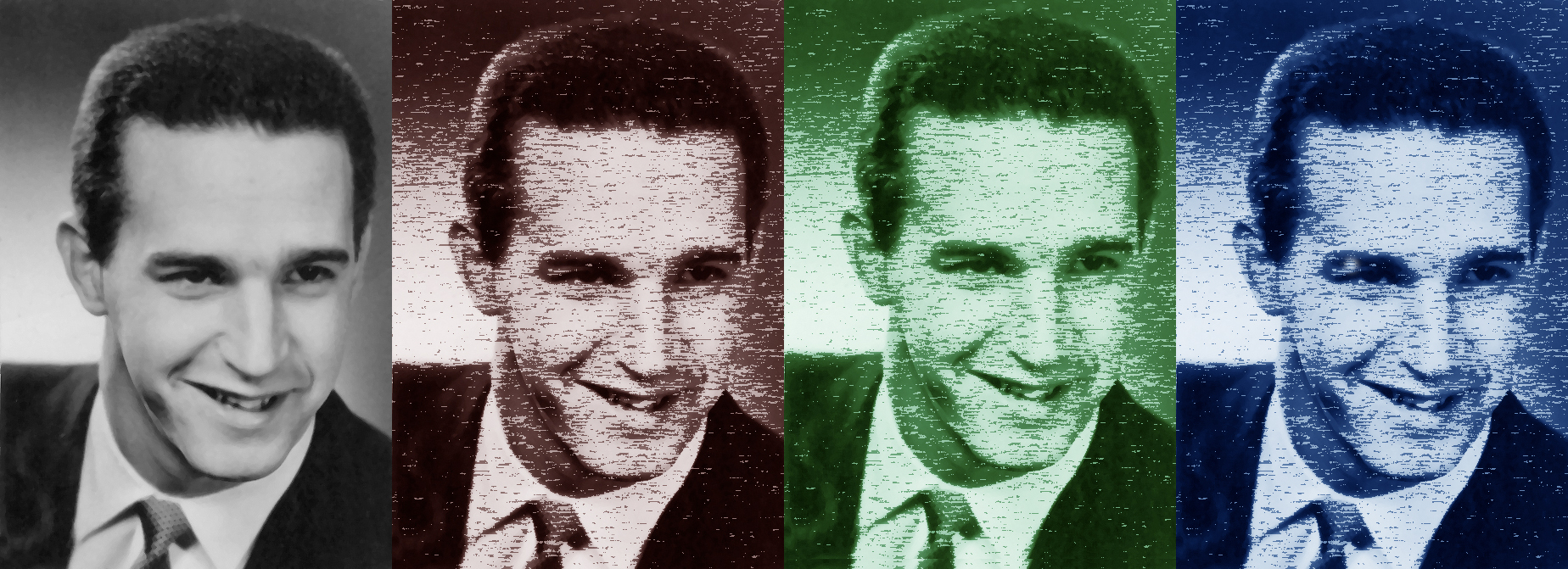
I would like to hereby nominate Ronald H. Tammen, Jr., as a candidate for Oswald’s look-alike, the man who was wearing, and then ostensibly discarding, a light-colored jacket; the man who walked out the back door of the Texas Theater in a (presumably white t-shirt style) pullover; the man who drove a red Falcon into El Chico’s parking lot while wearing a white t-shirt; one of the two men who boarded a CIA plane on a landing strip south of Dallas and who walked past astonished passenger Robert G. Vinson; and most significant of all, the man who shot and killed Officer J.D. Tippit.
Seriously?
It sounds crazy when I say it out loud. But, given what we now know about Ron, I think it’s possible.
What makes Ron Tammen a good candidate for the second Oswald?
I have a few key reasons for feeling this way:
1) They looked alike
A while ago, several of you commented that Ron looked kind of like Lee Harvey Oswald, and I didn’t disagree, though I think I downplayed it a little. To be honest, I wasn’t ready to go there at that point. Plus, I wasn’t sure how Ron Tammen could have had anything to do with the JFK assassination. But I’m ready to go there now, with all of the things we’ve learned about Ron and after reading Douglass’s book. Suddenly, it makes sense.
Their builds
In September 1951, when he was a freshman at Miami University, the Health Services physician, Dr. Paul Shumacher, had measured Ron to be 69 1/4”, or 5’9 1/4” tall, and weighing 145 pounds. In April 1953, after Ron disappeared, his mother told the FBI that Ron was 5’9” tall and now weighed 175 pounds. Occasionally, I’ve seen articles in the news that gave Ron an extra inch in height, saying that he was 5’10”.

When Oswald enlisted in the Marines in 1956, he was reported to be 68 inches tall—5’8”—and he weighed 135 pounds. (The photo at the bottom looks as if the top of his head is reaching the 5’9” mark, but I’m no doctor.) The medical examiner at his autopsy wrote that he was 5’9” with an estimated weight of 150 pounds. Both men were of a rather small build, though Oswald appears to have been slightly smaller.

Their ages
Their ages were relatively close, though Oswald was younger than Ron. Oswald was born on October 18, 1939, whereas Ron was born on July 23, 1933. I find it interesting how the announcement that went out over the police radio did a better job of describing Ron Tammen than Lee Harvey Oswald. Recall that they said the person on the sixth floor of the book depository was 5’10” tall and weighed roughly 165 pounds and was approximately 30. Oswald had just turned 24, and he didn’t exactly look older than his age. But do you know who was approximately 30? Ron Tammen. He’d just turned 30 that July.
Their hair
Both men had brown, wavy hair, which they usually parted on the left side.
Their eyes
Both men had hazel eyes, which is one of the rarer eye colors. According to a 2014 survey by the American Academy of Ophthalmology, roughly 18% of the U.S. population and only 5% of the world population has hazel eyes, whereas 45% of the U.S. population has brown eyes and 27% of the U.S. population has blue eyes. As a fellow hazel-eyed person, I remember being a little surprised when I first realized that Ron had hazel eyes too. Then, when I learned that Lee Harvey Oswald’s eyes were also hazel, I knew I needed to add it to the growing list of coincidences.

Their faces
Ron was better looking than Lee Harvey Oswald. He was more chiseled. He had a nicer smile. But they did have features in common—similar hairlines (though Ron had more hair), similar ears, somewhat similar noses. If you happened to know either one of them, there’s no chance that you would mistake one for the other. But the sightings didn’t involve people who knew Lee Harvey Oswald or his look-alike. They were total strangers who’d caught brief glimpses of a similar-looking man under strange, stressful circumstances. That might have been enough to cause those witnesses to look at the TV screen or the newspaper shortly thereafter and believe that they saw Oswald.


On the cover of John Armstrong’s book “Harvey & Lee” are the photos of Oswald and the Eastern European émigré that had been combined as a split-face composite. Whenever I look at the cover of that book, I see Ron Tammen. Once, I glanced at my copy from across the room, when most of the cover was hidden from view except for the top photo. It took me a second to realize I wasn’t looking at Ron’s photo. I’m not saying that Ron is the man whom Armstrong refers to as Harvey Oswald. I’m saying that both Oswald and the Eastern European individual had facial features that looked like Ron Tammen, especially when their faces were combined. It makes me wonder if anyone from the CIA noticed the resemblance and thought they could put it to use.
For copyright reasons, I don’t think I can post the image of the book cover, but click on the link and let me know what you think. Does the top image remind you of Ron? The cut-off photo on the left, down below the top photo, also looks like him to me.
2) Ron’s FBI documents match those of known or would-be assassins
Ron Tammen had some seriously heavy-duty marks on his FBI records, which indicates that he’d been living a life of violence after he’d disappeared. Somehow, some way, our “Good Man” had become a bad boy. Even so, it doesn’t appear that he’d ever been arrested. FBI records and other communications I’ve obtained have stated that the FBI only had one set of fingerprints on file for Ron, the ones that were taken when he was in the second grade. Those prints were later purged in June 2002, most likely due to a conflict with the Privacy Act, indicating that Ron had made the request himself. If Ron had ever been arrested, they would have taken a new set of fingerprints every time.
Let’s review the four most significant markings on Ron’s FBI records, starting with the one with the broadest application and ending with what I consider to be the most specific and most serious:
The “see index” notation written in the left margin of the first page of Ron’s records indicates that Ron Tammen was on the FBI’s Security Index and/or its successor, the Administrative Index. People who were added to the Security Index were considered dangerous or a threat to national security. Communists or suspected Communists were added as were mobsters, murderers, and other high-profile criminals. Admittedly, famous people and politicians might be added to the Security Index as well. If you were on the Security Index, the FBI was keeping tabs on your whereabouts. They did this so they could round you and the other “listers” up in the event of a national emergency. Therefore, because he was on the list, we know that the FBI was well aware of Ron’s whereabouts for a long time, though they neglected to mention this fact to Ron’s concerned parents.
Also on the first page of Ron’s FBI records, beneath the “see index,” is the notation 2-D. Based on other FBI records I’ve studied, I’ve deduced that this notation tells us that the Department of Justice—with the D standing for Department—received two copies of Ron’s records, or at least two copies of the top record. This wasn’t normal for a missing person case.
In fact, it was pretty extreme for any case. The DOJ generally stayed out of the FBI’s day-to-day business. Only once in a while would they receive a copy of an FBI report. If I see any D at all on an FBI report, it’s usually a 1-D. The 2-Ds are far less frequent. In addition to Ronald Tammen’s 2-D, Jack Ruby warranted a 2-D, as did James W. McCord, Jr., the Watergate burglar, and his entourage, and Thomas Peasner, the Korean War POW who was allegedly brainwashed by his Communist captors and high on the U.S. Army’s and FBI’s radar when he returned. Peasner was also of interest to the House Select Committee on Assassinations for being a pianist at Jack Ruby’s Carousel Club and for going missing after purchasing an assault rifle on November 9, 1963.
Ron’s FBI record dated 5/9/73 from the Cincinnati Field Office to Acting Director William D. Ruckelshaus contains a stamp that says “SEALED ENCL.” Sightings of this stamp are rare. The word “SEALED” signifies that whatever enclosures were included, they were of the “hot potato” variety and not for just anyone to see.
Here are the records I could find in which the FBI used the SEALED ENCL. stamp, in addition to Ron Tammen’s:
- Patricia Hearst kidnapping
- Atlanta Child Murders
I’ve also found one record for each of the following people or cases that has the word “Sealed” handwritten over the stamped word “Enclosure”:
- Richard Colvin Cox
- Carlos Marcello
- Hank Greenspun
- Kensalt (RFK assassination)
- U.S. Supreme Court bomb threat
A record for the following person has a typewritten notation to please forward in “Sealed Envelope”
- Frank Chavez
It’s the 10s in the upper-right corner of Ron Tammen’s FBI records that I think are by far the most prominent telltale sign that Ron Tammen was capable of assassinating J.D. Tippit. The 10s are found on records that seem to occupy the highest danger level—code red sort of stuff. Yes, a few Communists were given 10s, but I don’t think Ron got his 10s for embracing Communism. Judging from everything I’ve learned about him, he would have ascribed to the “better dead than red” philosophy.
Many of the 10s dealt with assassinations or assassination plots against holders of high offices, domestic or foreign. Others dealt with bombings or bomb plots. Others with mass murders. Others concerned politicians and other officials who’d been threatened with personal or widespread harm if they didn’t accede to the perpetrator’s demands. Others were Cuban exiles intent on overthrowing Fidel Castro. In the assassination category, I’ve found 10s on FBI reports for Robert F. Kennedy’s assassination. There are 10s on assassination plots against Spiro Agnew and Canadian Prime Minister Pierre Trudeau. There are 10s on Jean Rene Souetre’s records when he was being investigated for the Kennedy assassination. Recently, I found a 10 on the attempted assassination of George Wallace by Arthur Bremer.
So far, I’ve been floating the theory that the 10s signify that the FBI’s liaison to the U.S. Secret Service was likely cc’d, which means that the Secret Service was too. However, not all FBI records that involved the Secret Service received a 10. I could still be wrong. Still, the 10s are important and they signify something that could be considered a threat to the U.S. president, the vice president, and others in their circle of dignitaries, the very people that the Secret Service is responsible for protecting.
While it’s possible that Ron was involved in bomb plots or extortion plots, he may have been capable of assassination as well.
3) Ron already had an ‘in’ with the CIA
It’s not as if Ron Tammen didn’t know someone affiliated with the CIA. Ron’s psychology professor, Lt. Col. St. Clair Switzer, was identified in March 1952 as a potential consultant to the CIA for Project Artichoke and I strongly believe he was named along with Major Louis J. West for a well-balanced interrogation research center in January 1953. For a period of time, Switzer appeared to be serving as a liaison to the USAF surgeon general for experiments conducted by Louis Jolyon West for Project Artichoke. Additional evidence tells us that he was assisting a high-level hypnosis researcher—possibly West—during the 1956-57 academic year on topics that were skirting the edge if not completely out of bounds of what’s ethical. We also have anecdotal evidence that Ron Tammen was being hypnotized before his disappearance in April 1953.
Therefore, it isn’t too far-fetched to think that, if the CIA had something to do with Ron Tammen’s disappearance, and I believe that they did, they would have maintained that relationship for as long as they needed him. As we heard from Robert G. Vinson, the CIA isn’t easy to say no to. In November 1963, it had been over ten years since Tammen was driven away from Fisher Hall. I imagine that he would’ve become quite adept at whatever they’d been training him to do by then.
Are there other people who might qualify as the second Oswald?
In his 1976 book “The Taking of America,” author Richard E. Sprague suggests that the Oswald look-alike who shot J.D. Tippit was William H. (Billy) Seymour. I still need to read Sprague’s book. (As I said, it’s difficult to keep up with all of the JFK books that are out there, but it’s on the list.) Seymour was closely associated with Loran Eugene Hall, who is frequently mentioned in the JFK files, and both were linked to the Cuban exiles in Miami, Florida.
I’ve done some looking into Seymour’s FBI files, and, to be honest, I think Ron’s files are more incendiary than Seymour’s. Of course Seymour and Hall were included on the Security Index. That’s no surprise. However, whereas Ron had a bunch of 10s on his FBI records, Seymour and Hall had 5’s and 9’s. Seymour and Hall also had a 1-D, as opposed to Ron’s 2-D. Seymour was on their radar, to be sure, but, from what I can tell, it was mostly as Hall’s accomplice. I can’t help but feel that Ron had attained a heightened level of concern.
Here’s a little background intel on Seymour, courtesy of the FBI. Note that Ancestry.com lists his birthdate as January 12, 1937, so I’m pretty sure he was 26, not 23.

Admittedly, Seymour looked kind of like Oswald too. Kind of. But he was listed as 5’6” tall—two or three inches shorter than Oswald, and three inches shorter than Ron. That’s noticeably short for an American male, so noticeable that it would likely be the first characteristic a witness would think to mention. Other features were that his eyes were blue and he weighed 140 pounds. I wouldn’t say that he matched the description given by Vinson (5’7”-5’9”, 150-160 pounds). Also, he certainly didn’t match the 5’10”, 165 pound, approximately 30 description that was read over the Dallas police radio, which ostensibly led J.D. Tippit to summon Oswald’s look-alike to his car.
From what I can tell, Sprague doesn’t mention the red Ford Falcon sighting in his book, and Robert Vinson hadn’t come forward yet.
Billy Seymour sounds as though he was involved in the assassination plot somehow—he certainly was hanging around with the right people. Also, he has been linked to a different sighting involving a woman named Sylvia Odio. However, I still think it’s worth considering Ron Tammen as a candidate for the Tippit murder.
Are you thinking what I think you’re thinking?
Maybe? I am now proposing that Ron Tammen may have been an assassin, but not just any assassin. I am proposing that he was a hypnotic assassin—otherwise known as a Manchurian Candidate, employed by the CIA. Before he disappeared, Ron was a sweet, kind, studious guy whose lifelong dream was to earn a nice living and to find his place in society. How does that guy wind up on the FBI’s Security Index with marks on his records that are sure to get the attention of the people who were tasked with protecting the country’s top leaders?
We also have anecdotal evidence that, before he disappeared, he was being hypnotized by someone who later was assisting with Project Artichoke. Although Project Artichoke began as a program dedicated to interrogation research for the military through the use of hypnosis and drugs, it quickly drifted into the darker territory of creating hypnotically programmed assassins. According to Jeffrey Kaye and H.P. Albarelli, Jr., “…it is Project Artichoke that encapsulates the CIA’s real traveling road show of horrors and atrocities, not MK/ULTRA which, although responsible for its own acts of mindless cruelty, pales in comparison.”
Honestly, say what you will about this idea, but is it possible that Ron may have been a government-sanctioned human weapon—not a bomb plotter, but the bomb itself? It’s the only way that I can see Ron Tammen receiving those scribbles and stamps on his FBI documents without ostensibly ever having been arrested. It’s also the only way that I can see a person like him having the audacity to kill someone—a cop of all people—in cold blood and in broad daylight.
But it’s just a theory.
Is there any way to find out if your theory is correct?
I’ve had a crazy thought. The National Archives and Records Administration holds the exhibits from the Warren Commission. They have the light-colored jacket. They have the brown long-sleeved shirt. They also have the sweater that Oswald was wearing when Jack Ruby shot him. Has anyone ever thought to run some comparative DNA tests to determine if those three items were worn by the same person?
Granted, that light-colored jacket is old, and I’m sure any DNA that might be on it (through shed skin cells, a loose hair, a crumb of food the look-alike had been eating, I don’t know) is likely to be degraded as well as contaminated by the people who handled it. Maybe the DNA is still good on the inside of the jacket if no one tried it on—I’m no DNA technician. I think the blood on Oswald’s sweater seems more likely to still be viable versus whatever DNA might be on the brown shirt, but again, I’m not a DNA technician.
But hey, this is all we have. If there isn’t a match between the light-colored jacket and the black sweater, the brown shirt, or both, then I would suggest that they test the jacket against Marcia Tammen’s DNA, which is in CODIS, to see if there might be a match there.
The J.D. Tippit murder is central to the entire JFK assassination story. It was referred to as the Rosetta Stone by Warren Commission assistant counsel David Belin, and one of the chief reasons for proclaiming Oswald’s guilt for Kennedy’s assassination.
What do you think? Would the NARA archivists be up for solving this decades-old question? Who do I need to call to make it happen?
Why are you doing this? Aren’t you afraid that people will make fun of you?
If anyone should put Ron’s name out there as a contender, I guess it should be me. It’s OK. I’m willing to take the jabs, though I do reserve the right to block any unnecessarily mean people and garden-variety trolls.
What are your thoughts on the Warren Commission?
Oh, I think they were bending the narrative to their liking. We know they were ignoring some potentially important witnesses. And, who knows, they may have even been altering deposition testimony of the people they did speak with.
Why do you think that?
Take a look at this exchange after Earlene Roberts finished her deposition. The whole reason for a person who was deposed to sign their transcript is to ensure its veracity. Judging by this exchange, Earlene Roberts did not verify that her deposition transcript was accurate. In fact, Joseph A. Ball, senior legal counsel to the Warren Commission, was pushing for her not to return to review the transcript and sign it. Why? Did he see a problem with something she’d said?
Mr. BALL. Now, Mrs. Roberts, this deposition will be written up and you can read it if you want to and you can sign it, or you can waive the signature.
Mrs. ROBERTS. Well, you know, I can’t see too good how to read. I’m completely blind in my right eye.
Mr. BALL. Do you want to waive your signature? And then you won’t have to come back down here.
Mrs. ROBERTS. Well, okay.
Mr. BALL. All right. You waive it then?
Mrs. ROBERTS. Yes. Do you want me to sign it now?
Mr. BALL. No; we couldn’t, because this young lady has to write it up and it will be a couple of weeks before it will be ready.
Mrs. ROBERTS. Well, will you want me to come back or how?
Mr. BALL. Well, you can waive your signature and you won’t have to come back to do that-do you want to do that?
Mrs. ROBERTS. Okay, it will be all right.
Mr. BALL. All right. The Secret Service will take you home now.
Mrs. ROBERTS. All right.
Mr. RAZL. Thank you for coming.
Mrs. ROBERTS. All right.
Considering that the killing of Officer Tippit was the “Rosetta Stone” of the JFK assassination, I’d think that, of all the witnesses, the testimony of the last person to see Lee Harvey Oswald roughly 10 minutes before that killing took place would be something that they’d want to get 100 percent right. But then again, I’m no expert.
Disclaimer: I did my best to provide you with the most accurate details I could find pertaining to the Tippit murder. But with all of the inconsistencies in the Warren Report, it’s hard. If you happen to be a JFK expert and you notice a discrepancy in something I’ve said, please let me know. But also, please go easy on me. I really did try.


