


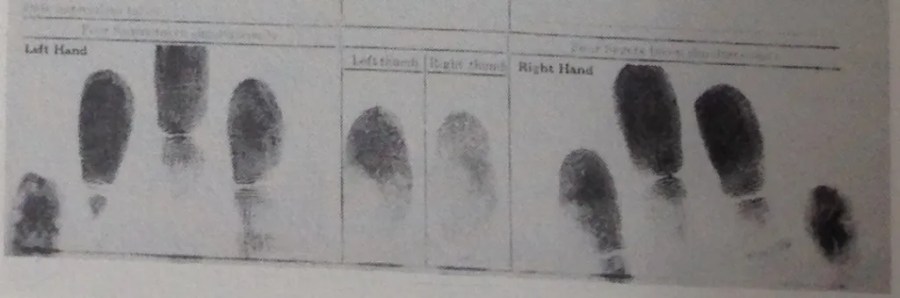
A sample of someone’s fingerprints from the FBI Law Enforcement Bulletin, Aug. 1953
Remember how, back in 2015 and 2016, I kept pestering the FBI to answer, yes-or-no, had they confirmed Ron Tammen to be dead? And remember how they chose not to answer that question despite the fact that a simple “no”—they had not confirmed him to be dead—would have sent me on my way, forlorn and (momentarily) defeated?
Back then, I took their non-answer to mean that Ron was dead but they just didn’t want to say he was dead. Because Ron’s fingerprints had been expunged long before he’d turn 110 (the age at which a person’s fingerprints are normally expunged, as cited by the FBI’s spokesperson), I figured that was all the evidence I needed to conclude that he was dead and had been dead for at least 7 years (the alternative scenario cited by their spokesperson). But with our recent discovery that the FBI was able to expunge his fingerprints early because of #N1-65-88-3, Item 1a—the National Archives and Record Administration’s (NARA’s) record schedule having to do with a Privacy Act conflict or a court order—I now believe Ron was alive when they expunged his fingerprints. It’s also feasible that he could be alive today, although I don’t think so.
You guys called it early. When I told you that the FBI was able to expunge Tammen’s fingerprints 30 years ahead of time due to a Privacy Act conflict or a court order, I think Blue was the first to say that he could have still been alive, and others agreed. Kudos to you, smart people!
I was a little slower, probably because I was so focused on the “court order” lingo and how I’d heard that term before. A couple of the former FBI staffers I’d spoken with had mentioned it as a possible reason for early expungement of Ron’s fingerprints, while no one had brought up the Privacy Act. Also, among the smattering of documents online that cited N1-65-88-3 for early expungement, they all had to do with a court order. So that’s where my brain was.
As for the “was he alive?” question, it seemed possible if it had to do with the Privacy Act, which I’d been bumping into with all of my Freedom of Information Act (FOIA) requests. That law is literally a question of life or death. If I couldn’t prove a person was dead, I (usually) didn’t get the info. The court order is so much grayer: what was the order and when was the order given and which court would have ordered it—federal or state or even lower? And if I were somehow able to get past all that, could we tell if Ron was still alive?
I knew I needed to talk to someone who was knowledgeable about such matters and who was willing to speak openly. Thankfully I found someone. I won’t be sharing the person’s name or credentials with you because I promised them we would be talking “on background.” (Translation: I can use the information they shared, but I won’t be identifying them.)
A word of warning: you’ll find that there was a point in our conversation where things went a little…askew. From the start, I’d told my source that the reason the FBI had expunged Ron’s fingerprints was the Privacy Act or a court order—good old N1-65-88-3, Item 1a—and the early part of our discussion reflected that. However, as the conversation progressed, my source began to speculate about a different reason for the expungement. Things became a little uncomfortable as I pushed back. Still, even those moments offer important insights into Ron’s case.
Most responses have been lightly edited or paraphrased to reflect the overall substance of what was said in Q&A fashion. Occasionally I’ve supplied additional background information to help clarify a response. If I have thoughts to add regarding a particular response, those’ll be in blue next to my initials. Here we go!
What are the main reasons that FBI files might be expunged ahead of time because of the Privacy Act?
If a person were to file a FOIA request on themself, and their file had incorrect information in it, they might ask that it be expunged. Or perhaps the information was collected illegally. For example, if a person was exercising his or her First Amendment rights (such as voicing their opposition to a political issue), and the FBI started a file on them, they could request that the file be expunged. Most Privacy Act cases have to do with First Amendment issues.
What happens when an FBI file is expunged based on the Privacy Act or a court order?
According to the Federal Records Act, government records can’t be destroyed without the approval of the head of NARA. In the case of a Privacy Act or court-ordered expungement, however, those take precedence. Once the FBI agrees to expunge a record for either of those reasons, NARA’s role is to simply document the action.
At my time of involvement, the FBI would write to the National Archives saying “we’re going to destroy file number XYZ under the Privacy Act.” The National Archives would keep that record and write back to the FBI. Then the FBI would destroy the file and replace it with a card saying “file number XYZ has been destroyed under the Privacy Act.”
JW: When I was told by the FBI that Ron’s fingerprints had been expunged in 2002, the spokesperson added “no other info available.” If the 2002 protocol was similar to the one described above, the spokesperson should have been able to tell me why Ron’s prints were expunged. Also, now that we know about NARA’s record schedule, the FBI spokesperson should have had access to that information too. At the risk of sounding naïve, I think the FBI was intentionally keeping it from me.
N1-65-88-3 doesn’t pop up much on Google. How frequently or rarely is this reason cited for the expungement of government records?
I don’t think that it happens a lot. It could be dozens or a hundred times a year, but I don’t think it’s that much.
Do they ever expunge FBI files for people who are deceased based on the Privacy Act?
That I don’t know. Under American law, dead people don’t have the right to privacy. But whether a family member could write it in, I’m not sure they would have the legal standing to make the request.
JW: Upon further reading, the Department of Justice has this to say: “Deceased individuals do not have any Privacy Act rights, nor do executors or next-of-kin.” This tells me that the FBI can’t expunge a file based on a Privacy Act conflict if the person is deceased. The FBI might request the file be expunged for another reason, but not for the Privacy Act. Therefore, if Ron’s file was expunged due to a conflict with the Privacy Act, it’s my belief Ron was alive in 2002.
On the other hand, in 2010, I was able to obtain Ron’s FBI files without providing proof of death or authorization from a third party. For this reason, I think Ron Tammen was deceased by 2010.
What about the court order? Are these generally for living people?
To be honest, I’ve never heard of an example of a court ordering the destruction of records, although I’m sure it probably happens. I’d say that, by far, the majority of expungements based on either the Privacy Act or a court order are due to the Privacy Act.
Legal questions have come up, one of which is: can a federal judge order something to be kept or destroyed when the Federal Records Act gives that authority to the head of NARA? But I don’t think it happens that often.
JW: It’s telling that our source doesn’t recall ever seeing a court-ordered expungement. Perhaps most useful is our source’s estimation that Privacy Act expungements far outweigh court-ordered expungements. As a result, it seems more likely that Ron’s fingerprints were expunged due to a Privacy Act conflict.
As for the alive-or-dead question, in the few court-ordered expungements I’ve seen online, the person whose records were being expunged was ostensibly alive. I’ve been attempting to find someone who can definitively answer my question, and I’ll continue to look.
Regarding the early expungement of fingerprint cards, have you heard of that happening before? If so, under what circumstances does that happen in your experience?
If I was thinking in terms of being a practical bureaucrat, if we’re in the process of converting tens of thousands, hundreds of thousands, of fingerprints to an automated system [which took place in 1999], and we have all these fingerprints that were gathered in World War II from school kids, and figuring they’re probably 70, 80 years old in the ‘90s, they might have simply gotten authority…and I’m not sure how. What they could have done is go to the National Archives with a blanket request saying “We’d like to destroy all fingerprint cards created before 1950 because they’re not relevant now, or we’re getting ready to convert these to the automated system and these will just add to the burden of doing that.”
How would that work?
If it was simply a request for expungement, the FBI would write the request on the Standard Form 115 [the form in which all such requests are written], send it to NARA with a brief explanation of why the records don’t have value to the FBI or anybody else, and describe when they would like to destroy them—when they’re 50 years old, 75 years old, or whatever. Then, one of the Archives staff would review the form and seek permission from the head of NARA. A copy would be returned to the FBI, and they would follow the schedule.
Would that be the N1-65-88-3—would that be a Privacy Act expungement?
No. The FBI would have submitted something with a different number and it would probably just be a request to destroy fingerprint cards that are X number of years old.
JW: I found an example of one of the more routine “thinning-out” records schedules from the year 2000 (marked 00), which I’m posting here. As our source said, the number is different and doesn’t involve the Privacy Act or a court-ordered expungement. Could this request have been initiated because of the FBI’s move to automation in 1999?

But the person from National Archives cited N1-65-88-3, which tells me that it IS a little different than the switchover to the automated system.
That could be an oversight on NARA’s part. They probably just assumed that it was destroyed under the Privacy Act when it was actually destroyed under the authority of another Standard Form 115.
JW: The NARA rep’s exact words were “The fingerprints in question were expunged from the FBI system as per N1-65-88-3, Item 1a. NARA does not have any further information regarding the expungement of this file.” That sounds a lot more certain than someone who is just assuming something. Also, I used to respond to public inquiries with a federal agency. We’d never put anything in writing without double-checking to make sure we had our facts straight.
I’ve submitted a FOIA request to NARA for “the paperwork associated with the FBI’s early expungement of the fingerprints (both paper and electronic) for Ronald H. Tammen, Jr., FBI # 358 406 B. This should include the relevant Standard Form 115…plus any additional documentation associated with the FBI’s action.” Once I have that, I’ll be able to decide if I need to file more FOIAs to determine if there was a mass expungement around 2002 because of a Privacy Act conflict or court order or if Ron’s case was special.
In light of the above, here’s where I’m leaning at the moment:
- Because Privacy Act or court-ordered expungements circumvent the role of the head of NARA, it imparts a higher level of import and urgency to the removal of Ron’s fingerprints.
- It’s far more likely that Ron’s fingerprints were expunged due to a Privacy Act conflict than a court order.
- If Ron’s fingerprints were expunged due to a Privacy Act conflict, then he was still alive in 2002.
- Ron’s fingerprints were NOT expunged as part of a mass expungement of obsolete fingerprints (e.g., fingerprints obtained from children before WWII or some other characteristic) to reduce the burden on the FBI’s automated system or any other reason to thin out their records.
- Whether Ron’s fingerprints were expunged as part of a mass expungement due to the Privacy Act or a court order remains to be seen.
And you? Where do you lean?